683 |
P a g e
ANDROID BASED ROBOT SOCCER
Tanvi P. Mahajan
1, A. S. Bhide
2, Ambarish D. Pundlik
1,3Department of Electronics & Communication, SSGB COET Bhusawal, (India)
2Professor, Department of Electronics & Communication, SSGB COET Bhusawal, (India)
ABSTRACT
Robot soccer is an interesting domain in the research field of autonomous as well as intelligent system. It is
challenge to develop a robot which acts in real time to recognize the skills of real soccer game such as movement to
avoid obstacles, shoot and goal keeping. Up till now, robot soccer employs personal computer for communication
between server and soccer players. This paper concentrates on the use of Android platform for robot soccer rather
than personal computer. This method uses tagging technique and few mathematical formulations to detect the object
and follow the desired path so as to keep the game as close and real as the actual soccer game.
Keywords : Android, Client-Server architecture, Fira, J2E, NetBeans, Robot soccer
I INTRODUCTION
The development of robots not only provide a great deal of business opportunities of technology industry, but also have great impact on areas such as national defense, security, domestic life, medical treatment, rescue works, exploitation in deep ocean, etc. According to different applications, robots can have different contribution in different areas. One of the challenging issues in robotic research is the cooperation, coordination, and negotiation among distributed agents in a multi-agent system. To speed up the development on this challenging issue, a group of Korean researchers initiate a robotics soccer game called Fira in 1995. Later the league becomes a well-known world competition, called Federation of International Robot Association (Fira). A soccer robot is a specialized autonomous robot and mobile robot that is used to play variants of soccer.Till now, the communication, object detection was based on computer technology. There are various methods, algorithms like adaptive Q-learning, Fuzzy Logic, Artificial intelligence, Kalman Filter, Rete algorithm, etc. which are used in robot soccer. The same thing can be implemented on android platform. Various algorithms which are stated above can be employed on android base. In this methodology, tagging scheme is used.
II SYSTEM DETAILS
684 |
P a g e
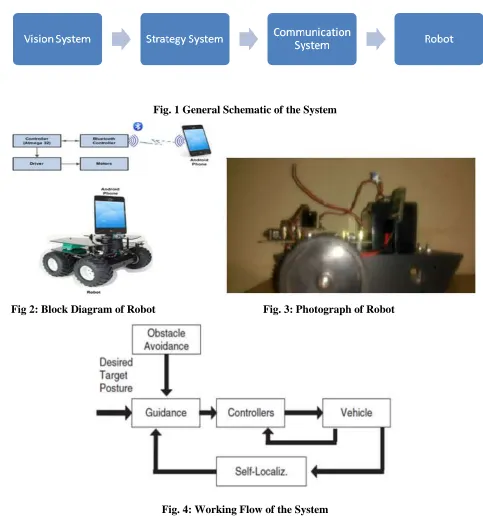
the computers of the teams on the side of the field. From this image a world model is constructed using the color coding of the ball and the different robots. We use an orange golf ball as the soccer ball. Using this world model the actions of the different robots are determined and send to the robots. The games in this league are typically very fast and chaotic. Fig. 1 shows the general schematic of system configuration.
Fig. 1 General Schematic of the System
Fig 2: Block Diagram of Robot
Fig. 3: Photograph of Robot
685 |
P a g e
In this methodology, tagging scheme is used. The object to be followed is identified from the image by tagging it. & then depending upon the role of each robot the task is accomplished. Figure 2 & 3 shows the block diagram and photograph of the robotic system.
There are five main subsystems in which all others are contained.
The vision system records data on the robot and obstacle positions.
The strategy system decides where the robots should move and solve the problem.
The communication system transmits the commands from the strategy system to the robot through communication media.
The on-board control system processes the data received from the communication system and executes the required commands.
The robot system controls the mechanical elements of the robot.
The working flow of the system is shown in figure 4. As soon as the supply is turned ON, the android unit for the nearby Bluetooth device. The Bluetooth module drives the current of 20mA to 30mA (average of 25mA), while pairing with the android unit. After pairing with the android unit, the Bluetooth module drives the current of 8mA. The camera of the android unit captures the images on the field in real time. These captured frames are further transferred the system on the robotic vehicle through Bluetooth module HC-06. The Bluetooth module communicates with microcontroller ATMEGA 32 at baud rate of 9600. The desired information is extracted from the captured images which are used by the strategy system. Strategy system includes microcontroller, motor driver, etc. As per the strategy microcontroller gives commands to motor driver L293D, so that the robot can move in forward, reverse, left or right direction. Here the motors used are of 60 RPM.
III MATHEMATICAL FORMULATION
In order to make the right movement of the robot, mathematical formulation is necessary. Here coordinate theory is used to determine the velocity as well as the angle between the nearest hurdle or ball and the robot.
The velocity of the robot can be estimated as-
‘VL = K1.de–Ka.θc (1)
‘VR = K1.de–Ka.θc (2)
Where, Kp is proportional gain.
The proportional gain is nothing but the correction signal which is directly proportional to the error. There are different values of kp for different angles. If smaller Kp is used for bigger angle errors and also for the small
angle error, the velocity values sent to the robot are smaller than the required values.
IV SOFTWARE DETAILS
686 |
P a g e
Fig. 5: First GUI Screen of Android Application
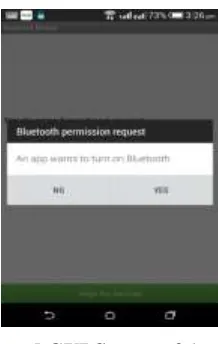
After clicking Proceed, we get the second screen which asks to turn ON the Bluetooth of the android unit as shown below-
Fig. 6: Second GUI Screen of Android App
After selecting the desired Bluetooth device, here H-C-2010-06-01, camera starts. We have to tap on the screen to select the object. As soon as we tap on the screen, robot starts to follow it & accordingly moves in forward, reverse, left or right direction.
687 |
P a g e
4.1 Java 2 Standard Edition (J2SE)
Java Platform or Standard Edition is a widely used platform for programming in the Java language. It is the Java Platform used to deploy portable applications for general use. In practical terms, Java SE consists of a virtual machine, which must be used to run Java programs, together with a set of libraries (or "packages") needed to allow the use of file systems, networks, graphical interfaces, and so on, from within those programs.
4.2 NetBeans Platform
The NetBeans Platform is a reusable framework for simplifying the development of Java Swing desktop applications. The NetBeans IDE bundle for Java SE contains what is needed to start developing NetBeans plugins and NetBeans Platform based applications; no additional SDK is required. Applications can install modules dynamically. Any application can include the Update Centre module to allow users of the application to download digitally-signed upgrades and new features directly into the running application. Reinstalling an upgrade or a new release does not force users to download the entire application again. The platform offers reusable services common to desktop applications, allowing developers to focus on the logic specific to their application. Among the features of the platform are:
User interface management (e.g. menus and toolbars)
User settings management
Storage management (saving and loading any kind of data)
Window management
Wizard framework (supports step-by-step dialogs)
NetBeans Visual Library
Integrated Development Tools
4.3 Client-Server Architecture using Serialized Objects / Serialization
In case the project needs client-server communication this is how it is handled in java-First step is to use data structures like Vectors and Lists. These come under Java Collections API. Secondly we declare our own classes using these data structures. E.g. a class Student to hold all the student information. Now these classes need to be pre-compiled and called within Java application as libraries. This is called as a Java Class Library. Now class objects cannot be sent via network directly. We need to convert these objects to bytes so that they can be sent/received. To do this we must use a concept called as Serialization. Basically it is a concept where in objects are converted to byte streams so that they can be sent via network and vice versa. The reverse process is called as deserialization. Finally to send these bytes them via network we need Java Networking.
V CONCLUSION
688 |
P a g e
the strategy in real robot soccer competition. Thus, using obstacle avoidance algorithm, robot can be made to move in curve shape, avoiding opponent robots or any other obstacles.Depending on positioning, robot can be made to move in straight line towards opponent goalie avoiding other robots or obstacles. The image processing algorithm, object recognition algorithm are successfully implemented & tested on smart phone equipped with digital camera i. e. HTC Desire 816.
VI ADVANTAGES
We are using android platform we do not need overhead camera on the field as the camera is built in android unit itself.
The android platform makes the communication in real time with minimum noise.
Remote desktop is not required as strategy system.
VII LIMITATIONS
There is difficulty in color identification in varying lightening conditions on the field.
The background & foreground must be highly contrasted to each other
VIII FUTURE SCOPE
To achieve the goal perfectly, the robot must recognize the ball accurately in any lightening condition. Also it must recognize the difference between the ball & object if both are of same color. This may be achievable if image processing is improved.
REFERENCES
[1] Awang Hendrianto Pratomo, Anton Satria Prabuwono, Mohd. Shanudin Zakaria, Khairuddin Omar, Md. Jan Nordin, Shahnorbanun Sahran, Siti Norul Huda Sheikh Abdullah and Anton Heryanto, Position and Obstacle Avoidance Algorithm in Robot Soccer, Journal of Computer Science 6 (2): 173-179, 2010 ISSN 1549-3636
[2] ThiloWeigel, Jens-Steffen Gutmann, Associate Member, IEEE, Markus Dietl, Alexander Kleiner, and Bernhard Nebel, CS Freiburg: Coordinating Robots for Successful Soccer PlayingIEEE TRANSACTIONS ON ROBOTICS AND AUTOMATION, VOL. 18, NO. 5, OCTOBER 2002
[3] Martin LauerRoland Hafner, Sascha Lange, Martin Riedmiller, Cognitive Concepts in Autonomous Soccer Playing Robots, Institute of Measurement and Control, Karlsruhe Institute of Technology, Engler-Bunte-Ring 21, 76131 Karlsruhe, GermanyInstitute of Computer Science, University of Freiburg, 79110 Freiburg, Germany
689 |
P a g e
[5] Ayan Banerjee, Ramanpreet Singh Arora, Aruna Chakrabarty, A Dynamic Identification Method for Robotic Soccer Game, International Journal of Wisdom Based Computing, Vol. 1 (3).
[6] Savitha G Venugopal P S Dr. Sarojadevi Dr. Niranjan Chiplunkar, An Approach for Object Detection in Android Device, 2014 Fifth International Conference on Signals and Image Processing