5660
A Novel Framework For The Adoption Of Cloud
Computing In The Higher Education Sector In
Developing Countries
Dr. Mahmoud Odeh
Abstract: Cloud computing is an emerging paradigm in information systems designed to deliver numerous computing services through networked media such as the Web. In developing countries, higher education institutions cannot escape from the growing adoption of cloud computing. Jordan is one such country, with higher education establishments that continue to seek opportunities to rationalize how they manage their resources. This research aims to develop a framework that considers the key factors affecting the adoption of cloud computing, to help Jordanian higher education institutions to implement the technology effectively and to improve the sharing knowledge between Jordanian universities. Fieldwork involving eleven universities in Jordan was conducted in order to specify the actual factors determining the design of the proposed framework. An interpretive paradigm using triangulation methods was applied to collect qualitative data, conducting thirty-one semi-structured interviews as well as three focus groups with major stakeholders. In addition, 100 qualitative surveys were distributed to Jordanian students, which successfully analyzed and represented as frequencies in this study. Nine factors influencing the adoption of cloud computing were identified and incorporated in the framework to explain the correlations between them. Finally, the framework was applied, validated, and tested by five experts in three Jordanian universities.
Index Terms: Cloud Computing, Higher education, Developing Countries, TAM, TOEQCC.
—————————— ——————————
1.
INTRODUCTION
This research is focused on the adoption of cloud computing in higher education institutions in Jordan. Jordan is a developing country located in the heart of the Middle East. Since the first public university was established in 1962, significant efforts by the government in Jordan have resulted in the realization of a total of 10 public and 21 private universities at present [1]. Although there is intensive support from the government towards the development and growth of universities, there is a notable need for the adoption of the latest ICT developments within Jordanian higher education institutions [2]. Additionally, the use of traditional methods for learning and teaching while delaying the adoption of new technologies is likely to have a negative effect on students and their skills when going into the employment market. This is particularly valid in subjects such as engineering, computer science and management information systems, which rely on information technology skills. Such effects spill over into Jordan‟s society and economic development. According to Al-Jaghoub, Al-Yaseen, Hourani, and El-Haddadeh [3], the efficiency of the higher education sector in Jordan is limited. Its shortcomings are due, amongst other factors, to the failure to adopt new technologies, in particular, cloud computing, in the current programs. The benefits gained from adopting cloud computing technology are many and include the students‟ readiness for future insertion into the local and global markets. However, cloud computing also helps with the implementation of new creative and different methods of teaching and learning as alternatives to traditional classroom methods currently dominating the sector in Jordan. For students and researchers alike cloud computing reduces the cost of reaching valuable knowledge from any location and at any time, thus expanding collaboration and knowledge sharing beyond the classroom [4, 5].
This paper describes the main factors influencing the adoption of cloud computing in higher education institutions in Jordan, as well as the motivators for and barriers to cloud computing adoption in such a context. Finally, the paper describes an approach to the effective adoption of cloud computing in the learning and teaching processes in Jordanian higher education institutions (JHEI).
Therefore, this research seeks to answer the following questions:
1.What are the main factors influencing the adoption of cloud computing in JHEIs?
2.What are the motivators for and barriers to cloud computing adoption by JHEIs?
3.What are the main phases for the effective adoption of cloud computing technology in JHEIs?
It is felt however that the results presented in this study would be relevant to the adoption of cloud computing in many other countries. In that sense, Jordan acts as a case study. To achieve its aims, the paper is structured as follows: describes the current coverage of the subject in the relevant literature; outlines the methodological approach to the conduct of the research; the different factors affecting the adoption of cloud computing in the Jordanian higher education sector are described, whilst the relationships between those factors are outlined in a new framework and presented. Conclusions, limitations, and recommendations for future research are finally presented.
1.1 Background
Cloud computing is described by Shawish and Salama [6] as “an umbrella term to describe a category of sophisticated on-demand computing services initially offered by commercial providers such as Amazon, Google, and Microsoft”. There seems to be no standard definition [7] for the term, considered by many as a new phenomenon or a new paradigm of computing technology that provides on-demand access to ICT resources shared with other users [8, 9]. Cloud computing models can be classified according to service and deployment models [10]. These classifications are based on computing ————————————————
5661
requirements from the customer‟s side. Service models consist of different layers, according to the architecture design of the cloud service providers. Accordingly, the cloud computing service model consists of three main types: Infrastructure as a Service (IaaS), Platform as a Service (PaaS), and Software as a Service (SaaS). Cloud computing deployment models, on the other hand, are classified as follows: Public Cloud, Private Cloud, Hybrid Cloud and Community Cloud [11]. Research has been conducted by authors such as Schneider and Sunyaev [12] to identify challenges that may arise during the adoption, acquisition, or integration of cloud services. Factors have emerged such as low comfort of IT staff with cloud services, perceived risk of losing governance or control and perceived complexity of the technology, which suggests that adoption of cloud computing is to a significant extent influenced by human factors issues within the organization. Thus, to explain the best approaches for the adoption of cloud computing, theories, and frameworks from different areas have been examined. One of the most popular theories in technology adoption is the Technology Acceptance Model (TAM) developed by Davis [13] and applied in different sectors. The primary aim of TAM is to determine the main factors related to the adoption of technology at the level of an individual‟s behavior [14]. Most of the previous studies that adopted TAM have employed a quantitative/positivist methodology [15-18]. However, this study does not take a deductive approach, nor does it test existing theory, as quantitative research does. The paper
focuses on the social reality of individuals and academic institutions and on the factors influencing the adoption of cloud computing.
TAM enables the study of the behavior of individuals in JHEIs as well as addressing attitudes towards using innovative technology. To study such factors, it is important to gain an in-depth understanding of the factors that may influence the adoption of cloud technology as well as the behavior of individuals regarding this technology. Therefore, this is one of the very few studies adopting TAM with a qualitative methodology to develop a new framework for the adoption of cloud computing in JHEIs, through addressing the main factors of the adoption and explaining the relationship between such factors. TAM postulates two main variables that affect users‟ decisions regarding new technology: perceived usefulness (PU), and perceived ease of use (PEOU). PU is “the degree to which a person believes that using a particular system would enhance his/her job performance”, and PEOU “the degree to which a person believes that using a particular system would be free from effort” [13]. The Technology-Organization-Environment-framework developed in [19] by Tornatzky and Fleischer, is also used to study factors relating to the adoption of cloud computing in the context of JHEIs. Another theory that has been widely used in several studies is the Diffusion of Innovations (DOI), developed by Rogers [20]. The main aim of DOI is to provide a clear explanation of the process of adopting new technology. It is one of the most important theories to explain the propagation of innovative technology at organizational and individual levels in specific contexts, such as education.
2
RESEARCH
METHODOLOGY
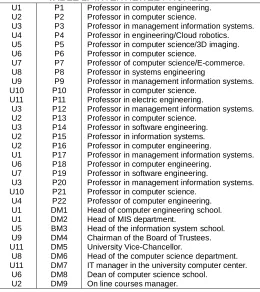
The author engaged with the main stakeholders of the research problem in their own settings for the purpose of data collection and analysis. A qualitative methodology with an interpretive stance relied on the analysis of relevant documentation and the collection of data through a series of interviews and a survey involving decision-makers, academics and students from eleven public and private universities in Jordan. The interpretive approach to data collection and analysis operated at three levels: individual, organizational and contextual. Each of these levels has factors that will impact on how cloud computing may be adopted. Technology adoption at the organizational level is being studied from the standpoint of Rogers‟ [20] DOI theory, which suggests that innovation adoption is affected by different factors such as compatibility, complexity, relative advantage, observability and trialability. The individual level is understood to depend mainly on TAM, while the environmental level is supported by a Technology-Organizational Environment (TOE), which also covers the technological and organizational aspects. Thirty-one interviews with academics and decision-makers were conducted from 19 June 2019 to 21 August 2019. Interviewees included deans of schools, heads of departments, professors of information technology and related fields, technical staff with expertise in cloud computing, and lecturers. Most interviews took place at participants‟ offices or in meeting rooms booked in advance by the university staff. A table describing the role of each interviewee within their institution's code is included in table 1.
TABLE 1. INTERVIEWEE PROFILES
U1 U2 U3 U4 U5 U6 U7 U8 U9 U10 U11 U3 U2 U3 U2 U2 U1 U6 U7 U3 U10 U4 U1 U1 U5 U9 U11 U8 U11 U6 U2 P1 P2 P3 P4 P5 P6 P7 P8 P9 P10 P11 P12 P13 P14 P15 P16 P17 P18 P19 P20 P21 P22 DM1 DM2 BM3 DM4 DM5 DM6 DM7 DM8 DM9
Professor in computer engineering. Professor in computer science.
Professor in management information systems. Professor in engineering/Cloud robotics. Professor in computer science/3D imaging. Professor in computer science.
Professor of computer science/E-commerce. Professor in systems engineering
Professor in management information systems. Professor in computer science.
Professor in electric engineering.
Professor in management information systems. Professor in computer science.
Professor in software engineering. Professor in information systems. Professor in computer engineering.
Professor in management information systems. Professor in computer engineering.
Professor in software engineering.
Professor in management information systems. Professor in computer science.
Professor of computer engineering. Head of computer engineering school. Head of MIS department.
Head of the information system school. Chairman of the Board of Trustees. University Vice-Chancellor.
Head of the computer science department. IT manager in the university computer center. Dean of computer science school.
On line courses manager.
5662
Survey questions focused on students‟ awareness levels of cloud computing, as well as their use of the Internet, ICT, and cloud computing. Some questions asked them to share their own experiences of the role of ICT in improving the quality of The qualitative data was analyzed based on the three-step process recommended by Miles and Huberman (2014): data condensation, data display and drawing/verifying conclusions. Bar charts and column charts were used to present information relating to frequencies or statistics. Ontologically, the research considered the universities in Jordan to be the unit of analysis, while epistemologically its exploratory nature, through the adoption of the qualitative methodology with an interpretive stance, is supported by statistical frequencies indicators.
3 MAIN RESULTS
The findings of the data analysis are presented in this section in narrative form, which serves to complement the graphical representation of the resulting framework for the implementation of cloud computing in Jordanian higher education institutions. A total of six motivators and three barriers for cloud computing adoption in JHEIs were identified from the data analysis. Such factors and their relationships with the supporting theories can be described as follows:
3.1 Cost benefits of cloud computing have a direct influence on the usefulness
A reduction of total IT expenses tends to have a high impact on the usefulness factor [15], and the services offered by cloud technology have the potential to increase usefulness in many regards, such as freeing Higher Education (HE) institutions from the cost of purchasing, implementing, and maintaining hardware and software locally [21, 22]. The findings of this research confirm the assumption of Lian et al. [23], who argued that the high cost of implementing IT, as well as technology upgrades, makes institutions consider cloud computing as a useful solution enabling them to avoid additional costs in implementing hardware and software. Another useful feature of the adoption of cloud computing is that it reduces electricity consumption. Continuous running of hardware devices such as servers, storage devices, and network routers and switches is responsible for a large part of the total energy costs [24]. Cooling server rooms is a further challenge faced by technical engineers in Jordanian universities, where summer temperature can rise to 55 degrees Celsius. The cost of purchasing and running advanced cooling units is very high [25], and adopting cloud computing virtual servers would remove much of this expense. One IT manager (DM9) said:
It is very important to know that the implementation of cloud computing and physical servers is very different. The implementation cost of cloud computing is almost zero because there is no need to buy any hardware or software at the very beginning. Therefore, we need to study the return of investment in cloud computing adoption for the short and long term, which I believe will be very useful from financial perspectives for this institution.
As a result, the cost-benefit of the adoption of cloud computing by JHEIs has a positive link with the usefulness factor, as it could reduce overall expenses by avoiding running costs and
hardware and software upgrades. Thus, cost-benefit is one of the most important motivators for adopting cloud computing.
3.2 Trialability of cloud computing has an influence over perceived usefulness
Adopting a trial version of cloud computing services and applications enables Jordanian universities to experiment with this technology, even if it is only on a limited basis [26]. A trial version can provide a better vision of the technology, with the opportunity to discover the advantages and disadvantages of cloud services, which might positively persuade JHEIs to adopt cloud computing. According to Rogers [20], trialability usually increases the opportunity for adoption.
Trialability is usually important for adopters, and here in Jordan, we are very late adopters not just in cloud computing but also in any technology. Therefore, it is very important to adopt a trial version first before the full implementation (P22).
Trialability is a key advantage that positively influences the usefulness factor; it allows for feedback encouraging more informed decisions on whether to accept or reject cloud computing. Accordingly, the technology-organization-environment-quality framework for cloud computing adoption in higher education (TOEQCC framework) introduced in this paper directly links trialability and usefulness.
3.3 Disaster recovery of cloud computing influences perceived usefulness
According to P21, Jordanian universities continue to seek solutions to rationalize the process of backup and recovery. Cloud computing offers a range of remote automated backup and recovery services [27]; a significant solution to the universities‟ problem that influences perceived usefulness. As the dean of one computer science school (DM5) said:
Backup and restoring university data considered as one of the most important issues that we have to face almost every day. We have a local SAN storage for backup purposes. However, the SAN storage unit is inside the server room. This will not help us to restore the data in the case of any disaster.
An IT manager (DM6) largely agreed
I believe that backup and disaster recovery in cloud computing is the second useful feature after the cost reduction. In 2012, the university cooling system suddenly stopped working. It was in the middle of the summer term and after 30 minutes one of the main storage units caught fire. The internal cables were destroyed and we lost the data stored in that unit.
As can be seen from these comments, data backup and disaster recovery are a priority in Jordanian universities and are vital in the case of the unexpected loss of data. Cloud computing storage can deliver several backups, from different geographical locations [28]. This service is, therefore, a useful solution to Jordanian universities‟ data disaster recovery challenge.
5663
This finding agrees with Jost [29], who argued that the disaster recovery service enables cloud users to recover their data in the event of a natural disaster (e.g. earthquake, flood, fire) or unexpected error by humans or machine. Since user data and applications are saved at different geographical locations, with several backup copies, data backup and recovery are a useful feature which can be considered as a motivator in the adoption of cloud technology by JHEIs.
3.4 Scalability of cloud computing has an influence on perceived usefulness
Cloud computing technology offers end users the flexibility of adding or removing nodes, servers and resources dynamically [26], and enabling HE institutions to customize the virtual resources based on upscaling or downscaling requirements [30]. Scalability, therefore, is one of the useful characteristics of cloud computing technology and is considered as a motivator for adoption [28]. Interviewees argued that the process of upgrading and utilizing new resources in Jordanian universities is a complicated process requiring much time and effort by the technical staff. An IT manager in one of Jordan‟s private universities (DM3) explained that:
To add a new server is a long process starting with an offer tender to local companies, then sorting the offers, comparing the prices with technical specifications, and finally conducting the selection process. This usually takes at least six weeks. In addition, it is not possible to remove servers, not in use. This long process can be eliminated by using cloud computing, which enables the university technical team to add or remove any server with one click.
Based on the above, it can be argued that scalability has a direct influence over the attitude to cloud computing in the TOEQCC framework.
3.5 Security and privacy may have a negative effect on behavioral intentions of the use of cloud computing technology
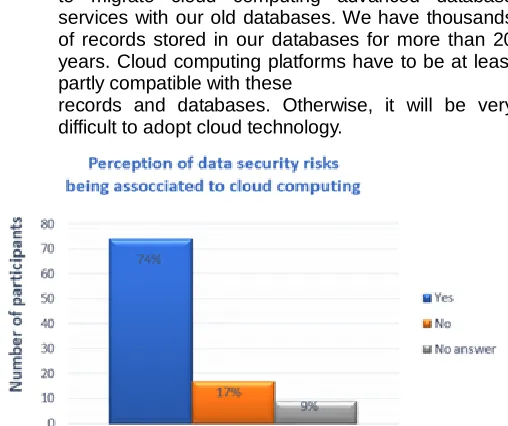
In the views of potential stakeholders in cloud computing technology in JHEIs who participated in this research, security and privacy are the most important negative influences on the adoption of cloud computing by JHEIs. Almost all the participants in interviews and 74% of the survey (see figure 1) expressed a negative attitude towards adopting cloud computing as regards the privacy and the security of data.
Figure 1. The influence of security and privacy concerns in the adoption of cloud computing by higher education institutions in
Jordan, as perceived by research participants.
In particular, most of the interviewees exhibited negative behavioral intentions towards using cloud computing
when the researcher raised the issue of the security of critical data. Most of the decision-makers and academics interviewed (e.g. DM3, DM7 and P3) ranked security and privacy as the top concern in the use of cloud computing technology. This top-priority concern is correlated with the behavioral intention of users towards this technology. Users‟ data in cloud computing would no longer be under university control, but under the control of the service provider, and stored physically outside the university at remote sites [26].
3.6 Compatibility of cloud computing has an influence on perceived ease of use
Compatibility is the extent to which cloud computing technology is consistent with the in-house technology, existing resources, and software and hardware already adopted by a JHEI [15, 20]. Evidence from senior academic and technical staff, and the researchers‟ direct observation of university server rooms and computer laboratories, suggests that the greater the compatibility between cloud computing and in-house systems, the easier it will be to adopt cloud computing in JHEIs. Consistency between cloud computing and in-house applications and services will also influence the ease of use and adoption of the new technology. The findings from this study also argue that compatibility is the main challenge to be faced during the implementation phase, especially in the migration step. As one IT manager (DM8) said:
The cloud computing implementation process consists of many stages. I believe that the big challenge is how to migrate cloud computing advanced database services with our old databases. We have thousands of records stored in our databases for more than 20 years. Cloud computing platforms have to be at least partly compatible with these
records and databases. Otherwise, it will be very difficult to adopt cloud technology.
Figure 2. The potential of cloud computing as a mechanism to
improve knowledge sharing in higher education institutions in Jordan, as perceived by research participants.
5664
servers, databases, e-learning applications). In brief, a high level of compatibility means easier use and adoption of cloud computing technology in JHEIs.
3.7 Knowledge sharing and attitude towards using cloud computing are linked
Knowledge sharing has a significant role in the success of any institution [31]. According to Sultan [32], cloud computing enables users to share their experience, skills and personal knowledge. In the context of HE, the need to share scientific knowledge motivates lecturers and students to use ICT. The findings of this study argue that cloud computing features could improve the sharing of knowledge between lecturers and students, and almost all interviewees agreed that cloud computing would enhance it. The need to increase knowledge sharing in Jordanian universities is an important factor that influences the attitude towards using cloud computing technology. According to our survey, 57% of students believe that the adoption of cloud computing will improve knowledge sharing in JHEIs. Most of the interviewees emphasized the need to share knowledge in order to improve the quality of HE outcomes in Jordan, and the value of new technology in achieving this. In brief, the need to increase knowledge sharing in JHEIs positively influences attitudes towards using cloud computing technology and may influence the quality of students‟ and lecturers‟ work.
3.8 Usage level of ICT has a relation with perceived ease of use and attitude towards using cloud computing
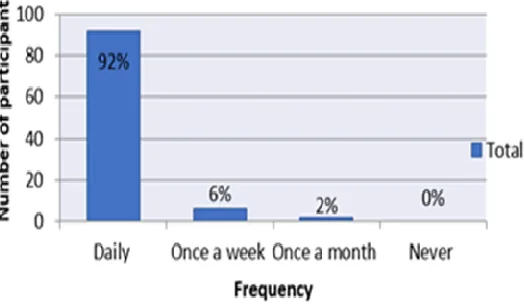
The frequency of IT use could influence the ease of use, and the results from our survey showed that 92% of students use the internet daily. Accordingly, JHEIs students appear to have good experience and skills in using internet services in general, which could influence their ease of using cloud computing, hosted on the internet network. However, as shown in figure 4, 43% of participants had never used cloud computing itself; 18% had used it for less than one month, 12% for six months, 8% for a year, and 19% for more than one year.
Figure 3. Frequency of Internet use by participants (i.e. students in Jordanian higher education institutions).
Figure 4. How long cloud computing has been used by
participants (i.e. students in Jordanian higher education institutions).
Although these findings indicate that a large number of participants had never used cloud technology before, an acceptable number did have some experience. Some of the interviewees (e.g. P16 and P19) stated that their use of the cloud was only for simple applications such as Google Docs, Microsoft OneDrive, Apple storage applications, and basic academic services. Such usage may also influence their attitude towards using cloud computing. This finding appears to be in line with Al-Hadrami [33], who investigated the factors affecting the use of web courses in Hashemite University in Jordan; he found a positive relationship between students‟ experience in using web courses and their attitude towards using innovative technology.
3.9 Higher education institution size
The data collected from the Jordanian Universities showed that Jordanian public universities‟ size (e.g. the size of facilities, number of students and staff) is much greater than that of private universities. Accordingly, small private universities have more flexibility in terms of the adoption of cloud computing. However, despite the large size of Jordanian public universities, the findings also show that these universities suffer from overpopulation. Accordingly, the adoption of cloud computing technology could provide more virtual classrooms, services, and resources, which could solve the limited capacity of such universities. Furthermore, the scalability and pay-per-use business model of cloud computing can provide flexibility in increasing or decreasing the number of resources, according to students „requirements.
4
THE
TECHNOLOGY-ORGANIZATIONAL-ENVIRONMENT AND QUALITY FRAMEWORK
(TOEQCC)
5665
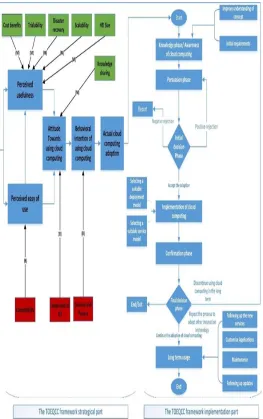
theories by Tornatzky et al. [19]. Thus, the proposed new framework, represented in figure 5, has been named Technology-Organisational Environment and Quality framework for the implementation of Cloud Computing (TOEQCC) in higher education institutions. Motivators for and barriers to cloud computing adoption in JHEIs are represented in the first part of the TOEQCC framework. The second part of the framework represents the process of cloud computing adoption by JHEIs, using a process flow diagram to explain the stages of adoption. In this diagram. The graphical representation in figure 5 is complemented in this section by a description in a narrative form. In order to help JHEIs to adopt cloud computing technology, in this research we have designed a sequence diagram, which includes five main steps that JHEIs can run. Such steps can be outlined as follows: awareness, persuasion, decision, implementation, and confirmation. The proposed process of cloud computing adoption in HE institutions in the TOEQCC framework was developed based on Rogers‟ DOI [20] model within the scenario of JHEI, using cloud computing as the specific technology. A process flow diagram, seen on the right side of the TOEQCC framework, was employed to explain the main stages of cloud computing adoption in HEs. The following sections illustrate the phases of adoption, adapted from the original DOI theory [20].
4.1 Awareness of cloud computing technology (Prior conditions)
The first phase in the process of adoption of cloud computing in JHEIs is to raise awareness of this technology: this is considered a pre-requisite for the success of cloud computing adoption. As a result of this research the awareness level could be raised through three steps as follows: Addressing the initial requirements of JHEIs: Once the university stakeholders are aware of the concept, as well as its benefits and limitations, it is important to develop a plan to determine the initial requirements needed for the adoption of cloud computing, including the needs of students, lecturers, administrative staff and management.
4.2 Persuasion phase of cloud computing adoption
At the persuasion stage, the decision-making unit attempts to be more psychologically involved in the process of adopting cloud computing. This stage is a cornerstone for the next phase (decision phase) and will provide more realistic feedback about the technology than the first stage (awareness phase), which provides only theoretical assumptions regarding cloud computing‟s limitations and benefits. In the persuasion phase, Jordanian universities seek feedback and detailed reports about cloud computing from lecturers, students, staff, technical support teams and financial departments.
4.3 Decision phase
The third phase in the adoption process is to decide whether to accept or reject cloud computing technology. For this phase, decision-making units should have detailed reports from the first and second phases. In positive rejection, the HE institution provides a report explaining the reasons for rejection. However, if the HE institution later accepts the technology, the steps are repeated from the persuasion stage. Alternatively, negative rejection refers to the decision to permanently close the door on cloud computing adoption and never re-enter the adoption process loop.Finally, the
decision-making unit must accept or reject the adoption of cloud computing based on the findings of their analysis.
4.4 Implementation Phase
5666
inappropriate for the JHEI and did not meet the expected relative advantages for the long term. In this case, it would be useful to generate a report to illustrate the reasons for rejection and how cloud computing failed to meet the university‟s requirements.
Figure 5. The technology-organization-environment-quality
framework for cloud computing adoption in higher education institutions in Jordan.
5
CONCLUSIONDespite the intensive use of cloud computing, limited research has been conducted regarding the use of ICT based on cloud computing by higher education (HE) institutions in developing countries, especially in Jordanian universities. In this paper, the researcher investigated the main factors that may influence the adoption of cloud computing and have suggested the TOEQCC framework for such adoption. An interpretive approach using a qualitative methodology has been employed. Thirty-one interviews with key stakeholders from eleven Jordanian universities were performed. The findings suggest that there are nine barriers and motivators for the adoption of cloud computing in JHEIs, which are: cost benefits, trialability, disaster recovery, scalability, HEI size, knowledge sharing,
compatibility, the usage level of ICT, and security and privacy. The TOEQCC framework can be used by JHEIs as a blueprint for a better understanding of the process of adoption of cloud computing. It provides the main steps in implementation and the most important factors affecting the adoption of cloud computing. It could also be applied in similar contexts in Middle East countries that share common denominators such as culture, language, economy, attitude toward using cloud technology, behavioral intention to use the new technology, and level of ICT use. Finally, the findings of this research are expected to be applicable not only to Jordanian society but also to other developing countries that have a similar culture and situation, particularly other countries in the Middle East.
ACKNOWLEDGMENT
This research is funded by the Deanship of Research in Zarqa University / Jordan.
REFERENCES
[1] M. Al Jabery and M. Zumberg, "General and Special Education Systems in Jordan: Present and Future Perspectives." International Journal of Special Education, vol. 23, (1), pp. 115-122, 2008.
[2] A. Al-Adwan and J. Smedley, "Implementing e-learning in the Jordanian Higher Education System: Factors affecting impact," International Journal of Education and Development using Information and Communication Technology, vol. 8, (1), pp. 121-135, 2012.
[3] S. Al-Jaghoub, H. Al-Yaseen, M. Hourani and R. El-Haddadeh, "E-learning adoption in higher education in jordan: Vision, reality and change," in European and Mediterranean Conference on Information Systems, Crowne Plaza Hotel, Izmir, 2009, .
[4] S. Stein, J. Ware, J. Laboy and H. E. Schaffer, "Improving K-12 pedagogy via a Cloud designed for education," Int. J. Inf. Manage., vol. 33, (1), pp. 235-241, 2013.
[5] V. H. Pardeshi, "Cloud computing for higher education institutes: architecture, strategy and recommendations for effective adaptation," Procedia Economics and Finance, vol. 11, pp. 589-599, 2014.
[6] A. Shawish and M. Salama, "Cloud computing: Paradigms and technologies," in Inter-Cooperative Collective Intelligence: Techniques and ApplicationsAnonymous Springer, 2014, pp. 39-67.
[7] N. Sultan, "Cloud computing for education: A new dawn?" Int. J. Inf. Manage., vol. 30, (2), pp. 109-116, 2010. [8] G. Pallis, "Cloud computing: the new frontier of internet
computing," IEEE Internet Comput., vol. 14, (5), pp. 70, 2010.
[9] L. Wang, G. Von Laszewski, A. Younge, X. He, M. Kunze, J. Tao and C. Fu, "Cloud computing: a perspective study," New Generation Computing, vol. 28, (2), pp. 137-146, 2010.
[10] M. M. Odeh, "A proposed theoretical solution for transferring from physical to virtual machines based on cloud computing," in 2019 5th International Conference on Information Management (ICIM), 2019, pp. 221-226. [11] P. Mell and T. Grance, "The nist definition of cloud
computing. Special publication 800-145, National Institute of Standards and Technology," Information Technology Laboratory, September, pp. 800-145, 2011. [12] S. Schneider and A. Sunyaev, "Determinant factors of
5667
literature in the era of cloud computing," J. Inf. Technol., vol. 31, (1), pp. 1-31, 2014.
[13] F. D. Davis, "Perceived usefulness, perceived ease of use, and user acceptance of information technology," MIS Quarterly, vol. 13, (3), pp. 319-340, 1989.
[14] S. K. Lippert and C. Govindarajulu, "Technological, organizational, and environmental antecedents to web services adoption," Communications of the IIMA, vol. 6, (1), pp. 14, 2006.
[15] H. M. Sabi, F. E. Uzoka, K. Langmia and F. N. Njeh, "Conceptualizing a model for adoption of cloud computing in education," Int. J. Inf. Manage., vol. 36, (2), pp. 183-191, 2016.
[16] G. Militaru, A. A. Purcărea, O. D. Negoiţă and A. Niculescu, "Examining cloud computing adoption intention in higher education: Exploratory study," in International Conference on Exploring Services Science, 2016, pp. 732-741.
[17] H. Gangwar, H. Date and R. Ramaswamy, "Understanding determinants of cloud computing adoption using an integrated TAM-TOE model," Journal of Enterprise Information Management, vol. 28, (1), pp. 107-130, 2015.
[18] C. Low, Y. Chen and M. Wu, "Understanding the determinants of cloud computing adoption," Industrial Management & Data Systems, vol. 111, (7), pp. 1006-1023, 2011.
[19] L. G. Tornatzky, M. Fleischer and A. K. Chakrabarti, Processes of Technological Innovation. Lexington Books, 1990.
[20] E. M. Rogers, Diffusion of Innovations: Simon and Schuster, 2010.
[21] K. B. Nayar and V. Kumar, "Cost benefit analysis of cloud computing in education," International Journal of Business Information Systems, vol. 27, (2), pp. 205-221, 2018.
[22] P. Hsu, S. Ray and Y. Li-Hsieh, "Examining cloud computing adoption intention, pricing mechanism, and deployment model," Int. J. Inf. Manage., vol. 34, (4), pp. 474-488, 2014.
[23] J. Lian, D. C. Yen and Y. Wang, "An exploratory study to understand the critical factors affecting the decision to adopt cloud computing in Taiwan hospital," Int. J. Inf. Manage., vol. 34, (1), pp. 28-36, 2014.
[24] K. Palanivel and S. Kuppuswami, "Green and energy-efficient computing architecture for E-learning," in Managing Big Data in Cloud Computing EnvironmentsAnonymous IGI Global, 2016, pp. 252-277. [25] R. Bianchini and R. Rajamony, "Power and energy
management for server systems," Computer, vol. 37, (11), pp. 68-76, 2004.
[26] D. S. Linthicum, Cloud Computing and SOA Convergence in Your Enterprise: A Step-by-Step Guide. Pearson Education, 2009.
[27] Rao, Cloud Computing. PHI Learning Pvt. Ltd., 2015. [28] S. Murugesan and I. Bojanova, Encyclopedia of Cloud
Computing. John Wiley & Sons, 2016.
[29] R. M. Jost, Selecting and Implementing an Integrated Library System: The most Important Decision You Will Ever make: Chandos Publishing, 2015.
[30] T. Velte, A. Velte and R. Elsenpeter, Cloud Computing, a Practical Approach. McGraw-Hill, Inc., 2009.
[31] A. Garcia-Perez, "A principled approach to knowledge elicitation and transfer in organisations," 2011.
[32] N. Sultan, "Knowledge management in the age of cloud computing and Web 2.0: Experiencing the power of disruptive innovations," Int. J. Inf. Manage., vol. 33, (1), pp. 160-165, 2013.
[33] A. H. Al-Hadrami, "Factors that Affect Learners' Performance in Web-Based Courses: The Case of the Accounting Courses at the Hashemite University," Factors that Affect Learners' Performance in Web-Based Courses: The Case of the Accounting Courses at the Hashemite University. Unpublished Thesis., 2012. [34] P. Legris, J. Ingham and P. Collerette, "Why do people
use information technology? A critical review of the technology acceptance model," Information & Management, vol. 40, (3), pp. 191-204, 2003.