A Metadata Calculus for Securing Information Flows
Mudhakar Srivatsa and Dakshi AgrawalIBM T.J. Watson Research Center
{msrivats, agrawal}@us.ibm.com
Shane Balfe
Royal Holloway, University of London
Abstract
Traditional approaches to information sharing use a highly conservative approach to deduce the meta-data for an output objectx derived from input ob-jects y1, y2, · · ·, yn (e.g.: maximum over the se-curity labels of all input objects). Such approaches does not account for functions that explicitly down-grade the value of an object. Consequently, the se-curity labels in traditional approaches tend to mono-tonically increase as newer objects are derived from existing ones. In this paper we present a novel meta-data calculus for securing information flows. The metadata calculus defines a metadata vector space that supports a time varying value function that is computed as a function of the object’s metadata and operators + and · to compute the metadata of an output object that is derived by downgrad-ing, transforming or fusing other objects. We also describe a concrete realization of our metadata cal-culus wherein the tightness of our value estimates competes in an optimization problem. We present several tradeoffs with space and accuracy and ex-plore a spectrum of solutions ranging from conser-vative to risk-based value estimates.
1
Introduction
Large corporations are slowly being transformed from monolithic, vertically integrated entities, into glob-ally disaggregated value networks, where each mem-ber focuses on its core competencies and relies on partners and suppliers to develop and deliver goods and services. The ability of multiple partners to come together, share sensitive business information and coordinate activities to rapidly respond to busi-ness opportunities, is becoming a key driver for suc-cess.
The defense sector too, has similar, dynamic in-formation sharing needs. Traditional wars between
armies of nation-states are being replaced by highly dynamic missions where teams of soldiers, strate-gists, logisticians, and support staff, drawn from a coalition of military organizations as well as lo-cal (military and civilian) authorities, fight against elusive enemies that easily blend into the civilian population [6]. Securely disseminating mission crit-ical tactcrit-ical intelligence to the pertinent people in a timely manner will be a critical factor in a mission’s success.
While it is clear that information sharing across organizational boundaries is becoming a necessity, it is important for the recipient to ensure that it receives high quality information from the sender. However, for a sender to share high quality infor-mation, the sender needs assurance from the recip-ient that the shared information will not be mis-used (e.g.: unregulated or unintended information disclosure). Poor quality of information and unau-thorized information disclosure can create the risk of legal liability, financial loss, tarnished reputation, or in some environments, a loss of life. Evidently, there is a risk related tradeoff between the quality of information and information misuse. Understand-ing this tradeoff minimally requires us to quantify the valueof information being shared.
Unfortunately, traditional approaches to infor-mation sharing suffer from two major drawbacks. First, they use fairly static security labels to tag information, and thus do not attempt to capture dynamic attributes of tactical information such as time sensitivity, accuracy, etc. The value of a piece of information (henceforth, called an object) is com-puted as a function of its security labels (henceforth, called metadata). For example, Multi-Level Secu-rity (MLS) labels such as unclassified, classified, se-cret, top secret are used to enforce mandatory ac-cess control in a military setting; Decentralized La-bel Management (DLM) laLa-bels each object with al-low and deny lists and regulates information fal-lows
Report Documentation Page
OMB No. 0704-0188Form ApprovedPublic reporting burden for the collection of information is estimated to average 1 hour per response, including the time for reviewing instructions, searching existing data sources, gathering and maintaining the data needed, and completing and reviewing the collection of information. Send comments regarding this burden estimate or any other aspect of this collection of information, including suggestions for reducing this burden, to Washington Headquarters Services, Directorate for Information Operations and Reports, 1215 Jefferson Davis Highway, Suite 1204, Arlington VA 22202-4302. Respondents should be aware that notwithstanding any other provision of law, no person shall be subject to a penalty for failing to comply with a collection of information if it does not display a currently valid OMB control number.
1. REPORT DATE DEC 2008 2. REPORT TYPE N/A 3. DATES COVERED -
4. TITLE AND SUBTITLE
A Metadata Calculus for Securing Information Flows
5a. CONTRACT NUMBER
5b. GRANT NUMBER
5c. PROGRAM ELEMENT NUMBER
6. AUTHOR(S) 5d. PROJECT NUMBER
5e. TASK NUMBER
5f. WORK UNIT NUMBER 7. PERFORMING ORGANIZATION NAME(S) AND ADDRESS(ES)
IBM T.J. Watson Research Center
8. PERFORMING ORGANIZATION REPORT NUMBER
9. SPONSORING/MONITORING AGENCY NAME(S) AND ADDRESS(ES) 10. SPONSOR/MONITOR’S ACRONYM(S)
11. SPONSOR/MONITOR’S REPORT NUMBER(S)
12. DISTRIBUTION/AVAILABILITY STATEMENT
Approved for public release, distribution unlimited
13. SUPPLEMENTARY NOTES
See also ADM002187. Proceedings of the Army Science Conference (26th) Held in Orlando, Florida on 1-4 December 2008
14. ABSTRACT 15. SUBJECT TERMS
16. SECURITY CLASSIFICATION OF: 17. LIMITATION OF ABSTRACT UU 18. NUMBER OF PAGES 7 19a. NAME OF RESPONSIBLE PERSON a. REPORT unclassified b. ABSTRACT unclassified c. THIS PAGE unclassified
Standard Form 298 (Rev. 8-98)
MLS DLM Metadata ofx lx Ax,Dx Metadata ofg(x1,· · ·, xn) max(lx1,· · ·, lxn) Tn i=1Axi, Sn i=1Dxi
Figure 1: Metadata Calculus based on these labels.
Second, traditional approaches to information sharing use a highly conservative approach to de-duce the metadata for an output object x derived from input objects x1, x2, · · ·, xn (see Figure 1). Such approaches does not account for functions that explicitly downgrade the value of an object. For example, a set of numeric objects may be statisti-cally downgraded using their mean; an image may be downgraded by lowering its resolution, smooth-ness factor, etc. Consequently, the security labels in traditional approaches tend to monotonically in-crease as newer objects are derived from existing ones. Ultimately, most of the derived objects receive the highest security label making them inaccessible to most of the users in the organization. As pointed out by the JASON committee report [5], traditional approaches severely constrict the flow of critical in-formation and are thus not appropriate for dynamic settings, where systems and processes evolve rapidly and there are transient needs for sharing tactical, time-sensitive information across organizational bound-aries.
In this paper we present a novel metadata cal-culus for securing information flows. We capture an object’s metadata using a vector space M and define a metadata calculus that supports the follow-ing primitives: (i) a time varyfollow-ing value function Γ based on an object’s metadata, and (ii) operators + and · on the vector space M that can be used to compute the metadata for an output object that is derived by downgrading, transforming or fusing other objects. We also describe a concrete realiza-tion of our metadata calculus wherein the tightness of our value estimates competes in an optimization problem. We present several tradeoffs with space and accuracy and explore a spectrum of solutions ranging from conservative to risk-based value esti-mates.
The rest of this paper is organized as follows. Section 2 describes related work on risk based se-cure information flows. Section 3 describes meta-data types and presents an information theoretic
approach to estimating the value of an object. Sec-tion 4 describes a calculus for succinctly computing the metadata for an output object that is derived from one or more input objects. Finally we conclude the paper in Section 5.
2
Related Work
There has been significant research on decentralized information labels and assured information sharing within and across multiple organizations [2, 3, 4, 10, 11, 12] in recent years. However, these works primarily focus on the problem of specifying and manipulating the sharing, propagation and down-grading constraints on data. These works also as-sume appropriate security controls that manipulate, bind and respect these labels are already in place, for example, via a secure distributed runtime lan-guage, or some other form of a secure distributed trusted computing base. Clearly, in practice, for the settings described in the introduction, one partner cannot be sure of either the existence, or the proper usage of, a secure runtime environment of another partner.
Recently, new approaches based on risk estima-tion and economic mechanisms have been proposed for enabling the sharing of information in dynamic environments [1, 5]. These approaches are based on the idea that the sender dynamically computes an estimate of the risk of information disclosure in providing information to a receiver based on the secrecy of the information to be divulged and the sender’s estimate on the trustworthiness of the re-cipient. The sender then “charges” the receiver for this estimated risk. The recipient, in turn, can de-cide which type of information is most useful to him and pay only to access that. Entities would either be given a line of risk credit, or adopt a market-based mechanism to “purchase risk” using a pseudo-currency. Under the assumption that the line of risk credit or the risk available for purchase in the market is limited, an entity will be encouraged to be frugal with their amassed risk credits and, con-2
sequently, reluctant to spend them unnecessarily. Since all information flows are “charged” against expected losses due to unauthorized disclosure and the amount of risk available is limited, an argument is made that the total information disclosure risk incurred by an organization is controlled.
While, as a concept, using risk estimation, charg-ing for risk of information flows, and limited risk credits are promising ideas for enabling information sharing in dynamic environments, the existing work in this area [1, 5] has gaps in how this concept can be realized to enable cross-organizational secure in-formation flows in dynamic environments such as between organizations or partners in a coalition. In [1, 5, 8, 7], while risk is estimated based on the ob-ject metadata [9], the actual formulas or examples use static credentials (e.g., the security clearance or category set) of the recipient, rather than a dynamic value of the object. Indeed, the value of most tac-tical information tends to decrease with time and evolve as the object is downgraded, transformed or fused with other objects. In this paper we present a novel metadata calculus that can be used to suc-cinctly estimate the time varying value of tactical information in a dynamic coalition setting.
3
Metadata Model
In this section we describe our metadata model. For the sake of simplicity we include one dynamic at-tribute, namely time, in our metadata model. We represent the metadata for an object x as a vector ~
x in a vector space M. Malso supports an unary operator that maps ~x ∈ M to value function: Γ:
M→(F→F), where F denotes an integer or real number field. For example, ~x = (10, 2) and Γ~x(t) = max(10−2t, 0) or Γ~x(t) = 10e−2t. The value operator Γ satisfies the following properties:
0≤Γ~x(t)<∞,∀t ∂Γ~x(t)
∂t ≤0,∀t x⊆y⇒Γ~x(t)≤Γ~y(t),∀t
Constraining the value of object to non-negative in-tegers (or real numbers) may be questionable. One can think of sources of disinformation (misguiding information) to have a negative value. In this paper we do not consider pieces of information that are in-tended to misguide the recipient. In the absence of
disinformation, the value of information is mono-tonic, that is, if an object xis completely contained in object y, then Γ~x(t) ≤Γ~y(t).
The value of an output object x computed as g(y1, y2,· · · , yn) is computed as shown by an em-pirical formula in Equation 1, where Yi ={Y1,· · ·, Yi−1, Yi+1, · · ·, Yn} and yi = {y1, · · ·, yi−1, yi+1, · · ·,yn}. Γ~x(t) = n X i=1 Γy~i(t)∗ fYi|X(yi|x, B) fX|Y i(x|yi) (1) We use fX to denote the probability distribution function for a random variable X. Value computa-tion uses the nocomputa-tion of self-informacomputa-tion expressed as I(yi|x) = D(δyi kfYi|X(yi|x)) = −log(fYi|X(yi|x)), where D(X k Y) denotes KL-divergence between probability distributions X and Y and δyi denotes the Dirac delta function whose value is one whenYi =yiand zero otherwise. Intuitively self-information I(yi|x) denotes the number of additional bits that need to be learnt in order to reconstruct yi given that the entity knows the probability distribution fYi|X. Hence, 2
−I(yi|x) = f
Yi|X(yi|x) denotes the fraction of information about yi that may be in-ferred from x. We remark that exact reconstruc-tion of yi may not be required for certain objects (e.g.: geographical location). In such cases, one can replace δyi by some probability distribution that is centered around yi.
We argue that Equation 1 satisfies the intuitive notion of object downgrade, transforms and fusion. In the rest of this section, we demonstrate the appli-cability of Equation 1 to a wide range of functions g(·) ranging from arithmetic functions, database op-erations and cryptographic functions. Figure 2, 3 and 4 show value computations for some sample functions g. We use B to denote background in-formation known to the consumer of object x such as cryptographic secrets.
In the case of bijective arithmetic functions (such asx=g(y1) =y1+ 1), we note that givenxand the function g, one can completely recover all informa-tion abouty1. Hence, the value ofxequals the value of y1 for all time instances t. On the other hand, arithmetic functions such as x = y21 loose informa-tion on y1; in particular, given x one can identify two possible values for y1 (namely, ±√x). In the absence of any background information on y1, this results in an entropy loss of one bit; equivalently
g B Γ~x note x=y1+ 1 − Γy~1(t) gis bijective x=y2 1 − Γy~1(t) 2 g is invertible x=y21 y1>0 Γy~1(t) gis bijective given B x=Pn i=1yi n,∀i,yi ∼fY 0 ≤Γ~x(t)≤Pni=1Γy~i(t) Statistical downgrading
Figure 2: Value Computation for Arithmetic Functions
g B Γ~x note
x=y1./y2 − 2k * (Γy~1(t)+Γy~2(t)) Join operation
x=y1∪y2 − Γy~1(t)+Γy~2(t) Union operation
x=πy1{y1, y2} − 2−k * Γ−−−−−→{y1, y2} Project operation
x=σp{y1, y2} − |{y|x|
1,y2}| * Γ
−−−−−→
{y1, y2} Select operation using predicatep
Figure 3: Value Computation for Database Functions: Assume, we have two database fields Y1 and Y2. The values y1 in Y1 and y2 in Y2 are independent and chosen using a uniform distribution between (0, 2k−1)
g B Γ~x note
x=K − 0 KeyK has zero value;
but knowledge ofK affects the value of other objects
x=EK(y1) − 0 Ideal encryption
x=EK(y1) K Γy~1(t) Ideal encryption
x=DK0(EK(y1)) K0 6=K 0 Ideal decryption
x=DK(EK(y1)) K Γy~1(t) Ideal decryption
x=HK(y1) K 0 Ideal hash
x=SigK(y1) K 0 Ideal signature
Figure 4: Value Computation for Cryptographic Functions
the value of x is half the value of y1. However, the recipient were to know that y1 ≥ 0, then there is no loss of information. Functions such as sum and average may exhibit different information loss char-acteristics. For example, let us suppose x = y1 + y2. If the recipient knows that 0≤y1,y2 ≤5, then given x = 0 (or 10), it can obtain all information about y1 and y2 respectively.
For database operations, we recognize the need to differentiate between union and join operations. Union operates on two sets of thesame type; for ex-ample, let us consider sets of type color y1 ={red} and y2 = {blue}. Consequently, union of two sets does not result in any additional information than the input sets. On the other hand, join operates on two sets of different types; for example, let us con-sider a set of typehx-coord, idiy1 ={h10,id1i}and a set of typehy-coord, idiy2={h5,id1i}. A join on y1 andy2 reveals the (x, y) coordinates of the entity (id1) and thus has significantly more information than the input sets. To cite another example, let us consider a 128-bit cryptographic keyK =LkR of value V, where L and R denote the left and the right 64-bites of a 128-bit key K. One might argue that the value of L and R is 2−64 ∗V, assuming the key K is randomly chosen over a 128-bit field. Now, let us consider a join of sets of type hL, kidi and hR, kidi, where kid denotes key identifier: y1 ={hL1,kid1i}and y2 ={hR1,kid1i}. It is easy to see that the value of x must be significantly higher than the sum of valuesy1 andy2. Indeed, Equation 1 amplifies the values ofy1 andy2 by a factor of 264 when deriving the value ofx.
For cryptographic operations, we model ideal behavior using a 0/1 value relationship with the in-put object. For example, using an ideal encryption function x = EK(y1), the value of x is zero if the recipient does not know K; otherwise, the value of x is equal to the value of y1, since the recipient can recover all information about y1 using the cor-responding decryption function D and the keyK.
4
Metadata Calculus
In this section, we describe a metadata calculus using two binary operators on the metadata vec-tor space M: vector addition +: M×M→M and scalar multiplication ·: F×M→M, where F de-notes a field such as integers or real numbers. These
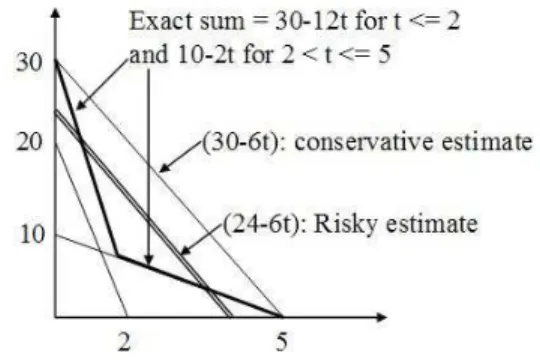
Figure 5: Conservative Vs Risky ‘+’ Operator binary operators satisfy the following homomorphic properties:
• ~x = y~1 + y~2 ⇔ Γ~x(t) = Γy~1(t) + Γy~2(t) for all t.
• ~x =a·y~1 ⇔ Γ~x(t) =a∗Γy~1(t) for allt. In addition, they also satisfy the following intu-itive properties:
• Commutative: For any y~1, y~2 ∈ M, y~1 + y~2 = y~2 +y~1.
• Associative: For anyy~1,y~2,y~3 ∈ M,y~1 + (y~2 + y~3) = (y~1 +y~2) +y~3.
• Zero vector~0: For anyy~1 ∈ M,y~1 +~0 =y~1.
• Distributive over + in M: For any a ∈ F, ~
y1,y~2 ∈ M,a·(y~1 +y~2) =a·y~1 +a·y~2.
• Distributive over + in F: For any a, b∈ F, ~
y1 ∈ M, (a+b)·y~1 = a·y~1 + b·y~1.
• Distributive over · in M: For anya,b ∈ F, ~
y1 ∈ M,a·(b·y~1) = (ab)·y~1.
• Scalar 1 in F: For anyy~1 ∈ M, 1·y~1 =y~1. Based on the properties described above, it is easy to see that when x is computed asg(y1, y2,· · ·, yn) then the metadata ~x can be computed as shown in Equation 2. Indeed give the homomorphic proper-ties on theM, we can show that Equation 2 implies Equation 1 for all time t.
~ x= n X i=1 fYi|X(yi|x, B) fX|Y i(x|yi) ·y~i (2)
4.1 Realizing the Metadata Calculus
In this section, we describe a concrete instantiation of metadata calculus. Unfortunately, there exists no vector space that satisfies all the required ho-momorphic properties. In this section, we describe a metadata vector space and value functions that satisfy a weaker notion of homomorphism as shown in Equation 3. It follows from Equation 3 that our metadata calculus makes conservative estimates on object values.
~
x=a·y~1⇔Γ~x(t) =a∗Γy~1(t),∀t ~
x=y~1+y~2⇒Γ~x(t)≥Γy~1(t) + Γy~2(t),∀t (3) We use a metadata space M=Z×Z, whereZ de-notes integer field. Given ~x = (c0, c1), Γ~x(t) = max(c0 −c1∗t, 0). Given x~1 = (c10, c11) and x~2 = (c20,c21), the + and·operators are defined as follows:
a·x~1 = (a∗c10, a∗c11) ~ x1+x~2 = c10+c20, c10+c20 maxc 1 0 c1 1 ,c 2 0 c2 1
Figure 5 illustrates the + operator on y~1 = (10, 2) and y~2 = (20, 10). It is easy to see that Γy~1(t) + Γy~2(t) is:
Γy~1(t) + Γy~2(t) =
(
30−12t ift≤2 10−2t if 2< t≤5 It is easy to that the above equation cannot be represented by a straight line and thus cannot be mapped into a metadata vector in M. Hence, we choose the least conservative straight line (30−6t) such that Γy~1(t) + Γy~2(t)≤30−6tfor allt. Indeed, there are several options to ensure that our value es-timates are tighter all of which can be modeled as optimization problems.
• First, we can increase the dimensionality of the metadata vector space and use a high or-der polynomial for Γ~x(t). It is easy to see that proposed metadata calculus can be extended to all value functions that are polynomial in time t. We note that increasing the dimen-sionality of the metadata vector allows us to compute tighter value estimates at the cost of higher storage cost.
• Second, we can represent ~x asktuples where each tuple describes a straight line within some time interval. We note that when x is com-puted as a function of y1, · · ·, yn, then the value of x may be represented by at most n linear constraints. For any given constant k
≤ n, we can compute a set of k linear con-straints that tightly bounds the set ofnlinear constraints. We note that increasing kallows us to compute tighter value estimates at the cost of higher storage cost.
• Third, we could permit bounded violations to the constraint Γ(−→y1+−→y2)(t)≥Γy~1(t) + Γy~2(t) for some instantst. One can quantify the risk (r+) in a value estimate using the area en-closed by the region wherein our value esti-mate is lower than the true value of the ob-ject; similarly, one can quantify overestima-tion (r−) using the area enclosed by the region wherein our value estimate is higher than the true value of the object. We formulate two optimization problems that allow us to trade off the conservativeness and tightness in our estimates. First, we can restrict the risk in our value estimate to at mostX% of the value of the object (averaged over its lifetime). Sec-ond, we can attempt to minimize a function of risk and overestimation, sayα∗r+−r−, for someα > 0.
5
Conclusion
In this paper we have presented a novel metadata calculus for securing information flows in a tacti-cal setting. The metadata tacti-calculus defines a meta-data vector space that supports a time varying value function that is computed as a function of the ob-ject’s metadata and operators + and · to compute the metadata of an output object that is derived by downgrading, transforming or fusing other ob-jects. We have also described a concrete realization of our metadata calculus using a value function that is polynomial in time t. We have formulated the problem of finding tight value estimates as various optimization problems. These formulations model various tradeoffs with space and accuracy and ex-plore a spectrum of solutions ranging from conser-vative to risk-based value estimates.
Acknowledgements
Research was sponsored by the U.S. Army Research Laboratory and the U.K. Ministry of Defence and was accomplished under Agreement Number W911NF-06-3-0001. The views and conclusions contained in this document are those of the author(s) and should not be interpreted as representing the of-ficial policies, either expressed or implied, of the U.S. Army Research Laboratory, the U.S. Govern-ment, the U.K. Ministry of Defence or the U.K. Government. The U.S. and U.K. Governments are authorised to reproduce and distribute reprints for Government purposes notwithstanding any copy-right notation hereon.
References
[1] P.-C. Cheng, P. Rohatgi, C. Keser, P.A. Karger, G.M. Wagner, and A.S. Reninger. Fuzzy Multi-Level Security: An Experiment on Quantified Risk-Adaptive Access Control. In
Proceedings of the 2007 IEEE Symposium on Security and Privacy (SP 2007), pages 222– 230. IEEE Computer Society, 2007.
[2] C.D. McCollum and J.R. Messing L. Notargia-como. Beyond the Pale of MAC and DAC-Defining New Forms of Access Control. In Pro-ceedings of the 1990 IEEE Symposium on Secu-rity and Privacy (S&P 1990), pages 190–200. IEEE Computer Society, 1990.
[3] A.C. Myers and B. Liskov. A Decentralized Model for Information Flow Control. In Pro-ceedings of the 1997 Symposium on Operating Systems Principles (SOSP 1997), pages 129– 142. ACM Press, 1997.
[4] A.C. Myers and B. Liskov. Complete Safe In-foramtion Flow with Decentralized Labels. In
Proceedings of the 1998 IEEE Symposium on Security and Privacy (S&P 1998), pages 186– 197. IEEE Computer Society, 2001.
[5] Jason Prograrm Office. HORIZONTAL INTE-GRATION: Broader Access Models for Real-izing Information Dominance. Special Report JSR-04-13, MITRE Corporation, 2004.
[6] D. Roberts, G. Lock, and D.C. Verma. Holis-tan: A Futuristic Scenario for International
Coalition Operations. In In Proceedings of Fourth International Conference on Knowl-edge Systems for Coalition Operations (KSCO 2007), 2007.
[7] M. Srivatsa, P. Rohatgi, and S. Balfe. Securing information flows: A quantitative risk analysis approach. In Proceedings of 15th ACM Con-ference on Computer and Communication Se-curity (CCS), 2008.
[8] M. Srivatsa, P. Rohatgi, S. Balfe, and K. G. Pa-terson. Trust management for secure informa-tion flows. InProceedings of 27th IEEE Confer-ence on Military Communications (MILCOM), 2008.
[9] M. Srivatsa, P. Rohatgi, S. Balfe, and S. Reidt. Securing information flows: A metadata frame-work. In Proceedings of 1st IEEE Workshop on Quality of Information for Sensor Networks (QoISN), 2008.
[10] N. Swamy, M. Hicks, and S. Tsang. Veri-fied Enforcement of Security Policies for Cross-Domain Information Flows. In Proceedings of the 2007 Military Communications Conference (MILCOM 2007), pages 192–206. IEEE Com-puter Society, 2007.
[11] J.A. Vaughan and S. Zdancewic. A Crypto-graphic Decentralized Label Model. In Proceed-ings of the 2007 IEEE Symposium on Security and Privacy (S&P 2007), pages 192–206. IEEE Computer Society, 2007.
[12] S. Zdancewic and A.C. Myers. Secure Informa-tion flkows and CPS. InProceedings of the 10th European Symposium on Programming (ESOP 2001), pages 46–61. Springer, 2001.