Page 353 www.ijiras.com | Email: [email protected]
Enabling Technologies For Inclusive Development: A Study On
Software Technologies For Visually Challenged
S R Krishna Pulivarthi
Department of Sociology, University of Hyderabad
I. INTRODUCTION
The term Disability is defined as per the Persons with Disability Act of India (1995), where in Disability means – a person suffering from not less than 40% of any disability. The term disability encompasses: blindness, low-vision, motor disability, mental retardation, hearing impairment, loco-motor, leprosy and mental illness. According to Census 2011 (Registrar General of India), there were 27 million persons with disabilities in India. This includes persons with visual, speech, hearing, mental and locomotors impairments. Total population of the visual impaired constitutes 18.77 per cent of the total disabled population.
Disabled persons as a consequence of disability imposed on them by the society have been facing challenges in life, on the work front and in the matter of education. Individuals with disabilities are not only more likely to be poor, but they are subject to prejudice, social isolation and discrimination. The discrimination is also seen in families. Majority of the disabled are at higher risk of unemployment, partial employment or full employment at lower wages. The
employment rate of persons with disability tends to be considerably lower than that of non-disabled people in India.
In the case of job market with poor education and limited skills people with disability have difficulties in competing with others. Physical or intellectual impairments may limit their job options, but for most, social prejudice makes employers unwilling to hire them. These rates of unemployment among the general adult disabled tend to be at 40-60% higher than for the general non disabled population (Elvan, 1999). This is true even in developed countries with well-organised skills training programmes to help in the transition from school to work. Moreover, even when the disabled enter the work place, they often find little support from the management. If they do not succeed in an apprenticeship or are fired from their first job, they are labelled as unemployable. This is even more difficult among women. Unemployment among disabled young women is higher than the unemployment among comparably educated disabled young men (Metts, 1999). Even when women have received a good education, it generally takes a longer time for
Abstract: One of the major sections of the socially excluded in India is that of visually challenged persons. Majority of them are from rural areas, with improper facilities and from poverty ridden families too. In order to overcome this exclusion, a few NGO’s, in addition to a few other governmental organisations are working in the direction of empowering the Visually Challenged persons. This study is descriptive in nature and aims at understanding the activities undertaken by ‘Enable India’, a Non Governmental Organisation (NGO) based at Bangalore City and its impact on job availability for persons with visual impairments. The findings of the study reveal that Enable India has been engaging in empowering the visually challenged, by imparting them various skills; among such skills. These skills include: usage of specially designed computer based soft-wares for them which would significantly enhance their employability prospects. With this initiation, Enable India helps the visually Challenged People towards Inclusive Empowerment in the wider society. The implications of the findings of study are discussed in this paper.
Page 354 www.ijiras.com | Email: [email protected] them to find a position, provides less job security, and less
prospect of advancement with that job.
To overcome the prejudice, several conventions have been established by many international organisations and countries as well, to protect the rights of the disabled. The „Disability Act of The International Labour Organisation (2003) also states that disabled workers, “whatever the origin of their disability, should be provided with full opportunities for rehabilitation, specialised vocational guidance, training and retraining, and employment for useful work”.
Marxist disability scholars (Gleeson, 1999; Oliver, 1990) have elaborated on the theoretical underpinnings of the link between economic activity and oppression of individuals with disabilities. They argue that the rise of industrial capitalism required individuals to sell their labour to the owners of the means of production. Because disabled individuals were unable to sell their labour on the same terms as non-disabled individuals, they were excluded from the industrial production system and therefore unable to support themselves independently. As industrial capitalism became entrenched as the dominant system for organising society, the ability to support oneself through wage labour became accepted as the measure of an individual's merit and standing in society. As a result, disabled individuals were labelled as inferior citizens. It is suggested that provision of employment is the only way to sustain the lives of differently abled in an acceptable way. Gain employment gives decent living conditions to any individual in society.
II. CONCEPT OF DISABILITY
The term differently abled was coined by the United States Democratic National Committee in the early 1980s as a more acceptable term than handicapped or disabled (Martyn, 1996). Moving beyond the early attempts based on rehabilitation model there have been initiations to empower the differently abled. The need for providing employment as a source of empowerment of the differently abled has also been realised. In order to make the differently abled employable it was recognized that a separate mode of educational system which incorporates training in the use of technologies with the help of sophisticated technologies was also needed (Martyn, 1996).
III. DISABLED POPULATION IN INDIA
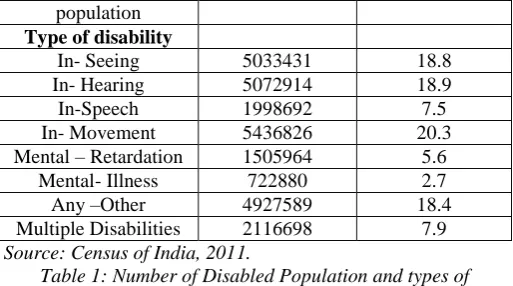
The World Health Organization (WHO) estimates that about 15 per cent of the world‟s population lives with some form of disability, of whom 2-4 per cent experience difficulties in functioning (World Health Organization, 2011). In India, there are two main official sources of nation-wide disability statistics, Census and NSS (National Sample Survey). According to Census 2011, the total disabled population in India was 26,810,557 which constitute more than 2 per cent of total population.
Population Percentage (%) Total Population 1,210,569,573 100.0
Total Disabled 26,810,557 2.21
population Type of disability
In- Seeing 5033431 18.8
In- Hearing 5072914 18.9
In-Speech 1998692 7.5
In- Movement 5436826 20.3
Mental – Retardation 1505964 5.6
Mental- Illness 722880 2.7
Any –Other 4927589 18.4
Multiple Disabilities 2116698 7.9
Source: Census of India, 2011.
Table 1: Number of Disabled Population and types of Disability
According to 2011 census, about 26,810,557 differently abled people live in India. They constitute about 2.21 per cent of the total Indian population. Among the 26.8 million disabled about fifty five per cent are literate and only twenty six per cent are employed as main workers and only ten per cent are employed as marginal workers. India is also home to one third of the world‟s poorest people, with 350 million people (35 per cent of the population) living on less than US$1 a day (Yeo, Rebecca and Karen Moore, 2003).
IV. DISABILITY AND EMPLOYMENT IN INDIA The employment or work that people do and where they work influences a person‟s social and economic status, standard of living, prestige and self-image. The study by Schneider and Ferritor (1982) suggests that the employment empowers individuals to achieve their life goals and it helps them to become independent. It also plays an important role with regard to an individual‟s self-respect. Thus, employment has personal, social and economic value.
The research report submitted by Hamilton, Theron and Oliver (1989) indicates that the meaningfulness of any individual life is mainly influenced or determined by person deploys his/her skills or talents in society, particularly in a work situation. This is especially true with regard to people with disabilities. This research report indicates that employment also improves the individual‟s sense of human dignity and contributes to the establishment of a positive self-image. Similarly, it was found that employment is not only important for able-bodied people, it is more important for people with disabilities (Schneider and Ferritor (1982).
As per Indian Census 2011 data on the employment pattern among the disabled in the country are available on three kinds of work categories. They are main workers, marginal workers and non-workers. The Census of India defines these categories as described below.
Main workers were those who had worked for the major part of the year preceding the date of enumeration i.e. those who were engaged in any economically productive activity for 183 days (or six months) or more during the year.
Marginal workers were those who worked any time in the year preceding the enumeration but did not work for a major part of the year, i.e. those who worked for less that 183 days (or six months).
Page 355 www.ijiras.com | Email: [email protected] Data suggest that there are about 69,82,009 disabled main
workers in the country. Out of total 69,82,009 disabled main workers nearly 25.3 percent, i.e. about 47,09,176 of them live in rural areas whereas 27.8 percent, i.e., about 22,72,833 disabled population live in urban areas (refer Table 2). More number of main workers in the urban areas indicates that these disabled were engaged, to a large extent, in service - sectors. This may be attributed to the general trend in favour of increasing urbanization and the addition of new towns in the country (2,772 were added between 2001 and 2011) (Reddy and Pavani 2015: 65). Significantly, out of 69,82,009 total disabled main workers men were about 54,64,857 and women were only 15,17,152. In other words, women main workers constitute a meagre 13 percent of the total disabled main workers. This presents the status of employment among women disabled in the country. Based on the types of disability it may be informed that about 8,93,906 visually challenged main workers live in rural areas whereas about 4,52,882 visually challenged main workers live in urban areas. Among people With Speech disability there are 4,08,828 who work in rural areas and only 2,34,373 work in urban areas. Among the Hearing disabled there are 9,52,179 main workers live in rural areas whereas 5,04,843live in urban areas. Among workers with Movement disability a majority of them work in rural areas i.e. 10,76,279 and 4,29,279 live in urban areas. Among the Mental Retardation there are 1,49,442 working in rural areas whereas 60,838 work in urban areas. While in
Mental-Illness there are 71,207 work in rural areas and 23,846 lives in urban areas. Among Any other category there are 9, 71,247 work in rural areas and 4,98,863 lives in urban areas. While in Multiple Disabilities there are 1,86,088 work in rural areas and 67,909 lives in urban areas.
Type of Disability
Disabled Population Rural Disabled Population Urban Disabled Population Persons Males Females Persons Males Females Persons Males Females Total 6982009 5464857 1517152 4709176 3600720 1108456 2272833 1864137 408696 In seeing 1346788 1045667 301121 893906 674495 219411 452882 371172 81710 In speech 643201 487333 155868 408828 297673 111155 234373 189660 44713 In hearing 1457022 1117992 339030 952179 707710 244469 504843 410282 94561
In movement
1505558 1248012 257546 1076279 883332 192947 429279 364680 64599 Mental
-Retardation
210280 163123 47157 149442 113179 36263 60838 49944 10894 Mental –
Illness
95053 74464 20589 71207 54628 16579 23846 19836 4010 Any Other 1470110 1130328 339782 971247 727541 243706 498863 402787 96076
Multiple Disabilities
253997 197938 56059 186088 142162 43926 67909 55776 12133
Source: Census of India, 2011.
Table 2: Main Workers
When data on the non-workers among the disabled were analysed, it was found that out of a total 1,70,70,608 disabled non-workers in the country, nearly 62 percent (1,16,32,238) of them live in rural areas whereas 66.5 percent i.e., about 54,38,370 ( unemployed disabled live in urban areas (Table 3). This indicates that a majority of the unemployed disabled live in rural areas. If we classify again this into various types of disability In Seeing there are 21, 50,937 unemployed people live in rural areas whereas 54, 38,370 unemployed live in urban areas. In Speech there are 7,37,091 unemployed who stay in rural areas and 4,22,343 unemployed live in urban areas. In hearing disability there are 19,50,477 non-workers who live in rural areas whereas 10,60,379 stay in urban areas. From In Movement disability there is a good number of non-workers living in rural areas i.e., 25,00,491and there are 9,01,459 people who live in urban areas. From Mental Retardation also there are 7, 80,779 unemployed who live in rural area whereas 4,02,900 stays in urban area. From Mental Illness there are 3,74,148 live in rural areas and 1, 94,198 live in urban areas. From Any other category there are 18,59,287
live in rural areas and 10,21,316 live in urban areas. While in
Multiple Disability category 12,79,028 live in rural areas and 4,45,206 live in urban areas.
Type of Disability
Disabled Population Rural Disabled Population Urban Disabled Population Persons Males Females Persons Males Females Persons Males Females Total 17070608 7915768 9154840 11632238 5498547 6133691 5438370 2417221 3021149 In seeing 3141512 1292994 1848518 2150937 899492 1251455 990575 393502 597073 In speech 1159434 522808 636626 737091 348446 388645 422343 174362 247981 In hearing 3010856 1234501 1776355 1950477 817884 1132593 1060379 416617 643762
In movement
3401950 1769366 1632584 2500491 1319187 1181304 901459 450179 451280 Mental
Retardation
1183679 638600 545079 780779 420257 360522 402900 218343 184557 Mental
Illness
568346 303885 264461 374148 197936 176212 194198 105949 88249 Any Other 2880603 1271412 1609191 1859287 843936 1015351 1021316 427476 593840
Multiple Disabilities
1724228 882202 842026 1279028 651409 627619 445200 230793 214407
Source: Census of India, 2011.
Table 3: Non – Workers
The analysis of data on the total disabled and employment levels among the disabled suggest important trends. From the data on three categories of workers, as per the census definition, it may be said that out of a total 28 million disabled there are about 9.7 million disabled who are capable of working and living on their own (this figure is arrived at after adding the two categories of workers, i.e. main workers and marginal workers). However, out of 9.7 million who are capable to work only 6.9 million disabled were main workers, largely, living in urban areas. However, a majority of these main workers live in urban areas. It may be inferred that, as mentioned above, they largely engaged in service – sectors. These figures highlight the need for measures towards facilitating employment to the disabled in the formal sector and formal organizations.
V. REVIEW OF STUDIES
A study by Klasing (2007) reveals that disabled people in India face various challenges that even threaten their very survival when compared with their counterparts in the developed countries. The findings of the study indicate that there is a strong relation between poverty, low educational level and impairment of disabled people in India. The study reports that, while about 80 per cent of the disabled people in India live in rural areas, the rehabilitative services are mostly concentrated in urban areas. It stated that the medical needs of impaired people in rural areas are grossly neglected (Reddy, 2011). On the patterns of exclusion of disabled people from education sphere, Klasing points out that some states have a high incidence of illiteracy, not just because of poor economic status, but also due to oppressive socio-cultural stereotypes that prevail in the Indian society.
Page 356 www.ijiras.com | Email: [email protected] Provision of employment is the only way to help the
differently abled to lead a life of dignity and self-respect. Employment by nature gives decent living conditions to any individual in society. There are certain institutions in the country today which are extending their valuable support to these differently abled people by providing employment- related training to become employees in companies. This social entrepreneurial activity was mostly started in the late twentieth century.
VI. HISTORY OF EMPOWERMENT OF THE DISABLED In the early days of the First World War, a place of refuge was developed near Havre, France with medical and surgical treatment for Belgian soldiers disabled in fighting for their homeland. It soon became known as the Depot des Invalids, a Centre for Medical Care and Vocational Instruction. The curriculum included carpentry, brush making, toy making, plumbing, mechanics, wood and metal turning, electrical work, upholstery, shoemaking, tailoring, printing, envelope making, manufacture of artificial limbs, etc. in which the disabled soldiers were trained. The objective of vocationally rehabilitating the disabled soldiers was to enable them to contribute to the war effort in a supporting role (IFP/SKILLS Working Paper No. 14, 2003).
In France vocational rehabilitation and return to work programmes had a somewhat similar development to that for Belgian disabled soldiers. In Britain the aftercare of disabled soldiers and sailors in Great Britain pre-First World War had been principally a matter of private initiative and financial support. State provision consisted largely of a small pension and, where needed, artificial limbs. This approach changed when an official report in February 1915 stated that primary responsibility in this regard was with government to ensure proper living conditions for disabled (IFP/SKILLS Working Paper No. 14, 2003).
The work of vocationally rehabilitating the disabled in Europe came through the necessity of using all available manpower and the recognition of the possibility of substituting retrained, but physically disabled men for those physically able. Though the origin of efforts of rehabilitation was rooted in compassion and charity, the efforts based on human rights began much later. The International Labor organization (ILO) made a number of conventions on Decent Work. ILO was instrumental behind the legislations on Differently abled people‟s employment. Some of such legislations are Workmen‟s Compensation (Accidents) Convention, 1925; Workmen‟s Compensation (Occupational Diseases) Convention, 1925; Equality of Treatment (Accident Compensation) Convention, 1925; Sickness Insurance (Industry) Convention, 1927; Sickness Insurance (Agriculture) Convention, 1927; Equal Remuneration Convention, 1951; Discrimination (Employment and Occupation) Convention, 1958; Human Resources Development Convention, 1975; Vocational Rehabilitation and Employment (Disabled Persons) Convention, 1983; Working Conditions (Hotels and Restaurants) Convention, 1991; Protection of Workers‟ Claims (Employer‟s Insolvency) Convention, 1992; Prevention of Major Industrial Accidents Convention, 1993.
From its birth to this time the ILO has made nearly 20 conventions particularly on empowering differently abled and emerged as the apex body in protecting the rights of differently abled.
The issue of vocational rehabilitation and work opportunities for persons with disability largely faded from political agendas during the economic depression of the 1930s. During and before World War II, European countries and United States have employed many disabled with quota systems. This quota system is based on compensating the war-disabled. Special attention on empowering differently abled people said to have started after UN Human rights Declaration. It is over 28 years since the 1981International Year of Disabled Persons brought global attention on the issue of persons who are differently abled.
In addition to the legal framework, extensive infrastructure has also been developed. The following seven National Institutes are working for development of manpower in different areas, namely
Institute for the Physically Handicapped, New Delhi
National Institute of Visually Handicapped, Dehradun
National Institute for Orthopedically Handicapped, Kolkata
National Institute for Mentally Handicapped, Secunderabad
National Institute for Hearing Handicapped, Mumbai
National Institute of Rehabilitation Training & Research, Cuttack
National Institute for Empowerment of Persons with Multiple Disabilities, Chennai.
There are five Composite Rehabilitation Centres, four Regional Rehabilitation Centres and 120 District Disability Rehabilitation Centres (DDRCs) providing various kinds of rehabilitation services to persons with disabilities. There are also several national institutions under the Ministry of Health & Family Welfare working in the field of rehabilitation, like National Institute of Mental Health and Neuro Sciences, Bangalore; All India Institute of Physical Medicine and Rehabilitation, Mumbai; All India Institute of Speech and Hearing, Mysore; Central Institute of Psychiatry, Ranchi, etc. In addition, certain State Government institutions also provide rehabilitation services. Besides, 250 private institutions conduct training courses for rehabilitation professionals. Since seventy five percent persons with disabilities live in rural areas, the services run by professionals will be extended to cover the uncovered and un-served areas.
VII. ENABLE INDIA – AN INTRODUCTION “Enable India” (hereafter EI) an organization working for the empowerment of the visually challenged, in particular, and differently abled, in general, was chosen for the study. Enable India is a Bangalore based social entrepreneurial non-government organisation which has been working for the up-liftment of various differently abled persons particularly the visually challenged through its specially designed vocational training programmes (See, Enable India).
Page 357 www.ijiras.com | Email: [email protected] have long been considered as unproductive liabilities, Shanti
Raghavan, through her organisation EI, has been attempting to break down stereotypes that cripple and restrain prospects for this promising, potential labour group. EI serves the differently abled persons, particularly the visually challenged, by providing training in necessary vocational skills and helps them in finding employment in formal organisations.
Promoting differently abled with employment in the formal sector is not a simple task given the conditions in which it is difficult for even an ordinary individual to get a job. Especially during the inflation days even skilled individuals are often finding it difficult to get a decent job. A disabled person thinking about employment appears a distant dream. But with the initiatives of EI employment for the disabled has become an achievable proposition. For this, Enable India organises training programmes and other kind of activities to strengthen the disabled both psychologically and technically (See, Enable India). .
Primarily, EI focuses on training the visually challenged and helps them to get employment in formal organisations in the private sector. The more important aim that Enable India seeks is to develop the next generation of visually impaired people who are self sustained. Its other aim includes training the visually impaired children so that they learn a lot more than just the technical software skills. EI not only provides vocational training, but also imparts supplemental education, communication skills and even mathematical skills. With this initiation, EI helps the visually impaired to learn mathematics, which they are generally, exempted from studying at schools. The mission of EI is to empower the visually impaired to utilise their skills to secure gainful employment. The idea is to provide a common playing field, a place where the visually impaired can work as comfortably as the sighted.
VIII. SOFTWARE TECHNOLOGIES FOR VISUALLY CHALLENGED
With the Commercial Screen Readers, Enable India is imparting the knowledge of the JAWS, Kurzweil, and Talking Typing Teacher - prominently to the visually challenged. With this initiation, Enable India helps the Visually Challenged. Training in the usage of computers to the visually challenged is an important component of the EI programmes. The visually challenged are trained to learn the special softwares to work with computers. There are a number of softwares which help the differently abled, to operate and apply in different work situations. Some of the softwares specially designed for the visually challenged are discussed below (See, Enable India). EI trains the visually challenged using some of these softwares. It is trying to incorporate other softwares into its training module as well. It is important to note that all these softwares are developed abroad. No software for the disabled has been developed in India. And all these softwares are available at a high cost.
Some of the Softwares used are:
JAWS 5.0 PROFESSIONAL EDITION: This is considered as important and popular screen reader software for visually impaired people. With this software speech synthesizer and the computer‟s sound card, information from the screen is read
aloud, providing access to a wide range of information, including employment and education related applications. JAWS also outputs to refreshable Braille displays, providing unmatched Braille support of any screen reader on the market.
KURZWEILL 3000: This is reading software that makes printed or electronic text accessible to people with visual impairment. With this software, we can modify reading speed, pitch, and emphasis to suit specific preferences. We can also edit or create documents assisted by an audible dictionary, thesaurus or prioritised spell checker, and archive them using a simple file management dialogue. Kurzweil 3000 helps persons with disabilities to work along with non-disabled without any problems. It also helps them to get wide source of information in online, mode including, locating electronic books and magazines, and even encyclopaedia articles from the Web. In addition, it takes reading on the move by sharing electronic information with MP3 players, Braille printers, portable note taking devices, and conventional e-mail applications.
TALKING TYPING TEACHER (TTT): This is an interactive programme for Windows that teaches keyboarding skills. It easily accommodates the specific needs of all visually impaired students/people. With just a few clicks of the mouse, you can pick from dozens of fonts or change the size of text as per the requirements of visually impaired people. Further, it also useful for large-print users, multiple student access, and has the ability to create customized lessons makes Talking Typing Teacher an invaluable teaching tool for individuals and professionals alike.
With all these softwares, Enable India trains the visually challenged students or people. It is trying to incorporate other softwares into its training module as well. As mentioned, the key focus of EI is training the visually impaired in computer operations. The organisation believes that operational knowledge of computers provides a distinct advantage to the visually impaired. The basis for this belief is that computer operations are simple and convenient to the visually challenged than any other skill training, as it involves less physical movement. Using the softwares available in the international market, the visually challenged can be taught to handle computer operations with ease. Moreover, computers are used in almost every organisation and there is a considerable demand for persons with knowledge to perform routine operations. Often the routine jobs in the software organisations are not taken up by the normal people as they are less paid jobs. Hence, EI saw this as an opportunity for the visually challenged to take up these jobs after due training.
Page 358 www.ijiras.com | Email: [email protected] these efforts have resulted in the increase of registrations,
training and employment of disabled over the years.
After identification of the formal organisations where there is a possibility to place the differently abled, EI contacts the management about the cause EI is working for. Once the management agrees to EI‟s proposal, a EI staff member studies the work process in the organisation to identify the jobs which are less complex, simple to perform and involve less physical movements that can be handled by the disabled.
IX. METHODOLOGY
The study was conducted at EI, Bangalore. For this study, primary data were collected through personal interviews with the help of semi-structured questionnaire from three categories of respondents. The first set of respondents included employees working in the EI at various levels like administration, training, outreach, etc. The second category of respondents included the disabled persons undergoing training at EI during the data collection period. The third set of respondents included the disabled persons who have undergone training at EI and are now working in different organisations. They were identified with the help of the information provided by EI. In all, about 30 disabled persons working in different organisations were approached and 22 of them responded and furnished the data. Data from these respondents were collected using mailed questionnaires sent by e-mail. The first level of respondents provided information on the structure and functioning of the organisation, whereas the second category of respondents, i.e., the disabled persons currently undergoing training provided information on their perceptions on the training provided by EI. The third category of respondents provided information on the nature of work they are engaged in their respective organisations and the problems they face with relation to their work, people in the organisation and their support to strengthen the capabilities of the disabled. The data collection exercise aimed to find out how Enable India has been empowering the disabled with its services and how far these services have been successful in empowering the disabled.
X. FINDINGS OF THE STUDY
In the last three years EI has imparted training to more than 600 disabled persons and out of which more than 400 have been placed in various organisations. These placements have been in major metros such as Bangalore, Mumbai, Chennai, Hyderabad, Kolkata and Delhi. Placements have been in sectors such as IT, ITES, Services, Retail, Garments Manufacturing. The disabled candidates are working in these organisations as Programmers, Telemarketing executives, HR executives, Trainers, Customer service executives, Service Management executives, Data entry operators, Medical Transcribers, Finance executives, etc. So far, Enable India
trained more than 300 visually challenged persons in computers out of which more than 70 have become computer trainers for the blind thus imparting training to around 400 and odd blind students indirectly.
XI. EI AND ITS COLLABORATORS
The organisations that collaborate with EI are related to IT and ITES sectors, Charity Trusts/Boards, NGOs, Corporate Offices, and Banks. This wide ranging collaboration and consultancy provides a lot of scope for negotiations and pursuance in indentifying jobs for the disabled. This approach serves not only in employment but also in fund raising and getting free softwares, computers and other equipment. EI also has been giving high priority to awareness part as it believes that awareness among the civil society members about the differently abled would help the latter to get a more respectable position in the society. As part of awareness campaign conferences and awareness workshops are conducted in all major cities along with other business, service oriented organisations.
XII. TRAINED SO FAR
Since its inception EI had more than 2400 persons with different disabilities including vision impairment, hearing impairment, physical disability, cerebral palsy, mental retardation, etc., registered for employment and training. The number of disabled trained in a year is about 400-500. The students‟ age ranges from 22 to 39 years. Most of them are from urban and semi-urban areas of Karnataka and other neighbouring states. The female participation in the training is less than 30 per cent.
In the last two years, Enable India facilitated a number of placements. Forty placements per quarter are achieved by the placement department of EI. Till now, candidates have secured jobs as telephone operators, tele-callers, peons, helpers, tea/coffee vending machine operators, gardeners, etc,. EI also assists in self employment. In self employment,
Enable India helped the disabled candidates to procure financial and material resources such as vending stalls, etc. Those who were trained in Medical Transcription also have been absorbed by the Medical transcription companies. Some of the disabled students trained at the EI have also been placed in government organisations. EI also trained the disabled students for various competitive examinations. All the placements are concentrated in metros and it was observed that salaries paid to the disabled are equal to that of the non-disabled. However, there appears to be an informal hierarchy based on the nature of disability in terms of salaries. A hearing disabled person is paid more than a physically disabled and the visually impaired is paid the lowest when compared to the other disabilities.
It was found in the study that „candidate sourcing‟ and „demand creation‟ are the two major strategic practices of the organization. To ensure that more disabled candidates get opportunities, the organization finds candidates not only from their own database but also from local and out station NGO networks. Demand creation starts from word of mouth, contacts, internet, referrals, and retention follow up visits, etc.
Page 359 www.ijiras.com | Email: [email protected] About 12 students have been undergoing training in
CCCT course at the time of data collection at the EI. All the respondents were visually challenged. The researcher collected data from all the disabled candidates undergoing training. The gender distribution of respondents was: out of 12 students 3 were females and 9 were male. Seven out of 12 hailed from urban and remaining from rural areas. In all, 7 out of 12 came to know about EI through their friends and rest of them heard about EI through other means like radio, internet, relatives, doctor, etc. These respondents belong to the age group 22 to 39 years.
Four out of 12 respondents mentioned that they gave up their jobs to join EI for computer training. Because, they felt that computer knowledge is essential for enhancing their employment prospects. When asked to specify the reason for taking up computer training, majority of the respondents felt that training in computer skills is very essential to each and every disabled person, particularly the visually challenged, as it enhances their capabilities and employability. And they have a strong feeling that only computer skill training can make them compete with non-disabled. They also felt that Information Technology and software solutions helped them to acquire new skills. Their preferred jobs are Human Resource Management, and BPO.
XIV. RESPONSES FROM OLD STUDENTS OF EI Data from disabled candidates who underwent training at EI and are presently working in various organisations were collected to know their perception about the usefulness of the training they received at EI in performing the current job. The importance and the impact of training, counselling, and the work place solution offered by the EI were also probed by the researcher. Data from this set of respondents were collected using mailed questionnaire sent by e-mail. In all, data were collected from 22 respondents.
Out of 22 respondents, 14 (63%) were men and the rest were women. Ten respondents belong to Karnataka state while rest of them belong to other states in the country. Respondents‟ age ranged from 20 to 38 years. Out of 22 respondents, 14 (64%) hail from urban areas whereas 36% hail are from rural areas. Though a majority of the differently abled live in the rural areas, most of the respondents came from urban areas. Major findings are
It was observed in the study that given proper training, disabled are capable of taking up jobs and face challenges at the workplaces.
The disabled candidates who were undergoing training felt that knowledge of computer skills is very essential for each and every disabled person as it enhances the job potential.
It is also interesting to note that 90% of the respondents‟ felt that, there is no wage discrimination in the workplace. They also felt that EI has played a key role in their training, placement and offering workplace solutions.
Work place solutions consultancy for all kinds of
disabilities. This is a very special programme of the EI. Unlike other organisations, EI supports their students
even after their placement in different organisations. In case of problems at the placed organisation, EI offers further training.
XV. CONCLUSION
The study found that technology can play a critical role in empowering the differently abled. Advanced software programmes enable a visually challenged to perform routine computer operations like any other. These softwares can be made use by various special schools for the disabled and NGOs working for the empowerment of the disabled.
However, the study also found certain inadequacies in the present working framework. One such inadequacy is that the softwares for the visually challenged are not available in major Indian languages. In this situation, a visually challenged has to learn English, which is a difficult proportion for the rural based visually challenged students. This might lead to the exclusion of rural disabled candidates. Second, the softwares have been very expensive and not available at affordable prices. Only those who can afford to buy can make use of them. Others have to depend on someone‟s charity. It is also interesting to note that there are no softwares developed by Indian companies. Most of the training imparted by EI is reaching only the urban based and the male disabled.
REFERENCES
[1] Bhanushali, (2005), „Defining Disabilities: NSSO vs Census‟, accessed on www.disabilityindia.org/nsso-census
[2] Enable India, retrieved on 27th Jan, 2013, from http://www.enable-india.org/about_us.html
[3] Elvan, Ann. 1999. Poverty and Disability; A Survey of Literature. Background paper for WDR 2000/20001 and as part of the Social Protection Unit's research on the economic consequences of disability. Retrieved on 14th April, 2009 from www.informaworld.com/index/
793638918.pdf.
[4] Etzioni, A. 1964. Modern Organizations, New Jersey, Prentice-Hall
[5] Gleeson, B. J. 1999. Geographies of Disability. London: Routledge
[6] Hamilton, J.H., Theron, C.D. & Oliver (1998). Training and Placement of the Disabled
[7] Person. Pretoria: Human Science Research Council. [8] Hiranandani, V. S. & Sonpal, D. (2010). Disability,
economic globalization and privatization: A case study of India. Disability Studies Quarterly, 30 (3/4)
[9] International Labour Organization 2003. Ability Asia. Bangkok: Regional Office for Asia and the Pacific. [10] Klasing, Insa. (2007). Disability and Social Exclusion in
rural India. Jaipur: Rawat Publications
Page 360 www.ijiras.com | Email: [email protected] [12] Martyn, Gary 1996. Differently Abled. Retrieved on 20th
January, 2008 http://www.phrases.org.uk/meanings/ 111450.html
[13] Metts, R. 1999. Disability issues, Trends and Recommendations for the World Bank. Washington: World Bank.
[14] Oliver, Michael 1996. Understanding Disability. Macmillan Press Ltd., London.
[15] Oliver, M. 1990. The Politics of Disablement. Basingstoke: Macmillan
[16] Reddy, R. 2011. “From Impairment to Disability and Beyond: Critical Explorations in Disability studies”,
Sociological Bulletin, 60 (2), 2011.
[17] Reddy, Raghava, C and Sree, Pavani, K. “Situating Census Data in Disability Discourse: An Analysis of
Census 2011 and 2001”. Indian Anthropologist, 45(2), 2015.
[18] Thomas, P. 2005. Poverty Reduction and Development in Cambodia: Enabling Disabled People to Play a Role.
Retrieved on 08th Mya, 2009 from
www.disabilitykar.net/docs/cambodia_ex.doc.
[19] World Health Organization, (2011), International classification of Functioning, Disability and Health;
WHO, Geneva.