Abstract
The women's contribution to family and society is highly significant as they are regarded as the nation builders. The women labour especially under Mahatma Gandhi National Rural Employment Guarantee Scheme (MGNREGS) is in the lime light in the recent past especially in the globalized era. The rural women labour earlier used to depend heavily on agriculture for employment, and now they are shifting their trend towards MGNREG Scheme. The various provisions under MGNREG scheme has excelled their preference to work. The past 5 years have significantly witnessed the trend in employment especially in rural areas with reference to women labour. The changing gender composition of agricultural wage labour and in MGNREG Scheme has brought a clear picture that the proportion of women is increasing considerably. But, the women problems especially in both areas have not been recognized properly. The quantum of work, leisure hours and special provisions for women in extreme cases were not been fulfilled. Though there is a considerable change in the wage pattern, the basic amenities are still unsolved problems. In view of these issues, the present paper will provide complete field based observations on women labour both under MGNREG Scheme and as well as for the women agricultural labourers. The study will brought a clear picture on the various problems faced by the women labour especially in both areas with special consideration on the quantum of works and other amenities provided. The study is conducted in the select villages of Warangal and Karimnagar Districts of North Telangana Region in the state of Andhra Pradesh. The study mainly focuses on analyzing the various similarities and special observations on the problems faced by the women labour in MGNREG Scheme and as well as in agriculture field. Further, the study also provide a base for critically examine the gender equity issues in wage pattern, quantum of work and special benefits received by the women labour in both the cases.
Key words: amenities, feminization, Globalized era, Quantum of work, utensils
* Assistant Professor, University Arts & Science College, Hanamkonda,Warangal-506004. E-mail id:[email protected]
Problems of Women Labour Under MGNREGS
-A Comparative Study with Special Reference to
Women Labour in Agriculture
Overview of MGNREGA
Mahatma Gandhi National Rural Employment Guarantee Act is a flagship rural employment generation and livelihood program of the UPA government in India. This social welfare programme guarantees one hundred days of employment per year at the prevailing minimum wage rate for unskilled labour. The MGNREGA was implemented in 200 districts, in the first phase, with effect from February2, 2006 and extended, subsequently, to additional 113 and 17 districts with effect from April 1st 2007 and May 15th 2007, respectively. The remaining districts were included under the Act with effect from April 1, 2008. The objective of MGNREGA is to ensure livelihood security for the rural people by ensuring atleast 100 days of guaranteed wage employment in a financial year to all the interested household whose adult members volunteer to do unskilled manual work. The Act envisages to achieving rejuvenate natural resource base of the area concerned, enhancing livelihood security of the rural poor by generating wage employment opportunities in works, creating a productive rural asset base, ensuring women empowerment, stimulates the local economy in villages.
Need and Importance of the Study
The success of any nation depends on the empowerment of people both in rural and urban areas. Both the rural and urban areas contribute huge value in achieving overall development of the country. In India, the rural population is higher than the urban population. Majority of the rural population depended on conventional employment opportunities. The rural development plays a crucial role in the overall development strategy of the country. The women empowerment traditionally given less importance in the rural areas due to lack of awareness and traditional cultural boundaries created by them. The MGNREG Scheme has brought lime light to the lives of women in rural areas. The guaranteed work and preference of women for work under the scheme has largely motivated the women to participate in the scheme. But, due lack of proper facilities at work place, discrimination at work place, lack of basic amenities always created huge dilemma in the minds of the women to continue and progress through the scheme. In view of this scenario, the present paper provide valuable field survey analysis on the problems for women under MGNREG scheme with comparison on the problems faced by the women agricultural labour in select villages of Warangal and Karimnagar Districts.
Review of Literature
Dr. Dinesh Das(2012), in the article titled "Examining India's Mahatma Gandhi National Rural Employment Guarantee Act(MGNREGA): Its impact and women's participation' have concentrated on the role of MGNREGA with special focus on women. The author concluded that MGNREGA has positive impact on employment pattern of women and the women are benefited individually because they are able to earn independently, spend some money for their own needs, contribute in family expenditure. But the author argued that the poor implementation across the nation such as lack of child care facility, worksite facility and illegal presence of contracts are the worrying factors for effective achievement of MGNREGA's objective.
Jyoti poonia(2012) in her article titled "Critical study of MGNREGA: Impact and women's participation" highlighted the impact of women participation in local development. The study on rural areas of Kerala with reference to women participation has revealed that there has been some shift out agriculture into the NREGS, mainly with respect to female workers since the minimum wage paid under the NREGS is far greater than the market agricultural wage for female workers, women who were not working previously have started to do so on NREGS sites.
Neha Tiwari & Rajshree Upadhyay(2012) in the article titled "Constraints faced by the women beneficiaries under Mahatma Gandhi National Rural Employment Guarantee Act (MGNREGA) presented the constrains faced by the women beneficiaries under the scheme. The authors argued that the basic amenities were not been met as specified in the scheme and further various provisions including creche facilities, toiletry, resting facilities are not been provided in majority of the cases.
Objectives of the Study
The study focuses on the following objectives.
1. To provide overview of participation of women in MGNREG Scheme.
2. To study the various problems faced by women labour under MGNREG scheme. 3. To brought comparative analysis on the amenities provided for women labour
both under MGNREG Scheme and in agriculture field.
And also, the study will provide the findings and suggestions on the basis of observation.
Methodology of the Study
Pradesh state. The secondary data is collected from the reports of MGNREG, articles publishes in journals, news papers and website.
Statistics on Participation of Women
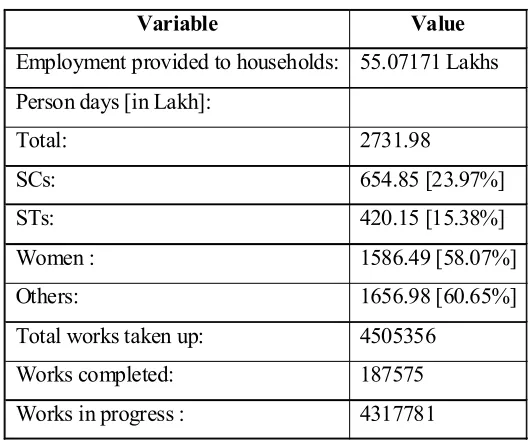
The following table shows the updated statistics on the work progress in the state of Andhra Pradesh. The table clearly shows that so far MGNREG Scheme provided benefit to 55.07 lakhs households with working days of 2731.98 lakhs. Out of total castes participated in MGNREG Scheme; the SC's contribution is high with a figure of 23.97% where as the STs contribution is situated at 15.38%. The total number of women worked for the scheme so far is 58.07%. This value clearly showing that the MGNREG Scheme especially benefited to the livelihood of women in the state of Andhra Pradesh. With the healthy contribution of women participation a total of 187575 works were completed and still the government is encouraging the people to participate for works of 43,17,781 which are still in progress.
Table 1
Variable Value
Employment provided to households: 55.07171 Lakhs
Person days [in Lakh]:
Total: 2731.98
SCs: 654.85 [23.97%]
STs: 420.15 [15.38%]
Women : 1586.49 [58.07%]
Others: 1656.98 [60.65%]
Total works taken up: 4505356
Works completed: 187575
Works in progress : 4317781
Source: Report of progress of AP under MGNREG Scheme
Problems for Women Labour Under MGNREGS
a)
Problems for women labour in participation of MGNREG Scheme
The field survey made with reference to the problems faced by the women labour in participation of the scheme and the important constraints recorded are given below.
Table 2
S.No. Operational problems Rating specified by the women labour High Medium Low Very low Nil
1. Delay in getting job card 78% 12% 6% 4% 0%
2. Delay in obtaining unemployment
allowances due to delay in job
92% 4% 4% 0% 0%
3. Misuse of job card by the others 12% 39% 43% 4% 2%
4. Delay in work payment 32% 49% 18% 1% 0%
5. Wage differences 21% 15% 59% 2% 3%
Source: Field survey
The above statistics are clearly showing that in 'delay in getting job card', 78?% of them have opined high which indicates that the problem is high for the women labour in getting job card. The problem of delay in obtaining unemployment allowances due to delay in job also rated as high with 92%. The misuse of job card by the others shows low percentage of 43%. 49% of the women labour given rating as 'medium' for the problem of delay in work payment. 59% of the women labour has given the rating as 'low' to the wage differences problem at work place. Overall, from the above results, it is clear that the important concerns are there for the problems including delaying obtaining unemployment allowances and delay in getting job card.
b) Problems of women labour at worksite
An attempt is made in order to provide the worksite constraints faced by the women labour at worksite of select regions. The findings are presented in the following table.
Table 3
S. No.
Operational problems Rating specified by the women labour High Medium Low Very low Nil
1. Lack of creche facility for children 98% 2% 0% 0% 0%
2. Lack of shading tents during rest period 46% 39% 13% 1% 1%
3. Ex-gratia payment for injury cases 87% 9% 4% 0% 0%
4. First aid kit 23% 49% 19% 8% 1%
5. Toiletry facilities 39% 42% 18% 1% 0%
The above table clearly shows that lack of creche facility for children was given 'high' rating with 98%. This indicates that majority of the women labour were not able to access the facilities of creche. 46% of them have given rating of 'high' for the shading tens offered at rest period. 87% of them given 'high' rating that they were not able to receive Ex-gratia payment for injury cases. 49% of the women gave rating of 'medium' regarding the facilities offered for first aid and one of the major problems clearly witnessed for women is the toiletry facilities. Together 81% of them have given rating of 'high' and medium which indicates that the problem is clearly evident for women labour with reference to participation under the scheme.
Comparative Analysis on Amenities for Women Labour
A comparative study is made with reference to the various issues related to women labour both for the MGNREG Scheme and as well as for the women labour working as agricultural labour in select villages of Warangal and Karimnagar Districts. The field survey results are presented in the following heads.
a) Comparative study on the facilities offered for women
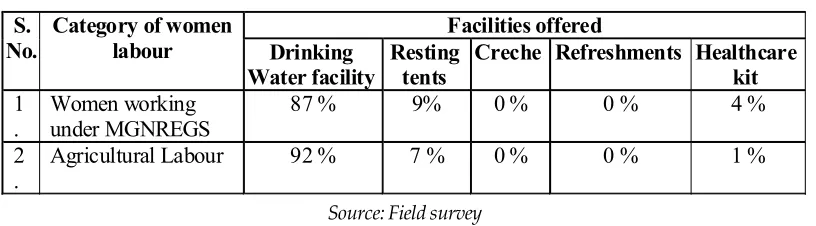
The following table gives a picture of field survey results with reference to the facilities offered to the women.
Table 4
S. No.
Category of women labour
Facilities offered Drinking
Water facility
Resting tents
Creche Refreshments Healthcare kit
1 .
Women working under MGNREGS
87 % 9% 0 % 0 % 4 %
2 .
Agricultural Labour 92 % 7 % 0 % 0 % 1 %
Source: Field survey
The above table clearly shows that the one of the major facilities offered for women working under MGNREGS is Drinking water facility. For the agricultural labour too, the major facilities offered is the 'drinking water facility'. It is observed that the resting tents are provided for very less percentage of working women. The facilities of crèche and refreshments at work place are completely zero percent. And the availability of health care kit at the work place is comparatively very less in both cases.
b) Transport facilities offered for women to the work place
Table 5
S. No.
Category of women labour
Facilities offered Transport facilities offered
to the work place
No transport facility offered to the work place
Total
1. Women working under MGNREGS
6 (07 %) 74 (93% ) 80 (100%)
2. Agricultural Labour 11 (14%) 69 (86%) 80 (100%)
Total 17 (11%) 143 (89% 160 (100%)
Source: field survey
From the above table it is clear that for 93% of women working under MGNREGS, the transport facilities are not offered to the work place. Where as 86% of the women are also opined that the transport facilities are not offered to the work place. Chi-square test is applied to determine the association between category of women labour and the facilities offered with reference to transportation. The chi-square(calculated) found is 1.64 which is less than the tabular of chi-square, i.e, 5.38. Hence it is to understand that there is no association between women labour working under both cases with the facilities offered at work place.
c) Factors contributed for joining in the scheme
Table 6
S. No.
Category of women labour
Factors contributed for joining in the scheme Lack of assets and resources Low level of skills Inability to get employment Social security Criticism as marginalized groups at other
work places
Total
1. Women
working under MGNREGS
16 (20%) 25
(31.25%) 32 (40%) 4 (5%) 3 (3.75%) 80 (100%)
2. Agricultural Labour
32 (40%) 19
(23.75%)
25 (31.25%) 6 (7.5%) 1
(1.25%)
80 (100%)
Total 48
(30%) 41 (51.25%) 57 (71.25%) 12 (15%) 5 (6.25%) 160 (100%)
in the opinion of women working for both cases and as well as to test whether there is a significant difference in the factors contributed for joining in the scheme. The test results are as follows.
Table 7
Test Results of ANOVA of Two-way classification
Source of
Variation SS Df MS F P-value F crit
Rows 0.9 1 0.9 0.020737 0.892461 7.708647
Columns 1145.6 4 286.4 6.599078 0.047394 6.388233
Error 173.6 4 43.4
Total 1320.1 9
The test results clearly show that there is no significant difference in the opinion of the women working for both MGNREGS and agricultural field. And there is a significant difference in the factors that have influenced the women to prefer to work.
d) Women problems about the work
The various problems faced related to work in both cases are presented below.
Table 8 S. No. Category of women labour
Problems of women regarding work Lack of awareness and skills Hardships in unskilled manual labour Lack of sensitivity treatment Discri- mination Extreme weather conditions Total
1. Women
working under MGNREGS 8 (10%) 31 (38.7%) 20 (25%) 15 (18.8%) 6 (7.5%) 80 (100%)
2. Agricultural Labour 14 (17.5%) 29 (36.25%) 5 (6.25%) 25 (31.25%) 7 (8.75%) 80 (100%)
Total 22
(13.75%) 60 (37.5%) 25 (15.62%) 40 (25%) 13 (8.12%) 160 (100%)
Source: Field survey
36.25% of them have also opined that hardships in unskilled manual labour is the major problem that they face while working in the agricultural field. Overall, the statistics are clearly showing that 'hardships in unskilled manual labour' and the 'discrimination' are the major problems that they are facing at the work place. One-way ANOVA is applied in order to determine whether there is a significant difference in the problems of women regarding work. The test results are as follows.
Table 9
One-way ANOVA results
Source of
Variation SS df MS F P-value F crit
Between Groups 679 4 169.75 4.637978 0.061661 5.192168
Within Groups 183 5 36.6
Total 862 9
The test results clearly shows that the Calculated value of F (4.637) is less than the Tabular value of F(5.192), hence it is to conclude that there is no significant difference in the problems of women regarding the work.
e) Problems of women with reference to children due to work
The perceptions of women labour under both cases were recorded with reference to the children due to working for the both cases including MGNREGS and agriculture labour.
Table No.10
S. No.
Category of women labour
Problems of women with reference to children due to work Unable to
concentrate on children education
Lack of crèches when working
Unawareness on child vaccine and health measures
Less time for feeding milk and (or) food
to child
Physical stressful work leading to
stress
1. Women working under MGNREGS
92% 72% 94% 93% 91%
2. Agricultural Labour 78% 69% 91% 90% 93%
Source: field survey
major problems opined by the majority of the women working under both cases are the 'less time for feeding milk and food to child, unawareness on child vaccine and health measures and physical stressful work leading to stress.
f) Perceptions of women labour on Gender equity
Table 11
S. No.
Category of women labour
Found different in approach Wage
pattern
Assignment of work
No. of working
hours
Equal opportunities
of work
Choice of preference
1. Women
working under MGNREGS
Yes (93%) No (07%)
Yes (61%) No (39%)
Yes (17%) No (83%)
Yes (09%) No (91%)
Yes (32%) No (68%)
2. Agricultural Labour
Yes (97%) No (03%)
Yes (49%) No (51%)
Yes (42%) No (58%)
Yes (11%) No (89%)
Yes (41%) No (59%)
Source: field survey
The above results clearly show the opinion of women labour with reference to Gender equity. Majority of the women labour both working for MGNREGS (93%) and Agricultural labour(97%) have opined 'yes' which indicate that there is a high difference in the wage pattern for men and women. When it comes to assignment of work, 61% of women working under MGNREGS and 49% of them have opined that there is a difference in the assignment of work for men and women. The number of working hours found less significant as majority of the women labour for both cases opined 'no'. When it comes to choice of preference the agricultural labour comparative getting benefit in preference of work comparing to the women labour working for MGNREG Scheme.
g) Study on benefits achieved by women labour
The survey results are presented below regarding the benefits achieved by the women labour working for both the cases.
engaged for. For timely wages, the women under MNGNREGS are comparatively better than the agricultural labour. The on field benefits are not existent for workers under MGNREGS. Where as 62% of the agricultural labour are getting benefits in terms of small portion of the agricultural yield given by the owners. Instant monetary help for sick cases is not provided for the women working under MGNREGS where as 41% of the agricultural labour are able to receive the monetary help for sick situations. 42% of the MGNREGS women labour and 69% of the agricultural labour are able to receive the timely information about the work. Overall, the benefits are clearly showing that the agricultural labour are comparatively getting more benefits than the women working under MGNREGS.
Table 12
S. No.
Category of women labour
Found different in approach
Travellin g fares Advance for the work Timely payment of wages On field benefits (including valued returns available sources) Instant monetary help for sick cases Timely information about the work 1 . Women working under MGNREGS Yes (07%) No (93%) Yes (2%) No (98%) Yes (79%) No (21%) Yes (2%) No (98%) Yes (8%) No (92%) Yes (42%) No (58%) 2 . Agricultural Labour Yes (22%) No (78%) Yes (59%) No (41%) Yes (42%) No (58%) Yes (62%) No (38%) Yes (41%) No (59%) Yes (69%) No (31%)
Source: Field survey
h) Comparative study on migrating to the other works
The field survey results were presented with reference to the women labour perception on migrating to the other works.
Table 13
S. No.
Category of women labour
Opinion on continuing in the present work Yes (Willing to
continue in the present work)
No (Not willing to continue in the present work and
prefer to migrate)
Total
1. Women working under MGNREGS
48 (60%) 32 (40%) 80 (100%)
2. Agricultural Labour 39 (48.7%) 41 (51.3%) 80 (100%)
Total 77 (48.12%) 73 (51.88%) 160 (100%)
Source: field survey
Findings & Suggestions
Ensuring the qualitative services of child care is one of the important measure that have to incorporated by the policy makers. The provision of crèches at work places will really give lot of faith and positive turn up by the women for doing work both under MGNREGs and in Agricultural field. Further, the enhance of skills are lacking in both the cases. Proper guidance about the basic education and support of training after the work hours will help to remove the stage of MGNREGS for 'Unskilled labour'. Most of the operations problems were still evident for women labour under MGNREGS. The delay in getting job card, delay in obtaining unemployment and wage payments will definitely disturb the women continuity in the scheme. Lack of operational facilities at the work place are also causing the problems for women labour. These include creche, lack of shading tents, first aid and toiletry facilities etc. The comparative analysis on the facilities offerd for both for MGNREGS women labour and women agricultural labour found that in both cases, majority of the facilities are not satisfied. Some of the important facilities include resting tents, drinking water, healthcare kit etc. For transportation facilities, in both the cases, the women are not able get the benefit. For majority of the women working under MGNREGS, inability to get employment encouraged to join in the scheme, further the low level of skills also encouraged for joining the work. For agricultural labour, lack of assets and resources, inability to get employment motivated them to work.
The comparative analysis on the difference in the benefits, it was observed that women labour for agriculture are getting comparatively more benefits than the women labour under MGNREGs. Most of the women labour under both cases have opined that they are not willing to migrate to the other works.
Hence from the survey it is to suggest that most of the common amenities were lacking in both for women labour working in agricultural field and as well as in MGNREGS. The awareness campaigns about the work, increasing the facilities at work place, immediate revision of existing wage rates, providing choice of works comparing to male workers, protection for sick and disabled women, ensuring timely delivery of wage and ensuring the gender equity in work will strengthen the women participation there by provide the objective of MGNREG scheme to achieve the success.
Conclusion
The NREGS has absolute potential to effectively stimulate the local development there by ensuring women empowerment. The scheme has undoubtedly supported to overcome from women's weak position in the labour market. The comparative study on women labour both under the scheme as well as in agricultural field, it was clearly observed that the problematic concerns in most of the cases are similar in nature. The wage pattern, structure of work pattern found to be different but the wage pattern shown clear difference in both the cases. Strengthening the supporting activities and increasing amenities for especially for women labour will really boost the government to ensure that the objective of increasing women contribution in the scheme will further move up to the next stage.
References
i. Neha Tiwari & Rajshree Upadhyay(2012), "Constraints faced by the women beneficiaries under Mahatma Gandhi National Rural Employment Guarantee Act(MGNREGA)", Studies on Home and Community Science, Vol. 6(2), KRE Publishers, online journal published in www.krepublishers.com
ii. Garg S(2008), "Economic impact of National Rural Employment Guarantee Programme on Women, Thesis published by Mahrana Pratap University of Agriculture and Technology, Udaipur.
iii. Hazarika, P.G.(2009), Promoting Women Empowerment and Gender Equality through the Right to Decent work: Implementation of National Rural Employme3nt Guarantee Programme(NREGP) in Assam State(India): A Case Study.
Websites
1. http://www.krepublishers.com/02-Journals/S-HCS/HCS-06-0-000-12-Web/HCS-06-2-000-12-Abst-PDF/S-HCS-06-2-099-12-186-Tiwari-N/S-HCS-06-2-099-12-186-Tiwari-N-Ab.pdf
2. www.nrega.ap.gov.in
3. www.nrega.net
4. www.rural.nic.in
5. www.indiastat.com