2019 International Conference on Artificial Intelligence and Computing Science (ICAICS 2019) ISBN: 978-1-60595-615-2
Topology Optimization of Typical Beam Structures Based
on Level Set Method
Wei-guang ZHENG, Shan-shan CHEN
*and Rong-jiang TANG
College of Mechanical and Electrical Engineering, Guilin University of Electronic Technology, Guangxi Guilin 541004, China
*Corresponding author
Keywords: Level set method, Minimum flexibility, Topology optimization.
Abstract. This paper takes the minimum flexibility of the structure as the objective function and the volume ratio of the solid material as the constraint condition to realize the topology optimization of the level set method. The radial basis function (RBF) can be used to interpolate discrete points into smooth curves, and the level set function can be used to implicitly describe the structure boundary. By designing the initial structure of the hole, it is obtained that the optimization result will be better if the hole is as wide as possible in the whole area. Through many experiments, it is proved that the restraint condition is that the remaining material volume ratio of 50% is more reasonable than other ratios. The effectiveness of the proposed method is verified by two classical examples of cantilever beam and simply supported beam. Comparing with the variable density method, the checkerboard format of gray level unit is eliminated, the smooth boundary is obtained, and the efficiency of hole nucleation is improved.
Introduction
Because of the obvious shortage of resources, rational and efficient use of resources has become the goal of many research fields, so structural optimization is more important in design. Nowadays, there are many applications of size, shape and topology optimization in structural optimization. Compared with size and shape optimization, topology optimization not only has a large design space, but also can distribute materials evenly in the design domain and achieve the optimal results according to the given constraints and load conditions. The methods of topology optimization of continuum structure include variable density method, homogenization method and level set method based on SIMP interpolation model. Variable density method was first proposed and used widely, but it has some shortcomings such as checkerboard mesh, gray level unit and so on. The homogenization method is to construct small structures by introducing a large number of variables into the number and size of holes to solve the problem, which results in too much calculation. The Level Set Method was first proposed by Osher and Stheian [1] to follow the frontier of curvature-dependent propagation. Then Sethian and Wiegmann [2] and Osher and Santosa [3] used the level set method in structural optimization. Wang and Wang [4] and Wang [5] introduced RBF into the level set method and developed an efficient topology optimization method. The linear combination of RBF and coefficients is used to decouple the level set function, which avoids the use of partial differential equation to solve the problem and reduces the computational complexity. The method can maintain relatively smooth level set function and improve the nucleation ability of materials in the optimization process. However, Gain and Paulino [6] suggest that this method may produce functions with fairly high absolute values in the level set and then cause convergence problems. In order to solve this problem, Wei P and Li Z [7] proposed an approximate re-initialization operation to prevent too much fluctuation due to the evolution of the level set method.
time, it is proved that putting holes all over the region as far as possible will lead to better topological results. Through many experiments, it is found that the restraint condition is that 50% of the remaining material volume is more reasonable than other proportions.
Level Set Method
The basic idea of the level set method is to embed the evolving curves and surfaces as zero level sets into the higher one-dimensional level set functions, and to obtain the evolution equation of closed hypercurves, and the closed curves and surfaces remain the set of zero level set cross sections of functions. The greatest advantage of the level set method is that it can accurately describe the changing characteristics of the moving boundary, and it is convenient to deal with geometric deformation [8]. The merging and disconnecting of the moving boundary is also suitable for any dimension space. In the level set method, the zero level set of the higher dimensional level set function (x, t) is embedded implicitly, which is usually defined as follows
ϕ , > 0 ∀ ∈ Ω\ Ω (1)
ϕ , = 0 ∀ ∈ Ω
ϕ , < 0 ∀ ∈ D\ Ω
Considering the level set x t corresponding to the level set function∅,then
∅ , = 0 (2)
The partial derivatives of time on both sides of equation (2) are obtained.
∅+ ∇∅ , = 0 (3)
Suppose V is the velocity in the outer normal direction.
∙ = (4) Among n = ∇∅/|∇∅|
Thus, the level set equation is obtained.
∅+ |∇∅| = 0 (5)
Topology Optimization Based on Level Set Method
Radial Basis Function
Radial basis function (RBF) is added to the level set method to reconstruct the scattered scalar data points and realize the evolution of final shape or topology. Its stability and smoothness can be combined with the level set method, which avoids the problem of mesh discretization and retains the advantage of implicit boundary description of the level set method.
Radial basis function is x, x" ∈ R$, x" is Center of a circle, it means The distance from x to x" is the radial radius. The function system formed by ‖x − x"‖satisfies k x = 0, Then ‖x − x"‖is the radial basis function. Its interpolation form is
() = (*+| − )|+,, )∈ - (6)
where || − )|| is the Eulerian distance on the domain of definition, and ) is the coordinate point position.
Normal Velocity
The boundary evolution of the level set method depends on the variation of the velocity field. The velocity function is
. ∅= |∇∅|
∅ , /, 0 = ∅" , / (7)
The normal velocity on the boundary is determined by strain energy density and Lagrange double integral. The gradient-based optimization method is used to solve the minimum flexibility problem in this paper.
Among them, is a Lagrange multiplier with volume constraints, E is an elastic matrix, and ε u is a strain.
Minimum Flexibility
Combined with the level set method, the level set model in this paper is described as the volume constraint under concentrated load.
45 6 7, ∅ = 8 9 ∅ : 7 ;: 7 <
s.t.∆ ∙ E ∅ σ = F (9)
G ∅ − 8 9 ∅ < ≤ BC
In the formula H ∅ is Heaviside function and its derivative delta δ ∅ is Diracdelta function.
H ∅ = F0 ∅ ≤ 01 ∅ > 0 , δ ∅ =< 9 ∅<∅
Numerical Example
Cantilever Beams
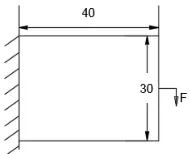
As shown in Figure 1, the total number of elements in the initial design domain of a cantilever beam is
N = nelx × nely = 40 × 30, Fixed the left-end boundary and applied a vertical downward
[image:3.612.259.354.397.474.2]concentrated force at the midpoint of the right-end boundary F = −100N, Elastic modulus of solid materials E = 2.06 × 10RPa, Poisson ratioμ = 0.3, Material densityρ = 7800kg/m[, The objective of the design is to minimize the flexibility of the structure under the constraint condition that the volume of the solid material of the structure does not exceed 50% of the volume of the design domain.
Figure 1. Cantilever beam model.
[image:3.612.164.448.516.585.2](a) (b) (c) (d)
Figure 2. Cantilever beam structure topology optimization process.
(a) (b) (c) (d)
Figure 3. SIMP method cantilever beam topology optimization process.
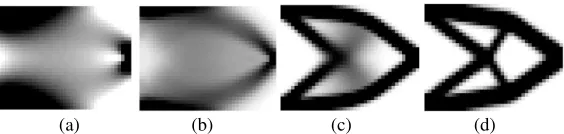
Figure 3 is the topology optimization process of density penalty method. It can be seen from the graph that there are gray units and checkerboard formats in the iteration process and the final results of density penalty method. Under the same constraints and structure conditions, the boundary obtained by the level set method is clearer and smoother than that obtained by the two methods.
(a)Step1 (b)Step110 (c)Step1 (d)Step145
[image:4.612.201.414.221.322.2](e)Step1 (f)Step260 (g)Step1 (h)Step102
Figure 4. Optimization of different opening conditions.
Level set method is essentially an evolutionary boundary algorithm. It can only move and merge holes through existing hole structures. Therefore, the initial structure design must give several holes in advance. If the initial structure gives too few holes, that is, the initial topology is too simple and the iteration step is too long, the final structure is not the simplest and optimal. It can be seen from this that the distribution of holes is as uniform as possible and the whole area is covered with holes. The number of holes should also be kept reasonable. It is not easy to have too many holes. The excessive holes affect the optimization efficiency. The size of holes has a proper proportion with the design area, so that the material area can fully realize the integration of holes to achieve the structural topology optimization.
[image:4.612.140.474.467.541.2]Vol:0.4 Vol:0.45 Vol:0.55 Vol:0.6
Figure 5. Topological optimization results with different volume constraints.
Figure 6. Objective function convergence graph and volume change curve.
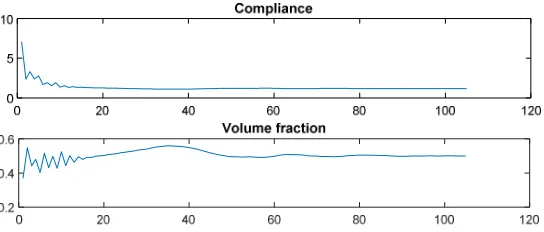
Figure 6 is a curve of minimum flexibility and volume convergence of the objective function of a cantilever beam. With the progress of topological optimization, the flexibility decreases rapidly from 7.11 at the beginning to 1.18 at the end, and the optimization stops to reach the optimal result of minimum flexibility. Before 15 steps, the iteration fluctuates greatly. The cusp of the material volume fluctuation is caused by the instability in numerical calculation. The volume fraction increases gradually from 0.37 to 0.56, then decreases to 0.50. There is no obvious fluctuation. Finally, the topology optimization is completed by 105 steps and converges to the 50% volume fraction of the structural material.
Summary
In this paper, the radial basis function (RBF) is introduced on the basis of the traditional level set. By using RBF, the scattered points can be re-assembled. Compared with the variable density method, the checkerboard format and gray level units can be eliminated. Because the defect of the level set method is that it cannot open the hole by itself, it is necessary to open the hole separately before optimization, and define the appropriate size of the hole. The number of holes should not be too much or too little, otherwise the size, location and number of holes will affect the final optimization results. Then the optimization results will be better if the holes are as wide as possible in the whole area.
In the design of minimum flexibility topology, the validity of this method is verified by a typical beam structure example, and the accuracy of this method is illustrated. Through many experiments, it is proved that the constraint condition of 50% of the volume of residual material is more reasonable than other proportions. The efficiency of nucleation of new holes is improved, and the final optimization results are suitable for practical engineering processing and application.
Acknowledgement
This research was financially supported by the National Natural Science Foundation of China (No. 51405093), and Natural Science Foundation of Guangxi (No. 2018GXNSFAA281276, 2018GXNSFBA281012), Key Laboratory Project of Guangxi Manufacturing System and Advanced Manufacturing Technology (17-259-05-010Z); Basic Competence Promotion Project for Young and Middle-aged Teachers in Guangxi Zhuang Autonomous Region in 2018(2018KY0205).
References
[1] Osher S., Sethian J.A. (1988) Fronts propagating with curvature-dependent speed: algorithms based on Hamilton Jacobi formulations. Comput Phys 79(1): 12–49.
[2] Sethian J.A., Wiegmann A. (2000) Structural boundary design via level set and immersed interface methods. Comput Phys 163(2): 489–528.
[4] Wang S.Y., Wang M.Y. (2006a) Radial basis functions and level set method for structural topology optimization. Int J Numer Meth Engng 65: 2060–2090.
[5] Wang S.Y., Lim K.M., Khoo B.C., Wang M.Y. (2007) An extended level set method for shape and topology optimization. Comput Phys 221(1): 395–421.
[6] Gain A.L., Paulino G.H. A critical comparative assessment of differential equation-driven methods for structural topology optimization. Springer-Verlag New York, Inc. 2013.
[7] Wei P., Li Z., Li X., et al. An 88-line MATLAB code for the parameterized level set method based topology optimization using radial basis functions. Structural & Multidisciplinary Optimization, 2018(1): 1-19.