© 2017 AJAST All rights reserved. www.ajast.net
POWER OPTIMIZATION IN OFDM NETWORKS USING VARIOUS PEAK TO
AVERAGE POWER RATIO TECHNIQUES
1Dr.V. NANDALAL and 2G.SELVAKUMAR
1ASSOCIATE PROFESSOR, 2ASSISTANT PROFESSOR, DEPARTMENT OF ECE, 1SKCET, 2SVSCE Email:1[email protected], 2[email protected]
Abstract-The increasing demand of ubiquitous multimedia service forces the future wireless communication for higher data rates to the dynamic wireless environment. Orthogonal Frequency-Division Multiplexing (OFDM) is the most common technique has received more attention due to its high spectral efficiency and its resistance to multipath fading in addition to high data rate and robust performance. Presence of large number of subcarriers leads to a large dynamic range with large Peak to Average Power Ratio (PAPR) in OFDM. High PAPR is the major limitation of OFDM in the present scenario. The present research work utilizes conic and convex optimization filtering techniques in customized formulations. The first proposed technique uses Standard Deviation based Iterative Clipping and Filtering (SD-ICF) to minimize PAPR. The filtering simply removes the out-of band spectral re-growth without considering the effect on the time domain peak after the IFFT operation. The main aspect of the SD-ICF approach is that, oversampling increases the resolution of the OFDM symbol giving a closer approximation to the band limited signal after filtering. As a result, it tends to cause sizable time-domain peaks, requiring clipping and filtering to be repeated many iterations before achieving the desired PAPR. The filter response is modified by exploiting convex optimization. As the PAPR is reduced to an optimized value, the effect of oversampling is also minimal. The second approach utilizes a Custom Optimized Iterative Adaptive Clipping and Filtering (COIACF) technique for PAPR reduction. COIACF minimizes PAPR to a desired level in less number of iterations. Moreover, COIACF include an Improved FFT-based method of constructing the linear system of equations, an improved update procedure to reduce the number of iterations. The proposed method shows a greater reduction in PAPR in lesser iterations with reduced out-of-band distortion and bit error rate. Here COIACF uses FFT to reduce the number of iterations. The third proposed Tone Reservation (TR) based technique utilizes the few unused OFDM subcarriers. There are unused subcarriers called Peak Reduction Carriers (PRCs) which are reserved to minimize the BER of the transmitted OFDM signal.TR method is combined with customized convex optimization minimizes the PAPR and BER at a lower computational cost. The performances of the three proposed techniques are evaluated at four different oversampling factors. It is observed from the simulation results that the proposed approaches provide significant reduction in PAPR and
BER when compared with conventional filtering techniques. The three key advantages of the proposed approaches are reduced PAPR and BER, lesser in band distortion and minimum out of band emission.
Keywords--- Orthogonal Frequency-Division
Multiplexing, wireless communication, Peak to Average Power Ratio (PAPR), Custom Optimized Iterative Adaptive Clipping and Filtering (COIACF), Tone Reservation
I. INTRODUCTION
A potential approach to accomplish high rate data transmission in a mobile environment [1] is Orthogonal Frequency Division Multiplexing (OFDM). Earlier, OFDM has been widely employed in digital audio and video broadcasting and Asymmetric Digital Subscriber Line (ADSL) modems as discussed in [2]. However, recently, OFDM systems have been actively deployed for fixed and mobile transmission. Wireless Local Area Network systems (WLANs) is the new generation system recognized on related WLAN standards as IEEE 802.11a (US), and HiperLAN/2 (Europe) [3].
A physical layer transmission rate upto 54 Mbps is carried by these systems for the physical layer implementation. Moreover, OFDM is being well thought-out for future broadband applications such as the Wireless Asynchronous Transfer Mode (ATM) and fourth generation transmission approaches. OFDM is a Multi-Carrier Modulation (MCM) scheme, in which corresponding several data streams are transmitted at the same time over a channel, with each transmitting only a small part of the total data rate were described in [4], [5]. A high-speed digital message can be separated into a large number of individual carrier waves using OFDM as discussed in [6]. The orthogonality ensures that the subcarriers being orthogonal to each other, permits the elimination of cross talk among co-channels.
limitation of present OFDM is the high PAPR and the reason for high PAPR is due to some signal values of OFDM much higher than the average value as discussed in [8].
The presence of High Power Amplifier (HPA) in a system with a transmitting power amplifier results in nonlinear distortions which subsequently creates intermodulation between different carriers with additional interference. The additional interference due to these distrotions leads to an increase in BER of the system. To avoid such non-linear distortions and to maintain a low BER, the amplifier has to operate in a linear region. However, such solution is not power competent and is therefore found inappropriate for wireless communications. Hence reduction of PAPR of transmitted signal as discussed in [2] is implemented. The traditional approaches have also been developed to minimize the PAPR result in a considerable loss of power efficiency. Iterative Clilpping and Filtering (ICF) are proposed to overcome the limitations of the conventional PAPR reduction approaches. It is observed to produce a considerable result. However, due to the clipping noise, this scheme undesirably degrades BER. The main drawback of repeated clipping and filtering method is its high complexity. Thus, the present research work aims to develop and improvise the ICF technique through efficient algorithm for PAPR reduction in OFDM.
II. RELATED WORK
In [9] described a Dummy Sequence Insertion (DSI) approach to reduce PAPR reduction. The balancing sequence and the grouping of the correlation sequence fit into the dummy sequence. The lowering of PAPR was evident using flipping technique along with DSI method and the PAPR threshold technique escalated the processing speed. The specified dummy sequence is inserted simply rather than other traditional partial transmit sequence and selected mapping methods. Hence, BER of the DSI method tends to self-govern the error in the dummy data sequence. Though DSI method is not better than the traditional PTS and block coding methods with respect to PAPR reduction, the DSI method has improved BER performance and is even more spectrally well-organized than the traditional block coding for PAPR reduction.
Mahmuda et al (2012) [10] introduced a new adaptive PAPR reduction scheme to reduce the PAPR of the OFDM signal can by lowering the value lower than a predefined threshold level. A conventional companding technique was also used to reduce the PAPR of the OFDM signal. For PAPR of the OFDM signal higher than any predefined level, one or more companding operations are required to lower PAPR to that predefined level and avoided companding if the signal’s PAPR is lower than the predefined level.
However, the trade-off between the improvement of the PAPR and BER can be optimized based on any specific application requirements.
In [11] suggested a two-step mechanism like Simple Amplitude Predistortion (SAP) algorithm furnished by Orthogonal Pilot Sequences (OPS) in a previous step providing a low-complex implementation which reduces the PAPR. The proposed OP-SOP approach excels the existing approach by reduction in PAPR owing to the advantages of orthogonal pilots with SAP algorithms. Moreover it is energy efficient hedged two aspects, transmitted energy and implementation energy. OP-SAP saves up to 57% of transmitted energy per predistorted symbol elated to SAP. Implementation energy needs extra cycles in processor which demand energy consumption where PAPR reduction techniques set forth additional computational complexity.
Singh et al (2012) [12] has compared efficient power reduction methods with less PAPR methods such as PTS, SLM and Iterative flipping and Original schemes. Though the proposed method offered a better PAPR resultant reduction than earlier methods yet more complex remained than the existing techniques.
In [13] formulated a novel idea to reduce PAPR values in OFDM systems by employing time-varying symbol block length of time-varying subcarrier named as Time-varying OFDM (TV-OFDM). PAPR is used as a measure to regulate both the symbol block length consequently. The standard algorithm was used to find out the symbol block length or subcarrier number followed by comparison of the results with traditional PAPR reduction methods. The simulation results showed that the time-varying modulation schemes can obviously reduce PAPR values of the OFDM system, whereas the Symbol Error Rate (SER) of time-invariant OFDM and TV-OFDM modulation ruins almost constant.
III. PROPOSED METHODOLOGY
The minimization of the PAPR with efficient clipping and filtering technique is focussed in this present research work to achieve significant results in terms of power reduction. The certain power reduction approaches proposed in this research work are:
3.1 Peak Power Reduction through Conic Optimized Standard Deviation Iterative Clipping and Filtering
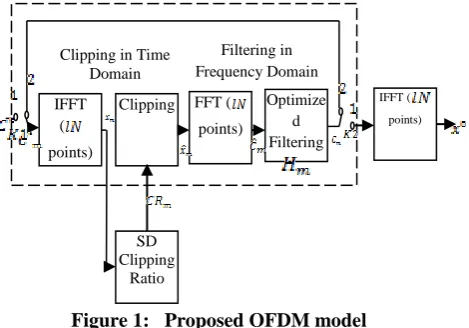
In Figure 1, c0 and x0 represent the original OFDM symbols in frequency-domain and time-domain,
respectively, where , ,
, , and m =
Figure 1: Proposed OFDM model
The two parameters associated to OFDM are PAPR and Error Vector Magnitude (EVM). The PAPR of the original time domain OFDM symbol, can be defined as
(1)
where and stands for the 2-norms and the respectively. k = 1, ..., is time index.
A single OFDM symbols EVM is defined as
(2) (2)
Clearly, a larger EVM value corresponds to larger distortion of the OFDM signal and reduced Bit Error Rate (BER) performance as discussed in Devlin et al (2008) [14].
3.3.1. Optimization Formulation
Convex optimization refers to the minimization of a convex objective function subject to convex constraints as discussed in [14]. Convex optimization approaches are essential in engineering applications as a local optimum is also taken as a global optimum in a convex problem and an exact optimality state and a duality theory exist to validate the optimal solution. Subsequently, when a design problem is formulated into a convex form, the model of the optimal solution, which often reveals design insights, can often be recognized.
Further, powerful numerical algorithms exist to solve for the optimal solution of convex problems efficiently. The interior-point method [15] and conic optimization [16] are the notable examples over the last two decades.
Convex optimization provides a powerful set of tools for the design and analysis of communication systems and signal processing algorithms. Convex optimization techniques are useful both in obtaining structural insights to the optimal solution, as well as in providing provably optimal numerical solutions to the problem efficiently. Thus, this research work utilizes
the above convex optimization formulation for solving the PAPR reduction problem in OFDM. The optimization formulation is integrated with clipping and filtering method.
3.3.2 Standard Interior Point Method
Interior point methods (also referred to as barrier methods) are a certain class of algorithms to solve linear and nonlinear convex optimization problems [17]. Von Neumann suggested a new method of linear programming, using the homogeneous linear system. The method consists of a self-concordant barrier function used to encode the convex set. Contrary to the simplex method, it reaches an optimal solution by traversing the interior of the feasible region.
But, the computational complexity in standard interior point method is higher in the worst case. However, the design based on customized interior-point method (CIPM) for SOCP model can significantly reduce the computation complexity. Thus, this work uses CIPM. CIPM has been proposed to make the optimization problem unconstrained; this is key to defining the forward and inverse dynamics in a consistent way. The resulting model has a parameter which sets the amount of contact smoothing, facilitating continuation methods for optimization.
3.3.3 Proposed Methodology
The high PAPR is reduced using optimized Standard Deviation based Iterative Clipping and Filtering (SD-ICF) has been proposed. The proposed method achieves a greater reduction in PAPR in a few iterations with reduced out-of-band distortion and bit error rate when compared over classical clipping techniques. Also, the effects of oversampling on the performance of proposed OFDM system is discussed. More specifically, the clipping procedure is performed by
(3)
is clipping level. Here
= mean ( ) + (σ * standard deviation ( )) σ sigma factor
CR represents the clipping ratio.
(4)
In classic Iterative Clipping and Filtering (ICF) method [18], the filtering uses a rectangular window with frequency response
(5) The filtering step simply removes the out-of band spectral re-growth without considering the effect Clipping FFT (
points)
IFFT (
points) Optimize
d Filtering
( )
SD Clipping
Ratio IFFT
(
points)
Clipping in Time Domain
A
Calculate clipping level, mean ( )+(
= clip(Xm)
=FFT ( ,lN)
Filter using optimized Hm Cm=Hm.
m=m+1
Set switch, to position 1 and iteration count, m=1
Get the first OFDM symbol, c0
Set s=s+1
Set switches, K1 and K2 to position 2
position 2
If m=1
B
=cm-1 Zero pad
B Start
Yes No
Clipping ratio, CR Maximum iteration, M
Symbol count, s Oversampling factor, l Number of subcarriers, N
=IFFT ( ,lN) C
on the time domain peak after the IFFT operation. As a result, it tends to cause sizable time-domain peaks, requiring clipping and filtering to be repeated many iterations before achieving the desired PAPR. The filter response is modified in the SD-ICF method by exploiting convex optimization. The filter minimizes the current OFDM symbols EVM subject to the reduced PAPR. For each iteration of the filtering of ICF, a conical filter is chosen that minimizes the current OFDM symbols EVM subject to the reduced PAPR. This new conical filter will replace the rectangular filter in the classic ICF method. However, the ICF technique, when implemented with a fixed rectangular window in the frequency-domain, requires much iteration to approach specified PAPR threshold in the complementary cumulative distribution function (CCDF). This work exploits the convexity optimization formulation. The general representation of the convexity condition is discussed below.
Condition for convexity:
f (ax + by) ≤ a f(x) + b f(y) (6) (6) General form of optimization problem
Minimize f(x) (objective function)
Subject to g(x) ≤ b (constraint function) (7)
(7)
where x represents the optimization variable and the vector x* represents an optimal solution if it has the smallest objective value between all the vectors that convince the constraints. The conical filter is designed in convex form which is formulated as follows [19]:
(8)
(9) (9)
(10) (10)
where
(11)
where matrix A consists of the first N columns of lN-IFFT inverse fast Fourier transforms twiddle factor matrix. is a in-band component, is a optimization filter, Tm is the clipping level in the m-th iteration. Thus, Amstrong filter is replaced by the conical filter.
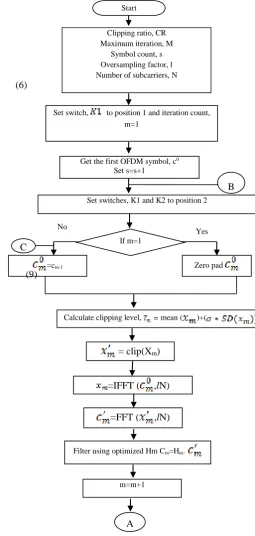
The flowchart of the SD-ICF is shown in Figure 2. In the beginning, the CR, maximum iteration and the symbol count are initialized. Then, the switch k1 is positioned to 1 and the iteration count is increased to m=1. OFDM symbol c0 is obtained and processed. Now, the switches K1 and K2 are moved to position 2. Now, if m is equal to one, zero padding of the mth iterated frequency domain OFDM signal, takes place, else becomes equivalent to cm-1. Inverse Fast Fourier
Figure 2 Flowchart of the proposed SD-ICF approach
3.2 PAPR Reduction of OFDM Signal Via Custom Conic Optimized Iterative Adaptive Clipping And Filtering
In this chapter, a novel Custom Conic Optimized Iterative Adaptive Clipping and Filtering (COIACF) is proposed to reduce the PAPR of OFDM signals with low complexity. COIACF is an approach that minimizes PAPR to the desired level in less number of iterations. Since amplitude clipping of the time domain OFDM signal causes in-band and out-band distortion, filtering is carried out in the frequency domain to null the out-of-band frequency components. This process is repeated several times to attain the pre-determined PAPR level leading to many iterations. Customized Convex Optimization (CCO) balances the tradeoff between PAPR and the distortion. Threshold based clipping along with CCO are analyzed for PAPR reduction. The experimental analysis has been carried out for the proposed work. The performance of the proposed COIACF approach has been compared with SD-ICF approach.
3.2.1 Customized Conic Optimized Iterative Adaptive Clipping And Filtering
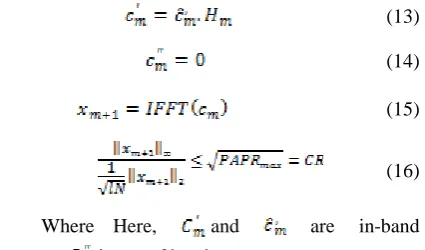
Conic optimization is the minimization of a convex objective function subject to convex constraints. Convex cones are the essential factors involved in conic optimization [20]. A local optimum in convex problem is also a global optimum. Convex Optimization is used widely in design and analysis of communication systems as discussed in [21]. In the proposed method, the filter response is modified by convex optimization as described in [22]; [23]. The filter minimizes the present OFDM symbol’s EVM correspond to the preferred . The filter design is as follows
(12)
Subject to
(13)
(14)
(15)
(16)
Where Here, and are in-band
component, is out-of band components.
The above Equation (4.5) is non-convex, but in order to convert it to a convex function, a reformulation process is performed using the Equations (3.16-3.19) from the previous chapter.
Let be the ideal OFDM constellation, and let
the modified constellation be where
is to be determined. The time-domain signal is calculated from c using an l-times oversampled IFFT. A PAR reduction algorithm should oversample the time-domain signal by to obtain an accurate estimate of the continuous-time peak power as discussed in [24]. Otherwise, the subsequent digital-to-analog conversion tends to regenerate the signal peaks as discussed in [25]. The convex optimization problem to find the OFDM waveform with minimum PAPR is given based on [26].
(17))
In variables
The optimization objective is to minimize the time-domain peak p. The second-last constraint bounds the constellation error, where is a parameter that is proportional to the allowed EVM as discussed in [27]. The diagonal matrix includes only the data carriers in the EVM calculation, where
(18)
The symbol specifies the real part, and is the complex vector inner-product defined by
(19)
This work mainly utilizes the Equation (17) for the convex formulation in developing the COIACF algorithm.
If m>M C
If s<S
Set switch, K2 to position 1
Get the processed OFDM signal,
c
0Stop
B A
No
Yes Yes
3.2.2 Customized Conic Optimized IACF Algorithm (COIACF)
Aggarwal & Teresa (2005) [26] proposed a customized IPM that exploits to improve efficiency of IPM. The main benefits of this algorithm over a generic solver is the integration of a fast FFT-based method for generating the linear system of equations and an improved update procedure to reduce the number of iterations.
Initialization: The algorithm initiates by choosing strictly feasible solution to Equation (17). The original constellation is feasible, so, Δ = 0. However, the algorithm will converge faster if the initial point is closer to the optimal solution. Many initialization strategies are possible, and simple PAPR reduction techniques such as clipping can even be used. Initialize the deviation and the Peak, as
discussed in [26].
-times oversampled IFFT. is a constellation error parameter
Step 1: The slacks are computed for each constraint in Equation (21)
(21)
is the complex vector inner-product. All slacks mustbe positive, otherwise the current iterate is not strictly feasible as discussed in Aggarwal & Teresa (2005).
Step 2: The components of vector ,
for are evaluated.
(22)
Step 3: Evaluate IFFT of the components of vector.
Step 4: The following linear system of equations are computed to formulate a search direction .
(23)
where , and are constructed
directly from the components of , and .
Let be the vector
(24) Let be the right circulant toeplitz matrix with top row
(25)
And let be the left circulant
hanlex matrix with top row
(26)
From by choosing the n rows of whose indices correspond to the carriers being optimized. and are formed by selecting the rows and columns of and whose indices correspond to the carriers being optimized [26]. For example, if and are optimizing the carriers
then and
Step 5: Let Compute oversampled IFFT of the Step 6: Take a step of length 0 by updating Peak ‘p’.
(28)
where as in [26]. The maximum step size
is calculated by setting the constraint slacks to zero.
Step 7: The process is repeated from step 1 till the gap is small enough or maximum number of iterations has been reached.
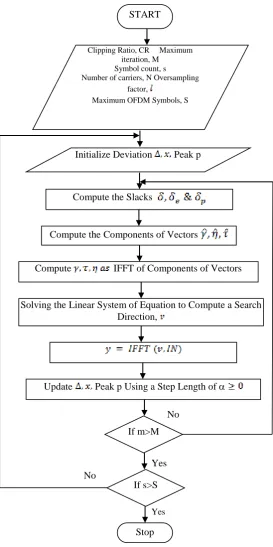
Figure 4.1 shows the process flow diagram of Custom Optimized IACF method. The Customized Interior Point Method (CIPM) contains simple steps such as initialization, computing search direction which involves solving the equations using Newton’s method, updating, iterating till the gap is below the specified value. Thus there is more complexity reduction when compared to the standard interior point method. CIPM is used to design a specific structure of FFT to improve the efficiency of the system. The main advantage of this algorithm over a generic solver is that it includes a FFT based method of constructing the linear system of equations, an improved update procedure is used to reduce the number of iterations, and the elimination of all control (if/then) statements. Thus, an improved filter
(27)
(2
(27)
START
Clipping Ratio, CR Maximum iteration, M Symbol count, s Number of carriers, N Oversampling
factor,
Maximum OFDM Symbols, S
Initialize Deviation Peak p
Compute the Slacks
Compute the Components of Vectors
Compute IFFT of Components of Vectors
Solving the Linear System of Equation to Compute a Search Direction,
Update Peak p Using a Step Length of
If m>M
If s>S
Stop Yes Yes No
No
response is formulated based on the customized conic optimization.
Figure 3 Custom optimized IACF method
3.3 Custom Optimized Tone Reservation Technique for Power Reduction in OFDM
Several researches have been carried out in ICF to provide a significant solution to PAPR issue in OFDM. The previous chapter discussed COIACF technique to customize the filter response in IACF procedure by exploiting the custom conic optimization.
The tone reservation algorithm is proposed for compensating the nonlinear effects of the transmitter amplifiers in OFDM systems as mentioned in [28]. In
this approach, some in-band distortion is allowed to more effectively compensate the effects of the clipping. The combined impact of these distortions along with that of noise on the capacity of system is also considered. Based on these trade-offs, in the cases where they receive noise power is unknown at the transmitter (as well as for high SNRs), the Signal-to-Distortion Ratio (SDR) is a good criterion for designing reserved tones which is closely related to the BER performance. To optimize SDR value, the optimization problem has to be converted into a convex problem. Thus, a barrier-method solution for the convex optimization problem can be developed.
3.3.1 Customized Convex Optimization
The OFDM signal is generated and the QPSK modulation is performed. IFFT converts the frequency domain information back to the time domain and the TR technique is applied. Then, again the information is converted back to frequency domain using FFT. The signal is demodulated so that the original signal is obtained and the Complementary Cumulative Distribution Function (CCDF) characteristics are plotted.
The Tone Reservation method is redeveloped as a convex optimization problem in which the goal is to minimize the Squared Crest Factor. The assumption is that the transmitter’s high power amplifier has fixed level hard clipping and the objective is to decrease the peak of signal magnitudes to become smaller than this fixed level. Interestingly, the proposed algorithm results in smaller PAPR, however optimizing SDR criterion results in an enhanced BER performance for the same transmit power. The proposed method can be easily correlated with other existing techniques such as Precoding for improving the error rate performance. This proposed method does not take advantage of the frequency selectivity multipath fading.
Convex minimization is a subfield of optimization, which is employed for the problem of minimizing convex functions over convex sets. Convex Optimization is used commonly in the estimation of signals, communication and networking and for designing electronic circuits.
Figure 4 Flowchart for customized convex optimization
IV. RESULTS AND DISCUSSION
A 256 sub-carrier OFDM system with QPSK modulation a n d over-sampling factor, is considered fo r simulation. The convex optimization problem presented is solved using the public software CVX as discussed in Grant & Boyd (2008) [29].
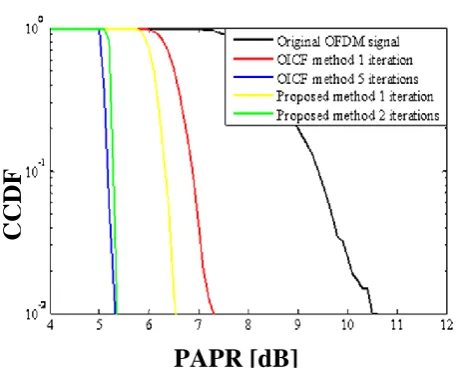
Figure 5 (a) plots the Complementary Cumulative Distribution Function (CCDFs) versus PAPR for SD-ICF method and existing Optimized Iterative Clipping and Filtering (OICF) method (for 1, 5 iterations) as discussed in [29]. Similarly, OFDM signals using the SD-ICF method has been achieved (for 1, 2 iterations) involving filter optimization. For both ICF methods, the desired PAPR is set to 5dB. From the Figure 5, it is clearly observed that Optimized Iterative Clipping and Filtering approach and the improved optimized SD-ICF method significantly reduces the PAPR while simultaneously
achieving a comparable sharp drop in their CCDFs. However, for the improved optimized SD-ICF method, the PAPR is reduced 5.4 dB at a probability of 10-2 after only two iterations. On the other hand, OICF method requires more number of iterations to achieve these same levels of PAPR reduction. Thus, the improved optimized SD-ICF method requires less
iteration to attain the desired PAPR.
Figure 5 (b) plots the bit error rate curves for the original OFDM signal, OICF method (for 5 iterations) and proposed method (for 1 iteration) through an AWGN channel. Even after the 5 iterations, the proposed approach is expected to produce significant results. Even then, the iterations taken for the proposed approach would probably be half the number of iterations of the OICF approach. Figure 5 (c) shows the BER evaluation of the proposed approach in Rayleigh Fading Channel. It is clearly observed that, BER of the proposed appraoch in Rayleigh Fading Channel is slightly higher when compared with AWGN channel. The two BER curves corresponding to modified symbols are located to the right of the original signal curve because the clipping procedure causes signal distortion. Comparing the two BER curves, it is observed that the signal distortion of the improved optimized SD-ICF method i s better than that of OICF method. Finally, the clipped signals are passed through a solid-state p o w e r amplifier (SSPA), wh i c h is modeled by
(29)
where is the input signal, is the
output of SSPA, G represents the gain of SSPA and represents the output of saturation point. represents the “knee factor” that controls the smoothness of the transition from the linear region to the saturation region of characteristic curve (a typical value of p is 1).
(a) PAPR Statistics for an OFDM system
CCDF
PAPR [dB]
Generating of OFDM Signal
Performing Modulation
Creating Rayleigh Multipath channel
Inserting Delays
Adding pilot symbols
Generation of phase factor matrix
Computation of PAPR to both input and new OFDM signal
Plot PAPR Characteristics
Demodulate the signal Demodulating the received signal
(b) BER comparison for OICF method and proposed method in AWGN
(c) BER comparison for OICF method and proposed method in Rayleigh Fading Channel
Figure 5 Performance evaluation of SD-ICF approach
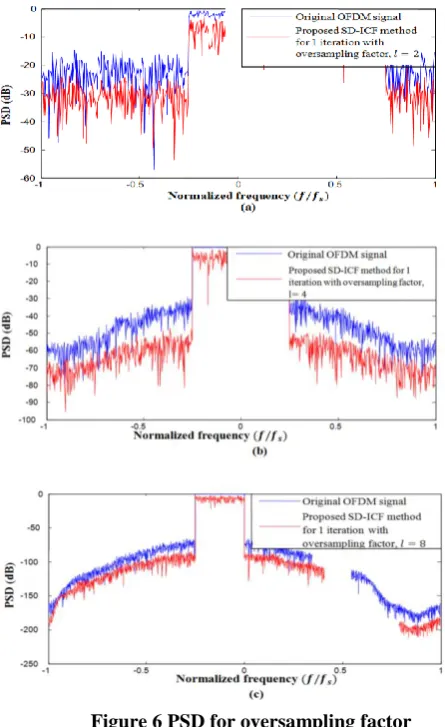
Oversampling the data i n IFFT increases the resolution o f the OFDM symbol giving a closer approximation to the band limited signal after filtering. In the proposed SD-ICF technique, the reduction in PAPR is of optimized value. Hence, oversampling has minimal effect on the PAPR. The comparison of the out of band radiation (PSD) curve that compares the original OFDM signal with the proposed method for different oversampling factor are shown below in Figure 6 (a, b and c) and the values of normalized f r e q u e n c y = 0.4, 0.6 and 0.8 are tabulated in Table 1 . The results s ho w that the out-of-band radiation is greatly attenuated and peak re-growth after filtering is reduced by the influence of oversampling. There is improvement in the out-of-band radiation as the oversampling f a c t o r is increased.
Figure 6 PSD for oversampling factor (a) l=2, (b) l=4, (c) l=8
Figure 7 depicts the BER plot for the proposed technique f o r various oversampling f a c t o r , = 2,4,8. Thus, the results show that oversampling factor is enough to have the same performance compared to a n infinite oversampled s i g n a l . The effect of oversampling order on the BER level is evaluated. The oversampled approach has the advantages of reducing in band distortion and peak reform to some extent. So, oversampling is necessary. If clipping is performed for the sufficiently-oversampled OFDM signals (e.g., L ≥4) in the discrete-time domain before a low-pass filter (LPF) and the signal passes through a band-pass filter (BPF), the BER performance will be less degraded. It is clearly observed that, when , BER will be higher than case of applying . But, the BER results of and are almost same. Thus, it is inferred that, the least BER results are obtained with oversampling factor of .
B
it
E
rr
o
r
Ra
te
(B
E
R)
Figure 7 BER plot for oversampling factor, l=1, 2, 4, 8
Performance Measure
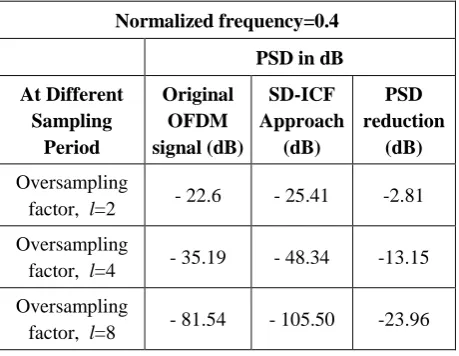
The performance of the proposed approach is measured at various oversampling factors such as, = 2, 4 and 8. It is clearly observed from the Table 3.1 that the performance of the SD-ICF approach is significant. The difference in the PSD reduction between the SD-ICF approach and original OFDM signal is evaluated. It is observed from the table that the difference in PSD reduction of the original and the SDICF approach is -2.81 dB for . Similarly, for other oversampling factors, the difference in PSD reduction of the SD-ICF approach is observed to be significant.
Table 1 shows the PSD of the proposed SD-ICF approach and original OFDM signal at various oversampling factors, = 2, 4 and 8 at normalized frequency (f/fs) at 0.4. The PSD difference between
original OFDM signal and SD-ICF approach is
calculated.
Table 1 Performance PSD evaluation of proposed approach at normalized frequency =0.4
Normalized frequency=0.4
PSD in dB At Different
Sampling Period
Original OFDM signal (dB)
SD-ICF Approach
(dB)
PSD reduction
(dB) Oversampling
factor, l=2 - 22.6 - 25.41 -2.81 Oversampling
factor, l=4 - 35.19 - 48.34 -13.15 Oversampling
factor, l=8 - 81.54 - 105.50 -23.96 Figure 8 shows the graphical comparison at normalized frequency, 0.4. It is clearly observed from the figure that the Proposed SD-ICF approach performs better at various over sampling factors. Table 2 shows the PSD comparison of the original OFDM signal and the proposed approach at normalized frequency, 0.6. The PSD difference obtained between the original signal and the proposed SD-ICF is evaluated. It is to be observed that, the proposed SD-ICF approach performs
well at various oversampling factors. This is clearly shown in Figure 3.10 as a graphical representation.
Figure 8 Comparison of proposed approach at normalized frequency=0.4
Table2Performance evaluation of proposed approach at normalized frequency =0.6
Normalized frequency=0.6 PSD in dB
At Different Sampling Period
Original OFDM signal (dB)
SD-ICF Approach
(dB)
PSD reduction
(dB) Oversampling factor,
l=2 - 26.93 - 32.51 -5.58
Oversampling factor,
l=4 - 48.93 - 55.16 -6.23
Oversampling factor,
l=8 - 91.96 - 109.40 -17.44
Figure 9 Comparison of proposed approach at normalized frequency=0.6
Table 3 shows the PSD comparison between the proposed SD-ICF approach and the original OFDM signal at normalized frequency, 0.8. When compared with normalized frequency, 0.4 and 0.6, the performance of proposed SD-ICF is observed to be significant at normalized frequency 0.8.
Table 3 Performance Evaluation of proposed approach at Normalized frequency=0.8
Normalized frequency=0.8 PSD in dB
At Different Sampling Period
Original OFDM signal (dB)
SD-ICF Approach
(dB)
PSD reduction
(dB) Oversampling
factor, l=2 - 27.96 - 34.34 -6.38 Oversampling
factor, l=4 - 55.95 - 60.34 -4.36 Oversampling
factor, l=8 - 114.5 - 164.55 -50.05 Figure 10 shows the graphical comparison of the PSD obtained for different oversampling factors at normalized frequency, 0.8. It is clearly observed from the figure that the SD-ICF approach performs well at various over sampling factors.
Figure 10 Comparison of proposed approach at normalized frequency=0.8
PERFORMANCE EVALUATION
Figure 11 clearly shows the BER plot with the oversampling factor, l=4 is sufficient to obtain a better BER performance.
-5 0 5 10
10-4 10-3 10-2 10-1 100
SNR(dB)
B
E
R
COIACF with l=1 COIACF with l=2 COIACF with l=4 COIACF with l=8
Figure 11 BER plot for COIACF with oversampling factor l = 1, 2, 4 and 8
The performance of the proposed approach is measured at various oversampling factors such as, l = 1, 2, 4 and 8. Table 4.2 shows the PSD of the proposed COIACF approach and SD-ICF approach at various oversampling factors, l = 1, 2, 4 and 8 at normalized frequency at 0.4. The PSD difference between original OFDM signal and SD-ICF approach is calculated.
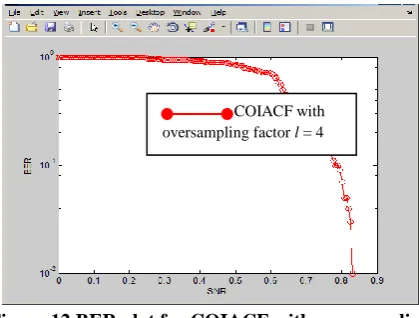
Similarly, the PSD difference between original signal and the proposed COIACF approach is also evaluated. Similarly, figure 11 shows the BER evaluation of the proposed COIACF approach at l = 4 for Rayleigh Fading Channel. It is observed from the graph that, BER performance of the Rayleigh Fading Channel is comparatively less significant when compared with AWGN channel. This is due to the larger distortions in the Rayleigh Fading Channel.
Figure 12 BER plot for COIACF with oversampling factor l = 4 in Rayleigh Fading Channel
It is clearly observed from the Table 4 that the performances of the proposed COIACF approach. The difference in the PSD reduction of the proposed COIACF approach and the SD-ICF approach is evaluated. It is observed from the table that the difference in PSD reduction of the original and the existing SD-ICF approach is -2.81 dB for l=2, but the difference in PSD reduction of the original and the proposed COIACF approach is observed to -15.3 dB. Similarly, for other oversampling factors, the difference in PSD reduction of the proposed COIACF approach is observed to be lesser when compared with SD-ICF approach.
Table 4 Performance PSD evaluation of proposed approach at normalized frequency=0.4
Normalized frequency=0.4
Oversampl ing factors,
Origin al OFD
M signal
(dB) SD-ICF (dB)
COIAC F (dB)
PSD Reducti
on Among Original and
SD-ICF (dB)
PSD Reducti
on Among Original
and COIAC
F (dB) l=2 - 22.6 - 25.41 - 37.9 -2.81 -15.3 l=4 - 35.19 - 48.34 - 94.8 -13.15 -59.61 l=8 - 81.54 -
105.50 - 192.7 -23.96 -111.16
Figure 13 shows the graphical comparison of the PSD obtained for different oversampling factors at
normalized frequency, 0.4. It is clearly observed from the figure that the Proposed COIACF approach performs better when compared with the Existing SD-ICF approach at various over sampling factors.
Figure 13 Comparison of proposed approach at Normalized frequency=0.4
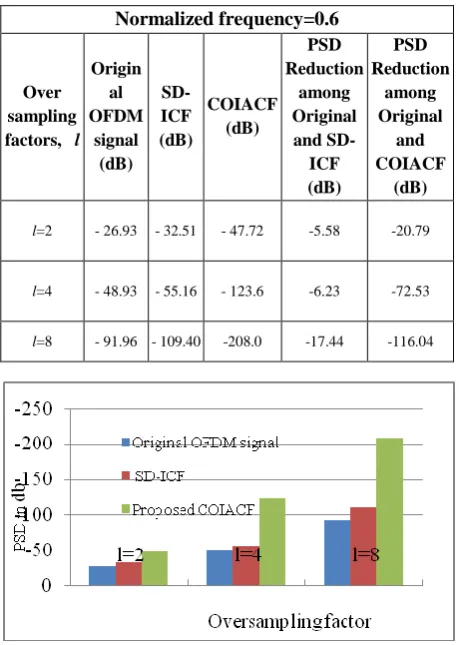
Table 5 shows the PSD comparison of the existing and the proposed approach at normalized frequency, 0.6. The PSD difference obtain between the original signal and existing SD-ICF is observed to be higher when compared with the PSD difference between original and proposed COIACF approach. Hence, it is to be noted that, the proposed COIACF approach performs better when compared with the existing SD-ICF approach. This is clearly shown in Figure 4.13 as a graphical representation.
Table 5 Performance evaluation of proposed approach at normalized frequency=0.6
Normalized frequency=0.6
Over sampling factors, l
Origin al OFDM
signal (dB)
SD-ICF (dB)
COIACF (dB)
PSD Reduction
among Original and
SD-ICF (dB)
PSD Reduction
among Original
and COIACF
(dB)
l=2 - 26.93 - 32.51 - 47.72 -5.58 -20.79
l=4 - 48.93 - 55.16 - 123.6 -6.23 -72.53
l=8 - 91.96 - 109.40 -208.0 -17.44 -116.04
Figure 14 Comparison of proposed approach at Normalized frequency=0.6
Table 6 shows the PSD comparison of the existing SD-ICF approach with the proposed COIACF approach at normalized frequency, 0.8. When compared with normalized frequency, 0.4 and 0.6, the performance of COIACF is observed to be significant at normalized frequency 0.8. When oversampling factor is 8, the PSD reduction difference attained between the original and the existing approach is -50.05 dB, where as the PSD reduction difference attained between the original and the proposed COIACF approach is -118.6 dB. Similarly, for other oversampling factors, the performance of the proposed approach is better than the existing work.
Table 6 Performance evaluation of proposed approach at normalized frequency=0.8
Normalized frequency=0.8
Oversampling factors, l
Original OFDM
signal (dB)
SD-ICF (dB)
COIACF (dB)
PSD Reduction
among Original and
SD-ICF (dB)
PSD reduction
among Original
and COIACF
(dB)
l=2 - 27.96 - 34.34 - 49.86 -6.38 -21.9
l=4 - 55.95 - 60.34 - 132.1 -4.39 -76.15
l=8 - 114.5 - 164.5 - 233.1 -50.05 -118.6
Figure 15 shows the graphical comparison of the PSD obtained for different oversampling factors at normalized frequency, 0.8. It is clearly observed from the figure that the proposed COIACF approach performs better when compared with the existing SD-ICF approach at various over sampling factors.
Figure 15 Comparison of proposed approach at Normalized frequency=0.8
The performance of the proposed approach is measured at various oversampling factors such as, = 2, 4 and 8. Table 7 shows the PAPR of the proposed Tone Reservation Customized Convex Optimization
(TRCCO) approach at various sampling
rates, . The performance is evaluated for
Table 7 PAPR performance for different sampling rate and different subcarriers
Sampling Rate No of Subcarriers
PAPR of TRCCO (dB)
128 3.984
256 4.342
128 4.01
256 4.346
128 4.019
256 4.363
Figure 16 show the graphical comparison of CCDF vs PAPR for TR and Differential Scaling techniques. The performance of PAPR is observed to be better in differential scaling approach when compared to TR approach.
Figure 16 CCDF vs. PAPR evaluation Figure 17 represents a general OFDM signal and a Custom Convex Optimized OFDM signal. From the Figure 17, it is clear that the PAPR is reduced while applying customized convex optimization. The PAPR is about 10.9 dB without the optimization approach and when CCO technique is applied, it reduces to 5.7 dB. Thus, there is a reduction of 5.2 dB in the proposed TRCCO approach.
Figure 17 PAPR comparison of original OFDM signal and custom convex optimized OFDM Signal
Figure 18 shows the PAPR reduction performance comparison of TR with Customized Convex Optimization (TRCCO) technique, TR approach and differential scaling approach. From the Figure 18, it is clear that after applying the customized convex optimization in the tone reserved signal, the
PAPR gets reduced considerably when compared with the TR and differential scaling techniques.
Figure 18 PAPR reduction comparisons Figure 19 shows the Power Spectral Density (PSD) comparison of the original OFDM signal with the proposed Tone Reservation Convex Optimization (TRCO) signal. From the Figure 19, it is clearly observed that the PSD is reduced in TRCO technique with respect to frequency. This shows that the Out of band radiation is minimized in the proposed TRCO technique.
Figure 19 PSD plot for the proposed TRCO technique
Figure 20 shows the comparison of PAPR reduction of the proposed TRCCO approach with TR and differential scaling approaches for various CCDF. It is observed from the figure that the proposed TRCCO approach attains lesser PAPR when compared with TR and differential scaling approaches for all CCDF taken for consideration.
0 1 2 3 4 5
0.3 0.25 0.2 0.15 0.1 0.05 0
P
AP
R
(
dB
)
CCDF Differential Scaling Tone Reservation approach Tone Reservation with CCO
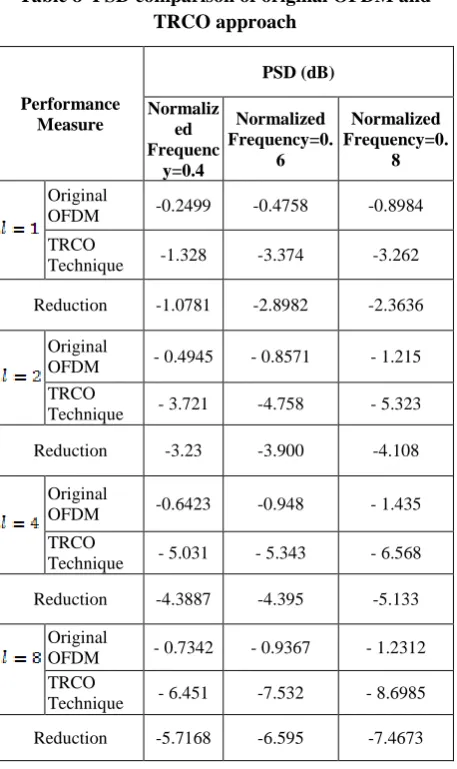
Table 8 shows the PSD comparison of the original OFDM signal with the TRCO OFDM signal at different normalized frequencies for . It is observed from the figure that TRCO approach shows lesser PSD for all the oversampling periods taken into consideration. For instance, at normalized frequency =0.4, the PSD of the original OFDM signal for is -0.7342 dB, where as PSD of the proposed TRCO approach is observed to be- 6.451dB. Similarly, for other oversampling factors, the PSD of the proposed TRCO approach is observed to be lesser when compared with the original OFDM signal.
Table 8 PSD comparison of original OFDM and TRCO approach
Performance Measure
PSD (dB)
Normaliz ed Frequenc
y=0.4
Normalized Frequency=0.
6
Normalized Frequency=0.
8
Original
OFDM -0.2499 -0.4758 -0.8984 TRCO
Technique -1.328 -3.374 -3.262 Reduction -1.0781 -2.8982 -2.3636
Original
OFDM - 0.4945 - 0.8571 - 1.215 TRCO
Technique - 3.721 -4.758 - 5.323 Reduction -3.23 -3.900 -4.108
Original
OFDM -0.6423 -0.948 - 1.435
TRCO
Technique - 5.031 - 5.343 - 6.568 Reduction -4.3887 -4.395 -5.133
Original
OFDM - 0.7342 - 0.9367 - 1.2312 TRCO
Technique - 6.451 -7.532 - 8.6985 Reduction -5.7168 -6.595 -7.4673
V. CONCLUSION AND FUTURE WORK
This research work mainly focuses on the PAPR reduction in OFDM systems. The importance of novel PAPR reduction techniques has been analyzed from existing literature. The limitations of the existing PAPR reduction provided the motivation for developing new and efficient PAPR reduction techniques.
The three novel and efficient power reduction techniques for OFDM have been proposed. An improved clipping and optimized filtering techniques to dynamically modify the filter response in an ICF procedure. The filter response is modified in the proposed SD-ICF method by exploiting convex optimization. The resulting improved optimized SD-ICF scheme can be used to greatly reduce the PAPR of
OFDM symbols. The performance of the proposed approach is measured at various oversampling factors, = 2, 4 and 8. It is clearly observed that the performance of the proposed SD-ICF approach is significant. PSD reduction of the proposed SD-ICF approach from the original OFDM signal is 2.81 dB, 13.15 dB and -23.96 dB for respectively. Moreover, it is observed that the proposed approach (SD-ICF) leads to lower out- of-band radiation than ICF method at different normalized frequencies.
The convex optimization formulation has been effectively integrated with ICF and TR in the second and the third proposed approaches respectively. The second proposed customized conic optimized iterative adaptive clipping and filtering (COIACF) uses fast FFT to reduce the number of iterations. The performance of the proposed COIACF approach is compared with the SD-ICF approach and the original signal. Difference in PSD reduction of the original OFDM signal and the proposed COIACF approach for normalized frequency = 0.4, is observed to -15.3 dB, -59.61 dB and -111.16
dB for respectively.
In third proposed work, the TR approach is integrated with convex optimization approach for the power spectral density reduction at various normalized frequencies. Moreover, TR method is combined with customized convex optimization for minimizing the SCF and BER solution at a lower computational cost. Simulation results clearly show that the proposed approaches offer less distortion in the processed OFDM symbols with better out-of-band radiation. The PAPR reduction of the proposed TRCCO is observed to be better when compared with differential scaling approaches.
The future scope of this research work focuses on the Quality of Service (QoS) of the OFDM systems in which the parameters like channel estimation, resource allocation, etc can be taken into consideration. More customized optimization approaches can be integrated with the present research work in order to have better system performance. The other future enhancement would be to analyze the performance of the present research work with Multiple Input Multiple Output (MIMO) OFDM systems. Moreover, applying the proposed optimization algorithm in an OFDM transmitter would require dedicated digital signal-processing hardware. A real-time implementation appears feasible given the capabilities of modern CMOS technology. The main challenge is to develop a fast, area- and power-efficient technique for solving the large linear system of equations.
REFERENCES
1. R.W Chang, 1996, “Synthesis of
Band-Limited Orthogonal Signals for Multi-channel Data Transmission,” Bell Syst. Tech., Vol. 45, pp.1775-1797.
2. L. J. Cimini, 1995, “Analysis and
3. R.W Chang, 1996, “Orthogonal Frequency Division Multiplexing,” U.S Patent 3388455, Jan 6, 1970.
4. Tarokh, V & Jafarkhani, H 2000, “On the computation and reduction of the peak to average power ratio in multicarrier communications,” IEEE Trans. Commun., vol. 48, pp. 37–44.
5. Wu, Y & Zou, WY 1995, “Orthogonal frequency division multiplexing: A multi-carrier modulation scheme,” IEEE Trans. Consumer Electronics, vol. 41, no. 3, pp. 392–399.
6. Abaurakhia, SA, Badran, EF & Darwish, AE 2009, ‘Linear Companding Transform for the Reduction of Peak-to-Average Power Ratio of
OFDM Signals’, IEEE Transactions on
Broadcasting, vol. 55, no. 1, pp. 155-160.
7. Nilofer, SK & Shaik, UF 2012, ‘Peak-To– Average Power Ratio Reduction of OFDM Signals’, IOSR Journal of Electronics and Communication Engineering (IOSR-JECE),vol.3, no.2, pp.01-05.
8. Proakis, JG 1987, Digital
Communications, McGraw-Hill.
9. Heung-Gyoon, R, Jae-Eun, L & Jin-Soo, P 2004, ‘Dummy Sequence Insertion (DSI) for PAPR Reduction in the OFDM Communication System’, IEEE Transactions on Consumer Electronics, vol.50, no. 1, pp.89-94.
10. Mahmuda, S, Tbassum, NH & Ahmed, F 2012, ‘Adaptive Companding as a PAPR Reduction Technique of an OFDM Signal’, Journal of Communications, vol. 7, no. 11,pp. 803-807. 11. Paredes, P, Fernandez-Getino, MC &
Garcia, MJ 2013, ‘Energy Efficient Peak Power Reduction in OFDM With Amplitude Predistortion Aided By Orthogonal Pilots’, IEEE Transactions on Consumer Electronics, vol.59, no.1, pp.45- 53. 12. Singh, K, Bharti, MR & Jamwal, S 2012,
‘A Modified PAPR Reduction Scheme based on SLM and PTS Techniques’, IEEE International Conference on Signal Processing, Computing and Control (ISPCC), pp.1- 6.
13. Shao, K, Guo, Z, Zhuang, L & Wang, G 2013, ‘An effective scheme for PAPR reduction of OFDM signal using time-varying subcarrier’, IEEE International Conference on Signal Processing, Communication and Computing (ICSPCC), pp.1-6. 14. Devlin, CA, Anding, Z & Brazil, TJ 2008, ‘Peak to average power ratio reduction technique for OFDM using pilot tones and unused carriers’, IEEE Symposium on Radio and Wireless, pp.33- 36.
15. Nesterov, Y & Nemirovskii, A 1994, Interior Point Polynomial Algorithms in Convex Programming, Society for Industrial and Applied Mathematics, Philadelphia.
16. Wolkowicz, H, Saigal, R &
Vandenberghe, L 1999, Handbook of Semidefinite
Programming: Theory, Algorithms and
Applications, Norwell, MA, Kluwer.
17. Dantzig, GB & Thapa, MN 2003, Linear Programming 2: Theory and Extensions, Springer-Verlag.
18. Josef, U & Roman, M 2007, ‘PAPR Reduction by Combination of Interleaving with Repeated Clipping and Filtering in OFDM’ 6th EURASIP Conference focused on Speech and Image Processing, Multimedia Communications and Services, pp. 249 - 252.
19. Wang, YC & Luo, ZQ 2011 , ‘Optimized iterative Clipping and Filtering for PAPR reduction of OFDM signals’, IEEE Transaction on Communications, vol.59, no.1, pp.33-37.
20. Aggarwal, A & Meng, T 2006,
‘Minimizing the Peak-to-average Power Ratio of OFDM Signals Using Convex Optimization’, IEEE Transactions on Signal Processing, vol. 54, no. 8, pp. 3099-3110.
21. Aggarwal, A & Meng, TH 2003,
‘Minimizing the Peak-to-average Power Ratio of OFDM Signals via Convex Optimization’, Proceedings of IEEE IEEE Globecom Conference, vol. 4, pp. 2385 - 2389.
22. Chao, W & Shu, HL 2008, ‘PAR
Reduction in OFDM through Convex
Programming’, IEEE International Conference on Acoustics, Speech and Signal Processing, pp. 3597 - 3600.
23. Luo, ZQ & Yu, W 2006, ‘An Introduction to Convex Optimization for Communications and Signal Processing’, IEEE Journal on Selected Areas In Communications, vol. 24, no. 8,pp. 1426-1438.
24. Sharif, M, Gharavi-Alkhansari, M & Khalaj, BH 2003, ‘On the Peak to- Average Power of OFDM Signals Based on Oversampling’, IEEE Transactions on Communications, vol. 51, no. 1, pp. 72-78.
25. Bauml, RW, Fischer, RFH & Huber, JB 1997, ‘Reducing the Peak-to-Average Power Ratio of Multicarrier Modulation by Selected Mapping’. Electronic. Letter, vol.32, pp.2056-2057.
26. Aggarwal, A & Teresa, HM 2005, ‘A Convex Interior-Point Method for Optimal OFDM PAR Reduction’, IEEE International Conference Communications, pp. 1985- 1990.
27. Aggarwal, A & Meng, TH 2004,
‘Globally Optimal Tradeoff Curves for OFDM PAR Reduction’, IEEE Workshop on Signal Processing Systems (SIPS), pp. 12-17.
28. Gazor, S & AliHemmati, R 2012, ‘Tone Reservation For OFDM Systems By Maximizing Signal-to-Distortion Ratio’, IEEE Transactions on Wireless Communications, vol.11, no.2, pp.762-770.
29. Grant, M & Boyd, S 2008, Matlab Information, CVX: Matlab software for disciplined
convex programming, <Available: