A Comparative Study of On-Demand Routing
Protocols for Mobile Ad-hoc Networks
Mandeep Kaur Research Scholar Lovely Professional University
Phagwara, Punjab
Manmohan Sharma Associate Professor Lovely Professional University
Phagwara, Punjab
Abstract- With a boost of mobile devices in today’s era, Mobile Ad Hoc Network has become an essential part and has gained an interest of researchers. It is a collection of self- organizing and adaptive mobile nodes or devices that works without fixed infrastructure where every single mobile node work as an end device and as well as router to move forward the data packets. As MANET is of highly dynamic in nature, the mobile nodes moves openly and freely and change their positions very often. This paper emphasis on various on-demand routing protocols. A critical overview of each protocol is also provided on the basis of the related work done in this area. We also tabulate the comparative analysis of these protocols on the basis of various parameters.
Keywords-MANET, AODV, DSR, TORA
I. INTRODUCTION
Wireless networks are having huge attention mainly developed in two types: Infrastructure mode and Infrastructure less or Ad-hoc mode. In first one, Access Points [AP] are used for communication between nodes. They help in forwarding data from node to node. While in Ad-hoc or Infrastructure less mode it works without Access point or centralized device. So each and every node is capable of doing both the jobs i.e. to forward data and also to transmit their own data [1]. MANET comprises of mobile components in a wireless network. These mobile nodes are having short range of transmission so nodes seek the support of their neighboring nodes to forward the data packets [2, 13]. The topology of MANET is much more dynamic as compared to the internet i.e. a wired network. So the protocols that are used in wired network will not be suitable for this network [3]. Due to this kind of nature the protocol must not require too much effort to establish a connection. Despite of having a single path the protocol should have multiple paths between the source and the destination. Due to the dynamic nature congestion is likely to occur on some routes in the network scenario so the protocol may acquire other route for communication. If one link has blocked or failed due to leaving of a node or any other cause communication should be continued with other links (if available). The path acquired for communication should be free from loop otherwise the data sent through that path may get stuck in that loop and will never reach to its destination. So the protocol should be designed in a way that hides all the complexity of the communication mechanism and provides an easy interface to the user.
Each and every node is responsible for two types of jobs. One is as an intermediate node to forward data to another node and also as a source node for transmitting its own particular data [1].
II. ROUTING PROTOCOLS
Mainly routing protocols are categorized into three types: Table driven or Proactive routing protocols On demand or Reactive routing protocols Hybrid routing protocols
2.1 Table-Driven or Proactive Routing Protocols
In this kind of routing when any network is going to establish or joining or removing of any node happens, the information about that node is transferred to all the neighboring nodes in the network so these keep them aware of any change that will occur. For this purpose these protocols maintain a table regularly about every node’s information in the network. After a fixed time each node updates the position or current information connected to the nodes to the other succeeding nodes. As a result all the nodes are having updated information about the routes so data packets can be sent from any node at any time. This kind of routing scheme results in less efficient use of the resources as resources are utilized in maintaining routes instead of data transfer. Routes are almost congested so data packets suffer from retires that lead to delay in the communication. These kinds of protocols are not well suited to work in the network where the changes are occurring continuously and rapidly because updation of the nodes results in overhead and data packets suffer from less preference. In other words, these kinds of protocols will work well where the resources are in good amount and during communication nodes will show less movement. These protocols are having some advantages also like:
Every node is having its own routing table that makes aware of the path to be selected. Quick recovery of the route is possible by adopting alternate path.
Nodes can choose the best possible path from the available multiple paths between source and destination. Various proactive routing protocols are available like: DSDV, OLSR, FSR, TBRPF, STAR and WRP.
2.2 On Demand or Reactive Routing Protocols
It has been seen that Proactive routing protocols are facing the problem of extreme traffic load because of the regular updation of the entries in case they are having need of it or not.
So that problem is overcome in Reactive routing that reduces the traffic up to a great extent because it will update the table only when there is a need of it rather than of regular updation. It starts finding path between source and the destination only when there is a need of finding it that’s why it is also called On-demand routing. Reactive routing consumes less bandwidth as there is no need of regular updation of the table entries.
In this kind of routing, paths are only made when it is demanded by the source, only then a node will start route discovery process. After that route maintenance procedure is started until route is not farther mandatory. Reactive routing protocols were designed with the purpose to reduce overhead.
Various kinds of routing protocols are: AODV, DSR, TORA, ABP, CBRP, LAR, ABR, and SSR.
2.3 Hybrid Routing Protocols
III. ON-DEMAND ROUTING PROTOCOLS
3.1 Ad-hoc On-demand Distance Vector (AODV)
As the name implies AODV is a protocol mixture of two techniques that are on demand using hop by hop routing and distance vector using destination based sequence numbers so it combines both the properties of DSR and DSDV protocols [2, 6]. It discovers route when there is a need of it generating a route request [RREQ] via a route discovery process rather than to maintain routes from each node to all other nodes. The intermediate nodes will forward RREQ. When request reaches to the destination it will create reverse route by generating route reply [RREP] message. From source to the destination each and every node works in hop by hop state as opposed in the source routing[the entire route] [3,6,7]. AODV handles one entry per destination based on traditional routing tables. When repairing link breakages it provides loop free routing. The salient feature of AODV is it provides communication in unicast, multicast and broadcast. Same as DSR this protocol uses the mechanism of discovering and maintaining of route to sustain a route. Whenever a source node has to transmit information to the destination it will check its own routing table to know whether the route exists or not , if the route does not exist then it will create a request that will hold the information regarding the source address, destination address, destination sequence number, broadcast ID and hop count. A RREQ message is distinctively identifiable by its source address and broadcast ID. Different categories of messages are used to perform the route maintenance to maintain the route: route error message, hello message and route time out message. If any message fails in the route then route error message is created. The purposes of hello messages are to maintain the link between the nodes. So it avoid the forward and in reverse pointers from termination. Respectively the third message is used when for a certain time there is no activity on the route and the time will be out for route pointers at the intermediate nodes. For those nodes link will be deleted. Routes [8] that are not in the use will be deleted from the table. The sequence number will avoid loops in the routing. AODV [9] will discover and maintain any route only if two nodes wants to interact with each other. The[10] basic difference between DSR and AODV is that each packet in DSR holds the complete information of routing as opposed to AODV where the packet holds only the destination address, so it results in fewer overhead than DSR. In DSR another variance is that the route reply will hold the address of every node in the route but in AODV the route reply will carry both destination address and the sequence number.
Benefit of AODV is that it is suitable for extremely dynamic environment or network, but the nodes may experience long delays while construction of routes and due to failure in links node could create another route discovery that results in extra delays and will utilize more bandwidth when the size of the network will increase. For [11] a single route request there will be more route reply messages so it will results in overhead. Another disadvantage leads to more utilization of bandwidth due to periodic hello messages.
3.2 Dynamic Source Routing (DSR)
3.3 Temporally Ordered Routing Algorithm (TORA)
TORA is a highly flexible, adaptable and powerful distributed routing protocol. It is built on the technique of link reversal to work in highly dynamic network. It finds various routes between the source and the destination. The protocol is mainly responsible for these tasks: Route creation, Route maintenance and Route erasure [3]. This protocol maintains various routes between source and destination so failure of any node will not affect the routing process, node can quickly switch to another route. To commence routing process, QRY packet will be transmitted from source to its neighbor and again QRY will be transmitted over the network until either it achieves the destination or the middle node having path to the destination. Then UPDATE packet will be transmitted by receiver of the QRY packet, that packet contains its height towards the destination. Each node’s height will be set according to the value that is greater than the height of the neighbor node and then broadcast this packet. In the case node is having no neighbor of fixed height then it will find new route towards the destination. In case of network partition node generates a CLR packet to reset of routing in the network. [7].
IV. RELATED WORK
Many researchers provide comparisons between different types of routing algorithms. Some of the following are mentioned here. In [7] a comparative analysis to measure the performance of protocols AODV, DSR, and TORA on the base of their characteristics, benefits and limitations was carried out. They have compared the protocol on the basis of various parameters. After analysis the performance was traced out to be more stable with low traffic. TORA was more efficient during the packet delivery. AODV keeps on improving at faster speeds and with denser mediums. It is better in route updating and maintenance process. In [11] a comparison between reactive and proactive protocols has done based on Quality of Service. As a result, DSDV was few nodes comprising of low mobility. DSR was preferable for moderate traffic with moderate mobility but if the traffic is more and nodes are dense AODV performs better so AODV performs optimally well. In [14] the routing protocols and their performance are considered to be the major section for concern by assuming the protocols based upon routing topology. Enlightened further it is with respect to both reactive [AODV, DSR] and proactive [DSDV] utilized for the study. By concluding it has been observed that among all the three protocols AODV is highly efficient and in comparison with reactive based protocols and proactive based protocols the first one is absolutely acceptable for the metrics [PDR, Throughput, and E2E Delay].In [15] DSDV protocol is compared with AODV and DSR. The later protocols performed better under high mobility situations than first one. AODV and DSR delivered nearly 85% of packets regardless of mobile rate when compared with DSDV and also showed high average E2E delay. In [16] performance analysis was done on prominent protocols AODV, DSR, DSDV and OLSR. As a result DSR was termed the best protocol in terms of average PDR. In [17] a routing protocol AODV_V based on AODV was proposed. The proposed protocol show better performance compared to normal AODV.
DSR works relentlessly great when the issue is related with wireless ad hoc network as analyzed in [18]. By concluding it can be stated as the efficiency factor was most promising. Another benefit of DSR is it adapts any network without being particularly having a specific infrastructure.
In [19] the authors concentrate on minimizing the factors such as network load, E2E delay and data packet loss in AODV and proposed a new algorithm based on AODV. In that the performance metrics were evaluated with no. of transfers. With the increment of no. of nodes the new advanced AODV performed well. In [20] the analysis of performance of wireless routing protocols was described based upon ROH, Throughput, E2E delay and PDR and proposed MRP [Mixed Routing Protocol]. The authors have compared MRP with various protocols like AODV and DSR and then TORA and DSR using NS2 Simulator. As a result MRP worked better than other routing protocols. A comparative analysis between all routing protocols AODV, DSDV, DSR and OLSR is done in [21] representing their performance on various metrics like throughput and PDR. It is concluded that throughput results as OLSR was the best for both cases of no. of nodes. So they performed better than reactive protocols. These routing protocols show consistency in their throughput values. OLSR was rarely affected by changes in halt time or no. of nodes. Whereas the maximum effect of change in halt time was seen in DSR.
V. A COMPARATIVE ANALYSIS
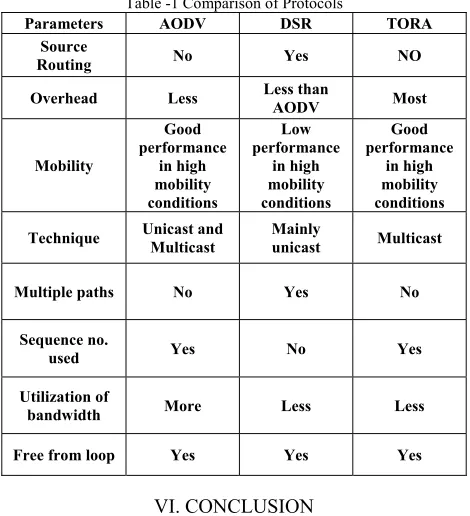
in case of routing overhead DSR works the best whereas in case of high mobility both AODV and TORA will show good performance and provides multicast routing, on the other hand in the similar conditions DSR provides only unicast. In DSR, there exits multiple paths while, in AODV and TORA only single route available from source to destination. Bandwidth utilization in DSR and TORA is less than AODV. All the three protocols are free from loop.
Table -1 Comparison of Protocols
Parameters AODV DSR TORA
Source
Routing No Yes NO
Overhead Less Less than AODV Most
Mobility
Good performance
in high mobility conditions
Low performance
in high mobility conditions
Good performance
in high mobility conditions
Technique Unicast and Multicast Mainly unicast Multicast
Multiple paths No Yes No
Sequence no.
used Yes No Yes
Utilization of
bandwidth More Less Less
Free from loop Yes Yes Yes
VI. CONCLUSION
This paper presents the overview of various on-demand routing protocols, their benefits and limitations. Their comparative study has shown in tabulated form on the basis of different parameters. In case of routing overhead DSR algorithm shown best performance in providing multiple paths, however, in high mobility the other algorithms shown better performance in providing single path. DSR and TORA shown better performances in bandwidth utilization compare to AODV. DSR provides unicast and the other protocols provide multicast routing. As in MANET the system topology is frequently changes with the time. Due to this characteristic of MANET it is hard to maintain the quality of service in the mobile ad hoc networks. Many routing protocols have been proposed till now, but still there are many challenges in the old routing protocols and these challenges creates a large scope to the future work for the development of powerful routing algorithm that will provide enhanced quality of service as well as satisfy all other metrics of the routing.
REFERENCES
[1] P. Gupta, P. Saxena, “Energy Consumption in Wireless Ad hoc Network,” IEEE, DOI 10.1109,2010, pp.831-835.
[2] V. Arora, C.R. Krishna, “Performance Evaluation of Routing Protocols for MANETs under Different Traffic Conditions,” 2nd International Conference on Computer Engineering and Technology, IEEE, Vol.6, 2010, pp.79-84.
[3] A.K. Gupta, H. Sadarwarti, and Verma A.K.,“ Performance analysis of AODV, DSR & TORA Routing Protocols,” IACSIT, Vol.2, No.2, April 2010, pp.226-231.
[4] M. Amnai, Y. Fakhri, and J.Abouchabaka,“Evaluation of Impact of Traffic VBR and Mobility on the Performance of AODV Routing Protocols in Mobile Ad hoc Networks,” IEEE, 2010.
[5] A. Tuteja, R. Gujral, and S. Thalia, “Comparative Performance Analysis of DSDV, AODV and DSR Routing Protocols in MANET using NS2,”International Conference on Advances in Computer Engineering, IEEE, DOI 10.1109, 2010, pp.330-333.
[7] S. Taneja, A. Kush, “A Survey of Routing Protocols in Mobile Ad Hoc Networks,” IJIMT, Vol. 1, No. 3, August 2010, pp.279-285.
[8] L. Shrivastava, S.S. Bhadauria, and G.S. Tomar, “Performance Evaluation of Routing Protocols in MANET with different traffic loads,” International Conference on Communication Systems and Network Technologies, IEEE, DOI 10.1109, 2011,pp.13-16.
[9] M. Barati, K. Atefi, F. Khosravi, and Y.A. Daftari, “Performance Evaluation of Energy Consumption for AODV and DSR Routing Protocols in MANET” International Conference on Computer & Information Science, International Conference on Computing, Communications and Network Technologies,IEEE,2012, pp.636-642.
[10] T.S. Khanvilkar, K.P. Patil, “Performance Evaluation and Comparison of Routing Protocols in MANETS, IEEE, July 2013.
[11] M.K. Gulati, K. Kumar, “ Performance Comparison of Mobile Ad Hoc Network Routing Protocols,” IJCNC,DOI : 10.5121,Vol.6, No.2,March 2014,pp.127-142
[12] K. Srinivas, A. Nagaraju, S. Ramachandram and G. Narsimha, “Performance Evaluation of Routing Protocols in Static and Dynamic Ad-hoc Networks based on Energy Consumption,” Second Vaagdevi International Conference on Information Technology for Real World problems,IEEE, DOI 10.1109, 2010, pp.47-51.
[13] G. Jayakumar, G. Ganapathy, “Performance Comparison of Mobile Ad-hoc Network Routing Protocol”, IJCSNS, VOL.7 No.11, November 2007, pp.77-84.
[14] P. Rohal, R. Dahia, and P. Dahia, “Study and Analysis of Throughput, Delay and Packet Delivery Ratio in MANET for Topology Based Routing Protocols (AODV, DSR and DSDV),” IJARET, Vol.1, Issue 2, March 2013, pp.54-58.
[15] S. Kumar, S.C. Sharma, and B. Suman, “Simulation Based Performance Analysis of Routing Protocols Using Random Waypoint Mobility Model in Mobile Ad Hoc Network”, Global Journal of Computer Science and Technology, Vol. 11 Issue 1 Version 1.0, February 2011, pp.17-22.
[16] S. Mohapatraa, P. Kanungob, “Performance analysis of AODV, DSR, OLSR and DSDV Routing Protocols using NS2 Simulator,” International Conference on Communication technology and System Design ELESVIER, 2011, pp.69-76.
[17] V.B. Dineshkumar, “Improvement of AODV Routing Protocol Based on Wireless Networks,” IJERA, Vol. 2, Issue 5, September-October2012, pp.001-003.
[18] D.B.J. Rao, K. Sreenu, and P. Kalpana, “A Study on Dynamic Source Routing Protocol for Wireless Ad Hoc Networks”, IJARCCE, 2012.
[19] A. Lanjewar, N. Gupta, “Optimizing Cost, Delay, Packet Loss and Network Load in AODV Routing Protocol,” IJCSIS, Vol.11, No. 4, April 2013.
[20] S. Abid, S. Khan, “Improving Performance of Routing Protocols Using MRP Framework”, IJASA, DOI: 10.5121, Vol.2, No.1, March 2014, pp.1-8.
[21] Z.D. Katheeth, K.K. Raman, ” Performance Evaluation with Throughput and Packet Delivery Ratio for Mobile Ad-hoc Networks, “International Journal of Advanced Research in Computer and Communication Engineering, IJARCCE, Vol.3, Issue 5, May 2014.
ACRONYMS
RREQ - Route request RREP - Route Reply QRY - Query CLR - Clear
DSDV - Destination Sequenced Distance Vector OLSR - Optimized Link State Routing
FSR - Fish State Routing WRP - Wireless Routing Protocol
STAR - Source Tree Adaptive Routing Protocol
TBRPF - Topology Dissemination Based on Reverse Path Forwarding AODV - Ad-hoc on demand Distance Vector
DSR - Dynamic Source Routing
TORA - Temporally Ordered Routing Algorithm ABP - Alternating Bit Protocol