International Journal of Web Services Research, 2(1), 77-88, Jan-March 2005 77
Security System for Distributed
Business Applications
Thomas Schmidt, Vienna University of Technology, Austria Gerald Wippel, Vienna University of Technology, Austria Klaus Glanzer, Vienna University of Technology, Austria
Karl Fürst, Vienna University of Technology, Austria
ABSTRACT
Internet-focused application components of cooperating enterprises need comprehensive security technologies that go far beyond simple Internet authentication and authorization mechanisms. Basically, authentication is the process of determining the identity of a user or system, whereas authorization is the process of specifying who is allowed to access which resources. XML-based Web services is an upcoming and very promising technology. It enables the communication among Internet application components regardless of their implementation language. A major drawback of existing Web service approaches is the missing security conventions. Therefore, we concentrated all our effort on developing a holistic extended enterprise authentication and authorization system to facilitate agile and secure enterprise-spanning business processes with Web service-enabled application components.
Keywords: authentication; authorization; business-to-business; enterprise integration; extended enterprise; Internet application; SAML; security; SOAP; Web services
INTRODUCTION
Collaboration between independent enterprises with different core competen-cies is a very important way to seize op-portunities very fast in agile business envi-ronments (Goldman, 1991; Camarinha-Matos, 1999). To distinguish the approach described in the following from the general term “business-to-business,” the more spe-cific term “extended enterprise” (Figure
1) will be used.
The following definition for extended enterprises is new but influenced by other related definitions and approaches:
ex-tended enterprises (EE) are temporary or permanent networks of independent enter-prises including a coordinator cooperating with the aim to design, manufacture, and sell a product or service in a project-ori-ented way independent of enterprise bor-derlines, automated inter-enterprise com-munication through the usage of informa-tion technology, and communicating via Internet-related technologies like XML-based Web services.
The extended enterprise coordinator mentioned above is often described as an enterprise, which extends its boundaries to incorporate business partners. This
coor-This paper appears in the journal International Journal of Web Services Research edited by Liang-Jie Zhang. 701 E. Chocolate Avenue, Suite 200, Hershey PA 17033-1240, USA
dinator has to provide specific resources for operating the extended enterprise. As a matter of course, the same enterprise can be involved in various extended enterprises. Thus it may happen that two enterprises cooperate in one business segment and compete in other business segments at the same time.
INTEGRATION CONCEPT
FOR EXTENDED
ENTERPRISES
The common goal of the extended enterprise members is the support of the whole product life cycle composed of prod-uct design and development, process plan-ning, logistics, production, marketing and sales, and etcetera. There is a need for several information systems to automate the particular life cycle steps. Different from isolated enterprises, the supporting information system functionalities are wide-spread in all participating enterprises. Therefore, a very extensive horizontal in-tegration and collaboration between these enterprises is necessary (Zhang, 2003) so
that each enterprise is able to contribute their part to the information systems inside the extended enterprise (Figure 2). The business value from such collaboration ex-tends across the entire concept develop-ment, design planning, engineering, and sup-plier relationship management (Sayah, 2003).
All business processes that support the product life cycle — summarized into the term “extended enterprise business pro-cesses” — interact with the enterprise busi-ness processes of the respective company. One precondition for such a closely hori-zontal integration is the existence of a ver-tical integration inside the company to pro-vide all internal business processes and business system functionalities to the busi-ness partners.
A very important ingredient for a suc-cessful software system enabling extended enterprises is security, particularly if the Internet is used as the communication tech-nology. In Figure 2 each participating com-pany is enveloped with a security layer to guarantee a secure information exchange, authorization, authentication, and other se-curity mechanisms. One enterprise, in the Extended Enterprise Developer Extended Enterprise Coordinator Customer Producer Salesman
majority of cases the extended enterprise coordinator, has to do the extended enter-prise administration including choosing of the business partners and assigning part-ners to projects and roles.
Due to the fact that security issues are manifold, in this paper the main focus lies on authorization and authentication measures for extended enterprises. The major issue here is to assure that only au-thorized people or systems have access to extended enterprise resources.
PRESENT SECURITY
APPROACHES
Role-Based Access Control
The concept of role-based access control (RBAC) (Sandhu, 1999; Ferraiolo, 2001) is a suitable mean to simplify admin-istration of privileges. The core idea here is not to grant a specific user privileges to access resources but to introduce an ab-straction layer: the roles (e.g., the role
Figure 2. Extended enterprise integration concept
Enterprise A EE-Coordinator Manufacturer Security Enterprise Business Processes CRM ERP Security PDM Enterprise Business Processes Production Control ERP Extended Enterprise Security PDM Enterprise Business Processes Enterprise B Salesman Enterprise C Logistics Service Provider
Enterprise D Developer EE-Administration Security Enterprise Business Processes CRM SCM
CRM …….. Customer Relationship Management ERP ……... Enterprise Resources Planning PDM …….. Product Data Management SCM …….. Supply Chain Management EE ……….. Extended Enterprise Extended Enterprise Business Processes CRM SCM Production Control ERP PDM Integration
“salesman”). Privileges are assigned to each role (e.g., “salesman” has access to a customer database). Roles are assigned to users (e.g., the role “salesman” is as-signed to the user “Bob”). This enables a simplified administration of roles because there are three separate activities, which can be carried out by different people (or roles): assigning roles to roles to establish a hierarchy, assigning privileges to roles, and assigning users to roles.
The RBAC approach has been widely accepted and implemented for enterprise wide access control. First research has been conducted in the field of distributed role-based access control (Sandhu, 2000; Johnston, 1998) to delegate administration to the departments of one enterprise. But, so far, there has been no holistic approach, which provides a solution for extended en-terprises.
Public Key Infrastructure
and Privilege Management
Infrastructure
The public key infrastructure (PKI) approach is often used to establish secu-rity in a distributed environment. Basically, both a public and a private key are used. The private key is kept secret by an entity (e.g., a person or an enterprise). The pub-lic key has to be distributed. Another cen-tral element of PKI is the certification au-thority (CA), which can certify (like a pass-port office) the identity of a specific user or entity. This certificate is similar to a pass-port in the real world. By using the public key infrastructure approach, a trust network can be built. A very important PKI-con-cept is the certification path. If someone has a certificate from a CA, which is trusted by your own CA, then you can trust this certificate.
The privilege management infrastruc-ture (PMI) is used for authorization. It uses so-called attribute certificates and enables privileges, roles, and delegation mecha-nisms. Similarly to the PKI CA, an attribute authority (AA) is defined. The attribute authority and certification authority are logi-cally (and, in many cases, physilogi-cally) com-pletely independent from each other. The creation and maintenance of “identity” can (and often should) be separated from the PMI. Thus the entire PKI, including CAs, may exist and operate prior to the estab-lishment of the PMI.
DRBAC-EE APPROACH
In addition to the RBAC approach, the new approach of distributed role-based access control for extended enterprises (DRBAC-EE) introduces a supplementary abstraction layer, the extended enterprise roles (Figure 3). Legally defined roles are a feature of the legal security framework and are defined contractually. In addition, the property if a role is a must-have or a can-have role is also contractually defined. An enterprise that collaborates in an ex-tended enterprise within the scope of a spe-cific project has to provide must-have roles. Additionally, the extended enterprise admin-istrator assigns the can-have roles. To give an example: the roles “member of the ad-visory board” and “member of the steering committee” are must-have roles. The roles “software developer” and “marketing man-ager” are can-have roles.The extended enterprise project ad-ministrator centrally controls projects in the security domain (in both the legal and tech-nical sense), including assigning can-have roles to the enterprises. The legal adminis-trator adds and removes participating en-terprises.
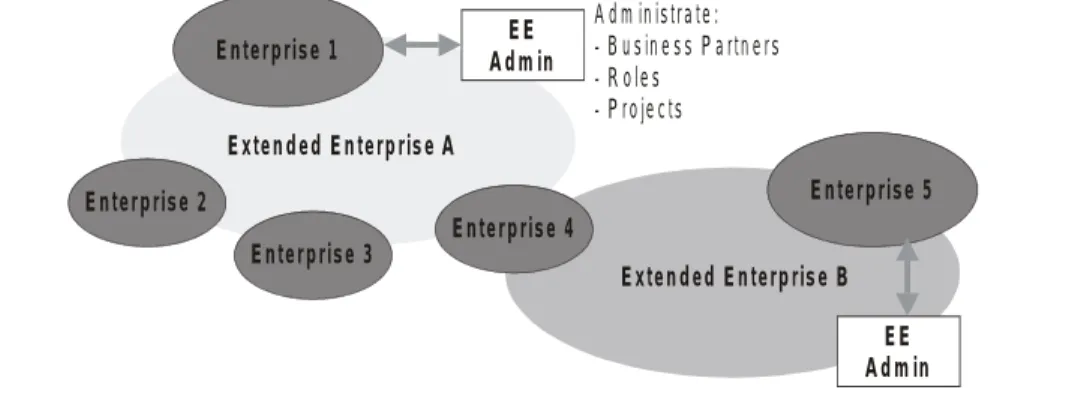
Figure 4 shows two extended
enter-prises, each with a single leader (enter-prises 1 and 5) that controls resources and operations. It is extremely important to have an automated translation between in-ternal and extended enterprise ontologies. This is especially true for enterprise 4, which has to deal with three different on-tologies: its own and the two of the differ-ent extended differ-enterprises. In practice, we can observe this problem with component suppliers in the automobile industry for ex-ample. They have to deal with different ontologies of their big customers. An auto-mated translation from one “world” into the other is a must. A heterogeneous but co-herent business space (extended enterprise A and extended enterprise B in Figure 4
has to be established with each partner of an extended enterprise.
Depending on the complexity of the service, we have developed two different approaches for extended enterprise autho-rization and authentication: indirect and di-rect access. The indidi-rect access approach adds an abstraction layer and can deal with ontology translation problems more effec-tively, whereas the direct access approach can be more efficient and is used mainly to access simple services.
Figure 5 shows the collaboration
dia-gram for the indirect approach, where user X of enterprise A wants to access a re-source of enterprise B. A central compo-nent is the “access management.” The main responsibilities are privilege
verifica-Figure 3. Role mapping within extended enterprises
Extended Enterprise Role Permission Role User Enterprise 1 Permission Role User Enterprise 2
Figure 4. Extended enterprise administration
Enterprise 5 Enterprise 2 Enterprise 1 AdminEE A dm inistrate : - B usine ss P artners - R oles - P rojects Enterprise 4 Enterprise 3 Extended Enterprise A EE Admin Extended Enterprise B
tion for internal and extended enterprise roles, ontology translation of internal to ex-tended enterprise roles and processes, and logging for documentation, data mining, and legal actions.
Having gained access (Figure 5), all communication is done using the access management component. The collaboration diagram shows a request submitted to the access management component by user X (1). This request can be signed (e.g., using XML digital signature) and/or secured (e.g., using the SSL protocol). The access man-agement component uses a security cer-tificate to check this request (2 and 2.1). The attribute authority of enterprise A is accessed to realize the translation between the user X and his extended enterprise roles (3 and 3.1). Subsequently, the enterprise A access management component signs the request with the signature of enterprise A and sends it with the complete role infor-mation to the access management compo-nent of enterprise B (4). The roles in this request are the extended enterprise roles
and are therefore valid only in the context of this specific extended enterprise. The certification authority of the extended en-terprise is accessed to check the signature of the request (5 and 5.1). The request is logged for documentation, billing and data mining. After that, the resource is accessed (6 and 6.1) and the response is signed and sent back to enterprise A (7). This response is also checked (8 and 8.1) and transferred to user X (9). The response to the user could also be signed and/or secured to as-sure security (certificate check by the user is not shown here).
IMPLEMENTATION
The implementation of the DRBAC-EE approach is based on the Service Ori-ented Architecture (SOA) and consists of several services as mentioned in the above collaboration diagram. The authentication service of this approach uses an attribute-based authentication with a privilege
man-Figure 5. Managing indirect access with DRBAC-EE
Enterprise B Enterprise A
8.1: S end Securtiy C ertificate
5.1: S end Security C ertificate 8: G et Enterprise B Securtiy C ertificate
4: Enterprise A signed Request
3: G et Roles of U ser X 2: G et U ser X S ecurity Certificate
9: Signed/S ecured Response
2.1: S ecurity Certificate 3.1: S end R oles of User X
6.1: Response
5: G et Enterprise A Security Certificate 7: Enterprise B signed R esponse
6: Access Resource 1: Signed/S ecured Request
Enterprise A Certification Authority Enterprise B Access Management Enterprise A Attribute Authority Enterprise A User X Extended Enterprise Certification Authority Enterprise B Resource Enterprise A Access Management
agement infrastructure. In contrast to X.509 (ITU-T, 2000), XML is used to handle the data needed. The necessary attributes are included in the header of the SOAP mes-sage:
•
extended enterprise•
enterprises that will act as business part-ners•
projects to be carried out in the scope of the extended enterprise, and•
legally defined, shared, and project-spe-cific roles.The SOAP envelope is enriched with additional headers based on the Security Assertions Markup Language (SAML) (SAML, 2002) and Web Service Security (WSS) (WSS, 2002) specification.
SAML, an open standard of Organi-zation for Advancement of Structured In-formation Standards (OASIS), is an XML-based specification for exchanging secu-rity information. One major design goal for SAML was Single Sign-On (SSO), the abil-ity of a user or service to authenticate in one domain and use resources in other do-mains without re-authenticating. SAML defines XML-encoded security assertions, an XML-encoded request/response proto-col, and rules for using assertions with stan-dard transport and messaging frameworks. An assertion is a declaration of fact ac-cording to someone.
WSS specification, originally devel-oped by IBM, Microsoft and VeriSign, is now a public draft standard of OASIS that describes enhancements to the SOAP mes-saging to provide quality of protection through message integrity and single mes-sage authentication. The goal of the speci-fication is to enable applications to conduct secure SOAP message exchanges. The WSS specification provides three main
mechanisms: security token propagation, message integrity, and message confiden-tiality. Among other things the WSS speci-fication specifies an extension mechanism of the SOAP header with SAML security token, which is used by the DRBAC-EE approach.
The central access management ser-vice of this approach is mainly responsible for authorization of subjects and for rout-ing of messages. As the authentication service it uses SAML to wrap security at-tributes. Furthermore, the service utilizes XACML (eXtensible Access Control Markup Language) for the authorization check and for expressing security policies (XACML, 2003).
XACML is an XML-based language for access control that has been standard-ized within OASIS. It provides an access control model and it is a common language to express and to enforce security policies in a variety of environments. XACML al-lows primarily developers to describe ac-cess control policies for XML objects, but also other objects like Web services or files. The access management service con-sists of the following sub-services (see
Fig-ure 6):
•
The cryptographic service is responsible for encryption of messages and for the generation and verification of signatures attached to messages. The used APIs, which are based on XML Encryption and XML Signature specification, enable the encryption of total or several parts of messages, offering a secure and unbro-ken security channel between different services. This service uses the certifi-cation authority service to fulfill its task.•
The access enforcement service en-forces an access decision from the ac-cess decision service and permits orde-nies access to the service based on re-turned results. To fulfill this task, it ex-tracts the needed information from the incoming message or/and from the at-tribute authority. Atat-tributes concerning the requestor (e.g., user, service) are wrapped by a SAML structure in the header of the message and attributes concerning service operation are direct extracted from the body of the message. The access enforcement service can also be part of the target service to re-strict access.
•
The access decision service makes the access decision based on the obtained attributes from the message and the per-missions respectively rules stored in the XACML policies. The internal reference engine of this service uses XACML poli-cies for the fine-grained access protec-tion of services and resources. At present these policies are either XML files or build up from a database. This service offers a Web service and Javainterface based on the ISO/IEC 10181-3 standard. To support the direct ap-proach as mentioned above an external party can send SAML requests to this XACML-based service to enforce ac-cess decision. For the decision proac-cess the access decision service uses the at-tribute authority, the certification author-ity, the permission and rule store, and the environment.
•
The context mapping service is part of the attribute authority service and pro-vides the proper mapping of the internal enterprise attributes to the external ex-tended enterprise attributes and vice versa.•
The dispatcher service routes received message to the target service. The rout-ing information are extracted from the received message header and/or re-quested from a local or global directory services (e.g., UDDI).•
The billing, audit and logging services are collecting data for billing, data mining,Figure 6. Basic services of the access management service
Cryptografic Web Service Dispatcher Access Enforcement SOAP Message
Web Service Interface
Certification Authority Attribute Authority
Enviroment Permission
Persistence Access Management Service
SOAP Message Context Mapping Access Decision AD -I nt erf a c e Reference-Engine Audit Logging Billing
documentation and maintenance of the system.
•
A SOAP header enriched with additional security attributes needed for the autho-rization is shown in Figure 7. Like the SOAP body, this header has to be signed for security reasons (not shown here).The <wsse:Security> SOAP header block of the WSS specification provides
the mechanism for attaching security-lated information targeted at a specific re-cipient. SAML assertion element <saml:Assertion> are attached to the SOAP message using WSS by placing as-sertion elements inside the <wsse:Security> header. Attributes of the <saml:Assertion> element specify the version of SAML, id of the assertion, issuer of the assertion, time of the instantiation. Sub-Element
Figure 7. Added information in the header of the SOAP request
<soap-env:Header> <wsse:Security >
<saml:Assertion MajorVersion="1" MinorVersion="0" AssertionID="2sxJu9g/vvLG9sAN9bKp/8q0NKU="
Issuer="www.floci-ee.com" IssueInstant="2003-02-14T16:58:33.173Z">
<saml:Conditions NotBefore="2003-02-14T16:53:33.173Z" NotOnOrAfter="2003-02-15T16:53:33.173Z"/> <saml:AuthenticationStatement
AuthenticationMethod="urn:oasis:names:tc:SAML:1.0:am:X509-PKI" AuthenticationInstant="2003-02-14T16:53:33.173Z">
<saml:Subject>
<saml:NameIdentifier NameQualifier="www.floci-ee.com" Format=""> EELogisticManager</saml:NameIdentifier> <saml:SubjectConfirmation> <saml:ConfirmationMethod> urn:oasis:names:tc:SAML:1.0:cm:holder-of-key</saml:ConfirmationMethod> <ds:KeyInfo><ds:X509Data>…</ds:X509Data></ds:KeyInfo> </saml:SubjectConfirmation> </saml:Subject> </saml:AuthenticationStatement> <saml:AttributeStatement> <saml:Subject>
<saml:NameIdentifier NameQualifier="www.floci-ee.com" Format=""> EELogisticManager</saml:NameIdentifier> <saml:SubjectConfirmation> <saml:ConfirmationMethod> urn:oasis:names:tc:SAML:1.0:cm:holder-of-key</saml:ConfirmationMethod> <ds:KeyInfo><ds:X509Data>…</ds:X509Data></ds:KeyInfo> </saml:SubjectConfirmation> </saml:Subject> <saml:Attribute AttributeName="ExternalContext" AttributeNamespace="http://www.floci-ee.com/drbac-ee/2003-01"> <saml:AttributeValue> <f:RequestAttributes> <f:User> <f:Id>312983</f:Id><f:Name>MrSample</f:Name></f:User> <f:ExtendedEnterprise> <f:Id>23</f:Id><f:Name>EE2</f:Name></f:ExtendedEnterprise> <f:Service> <f:WsdlUrl>http://host/wsdl/Timetable.wsdl</f:WsdlUrl> <f:URL/> <f:EndPoint>http://host:8080/TasksWS/jaxrpc/TimetableIF</f:EndPoint> </f:Service> <f:Enterprise> <f:Id>234876</f:Id><f:Name>ACIN</f:Name></f:Enterprise> <f:EERolesToEEProjects> <f:EERolesToEEProject> <f:EEProject> <f:Id>127746</f:Id><f:Name>Project</f:Name></f:EEProject> <f:EERoles> <f:EERole> <f:Id>154</f:Id><f:Name>EEManager</f:Name></f:EERole> </f:EERoles> </f:EERolesToEEProject> </f:EERolesToEEProjects> </f:RequestAttributes> </saml:AttributeValue> </saml:Attribute> </saml:AttributeStatement> <ds:Signature>…</ds:Signature> </saml:Assertion> <ds:Signature>…</ds:Signature> </wsse:Security> </soap-env:Header>
<saml:Conditions> specifies the time span at which the assertions are valid.
The element <saml:Authentication Statement> declares a statement that its subject, specified using sub-element <saml:Subject> was authenticated by par-ticular means at a parpar-ticular time using its attributes AuthenticationMethod and AuthenticationInstant. The example above specifies authentication by means of X.509 PKI. Sub-element <saml:NameIdentifier> of element <saml:Subject> declares the name and the domain of the subject. In our case the name of extended enterprise roles are declared. Sub-element <saml:Subject Confirmation> of element <saml:Subject> specifies the protocol to be used to au-thenticate the subject and additional authen-tication information using the sub-elements <saml:ConfirmationMethode> and <saml:SubjectConfirmationData>.
The <saml:AttributeStatement> asso-ciates the specified subjects using sub-ele-ment <saml:Subject> with the specified at-tributes using the element <saml:Attribute>. The element <saml:Subject> identifies a subject using element <saml:Name Identi-fier> specifying role name and an element <saml:SubjectConfirmation> supplying data that allows secure authentication of the subject. The example above uses a signa-ture for the confirmation.
The element <saml:Attribute> and its sub-element <saml:AttributeValue> specify all attributes names and values like ex-tended enterprise, enterprise, exex-tended en-terprise roles and projects required by the target service.
The last element <ds:Signature> in the SOAP Header contains a signature with a reference to a SAML assertion.
CONCLUSION
The ability to create agile business value networks from independent enter-prises in an effortless and secure way will be the crucial point of success for next generation business-to-business software. Especially the establishment and mainte-nance of security are extremely important requirements of the industry for agile busi-ness value networks.
Within the scope of an international research and development project, design and implementation of a holistic security system for the complex extended enterprise environment have been done successfully. Considering as example business case, a proof-of-concept prototype has been real-ized in close collaboration with the indus-trial end-users within the project consor-tium.
ACKNOWLEDGMENTS
This work was partly supported by the European Commission within the scope of the Growth project FLoCI-EE, G1RD-CT-2000-00324.REFERENCES
Camarinha-Matos, L.M., & Afsarmanesh, M. (eds.). (1999). Infrastructures for
virtual enterprises. Boston: Kluwer
Academic Publishers.
Ferraiolo, D.F., Sandhu, R.S., Gavrila, S., Kuhn, D.R., & Chandramouli, R. (2001). Proposed NIST standard for role-based access control. ACM Transactions on
Information and System Security, 4 (3),
224-274.
Goldman, S., Preiss, K., Nagel, R., & Dove, R. (1991). 21st century
(Vol. 2). Bethlehem, PA: Iacocca Insti-tute, Lehigh University.
ITU-T. (2000, March). ITU-T
Recommen-dation X.509: Information technol-ogy. Open systems interconnection. The Directory: Public-key and at-tribute certificate frameworks. ITU: International Telecommunication Union.
Johnston, W., Mudumbai, S., & Thompson, M. (1998). Authorization and attribute certificates for widely distributed access control. In Seventh International
Workshop on Enabling Technologies: Infrastructure for Collaborative En-terprises.
SAML (Security Assertions Markup Lan-guage) 1.0. (2002, May 31).
Commit-tee Specification OASIS (Organization for Advancement of Structured Infor-mation Standards). Retrieved from
www.oasis-open.org/committees/secu-rity/
Sandhu, R.S., & Coyne, E.J. (1999, Febru-ary). Role-based access control mod-els. IEEE Computer, 38-47.
Sandhu, R.S. (2000). Engineering author-ity and trust in cyberspace: The om-am and rbac way. In Proceedings of the
Fifth ACM Workshop on Role-Based Access Control (pp. 111-119).
Sayah, J., & Zhang, L.J. (2003, September 30). On-demand business
collabora-tion enablement with Web services.
IBM Research Report, No. RC22926 (W0309-191). IBM T.J. Watson Re-search Center.
WSS (Web Service Security) 0.9. (2002,
January 26). Working Draft OASIS (Organization for Advancement of Structured Information Standards). Re-trieved from
www.oasis-open.org/com-mittees/wss/
XACML (eXtensible Access Control Markup Language) 1.0. (2003,
Sep-tember). Committee Specification OA-SIS (Organization for Advancement of Structured Information Standards). Re-trieved from
www.oasi-sopen.org/com-m i t t e e s / t c _ h o www.oasi-sopen.org/com-m e . p h p ? wg_abbrev=xacml
Zhang, L.J., & Jeckle, M. (2003). The next big thing: Web services collaboration. In
Proceedings of the 2003 International Conference on Web Services Europe (ICWS-Europe03) (pp. 1-10).
Spring-Bergle, LNCS 2853.
Thomas Schmidt is currently working as a research assistant at the Automation Control Institute in the Vienna University of Technology as the head of the working group “Intelligent Product Development.” He has experience in industrial projects and European community projects, where he was project coordinator of the research and development project “FLoCI-EE.” He received his PhD from the Faculty of Electrical Engineering and Information Technology, Vienna University of Technology. His research interests include enterprise integration and collaboration, business process optimization, and Internet technologies.
Gerald Wippel was a research assistant at the Automation Control Institute in the Vienna University of Technology in the working group “Intelligent Product Development.” He graduated in industrial electronics and control theory at Vienna University of Technology and contributed to the research and development project “FLoCI-EE.” His research interests include enterprise integration, Internet technologies and IT security.
Klaus Glanzer was a Research Assistant at the Automation Control Institute in the Vienna University of Technology in the working group “Intelligent Product Development.” He graduated in Industrial Electronics and Control Theory at Vienna University of Technology and contributed to the research and development projects “FLoCI-EE” and Holonic Manufacturing Systems. His research interests include enterprise integration, flexible shop floor automation, and Internet applications for business and manufacturing processes.
Karl Fürst currently works for SAP AG, Germany. Before that, he worked as assistant professor for the Automation Control Institute of the Vienna University of Technology, Austria. He led numerous national and international scientific and industry focussed research and development projects in areas such as extended enterprises, Web services, product data management, sensor networks with IEEE-1394, machine vision, and business-focussed site optimization. His teaching interests included computer integrated manufacturing, computer aided design, flexible automation, computer process control, and product development. He is an IEEE and ACM member. Karl Fürst earned his degrees Dipl.-Ing. and Dr. from the Faculty of Electrical Engineering at the Vienna University of Technology.