Background. This article reviews the use of temporary anchorage devices (TADs) for maxillary molar intrusion.
Types of Studies Reviewed.The authors
reviewed clinical, radiographic and histologic studies and
case reports. The studies provided information regarding the application, placement and biological response of orthodontic TADs.
Results.TAD-supported molar intrusion is controlled and timely and may be accomplished without the need for full-arch brackets and wires. Supraerupted maxillary first molars can be intruded 3 to 8 millimeters in 7.5 months (approximately 0.5-1.0 mm per month), without loss of tooth vitality, adverse periodontal response or radiographically evident root resorption.
Clinical Implications.True molar intrusion can be achieved suc-cessfully with orthodontic TADs, re-establishing a functional posterior occlusion and reducing the need for prosthetic crown reduction. Key Words.Temporary anchorage device; intrusion. JADA 2007;138(1):56-64.
S
upraerupted maxillary molars are a common clin-ical finding in dental prac-tice. Early loss of the mandibular first molar often leads to extrusion of the opposing maxillary first molar into the edentulous space.Re-establishing a functional posterior occlusion requires a comprehensive dental treatment plan involving full-arch braces, headgear, surgical impaction or iatrogenic root canal therapy with significant occlusal equilibration.1,2Orthodontic
tempo-rary anchorage devices (TADs) pro-vide a minimally invasive treat-ment alternative, one that does not require the patient’s compliance, for molar intrusion.
This article focuses on ortho-dontic TADs with specific emphasis on their application in molar intrusion.
TEMPORARY ANCHORAGE DEVICES
A TAD is a titanium-alloy mini-screw, ranging from 6 to 12 millime-ters in length and 1.2 to 2 mm in
A B S T R A C T
A
R TICL E 2
Dr. Kravitz is an orthodontic resident, Department of Orthodontics, College of Dentistry, University of Illinois at Chicago, 801 S. Paulina St., MC 841, Chicago, Ill., e-mail “[email protected]”. Address reprint requests to Dr. Kravitz.
Dr. Kusnoto is the clinical chair and an assistant professor, Department of Orthodontics, College of Den-tistry, University of Illinois at Chicago.
Dr. Tsay is an associate professor, Department of Orthodontics, College of Dentistry, University of Illinois at Chicago.
Dr. Hohlt is an associate professor, Department of Orthodontics, School of Dentistry, Indiana University, Indianapolis. J A D A C O N T I N U I NG E DU C A T IO N ✷ ✷
The use of temporary anchorage devices
for molar intrusion
diameter, that is fixed to bone temporarily to enhance orthodontic anchorage.3Placement is
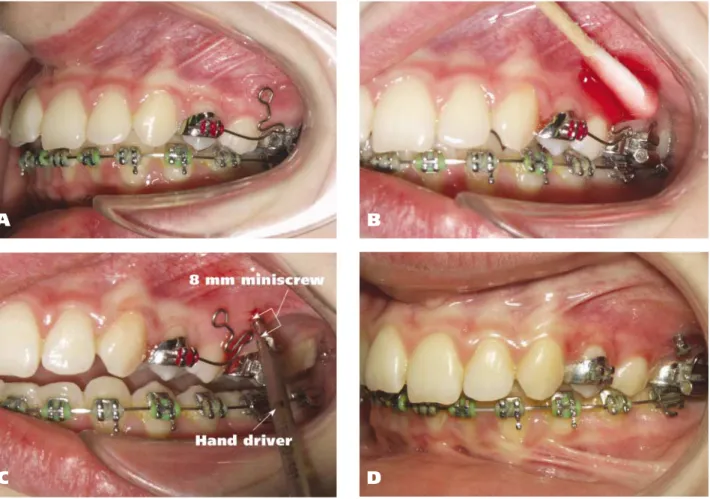
minimally invasive and often completed using only topical anesthetic (Figure 1). They can be inserted directly through the gingival tissue into bone with a hand driver. In regions of thick soft tissue and dense cortical bone, a mucosal punch and pilot hole may be placed to help guide inser-tion. Stationary anchorage is achieved by grip-ping mechanically to cortical bone, rather than by osseointegration.4Therefore, the orthodontist is
able to load the TAD immediately, as well as remove it with a simple twist of the hand driver. Stationary anchorage failure of TADs under orthodontic loading varies between 9 and 30 percent.5-8
Self-tapping versus self-drilling TADs.
TADs are either self-tapping or self-drilling in design. Self-tapping TADs feature a conical design with a threaded shaft and a tapered furrow at the tip. These miniscrews often require a pilot hole before being inserted with a hand driver. Self-drilling TADs feature a corkscrew design with a threaded shaft and a sharp tip.9The shaft
is designed to work like a cutting flute, expelling bone debris onto the surface during insertion.9
Self-drilling TADs are placed directly with a hand driver without the need for a pilot hole.
TREATMENT CONSIDERATIONS
Patient selection. TADs are approved by the U.S. Food and Drug Administration for use in patients 12 years and older.10Juvenile patients
who have not completed skeletal growth, as deter-mined by a hand-wrist radiograph, should not undergo TAD placement directly into the maxil-lary palatal midline suture.10Ossification of the
Figure 1. A.Surgical guide marks the site of temporary anchorage device (TAD) insertion on a periapical radiograph. B.Tetracaine,
lido-caine and phenylephinerine 20 percent topical anesthetic applied for five minutes. C.Direct insertion of a self-drilling TAD with a hand
driver at the mucogingival junction. Angulation 45 degrees from occlusal plane greatly minimizes the risk of root approximation. D.
Inser-tion complete and ready for immediate loading (Dual-Top Miniscrews, Rocky Mountain Orthodontics, Denver). Image of DualTop ortho-dontic miniscrew reproduced with permission of Rocky Mountain Orthoortho-dontics.
ABBREVIATION KEY. HU:Houndsfield units. TADs:
Temporary anchorage devices.
A
C
D
the TAD was placed in a region of low bone den-sity with inadequate cortical thickness.13Misch14
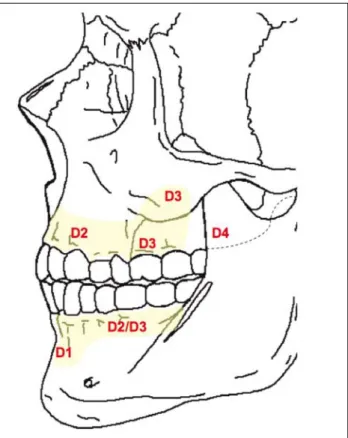
classified bone density into four groups—D1, D2, D3 and D4—based on the number of Hounsfield units (HU)—units of measurement used in com-puted tomographic scanning to characterize tissue density. D1 (> 1,250 HU) is dense cortical bone primarily found in the anterior mandible, buccal shelf and midpalatal region. D1 bone has the tac-tile analogue of oak. D2 (850-1,250 HU) is porous cortical bone with coarse trabeculae found pri-marily in the anterior maxilla, the midpalatal region and the posterior mandible. D2 bone has the tactile analogue of pine. D3 (350-850 HU) is thin (1 mm), porous cortical bone with fine trabec-ulae, found primarily in the posterior maxilla and mandible. D3 has the tactile analogue of balsa wood. D4 (150-350 HU) is fine trabecular bone, found primarily in the tuberosity region (Figure 2). D4 has the tactile analogue of polystyrene foam.14
Regions of D1 to D3 bone are adequate for TAD insertion. TADs placed in D1 bone may require a drilled purchase point to perforate the thick outer cortical plate. TADs placed in D1 and D2 bone exhibit lower stress at the screw-bone interface and may provide greater stationary anchorage during loading.15Placement in D4 bone is not
rec-ommended owing to the high failure rate asso-ciated with it (35-50 percent).16,17
Soft-tissue health. Inflammation of the sur-rounding soft tissue is directly associated with stationary anchorage failure.6,7TADs placed in
nonkeratinized alveolar tissue have a greater failure rate than those inserted into attached tissue.6The loose alveolar tissue is irritated
easily, leading to gingival inflammation and over-growth of the miniscrew head. In the buccal pos-terior region where the mucogingival junction is shorter, the clinician may choose to place the TAD
in alveolar mucosa to avoid root proximity.
Bone availability. In the maxillary posterior dentoalveolus, the greatest amount of interradic-ular bone is located between the second premolar and first molar, 5 to 8 mm from the alveolar crest.18,19In the mandibular posterior
dentoalve-olus, the greatest amount of interradicular bone is on either side of the first molar, approximately 11 mm from the alveolar crest. In the anterior region of the maxilla and mandible, the greatest amount of interradicular bone is located between the canine and lateral incisor.18,19If inadequate
interradicular bone is available, the clinician can place the TAD palatally or diverge the roots before inserting it.
PLACEMENT OF TEMPORARY ANCHORAGE DEVICES
Insertion technique. Proper angle of insertion is important for cortical anchorage, the patient’s safety and biomechanical control. In the posterior
Figure 2.Regions of bone density (as classified in Misch.14)
D1 bone has the highest density. D4 bone has the lowest density and is not recommended for placement. Temporary anchorage devices (TADs) can be placed in D1 to D3 bone (yellow region) with a 70 to 90 percent success rate. The maxillary midpalatal region (not shown) contains D1 and D2 bone. TADs placed in the retromolar pad or zygomatic region may require a flap; patients requiring such placement should be referred to a surgeon.
maxilla, the angle of insertion should be 30 to 45 degrees to the occlusal plane.20Steeper
angula-tion (< 30 degrees) minimizes the risk of root per-foration but may increase the risk of miniscrew slippage. In the anterior maxilla and posterior edentulous maxilla, the angle of insertion should approximate 90 degrees to the occlusal plane (parallel to the paranasal sinus floor) to minimize perforation of the sinus.21This allows for a more
gingival position of the TAD head, which is bio-mechanically advantageous during molar intru-sion. In the mandible, the angle of insertion should be 30 to 45 degrees to the occlusal plane to increase the surface area contact between the miniscrew and the thicker cortical bone.20A
sur-gical stent made of orthodontic wire can be used to guide insertion (Figure 3).
Force load. In regard to stationary anchorage, numerous articles have recommended loading forces of 300 grams of force or less.5,6,22-27Dalstra
and colleagues28suggested loading forces of 50 g
in regions of thin cortical bone and fine trabecula. Buchter and colleagues22reported that TADs
inserted into dense mandibular bone remained clinically stable at forces up to 900 g. In regions of poor bone density, simply placing a longer screw or applying lighter force does not ensure sta-tionary anchorage.6,29
Intrusive force should be light and continuous to produce the appropriate pressure within the
Figure 3.Surgical stents. A.Before insertion in the posterior region, a 16 round stainless steel wire is placed at the level of the
mucogin-gival junction. B.Radiographic confirmation of adequate interradicular bone thickness and proper insertion site. C.Before insertion in the
anterior region, 16 x 16 stainless steel wires are placed outlining the outer margins of the roots (technique was introduced by W.F.H.).
D.Postoperative radiograph confirming accurate interradicular placement.
A
C
D
B
periodontal ligament and minimize the risk of root resorption.30Kalra and collagues31used 90 g
of force to intrude maxillary molars in children; Melsen and Fiorelli32used 50 g of force to intrude
maxillary molars in adults. Park and colleagues33
used 200 g of force for miniscrew-supported max-illary molar intrusion, and Umermori and col-leagues34used 500 g of initial force for
miniplate-supported mandibular molar intrusion. The recommended force for miniscrew-supported max-illary molar intrusion is 100 to 200 g. En-masse intrusion of the second premolar and the first and second molar requires greater force, approxi-mately 200 to 400 g per side.35,36
Chlorhexidine rinse. Chlorhexidine (0.12 per-cent, 10 milliliters) should be used a minimum of twice daily during the first week after placement and continued throughout the course of treatment if needed to minimize soft-tissue inflammation. Chlorhexidine is a cationic, bacteristatic and bac-teriocidal rinse that works via sustantivity within the oral cavity. It has the added benefit of slowing down epithelialization, which may limit soft-tissue overgrowth. After rinsing with chlorhexidine, patients should wait 30 minutes before brushing with fluoridated toothpaste. The anionic agents in fluoridated toothpaste will reduce the activity of the rinse, and the surface contact of the tooth-brush will remove the chlorhexidine coating.37 MAXILLARY MOLAR INTRUSION WITH TEMPORARY ANCHORAGE DEVICES
Protocol. For maxillary molar intrusion using a single TAD, the miniscrew should be placed in the buccal dentoalveolus between the second
pre-molar and first pre-molar at the mucogingival junc-tion. To prevent the intruding molar crown from tipping buccally, the clinician can place a
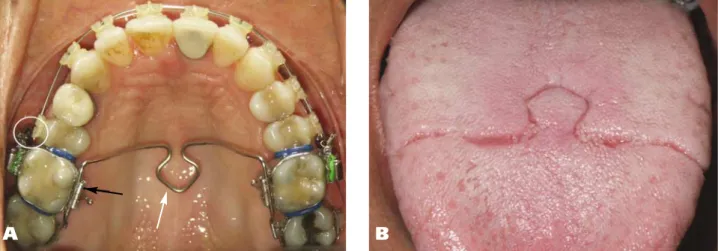
transpalatal arch with buccal root activation. The transpalatal arch should be raised 3 to 5 mm away from the palate to allow resting tongue pres-sure to aid with intrusion (Figure 4).
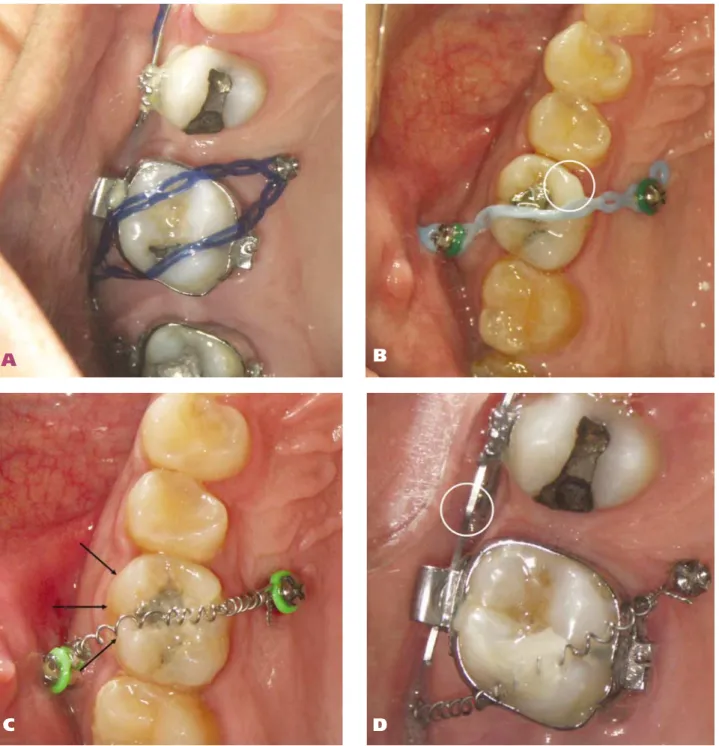
For maxillary molar intrusion using two TADs, one miniscrew should be placed in the buccal region between the first and second molar; the other in the palatal slope between the second pre-molar and first pre-molar just medial to the greater palatine nerve. This will allow the elastic chain or nickel-titanium coil to pass diagonally across the occlusal table. Owing to the angulation of the palatal slope, there is a tendency for the molar to tip palatally during intrusion. Partial braces may be needed during or after intrusion to prevent the molar from moving into crossbite (Figure 5).
In the absence of adequate interradicular space, TADs can be placed in the palate, either in the midline region or the palatal slope. TADs placed in the midline region often require an extension arm reaching up the palatal slope (Figure 6, page 62). Partial braces from the first premolar to the second molar can be placed to counterbalance palatal crown tipping.
Rate. The rate of single molar intrusion2,32,34-36,38
(Table, page 62) is approximately 0.75 mm per month. Yao and colleagues2investigated
maxil-lary molar intrusion in 26 first molars and 17 second molars. The authors reported a mean intrusion of 3 to 4 mm (range, 3.68-8.67 mm) for the first molar and a mean intrusion of 1 to 2 mm for the second molar in 7.5 months. Sherwood and
Figure 4.Molar intrusion with a single temporary anchorage device (TAD) and a transpalatal bar. A.Placement of the TAD between the
second premolar and first molar (white circle). Buccal root activation is applied to the transpalatal bar (black arrow). The transpalatal arch is
raised 3 to 5 millimeters away from the palate (white arrow). B.Resting tongue pressure against the transpalatal bar aids with intrusive forces.
colleagues38 presented two case reports of
maxil-lary first molar intrusion and reported a mean intrusion of 4.1 mm after 6.5 months. Sherwood and colleagues39intruded maxillary first molars
in four adults and reported a mean intrusion of 2.0 mm (range, 1.45-3.32 mm) after 5.5 months.
Park and colleagues33presented two case reports
of maxillary first and second molar intrusion and reported an intrusion rate of 0.5 to 1.0 mm per month (Figure 7, page 63).
The rate of en-masse intrusion of the second premolar and the first and second molar is
Figure 5.Molar intrusion with two temporary anchorage devices (TADs). The buccal TAD was placed between the first and second molar,
and the palatal TAD was placed between the second premolar and the first molar. Placement of the palatal TAD mesial to the first molar
avoids the greater palatine foramen and D4 bone. A.Criss-cross design with elastic chain. B.Twisting of the elastic chain and cuspal
build-up with resin-based composite (white circle) prevents the chain from slipping off the occlusal table during mastication.C.A 150-gram
nickel-titanium (NiTi) coil. Notice the tendency of the molar to tip palatally during intrusion (black arrows). D.A 150-g NiTi coil stabilized with
band cement to the occlusal surface. Partial fixed appliances (white circle) minimize unwanted tipping.
B
A
dontic intrusion may be highly susceptible to root resorption.40Pressure from intrusive forces
con-centrate at the root apex, leading to compression and necrosis of the periodontal ligament. Several studies have examined root resorption of pos-terior teeth in regard to traditional orthodontic treatment. Sharpe and colleagues41reported that
molars have the second highest incidence of root resorption, after incisors. Beck and Harris42
reported root resorption in first molars under-going tip-back and intrusion mechanics. McNab and colleagues43reported root resorption of the
maxillary first molar after distalization and intrusion with a high-pull headgear. Reitan44
showed histologically that resorption may occur in premolars subjected to 25 to 240 g
of force. In contrast, Owman-Moll45
reported no difference in root resorption for premolars undergoing light (50 g) and heavy (200 g) ortho-dontic load in the buccal direction.
DISCUSSION
Miniscrew-supported molar intru-sion has drawn great interest among researchers, especially in terms of whether molars can be intruded under continuous heavy force without significant root resorp-tion or perforaresorp-tion of the sinus floor. Ari-Demirkaya and colleagues46
measured root resorption of maxil-lary first molars after intrusion with TADs. The study compared 16 consecutively treated adults who underwent molar intrusion by means of skeletal anchorage with a control group of 16 adults who had undergone fixed orthodontic treat-ment without molar intrusion. The
authors concluded that the amount of root resorp-tion detected after molar intrusion was not clini-cally different from that in control groups treated without intrusion mechanics. In an animal study, Daimaruya and colleagues47intruded maxillary
second premolars into the nasal floor of six bea-gles to histologically elucidate the effects of molar intrusion against the maxillary sinus floor. The beagle’s nasal sinus and bony floor are
histologi-Figure 6.Extension bar. Palatal miniscrews will require an
exten-sion bar to reach up the palatal slope for molar intruexten-sion. Often, two temporary anchorage devices are placed to prevent rotation of the bar. Partial fixed appliances minimize palatal crown tipping.
TABLE
Amount of maxillary molar intrusion
and length of active intrusion time.
STUDY TOOTH MEASURED INTRUSION TIME (MONTHS) MEAN AMOUNT OF INTRUSION (mm*) * mm: Millimeters. Yao and colleagues2 Park and colleagues33 Sherwood and colleagues38 Yao and colleagues1 Erverdi and colleagues35 Erverdi and colleagues36 Sherwood and colleagues39 First molar Second molar Second molar First molar First molar Second molar First molar Second molar First molar First molar First molar 3-4 (range, 3.68-8.67) 1.0-2.0 0.5-1.0 mm/ month 4.0 4.2 3.0 2.0-3.0 3.6 2.6 2.0 (range, 1.45-3.32) 7.5 5.0 5.0 8.0 5.5 7.5 5.0 5.0 7.0 5.1 5.5 Single-Tooth Intrusion En-Masse Intrusion
cally similar to the human maxillary sinus. The authors reported a mean apical root resorption (± standard deviation) of only 0.18 ± 0.18 mm after seven months of intrusion. The sinus floor membrane lifted intranasally with the intruding palatal root.
Risks and complications of molar intru-sion. The potential risks of TAD placement must be understood clearly by both the clinician and the patient.
dRoot trauma.Trauma to the periodontal liga-ment or dental root may lead to loss of tooth vitality or ankylosis. If there is no pulpal involve-ment, the outer root and periodontium may demonstrate complete repair in three to four months.48
dStationary anchorage failure.TADs may become loose,6tip and extrude29under
ortho-dontic load. Miniscrews that become mobile will not regain stability and may need to be removed and reinserted. Inadequate primary stability on initial placement likely is a result of inadequate cortical bone thickness.49Delayed mobility that
occurs days or months after placement likely is a
result of inadequate cortical thickness and exces-sive force load.50
dSoft-tissue irritation.TADs placed in loose alve-olar mucosa may result in soft-tissue irritation, tissue overgrowth and minor aphthous
ulceration.6
dNerve injury.Placement of TADs in the maxil-lary palatal slope risks injury to the greater pala-tine nerve. The greater palapala-tine nerve exits out its foramen, which is located laterally to the second or third molar,51and it travels anteriorly along
the palatal slope 5 to 15 mm from the gingival border.
dSinus perforation.Small (< 2 mm) perforations of the paranasal sinus floor will heal by them-selves without complications52,53and should not
affect miniscrew stability.54Larger perforations
may result in sinusitis or a chronic oroantral fis-tula.52TADs diameters rarely exceed 2 mm, and
TADs may not need to be removed if the patient is asymptomatic.
dRelapse.Relapse extrusion of intruded molars may occur. The average relapse rate for first and second molar intrusion is approximately 30 percent.54
CONCLUSION
The scope of orthodontics is expanding. TADs have allowed the orthodontist to overcome anchorage limitations and perform difficult tooth movements predictably and with minimal patient compliance. Restorative dentists, periodontists and surgeons should ensure that they have a clear understanding of the many applications of ortho-dontic TADs when presenting patients with options for correcting occlusal problems. ■
1. Yao CC, Wu CB, Wu HY, Kok SH, Chang HF, Chen YJ. Intrusion of the overerupted upper left first and second molars by mini-implants with partial-fixed orthodontic appliances: a case report. Angle Orthod 2004;74(4):550-7.
2. Yao CC, Lee JJ, Chen HY, Chang ZC, Chang HF, Chen YJ. Maxil-lary molar intrusion with fixed appliances and mini-implant anchorage studied in three dimensions. Angle Orthod 2005;75(5):754-60.
3. Cope J. Temporary anchorage devices in orthodontics: a paradigm shift. Semin Orthod 2005;11(1):3-9.
4. Hermann R, Cope J. Miniscrew implants: IMTEC MiniOrtho Implants. Semin Orthod 2005;11(1):32-9.
5. Park HS, Jeong SH, Kwon OW. Factors affecting the clinical suc-cess of screw implants used as orthodontic anchorage. Am J Orthod Dentofacial Orthop 2006;130(1):18-25.
6. Miyawaki S, Koyama I, Inoue M, Mishima K, Sugahara T, Takano-Yamamoto T. Factors associated with the stability of titanium screws placed in the posterior region for orthodontic anchorage. Am J Orthod Dentofacial Orthop 2003;124(4):373-8.
7. Cheng SJ, Tseng IY, Lee JJ, Kok SH. A prospective study of the risk factors associated with failure of mini-implants used for ortho-dontic anchorage. Int J Oral Maxillofac Implants 2004;19(1):100-6. 8. Fritz U, Ehmer A, Diedrich P. Clinical suitability of titanium microscrews for orthodontic anchorage-preliminary experiences. J Orofac Orthop 2004;65(5):410-8.
Figure 7. A.Pretreatment panoramic radiograph of patient with
a supraerupted maxillary first molar as a result of early loss of the
mandibular first molar. B.Postintrusion panoramic radiograph
taken before removal of the temporary anchorage device, showing that 4.4 millimeters of molar intrusion was achieved in less than six months without the need for a fixed appliance. The maxillary molar was intruded within the maxillary sinus without radiographi-cally detectable root resorption. A removable retainer was made to allow the molar to settle into proper occlusion.
A
success and failure rates at 3-year follow-up in a multicenter study of overdentures supported by Brånemark implants. Int J Oral Maxillofac Implants 1995;10(1):33-42.
18. Poggio PM, Incorvati C, Velo S, Carano A. ‘Safe zones’: a guide for miniscrew positioning in the maxillary and mandibular arch. Angle Orthod 2006;76(2):191-7.
19. Schnelle MA, Beck FM, Jaynes RM, Huja SS. A radiographic evaluation of the availability of bone for placement of miniscrews. Angle Orthod 2004;74(6):832-7.
20. Carano A, Velo S, Leone P, Siciliani G. Clinical applications of the Miniscrew Anchorage System. J Clin Orthod 2005;39(1):9-24.
21. Kravitz N, Kusnoto B. Dual-Top Anchor Mini Orthoscrews: sem-inar manual—UIC Clinical Test Protocol 2005. Denver: Rocky Moun-tain Orthotics; 2005:17-40.
22. Buchter A, Wiechmann D, Koerdt S, Wiesmann HP, Piffko J, Meyer U. Load-related implant reaction of mini-implants used for orthodontic anchorage. Clin Oral Implants Res 2005;16(4):473-9.
23. Roberts WE, Marshall KJ, Mozsary PG. Rigid endosseous implant utilized as anchorage to protract molars and close an atrophic extrac-tion site. Angle Orthod 1990;60(2):135-52.
24. Costa A, Raffainl M, Melsen B. Miniscrews as orthodontic anchorage: a preliminary report. Int J Adult Orthodon Orthognath Surg 1998;13(3):201-9.
25. Kanomi R. Mini-implant for orthodontic anchorage. J Clin Orthod 1997;31(11):763-7.
26. Park HS, Bae SM, Kyung HM, Sung JH. Micro-implant anchorage for treatment of skeletal Class I bialveolar protrusion. J Clin Orthod 2001;35(7):417-22.
27. Tseng YC, Hsieh CH, Chen CH, Shen YS, Huang IY, Chen CM. The application of mini-implants for orthodontic anchorage. Int J Oral Maxillofac Surg 2006;35(8):704-7.
28. Dalstra M, Cattaneo P, Melsen B. Load transfer of miniscrews for orthodontic anchorage. Orthod 2004;1:53-62.
29. Liou EJ, Pai BC, Lin JC. Do miniscrews remain stationary under orthodontic forces? Am J Orthod Dentofacial Orthop 2004;126(1):42-7.
30. Proffit WR. Contemporary orthodontics. 3rd ed. St. Louis: Mosby; 2000.
31. Kalra V, Burstone CJ, Nanda R. Effects of a fixed magnetic appli-ance in the dentofacial complex. Am J Orthod Dentofacial Orthop 1989;95(6):467-78.
32. Melsen B, Fiorelli G. Upper molar intrusion. J Clin Orthod 1996;30(2):91-6.
33. Park YC, Lee SY, Kim DH, Jee SH. Intrusion of posterior teeth using mini-screw implants. Am J Orthod Dentofacial Orthop
apical root resorption, and crestal alveolar bone levels. Am J Orthod Dentofacial Orthop 1987;91(3):252-8.
42. Beck BW, Harris EF. Apical root resorption in orthodontically treated subjects: analysis of edgewise and light wire mechanics. Am J Orthod Dentofacial Orthop 1994;105(4):350-61.
43. McNab S, Battistutta D, Taverne A, Symons AL. External apical root resorption following orthodontic treatment. Angle Orthod 2000;70(3):227-32.
44. Reitan K. Clinical and histologic observations of tooth movement during and after orthodontic treatment. Am J Orthod 1967;
53(10):721-45.
45. Owman-Moll P. Orthodontic tooth movement and root resorption with special reference to force magnitude and duration: a clinical and histological investigation in adolescents. Swed Dent J Suppl 1995;105:1-45.
46. Ari-Demirkaya A, Masry M, Erverdi N. Apical root resorption of maxillary first molars after intrusion with zygomatic skeletal anchorage. Angle Orthod 2005;75(5):761-7.
47. Daimaruya T, Takahashi I, Nagasaka H, Umemori M, Sugawara J, Mitani H. Effects of maxillary molar intrusion of the nasal floor and tooth root using the skeletal anchorage system in dogs. Angle Orthod 2003;73(2):158-66.
48. Asscherickx K, Vannet BV, Wehrbein H, Sabzevar MM. Root repair after injury from mini-screw. Clin Oral Implants Res 2005;16(5):575-8.
49. Graham J, Cope J. Miniscrew troubleshooting. Orthod Products 2006;4-5:26-32.
50. Jaffar A, Hamadah H. An analysis of the position of the greater palatine foramen. J Basic Med Sci 2003;3:24-32.
51. Schow S. Odontogenic diseases of the maxillary sinus. In: Peterson L, Ellis E III, Hupp J, Tucker MR, eds. Contemporary oral and maxillofacial surgery. St Louis: Mosby-Year Book; 1993:465-82. 52. Reiser GM, Rabinovitz Z, Bruno J, Damoulis PD, Griffin TJ. Evaluation of maxillary sinus membrane response following elevation with the crestal osteotome technique in human cadavers. Int J Oral Maxillofac Implants 2001;16(6):833-40.
53. Brånemark PI, Adell R, Albrektsson T, Lekholm U, Lindstrom J, Rockler B. An experimental and clinical study of osseointegrated implants penetrating the nasal cavity and maxillary sinus. J Oral Maxillofac Surg 1984;42(8):497-505.
54. Sugawara J, Baik UB, Umemori M, et al. Treatment of posttreat-ment dentoalveolar changes following intrusion of mandibular molars with application of a skeletal anchorage system (SAS) for open bite cor-rection. Int J Adult Orthodon Orthognath Surg 2002;17(4):243-53.