Cellular M2M Network Access Congestion:
Performance Analysis and Solutions
Fengming Cao and Zhong Fan
Toshiba Research Europe, Telecommunications Research Laboratory 32 Queen Square, Bristol, BS1 4ND, UK
{fengming.cao, zhong.fan}@toshiba-trel.com
Abstract — Machine to machine (M2M) communication is the
direct communication between devices without human
involvements. Recently M2M services in cellular networks have been promoted by cellular operators for sustainable profits for the next decade. However, M2M will also bring serious access congestion problems into cellular networks. This paper studies random access (RA) protocols for cellular M2M communication systems and in particular investigates two RA methods including transmission probability control and two-hop Aloha as well as their dynamic extensions. Our analysis illustrates that the proposed solutions can provide much better performance in terms of random access throughput and delay.
Keywords – M2M, random access, Aloha
I. INTRODUCTION
Machine to machine (M2M) communications are the direct communications between devices without human involvements. As an enabling technology for a wide range of Internet of things (IoT) applications such as telematics, smart metering, healthcare,security, and fleet management, M2M has drawn huge attentions in the past few years [1]. Driven by the consumers’ demand for new services and enterprises’ need to reduce costs, significant growth in the M2M market during the next few years has been predicted. It is forecasted that the number of M2M devices will expand to billions by 2020 and cumulative M2M cellular connections are expected to rise to 364.5 million globally by 2016 [2].
With the rapid development of the M2M landscape, it is inevitable to use the ubiquitous cellular infrastructure to facilitate M2M communications. Recently, M2M has been intensively discussed in the cellular standardization bodies such as 3GPP LTE and WiMAX, as mobile operators and vendors are seeking new services and applications for sustainable profits for the next decade [3, 4, 5]. M2M over cellular is one of the best options to connect diverse devices over great distances by using established, ubiquitous and robust networks with proven technologies. For example, British Gas is installing smart meters for their customers, where smart meters take accurate readings of energy usage in small time granularity and automatically send the data via a cellular network [6]. In 3GPP, M2M is also referred to as MTC (machine type communications).
Basically, to facilitate M2M communications, a cellular network has to meet the following requirements:
support of extremely high number of devices, with different traffic characteristics,
support of various latencies, high reliability and low power consumption,
support of different mobility profiles, and
no negative impact on human to human (H2H) communications.
One of the most critical challenges in cellular M2M is the network access congestion problem, where massive M2M accesses happen in a very short time and consequently cause very low access success probability and long access delays [7]. Fig. 1 shows the population density in London based on 2007 statistics [5]. Based on this information, the average number of households per square kilometer and consequently the number of smart electricity meters per cell for different cell radii (assuming each household has an electricity meter) can be estimated. Table I lists the expected number of households per cell for typical cell radii [5]. Compared to the number of active conventional H2H users in a cell (usually less than 100), the huge amount of M2M devices in a cell could cause severe congestion in network access.
Fig. 1: The population density in London
For a given wireless communication system, multiple access protocols have huge impact on the system performance. Basically there are two kinds of contention-based access protocols. One is the carrier sense multiple access (CSMA) protocol based on the principle of listen before talk. The other is the Aloha-based access protocol, in which a user simply transmits whenever it wants to. Normally, CSMA-based access 1st International Workshop on Internet of Things Communications and Technologies (IoT'13)
is more efficient than Aloha-based access and is widely used in short range networks such as WiFi [13]. However, due to the hidden node problem, it is not suitable for networks with large cell sizes such as cellular and satellite systems. To improve system efficiency, access requests in cellular systems (from 2G to 4G) are typically based on Aloha random access. In LTE, the RA procedure consists of four steps: random access preamble transmission, random access response, RRC (radio resource control) connection request, and RRC connection setup [11]. In LTE, a random access opportunity (RAO) is defined as a three-dimensional radio resource block in a time-frequency domain with a fixed number of preambles. Thus a RAO is the combination of random access slot, frequency band, and preamble signature [12].
The integration with vast M2M devices brings a unique challenge in designing an efficient and reliable random access protocol for cellular networks, and various proposals have been under active discussion in standardization bodies (e.g. [4][5]). In 3GPP, several radio access network contention resolution schemes have been developed: random backoff, access class barring, dedicated resource allocation, etc. Each of these methods has its strengths and weaknesses and none of them is widely acknowledged as the best solution. In the literature, a few papers have also investigated radio access network (RAN) overload issues of M2M communications in 3GPP LTE networks. For example, in [10], the authors propose a radio resource management method based on grouping according to the quality of service (QoS) requirements and packet arrival rate of each MTC group. However, when there is a massive number of MTC access attempts, this scheme does not scale well.
Table I: Intensity of smart meters
Area Population Density (Sq Km) Typical Cell Size (Km) No. Households/cell Central London 10000 0.5 4968 Urban London 7500 2 35670
This paper is motivated to analyze the cellular random access protocol and propose some new solutions. The contributions of the paper are as follows.
1) The impact on the slotted Aloha performance due to M2M applications has been thoroughly studied.
2) Two methods including transmission probability control (TPC) and two-hop Aloha have been analyzed.
3) Dynamic TPC and two-hop solutions have been proposed and their advantages are demonstrated.
The rest of the paper is organized as follows. Section II describes the widely-used slotted Aloha random access protocol. The impact on non-M2M (i.e., H2H) applications is studied in Section III. The new solutions including transmission probability control and two-hop Aloha are proposed in Section IV and Section V concludes the paper.
II. ALOHA RANDOM ACCESS
In the following, we briefly go through the slotted Aloha protocol, which has been widely used in most of cellular systems. The slotted Aloha protocol is an improved version of the pure Aloha protocol, where a user can send the request only at the beginning of a time slot. If the request message collides with another transmission, it will be re-sent at a later time slot. Suppose there are 𝑀 users and each user sends the request message with an arrival rate 𝜆′, and the total arrival rate
(transmission attempts) will be 𝜆 = 𝜆′𝑀. Assume there are 𝑁
opportunities for the users to send the request, where an opportunity can be a narrow band, an access code in a given time slot, or a combination of both, depending on the cellular system in place. The arrival of independent transmissions can be modeled as a Poisson distribution, i.e., the probability that 𝑘
transmissions occur is given as
𝑃(𝑘) =( 𝜆 𝑁) 𝑘 𝑒− 𝜆 𝑁 𝑘! (1)
Now the throughput of successful transmission in one opportunity is defined as the probability of having just one transmission, i.e., 𝑃(1):
𝑇𝑐 = 𝜆 𝑁𝑒
−𝜆/𝑁 (2)
Then the throughput of all the opportunities can be calculated as
𝑇 = 𝑁𝑇𝑐
= 𝜆𝑒−𝑁𝜆 (3)
For any given user, the user collision probability in an opportunity is defined as the ratio of number of collisions to the number of total transmissions, i.e.:
𝑃𝑐 = ∑∞𝑖=0𝑖𝑃(𝑖)−𝑃(1) ∑∞𝑖=0𝑖𝑃(𝑖) = 𝜆 𝑁− 𝜆 𝑁𝑒 −𝑁𝜆 𝜆 𝑁 = 1 − 𝑒−𝑁𝜆
The success probability at 𝑘𝑡ℎ transmission after the first 𝑘 − 1 attempts failed is given as
𝑆𝑘= 𝑃𝑐𝑘−1𝑃(0)
= (1 − 𝑒−𝑁𝜆)𝑘−1 𝑒−𝜆/𝑁 (4) Normally, the access delay distribution depends very much on the backoff policies. Instead of focusing on a specific backoff policy, here we assume there are no retransmissions and the access delay is defined as a generic term as the average number of trials to send over an access request and can be obtained as
𝐷 = ∑∞𝑘=1𝑘 ∙ 𝑆𝑘
= ∑∞ 𝑘(1 − 𝑒−𝜆/𝑁)𝑘−1𝑒−𝜆/𝑁
𝑘=1
= 𝑒𝜆/𝑁 (5) Fig. 2 illustrates the throughput versus total arrival rates with different number of opportunities (4, 8, 16, and 32). It is well known that the maximum throughput per opportunity can be achieved as 𝑇𝑐,𝑚𝑎𝑥= 𝑒−1 when 𝜆 = 𝑁, which means the
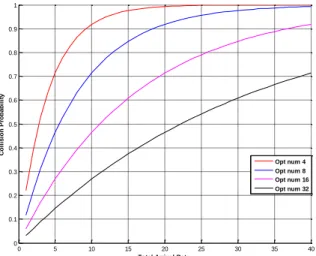
average delay 𝐷 = 𝑒. The figure clearly shows that the throughput will dramatically decline with the increase of the total arrival rate when 𝜆 > 𝑁. Fig. 3 depicts the average delay with different total arrival rates and we can see that the average delay increases with the total arrival rate exponentially. Similarly, Fig. 4 shows the collision probability versus total arrival rate, and it can be seen that with four opportunities, the collision probability will reach 1 when the arrival rate is just about 20. On the other hand, the collision probability drops rapidly as the number of random access opportunity increases.
Fig. 2: Throughput vs. total arrival rate
Fig. 3: Access delay vs. total arrival rate
From Fig. 2 and Fig. 3, we can observe that the throughput and access delay are highly related to the number of access opportunities 𝑁 and the total arrival rate 𝜆, which depends on the number of users 𝑀 and the individual arrival rate 𝜆′.
Usually, the total number of opportunities for a given system is fixed. When the total arrival rate is larger than the number of opportunities, increasing the arrival rate will reduce the throughput and increase the access delay significantly. To this end, M2M applications with a vast number of M2M devices may result in severe congestion of random access channels. In the following section we will further analyze the impact of massive M2M access on the RA performance of non-M2M applications.
Fig. 4: Collision probability vs. total arrival rate
III. THE IMPACT ON NON-M2M TRAFFIC When M2M users are integrated into cellular networks, they have to compete with conventional non-M2M users during the random access procedure. Given the total number of users 𝑀, all the users are divided into 2 sets for M2M users and non-M2M users as ℂ𝑖 (1 ≤ 𝑖 ≤ 2), and 𝑀 = ∑2𝑖=1𝑀𝑖 , where 𝑀𝑖= |ℂ𝑖|. Denote 𝜆𝑖′ as the transmission rate of each user in ℂ𝑖 , then
the arrival rate for the 𝑖𝑡ℎ set will be 𝜆𝑖= 𝜆𝑖′𝑀𝑖 and the total arrival rate will be 𝜆 = ∑2𝑖=1𝜆𝑖. Now we will analyze the
impact on the non-M2M users when the M2M users share the opportunities with the non-M2M users. Based on (3), we can get the access throughput as
𝑇 = 𝜆𝑒−𝑁𝜆
= 𝑒−𝑁𝜆 ∑2𝑖=1𝜆𝑖 = ∑2𝑖=1𝑇𝑖 (6)
where 𝑇𝑖= 𝜆𝑖𝑒− 𝜆
𝑁 is the access throughput of the 𝑖𝑡ℎ class set.
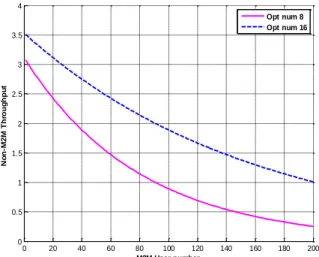
Fig. 5 shows the throughput of non-M2M users vs. the number of M2M users with different number of opportunities, assuming each user’s arrival rate is 0.2 and there are 20 non-M2M users.
0 10 20 30 40 0 0.05 0.1 0.15 0.2 0.25 0.3 0.35 0.4
Total Arrival Rate
T h ro u g h p u t p e r o p p o rt u n it y Opt num 4 Opt num 8 Opt num 16 Opt num 32 0 10 20 30 40 0 2 4 6 8 10 12
Total Arrival Rate
T o ta l T h ro u g h p u t Opt num 4 Opt num 8 Opt num 16 Opt num 32 0 5 10 15 20 25 30 35 40 100 101 102 103
Total Arrival Rate
A v e ra g e a c c e s s d e la y Opt num 8 Opt num 16 0 5 10 15 20 25 30 35 40 0 0.1 0.2 0.3 0.4 0.5 0.6 0.7 0.8 0.9 1
Total Arrival Rate
C ol li s ion P rob a bi li ty Opt num 4 Opt num 8 Opt num 16 Opt num 32
It clearly demonstrates that the throughput of non-M2M users will degrade significantly with the increasing number of M2M users.
Fig. 5: Non-M2M throughput vs. number of M2M users IV. M2M RANDOM ACCESS SOLUTIONS
The above analysis has demonstrated the negative impact resulted from the integration of massive M2M devices. If there are enough number of RA opportunities, the system may be able to cope with the access congestion resulted from M2M users, but this is usually not the case due to the huge number of M2M devices and practical system constraints. Therefore random access schemes have to be enhanced to tackle the access congestion problem. In [5][8], dedicated opportunities have been proposed, where the M2M users are allocated some dedicated opportunities to access the network instead of sharing the same opportunities with non-M2M users. Dedicated opportunities can surely mitigate the impact on the non-M2M users, but network access congestion still remains for the M2M users. Backoff has also been suggested to avoid access collision, whereas a user will retransmit the request at a later time slot through a given backoff policy if a collision happens [9]. Backoff is regarded as an effective means to improve the efficiency, but this advantage will diminish with high collision probability due to a large number of users. In the following, two methods are investigated to specifically address the M2M network access congestion problem. One is the transmission probability control strategy and the other is the two-hop slot Aloha algorithm.
A. Transmission probability control (TPC)
As mentioned before, M2M enables a wide range of applications from smart metering to fleet management, all having very different traffic characteristics. Some applications may need to access the network almost in real time while others are delay-tolerant. This actually implies that priorities can be applied to different users during the random access process to reduce congestions. According to different applications’ quality of service (QoS) requirements, the base station (BS) can prioritize the classes of users and process random access based
on the priorities. This can be implemented by imposing a transmission probability. This is also known as access class barring in the 3GPP literature.
As analyzed in Section II, the access throughput and delay are directly related to the total arrival rate, which is composed of the individual arrival rate and the number of users. The individual arrival rate can be controlled by the BS through a transmission probability as shown in Fig. 6, where a predefined value 𝛼 is assigned to all the users or a given set of users. Whenever a user wants to send a request, it will generate a random value 𝛽 with uniform distribution in the range of (0, 1), and compare it with 𝛼. If 𝛽 < 𝛼, the request will be sent straightaway; otherwise, the user has to wait for the next time slot and repeat the aforementioned steps.
Fig. 6: Random access with transmission probability control Here we only analyze the case when 𝛼 is used for all the 𝑀
users each with arrival rate of 𝜆′ . The total arrival rate will
become 𝛾 = 𝛼𝜆 and similar to (3) the throughput for all the opportunities is given as
𝑇𝑡𝑝𝑐= 𝛾𝑒−𝛾𝑁 (7) The new arrival rate 𝛾 is the actual arrival rate to the base station, and the delay with the new arrival rate is 𝐷𝑡𝑝𝑐′ = 𝑒𝛾/𝑁. With transmission probability control, every attempt with the original arrival rate 𝜆 will have a probability of 𝛼 to become an attempt with arrival rate 𝛾 , hence it can be observed that the delay 𝐷𝑡𝑝𝑐 with the original arrival rate 𝜆 is given as 𝛼𝐷𝑡𝑝𝑐= 𝐷𝑡𝑝𝑐′ , i.e.,
𝐷𝑡𝑝𝑐=𝑒𝛾/𝑁
𝛼 (8) B. Two-hop M2M random access
The other solution to the network access congestion problem is to divide the users into clusters or groups, and the users in the same cluster have to go through a gateway or aggregator to access the BS, which makes the access procedure become a two-hop Aloha protocol. Fig. 7 shows a two-hop M2M network, where we assume only the users generate the requests and the gateways are only responsible for collecting and forwarding the request to the base station. Assume there are 𝐼
0 20 40 60 80 100 120 140 160 180 200 0 0.5 1 1.5 2 2.5 3 3.5 4 M2M User number N o n -M 2 M T h ro u g h p u t Opt num 8 Opt num 16 Next time N o N o 𝛼 𝑠𝑒𝑛𝑑 𝑟𝑒𝑞𝑢𝑒𝑠𝑡 User BS 𝛽 ∈ 𝑈(0,1) 𝛽 < 𝛼 Y o
clusters each having 𝑀𝑖 users with arrival rate of 𝜆′𝑖, then the
total number of users is 𝑀 = ∑𝐼𝑖=1𝑀𝑖 and the total arrival rate
at BS will be
𝜆 = ∑𝐼𝑖=1𝜆𝑖 (9)
where 𝜆𝑖 is the arrival rate from the gateway of cluster 𝑖, which is equal to the access throughput in cluster 𝑖:
𝜆𝑖= 𝑀𝑖𝜆𝑖′𝑒 −𝑀𝑖𝜆𝑖
′
𝑁 (10) Hence the access throughput at the BS is
𝑇𝑡𝑤𝑜−ℎ𝑜𝑝= 𝜆𝑒− 𝜆 𝑁 = ∑ 𝑀𝑖𝜆𝑖′𝑒− 𝑀𝑖𝜆𝑖′ 𝑁 𝐼 𝑖=1 𝑒− ∑ 𝑀𝑖𝜆𝑖′𝑒−𝑀𝑖𝜆𝑖 ′ 𝑁 𝐼 𝑖=1 𝑁 (11)
Then the average access delay from a user to the BS is composed of the average access delay from the user to the gateway 𝐷𝑢𝑠→𝑔𝑤 and the average delay from the gateway to the BS 𝐷𝑔𝑤→𝑏𝑠, which can be calculated as
𝐷𝑡𝑤𝑜−ℎ𝑜𝑝= 𝐷𝑔𝑤→𝑏𝑠+ 𝐷𝑢𝑠→𝑔𝑤 = 𝑒𝜆/𝑁+1 𝐼∑ 𝑒 𝑀𝑖𝜆𝑖′/𝑁 𝐼 𝑖=1 = 𝑒 ∑ 𝑀𝑖𝜆𝑖′𝑒−𝑀𝑖𝜆𝑖 ′ 𝑁 𝐼 𝑖=1 𝑁 +1 𝐼∑ 𝑒 𝑀𝑖𝜆𝑖′/𝑁 𝐼 𝑖=1 (12)
Figure 7: A two-hop M2M network
C. Dynamic random access
The TPC or two-hop solution can be enhanced to maximize the throughput by dynamically controlling the transmission probability 𝛼 for TPC or optimizing the number of groups 𝐼 for the two-hop method.
Dynamic TPC
We need to find 𝛼∗ such that
𝛼∗= arg max 0<𝛼≤1
𝑇𝑡𝑝𝑐 (13)
By setting the derivative of 𝑇𝑡𝑝𝑐 with respect to 𝛼 to zero, 𝛼∗
is obtained as
𝛼∗= min (𝑁
𝜆, 1) (14)
With 𝛼∗, the access throughput and delay become
𝑇𝑡𝑝𝑐∗ = 𝑁𝑒−1 (15)
𝐷𝑡𝑝𝑐∗ =𝑒
𝛼 (16) Dynamic two-hop access
We need to find 𝐼∗ such that
𝐼∗= arg max
𝐼∈ℕ+ 𝑇𝑡𝑤𝑜−ℎ𝑜𝑝 (17)
where ℕ+is the set of natural numbers excluding zero.
Similarly, by setting 𝜕𝑇𝑡𝑤𝑜−ℎ𝑜𝑝 𝜕𝜆 = 0, we can get ∑ 𝑀𝑖𝜆′𝑖𝑒− 𝑀𝑖𝜆𝑖′ 𝑁 = 𝑁 𝐼∗ 𝑖=1 (18)
With the assumption that each group has the same number of users and the same arrival rate of 𝜆′𝑖, denote 𝜇 = ∑𝐼 𝑀𝑖𝜆𝑖′
∗
𝑖=1 as
the sum of all the user’s arrival rate, then (18) will become
𝜇𝑒−𝐼∗𝜇×𝑁 = 𝑁 Then 𝐼∗ is given as 𝐼∗= 𝑟𝑜𝑢𝑛𝑑( 𝜇 𝑁 log(𝜇 𝑁) ) (19) where 𝑟𝑜𝑢𝑛𝑑(𝑥) rounds 𝑥 to the nearest integer. It should be note that 𝐼∗ will become negative when 𝜇 < 𝑁 or infinity when 𝜇 = 𝑁, and in this case 𝐼∗ will be set to 1.
D. Performance comparison
The system performance is studied in terms of access delay and access throughput. It is assumed that there are 16 RA opportunities and varying number of users, and each user has the same arrival rate of 0.8. There are five cases to compare: “Normal” means conventional slotted Aloha, “TPC” is the TPC method using fixed transmission probability, i.e., 𝛼 = 0.4, “Two-hop” is the two-hop access method using fixed number of groups, i.e., 𝐼 = 5, and “TPC-Op” and “Two-hop-Op” are dynamic TPC and dynamic two-hop access respectively. In the following, we are mainly interested in the performance with larger number of users, i.e., 𝑀 > 30.
Fig. 8 illustrates the access delay with different number of users. Compared with the “Normal” case, access delay can be significantly reduced even with fixed transmission probability. From the figure, we can see that dynamic TPC can further improve the delay, while the two-hop solutions with either fixed grouping or dynamic grouping provide the lowest delays. The throughputs vs. number of users are depicted in Fig. 9, where the dynamic TPC or two-hop solutions outperform the others with a large margin. As expected, the dynamic solutions are
… … … BS Gateway User ……. …
adaptive to the number of users and always provide the best throughputs. Even the fixed two-hop access method can give a much better throughput than the “Normal” method.
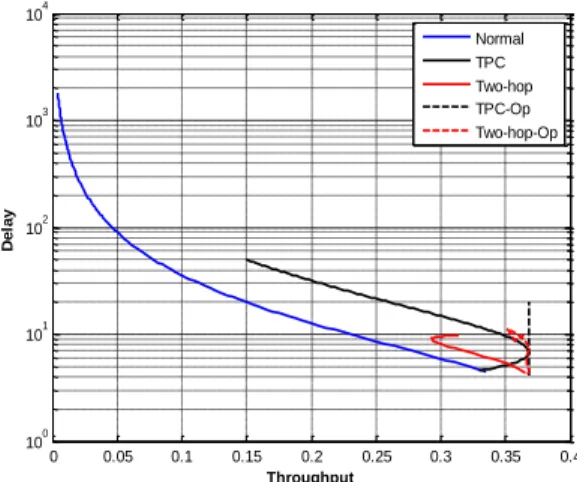
Fig. 10 shows the delay vs. throughput when the number of users is larger than 30 and it well summarizes the comparisons. In terms of delay, two-hop solutions achieve the best, dynamic TPC comes second, and “Normal” is the worst. In terms of throughput, dynamic TPC is slightly better than dynamic two-hop while the fixed two-two-hop solution has more gain over the fixed TPC and “Normal”. It should be noted that the throughput per opportunity is used here, and the graph would have the same trend in comparison if the total access throughput was used.
Fig. 8: Comparison of delay vs. number of users
Fig. 9: Throughput per opportunity vs. number of users
V. CONCLUSION
This paper has studied random access of M2M communications in cellular networks to address the network access congestion problem. Two methods, namely, transmission probability control and two-hop access Aloha, have been investigated. Furthermore, their respective dynamic extensions have been proposed. Performance evaluation shows the proposed solutions can significantly improve the access delay and throughput of M2M applications.
For future work, we are extending our analytical model to the case of multiple traffic priority classes (e.g. with different TPC parameters) and studying the performance with realistic
LTE system parameters and configurations. Further, we are going to investigate MTC scheduling and study its impact on both H2H and MTC traffic in LTE networks. The end-to-end performance of M2M applications over heterogeneous networks (e.g. WLAN, LTE, small cells) is also of interests.
Fig. 10: Comparison of delay vs. throughput per opportunity (number of users ranges from 30 to 150)
VI. ACKNOWLEDGMENTS
The authors would like to acknowledge the fruitful discussions with their colleagues at Toshiba and the support of its directors.
REFERENCES
[1] G. Wu, S. Talwar, K. Johnsson, N. Himayat, and K. Johnson, M2M: From mobile to embedded Internet, IEEE Communications Magazine, April 2011.
[2] ABI research report, Cellular M2M Connectivity Services: The Market Opportunity for Mobile Operators, MVNOs, and Other Connectivity Service Providers, 2012.
[3] 3GPP TR 22.868, Study on facilitating machine to machine communication in 3GPP systems, 2007.
[4] 3GPP TR 23.888, System improvements for Machine-Type Communications (MTC), 2012.
[5] 3GPP TR 37.868, Study on RAN Improvements for Machine-type Communications, 2012.
[6] British Gas smart meter upgrade, http://www.britishgas.co.uk/smarter-living/control-energy/smart-meters.html
[7] T. Taleb and A. Kunz, Machine type communications in 3GPP networks: potential, challenges, and solutions, IEEE Communications Magazine, March 2012.
[8] K. Lee, S. Kim, and B. Yi, Throughput comparison of random access methods for M2M service over LTE networks, IEEE GLOBECOM Workshops, Dec. 2011.
[9] B. Kwak, N. Song, and M. Miller, Performance analysis of exponential backoff, IEEE/ACM Trans. on Networking, vol. 13, no. 2, April 2005. [10] S. Lien et al., Toward ubiquitous massive accesses in 3GPP
machine-tomachine communications, IEEE Communications Magazine, Apr. 2011.
[11] M. Cheng et al., Overload control for machine-type communications in LTE-advanced systems, IEEE Communications Magazine, June 2012. [12] R. Cheng et al., RACH collision probability for machine-type
communications, IEEE VTC-Spring, 2012.
[13] Z. Shi et al., Analytical models for understanding space, backoff and flow correlation in CSMA wireless networks, Wireless Networks, Springer, 2012. 0 50 100 150 100 101 102 103 104 User number D e la y Normal TPC Two-hop TPC-Op Two-hop-Op 0 50 100 150 200 250 300 350 400 0 0.05 0.1 0.15 0.2 0.25 0.3 0.35 0.4 User Number Th rou gh pu t Normal TPC Two-hop TPC-Op Two-hop-Op 0 0.05 0.1 0.15 0.2 0.25 0.3 0.35 0.4 100 101 102 103 104 Throughput D e la y Normal TPC Two-hop TPC-Op Two-hop-Op
![Fig. 1 shows the population density in London based on 2007 statistics [5]. Based on this information, the average number of households per square kilometer and consequently the number of smart electricity meters per cell for different cell rad](https://thumb-us.123doks.com/thumbv2/123dok_us/9446074.2424955/1.893.476.820.684.913/population-statistics-information-households-kilometer-consequently-electricity-different.webp)