CloudTPS: Scalable Transactions
for Web Applications in the Cloud
Zhou Wei, Guillaume Pierre, Chi-Hung Chi
Abstract—NoSQL Cloud data stores provide scalability and high availability properties for web applications, but at the same time they sacrifice data consistency. However, many applications cannot afford any data inconsistency. CloudTPS is a scalable transaction manager which guarantees full ACID properties for multi-item transactions issued by Web applications, even in the presence of server failures and network partitions. We implement this approach on top of the two main families of scalable data layers: Bigtable and SimpleDB. Performance evaluation on top of HBase (an open-source version of Bigtable) in our local cluster and Amazon SimpleDB in the Amazon cloud shows that our system scales linearly at least up to 40 nodes in our local cluster and 80 nodes in the Amazon cloud.
Index Terms—Scalability, Web applications, cloud computing, transactions, NoSQL.
✦
1
INTRODUCTION
C
LOUDcomputing offers the vision of a virtuallyinfi-nite pool of computing, storage and networking re-sources where applications can be scalably deployed [1]. In particular, NoSQL cloud database services such as Amazon’s SimpleDB [2] and Google’s Bigtable [3] offer a scalable data tier for applications in the cloud. These systems typically partition the application data to pro-vide incremental scalability, and replicate the partitioned data to tolerate server failures.
The scalability and high availability properties of Cloud platforms however come at a cost. First, these scalable database services allow data query only by primary key rather than supporting secondary-key or join queries. Second, these services provide only weak consistency such as eventual data consistency: any data update becomes visible after a finite but undeterministic amount of time. As weak as this consistency property may seem, it does allow to build a wide range of useful applications, as demonstrated by the commercial success of Cloud computing platforms. However, many other applications such as payment and online auction services cannot afford any data inconsistency. While primary-key-only data access is a relatively minor inconvenience that can often be accommodated by good data structures, it is essential to provide transactional data consistency to support the applications that need it.
• Zhou Wei is with VU University Amsterdam, the Netherlands and Tsinghua University Beijing, China. Email: [email protected]
• Guillaume Pierre is with VU University Amsterdam, The Netherlands. Email: [email protected]
• Chi-Hung Chi is with Tsinghua University Beijing, China. Email: [email protected]
This work is partially supported by the 863 HighTech Program of China under award #2008AA01Z12.
Manuscript received Nov. 23, 2010; revised Mar. 2, 2011.
For information on obtaining reprints of this article, please send e-mail to: [email protected] and reference IEEECS Log Number TSCSI-2010-11-0141. Digital Object Identifier no. 00.0000/TSC.0000.00.
A transaction is a set of queries to be executed atom-ically on a single consistent view of a database. The main challenge to support transactional guarantees in a cloud computing environment is to provide the ACID properties of Atomicity, Consistency, Isolation and Dura-bility [4] without compromising the scalaDura-bility properties of the cloud. However, the underlying cloud data storage services provide only eventual consistency. We address this discrepancy by creating a secondary temporary copy of the application data in the transaction managers that handle consistency.
Obviously, any centralized transaction manager would face two scalability problems: 1) A single transaction manager must execute all incoming transactions and would eventually become the performance and avail-ability bottleneck; 2) A single transaction manager must maintain a copy of all data accessed by transactions and would eventually run out of storage space. To support scalable transactions, we propose to split the transaction manager into any number of Local Transaction Managers (LTMs) and to partition the application data and the load of transaction processing across LTMs.
CloudTPS exploits three properties typical of Web ap-plications to allow efficient and scalable operations. First, we observe that in Web applications, all transactions are short-lived because each transaction is encapsulated in the processing of a particular request from a user. This rules out long-lived transactions that make scalable transactional systems so difficult to design, even in medium-scale environments [5]. Second, Web applica-tions tend to issue transacapplica-tions that span a relatively small number of well-identified data items. This means that the commit protocol for any given transaction can be confined to a relatively small number of servers holding the accessed data items. It also implies a low (although not negligible) number of conflicts between multiple transactions concurrently trying to read/write the same data items. Third, many read-only queries of
Web applications can produce useful results by accessing an older yet consistent version of data. This allows to execute complex read queries directly in the cloud data service, rather than in LTMs.
CloudTPS must maintain the ACID properties even in the case of server failures. For this, we replicate data items and transaction states to multiple LTMs, and periodically checkpoint consistent data snapshots to the cloud storage service. Consistency correctness relies on the eventual consistency and high availability properties of Cloud computing storage services: we need not worry about data loss or unavailability after a data update has been issued to the storage service.
It should be noted that the CAP theorem proves that it is impossible to provide both strong Consistency and high Availability in the presence of network Parti-tions [6]. Typical cloud services choose high availability over strong consistency. In this article, we make the opposite choice and prefer providing transactional con-sistency for the applications that require it, possibly at the cost of unavailability during network failures.
To implement CloudTPS efficiently, we must address two additional issues:
Firstly, there exists a wide variety of cloud data ser-vices [2], [3], [7], [8]. CloudTPS should be portable across them, and the porting should require only minor adapta-tion. On the one hand, as current cloud data services use different data models and interfaces, we build CloudTPS upon their common features: our data model is based on key-value pairs. The implementation only demands a simple primary-key-based “GET/PUT” interface from cloud data services. On the other hand, current cloud data services provide different consistency levels. For instance, Bigtable supports transactions on single data items while SimpleDB provides either eventual consis-tency or single-item transactions. To ensure the correct-ness and efficiency of CloudTPS, we implement various mechanisms for different underlying consistency levels. Secondly, loading a full copy of application data into the system may overflow the memory of LTMs, forcing one to use many LTMs just for their storage capacity. This is, however, not necessary as only the currently accessed data items contribute to maintaining ACID properties. Other unaccessed data items can be evicted from the LTMs if we can fetch their latest stored versions from the cloud storage service. Web applications exhibit temporal locality where only a portion of application data is accessed at any time [9], [10]. We can therefore design efficient memory management mechanisms to restrict the number of in-memory data items in LTMs while maintaining strong data consistency. Data items being accessed by uncommitted transactions must stay in the LTMs to maintain ACID properties; others depend on a trade-off between memory size and access latency. We use a cost-aware replacement policy to dictate which data items should remain in the LTMs.
We demonstrate the scalability of our transactional
database service using a prototype implementation1.
Following the data models of Bigtable and SimpleDB, transactions are allowed to access any number of data items by primary key at the granularity of the data row. The list of primary keys accessed by a transaction must be given explicitly before executing the transaction. This means for example that range queries are not supported within a transaction. CloudTPS supports both read-write and read-only transactions.
We evaluate our prototype under a workload derived from the TPC-W e-commerce benchmark [11]. We imple-mented CloudTPS on top of two different scalable data layers: HBase, an open-source clone of BigTable [12], running in our local cluster; and SimpleDB, running in the Amazon Cloud [13]. We show that CloudTPS scales linearly to at least 40 LTMs in our local cluster and 80 LTMs in the Amazon Cloud. This means that, according to the principles of Cloud computing, any increase in workload can be accommodated by provisioning more servers. CloudTPS tolerates server failures, which only cause a few aborted transactions (authorized by the ACID properties) and a temporary drop of throughput during transaction recovery and data reorganization. In case of network partitions, CloudTPS may reject incom-ing transactions to maintain data consistency. It recovers and becomes available again as soon as the network is restored, while still maintaining ACID properties. We finally evaluate our memory management mechanism and show that it can effectively control the buffer sizes of LTMs and only cause minor performance overhead.
This article is an extended version of a previous con-ference paper [14]. The additional contributions of this article are as follows: (i) We describe the membership management and failure recovery protocol in detail. This protocol maintains ACID properties in the case of machine failures and network partitions. (ii) We present the memory management mechanism, which prevents LTMs from memory overflow and reduces the required number of LTMs. (iii) We describe our prototype imple-mentation on top of SimpleDB and discuss the port of CloudTPS to other cloud data services. (iv) We further demonstrate the scalability of our transactional system by evaluating the performance of our prototype imple-mentation on top of SimpleDB in the Amazon Cloud.
This article is organized as follows. Sections 2 presents related work. Sections 3 and 4 respectively describe the system model and the system design. Section 5 discusses implementation details and two optimizations for mem-ory management and read-only transactions. Section 6 presents performance evaluations. Section 7 concludes.
2
RELATED
WORK
2.1 Data Storage in the Cloud
The simplest way to store structured data in the cloud is to deploy a relational database such as MySQL or Oracle.
The relational data model, typically implemented via the SQL language, provides great flexibility in accessing data. It supports sophisticated data access operations such as aggregation, range queries, join queries, etc. RDBMSs support transactions and guarantee strong data consistency. One can easily deploy a classical RDBMS in the cloud and thus get support for transactional consistency. However, the flexible query language and strong data consistency prevent one from partitioning data automatically, which is the key for performance scalability. These systems rely on replication techniques and therefore do not bring extra scalability improvement compared to a non-cloud deployment [15], [16].
On the other hand, a new family of cloud database services such as Google Bigtable [3], Amazon SimpleDB [2], Yahoo PNUTS [7], and Cassandra [17], uses sim-plified data models based on attribute-value pairs. Ap-plication data are organized into tables, of which each is a collection of data items. Data items are typically accessed through a “GET/ PUT” interface by primary key. Additional sophisticated data access operations, such as range queries in SimpleDB or data item scanning in Bigtable, are limited within a table. None of them supports operation across multiple tables, such as join queries. This data model allows such systems to partition application data into any number of tables efficiently. Furthermore, these cloud database services relax data consistency: they disallow any consistency rules across multiple data partitions and provide little support for transactions. For example, SimpleDB and Cassandra support eventual consistency, which means that data updates can be visible after an undeterministic amount of time [18]. Bigtable, SimpleDB and PNUTS support transactions but only over a single data item, which is not sufficient to guarantee strong data consistency.
Google Megastore [19], [20] is a transactional indexed record manager on top of BigTable. Megastore supports ACID transactions across multiple data items. However, programmers have to manually link data items into hierarchical groups, and each transaction can only access a single group. In CloudTPS, transactions can access any set of data items together.
Microsoft SQL Azure Database [8] is a scalable cloud data service which supports the relational data model and ACID transactions containing any SQL queries. However, similar to Megastore, it requires manual data partitioning and does not support distributed transac-tions or queries across multiple data partitransac-tions located in different servers.
An alternative approach to implement a cloud database is to run any number of database engines in the cloud, and use the cloud file system as shared storage medium [21]. Each engine has access to the full data set and therefore can support any form of SQL queries. On the other hand, this approach cannot provide full ACID properties. In particular, the authors claim that the Isolation property cannot be provided, and that only reduced levels of consistency can be offered.
Sudipt [22] proposes a similar approach to ours to support scalable transactions in the cloud. It also splits the transaction manager into multiple ones, where each one loads a specific data partition from the cloud storage service and owns exclusive access to it. However, the system does not address the problem of maintaining ACID properties in the presence of machine failures. Furthermore it allows only restricted transactional se-mantic, similar to the one of Sinfonia [23], for distributed transactions across multiple data partitions.
2.2 Distributed Transactional Systems
There have been decades of research efforts in efficiently implementing distributed transactions for distributed database systems [24]. A number of distributed commit protocols [25], [26], [27] and concurrency control mech-anisms [28], [29] have been proposed to maintain the ACID properties of distributed transactions. However, as distributed databases use the same relational data model as RDBMS, they also cannot partition the data automati-cally and thus lack scalability. On the other hand, we can apply these techniques as building blocks in designing CloudTPS. We rely on 2-Phase Commit (2PC) [25] as the distributed commit protocol for ensuring Atomicity, and on timestamp-ordering [30] for concurrency control.
H-Store [31], [32] is a distributed main memory OLTP database, which executes on a cluster of shared-nothing main memory executor nodes. H-Store supports trans-actions accessing multiple data records with SQL se-mantics, implemented as predefined stored procedures written in C++. It also replicates data records to tolerate machine failures. H-Store focuses on absolute system performance in terms of transaction throughput, and achieves very high performance on one executor node. However, H-Store’s scalability relies on careful data par-tition across executor nodes, such that most transactions access only one executor node. On the other hand, we prefer to focus on achieving linear scalability specifically for Web applications, such that any increase in workload can be accommodated by provisioning more servers. Also note that H-Store does not maintain persistent logs or keep any data in the non-volatile storage of either the executor nodes nor any backing store. CloudTPS checkpoints the updates back to the cloud data service to guarantee durability for each transaction.
Sinfonia [23] is a distributed message passing frame-work which supports transactional access to in-memory data across a distributed system. It addresses fault tolerance by primary-copy replication and by writing transactionally consistent backups to disk images. In contrast with our work, Sinfonia provides a low-level data access interface based on memory address and only supports transactions with restricted semantics. Besides, it requires the applications to manage data placement and caching themselves across the distributed system. Sinfonia targets infrastructure applications which require fine-grained control of data structure and placement to
optimize performance. On the other hand, Web appli-cations usually require rapid and flexible development, so we prefer accessing a logical and location-transparent data structure with rich-semantic transactions.
Transactional memory (TM) systems relate to our work as they support transactional access to in-memory data. They traditionally target single multiprocessor ma-chines [33], but recent research works extend them to distributed systems and support distributed transactions across in-memory data of multiple machines [34], [35], [36]. Distributed TM systems however provide no dura-bility for transactions and do not address machine fail-ures. The reason is that TM systems are mainly designed for parallel programs that solve large-sized problems. In this case, only the final results are valuable and required to be durable. On the other hand, TM systems usually execute in a managed environment with few machine failures. They thus provide no durability for intermediate transactions and do not address machine failures to maximize the system performance. However for Web applications which are usually interactive, the result of each transaction is critical. TM systems are therefore not suitable for Web applications.
One of the most similar system to ours is the Scalaris transactional DHT [37]. It splits data across any number of DHT nodes, and supports transactional access to any set of data items addressed by primary key. However, it is purely an in-memory system so it does not supports durability for the stored data. In contrast, CloudTPS provides durability for transactions by checkpointing data updates into the cloud data service. Scalaris relies on the Paxos transactional algorithm, which can address Byzantine failures, but introduces high costs for each transaction. Moreover, each query requires one or more requests to be routed through the DHT, potentially adding latency and overhead. Cloud computing envi-ronments can also be expected to be much more reliable than typical peer-to-peer systems, which allows us to use more lightweight mechanisms for fault tolerance.
Similar to our work, Google Percolator provides multi-row ACID transactions on top of Bigtable [38]. Percolator employs Bigtable as a shared memory for all instances of its client-side library to coordinate transaction man-agement. The data updates and transaction coordination information, such as locks and primary node of a trans-action, are directly written into BigTable. Using single-rows transactions of Bigtable, Percolator can atomically perform multiple actions on a single row, such as lock a data item and mark the primary node of the transaction. In contrast, CloudTPS maintains the data updates, trans-action states and queue of transtrans-actions all in the memory of LTMs. The underlying cloud data store does not participate in the transaction coordination. LTMs check-point data updates back to the cloud data store only after the transaction has been committed. The design differences of CloudTPS and Percolator originate from their distinct focuses. CloudTPS targets response-time sensitive Web applications, while Percolator is designed
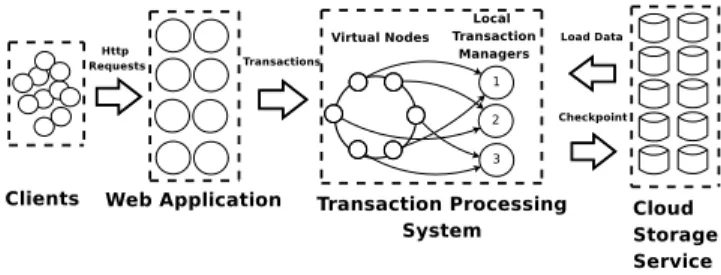
Fig. 1. CloudTPS system organization.
for incremental processing of massive data processing tasks which typically have a relaxed latency requirement.
3
S
YSTEMM
ODELFigure 1 shows the organization of CloudTPS. Clients issue HTTP requests to a Web application, which in turn issues transactions to a Transaction Processing System (TPS). The TPS is composed of any number of LTMs, each of which is responsible for a subset of all data items. The Web application can submit a transaction to any LTM that is responsible for one of the accessed data items. This LTM then acts as the coordinator of the transaction across all LTMs in charge of the data items accessed by the transaction. The LTMs operate on an in-memory copy of the data items loaded from the cloud storage service. Data updates resulting from transactions are kept in memory of the LTMs. To prevent data loss due to LTM server failures, the data updates are repli-cated to multiple LTM servers. LTMs also periodically checkpoint the updates back to the cloud storage service which is assumed to be highly-available and persistent. We implement transactions using the 2-Phase Commit protocol (2PC). In the first phase, the coordinator re-quests all involved LTMs and asks them to check that the operation can indeed been executed correctly. If all LTMs vote favorably, then the second phase actually commits the transaction. Otherwise, the transaction is aborted.
CloudTPS transactions are short-lived and access only well-identified data items. CloudTPS allows only server-side transactions implemented as predefined procedures stored at all LTMs. Each transaction contains one or more sub-transactions, which operate on a single data item each. The application must provide the primary keys of all accessed data items when it issues a transaction.
Concretely, a transaction is implemented as a Java object containing a list of sub-transaction instances. All sub-transactions are implemented as sub-classes of the
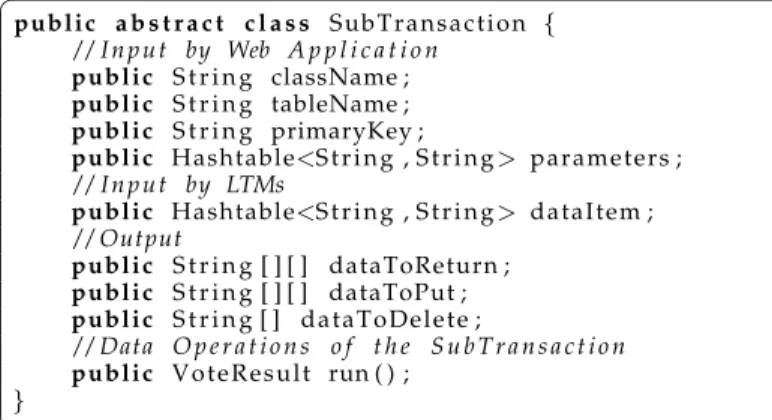
SubTransaction abstract Java class. As shown in Fig-ure 2, each sub-transaction contains a unique class name to identify itself, a table name and primary key to identify the accessed data item, and input parameters organized as attribute-value pairs. Each sub-transaction implements its own data operations by overriding the
run()operation. The return value of the run() operation specifies whether this sub-transaction is able to commit.
public a b s t r a c t c l a s s S u b T r a nsa ct i o n { / / I n p u t by Web A p p l i c a t i o n public S t r i n g className ; public S t r i n g tableName ; public S t r i n g primaryKey ;
public Hashtable<S t r i n g , S t r i n g> parameters ;
/ / I n p u t by LTMs
public Hashtable<S t r i n g , S t r i n g> dataItem ;
/ / Output public S t r i n g [ ] [ ] dataToReturn ; public S t r i n g [ ] [ ] dataToPut ; public S t r i n g [ ] dataToDelete ; / / Data O p e r a t i o n s o f t h e S u b T r a n s a c t i o n public V o t e R e s u l t run ( ) ; }
Fig. 2. The parent class of all sub-transactions classes.
The execution of run() also generates the data updates
and the results for read data operations, which are stored
in the Outputattributes.
The bytecode of all sub-transactions is deployed at all LTMs beforehand. A Web application issues a transaction by submitting the names of included sub-transactions and their parameters. LTMs then construct the corre-sponding sub-transaction instances to execute the trans-action. In the first phase of 2PC, LTMs load the data
items of each sub-transaction and execute the run()
op-eration to decide on their votes and generate proposed data updates. If an agreement to “COMMIT” is reached, LTMs apply the updates.
We assign data items to LTMs using consistent hash-ing [39]. To achieve a balanced assignment, we first cluster data items into virtual nodes, and then assign virtual nodes to LTMs. As shown in Figure 1, multi-ple virtual nodes can be assigned to the same LTM. To tolerate LTM failures, virtual nodes and transaction states are replicated to one or more LTMs. After an LTM server failure, the latest updates can then be recovered and affected transactions can continue execution while satisfying ACID properties.
4
S
YSTEMD
ESIGNWe now detail the design of the TPS to guarantee the Atomicity, Consistency, Isolation and Durability proper-ties. Each of the properties is discussed individually. We then discuss the membership mechanisms to guarantee the ACID properties even in case of LTM failures and network partitions.
4.1 Atomicity
The Atomicity property requires that either all opera-tions of a transaction complete successfully, or none of them does. To ensure Atomicity, for each transaction issued, CloudTPS performs two-phase commit (2PC) across all the LTMs responsible for the data items accessed. As soon as an agreement to “COMMIT” is reached, the transaction coordinator can simultaneously
return the result to the web application and complete the second phase [40].
To ensure Atomicity in the presence of server failures, all transaction states and data items should be replicated to one or more LTMs. LTMs replicate the data items to the backup LTMs during the second phase of transaction. Thus when the second phase completes successfully, all replicas of the accessed data items are consistent. The transaction state includes the transaction timestamp (discussed in Section 4.3), the agreement to “COMMIT,” and the list of data updates to be committed.
When an LTM fails, the transactions it was coordinat-ing can be in two states. If a transaction has reached an agreement to “COMMIT,” then it must eventually be committed; otherwise, the transaction can still be aborted. Therefore, we replicate transaction states in two occasions: 1) When an LTM receives a new transaction, it must replicate the transaction state to other LTMs before confirming to the application that the transaction has been successfully submitted; 2) After all participant LTMs reach an agreement to “COMMIT” at the coordi-nator, the coordinator updates the transaction state at its backups with the agreement to “COMMIT” and all the data updates. The participant LTMs piggyback their data updates with their vote messages. This creates in essence in-memory “redo logs” at the backup LTMs. The coordinator must finish this step before carrying out the second phase of the commit protocol. If the coordinator fails after this step, the backup LTMs can then commit the transaction. Otherwise, it can simply abort the trans-action without violating the ACID properties.
An LTM server failure also results in the inaccessibility of the data items it was responsible for. It is necessary to
re-replicate these data items to maintainN backups. If a
second LTM server failure happens during the recovery process of a previous LTM server failure, the system initiates the recovery of the second failure after the first recovery process has completed. The transactions that cannot recover from the first failure because they also accessed the second failed LTM are left untouched until the second recovery process.
As each transaction and data item hasN+1replicas in
total, the TPS can thus guarantee the Atomicity property
under the simultaneous failure ofN LTM servers.
4.2 Consistency
The Consistency property requires that a transaction, which executes on a database that is internally consis-tent, will leave the database in an internally consistent state. Consistency is typically expressed as a set of declarative integrity constraints. We assume that the con-sistency rule is applied within the logic of transactions. Therefore, the Consistency property is satisfied as long as all transactions are executed correctly.
4.3 Isolation
The Isolation property requires that the behavior of a transaction is not disturbed by the presence of other
transactions that may be accessing the same data items concurrently. The TPS decomposes a transaction into a number of sub-transactions, each accessing a single data item. Thus the Isolation property requires that if two transactions conflict on any number of data items, all their conflicting sub-transactions must be executed sequentially, even though the sub-transactions are exe-cuted in multiple LTMs.
We apply timestamp ordering for globally ordering conflicting transactions across all LTMs. Each transaction has an globally unique timestamp among all of its con-flicting transactions. All LTMs then order transactions as follows: a sub-transaction can execute only after all con-flicting sub-transactions with a lower timestamp have committed. It may happen that a transaction is delayed (e.g., because of network delays) and that a conflicting sub-transaction with a younger timestamp has already committed. In this case, the older transaction will abort, obtain a new timestamp and restart the execution of all of its sub-transactions.
As each sub-transaction accesses only one data item by primary key, the implementation is straightforward. Each LTM maintains a list of sub-transactions for each data item it handles. The list is ordered by timestamp so LTMs can execute the sub-transactions sequentially in the timestamp order. The exception discussed before happens when an LTM inserts a sub-transaction into the list but finds its timestamp smaller than the one currently being executed. It then reports the exception to the coordinator LTM of this transaction so that the whole transaction can be restarted. We extended the 2PC with an optional “RESTART” phase, which is triggered if any of the sub-transactions reports an ordering exception. After a transaction reaches an agreement and enters the second phase of 2PC, it cannot be restarted any more.
We are well aware that assigning timestamps to trans-actions using a single global timestamp manager can create a potential bottleneck and a single point of failure in the system. A simpler, fully decentralized solution consists of letting each LTM generate timestamps using its own local clock, coupled with the LTM’s ID to enforce a total order between timestamps. Note that this solution does not require perfectly synchronized clocks for ensur-ing correctness. Transactions do not necessarily need to be timestamped according to their real-time submission order, but there must simply be a total order between any pair of transactions. However, if one LTM clock significantly lags behind the others, then the transactions submitted at this LTM will have a higher chance of being restarted than others. The DAS-3 cluster does not use NTP synchronization between its nodes, which is the reason why we used a centralized timestamp manager in our experiments.
4.4 Durability
The Durability property requires that the effects of com-mitted transactions cannot be undone and would survive
server failures. In our case, it means that all the data updates of committed transactions must be successfully written back to the backend cloud storage service.
The main issue here is to support LTM failures without losing data. For performance reasons, the commit of a transaction does not directly update data in the cloud storage service but only updates the in-memory copy of data items in the LTMs. Instead, each LTM issues periodic updates to the cloud storage service. During the time between a transaction commit and the next checkpoint, durability is ensured by the replication of data items across several LTMs. After checkpoint, we can rely on the high availability and eventual consistency properties of the cloud storage service for durability.
When an LTM server fails, all the data items stored in its memory that were not checkpointed yet are lost. However, as discussed in Section 4.1, all data items of the failed LTM can be recovered from the backup LTMs. The difficulty here is that the backups do not know which data items have already been checkpointed. One solution would be to checkpoint all recovered data items. However, this can cause a lot of unnecessary writes. One optimization is to record the latest checkpointed transaction timestamp of each data item and replicate these timestamps to the backup LTMs. We further cluster transactions into groups, then replicate timestamps only after a whole group of transactions has completed.
Another issue related to checkpointing is to avoid degrading the system performance at the time of a checkpoint. The checkpoint process must iterate through the latest updates of committed transactions and select the data items to be checkpointed. A naive implemen-tation that would lock the whole buffer during check-pointing would also block the concurrent execution of transactions. We address this problem by maintaining an extra buffer in memory with the list of data items to be checkpointed. Transactions write to this buffer by sending updates to an unbounded non-blocking concur-rent queue [41]. This data structure has the property of allowing multiple threads to write concurrently to the queue without blocking each other. Moreover, it orders elements in FIFO order, so old updates will not override younger ones.
4.5 Membership
To correctly execute transactions, all LTMs must share the same view of system membership to determine the assignment of data items consistently. The system membership changes when LTMs join, leave, fail or recover from failures. These events may happen at any time, including during the execution of transactions. To ensure the ACID properties, changes in system mem-bership must not take place during the 2PC execution of any transaction. When an LTM fails, other LTMs must therefore first complete the recovery of all ongoing transactions before updating the system membership.
In addition to LTM failures, the system may also encounter network failures, which can temporarily split
the LTMs into multiple disconnected partitions. In such a case, according to the CAP dilemma, we decide to guarantee consistency at the possible cost of a loss of availability. In the case of system partitioning, trans-actions may still proceed provided that: (i) one of the partitions is able to elect itself as the “majority” partition; and (ii) its LTMs can recover the consistent states of all data items. In all other cases the system will reject incoming transactions until it fulfills the condition again. This section presents our mechanism to recover the system consistently from network partitions.
4.5.1 Membership Updates
To ensure a consistent membership, all membership changes are realized through a 2PC across all available LTMs. All LTMs block incoming transactions until the new system membership has been committed consis-tently. In the first phase of a membership change, each LTM waits for all of its coordinated ongoing transactions to terminate, and then votes “COMMIT.” After reaching an agreement to “COMMIT,” the second phase updates the system membership and applies the new data as-signment through data item replication/relocation.
Each membership change creates a new membership version attached to a monotonically increasing times-tamp. Each LTM attaches the timestamp of its current membership to all of its messages. If an LTM receives a message with a higher timestamp than its own, this means that the other LTMs consider it as having failed. The concerned LTM discards its entire state and rejoins. After each membership change, the new timestamp is stored in a special “Membership” table in the cloud data service. By scanning through this “Membership” table, any new LTM or any Web application instance can locate the currently available LTMs. One issue is that the cloud data services may return a stale membership. However, one can contact the TPS and obtain the latest membership as long as the stale membership contains at least one LTM currently in the TPS.
Any LTM may initiate a membership update if it wants to join the system or it detects the unavailability of other LTMs. This means that multiple membership updates may be issued simultaneously. To guarantee the isolation of such updates, we use a simple opti-mistic concurrency control mechanism so that only one membership update can take place at a time [42]. If an LTM receives a request for a membership update before a previous one has finished, then this LTM will vote “ABORT” to the latter. To avoid continuous conflicts and aborts, LTMs may insert a random time delay before re-initiating the aborted membership update.
4.5.2 Dealing with Network Partitions
In case of a network partition, multiple system subsets may consider that the other unreachable LTMs have failed, recover from their “failures” and carry on with processing the application workload independently from
A B
C
X
Fig. 3. An example of unclean network partition.
each other. However, this would violate the ACID prop-erties and must therefore be avoided.
For simplicity, we assume that no network partition occurs during the recovery of another partition. Support-ing this latter case requires additional algorithms that we consider out of the scope of this article.
We use the Accessible Copies algorithm [43] to recover the system consistently during network partitions. This algorithm ensures that only one partition may access a given data item by allowing access to a given data item only within a partition that contains a majority of replicas. Instead of using a majority partition for each data item, we adapt the “majority” rule such that only the partition that contains more than half of the previous membership can access all data items. Minority partitions are forbidden access to any data item. It may
happen that the majority partition lacks more than N
LTM servers from the previous membership2, and thus
cannot recover all data items; in this case it rejects all incoming transactions until it can recover all data items. Once a majority partition is established, it can recover all the ongoing transactions and accept new incoming transactions. After recovery, all LTMs in the majority partition have the new system membership with an increased timestamp. The other ones, which still have the previous membership timestamp, can detect after network partition recovery that they have been excluded from the membership, and rejoin as new members.
When an LTM discovers that other LTMs are unreach-able because of LTM crashes and/or network partitions, it identifies its new partition membership through a 2PC across all LTMs. In the first phase, it sends an “invitation” to all LTMs; any responding LTM which votes “COMMIT” belongs to its partition membership. After all LTMs either respond or time-out, the second phase updates the partition membership of all LTMs in the partition of the coordinator. One optimization is to exclude the discovered unreachable LTMs from the first 2PC of building partition membership. This optimization is effective for the scenario of LTM failures, avoiding a possible delay of time-out in waiting for responses from these failed LTMs. In case of network partitions, the first 2PC may fail to establish a majority partition to recover the system. LTMs should then include these excluded LTMs back into the following periodic 2PCs building partition membership.
The above mechanism can organize the TPS into a number of disjoint partitions, provided that the
work is “cleanly” partitioned: any two LTMs in the same partition can communicate, and any two LTMs in different partitions cannot. However, a network may also be “uncleanly” partitioned due to the lag of recon-structing routing tables. Figure 3 shows an example of unclean partition where each LTM has a different view
of reachable LTMs: view(A) = {A,C}, view(B) = {B,C}
and view(C) = {A,B,C}. In this case, LTM C may join
two different partitions: either {A,C} or {B,C}, which
both turn out to be majority partitions. To ensure that an LTM can only belong to one partition at a time, we define that if an LTM has already joined a partition, it will vote “ABORT” to any “invitation” of joining a different partition.
Minority partitions periodically try to rejoin the sys-tem by checking if previously unavailable nodes become reachable again. Receiving an “ABORT” vote for an “invitation” indicates that partitions are reconnected. In this case, the two partitions can be merged through a 2PC across all LTMs in the two partitions. The first phase is to push the memberships of two partitions to all the participant LTMs. A participant LTM votes “COMMIT” if the received membership matches its current latest partition membership. Otherwise, it votes “ABORT.” If an agreement to “COMMIT” is reached, the second phase updates the partition membership of all participant LTMs into the combined membership of two partitions. If any participant LTM votes “ABORT” or fails to respond, the 2PC is aborted.
5
SYSTEM
IMPLEMENTATION
This section discusses implementation details of
CloudTPS, in particular how to support various backend cloud data storage services. We also present two optional optimizations: memory management to prevent memory overflow in the LTMs, and handling of read-only transactions containing complex read queries.
5.1 Portability
CloudTPS relies on a cloud data storage service to ensure transaction durability. However, current cloud data stor-age services support different data models, consistency guarantees, operation semantics and interfaces. Adapt-ing CloudTPS to all of them is a challenge. We compare three prominent and typical cloud data services: Amazon SimpleDB, Google Bigtable and Yahoo PNUTS. Our im-plementation is compatible with SimpleDB and Bigtable. Porting CloudTPS to other data services requires only minor adaptations.
SimpleDB, Bigtable and PNUTS have a number of similarities in their data models. They all organize ap-plication data into tables. A table is structured as a collection of data items with unique primary keys. The data items are described by attribute-value pairs. All attribute values are typed as strings. Data items in the same table can have different attributes. Data items are
TABLE 1
Key differences between cloud data services SimpleDB Bigtable PNUTS Data Item Multi-value Multi-version Multi-version
attribute with timestamp with timestamp Explicitly
Schema No schema Column-families claimed attributes Range queries Single-table Single-table
Operation on arbitrary scan with scan with attributes various filtering predicates of a table conditions
Consistency Eventual Single-row Single-row consistency transaction transaction
accessed with “GET/PUT” by primary key. Operations across tables, such as join queries, are not supported.
On the other hand, as shown in Table 1, the three cloud data services also have some key differences:
First, SimpleDB supports multiple values per attribute of a data item, while Bigtable and PNUTS only allow one. To be compatible with all of them, our data model allows only one value per attribute.
Second, SimpleDB does not impose a predefined schema for its tables. PNUTS requires explicit claims of all attributes in a table, but it is still compatible with SimpleDB, as it does not require all records to have values for all claimed attributes and new attributes can be added at any time without halting query or update ac-tivity. On the other hand, Bigtable groups attributes into predefined column-families. To access an attribute, one must include its column-family name as its prefix. We address this difference by always prepending attribute names with the column-family name for Bigtable.
Third, all three cloud data services support sophis-ticated data access operations within a table, but via different APIs. SimpleDB supports range queries inside a table with its specific language; Bigtable and PNUTS provide similar functionality with table scanning using various filtering conditions or predicates. This difference is irrelevant to the system design described before, as it accesses data items only by primary key. However, the optimization of read-only transactions, described in Section 5.3, allows Web applications to access consistent data snapshots in cloud data services directly via their APIs. Therefore, the implementation of this optimization depends on the interface of the underlying cloud data service.
Finally, SimpleDB provides eventual consistency by default so that applications may read stale data. In contrast, Bigtable and PNUTS support single-row trans-actions, so they can guarantee returning the latest up-dates. We assume that when CloudTPS starts and loads a data item from the cloud data service for the first time, all the replicas of this data item are consistent. So CloudTPS can obtain the latest updates in this case, regardless of the consistency level of underlying cloud data service. However, this is not true for reloading a data item that has been recently updated. Different
data consistency models of cloud data services require additional adaptations to implement our performance optimizations, as discussed in the following sections.
5.2 Memory Management
For efficiency reasons we keep all data in the main memory of the LTMs. However, maintaining a full copy of all application data may overflow the memory space, if the size of the data is large. One would thus have to allocate unnecessary LTM servers just for their memory space, rather than for their contributions to performance improvement. On the other hand, we notice that Web applications exhibit temporal data locality so that only a small portion of application data is accessed at any time [9], [10]. Keeping unused data in the LTMs is not necessary for maintaining ACID properties, so LTMs can evict these data items in case of memory shortage, and reload them from the cloud data service when necessary. The key issue is that the eviction of any data items from LTMs must not violate the ACID properties of transactions. Obviously, the data items that are currently accessed by ongoing transactions must not be evicted until the transaction completes and the data updates have been checkpointed. After evicting a data item from the LTMs, future transactions may require it again. To guarantee strong consistency for these transactions, LTMs have to guarantee that the latest version of the evicted data items can be obtained from the cloud data service in the next read. The solution to this issue, however, depends on the consistency level guaranteed by the underlying cloud data service. To ensure that the latest version of a data item is visible, CloudTPS re-quires that the underlying cloud data service supports at least “Monotonic-reads” consistency [44]. If the data ser-vice provides the “Read-your-writes” consistency, check-pointing back the latest updates successfully is sufficient to be able to evict a data item. For instance, Bigtable and PNUTS support single-row transactions and thus pro-vide “Read-your-writes” consistency. If the data service provides only eventual consistency, such as in SimpleDB, then LTMs may still obtain stale data even after a “GET” returned the latest version. To address this problem, we store the timestamps of the latest versions of all data items in LTMs, which can then determine if the newly loaded version of data item is up-to-date. If it is not, LTMs will abort the transactions and maintain ACID properties at the cost of rejecting these transactions.
Storing the latest timestamps of all data items in memory may also overflow the memory if the number of data items is extremely large. Storing them in the cloud data service is not an option, since they must maintain strong consistency. A simple solution could be to store them in the local hard drive of the LTM.
Another difficulty is that SimpleDB does not support multi-versions with timestamp, but multi-values for an attribute. We address this by attaching a timestamp at the end of the value of each attribute and so transform “multi-values” into “multi-versions.”
To minimize the performance overhead of memory management, we must maximize the hit rate of trans-actions in LTMs and thus carefully select which data items should be evicted. Standard cache replacement algorithms, such as LRU, assume that all data items have identical sizes. However, in CloudTPS, data items can have very different sizes, leading to poor perfor-mance. Instead we adopt the cost-aware GreedyDual-Size (GDS) algorithm [45], which leverages knowledge of data item sizes to select data items to evict. The GDS
algorithm associates a value H to each data item p:
H(p) =L+cost/size, whereLis theH value of the latest
evicted data item. We set thecostparameter to 1 for all
data items as this optimizes hit rate. The parametersize
refers to the size of data itemp. Each time an LTM needs
to replace a data item, it selects the data item with the
lowest H value and updates itsL value to theH value
of this evicted data item. When a data item is accessed,
the H value of this data item is recalculated with the
updated parameters: the latest L value and its possibly
changedsize.
5.3 ReadOnly Transactions
CloudTPS supports read-write and read-only transac-tions indifferently. The only difference is that in read-only transactions no data item is updated during the second phase of 2PC. Read-only transactions have the same strong data consistency property as read-write transactions, but also the same constraint: accessing well identified data items by primary key only. However, CloudTPS provides an additional feature to support complex read-only transactions containing for example range queries.
We exploit the fact that many read queries can produce useful results by accessing a consistent but possibly stale data snapshot. For example, in e-commerce Web applications, a promotion service may identify the best seller items by aggregating recent orders information. However, it may not be necessary to compute the result based on the absolute most recent orders. We therefore introduce the concept of Weakly-Consistent Read-only Transaction (WCRT): A WCRT contains any number of read operations offered by the cloud data service, such as table scans for Bigtable. Web applications issue WCRTs directly to the cloud data service, bypassing the LTMs. All read operations of a WCRT executes on the same internally consistent but possibly slightly outdated snapshot of the database.
To implement WCRTs, we introduce a snapshot mech-anism in the checkpoint process of LTMs, which marks each data update with a specific snapshot ID that is monotonically increasing. This ID is used as the version number of the newly created version when it is written to the cloud storage service. A WCRT can thus access a specific snapshot by only reading the latest version of any data item of which the timestamp is not larger than the snapshot ID.
We group transactions in sets of M conscutive trans-actions. Each set constitutes a new snapshot. Assuming that the transaction timestamp is implemented as a simple counter, the first snapshot reflects all the updates
of committed transactions [0, M). The next snapshot
reflects updates from transactions [0,2M), and so on.
At the finest granularity, with M = 1, each read-write
transaction creates a new snapshot.
The key issue in this snapshot mechanism is to de-termine whether a consistent snapshot is fully available in the cloud data service such that WCRTs can execute on it. A consistent snapshot contains all the updates of the transactions which it reflects. It is fully available only after all these updates have been checkpointed back. The main difficulty is that a transaction may update data items across multiple LTMs, where each LTM performs checkpoints for its own data items independently from the others. Therefore, CloudTPS must collect checkpoint progress information from multiple LTMs. To address this issue, we use the cloud data service as a shared medium for collecting checkpoint progress information. The system creates an extra table named “Checkpoint,” where each LTM writes its latest completed snapshot ID into a separate data item using its membership ID as the primary key value. So the minimal snapshot ID stored in the “Checkpoint” table represents the latest snapshot of which the updates are all checkpointed.
Even though all the updates of a snapshot have been checkpointed successfully, the availability of this snap-shot still depends on the consistency level provided by the cloud data service. The data services must provide at least “Monotonic-reads” consistency, so that LTMs can verify the visibility of the updates before claiming the snapshot is available. Bigtable and PNUTs support single-row transactions and thus provide the “Read-Your-Writes” consistency. Therefore, the snapshot is im-mediately available after writing all checkpoints back. Lastly, if the cloud data store supports only eventual consistency, it is impossible to guarantee the visibility of certain writes in the next read so this feature is not supported.
6
EVALUATION
We demonstrate the scalability of CloudTPS by present-ing the performance evaluation of a prototype imple-mentation on top of two different families of scalable data layers: HBase running in our local DAS-3 clus-ter [12] and SimpleDB running in the Amazon Cloud. We also show that CloudTPS can recover from LTM failures and network partitions efficiently by presenting the throughput of CloudTPS under these failures. Lastly, we demonstrate the effectiveness of the memory man-agement mechanism and discuss the trade-off between system performance and buffer sizes.
We evaluate CloudTPS under a workload derived from TPC-W [11], an industry standard e-commerce benchmark that models an online bookstore similar to Amazon.com.
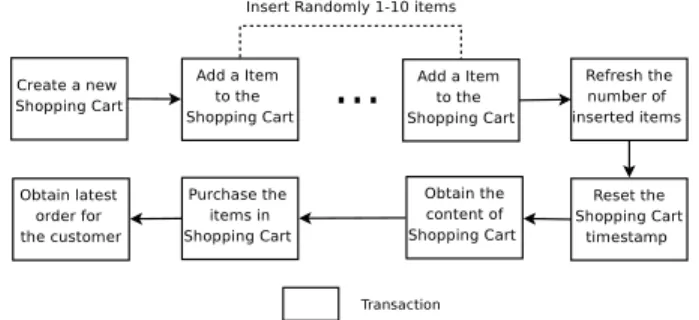
Fig. 4. Transactions of TPC-W.
6.1 Migration of TPC-W to the Cloud
TPC-W was originally designed as a Web application using a SQL-based relational database as backend. We therefore need to adapt the original relational data model of TPC-W into the data models of BigTable and SimpleDB. As described in Section 5.1, we can easily adapt the Bigtable data model into SimpleDB data model by using the exact same attribute names, which are prepended with the column family names. Therefore, we first adapt the relational data model of TPC-W into the Bigtable data model.
Using similar data denormalization techniques as in [46], we designed a Bigtable data model for TPC-W that contains the data accessed by the transactions in Figure 4. The relational data model of TPC-W com-prises six tables that are accessed by these transactions. To adapt this data model to Bigtable, we first com-bine five tables (“Orders, Order Line, Shopping Cart, Shopping Cart Entry, CC XACTS”) into one “bigtable” named “Shopping.” Each of the original tables is stored as a column family. The new bigtable “Shopping” has the same primary key as table “Shopping Cart.” For table “Order Line,” multiple rows are related to one row in ta-ble “Order,” they are combined into one row and stored in the new bigtable by defining different column names for the values of same data column but different rows. Second, for the remaining table “Item,” only the column “i stock” is accessed. We can thus have a bigtable named “Item Stock” which only contains this column and has the same primary key. Finally, for the last transaction in Figure 4 which retrieves the latest order information for a specific customer, we create an extra index bigtable “Latest Order” which uses customer IDs as its primary key and contains one column storing the latest order ID of the customer.
For both HBase and SimpleDB, we populate 144,000 customer records in the “Latest Order” bigtable and 10,000 item records in the “Item Stock” bigtable. We then populate the “Shopping” bigtable according to the benchmark requirements. As shown in Figure 4, the workload continuously creates new shopping carts. Thus, the size of the “Shopping” bigtable increases con-tinuously during the evaluation, while the other two bigtables remain constant in size. In the memory
man-agement evaluation, we also measure the performance of 1 million records in the “Item Stock” bigtable.
In the performance evaluation based on HBase, we observed a load balancing problem. TPC-W assigns new shopping cart IDs sequentially. However, each HBase node is responsible for a set of contiguous ranges of ID values, so at any moment of time, most newly created shopping carts would be handled by the same HBase node. To address this problem, we horizontally parti-tioned the bigtables into 50 sub-bigtables and allocated data items to subtables in round-robin fashion.
To port TPC-W to SimpleDB, we organize application data into a number of domains (i.e., tables), but each domain can only sustain a limited amount of update workload. So we also have to horizontally partition a table in round-robin fashion and place each partition into a domain. Different from HBase, we can use at most 100 domains for the whole application. We therefore partition the three tables into different number of sub-tables according to our estimated data access loads. We horizontally partition the “Shopping” bigtable into 80 domains and the other two bigtables into 5 domains each. This way SimpleDB can provide sufficient capacity for both writes and reads, while CloudTPS remains the performance bottleneck for performance evaluation.
6.2 Experiment Setup
We perform evaluations on top of two scalable data layers: 1) HBase v0.2.1 [12] running in the DAS-3 clus-ter [47]; 2) SimpleDB in the Amazon Cloud [13]. We use Tomcat v5.5.20 as application server. The LTMs and load generators are deployed in separate application servers. DAS-3 is an 85-node Linux-based server cluster. Each node has a dual-CPU / dual-core 2.4 GHz AMD Opteron DP 280, 4 GB of memory and a 250 GB IDE hard drive. Nodes are interconnected with a Gigabit LAN.
Amazon EC2 offers various types of virtual machine instances. We perform our evaluations with Small In-stances in the Standard family (with 1.7 GB memory, 1 virtual core with 1 EC2 Compute Unit, and 160 GB storage) as well as Medium Instances in the High-CPU family (with 1.7 GB of memory, 2 virtual cores with 2.5 EC2 Compute Units each, and 350 GB of storage). At the time of our experiment, Standard Small instances cost $0.10 per instance-hour while High-CPU Medium instances cost $0.20 per instance-hour. One EC2 Com-pute Unit provides the CPU capacity of a 1.0-1.2 GHz 2007 Opteron or 2007 Xeon processor.
TPC-W workload is generated by a configurable num-ber of Emulated Browsers (EBs) which issue requests from one simulated user. Our evaluations assume that the application load remains roughly constant. The workload that an Emulated Browser issues to the TPS mainly consists of read-write transactions that require strong data consistency. Figure 4 shows the workflow of transactions issued by an Emulated Browser, which simulates a typical customer shopping process. Each EB
waits for 500 milliseconds on average between receiving a response and issuing the next transaction.
6.3 Scalability Evaluation
We study the scalability of CloudTPS in terms of max-imum sustainable throughput under a response time constraint. In DAS-3, we assign one physical machine for each LTM, and have low contention on other resources such as network. Therefore, for the evaluations in DAS-3, we define a demanding response time constraint that imposes that the 99% of transactions must return within 100 ms. On the other hand, in the public Amazon cloud, our LTMs have to share a physical machine with other instances, and we have less control of the resources such as CPU, memory, network, etc. Furthermore, even multi-ple instances of the exact same type may exhibit different performance behavior [48]. Therefore, to prevent these interferences from disturbing our evaluation results, we relax the response time constraint for the evaluations in the Amazon cloud: 90% of transactions must return within 100 ms.
We perform the scalability evaluation by measuring the maximum sustainable throughput of the system consisting of a given number of LTMs before the con-straint gets violated. In DAS-3, we start with one LTM and 5 HBase servers, then add more LTM and HBase servers. We carry out each round of the experiment for 30 minutes to measure the performance of system under a certain number of EBs. In all cases, we delib-erately over-allocate the number of HBase servers and client machines to make sure that CloudTPS remains the performance bottleneck. We perform similar steps in the Amazon cloud. CloudTPS remains the performance bottleneck, as SimpleDB can provide sufficient capacity for both writes and reads. We configure the system so that each transaction and data item has one backup in total, and set the checkpoint interval to 1 second.
Figure 5(a) shows that CloudTPS scales nearly linearly in DAS-3. When using 40 LTM servers it reaches a maximum throughput of 7286 transactions per second generated by 3825 emulated browsers. In this last con-figuration, we use 40 LTM servers, 36 HBase servers, 3 clients to generate load, and 1 global timestamp server. This configuration uses the entire DAS-3 cluster so we could not extend the experiment further. The maximum throughput of the system at that point is approximately 10 times that of a single LTM server.
Figure 5(b) shows the scalability evaluation in the Amazon cloud. Here as well, CloudTPS scales nearly linearly with both types of EC2 virtual instances. When using 80 “Standard Small” instances, CloudTPS reaches a maximum throughput of 2844 transactions per second generated by 1600 emulated browsers. The maximum throughput of the system at that point is approximately 40 times that of a single LTM server. When using 20 “High-CPU” Medium instances, CloudTPS reaches a maximum throughput of 3251 transactions per second
0 1000 2000 3000 4000 5000 6000 7000 8000 0 5 10 15 20 25 30 35 40 Maximum Throughput (TPS) Number of LTMs
(a) HBase + DAS-3.
0 500 1000 1500 2000 2500 3000 3500 0 10 20 30 40 50 60 70 80 Maximum Throughput (TPS) Number of LTMs Standard Small HighCPU Medium
(b) SimpleDB + Amazon EC2.
Fig. 5. Throughput under a response time constraint.
1 10 100 1000 10000 100000 1e+06 1e+07 0 5 10 15 20 25 Number of Transactions Number Of Accessed LTMs
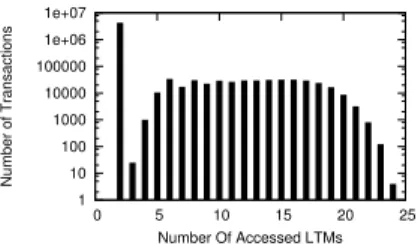
Fig. 6. Number of LTMs accessed by the transactions of TPC-W with a total system system size of 40 LTMs.
generated by 1800 emulated browsers. This is a 10-fold improvement compared to one LTM.
Furthermore, we explore the cost-effectiveness of the two EC2 instance types for CloudTPS. The “High-CPU medium” instances cost 2 times more than “Standard Small” instances. As show in Figure 5(b), 20 “High-CPU medium” instances, which together cost $4 per hour, can sustain a higher throughput than 80 “Standard Small” instances, which together cost $8 per hour. For this application, using “High-CPU medium” instances are more cost-effective than “Standard Small” ones.
The linear scalability of CloudTPS relies on the prop-erty that transactions issued by Web applications only access a small number of data items, and thus span only a small number of LTMs. We illustrate this property by measuring the number of LTMs that participate in the transactions with the configuration of 40 LTMs servers. As shown in Figure 6, 91% of transactions access only two LTMs, i.e., one LTM and its backup. We expect this behavior to be typical of Web applications. The purchase transaction in Figure 4 is the only transaction that accesses more than one data item. It first creates an order and clears the shopping cart inside the data item
of the “Shopping” bigtable, then updates the stocks of all purchased items in the “Item Stock” bigtable, and lastly updates the latest order ID of the customer in the “Latest Order” bigtable. As the number of items contained in a shopping cart is uniformly distributed between 1 and 10, the number of data items accessed by a purchase transactions also has an uniform distribution between 3 and 12. Counting in the backup LTMs, the maximum number of accessed LTMs is 24. Figure 6 shows that larger number of purchase transactions access 5 to 19 LTMs. It is because the accessed data items may be located within the same LTM, so the number of accessed LTMs may be smaller than the number of accessed data items.
In our evaluations, we observe that CloudTPS is mostly latency-bound. For example, LTMs that are stressed to the point of almost violating the response time constraint never exhibit a CPU load above 50%, and their network bandwidth usage consistently remains very low. The main factors influencing performance are the network round-trip times and the queueing de-lays inside LTMs. CloudTPS is therefore best suited for deployments within a single data center. Some Cloud data stores, such as PNUTS, replicate data across data centers to ensure low latency for geographically dis-tributed user-base and tolerate failures of a complete data center. Using CloudTPS in such scenarios would increase network latencies between LTMs, thereby in-creasing response time of transactions and dein-creasing the throughput. Exploiting a multi-data center environment efficiently would require to revisit the policy which assigns data items to LTMs so that data items are placed close to the users which access them most. We however consider such extension as out of the scope of this article.
6.4 Tolerance to Failures and Partitions
We now study the system performance in the presence of LTM server failures and network partitions. We perform the evaluation in both DAS-3 and the Amazon Cloud. We configure CloudTPS with 5 LTM servers, and each transaction and data item has one backup. We generate a workload using 500 EBs in DAS-3 and 50 EBs in the Amazon cloud, such that the system would not overload even after an LTM server failure. After the system throughput is stabilized, we first kill one LTM server. Afterwards, we simulate a 5-minutes network partition where each partition contains one LTM server. After detecting the failures, all alive LTMs continu-ously attempt to contact with other LTMs. The time delay between two attempts of contact follows a uniform distribution between 200 and 1200 milli-seconds.
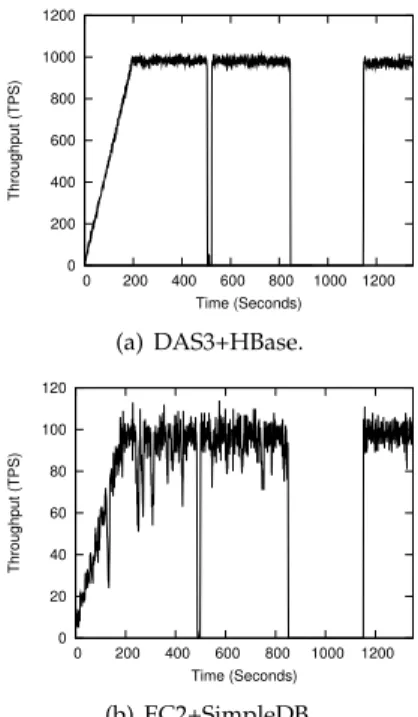
Figure 7(a) illustrates the evaluation in DAS-3. We first warm up the system by adding 25 EBs every 10 seconds. The full load is reached after 200 seconds. After running the system normally for a while, one LTM server is shutdown to simulate a failure at time 504 seconds. After the LTM failure it takes 18.6 seconds for the system to
0 200 400 600 800 1000 1200 0 200 400 600 800 1000 1200 Throughput (TPS) Time (Seconds) (a) DAS3+HBase. 0 20 40 60 80 100 120 0 200 400 600 800 1000 1200 Throughput (TPS) Time (Seconds) (b) EC2+SimpleDB.
Fig. 7. Effect of LTM failures and network partitions.
return to the previous level of transaction throughput. This duration is composed of:
• 0.5 second to rebuild a new membership, including
a delay of 382 ms before the 2PC to avoid conflicts and 113 ms to build the new membership;
• 12.2 seconds to recover the blocked transactions
which were accessing the failed LTM;
• 5.9 seconds to reorganize the data placement of
LTMs to match the new system membership. Afterward, at time 846 seconds, we simulate a net-work partition lasting for 5 minutes. When we restore the network partition, the system recovers and returns to the previous level of transaction throughput in 135 milliseconds. The reason why the system recovers so fast is because there is no LTM failure along with the network partition, so all blocked transactions can resume execution without recovery, and no data redistribution is necessary.
Figure 7(b) depicts the same evaluation in Amazon EC2. The LTM server fails at time 486 seconds. After detecting the LTM failure, the system spends 13 seconds to recover and the transaction throughput returns to the previous level at time 499 seconds. During the failure recovery, the remaining 4 LTMs first merge into one partition in about 1 second. Then the system recovers transactions in 4 seconds and reorganizes data place-ment in 8 seconds. Later, the system encounters a 5-minutes network partition. After the network partition is restored, the system recovers in 207 milliseconds and returns to the previous level of transaction throughput at time 1152 seconds. The system throughput in the Amazon cloud fluctuates more than in DAS-3 because we have less control of virtualized resources in the Amazon cloud. 0 20 40 60 80 100 120 0 500 1000 1500 2000 2500 3000
Hit Rate (Percentage %)
Time (Seconds) 10k items 1M items
Fig. 8. Hit rate of LTM #1.
6.5 Memory Management
Lastly, we demonstrate that our memory management mechanism can effectively prevent LTMs from memory overflow, and study the performance of CloudTPS with different buffer sizes and data sizes. We carry out the evaluation in DAS-3 on top of HBase, which provides “Read-your-writes” consistency. We configure the system such that, before evicting a data item, LTMs fetch the data item from HBase and verify that the obtained value reflects the latest in-memory updates. Therefore, this per-formance evaluation represents the system implementa-tion for the cloud data services supporting “Monotonic-reads” consistency level.
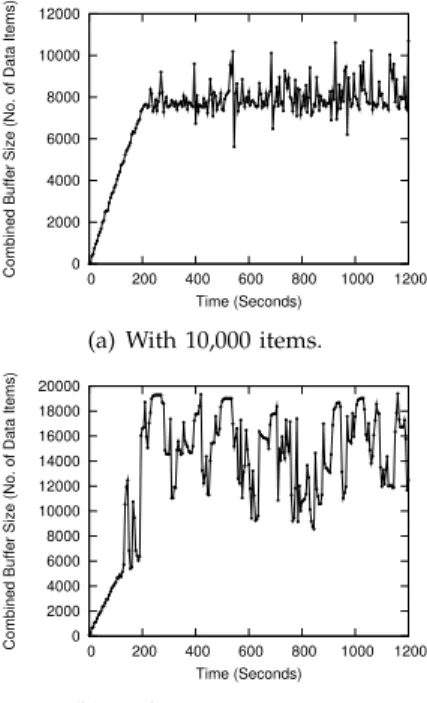
We first deploy a system with 3 LTMs and impose a constant workload for one hour. We configure the system so that each LTM can maintain at most 8000 data items in its buffer. We then evaluate the system under two different scales of data set sizes: either 10,000 or 1,000,000 records in the “Item Stock” table. For the data size of 10,000 items, we impose a workload of 500 EBs. For the data size of 1 million items, we impose 250 EBs.
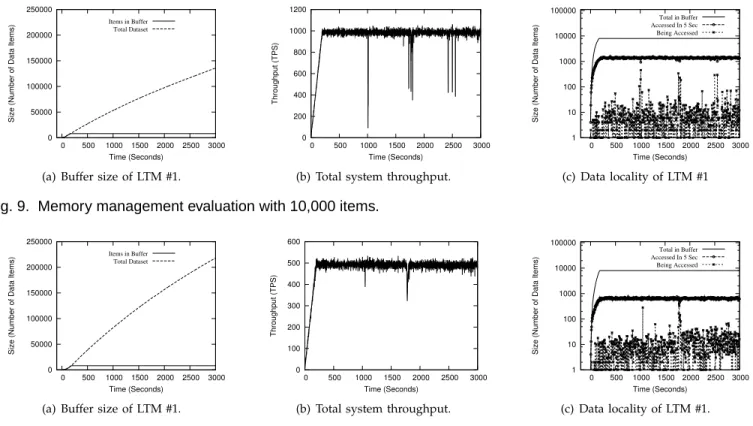
Figure 9(a) shows that under both data set sizes, our mechanism effectively maintains the buffer size of LTM #1 within the limit of 8000 data items. Using 10,000 “Item Stock” items, without memory management, af-ter an hour, this LTM would have to maintain almost 140,000 data items in memory. As for the data size of 1,000,000 “Item Stock” items, Figure 10(a) shows that, after an hour, the total data set increases to an even larger number of more than 200,000 data items. In both cases, without memory management, the size of the total accessed data set increases almost linearly, which would eventually cause a memory overflow.
We then compare the performance of the system under different data set sizes. Figure 8 shows that the hit rate of LTM #1 stabilizes around 90% for 10,000 items, and about 60% for 1 million items. The other LTMs in the system behave similarly. Figures 9(b) and 10(b) show the total transaction throughput during the 1-hour evaluation. The drops of throughput at some points are due to the JVM garbage collection, which temporarily block the LTMs. With 10,000 items, the system sustains a transaction throughput of about 1000 TPS and 99.4% of transactions complete within 100 ms. For 1 million