Straightforward and Accurate Nonlinear Device Model
Parameter-Estimation Method Based on Vectorial Large-Signal Measurements
Dominique M. M.-P. Schreurs, Jan Verspecht, Servaas Vandenberghe, Ewout Vandamme
Jan Verspecht bvba
Gertrudeveld 15
1840 Steenhuffel
Belgium
email: [email protected]
web: http://www.janverspecht.com
IEEE Transactions on Microwave Theory and Techniques, Vol. 50, No. 10, pp. 2315-2319
© 2002 IEEE. Personal use of this material is permitted. However, permission to
reprint/republish this material for advertising or promotional purposes or for creating new
collective works for resale or redistribution to servers or lists, or to reuse any copyrighted
component of this work in other works must be obtained from the IEEE.
Straightforward and Accurate Nonlinear Device
Model Parameter-Estimation Method Based
on Vectorial Large-Signal Measurements
Dominique M. M.-P. Schreurs, Senior Member, IEEE, Jan Verspecht, Servaas Vandenberghe, and
Ewout Vandamme, Member, IEEE
Abstract—To model nonlinear device behavior at microwave
fre-quencies, accurate large-signal models are required. However, the standard procedure to estimate model parameters is often cum-bersome, as it involves several measurement systems (dc, vector network analyzer, etc.). Therefore, we propose a new nonlinear modeling technique, which reduces the complexity of the model generation tremendously and only requires full two-port vectorial large-signal measurements. This paper reports on the results ob-tained with this new modeling technique applied to both empirical and artificial-neural-network device models. Experimental results are given for high electron-mobility transistors and MOSFETs. We also show that realistic signal excitations can easily be included in the optimization process.
Index Terms—Large-signal measurements, nonlinear modeling,
optimization.
I. INTRODUCTION
A
RECENT development in microwave metrology is a mea-surement system that not only enables the meamea-surement of the absolute amplitude of harmonics, and if present, intermodu-lation products, but also can measure the corresponding phases [1]–[5]. These so-called “vectorial large-signal measurements” have triggered researchers worldwide to investigate the impli-cations of the additional measurement information (being the phase) on the ease and accuracy of nonlinear model generation. Nonlinear models of microwave devices are commonly de-scribed in terms of state functions. These quantities are classi-cally determined via a small-signal detour based on multibias -parameter measurements. The first investigated approach of using vectorial large-signal measurements in nonlinear mod-eling was to efficiently extract the device’s state functions di-rectly from these measurements [6]. However, the drawback of this extraction method is that the obtained model accuracy is strongly related to the available measurement bandwidth. There-fore, we developed an advanced nonlinear modeling method based on optimization [7]. State functions are typically repre-sented by lookup tables [8], [9] or by parametric models. The latter are characterized by a number of parameters of which theManuscript received June 26, 2001. The work of D. M. M.-P. Schreurs was supported by the Fund for Scientific Research-Vlaanderen under a Post-Doctoral Fellowship.
D. M. M.-P. Schreurs and S. Vandenberghe are with the Electronics Systems, Automation, and Technology Department, Telecommunications and Microwaves Division, Katholieke Universiteit Leuven, B-3001 Leuven, Belgium (e-mail: [email protected]).
J. Verspecht and E. Vandamme are with the Network Measurement and Description Group, Agilent Technologies, B-2880 Bornem, Belgium.
Digital Object Identifier 10.1109/TMTT.2002.803427.
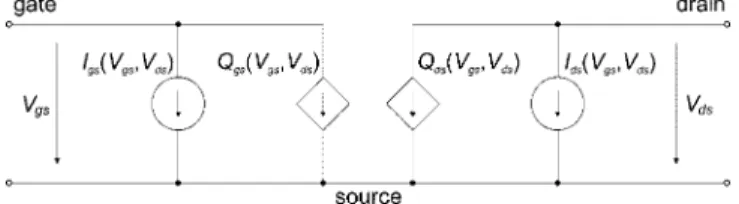
Fig. 1. Intrinsic quasi-static nonlinear FET model.
values can be estimated through optimization. As optimization is not suited for lookup tables, this method is not applicable to lookup table models.
Section II describes the straightforward procedure to estimate the parameters of nonlinear device models from vectorial large-signal measurements only. In this study, we apply this method to two types of parametric model types, namely, empirical and artificial-neural-network (ANN) models. Experimental results are presented and analyzed in Section III. Finally, conclusions are drawn in Section IV.
II. NONLINEARMODELPARAMETER-ESTIMATIONMETHOD
A. Optimization Procedure
Fig. 1 represents the nonlinear quasi-static model of an FET, consisting of four state functions. The assumption of quasi-static operation is valid up to the frequencies used in the experiments presented in Section III. Depending on the actually used para-metric model, the contributions of the extrinsic elements might or might not be included. If not, they can separately be deter-mined from -parameter measurements [10], [11].
The classical procedure to determine the parameters of em-pirical or ANN models is to optimize the functions toward the dc measured state functions, e.g., , and/or toward the -pa-rameter measurement-based state functions, e.g., or the cor-responding large-signal . Bandler et al. [12] proposed, as extension to this procedure, to optimize consistently toward all available measurements, such as dc, multibias -parameter, and spectrum analyzer data. Obviously, the additional phase infor-mation of vectorial large-signal measurements could be incor-porated in the optimization procedure. However, this requires special optimization software to ensure consistency because it is not straightforward to implement this method in standard cir-cuit simulators. The reason is that it is not possible to optimize simultaneously toward dc, -parameter, and harmonic-balance simulations.
2316 IEEE TRANSACTIONS ON MICROWAVE THEORY AND TECHNIQUES, VOL. 50, NO. 10, OCTOBER 2002
Our approach consists of a nonlinear model parameter-esti-mation procedure based on vectorial large-signal measurements only [7]. Since these measurements provide both amplitude and phase information of the spectral components of the traveling voltage waves, they contain all necessary information. The advantage of this approach is that only one type of measure-ments, i.e., in casu vectorial large-signal measuremeasure-ments, and only one type of simulation, i.e., in casu harmonic-balance analysis, are needed. It is even possible to include “dc”- or “ -parameter”-like information by choosing the appropriate operating conditions, e.g., a low input power, when performing the vectorial large-signal measurements.
We have developed this procedure on a measurement setup, i.e., the nonlinear network measurement system (NNMS) [4], which enables to measure simultaneously the currents and volt-ages at both device ports. The latter implies that the expres-sions for all four of the state functions can be optimized at once. The first step of the procedure is to perform a number of mea-surements, called “experiments.” It is possible to sweep any de-gree of freedom of the measurement system, like input power, excitation frequency, dc bias, load impedance, etc. However, one could focus on particular experiments depending on the ul-timate application. Next, the measurement data are stored in Citifile format, which is compatible with the used microwave circuit simulator (ADS, Agilent Technologies). To allow any kind of excitation settings, we take as independent variables the experiment number and frequencies. However, we explic-itly save the excitation settings in order to automatically per-form the harmonic-balance simulations at the exact operating conditions at which the measurements were performed. Subse-quently, the model parameters are estimated during a single opti-mization process, executed in the circuit simulator environment, in which all the experiments are combined. The optimization goals are expressed in terms of minimizing the difference be-tween the measured and simulated spectral components, taking into account all the significant harmonics and, if present, inter-modulation products.
B. Parametric Model Representations
The proposed parameter-estimation method can be applied to both empirical and ANN models. We will evaluate and compare these two approaches in terms of model accuracy and extrapo-lation properties.
The parameter-estimation procedure is general in the sense that it can be applied to any empirical nonlinear model of a one-or two-pone-ort microwave device. To demonstrate the applicability of the method, we used the Chalmers’ empirical nonlinear high electron-mobility transistor (HEMT) model. The expression for the drain–source current is based on [13] and the functions representing the intrinsic bias-dependent capacitances are taken from [14].
Concerning the ANN, it is not the purpose of this study to find the most optimal ANN formulation [15], but to show the principle that the proposed method can be applied to ANNs. We decided not to define one global ANN, but represented each of the four device’s state functions by a separate ANN. The reason is that it is known from device physics that the characteristics
of the currents and charges differ significantly and, hence, this can be considered as an a priori knowledge-based pruning tech-nique. In this paper, we will show what level of accuracy can be obtained with an ANN consisting of only one hidden layer with five nodes to represent and with three nodes for and . The gate–source current can be neglected for the ex-perimental conditions presented in Section III. The ANN accu-racy can easily be increased by adding additional hidden layers and nodes, but at the cost of a lower model generation speed. The independent input variables are the terminal voltages and . The functional description is of the form
(1) where is the number of nodes and where , , , and are the parameters to be determined. We choose this particular functional description because the is smooth and its limits are well defined. This is contrary to an exponential-like expression, which might give rise to convergence problems when the nonlinear model is being evaluated by the iterative harmonic-balance analysis. The ANN training was not per-formed in a separate software program, but was also executed by the optimizer available in the circuit simulator.
III. EXPERIMENTALRESULTS
To illustrate the parameter-estimation procedure, we present and analyze experimental and modeling results on transistors fabricated with different technologies and excited at several op-erating conditions.
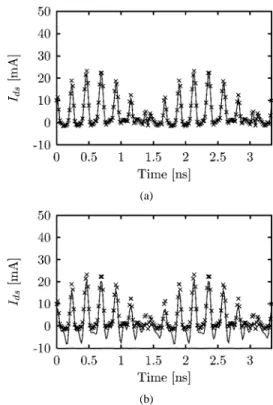
The first example is the Chalmers model applied to a GaAs pseudomorphic high electron-mobility transistor (pHEMT). The device is operated in class B, while the input power is swept from 20.4 to 3.4 dBm. All the model parameters are simultaneously optimized toward these measurements. Fig. 2 compares the measured and simulated time-domain waveform of [see Fig. 2(a)] and of [see Fig. 2(b)] as a function of the corresponding time-domain waveform of at a high input power. This figure clearly shows a very good agreement between measurements and modeling results and, hence, indicates a high model accuracy.
Fig. 3 shows excellent agreement between the measured and modeled versus by applying the ANN model to an nMOS transistor operated in class A. This example demon-strates that the proposed procedure is not limited to HEMTs, but applicable to one- and two-port nonlinear microwave devices in general.
Furthermore, complicated and realistic operating conditions can easily be included in the optimization procedure. Examples are load–pull measurements [7] and two-tone excitations. The latter is demonstrated on an InP lattice-matched (LM) HEMT. A single-tone continuous wave (CW) signal is applied to the gate and a single-tone CW signal at a different fundamental frequency is applied to the drain. Fig. 4 compares the measured with the Chalmers model results and ANN results, respec-tively. Both model types represent the modulated well.
(a)
(b)
Fig. 2. Measured (2) and Chalmers modeled (—) (a) I (t) and (b) I (t) versus V (t) of a 0.2 m 2 100 m GaAs pHEMT (V = 00:5 V,
V = 1:5 V, f = 3:6 GHz, P = 03:4 dBm).
Fig. 3. Comparison of the measured (2) and neural-network modeled (—)
I (t) versus V (t) of a 0.2 m 2 50 m nMOS (V = 0:9 V, V = 1:8 V, f = 0:9 GHz, P = 3:4 dBm).
There is no significant difference in model accuracy between the Chalmers model and the limited-size ANN.
Fig. 5 presents the results of both the Chalmers and ANN models when extrapolated toward a dc-bias condition that was not included in the optimization. We notice that the Chalmers model is able to represent very well the device’s characteristics at this particular operating condition. On the contrary, the ANN only approximates the general behavior. The reason is that the ANN is a black-box model and, therefore, not suited for extrap-olation. It will, however, behave well at operating frequencies different from the frequencies used in the training process since the ANN definition (see Section II-B) explicitly makes the dis-tinction between charge and current sources. The extrapolation capability of the Chalmers model toward other dc biases is sig-nificantly better since the underlying equations are related to the device physics. By including operating conditions closer to the one used in Fig. 5, the accuracy of the ANN model improves.
(a)
(b)
Fig. 4. Comparison of the measured (2), (a) Chalmers (—), and (b) ANN modeled (—)I (t) of a 0.2 m 2 100 m InP LM HEMT excited by a two-tone signal (V = 00:1 V, V = 1:2 V, f = 4:2 GHz, f =
4:8 GHz, a = 03:9 dBm, a = 2:4 dBm, (a ) 0 (a ) = 095 ).
(a)
(b)
Fig. 5. Comparison of the measured (2), (a) Chalmers (—), and (b) ANN extrapolated (—)I (t) of a 0.2 m 2 100 m InP LM HEMT excited by a two-tone signal (V = 00:3 V, V = 0:6 V).
When there is interest to increase the accuracy and operating range to be covered, ANNs have the advantage that it is straight-forward to increase the number of hidden layers and nodes in order to obtain these goals. In the case of empirical models,
2318 IEEE TRANSACTIONS ON MICROWAVE THEORY AND TECHNIQUES, VOL. 50, NO. 10, OCTOBER 2002
the number of parameters is mostly fixed and possible exten-sions are limited. The consequence is that the obtained accu-racy is strongly related to the physical phenomena described by the empirical expressions. Therefore, extrapolations toward “smooth” operating conditions will, in general, yield good re-sults, but extrapolations toward “extreme” operating conditions will be worse.
Finally, the parameter-estimation time depends on the soft-ware used, but this is, in general, less for empirical models. Typ-ically, an empirical model has significantly less model param-eters than an ANN, e.g., 18 compared to 44 for the modeling results presented in this paper.
It is clear that the choice between an empirical model or an ANN strongly depends on the envisaged application.
IV. CONCLUSIONS
We have shown that using only full two-port vectorial large-signal measurements is sufficient to accurately estimate the pa-rameters of nonlinear microwave device models. The developed straightforward quasi-automatic procedure has been applied to empirical and ANN models, and has been successfully demon-strated on HEMTs and nMOS devices. Finally, we pointed out that including realistic operating conditions in the optimization process broadens the model validity range.
ACKNOWLEDGMENT
The Katholieke Universiteit Leuven, Leuven, Belgium, acknowledges Agilent Technologies for the donation of the NNMS.
REFERENCES
[1] F. van Raay and G. Kompa, “A new on-wafer large-signal waveform measurement system with 40 GHz harmonic bandwidth,” in IEEE
MTT-S Int. Microwave Symp. Dig., 1992, pp. 1435–1438.
[2] M. Demmler, P. Tasker, and M. Schlechtweg, “A vector corrected high power on-wafer measurement system with a frequency range for the higher harmonics up to 40 GHz,” in Proc. 24th Eur. Microwave Conf., 1994, pp. 1367–1372.
[3] J. Leckey, J. Stewart, A. Patterson, and M. Kelly, “Nonlinear MESFET parameter estimation using harmonic amplitude and phase mea-surements,” in IEEE MTT-S Int. Microwave Symp. Dig., 1994, pp. 1563–1566.
[4] J. Verspecht, P. Debie, A. Barel, and L. Martens, “Accurate on wafer measurement of phase and amplitude of the spectral components of in-cident and scattered voltage waves at the signal ports of a nonlinear mi-crowave device,” in IEEE MTT-S Int. Mimi-crowave Symp. Dig., 1995, pp. 1029–1032.
[5] C. Wei, Y. Lan, J. Hwang, W. Ho, and J. Higgins, “Waveform character-ization of microwave power heterojunction bipolar transistors,” in IEEE
MTT-S Int. Microwave Symp. Dig., 1995, pp. 1239–1242.
[6] D. Schreurs, J. Verspecht, B. Nauwelaers, A. Van de Capelle, and M. Van Rossum, “Direct extraction of the nonlinear model for two-port devices from vectorial nonlinear network analyzer measurements,” in Proc. 27th
Eur. Microwave Conf., 1997, pp. 921–926.
[7] D. Schreurs, J. Verspecht, S. Vandenberghe, G. Carchon, K. van der Zanden, and B. Nauwelaers, “Easy and accurate empirical transistor model parameter estimation from vectorial large-signal measurements,” in IEEE MTT-S Int. Microwave Symp. Dig., 1999, pp. 753–756. [8] D. Root, S. Fan, and J. Meyer, “Technology independent large signal
non quasistatic FET models by direct construction from automatically characterized device data,” in Proc. 21th Eur. Microwave Conf., 1991, pp. 927–932.
[9] D. Schreurs, H. van Meer, K. van der Zanden, W. De Raedt, B. Nauwe-laers, and A. Van de Capelle, “Improved HEMT model for low phase noise InP based MMIC oscillators,” IEEE Trans. Microwave Theory
Tech., vol. 46, pp. 1583–1585, Oct. 1998.
[10] G. Dambrine, A. Cappy, F. Heliodore, and E. Playez, “A new method for determining the FET small-signal equivalent circuit,” IEEE Trans.
Microwave Theory Tech., vol. 36, pp. 1151–1159, July 1988.
[11] D. Schreurs, Y. Baeyens, B. Nauwelaers, W. De Raedt, M. Van Hove, and M. Van Rossum, “S-parameter measurement based quasistatic large-signal cold HEMT model for resistive mixer design,” Int. J. Microwave
and Millimeter-Wave Computer-Aided Eng., vol. 6, no. 4, pp. 250–258,
1996.
[12] J. Bandler, Q. Zhang, S. Ye, and S. Chen, “Efficient large-signal FET parameter extraction using harmonics,” IEEE Trans. Microwave Theory
Tech., vol. 37, pp. 2099–2108, Dec. 1989.
[13] I. Angelov, H. Zirath, and N. Rorsman, “Validation of a nonlinear transistor model by power spectrum characteristics of HEMT’s and MESFET’s,” IEEE Trans. Microwave Theory Tech., vol. 43, pp. 1046–1052, May 1995.
[14] , “A new empirical nonlinear model for HEMT and MESFET de-vices,” IEEE Trans. Microwave Theory Tech., vol. 40, pp. 2258–2266, Dec. 1992.
[15] Q. Zhang and K. Gupta, Neural Networks for RF and Microwave
De-sign. Norwood, MA: Artech House, 2000.
Dominique M. M.-P. Schreurs (S’90–M’97–
SM’02) received the M.Sc. degree in electronic engineering and Ph.D. degree (with honors) from the Katholieke Universiteit Leuven (K.U.Leuven), Leuven, Belgium, in 1992 and 1997, respectively.
She is currently a Post-Doctoral Fellow of the Fund for Scientific Research-Vlaanderen and a Visiting Assistant Professor at the K.U.Leuven. Her main research interest is the use of vectorial large-signal measurements for the characterization and modeling of nonlinear microwave devices.
Jan Verspecht was born on December 12, 1967, in
Merchtem, Belgium. He received the Electrical En-gineering and Ph.D. degrees from the Vrije Univer-siteit Brussel (VUB), Brussels, Belgium, in 1990 and 1995, respectively.
Upon graduation in 1990, he became a Research Engineer and later a Technical Lead for the Network Measurement and Description Group (NMDG), Hewlett-Packard Company (which became a part of Agilent Technologies), Bornem, Belgium, in 1999. He is currently involved with advanced measuring and modeling techniques to deal with large-signal behavior of microwave devices.
Servaas Vandenberghe was born in Leuven,
Belgium, on March 31, 1972. He received the M.Sc. degree in electrical engineering from the Katholieke Universiteit Leuven (K.U.Leuven) Leuven, Belgium, in 1996, and is currently working toward the Ph.D. degree at the K.U.Leuven.
His main research interest is equivalent-cir-cuit-based nonlinear HEMT modeling.
Ewout Vandamme (S’93–M’00) was born in
Eindhoven, The Netherlands, in 1972. He received the M.Sc. degree in electrical engineering from the Eindhoven University of Technology, in in 1994, the M.Sc. degree in physics of microelectronics and materials science from the Katholieke Universiteit Leuven (K.U.Leuven), Leuven, Belgium, in 1995, and the Ph.D. degree from the K.U.Leuven in 2001. His doctoral dissertation focused on CMOS technology development and modeling and was performed in collaboration with the interuniversity microelectronics research center (IMEC), Leuven, Belgium.
He is currently with the Network Measurement and Description Group (NMDG), Agilent Technologies, Bornem, Belgium. His current research interest is large-signal network analyzer technology and its use for large-signal device and RF integrated-circuit (RFIC) modeling.