High Performance Deferred Update
Replication
Doctoral Dissertation submitted to the
Faculty of Informatics of theUniversità della Svizzera Italiana in partial fulfillment of the requirements for the degree of
Doctor of Philosophy
presented by
Daniele Sciascia
under the supervision of
Prof. Fernando Pedone
Dissertation Committee
Prof. Mehdi Jazayeri Università della Svizzera Italiana, Switzerland
Prof. Olaf Schenk Università della Svizzera Italiana, Switzerland
Prof. Jose Enrique Armendariz-Inigo UPNa, Spain
Prof. Luis Rodrigues INESC-ID, Portugal
Prof. Willy Zwaenepoel EPFL, Switzerland
Dissertation accepted on March 2015
Prof. Fernando Pedone
Research Advisor
Università della Svizzera Italiana, Switzerland
Stefan Wolf, Igor Pivkin
PhD Program Directors
I certify that except where due acknowledgement has been given, the work presented in this thesis is that of the author alone; the work has not been sub-mitted previously, in whole or in part, to qualify for any other academic award; and the content of the thesis is the result of work which has been carried out since the official commencement date of the approved research program.
Daniele Sciascia Lugano, March 2015
To Laura
An expert is a man who has made all the mistakes which can be made in a very narrow field.
Neils Bohr
Abstract
Replication is a well-known approach to implementing storage systems that can tolerate failures. Replicated storage systems are designed such that the state of the system is kept at several replicas. A replication protocol ensures that the failure of a replica is masked by the rest of the system, in a way that is transparent to its users. Replicated storage systems are among the most important building blocks in the design of large scale applications. Applications at scale are often deployed on top of commodity hardware, store a vast amount of data, and serve a large number of users. The larger the system, the higher its vulnerability to failures. The ability to tolerate failures is not the only desirable feature in a replicated system. Storage systems need to be efficient in order to accommodate requests from a large user base while achieving low response times. In that respect, replication can leverage multiple replicas to parallelize the execution of user requests.
This thesis focuses on Deferred Update Replication (DUR), a well-established database replication approach. It provides high availability in that every replica can execute client transactions. In terms of performance, it is better than other replication techniques in that only one replica executes a given transaction while the other replicas only apply state changes. However, DUR suffers from the following drawback: each replica stores a full copy of the database, which has consequences in terms of performance.
The first consequence is that DUR cannot take advantage of the aggregated memory available to the replicas. Our first contribution is a distributed caching mechanism that addresses the problem. It makes efficient use of the main mem-ory of an entire cluster of machines, while guaranteeing strong consistency.
The second consequence is that DUR cannot scale with the number of repli-cas. The throughput of a fully replicated system is inherently limited by the number of transactions that a single replica can apply to its local storage. We propose a scalable version of the DUR approach where the system state is par-titioned in smaller replica sets. Transactions that access disjoint partitions are parallelized.
viii
The last part of the thesis focuses on latency. We show that the scalable DUR-based approach may have detrimental effects on response time, especially when replicas are geographically distributed. The thesis considers different deployments and their implications on latency. We propose optimizations that provide substantial gains in geographically distributed environments.
Acknowledgements
I am truly grateful to my advisor Fernando Pedone. Fernando taught me a lot and has always been generous in guiding me with all his knowledge and expe-rience. I admire him for his dedication towards his students. The only secret he has not shared with me is where all his energy, enthusiasm and patience come from.
I wish to thank the members of the dissertation committee, Mehdi Jaza-yeri, Olaf Schenk, Jose Enrique Armendariz-Inigo, Luis Rodrigues and Willy Zwaenepoel for the time they dedicated to this thesis and for their feedback.
I am also grateful to Willy Zwaenepoel for hosting me at EPFL, where I felt part of his LABOS team. I spent most of the time there working with Jiaqing Du, and remotely with Sameh Elnikety. Thank you all for the fun and fruitful summer.
I thank the current and former members of the Distributed Systems Lab: Marco Primi, Nicolas Schiper, Amir Malekpour, Ricardo Padilha, Parisa Jalili Marandi, Eduardo Bezerra, Leandro Pacheco, Samuel Benz, Odorico Mendiza-bal, Daniel Cason and Tu Dang.
For most of the time, I have been commuting to Lugano by train. Many friends on the train, “gli amici del treno”, made my daily ride more fun: Mar-cello Scipioni, Giacomo Inches, Davide Eynard, and Fernanda Gallo.
I wish to thank my parents and my brother, Angela, Salvatore, and Claudio. It is nice to know that there is always somebody I can rely on. Finally, thanks to my partner Laura, who stood by me throughout this experience.
Preface
The result of this research appears in the following papers:
D. Sciascia and F. Pedone. RAM-DUR: In-Memory Deferred Update Replication. 31st International Symposium on Reliable Distributed Systems (SRDS 2012) D. Sciascia, F. Pedone and F. Junqueira. Scalable Deferred Update Replication. 42nd International Conference on Dependable Systems and Networks (DSN 2012)
D. Sciascia and F. Pedone. Geo-replicated storage with scalable deferred update replication. 43rd International Conference on Dependable Systems and Net-works (DSN 2013)
And was later extended in the following publications:
A. Tomic, D. Sciascia and F. Pedone. MoSQL: An Elastic Storage Engine for MySQL.28th ACM Symposium on Applied Computing, DADS Track (SAC 2013) L. Pacheco, D. Sciascia and F. Pedone. Parallel Deferred Update Replication. 13th IEEE International Symposium on Network Computing and Applications (NCA 2014)
Outside of the main scope of this research, I worked on the design of a State Machine Replication protocol based on physical clocks. This work has been published in the following paper:
J. Du, D. Sciascia, S. Elnikety, W. Zwaenepoel and F. Pedone Clock-RSM: Low-Latency Inter-Datacenter State Machine Replication Using Loosely Synchronized Physical Clocks. 44th International Conference on Dependable Systems and Networks (DSN 2014)
Contents
Contents xi
List of Figures xvii
List of Tables xix
List of Algorithms xxi
1 Introduction 1
1.1 Context . . . 1
1.2 Motivation . . . 3
1.3 Contributions . . . 3
1.4 Outline . . . 4
2 System Model and Definitions 7 2.1 Processes and failures . . . 7
2.2 Communication . . . 7
2.2.1 One-to-one communication . . . 8
2.2.2 One-to-many communication . . . 8
2.3 Synchrony assumptions . . . 8
2.4 Database and transactions . . . 8
2.5 Serializability . . . 9
3 Deferred Update Replication 11 3.1 General idea . . . 12
3.2 The algorithm in detail . . . 12
3.3 DUR and other replication techniques . . . 15
4 In-Memory Deferred Update Replication 17 4.1 General idea . . . 18
4.2 Ensuring Serializability . . . 19 xiii
xiv Contents
4.3 The algorithm in detail . . . 22
4.4 Cache-only vnodes . . . 22
4.5 Discussion . . . 24
4.6 Implementation and optimizations . . . 25
4.7 Performance evaluation . . . 25
4.7.1 Setup and benchmarks . . . 26
4.7.2 Throughput and latency . . . 27
4.7.3 Performance under remote requests . . . 27
4.7.4 Cache-only vnodes . . . 28
4.8 Related Work . . . 29
4.9 Conclusion . . . 31
5 Scalable Deferred Update Replication 33 5.1 Motivation . . . 33
5.2 Additional definitions and assumptions . . . 34
5.3 A straightforward (and incorrect) extension . . . 34
5.4 A complete and correct protocol . . . 35
5.4.1 The algorithm in detail . . . 36
5.5 Handling partially terminated transactions . . . 38
5.6 Certification—less read-only transactions . . . 40
5.6.1 The algorithm in detail . . . 41
5.7 Discussion . . . 43
5.8 Implementation and optimizations . . . 43
5.9 Performance Evaluation . . . 44
5.9.1 Setup and benchmarks . . . 44
5.9.2 Throughput . . . 45
5.9.3 Latency . . . 47
5.9.4 Abort rate . . . 48
5.10 Related Work . . . 49
5.11 Conclusion . . . 51
6 Geo-Replication using Deferred Update Replication 53 6.1 Motivation . . . 53
6.2 A system model for geo-replication . . . 54
6.3 Geographically distributed deployments . . . 55
6.4 Performance considerations . . . 56
6.5 Delaying transactions . . . 57
6.5.1 The algorithm in detail . . . 57
xv Contents
6.6.1 The algorithm in detail . . . 59
6.7 Reordering with broadcasting of votes . . . 60
6.7.1 The algorithm in detail . . . 62
6.8 Performance Evaluation . . . 62
6.8.1 Setup and benchmarks . . . 62
6.8.2 Baseline . . . 64
6.8.3 Delaying transactions . . . 66
6.8.4 Reordering transactions . . . 68
6.8.5 Social network application . . . 71
6.8.6 Impact of Snapshots . . . 72 6.9 Related Work . . . 74 6.10 Conclusion . . . 76 7 Conclusions 77 7.1 Contributions . . . 77 7.2 Future Directions . . . 78
A RAM-DUR: Proof of correctness 81 B S-DUR: Proof of correctness 85 B.1 Scalable Deferred Update Replication . . . 85
B.2 Read-only snapshots . . . 88
C Geo-DUR: Proof of correctness 91 C.1 Delaying transactions . . . 91
C.2 Reordering with fixed threshold . . . 91
C.3 Reordering with broadcasting of votes . . . 92
Figures
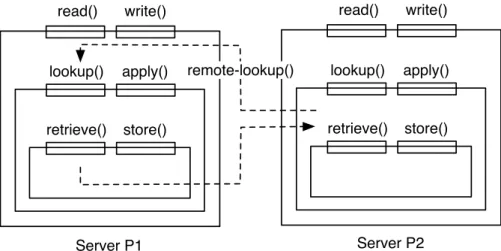
4.1 Simplified storage abstractions of a vnode. . . 19
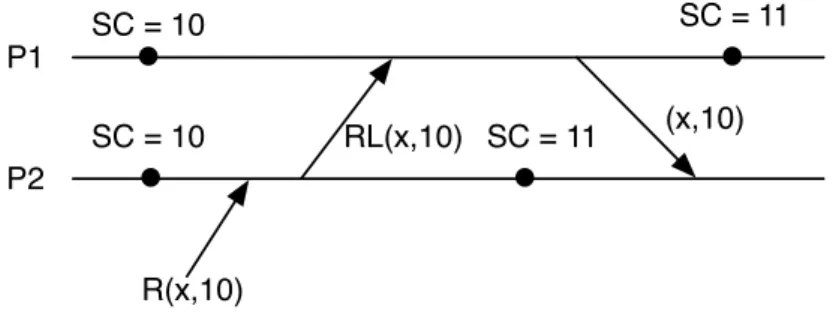
4.2 Problematic execution 1. Dots show the delivery of a transaction that created snapshotSC. R(x,i) is a read request for versioniof data item x. RL(x,i) is a remote lookup request for version iof data itemx. . . . 20
4.3 Problematic execution 2. . . 20
4.4 Problematic execution 3. . . 21
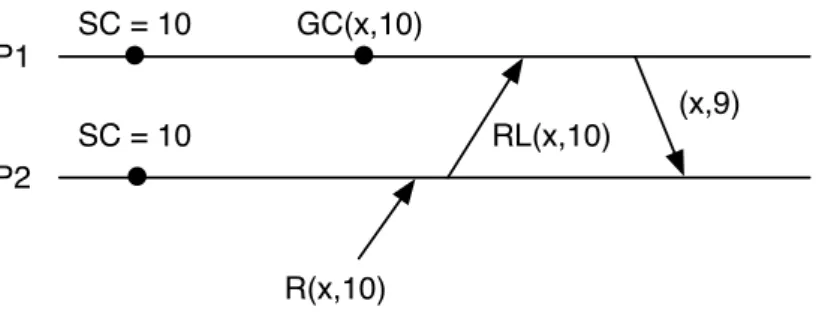
4.5 Problematic execution 4. GC(x,i) shows the garbage collection for versioniof itemx. . . . 22
4.6 Throughput and latency. . . 28
4.7 Performance under remote requests (Small DB). . . 29
4.8 Adding cache-only vnodes (Large DB). . . 30
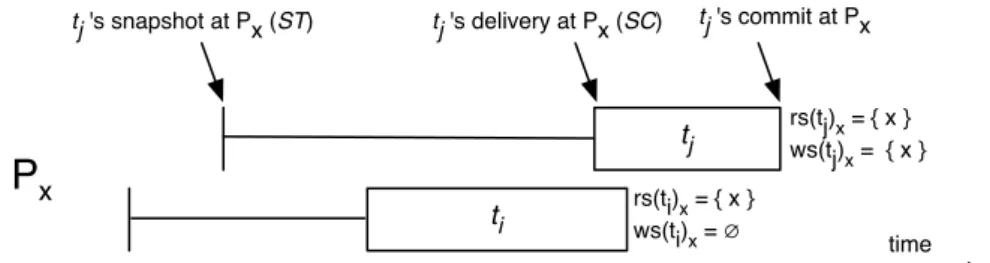
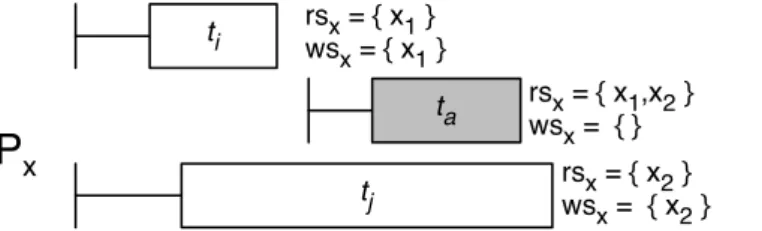
5.1 Example 1. Transactionsti andtjare delivered in different order at partitions Px andPy. At partitionPx the readset of tj does not intersect the writeset of ti. Similarly, at partition Py the readset oftidoes not intersect the writeset oftj. Both partitions commit, but the execution is not serializable. . . 36
5.2 Example 2. At partitions Px, read-only transaction ta observes the effects ti but not the effects oftj. At partition Py, read-only transaction tb observes the effects of tj but not the effects of ti. Thus violating serializability. . . 41
5.3 Normalized throughput versus percentage of global transactions. 46 5.4 Latency versus percentage of global transactions. 99-th per-centile latency (bars) and average latency (diamonds). . . 48
5.5 Abort rate versus percentage of global transactions. . . 49 xvii
xviii Figures 6.1 Scalable Deferred Update Replication deployments in a
geograph-ically distributed environment, where δ is the maximum com-munication delay between servers in the same region and ∆ is the maximum communication delay across regions; typically
∆ δ. The database contains two partitions, P1 and P2, and
clients are deployed in the same datacenter as servers1. . . 56
6.2 S-DUR’s local and global transactions in two geographically dis-tributed deployments (WAN 1 and WAN 2). Throughput in trans-actions per second (tps), latency 99-th percentile (bars) and av-erage latency (diamonds in bars) in milliseconds (ms). . . 65
6.3 S-DUR’s local and global transactions in two geographically dis-tributed deployments (WAN 1 and WAN 2). Cumulative distri-bution functions (CDF) of latencies for 0% and 1% of global transactions. . . 66
6.4 Local transactions with delayed transactions in WAN 1. . . 67
6.5 Global transactions with delayed transactions in WAN 1. . . 67
6.6 Local transactions with reordering in WAN 1. . . 68
6.7 Global transactions with reordering in WAN 1. . . 69
6.8 Local transactions with reordering in WAN 2. . . 70
6.9 Global transactions with reordering in WAN 2. . . 70
6.10 Social network application in WAN 1. . . 71
6.11 Social network application in WAN 2. . . 72
6.12 Impact of snapshots in WAN 1. . . 73
6.13 Impact of snapshots in WAN 2 . . . 73
A.1 Instances of cases (i) and (ii) in proof. . . 84
B.1 Interleaved executions of transactions (Cases 1–3 are possible under S-DUR but not Case 4). . . 87
Tables
4.1 Transaction types in workload . . . 26 4.2 Datasets in workload . . . 26 5.1 Workload types - Varying number of read and write operations
per transaction (ops), and key and value sizes (bytes). . . 45
Algorithms
1 Deferred Update Replication, client c . . . 13 2 Deferred Update Replication, servers . . . 14 3 In-Memory Deferred Update Replication, servers . . . 23 4 Scalable Deferred Update Replication, client c . . . 37 5 Scalable Deferred Update Replication, serversin partition p . . 39 6 Snapshot Algorithm, serversin partition p . . . 42 7 Transaction delaying, serversin partition p . . . 58 8 Certification with fixed threshold, servers in partition p . . . 61 9 Certification with broadcasting votes, serversin partition p . . . 63
Chapter 1
Introduction
In recent years we have witnessed increased demand for reliable storage sys-tems that run on top of cheap commodity hardware. Applications at scale rely on servers that are distributed over several data centers, located in different geographical areas to provide high availability and low response times to their clients. These applications store a vast amount of data and serve a large num-ber of users. As systems become larger, failures are more frequent. Failures may originate from human errors, single machine failures, network equipment and communication failures, and sometimes disasters that shutdown data cen-ters entirely. One way to cope with such failures is replication, where several replicas cooperatively store the state of the system. In the event of failures, replication protocols can mask the failure of replicas to ensure continued ser-vice. The main challenge for replication protocols is to provide the illusion of operating a single high-performance and fault-tolerant system.
1.1
Context
Storage systems have evolved rapidly over the past two decades. The internet industry is one of the major driving forces behind the evolution of storage sys-tems. The main reason is that web applications at scale store a large amount of data (e.g., user profiles, posts, photos, shopping carts) and serve a massive number of users spread around the globe.
Early web applications in the 90’s were usually built using a scripting lan-guage in combination with a centralized SQL database. This kind of solution gave enough power to build web applications that served static and dynam-ically generated contents. Static content was simply stored on a file system. While dynamic content was usually generated based on the user that is
2 1.1 Context nected to the application, and the particular actions performed by the user. Centralized relational databases were flexible enough to capture most storage requirements of web application builders: they were fast enough and stored data reliably. Moreover, the SQL language offered powerful features such as transactions, joins, indexes and views.
In the early 2000s the largest internet companies started to build their own storage solutions from scratch[12; 14; 20; 30; 35]. Their platforms had to sus-tain a rapid growth in users and data. Three major trends arose: (1) The use of commodity hardware and the scale of these applications called for storage systems that were available in the event of failures and outages. Failures are costly in that they have immediate consequences on the income generated by the applications (e.g. stopping sales, not serving advertisement). (2) SQL was not necessarily the best language to handle the data. Simpler interfaces such as key-value and columnar stores became popular. These interfaces usually did not provide transactions, in some cases they provided limited forms of atom-icity. (3) Relaxed consistency criteria reduce latency and can sustain higher transaction/operation rates. For instance, eventual consistency [69] achieves low latency and high throughput. However, data may diverge under concur-rent access or network partitions, with the complexity of reconciliation pushed to the application layer. For some applications, or parts of the application, reconciling data is relatively easy (e.g., the operations are commutable).
More recently, many large web applications have moved to the cloud, where they share large computing infrastructures. Companies can simply buy comput-ing power and storage by the hour. Buildcomput-ing infrastructures that are distributed over several geographical locations is not only feasible, it can be done without upfront investments. The focus now is on storage systems that can be dis-tributed over several geographically disdis-tributed datacenters. There are two main reasons for this trend: (1) Storing data close the user reduces the per-ceived latency. Web applications have typically a large fan-out. A client request to a web application typically translates to tens of requests to backend web ser-vices and storage systems[19]. These requests are executed in parallel and the overall latency depends on the slowest component, or those components with the highest latency variability. (2) Geo-replication tolerates disasters, such as the failure of an entire datacenter. Cloud computing vendors offer several stor-age solutions, such as Amazon’s S3 and SimpleDB, or Microsoft Azure’s Blobs and Tables. These solutions provide a variety of interfaces, from simple key-value, to simplified SQL-like languages.
3 1.2 Motivation
1.2
Motivation
This thesis focuses on distributed and replicated database systems that guar-antee strong consistency. This type of systems have recently seen a renovated interest in both academia[3; 33; 55; 66] and industry [7; 15; 59]. Strongly consistent storage systems offer the illusion and semantics of a single non-replicated system. These systems mask failures and do not allow replicas to diverge, leading to simpler application designs. However, building a system that maintains low-latency and high-throughput with strong consistency guar-antees, despite machine failures, is challenging. Replicas have to synchronize in order to avoid inconsistencies that would break the illusion of a single high performance and fault-tolerant database.
In this context, we revisit Deferred Update Replication, a well-known ap-proach to building fault-tolerant data management systems. This apap-proach has been mainly studied in the context of group communication-based database replication (e.g., [47; 52]), where fault-tolerant group communication primi-tives are employed to order transactions in multiple replicas. This approach has several advantages in terms of performance, although most existing solutions have focused on full replication, which is not always acceptable. Full replica-tion requires each replica to hold a complete copy of the database and limits the scalability of update transactions since every transaction must be executed by every replica. More recently, partial replication protocols based on deferred update replication have been proposed. Though the existing solutions typi-cally make use of atomic multicast primitives[6; 27; 55], which require more communication steps and are therefore more expensive.
1.3
Contributions
The major goal of this thesis is to revisit the Deferred Update Replication ap-proach in light of current architectural and deployment trends. Where possible, we preferred solutions that resulted in the same guarantees provided by the original approach, while providing increased performance in terms of latency, throughput, or both. We next outline the three main contributions of this thesis.
In-memory execution in Deferred Update Replication. RAM-DUR is an ex-tension of the Deferred Update Replication (DUR) approach that allows for fast in-memory execution of transactions. As pointed out in[64], given the current cost of main memory, many workloads should be considered as in-memory only.
4 1.4 Outline The main assumption in RAM-DUR is that retrieving items remotely (through the network) is more efficient than accessing the local disk. We devised a pro-tocol that leverages this assumption. Servers only store a subset of the dataset and retrieve items from remote servers when needed. The resulting protocol still meets the same consistency level of DUR.
Scalable Deferred Update Replication.S-DUR improves the overall scalability of DUR. The assumption here is that the database can be partitioned and that most transactions access contents from one partition (local transactions), while a minority of transactions access two or more partitions (global transactions). We devised a protocol in which each partition is fully replicated in a small set of servers. Local transactions are handled as in the baseline DUR protocol, while global transactions require only one additional inter-partition roundtrip. The resulting protocol guarantees the same consistency level of DUR. Moreover, the S-DUR protocol is less expensive compared to previous partial-replication ap-proaches that are based on atomic multicast[6; 27; 55].
Deferred Update Replication in geographically distributed environments.
Large scale web services and applications are often deployed over several geo-graphically distributed datacenters. The main goal of geographical replication is to keep data “close” to the actual user to reduce the perceived latency. Al-though desirable, efficient and strongly consistent replication over wide-area networks is hard to achieve due to the high latency of wide-area links. One solution is to deploy S-DUR partitions over multiple geographically distributed datacenters. However, even if local transactions are cheaper than global ones, the following problem arises in mixed workloads. Within a partition, the com-mitment of transactions is serialized. Therefore local transactions may be de-layed by global transaction that are pending due to the extra roundtrip. To overcome this limitation we propose two different termination strategies, based on the idea of reordering transactions.
1.4
Outline
The following chapters are structured as follows. Chapters 2 and 3 provide useful background on this work. Chapter 2 states the system model and the definitions that are assumed in the rest of the thesis. Chapter 3 illustrates the Deferred Update Replication protocol that will serve as a baseline in comparing the protocols developed in the following chapters. Chapter 4 presents the first
5 1.4 Outline contribution, an optimized version of the baseline protocol of Chapter 3, with support for in-memory execution of transactions. Chapter 5 presents S-DUR, a scalable partial replication protocol, based on deferred update replication. Chapter 6 considers the problem of partial replication in the context of wide-area networks, and proposes an optimization and two alternative termination protocols that, in this context, outperform the S-DUR protocol of Chapter 5. Chapter 7 concludes the thesis and proposes future work. Appendices A, B and C argue about the correctness of the proposed protocols.
Chapter 2
System Model and Definitions
In this chapter, we first review the system model we assume and present the definitions we will use throughout the thesis.
2.1
Processes and failures
We consider a system composed of an unbounded set C ={c1,c2, ...}of client processes and a bounded setS ={s1, ...,sn} of database server processes. We
assume the crash-recovery model in which processes may fail by crashing but never perform incorrect actions (i.e., no Byzantine failures). Correct processes are non-faulty. A correct process is operational “forever” and can reliably ex-change messages with other correct processes. Notice that in practice, “forever” means long enough for some useful computation to be performed. Faulty pro-cesses lose all of their volatile state. However, propro-cesses have access to a local stable storage that can be used for storing and retrieving state that survives failures. The state on stable storage can be used for recovery.
2.2
Communication
Processes communicate through message passing and have no access to a shared memory or a global clock. Processes communicate using either one-to-one or one-to-many communication.
8 2.3 Synchrony assumptions
2.2.1
One-to-one communication
One-to-one communication uses primitives send(m) and receive(m), where m is a message. Links are quasi-reliable: if both the sender and the receiver are correct, then every message sent is eventually received.
2.2.2
One-to-many communication
Server processes may use one-to-many communication that relies on total order broadcast [21]. One-to-many communication uses primitives abcast(m) and adeliver(m). Total order broadcast ensures the following properties:
• Validity. If a correct process broadcasts m, then all correct processes eventually deliverm.
• Agreement. If a process deliversm, then all correct processes eventually deliverm.
• Integrity. For any messagem, every process deliversmat most once, and only ifmwas previously
• Total Order. If correct processes p and q both deliver messages m and m0, then pdeliversmbeforem0if and only ifqdeliversmbeforem0.
2.3
Synchrony assumptions
Solving total order broadcast requires some synchrony assumptions[10; 26]. We assume that the system is partially synchronous [24], that is, it is initially asynchronous and eventually becomes synchronous. The time when the system becomes synchronous is called the Global Stabilization Time (GST) [24], and it is unknown to the processes. Before GST, there are no bounds on the time it takes for messages to be transmitted and actions to be executed. After GST, such bounds exist but are unknown. Moreover, in order to ensure liveness, we assume thatafterGST all remaining processes are correct.
2.4
Database and transactions
We assume a multiversion database composed of a set of data items D = {x1,x2, . . .}. Each data item is a tuple 〈k,v,ts〉, where k is a key, v its value,
9 2.5 Serializability and ts its version. A transaction is a sequence of read and write operations on data items followed by a commit or an abort operation. We represent a transaction t as a tuple〈id,st,rs,ws〉where id is a unique identifier for t,st is the database snapshot version seen by t, rs is the set of data items read by t, denoted readset(t), and ws is the set of data items written by t, denoted writeset(t). The set of items read or written by t is denoted by items(t). The readset of t contains the keys of the items read by t; the writeset of t contains both the keys and the values of the items updated by t. In the algorithms, we usedot notation to access the attributes of a transaction, for instance t.rs denotes the readset of transactiont.
2.5
Serializability
Several consistency criteria for database transactions exist[1]. In this thesis, we are mainly interested inone-copy serializability: every concurrent execution of committed transactions is equivalent to a serial execution involving the same transactions[8].
Chapter 3
Deferred Update Replication
Deferred Update Replication (DUR) is a well-established approach to fault-tolerant data management systems. The idea behind Deferred Update Repli-cation is conceptually simple: a group of servers fully replicate the database; to execute a transaction, a client chooses one server and submits the transaction commands to this server. During the execution of the transaction, there is no coordination among different servers. When the client issues a commit request, the transaction starts termination: its updates and some meta data are atom-ically broadcast to all servers. Atomic broadcast ensures that all servers de-liver the updates in the same order and can certify the transaction in the same way. Certification guarantees that the database remains consistent despite the concurrent execution of transactions. The transaction passes certification and commits in a server only if it can be serialized with other committed transac-tions; otherwise the transaction is aborted—essentially, the technique relies on optimistic concurrency control[34].
Deferred update replication has two main characteristics, which contribute to its performance. First, an update transaction is executed by a single server; the other servers only certify the transaction and apply its updates to their database, should the transaction pass certification. Applying a transaction’s updates is usually cheaper than executing the transaction. Second, read-only transactions do not need to be certified. A replica can serialize a read-only transaction by carefully synchronizing it locally (e.g., using a multiversion database). Consequently, read-only transactions scale with the number of repli-cas. In this chapter we present a protocol for DUR, which will serve as a base-line in the following chapters.
12 3.1 General idea
3.1
General idea
In Deferred Update Replication, the lifetime of a transaction is divided in two phases: (1) theexecution phase and (2) the termination phase. The execution phase starts when the client issues the first transaction operation and finishes when the client requests to commit or abort the transaction, when the termi-nation phase starts. The termitermi-nation phase finishes when the transaction is committed or aborted.
Before starting a transaction t, a clientc selects the replica s that will exe-cute t’s operations; other replicas will not be involved in t’s execution. When s receives a read command for x from c, it returns the value of x and its cor-responding version. The first read determines thedatabase snapshotthe client will see upon executing other read operations for t. Write operations are lo-cally buffered by c. It is only during transaction termination that updates are propagated to the servers.
In the termination phase, the client atomically broadcasts t’s readset and writeset to all replicas. Upon delivering t’s termination request, s certifies t. Certification ensures a serializable execution; it essentially checks whether t’s read operations have seen values that are still up-to-date whentis certified. Ift passes certification, thensexecutes t’s writes against the database and assigns each new value the same version numberk, reflecting the fact thatt is thek-th committed transaction ats.
The version of DUR we detail next closely resembles the Database State Machine Approach[47], and assumes a multiversion database at each replica to allow local termination of read-only transactions. This optimization was first introduced in[51].
3.2
The algorithm in detail
Algorithms 1 and 2 illustrate the technique for the client and server, respec-tively. Before submitting transaction operations, the client application first ini-tializes the transaction using functionbegin()(lines 1 – 4). A read operation on itemkstarts by updating transaction t’s readset (line 6, Algorithm 1) and then checking whether t has previously updated k (line 7), in which case this must be the value returned (line 8); otherwise the client selects a servers to handle the request (line 10). The client then waits for a response from s (line 11). If c suspects thats crashed, it simply contacts another replica (not shown for brevity). Upon the first read, c updates t’s snapshot (line 12), which will
de-13 3.2 The algorithm in detail
Algorithm 1Deferred Update Replication, client c 1: functionbegin(t)
2: t.rs← ; {initialize readset}
3: t.ws← ; {initialize writeset}
4: t.st← ⊥ {initially transactions have no snapshot}
5: functionread(t,k)
6: t.rs←t.rs∪ {k} {add key to readset}
7: if(k,?)∈t.wsthen {if key previously written...}
8: return v s.t. (k,v)∈t.ws {return written value}
9: else {else, if key never written...}
10: send(read,k,t.st)to somes∈S {send read request}
11: wait untilreceive(k,v,st)froms {wait for response}
12: if t.st=⊥then t.st←st {if first read, init snapshot}
13: return v {return value from server}
14: functionwrite(t,k,v)
15: t.ws←t.ws∪ {(k,v)} {add key to writeset}
16: functioncommit(t)
17: if t.ws=;then {if transaction is read-only...}
18: return commit {commit it right away}
19: else {else, if it is an update...}
20: send(commit,t)to a chosen server s∈S 21: wait untilreceive(outcome)froms
22: return outcome {outcome is either commit or abort}
termine the version of future reads performed by t. To perform a write as part of t, the client simply adds item(k,v)to t.ws(lines 14–15). The commit of a read-only transaction is local (lines 17–18). If t is an update transaction, the client simply submits t to some server and waits for a response, eithercommit orabort(lines 20–22).
Servers maintain variablesSCand DB(lines 2–3, Algorithm 2). SChas the latest snapshot created by servers. DBis a vector, where entryDB[i]contains the i-th committed transaction at s. When s receives the first read operation from a client, say, on key k, s returns the value of k in the latest snapshot (lines 4–7) together with the snapshot id. The client will use this snapshot id when executing future read operations. Ifs receives a read request with a snapshot id, then it returns a value consistent with the snapshot (line 6; see also next section). Upon delivering t (line 8),s certifies it (line 9) and replies toc
14 3.2 The algorithm in detail
Algorithm 2Deferred Update Replication, servers 1: Initialization
2: SC←0 {snapshot counter}
3: DB[...]← ; {list of applied transactions}
4: whenreceive(r ead,k,st)fromc
5: ifst=⊥thenst←SC {if first read, initialize snapshot}
6: retrieve(k,v,st)fromDB {most recent version≤st}
7: send(k,v,st)toc {return result to client}
8: whenreceive(commi t,t) 9: abcast(t)to all servers inS 10: whenadeliver(t)
11: out come←certify(t) {outcome is either commit or abort}
12: send(outcome)toc {return outcome to client}
13: functioncertify(t) {used in line 9}
14: for i← t.sttoSCdo {for all concurrent transactions...}
15: ifDB[i].ws∩t.rs6=;then {if some intersection...}
16: return abort {transaction must abort}
17: SC←SC+1 {here no intersection: one more snapshot}
18: DB[SC]← t {keep track of committed writeset}
19: return commit {transaction must commit}
(line 12). If the outcome of certification is commit,sapplies t’s updates to the database (lines 10–11). Certification checks the existence of some transaction uthat (a) committed aftert received its snapshot and (b) updated an item read by t. If uexists, then t must abort (lines 14–16). If t passes certification, one more snapshot is created (line 17) and t’s updated entries are recorded for the following certification (lines 17–18).
Database snapshots guarantee that all reads performed by a transaction see a consistent view of the database. Therefore, a read-only transaction t is seri-alized according to the version of the valuet received in its first read operation and does not need certification. Future reads of a transaction return versions consistent with the first read. A read on key k is consistent with snapshot SC if it returns the most recent version of k equal to or smaller than SC (line 6, Algorithm 2). This rule guarantees that between the version returned for k andSCno committed transactionuhas modified the value ofk(otherwise,u’s value would be the most recent one).
15 3.3 DUR and other replication techniques
3.3
DUR and other replication techniques
Several database replication protocols are based on deferred update replication (e.g.,[2; 32; 38; 44; 47]), which can be explained by its performance advan-tages with respect to other replication techniques, such as primary-backup and state-machine replication. With state-machine replication, every update trans-action must be executed by all servers [56]. Thus, adding servers does not increase the throughput of update transactions; throughput is limited by what one replica can execute. With primary-backup replication [63], the primary first executes update transactions and then propagates their updates to the backups, which apply them without re-executing the transactions; the through-put of update transactions is limited by the capacity of the primary, not by the number of replicas. Servers act as “primaries” in deferred update replication, locally executing transactions and then propagating their updates to the other servers.
Chapter 4
In-Memory Deferred Update
Replication
In typical data management systems, servers strive to store the database in memory (i.e., a cache) when executing transactions to avoid reading from the on-disk database image and thus improving performance. Disk writes are needed at commit time to ensure durability; however, disk writes are typically sequential, in the form of log append operations[28]. Since caching the whole database (or a large portion of it) in memory is only possible if the data fits in the memory of the server, some data management architectures recur to par-titioning the database across multiple servers in order to increase the chances that the data assigned to each server (i.e., a partition) fits its main memory.
Partitioning schemes, however, sometimes restrict transaction execution to a single partition or sacrifice consistency of multi-partition transactions. Par-titioning the database across multiple servers without restricting transaction execution and sacrificing consistency is possible with variations of deferred up-date replication (see Chapter 5 and 6). In all such protocols, however, multi-partition transactions have a higher response time than single-multi-partition trans-actions due to additional communication between partitions during the certi-fication of transactions — essentially, multi-partition transactions have to pass through a voting phase during termination to ensure that they are serializable across the system
This chapter introduces in-memory deferred update replication (RAM-DUR), an extension to deferred update replication where the database is partitioned among a set of servers. Ideally, the database will fit the aggregated memory of the compound, but not necessarily the main memory of any individual server. If a server needs a data item it does not cache, instead of retrieving the item from
18 4.1 General idea disk, the server retrieves it from the cache of a remote server. The rationale behind RAM-DUR is that network access is faster than a local disk access. Dif-ferently from previous approaches, RAM-DUR does not increase the response time of transactions. Transactions are certified following the traditional de-ferred update replication procedure and there is no voting phase during trans-action termination. RAM-DUR’s key insight is a distributed cache mechanism that allows servers to cache portions of the database without sacrificing serial-izability.
4.1
General idea
RAM-DUR distinguishes between two types of servers: core servers, which ex-ecute the traditional deferred update replication, andvolatile servers(vnodes), which store a subset of the database in memory only. The purpose of vnodes is to increase the performance of transaction execution by ensuring that data is always in memory. The system does not rely on vnodes for durability. Vn-odes essentially implement a caching layer that ensures consistent execution of transactions. As we discuss in Section 4.5, transaction durability is guaranteed by the core servers.
RAM-DUR partitions database entries among vnodes based on their key, using a user defined partitioning scheme (such as range or hash partitioning). A vnode is theownerof all entries assigned to it as a result of the partitioning scheme. A vnode executes both read operations from the clients and remote lookup operations from other vnodes. A vnode v issues a remote lookup for key k to the owner of k when some client requests to read k and v does not storeklocally (e.g.,vis not the owner ofk). In addition to its assigned entries, vnodes can cache any other entries, as long as memory is available. A vnode is required to store new versions of the keys it owns, but it may discard other entries, as long as consistency is not violated, as detailed next.
We define two operations to manipulate the local storage of vnodes: (1) lookup(k,st), which returns a tuple〈key,value,version〉from the local storage of the vnode or from the owner ofk (by remotely fetching the tuple); and (2) apply(k,v,st), which stores item (k,v) with versionst in the vnode’s storage. The lookup request must return the largest version ofkequal to or smaller than st. Figure 4.1 depicts a simplified view of the various storage abstractions of a vnode. Clients (i.e., applications) have access to data through the read and writeprimitives, which are implemented on top oflookupandapplyprimitives. A lookup will be translated into a local retrieve operation or a remote-lookup
19 4.2 Ensuring Serializability operation, depending on whether the item read is cached or not, respectively; applyis implemented by a call tostore. Theremote-lookuprequest is submitted to the owner of the missing entry, which will translate it into a lookup to its local storage. retrieve() store() lookup() apply() read() write() retrieve() store() lookup() apply() read() write() remote-lookup() Server P1 Server P2
Figure 4.1. Simplified storage abstractions of a vnode.
4.2
Ensuring Serializability
In order to preserve serializability, lookup and apply have to follow a number of rules. We introduce these rules next and justify their need with a few execu-tions. In all executions described next, vnodeP1is the owner of data itemx and vnodeP2 does not ownx and does not have a cached version of x. Transaction t issues read operations on x againstP2.
Execution 1. Transaction t issues a read operation on x for version 11 against P2 (see Figure 4.2). As a result, P2 issues a remote lookup operation against P1. When P1 handles the request, its SC is 10 while P2 had delivered snapshot 11 before starting t (recall from Algorithm 2 that SC is the latest snapshot created by a server). P1 returns the largest version of x it knows about equal to or smaller than 11, which in this case is version 10. However, snapshot 11 may include an update tox, which should be visible to transaction t.
20 4.2 Ensuring Serializability P1 P2 SC = 10 SC = 10 SC = 11 SC = 11 R(x,11) RL(x,11) (x,10)
Figure 4.2. Problematic execution 1. Dots show the delivery of a transaction that created snapshot SC. R(x,i) is a read request for version i of data item x. RL(x,i) is a remote lookup request for versioniof data itemx.
• Rule 1. A vnode can only reply to a remote lookup for version v if v is less than or equal to the vnode’s SC.
Execution 2. In this case (Figure 4.3), t issues a read operation for key x with version 10 against P2. P2 sends a remote lookup request to P1 and then delivers snapshot 11, before receiving a reply from P1. If snapshot 11 contains an updated version ofx,P2is allowed to discard it (becauseP2is not the owner of x). Later P2 receives a reply for x with version 10. To avoid future requests to x, P2 caches x with version 10 locally. Suppose a later transaction t0 reads x with version 11, P2 returns x with version 10, i.e. the most recent x with version less than or equal to 11. This execution is not serializable because t0 should see version 11 ofx.
P1 P2 SC = 10 SC = 10 SC = 11 SC = 11 R(x,10) RL(x,10) (x,10)
Figure 4.3.Problematic execution 2. This case is excluded by Rule 2:
21 4.2 Ensuring Serializability • Rule 2. A vnode must not discard a delivered version of k if it has a pending
remote request for k.
Execution 3. Assume that P2 is ahead in the execution by two snapshots (Figure 4.4). P2 requests version 8 of key x. When P1 receives the request it sends key x at version 8 to P1. According to the rules defined so far, P2 can cache (x, 8)locally. However, a later transaction t with st =9 might request
(x, 9), and because P2 is ahead in the execution it already discarded version 9 and returns(x, 8). P1 P2 SC = 8 SC = 10 R(x,8) RL(x,8) (x,8)
Figure 4.4. Problematic execution 3. Rule 3 avoids this case.
• Rule 3. A key can only be cached if the SC of the vnode handling a request for k is bigger than or equal to the SC of the requesting vnode. Also, k can be cached only if it is the newest version smaller than SC.
Execution 4. Figure 4.5 shows an execution in which both P1 andP2 deliver snapshot 10. Right after delivering the snapshot, P1 garbage collects item x with version 10. Later transaction t requests to read item x with version 10, and accordingly P2 sends a remote request to P1. Since version 10 of x was garbage collected, P1 returns the most recent version less than 10, namely x with version 9.
Rule 4 applies to both cached and non-cached entries.
• Rule 4. A vnode can garbage collect version v of item k only if it has already garbage collected all versions of k with version less than v. The owner of k must preserve at least one version (the latest one), while vnodes caching k can remove all versions.
22 4.3 The algorithm in detail P1 P2 SC = 10 SC = 10 R(x,10) RL(x,10) (x,9) GC(x,10)
Figure 4.5. Problematic execution 4. GC(x,i) shows the garbage collection for versioniof itemx.
4.3
The algorithm in detail
RAM-DUR is an extension to the deferred update replication that does not re-quire modifications to the client side. In this section we only discuss the pro-tocol for vnodes, shown in Algorithm 3, while we assume clients follow Algo-rithm 1 (see page 13).
Read requests are executed at vnodes by the lookup() primitive (line 6), which either returns the entry stored locally (line 22) or requests the entry to the key owner (lines 24 and 25). According to Rule 3, the returned entry is cacheable if it is the newest entry stored by its owner and the owner’s snapshot counterSCis at least as big as the requested version (line 17). Before respond-ing to a remote lookup request, the owner of a key makes sure that its SC is equal to or greater than the requested version, ensuring Rule 1 (line 14).
Upon delivering a committing transaction t (line 8), a vnode certifies t using the same procedure as core servers (line 9, 31-37). If the outcome of certification is commit, t’s modification to the database are applied to the local storage (lines 11 and 12). The apply primitive only keeps an entry in local storage if it satisfies Rule 2 (lines 29 and 30).
4.4
Cache-only vnodes
So far we assumed that each vnode owns a portion of the dataset. A cache-only vnode is a regular vnode that does not own any data items, in which case it will only cache data items owned by other vnodes and does not store any data items permanently.
23 4.4 Cache-only vnodes
Algorithm 3In-Memory Deferred Update Replication, servers 1: Initialization
2: SC←0 {snapshot counter}
3: DB[...]← ; {list of applied transactions}
4: whenreceive(r ead,k,st)fromc
5: ifst=⊥thenst←SC {if first read, initialize snapshot}
6: v←lookup(k,st) {most recent version≤st in database}
7: send(k,v,st)toc {return result to client}
8: whenadeliver(t)
9: out come←certify(t) {outcome is either commit or abort}
10: if out come=committhen {it passes certification...}
11: for all(k,v)∈t.wsdo {for each update in t’s writeset...}
12: apply(k,v) {...apply update to database}
13: send(outcome)toc {return outcome to client}
14: whenreceive(remote-lookup,k,sc,st)from r andSC≥st {Rule 1}
15: v←lookup(k,st) 16: cacheable←false
17: if v is newest version stored locallyandSC≥sc then {Rule 3}
18: cacheable←true
19: send(k,v,st,cacheable)tor
20: functionlookup(k,st) {used in lines 6 and 15}
21: if kis stored locallythen
22: return retrieve(k,st)
23: else
24: send(remote-lookup,k,SC,st)toowner(k) 25: wait untilreceive(k,v,st,cacheable) 26: ifcacheablethenstore(k,v,st) 27: return v
28: functionapply(k,v) {used in line 7}
29: if s = owner(k) or k is stored locally or pending remote request for k
then {Rule 2}
30: store(k,v,SC)
31: functioncertify(t) {used in line 9}
32: for i← t.sttoSCdo {for all concurrent transactions...}
33: ifDB[i].ws∩t.rs6=;then {if some intersection...}
34: return abort {transaction must abort}
35: SC←SC+1 {here no intersection: one more snapshot}
36: DB[SC]← t {keep track of committed writeset}
24 4.5 Discussion Cache-only vnodes can be deployed in an existing RAM-DUR cluster on-the-fly, with minimal impact on the performance of the cluster. A cache-only vnode startsempty, with no data items in its storage. Therefore adding a cache-only vnode does not require a recovery step, and will not require to redistribute data over the cluster of vnodes (which is possibly an expensive operation).
Deploying cache-only vnodes can be advantageous in many circumstances. For instance, some services follow diurnal or seasonal patterns, where the ser-vice is subject to workload spikes during particular times of the day. Cache-only vnodes do not add storage capacity, instead they increase the available process-ing power to execute transactions in the workload. Cache-only vnodes are thus useful for absorbing workload spikes due to increased number of clients.
4.5
Discussion
The motivation for vnodes in RAM-DUR is performance. Two mechanisms im-plemented by vnodes improve performance. First, by requesting a missing data from a remote vnode, no local disk reads are necessary. This approach is quite effective since retrieving a missing item from the main memory of a remote vnode is much faster than retrieving the item from the local disk (with cur-rent hardware, a round-trip in a local area network is in the order of 0.1 mil-liseconds, while a non-cached disk access may take 10ms, a discussion maybe found in [42]). Second, items often accessed are cached by vnodes, thus re-ducing network traffic and execution delay. Cached data is updated as part of the termination of transactions, ensuring “data freshness”.
Our mechanism to broadcast terminating transactions to servers is based on Paxos[36]. Paxos’s “acceptors” can be co-located with core servers or deployed at independent nodes, the approach used in all our DUR and RAM-DUR experi-ments. Therefore, when a transaction is delivered by a server, the transaction’s contents and order have been safely stored by the acceptors and will not be for-gotten, despite failures. This mechanism ensures transaction durability despite the crash of vnodes.
Although recovering a vnode from the state of core servers is a simple oper-ation, until it recovers, all entries the vnode owns will be unavailable for other vnodes. To prevent blocking due to the crash of a vnode, we extend the logic of vnodes to request missing items from core servers, should they suspect the crash of one of its peers. Notice that as long as core servers respect the rules presented in the previous sections, consistency will be preserved.
25 4.6 Implementation and optimizations
4.6
Implementation and optimizations
For the implementation of RAM-DUR, we use Ring Paxos [41] as our atomic broadcast primitive. Acceptors log delivered values on disk asynchronously, as part of the atomic broadcast execution—we assume that there is always a ma-jority of operational acceptors in order to ensure durability. Optionally, RAM-DUR servers can store a consistent snapshot of their in-memory state to disk. This checkpointing mechanism can be used for backups, or to restart the whole system by replaying only the tail of the Paxos log since the last checkpoint.
Our DUR and RAM-DUR prototypes broadcast transactions in small batches. This is essentially the well-known group commit optimization in centralized databases. In our case, it amortizes the cost of the atomic broadcast primitive over several transactions.
We use bloom filters to efficiently check for intersections between transac-tion readsets and writesets. The implementatransac-tion keeps track of only the pastK writeset bloom filters, whereKis a configurable parameter of the system. There are two more advantages in using bloom filters: (1) bloom filters have negligi-ble memory requirements; and (2) they allow us to send just the hashes of the readset when broadcasting a transaction, thus reducing network bandwidth. Using bloom filters results in a negligible number of transactions aborted due to false positives.
We used the same code base to implement standard DUR. In the case of DUR, we disabled those features that are unique to RAM-DUR (i.e., each server has a full copy of the database, does not issue remote requests, and has no cache mechanism). Local storage of DUR is implemented using Berkeley DB (BDB); for RAM-DUR, we provide an alternative storage implemented as a mul-tiversion hash-table, optimized for keeping data in-memory only.
4.7
Performance evaluation
We assess next the performance of RAM-DUR. We measured throughput and latency of RAM-DUR and compared them against standard DUR, under work-loads that both fit and do not fit in the memory of a single server. We also assess the effects of adding cache-only vnodes to a running RAM-DUR cluster.
26 4.7 Performance evaluation
4.7.1
Setup and benchmarks
We ran the experiments in a cluster of Dell SC1435 servers equipped with two dual-core AMD-Opteron 2.0 GHz processors and 4 GB of main memory, and interconnected through an HP ProCurve2900-48G Gigabit Ethernet switch. Servers are attached to a 73 GB 15krpm SAS hard-disk.
We evaluated the performance of RAM-DUR using a simple micro-benchmark. The benchmark consists of two types of transactions (see Table 4.1): (1)update transactionsperform a read and a write on the same key; (2) read-only trans-actions perform two read operations on different keys. Keys are 4 bytes long, while values consist of 1024 bytes.
Clients are evenly distributed across servers. Each client issues a mix of 10% update and 90% read-only transactions. Keys are selected uniformly at random from a portion of 1/n of the total number of items in the dataset, where nis the number of servers. Clients connected to the same vnode access the same portion, which ensures some data locality.
We consider two datasets (see Table 4.2): (1) a small database, where servers are loaded with 100 thousand data items per vnode and the dataset fits in the memory of a single server; and (2) a large database, where servers are loaded with 400 thousand items per vnode and the dataset does no fit in the memory of a single server, but it fits the aggregated memory of all servers.
Moreover, to make the comparison between DUR and RAM-DUR fair, we use the same number of nodes. Therefore, in DUR and RAM-DUR 3, only three servers in total execute transactions, core servers in DUR and vnodes in RAM-DUR. We assess the benefit of additional vnodes with RAM-DUR 6, a configuration with 6 vnodes.
Type Operations Frequency
Read-only 2 reads 90%
Update 1 read, 1 write 10%
Table 4.1.Transaction types in workload
Dataset Size Characteristic
Small DB 100K items per server fits RAM of a single server Large DB 400K items per server fits aggregated servers’ RAM
27 4.7 Performance evaluation
4.7.2
Throughput and latency
Figure 4.6 shows throughput and latency of DUR and RAM-DUR under max-imum load. When data fits in memory (i.e., Small DB) we notice that both DUR and RAM-DUR perform well, although RAM-DUR performs two times faster than DUR. We attribute this difference to the fact that DUR is fully repli-cated, and thus, every update must be applied to storage. Also, RAM-DUR’s in-memory only storage is faster than DUR’s Berkeley DB-based storage. In terms of latency, DUR does better than RAM-DUR, especially for read-only transac-tions. This difference is due to the fact that RAM-DUR sustains more clients (in this experiment we run 8 and 32 clients per server for respectively DUR and RAM-DUR).
When the dataset does not fit in the memory of a single node (i.e., Large DB) we notice a significant impact on DUR’s performance. Performing reads from the local storage and applying updates requires disk access. In this setup, DUR performs only 94 update transactions and 816 read-only transactions per second. On the other hand, we observed a minimal performance impact in the case of RAM-DUR. DUR’s latency is also heavily impacted: latency of update transactions more than doubled; latency of read-only transactions went from only 0.4 milliseconds to slightly less than 6 milliseconds.
Finally, increasing the number of servers in RAM-DUR is beneficial. Going from 3 to 6 vnodes roughly doubled the performance of RAM-DUR, at the same time keeping latency low.
4.7.3
Performance under remote requests
In the following experiment, we show how quickly a vnode builds its working set and how its performance compares to a core server in DUR, where remote requests never take place. In this experiment, an equal number of clients issue transactions against DUR and RAM-DUR and, for the sake of the comparison, we only consider the case where the dataset fits in memory. Figure 4.7 shows throughput, latency, and the number of remote requests over time. At time 0, RAM-DUR servers where loaded with 100 thousand items per node, however they store locally only data items they own, and do not store any cached items. Transaction execution starts at time 1, and at this time RAM-DUR’s throughput and latency are worse than DUR’s. As the number of remote requests diminish, RAM-DUR quickly catches up with DUR, and at time 5 both protocols roughly perform the same. At time 10 the number of remote requests per second is one fifth of the value in the beginning of the execution, and RAM-DUR starts
28 4.7 Performance evaluation 0K 2K 4K 6K 8K 10K 12K Throughput (tps) - update 0 2 4 6 8 10 12 Latency (ms) 0K 20K 40K 60K 80K 100K Small DB Large DB Throughput (tps) - readonly 0 1 2 3 4 5 6 Small DB Large DB Latency (ms) DUR RAM-DUR 3 RAM-DUR 6
Figure 4.6. Throughput and latency.
approaching its peak performance.
4.7.4
Cache-only vnodes
We evaluate next the effects of online additions of cache-only vnodes (Fig-ure 4.8). A cache-only vnode is a vnode which does not own any data items. Initially there are 6 vnodes. At time 20, a cache-only vnode is added to the com-pound and at time 60 another one is included. System throughput increases as more vnodes are added. The first graph, on the top of Figure 4.8, shows the aggregated throughput of all vnodes in the system as well as the additional throughput added by the 7th vnode. In terms of latency, we observe that the addition of a new vnode slightly increases the average aggregated latency. This effect is due to the fact that cache-only vnodes start without any items, and therefore every read results in a remote request initially. The increase in la-tency is experienced only at the added vnode. However as new vnodes cache
29 4.8 Related Work 0K 10K 20K 30K 40K 50K Throughput (tps) DUR RAM-DUR 0 0.2 0.4 0.6 0.8 Latency (ms) 0 20 40 60 80 100 0 5 10 15 20 25 30 35 40
Remote Read Requests (%)
Time (sec)
Figure 4.7. Performance under remote requests (Small DB).
their working set, remote requests decrease. After 10–15 seconds, the 7th vn-ode contributes the same throughput as the vnvn-odes that were already present at the beginning of the execution, its latency approaches the aggregated average latency, and the number of remote requests per second approaches zero.
4.8
Related Work
A number of protocols for deferred update replication where servers keep a full copy of the database have been proposed (e.g., [2; 32; 38; 44; 47]). Similar to RAM-DUR some protocols provide partial replication to improve the perfor-mance of deferred update replication (e.g.,[54; 58; 60]). This also improves scalability in that only the subset of servers addressed by a transaction applies updates to their local database. These protocols, including RAM-DUR, require transactions to be atomically broadcast to all participants. However, only
RAM-30 4.8 Related Work 0K 20K 40K 60K 80K 100K 120K 140K Throughput (tps)
6 data nodes 7 data nodes 8 data nodes
0 1 2 3 Latency (ms) Aggregated Node 7 Node 8 0 20 40 60 80 100 0 10 20 30 40 50 60 70 80 90 100
Remote Read Requests (%)
Time (sec)
Figure 4.8.Adding cache-only vnodes (Large DB).
DUR addresses the case where data is kept always in memory.
Full database replication hinders the scalability of update transactions, which in RAM-DUR is inherently limited by the number of transactions that can be ordered. We address the scalability issue of update transactions in Chapter 5. Nothing prevents combining RAM-DUR’s mechanisms described here with other techniques for improving scalability.
G-Store [18] proposes akey group protocol that allows transactional multi-key access over dynamic and non-overlapping groups of multi-keys. To execute a transaction that accesses multiple keys, the key group protocol must transfer ownership for all keys in a group to a single node. Once a node owns a group, it can efficiently execute multi-key transactions. RAM-DUR has no such con-straints.
H-Store [64] shares some design considerations with RAM-DUR, although the main approach is different. In H-Store the execution is optimized depend-ing on transaction classes and schema characteristics in order to distdepend-inguish
31 4.9 Conclusion two-phase, strictly two-phase and sterile transactions and attain high perfor-mance. This can be done automatically, or by pre-declaring transaction classes, which makes the system less flexible.
Recent trends in networking hardware suggests that in-memory storage sys-tems should make use of modern networking equipment supporting Remote Direct Memory Access (RDMA) [22; 31]. RDMA allows applications to access memory of a remote node directly, without interrupting the remote CPU, yield-ing significant improvements in latency. RAM-DUR’s remote reads could be implemented using RDMA.
As discussed in Section 4.6, the implementation of RAM-DUR makes use of Bloom filters to efficiently perform certification. A similar technique was first introduced in theD2S T M distributed transactional memory system[16].
Tashkent+ [25]exploits information about the working set to load balance transactions over a set of replicas. The idea is to better utilize the memory of a cluster by submitting related transactions to the same replica. Similar tech-niques could be used in RAM-DUR to improve cache effectiveness of vnodes.
RAM-DUR has been extended with indexing and integrated with MySQL to support full relational semantics[67; 68].
4.9
Conclusion
This chapter presented an extension to deferred update replication. Deferred update replication is widely used by several database protocols due to its per-formance advantages: scalable read-only transactions, and good throughput under update transactions. RAM-DUR extends deferred update replication with the goal of in-memory execution. We introduce two mechanisms, remote reads and caching, which allow us to significantly speedup the execution phase in workloads that do not fit the memory of a single server. Moreover, we do so without sacrificing consistency. We assessed the performance of RAM-DUR un-der different scenarios and showed how RAM-DUR can quickly add cache-only vnodes to further improve system throughput online.
Chapter 5
Scalable Deferred Update
Replication
This chapter introduces Scalable Deferred Update Replication (S-DUR), which improves the scalability of read-only and update transactions. Our solution is to divide the database into partitions, replicate each partition among a group of servers, and orchestrate the execution and termination of transactions across partitions. Local transactions, those that read and write items within a sin-gle partition, are handled as in traditional deferred update replication. Global transactions, those that access items in more than one partition, undergo a dif-ferent execution and termination procedure. During execution, a global trans-action has its read operations submitted to servers in different partitions. Dur-ing termination, partitions coordinate to ensure consistency usDur-ing a two-phase commit-like protocol, where each participant is a partition. Different than two-phase commit[8], the termination of global transactions is non-blocking since each partition is highly available.
5.1
Motivation
While read-only transactions scale with the number of replicas in deferred up-date replication (Chapter 3), the same does not hold for upup-date transactions. There are two potential bottlenecks in the termination protocol: (1) every up-date transaction needs to be atomically broadcast; and (2) every server needs to certify and apply the updates of every committing transaction. Through-put is therefore bounded by the number of transactions that can be atomically broadcast or by the number of transa