UNIVERSITY OF THE WESTERN CAPE FACULTY OF COMMUNITY AND HEALTH SCIENCE
RESEARCH REPORT
Title: Student midwives’ experiences of the objective structured clinical examination (OSCE) at a university in the Western Cape
Student Name: Debora Ann Kleinsmith Student Number: 2215330
A mini-thesis submitted in partial fulfilment of the requirements for the degree of Master in Nursing (Education) in the School of Nursing, Faculty of Community and Health Sciences, University of the Western Cape
Supervisor: Prof F. Daniels Date: December 2016
i KEY CONCEPTS
Assessment
Clinical learning opportunities Experiences
Simulation
Millennium development goals 4 and 5
Objective structured clinical examination (OSCE) Student midwife
ii ABSTRACT
The Objective Structured Clinical Examination (OSCE) is a formative and summative assessment method used in several health science disciplines. The primary focus of this research study was to explore and describe the experiences of student midwives of the OSCE as used in a specific university context and determine how effective it is in preparing student midwives for clinical practice. However the researcher acknowledges the value of the OSCA (Objective Structured Clinical Assessment), which was not used in the context where the study was conducted. Due to the scarcity of academic literature in South Africa and internationally regarding the experiences of student midwives of OSCE assessments, this research study attempted to increase evidence of students’ experiences for improving the OSCE as an assessment method at a school of nursing used in this study.
Research purpose: The purpose of the study was to explore and describe student midwives’ experiences of the Objective Structured Clinical Examination, at the SoN, at a university in the Western Cape, and ascertain whether it prepared them adequately for clinical practice. Research design: A qualitative approach with an exploratory descriptive design was used for the investigation of the student midwives’ experiences of this assessment method. Sample: Purposive sampling was utilised to select third year Bachelor of Nursing students, who completed the OSCE during semester one in 2014, at a University in the Western Cape. Nine participants were interviewed. Data collection: The data collection was obtained through semi-structured interviews. Data analysis: The data analysis was done manually using the Thomas (2003) data analysis process. Saturation was reached after nine interviews, when no new relevant knowledge was being acquired.
Findings: OSCE preparation was supported by theory and clinical learning opportunities. The OSCE environment was found to be challenging and stressful. Alignment of OSCE stations
iii
to clinical skills, theory, clinical practice and appropriateness of time allocation. Students had differing views about their level of confidence and competence.
Recommendations: Although the OSCE is a valued instrument in the summative assessment of midwifery students, attention must be given to the careful planning of the OSCE environment and the use of simulation techniques. Adequate support for students is essential, and adherence to a standard method of facilitation in clinical learning, in the skills laboratory, is crucial to fairness in learning and assessment. The direct input from valuable stakeholders in clinical training, such as educators and clinical supervisors, must be considered in order to identify ways to improve the OSCE.
iv DECLARATION
I declare that the student midwives’ experiences of the Objective Structured Clinical Examination (OSCE) at a university in the Western Cape is my own work, and has not been submitted for any degree or examination in any other university, and that all the sources I have used or quoted have been indicated and acknowledged by complete references.
FULL NAME: Debora Ann Kleinsmith SIGNATURE: DATE: December 2016
v ACKNOWLEDGEMENTS
I firstly acknowledge the blessings bestowed from my Heavenly Father for His grace and mercy in allowing me this opportunity.
Special tributes: My two sons, Marcell and Ashton, for their support and for always believing in me.
My Supervisor, Prof F Daniels, for the motivation and constant drive to complete; for her trust, support, and guidance.
My colleagues, Marlene Lategan, Bernice Pete, Sonja Walker, Lindy Van der Berg and Jeffrey Hoffman who gave guidance and support, believed in me and motivated me to complete.
All my friends and family for their support.
My initial supervisor, Mrs Lorraine Fakude, who trusted and believed in me and provided constant support until her retirement.
A special tribute to all of you for allowing me to achieve this - you are loved.
vi LIST OF ABBREVIATIONS
BPG Best Practice Guidelines CHS Community Health Services
ICM International Confederation of Midwives MDG Millennium Development Goals
MOUs Midwife Obstetric Units
OSCE Objective Structured Clinical Examination PPH Postpartum Haemorrhage
SANC South African Nursing Council SoN School of Nursing
vii LIST OF FIGURES
Figure 1.1. OSCE stations adapted from Gupta et al., (2010) ………5
LIST OF TABLES
Table 4.1. Themes and Categories ………..………….. 29
viii
Table of Contents
KEY CONCEPTS ... i ABSTRACT ... ii DECLARATION ... iv ACKNOWLEDGEMENTS ... v LIST OF ABBREVIATIONS ... viLIST OF FIGURES ... vii
LIST OF TABLES ... vii
CHAPTER ONE ... 1
ORIENTATION TO THE STUDY ... 1
1. Introduction ... 1
1.1. Orientation to the study ... 1
1.2. Background ... 5
1.3. Problem statement ... 7
1.4. Research purpose ... 7
1.5. Objectives ... 7
1.6. Research question ... 8
1.7. Significance of the study ... 8
1.8. Operational definitions ... 8 1.9. Research methods ... 11 1.10. Summary ... 12 CHAPTER TWO ... 13 LITERATURE REVIEW ... 13 2. Introduction ... 13
2.1. Diversity of OSCE designs ... 13
2.2. Use of OSCE in undergraduate nursing programmes ... 15
2.3. Summary ... 16 CHAPTER THREE ... 17 RESEARCH METHODOLOGY ... 17 3. Introduction ... 17 3.1. Research approach ... 17 3.2. Research design ... 17
ix 3.3. Research setting ... 19 3.4. Population ... 19 3.5. Sampling ... 19 3.6. Data Collection ... 20 3.7. Research Ethics ... 23 3.8. Data analysis ... 25 3.9. Bracketing ... 28 3.10. Summary ... 28 CHAPTER FOUR ... 29
RESULTS AND DISCUSSION ... 29
4.1. Introduction ... 29
4.2. Findings ... 30
4.3. Discussion ... 31
4.3.1. Theme One: OSCE preparation was supported by theory and clinical learning opportunities ... 31
4.3.2. Theme Two: The OSCE environment was found to be challenging and stressful ... 40
4.3.3 Theme Three: Alignment of OSCE stations to clinical skills, theory, clinical practice and appropriateness of time allocation ... 48
4.3.4. Theme Four: Students had differing views about their level of confidence and competence ... 54
4.4. Summary ... 57
CHAPTER FIVE ... 58
SUMMARY OF FINDINGS, LIMITATIONS, ... 58
RECOMMENDATIONS ... 58 AND SUMMARY ... 58 5.1 Introduction ... 58 5.2 Summary of findings ... 58 5.3 Limitations ... 58 5.4 Recommendations ... 59
5.4.1 Recommendations for improving the OSCE ... 59
5.4.3 Recommendations for further research... 60
5.5 Summary ... 61
REFERENCES ... 62
Annexure A: Interview Guide ... 75
x
Annexure B: Participant Information Letter ... 76
Annexure C: Consent Form... 78
Annexure D: Ethics Clearance ... 79
Annexure E: Evidence of Proofreading ... 80
1
CHAPTER ONE
ORIENTATION TO THE STUDY 1. Introduction
The aim of chapter one is to create a platform to present key components of the research study for the following chapters (Bui, 2009). It introduces the study and provides an overview of the background to the study. The problem statement, research aim, research objective, research question, significance of the study, operational definitions and a summary are presented in this chapter.
1.1. Orientation to the study
The school of nursing (SoN) at a university in the Western Cape offers an undergraduate nursing programme (Bachelor of Nursing degree) with a clinical learning component that takes place in clinical laboratories and a variety of clinical settings. The midwifery and community nursing components are presented in the third year of the programme.
Based on the large number of students in the third year and the constraints with clinical learning space, students are divided into two groups for the duration of the year (Semester one and Semester two). One group will do Midwifery in the first semester while the other group does community nursing. This arrangement is then interchanged in semester two.
Midwifery students are allocated to Midwife Obstetric Units (MOUs) in order to get practical experience in performing low risk parturition. MOUs are 24-hour specialist maternal services situated within Community Health Services (CHS), staffed only by midwives.
2
“A midwife is the primary caregiver during normal pregnancy, birth, and postnatal (after birth) period, including newborn care” (Sellers, 2012:13). Midwifery students are also placed at District/Provincial hospitals to get exposure of high-risk natality. MOUs directly refer child deliveries that have become life threatening to both mother and child to District/Provincial hospitals. Students are placed at each of these facilities for a period seven weeks respectively.
The aim of these clinical placements is to expose the midwifery student to a wide variety of transferable clinical skills required for their own development as midwives. Government health services operated by midwives, is a fundamental component of healthcare delivery in South Africa, as the midwife has become the primary caregiver during a woman’s antenatal and childbirth period, in the public sector (Sellers, 2012). Advancement in clinical teaching has therefore become crucial to the outcome of efficient maternal healthcare.
However, clinical education is challenged as described by McWilliam and Botwinski (2010) who postulate that downsizing of healthcare institutions with the shift to community-based patient care, and competing growing educational programmes result in simultaneous decrease in institutional clinical learning opportunities.
This implies that the increase in student numbers results in limited learning opportunities per student. Furthermore, it should be acknowledged that one geographical region / province might have more than one institution offering the same programme, therefore resulting in further competition for clinical learning opportunities in the clinical field. Taken into context, alternative approaches to clinical teaching and assessment must be explored. The use of simulation teaching techniques is on the increase in nursing education. Simulation in clinical
3
skills laboratories (Skill Labs) is a method of replicating real life clinical scenarios, in order to transfer skills needed for practice to students (McWilliam & Botwinski, 2010). Assessments (formative or summative), of these clinical competencies are a vital aspect to the educational process. According to Merriman and Westcott, (2010) formative assessments within a module of learning are continuous in nature and help the student to learn by receiving immediate feedback. Summative assessments are done at the end of a module when an overall mark or score is given.
The midwifery training provided by the school of nursing in this study comprises of formative assessments of clinical antenatal (preceding birth), postnatal (after birth) assessment, and a final summative assessment in the form of an OSCE. The OSCE has become the standard method for the assessment of the clinical competence of midwifery students at this institution. This could be as the OSCE provides enough space required for the assessment of midwifery students in a variety of competencies within a short period of time (Oranye, Ahmad, Ahmad & Abu Bakar, 2012).
Although studies exist on the use of the OSCE in other disciplines, currently very few studies explain the experiences of student midwives internationally and from a South African perspective. A study done by Muldoon, Biesty and Smith (2014) only reported on the attitudes of student midwives towards an OSCE on lactation and feeding. In this study, it was found that the OSCE were a beneficial means of assessment for student midwives. Another similar study on student midwives done by Barry, Noonan, Bradshaw and Murphy-Tighe (2012) at the University of Limerick in Ireland, found that the acuity of learning linked with
4
OSCEs, may contribute to ensuring students are safe and competent practitioners at the end of the programme. However, Billings and Halstead (2012:443) highlight issues “of validity and reliability which are important to summative assessments”.
The educational principles postulated by Khan, Ramachandran, Gaunt and Pushkar (2013:1444) serves as guidance to a well- designed OSCE “as it has a high level of validity (assesses what it is designed to assess) and reliability (the examination results are reproducible with very little error)”. In other words, legitimacy (validity) and trustworthiness (reliability) are primary issues underlying the principles of the OSCE.
The concept of validity reliance, exist as a standardised scoring rubric where equally qualified assessors ask the same questions to every midwifery student. Reliability refers to the principle and practice that OSCE stations intend to assess a specific clinical task, blueprinted against the curriculum. These principles limit the amount of error in an assessment. It therefore becomes clear that the testing and transference of classroom learning into clinical performance, is essential for programme educators to determine, the students’ clinical competence, and identify gaps in the curriculum.
For educators, it is important that this assessment be examined from the viewpoint of the student (Fidment, 2012). Thus, the researcher deemed it important to explore and describe the experiences of student midwives of the OSCE.
5 1.2. Background
The OSCE is predominantly used in most medical and associated health professions to assess student’s clinical skills (Oranye et al., 2012). The first introduction of the OSCE into medical education was made possible by Harden and Gleeson (1979). OSCEs generally take place within a simulated environment provided in a clinical skills laboratory for the purpose of unified exposure, to the same level of assessment.
The original OSCE comprises of a circuit of 16 to 20 stations devoted to the assessment of one particular competency, with each station taking five minutes to complete (Gupta, Dewan & Singh, 2010:912).
1 2 3 4 5 6
12 11 10 9 8 7
Figure1.1: OSCE stations adapted from Gupta et al. (2010)
Gupta et al., (2010) suggest that an OSCE is sufficient, if stations ranges from 12 to 30. The time allocation for each station is usually five minutes. Epstein (2007) cited in Khan et al., (2013), recommends that an adequate reliability could be achieved with 14-18 stations each, with five-ten minutes allocated per competency. Selected competencies related to the module are decided on and included in the stations. These may include a physical assessment,
6
identifying a diagnosis, decision-making, or client education (Merriman & Westcott, 2010). The students are expected to rotate through each station and complete all the competencies. The stations consist of examining their communication skills or procedure stations where questions are being posed (Bhangu, 2009). With all the stations, irrespective the procedure, the facilitation of an assessor is required.
At the nursing school of this study, a contemporary OSCE for student midwives consists of two (maternal and foetal) competencies in one station and not a circuit of stations. The marking criterion is devised with reference to standard midwifery textbooks and local guidelines on best practice in midwifery. The use of highlighted compulsory items (critical points) is adopted to emphasise the clinical importance of selected check list items which, if not done, would result in adverse effects on patient care (Merriman & Westcott, 2010). If a student therefore omits any of these critical points, it would lead to a substantial decrease in the overall score of their competency. The researcher was unable to locate any guidelines or the origin of the contemporary form of OSCE used at the school of nursing in this study. Preparation for the OSCE is usually done at the end of the student midwives’ skills laboratory programme.
The midwifery student receives no immediate feedback during and after the OSCE. Supporting this practice, Small, Pretorius, Walters, Ackerman and Tshifugula (2013) stated that if the clinical competence of the students is rated based on the outcomes of the assessments, then the accuracy and authenticity of the OSCEs are unknown.
7
It is often the case that students focus on specific clinical skills and disregard others (Merriman & Westcott, 2010). The researcher observed from her own personal experience during the OSCE and as clinical supervisor, that despite students being found to be competent after completion of the OSCE, there is still a lack of confidence and gaps in their knowledge, when they are placed back in the facilities (MOU’s).
1.3. Problem statement
Given the divergent structure of the contemporary OSCE (from the original OSCE), used to assess student midwives at the school of nursing of this study, it has not been established whether the contemporary OSCE fully prepares students for clinical practice. Despite some small growth in literature on experiences of OSCE assessment among undergraduate student nurses internationally (Small et al., 2013; Barry et al., 2012; Nulty, Mitchell, Jeffrey, Henderson & Groves, 2011), very few literature exists on the experiences, of student midwives of the OSCE, in South Africa. Additionally, little is known about the experiences of student midwives during the OSCE, at a university in Western Cape.
1.4. Research purpose
The purpose of the study was to explore and describe student midwives’ experiences of the Objective Structured Clinical Examination, at the SoN, at a university in the Western Cape, and ascertain whether it prepared them adequately for clinical practice.
1.5. Objectives
• To explore and describe the experiences of student midwives regarding OSCE.
8
• To determine whether the OSCE prepared students for clinical practice.
1.6. Research question
What are the experiences of student midwives’ regarding the Objective Structured Clinical Examination, at the SoN and how adequately did it prepare students for clinical practice?
1.7. Significance of the study
The researcher believes that the findings of this study when published will add to the existing body of knowledge on the use of the OSCE in midwifery education. The findings will also provide clinical nurse educators and facilitators insight into student midwives’ experiences and contribute to the improvement of the midwifery OSCE. Applicable findings can be applied to other year levels of the Bachelor of Nursing programme for improvement of the OSCE.
The improvements made to the OSCE based on the findings of this study will ensure that students registered for this programme are more adequately prepared for clinical practice. Overall, the most significant contribution will be that future students would contribute to improving the millennium development goals 4 and 5, as they would provide care, which improves patient outcomes. The millennium development goals MDG4 include reducing child mortality by two thirds and MDG5, improving maternal health.
1.8. Operational definitions
For the purpose of this research, the terms below were defined as follows:
9
Assessment: means a structured process for the gathering of evidence and making judgments about a learner’s performance in relation to the prescribed requirements for the professional
nurse education and training programme (Nursing Act, 2005). In this study, assessment refers to the OSCE, which is used as the summative assessment within the midwifery clinical programme.
Clinical learning opportunities: Clinical learning opportunities refer to the range of learning experiences available in a health care setting or other experiential learning sites for a learner to gain clinical skills (Nursing Act, 2005). In the school of nursing clinical learning opportunities in midwifery is acquired in health care settings such as maternity wards (antenatal, labour and postnatal) supervised by registered midwives, supervisors and doctors.
Experiences: The knowledge or skill acquired during a period of practical exposure to within a particular profession. In this study, experience refers to the personal encounters of midwifery students during the OSCE.
Simulation: Simulation is viewed as a technique not technology to replace or amplify real experiences with guided experiences, often immersive in nature that evoke or replicate substantial aspects of the real world (Gaba, 2004:i2 cited in Galloway, 2009:2). Simulation used in midwifery practice at the school of nursing used in this study, comprised the use of low, medium and high fidelity simulators.
10
MDG 4: refers to Millennium Development Goal 4, which aimed to - reduce child mortality by two thirds. This includes reducing the under- five mortality rate, infant mortality rate and increasing the proportion of one year old children immunised against measles (The Millennium Development Goals Report, 2015).
MDG 5: refers to Millennium Development Goal 5, which aimed to- improve maternal health by reducing three quarters of the maternal mortality ratio. The other aim is to increase the proportion of births attended by skilled health personnel (The Millennium Development Goals Report, 2015).
Objective structured clinical examination: Is a type of examination used in health sciences to test clinical performances with explicit criteria to assess knowledge and skills. An observed OSCE is the most common type and it may involve areas where the student is examined on a one-to-one basis (Merriman & Westcott, 2010). In the school of nursing used in this study, an adapted version of OSCE is applied where only two stations were used.
Student midwife: Student midwife refers to the student time in midwifery practice settings for acquiring and applying knowledge, skills and behaviours in demonstrating competency in the practice of midwifery (International Confederation of Midwives (ICM), 2014:12). In the Bachelor of Nursing programme used in this study, a student midwife is a student in the third year of study that is completing the midwifery component of the programme.
11 1.9. Research methods
The following is a brief description of the research methods; a detailed description is provided in chapter 3.
1.9.1. Research approach and design
A qualitative approach and an explorative descriptive design were used in this study. 1.9.2. Research setting
The research setting was a school of nursing within a Faculty of Community and Health Sciences at a university in the Western Cape.
1.9.3. Population
The population comprised of 80 student midwives registered in the third (3rd) year of the Bachelor of Nursing programme who had completed the OSCE during the first semester of 2014.
1.9.4. Sampling
Sampling method was purposive and data saturation was reached when no new information was yielded after nine interviews.
1.9.5. Data collection
Data was collected using semi-structured interviews. The interview guide contained three open-ended questions which were adapted from an existing instrument.
1.9.6. Research ethics
Research ethics was maintained through the study. Participants consented and participation was voluntary. Permission was obtained from the university and school used in this study. Participants were assured of confidentiality and anonymity throughout the research process.
12 1.9.7. Data analysis
Data analysis was done inductively. The process describe by Thomas (2003) was used. Four themes were generated from the data.
1.10. Summary
The aim of this chapter was to present the principle components of the research study for the following chapters. It consisted of the introduction of the study and overview of the background, the problem statement, research purpose, research objective, research question, significance of the study, definitions of key concepts and research methods. The next chapter will present an overview of the limited literature reviewed by the researcher.
13
CHAPTER TWO LITERATURE REVIEW 2. Introduction
The previous chapter provided an introduction to the study. While the researcher acknowledges the various contentions regarding the inclusion of a literature chapter in qualitative research, the researcher chose to explore the research topic in a limited way before embarking on the study to provide a basic understanding of the topic that has been researched. According to Burns and Grove (2011) in qualitative research, “the literature should be presented and compared concurrently with the study findings. This chapter therefore presents an overview of the limited literature reviewed by the researcher.
A preliminary literature review was conducted through an electronic database search of Cinahl, Medline, Ebschohost, Proquest, Google Scholar, Nexus and Pubmed to find out what has been done in the researcher’s field of study. A qualitative study usually begins with a conscious effort to bracket preconceived ideas about possible outcomes Spradley (1979) as cited in Tappen (2011). To ensure that the information did not to influence the researcher’s concept about the study an in-depth literature study was done after data collection and analysis. However, the preliminary literature consulted was constructed and presented by method Mouton (2001) and specified the diversity of OSCE designs and use in undergraduate nursing programmes. There is a paucity of literature exploring the student midwives’ experiences in South Africa and internationally.
2.1. Diversity of OSCE designs
The OSCE has been used as an assessment method in an extensive display of disciplines including medical, psychiatric, dietetics, nursing, and midwifery. Rushforth (2007) reports
14
that in nursing the original Harden Model of the OSCE was adapted to such a degree that the format has been altered from the original evidence based model.
Blundell and Harrison (2009) suggest that the possibilities for individual stations can be separated into clinical, practical and data interpretation. Merriman and Westcott (2010) describe different types of OSCEs which include an observed OSCE as the mutual type, based on a one-to-one exposure to an examiner and manikins as patients. The computer- assisted OSCE makes use of computer software to set up scenarios. Simultaneously a video recording of the student‘s performance can be done in support of the assessment. An oral/viva examination can also be used as part of the OSCE where the examiner tests the student’s knowledge with pre-set questions.
According to Gupta et al., (2010), student learning is not limited to five or six stations generally used in a subject but a good blueprint of competencies should be tested. These competencies should be alternated in different examinations. Since validity and reliability of the OSCEs remain a concern, Gupta et al., (2010) conducted a study in Italy, which focused on issues of validity, objectivity, reliability, and standard settings of the OSCEs.
Selim, Ramadan, El-Gueneidy and Gaafer (2012) conducted a study on psychiatric nursing students in Egypt. The aim was to assess the validity and reliability of OSCEs in psychiatric nursing. The set- up of the OSCE involved thirteen stations (11 working and two rest stations). The researchers found that the examining of a wider selection of skills and selection of examiners resulted in reducing the risk of bias and increased validity.
15
A university in Zambia‘s first implementation of the OSCE was as recent as 2012 with the simultaneous implementation of a competence - based curriculum. The areas that the authors identified for improvement included the preparation and orientation of the students, weighing of the scenarios, use of checklists and the cost of the OSCE (Mukwato, Mwape, Makukula, Mweeba & Maimbolwa, 2013).
A study conducted by Jo and An (2014) in Korea on fourth year nursing students, also found that the OSCE increases confidence for clinical practice. They made use of three stations each three to four minutes long and used standardised patients. The implementation and assessment of an OSCE are documented within the majority of medical programmes. Nandi, Bharati, Narayan, Yamuna, Lokeshmaran and Pal (2015) conducted a study in India and used the OSCE comparable to customary methods (case presentations) for medical graduates.
They made use of ten stations each took five minutes to complete. They found the students’ performance in the OSCE was more enhanced than in the case presentations. Another study performed in Malaysia by Sim, Aziz, Mansor, Vijayanantham, Choang and Vadivelie (2015) also with medical students used the OSCE for the assessment of their clinical reasoning skills, which is seen as the core of their practice. The composition of the OSCE consisted of sixteen (16) workstations of five minutes each and one rest station. There was a one-minute gap between stations.
2.2. Use of OSCE in undergraduate nursing programmes
A literature search of studies conducted by various worldwide universities revealed the OSCEs advantage when used in undergraduate programmes. A qualitative study on student
16
midwives’ experiences was done by Barry et al., (2012) at the University of Limerick in Ireland. The researchers in this study associated the use of the OSCEs in midwifery with the depth of learning. The majority of students found the preparation for the OSCE helpful and contributed to effective learning.
A study performed by Mitchell, Jeffrey, Henderson, Glover, Nulty, Kelly, Groves and Knight (2014) supports the value of the OSCE in an undergraduate nursing curriculum. In another study done by Nulty et al., (2011), which is the same authors, at an Australian University focused on the use of the OSCE in midwifery students’ preparation for practice. It was found that the students value the OSCE for providing learning opportunities. The midwifery students also recognised an enhancement in their confidence and felt better equipped for clinical practice after completion of the OSCE.
Zaric and Belfield (2015) incorporated the OSCE into the dental curriculum in the United Kingdom with the provision of immediate feedback. This implies that it is used in the form of a formative assessment and gives students adequate time to respond and identify the gaps in their knowledge before the summative assessment.
2.3. Summary
This chapter provided an overview of the limited literature consulted to have a basic understanding of the topic that has been researched. It presented the diversity of OSCE designs in various disciplines within a global context. It also highlights the variation in the structure of the OSCE in terms of the number of stations, designs and the significance for the particular disciplines. The next chapter will provide a description of the research methods used in this research.
17
CHAPTER THREE RESEARCH METHODOLOGY 3. Introduction
The previous chapter provided an overview of a limited literature review. This chapter will provide a comprehensive explanation of the research design and methods used which include the research approach, research design, research setting, population, sampling, data collection, research ethics, data analysis, and bracketing.
3.1. Research approach
A qualitative approach was adopted for this study. Qualitative research is a method of observing the meaning that individuals provide to a social or human problem. Polit and Beck (2012:19) describe that qualitative researchers sometimes study phenomena about which little is known, such as the experiences of student midwives regarding the OSCE. As suggested by Creswell (2009), the researcher developed questions, collected data in the participant’s setting and analysed the data to generate themes with the aim of applying insight to the depth of the data.
This is in line with the notion that the method of reasoning in qualitative research as described by Burns and Grove (2007:62) involves putting pieces together to make a whole. The rationale is to establish different meanings embedded in the individual’s experiences that are derived from this process.
3.2. Research design
An exploratory descriptive design was employed in this study.
18 3.2.1. Exploratory Design
This research study was exploratory in nature since little is known about student midwives’ experiences about the OSCE at the university used in the study. Exploratory research is conducted to acquire an understanding of a situation, phenomenon, and people’s experiences (De Vos, Strydom, Fouché & Delport, 2011).
The advantage of exploratory research is that it allows participants to respond to research questions in their own words. The research questions were open-ended which allowed participants the opportunity to express themselves freely regarding their experiences of the OSCE conducted at the SoN, used in the study.
3.2.2. Descriptive Design
Descriptive designs focus on describing the collected information in a particular field of study (Burns & Grove, 2005). The purpose of using the descriptive design in this study was to explore and then describe the experiences of student midwives regarding the OSCE. Burns and Grove (2005) proposed that the aim of a descriptive design is to create an image of a situation as it naturally happens. According to Burns and Grove (2011), the descriptive approach is based on Husserl’s philosophy and suitable when the purpose of the research is to describe experiences of study participants. The researcher used the words of the participant’s responses during semi-structured interviews.
19 3.3. Research setting
Conducting a study in the natural setting requires that the researcher does not influence the environment of the study (Burns & Grove, 2011). The research setting was at a school of nursing within a Faculty of Community and Health Sciences at a university in the Western Cape. This particular setting was selected because this is where the OSCE methodology is still being used. This environment created the natural setting where the problem occurred and needs to be sustained to get the best possible results (Streubert & Carpenter, 2003). The school of nursing offers both undergraduate and postgraduate programmes in nursing.
3.4. Population
According to Burns and Grove (2011: 290) a population is defined as- a particular group of individuals or elements who are the focus of the research. The researcher targeted this population because they are familiar with the subject under study (Moule & Goodman, 2009). The population comprised all students registered in the third year of the Bachelor of Nursing programme during 2014, and who had completed the OSCE during the first semester of that year. The population comprised of 80 student midwives. These student midwives were included in this study to obtain information about their experiences of the OSCE.
3.5. Sampling
The researcher used the method of purposive sampling. In qualitative research, purposive sampling selects the specific participants or objects that will provide the knowledge about the question at hand (Brink, Van der Walt & Van Rensburg, 2012). In qualitative research, sampling does not rely on large numbers of participants; instead, the aim is for detail and saturation of data around the research topic (Tappen, 2011). According to Streubert and
20
Carpenter (2003) in qualitative research, the number of participants can include as few as five, or more than 50 people.
The number of participants that gave consent in this study was twenty-five (25) student midwives. The researcher started with a sample of seventeen (17) participants. However, data saturation was reach after the ninth participant. Saturation is reached when no new information is yielded.
3.5.1. Sampling criteria
The following inclusion criteria were applied:
• Students registered at a university in the Western Cape
• Student midwives in the Bachelor of Nursing programme at third year level • Students who had completed the midwifery OSCE in semester 1 of 2014
• All other students in the Bachelor of Nursing programme at the university selected for the study were excluded from the study.
3.6. Data Collection
3.6.1. Data collection method
The researcher conducted semi-structured interviews. Green and Thorogood (2009) suggest that semi-structured interviews have the potential to give the interviewer flexibility on how to ask questions. Semi-structured interviews are used when the researcher cannot predict all the possible responses but want to keep responses freely on a specific topic (Polit & Beck, 2012).
21
According to Tappen (2011:239-240) “the qualitative interviewing process consists of three steps commencing with opening of the interview which could take the form of an introduction; the second step is continuing of the interview which involves encouraging the participants and asking for explanations. The third step is completing of the interview by simplifying and revising important points”.
3.6.2. Data collection instrument
Data was obtained using a semi-structured interview guide. The interview guide was used to stimulate discussion with the participants. The guide contained three open-ended questions (Annexure A) which were obtained and adapted from Barry et al., (2012). The questions used were predetermined and ordered. The use of open-ended questions allows the participant to answer in a few phrases or sentences (Tappen, 2011).
3.6.3. Data collection process
After approval of the research proposal and ethic clearance was granted, the researcher held an information session on 5 September 2014 with the third year nursing students at a university used in this study. The research study was introduced and the procedure of data collection clearly explained to the students after permission was obtained from the Director of the nursing school and the Registrar of the university. The researcher also informed the students of all the ethics issues related to the research. Students were invited to participate in the study. Of the total population of eighty (80) students, twenty-five (25) students consented to participate. The researcher set appointment dates for the first seventeen (17) participants on receipt of the signed informed consent forms.
22
The appointments were arranged according to the availability of the participants. Three (3) of the consenting participants withdrew from the study. Two (2) of the participants did not attend the booked sessions. However, nine (9) of the participants were interviewed when data saturation was reached.
The physical setting where qualitative data is collected is important, and should ideally be in a quiet, comfortable room where there are no disturbances (Green & Thorogood, 2009). For the benefit of the participants, data was collected during the period of October to November 2014 at the School of Nursing in a quiet, familiar, comfortable room accessible to the participants. This was in line with Moule and Goodman (2009) who suggest that the researcher must consider the appropriate conditions for data collection that will enable the participants to relax.
On the appointed dates, the researcher welcomed the participants in a relaxed and trusting atmosphere with minimal social conversation. The interview commenced with an open question directed towards the overall area of research inquiry by asking, what was your experience of the OSCE (Moule & Goodman, 2009).
Three questions were followed up with probing questions (Annexure A), served as a guide for the researcher to ensure participants do not deviate from describing their experiences. Interviews were audiotaped with permission of the participants. The one-on-one interviews provided an opportunity for the researcher to observe the participant‘s non-verbal gestures and body language in comparison with their verbal responses to the questions. Additional field notes were taken to capture non-verbal communication. Each interview lasted between 40-60
23
minutes. The withdrawal of some participants influenced the scheduling of appointments and valuable time was lost, as the researcher had to include potential participants that were still available to complete the data collection process.
3.7. Research Ethics
Ethics clearance was obtained from the University‘s Ethics and Senate Higher Degrees Committee (Registration number 14/6/26-Annexure D). Permission was also obtained from the Registrar of the university and Director of the School of Nursing where the study was conducted. An information letter was designed to inform potential participants about the study (Annexure B).
Informed consent was signed prior to commencing the semi-structured interviews with the intent that the study information had been comprehended and that potential participants did not oppose to being audiotaped during the interview (Annexure C). Prospective participants were also informed that participation was voluntary and that they could withdraw from the study at any time during the research process.
Participants were informed of possible risks and discomfort associated with the study. They were assured of confidentiality and anonymity throughout the research process. Their names only appeared on the consent form and therefore only the researcher knew their identity. Code names (pseudonyms) were provided to the participants on commencing the audio recording and transcription of their interviews.
24
The researcher was also aware that her personal feelings and experiences could have influenced the study thus used bracketing as described later in the chapter. The participants were informed that no monetary incentives would be offered to participate in the study (Burns & Grove, 2011).
The ethics principles for this research study was also based on the three principles as stated by Brink et al., (2012) as the principles of respect for persons, principle of beneficence and justice.
Principle of respect for persons
Participation in this study was voluntarily. It was important that the researcher did not use her position as a clinical supervisor, in the school used in this study, as a position of power to cohere students to participate. Participants were briefed that they could withdraw from the study at any time without penalty.
Principle of beneficence
The researcher secured the well-being of the participants by protecting them from harm and discomfort (Brink et al., 2012). The study posed no threat to the participants, in addition to this, the researcher ensured the confidentiality of participation and anonymity of the responses throughout the study.
25 Principle of justice
The researcher selected the population in fairness and treatment. Permission was obtained from the participant to audiotape the interviews. The researcher ensured that all information is kept anonymous and confidential.
3.8. Data analysis
According to Polit and Beck (2012) data collection and data analysis often occur simultaneously in qualitative studies. However, the data analysis in this study was done after all the interviews were completed. During data analysis, the researcher’s preconceived ideas were put aside (bracketing) to prevent personal biases from influencing data interpretation and the findings (Brink et al., 2012). In an attempt to substantiate or support the research results, a literature control was done after data collection.
Data analysis is a process of reducing, organizing and giving meaning to the data collected (Burns & Grove, 2005). Data analysis and the interpretation of findings consist of two steps the reduction of a large amount of data; and identification of patterns and themes (Mouton, 2006). Inductive analysis was used in this study. An inductive approach requires that the researcher make sense of the study without imposing pre-existing expectations on the phenomenon or setting under study. The inductive process of data analysis described by Thomas (2003) was used. Data analysis was done manually.
The audio recordings were downloaded to the researcher’s personal computer. The researcher familiarized herself with the data by listening to the tape recordings before transcribing them
26
verbatim into text. The researcher then read and re-read the transcriptions. Each transcription was read carefully line by line and words or phrases that appeared to capture similar thoughts and concepts were coded. Many codes representing common thoughts formed the categories. Several categories, depending on their links, formed the themes (Thomas, 2003).
Units of meanings in the form of quotations of what participants said were used to substantiate the categories in the presentation and discussion of the categories. Eleven (11) categories were formulated after similarities were found from participant’s statements and four (4) themes emerged from these categories.
3.8.1. Rigor and Trustworthiness
The researcher created an opportunity for participants to review the researcher’s understanding of the collected data to contribute towards the trustworthiness of the data at hand. This was done through the verification of transcribed data. This served as a method of ensuring that the data presented was a sound representation of the experiences of the participants in this research project. In qualitative research, four key components have been identified based on the model of Lincoln and Guba (1985) as cited in Burns and Grove (2005) to institute rigor and trustworthiness viz. credibility, transferability, dependability, and confirmability.
3.8.1.1. Credibility
With regard to credibility, the researcher made an explicit attempt to capture the experiences through the process by which themes were identified. Accurate transcribing of the data was performed and line-by-line analysis was done in order to find similarities between words and
27
sentences. Categories were formulated after similarities were found and four themes emerged from these categories.
3.8.1.2. Transferability
In relation to transferability, the researcher was interested in describing the student midwives’ experiences within the precise contexts in which they occurred (Brink et al., 2012). The provision of a thick description of the research design and methods used- aided the researcher with transferability.
3.8.1.3. Dependability
Brink et al., (2012:172-173) define dependability as stability of data over time. For the purpose of dependability, the researcher ensured the methods used in this study, so that it may be used in a similar study and context resulting in generation of the same results.
3.8.1.4. Confirmability
Brink et al., (2012:173) defines confirmability as the potential for congruency of data in terms of accuracy, relevance or meaning. While the researcher used the raw data from audiotape recordings and the verbatim transcriptions of the participants’ experiences, she ensured confirmability by reporting the work done, the analysis undertaken and the conclusions that were reached.
28 3.9. Bracketing
The researcher facilitated clinical learning of the participants in this study in her capacity as a clinical supervisor during the first semester of 2014. Although the researcher was involved in the OSCE, she was aware that it could have affected the level of disclosure by participants about their experiences. It was therefore important for the researcher to inform each participant about the purpose of the research study, in order for them to be comfortable and respond truthfully. The researcher also set aside personal biases when engaging with participants as described by Polit and Beck (2012). During the interviewing process, the researcher became aware of her own personal feelings but did not demonstrate her own opinion or disbelief to the participants during the research process. Obtaining a true reflection from the participants concerning their experiences was the focus and this was ensured. During data analysis, the researcher excluded her own personal views and experiences of the OSCE. This implies that the study was not influenced by the researcher’s possible bias.
3.10. Summary
This chapter presented a detailed overview of the research methods used in this study. Justification for selection of the methods and techniques are provided. In the following chapter, the findings and discussions will be presented in detail.
29
CHAPTER FOUR RESULTS AND DISCUSSION 4.1. Introduction
The purpose of this study was to explore student midwives’ experiences of the OSCE and to establish whether it prepared them for clinical practice. In this chapter, the research findings are presented and discussed. Data was collected through semi-structured interviews with nine student midwives who were registered for the 4 year Bachelor of Nursing programme at a university in the Western Cape. Participants were asked three questions - to describe their preparation for the OSCE; to describe their experience of the OSCE and to explain whether the OSCE prepared them for clinical practice.
The following were the research objectives:
The objective for this study was to explore the experiences of student midwives of the Objective Structured Clinical Examination.
To determine if it prepared them for clinical practice.
Data was analysed using the Thomas method of analysis for qualitative data (2003). A detailed description of this method is given in chapter 3. The researcher listened to the audiotapes, and read and re-read the verbatim transcripts, to get a comprehensive understanding of the interviews and to familiarize herself with the data. Thereafter, the researcher analysed each transcript one by one, until all the transcripts were coded. Similar topics were grouped together into eleven categories. These eleven categories generated four themes. Each theme is discussed in this chapter and relevant quotations from the participants are provided to give a rich description of what participants said about the topic. Relevant literature is also cited as a control to the findings of this research. However, literature pertaining to some of the findings
30
was not always available which highlights the significance of this research and its value to the limited body of knowledge in this area. The verbatim quotes are presented without an attempt by the researcher, to correct the grammatical errors.
4.2. Findings
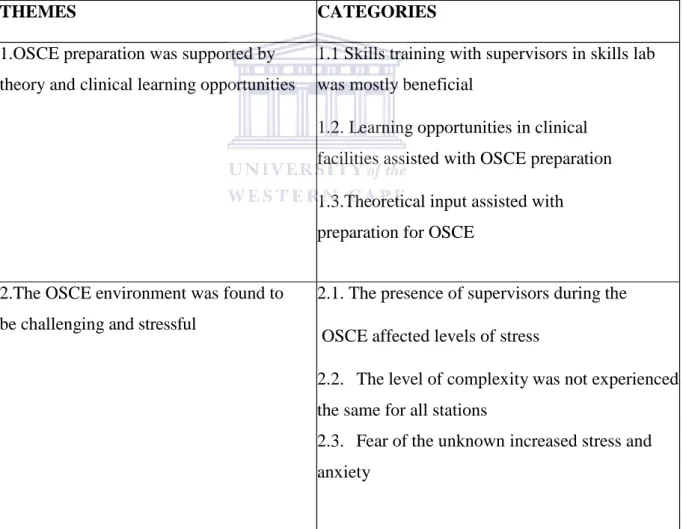
Four major themes emerged from the data collected from nine semi-structured interviews with third year midwifery Bachelor of Nursing students. These are listed in table 4.1.
Table 4.1: Themes and Categories
THEMES CATEGORIES
1.OSCE preparation was supported by theory and clinical learning opportunities
1.1 Skills training with supervisors in skills lab was mostly beneficial
1.2. Learning opportunities in clinical
facilities assisted with OSCE preparation 1.3.Theoretical input assisted with
preparation for OSCE
2.The OSCE environment was found to be challenging and stressful
2.1. The presence of supervisors during the OSCE affected levels of stress
2.2. The level of complexity was not experienced the same for all stations
2.3. Fear of the unknown increased stress and anxiety
31 3. Alignment of OSCE stations to clinical skills, theory, clinical practice and
appropriateness of time allocation
3.1 Students found the content of the OSCE to be appropriate and sufficient
3.2 Students found the OSCE scenarios similar to the scenarios in the clinical skills laboratory and clinical placements
3.3 Students found the time allocation for performance of the skills appropriate 4.Students had differing views about their
level of confidence and competence
4.1 Students felt confident after completion of the OSCE
4.2 Students did not feel that they were competent after the OSCE
4.3. Discussion
The experiences of the participants were communicated in many ways and relate to both positive and negative experiences they had about the OSCE. The identified themes are discussed individually, and quotations of participant‘s responses are presented and supported by literature as far as possible.
4.3.1. Theme One: OSCE preparation was supported by theory and clinical learning opportunities
It is expected of a student midwife to be actively and purposefully engaged in their learning. Therefore, students must become fully knowledgeable of the content of the study modules that consists of theory and practical components. OSCE concludes the final clinical component of the midwifery module for which students are assessed.
32
Success in an OSCE requires that students equip themselves with the necessary knowledge and skills in preparation for the OSCE. Students reported that skills training in the skills lab, the available learning opportunities in practice and the theoretical underpinning of clinical skills helped them prepare for the OSCE.
4.3.1.1 Category 1: Skills training with supervisors in skills lab was mostly beneficial The clinical skills laboratory method is a learner-centred teaching approach and has been adopted from the following schools of Nursing: Hogenschool, Arnhem and Nijmegen, and the University of Maastricht. All these educational institutions are located in the Netherlands. The skills laboratory methodology was introduced at SoN in 2007; to assist students to develop the necessary clinical skills prior to their placement in health care facilities. The provision of the simulated environment and its use in undergraduate programs has been identified and valued in most research (Longworth, 2013; Bland & Ousey, 2012; Kaakinen & Arwood, 2009; Galloway, 2009; Moule, Wilford, Sales & Lockyer, 2008). The students make use of the opportunity offered to practice in the simulated learning environment, become familiar and with the low, medium and high fidelity simulators.
The phases of skills development which students pass through according to the skills laboratory method includes orientation to the skill; visualisation of the skill; guided practice; independent practice and assessment. The goal of orientation is to create awareness regarding the method where competency and self-directed learning are emphasized. The goal of visualisation is where the students participate during the pre-clinical placement and supervisors perform demonstrations, which students visualise. During the guided
33
practice, a more comprehensive approach to skills development is applied, with the presentation of feedback, through reflection. Independent practice requires that the student use their workbooks as a guide and practice on their own in the skills laboratory. This step develops the student as a self-directed learner (Jeggels, Traut & Kwast, 2010).
According to the third year clinical programme, at the university used in the study, after orientation and visualisation, each student is allocated one day of the week for guided practice with the clinical supervisors in the skills laboratory. These sessions are compulsory. This day can also be used to practice independently.
The participants found their preparation in the clinical skills laboratory very beneficial as were reported by these participants: Participant (4) reported “when we have skills...everybody is relaxed and it’s a certain way and the supervisor talk[s] in between
and say[s] ok this is how it’s gonna [going to] be done”. Participant (1) felt that “The
skills lab must be there… without the skills lab we are going to fail the OSCE.”
The researcher however did not continue to explore why this participant felt so strongly. It would have been valuable to have explored what the participant valued about the skills laboratory and its preparation of students for the OSCE that made her feel that students would fail OSCE without skills lab experience.
Participant (3) felt that they were prepared well in advance for the OSCE and said “I just think the third year midwifery OSCE was fine the way it was because we went through everything…so it’s like I can’t say that I don’t feel confident when I entered the OSCE
because we were prepared… since the beginning of the year.” Participant three’s comment
34
confirms that students were prepared for all the skills that could have been included in the OSCE and that they received ample time to prepare.
Students used various sources of information as was suggested by participant (8) who explained how he tried to capture notes during the skills laboratory session and used it together with lecture notes and course material to prepare himself for the OSCE.
Some students practised in groups by constructing their own scenarios, simulation, and visualisation with their peers both on and off campus. One participant (5) reported on how she used a doll at home and tried to apply what she had learnt from her supervisor. Another participant (9) said “We also practiced for the OSCE [be] cause you need to be
competent in the skill…when you do your OSCE.” The participant went on to explain, “At
Disa [the hostel] we’d have like a group discussion and then we just throw a scenario and
then would try and see how you do it and discuss it [be] cause we also learn from each
other which was a good experience.”
The above-shared experiences of student midwives indicate that participants agreed that the skills sessions with the supervisors contributed significantly in their preparation for the OSCE, which confirms Street and Hamilton’s (2010) argument that a higher level of confidence will be experienced with good preparation, resulting in demonstrating the appropriate knowledge and skills that are required.
A comparable study conducted by Barry et al., (2012) on student midwives experiences also found that the preparation through the skills lab methodology for the OSCE was helpful. This includes current study, lecture led theory, workshops, individual preparation and
35
practising in the skills laboratory, in groups, was found by other studies to assist with students’ preparation (Mitchell, 2014; Fidment, 2012 & Barry et al., 2012).
The implementation of self-directed learning, required for the development of competence however remains a challenge especially when practising with peers. One participant (7) stated “…in the morning session we done with the supervisors…afternoon sessions- we
are supposed to do on each individual [on their own]…if you have a problem you
see the supervisor to help you in the afternoon sessions.” However, Jeggels et al., (2010)
reported that supervisors identified that the optimal utilisation of the skills lab by many students to practice independently does not occur, and has an impact on their development of clinical skills.
Despite the many positive experiences, participants also highlighted challenges. One of the challenges according to a participant (8) was the inconsistency of information received from supervisors during the skills session. This is the participant‘s account “I was first
confused…because…if on this specific procedure I had information that…when they ask me I will answer this way…and getting another student saying that no, my supervisor said according to her it would be done this way, so that’s why…I was a little bit confused.”
It is therefore evident that students require standardised facilitation sessions in the skills laboratory, to avoid such confusion. Midwifery students are not exposed to a mock OSCE which would better prepare them for the actual OSCE.
36
Challenges with the standardising of facilitation of skills laboratory sessions at SoN can be linked to the fact, that the large number of students in the third year of the programme requires the assistance of capable clinical supervisors, to ensure adequate supervision. Not all clinical supervisors are familiar with the methodology at work in the skills laboratory, when employed at the SoN. Regardless of the fact that all clinical supervisors receive orientation to the skills lab methodology, and undergo a period of shadowing and mentoring themselves, as has been the case the past four years, some clinical supervisors still struggle to let go of traditional student facilitation methods. However, clinical supervisors are given information sessions, in preparation for the OSCE, regarding consistency and what students will receive during the skills laboratory sessions.
According to McGlory, Johnson, Freeman, Heath, O‘Neill and Cooper (2005) a supervisor’s role is primarily to oversee, provide guidance and feedback to students. Students are expected to ask questions pertaining to the OSCE, it is clear that this student (participant 8) still did not feel adequately prepared. The challenge for all students thus remains to participate equally and become familiar with the OSCE process. Efforts to standardise the facilitation of the skills, throughout the phases of the skills laboratory, must be implemented.
This challenge is similar to that found in a study conducted by Longworth (2013) on the factors that affect the learning and transfer of skills taught to student midwives. Student midwives highlighted the mentor‘s ability to demonstrate procedures effectively as a factor, which greatly influences the learning and transfer of skills. The participants in Longworth’s study also commented that certain mentors do procedures strictly according to the textbook
37
while others do not. This results in students being exposed to poor demonstration of procedures, which influence their learning.
According to Jeggels et al., (2010) the criteria for employment as clinical supervisors at a nursing school is two years’ experience in a specific nursing discipline. However, no formal training in supervision and assessments of nursing students are required. Nevertheless, clinical supervisors were required to provide in-service training to midwifery and other categories of nursing students whilst practicing as professional nurses in clinical areas. However, these teaching sessions with students were limited to specific competencies, when suitable learning opportunities were available. Clinical teaching is also not the main function of professional nurses. They are often occupied by other more pressing duties such as management of a unit, patient care, and issues relating to ethics. It is therefore understandable that clinical supervisors would require training in teaching methodology, needed for the supervision of students.
4.3.1.2. Category 2: Learning opportunities in clinical facilities assisted with OSCE preparation
Clinical learning opportunities refer to the range of learning experiences available, in a health care setting or other experiential learning sites, for a learner to gain clinical skills
(Nursing Act, 2005). Clinical learning opportunities for midwifery students in the Bachelor of Nursing programme at the SoN are acquired in maternity wards (antenatal, labour and postnatal), and this process is supervised by clinical supervisors, registered midwives, and physicians. MOUs (midwife obstetric units) which are 24-hour specialist maternal services, staffed only by midwives are used for clinical placements as well as
38
district/provincial hospitals. At these facilities students encountered low and high risk pregnancies.
Three participants indicated that they received supervision and guidance from the facility staff members that also contributed in their preparation for the OSCE. Participant (6) reported, “We had a lot of practice in the facilities… if I didn’t understand something I would
just “Google” [internet] …I just went according… to the assessment too…and the sisters
there guided you.” Student midwives are expected to apply in practice what they learn
in their undergraduate programme.
The experience however becomes challenging when a skill is procedurally performed differently in the practice environment as reported by participant (2) “...they just supposed
to do the basics; put up the drip and put in a catheter [low risk] and just make the patient
ready for high risk but then they will introduce the drugs…but there was some of the sisters that do the stuff although they not supposed to.”
Quinn and Hughes (2007) argue that students should be encouraged to take ownership of their own learning and become active in identifying learning opportunities, when exposed to an effective learning environment. Houghton (2012) however suggests that students value the experience when being part of the clinical culture. However, learning can be impeded by the anxiety caused by the reality of practice. Silva, Souza, Trentini, Bonetti and Mattosinho (2010) aptly describe this as a reality shock, when the nursing in health institutions differ, from what they have learned. This is where the clinical supervisors, employed by universities and training facilities, are expected to provide the necessary support to students,