This is the
Accepted Version
of a paper published in the
journal Medical Teacher:
Malau-Aduli, Bunmi S., Teague, Peta-Ann, D'Souza, Karen,
Heal, Clare, Turner, Richard, Garne, David, and van der
Vleuten, Cees (2017)
A collaborative comparison of
Objective Structured Clinical Examination (OSCE)
standard setting methods at Australian medical schools.
Medical Teacher, 39 (12). pp. 1261-1267.
https://doi.org/10.1080/0142159X.2017.1372565
1
A collaborative comparison of Objective Structured Clinical Examination
1
(OSCE) standard setting methods at Australian medical schools
2 3
Bunmi S. Malau-Adulia, Peta-Ann Teaguea, Karen D’Souzab, Clare Heala, Richard Turnerc, 4
David Garned, Cees van der Vleutene 5
6
aCollege of Medicine and Dentistry, James Cook University, Queensland, Australia 7
bSchool of Medicine, Deakin University, Victoria, Australia 8
cSchool of Medicine, University of Tasmania, Tasmania, Australia 9
dSchool of Medicine, University of Wollongong, New South Wales, Australia 10
eSchool of Health Professions Education, Maastricht University, Maastricht, 11
Netherlands 12
13 14 15
Corresponding Author: Bunmi Malau-Aduli, College of Medicine and Dentistry, Division of 16
Tropical Health and Medicine, James Cook University, Townsville, Australia 17
Tel: +61747814418; Fax: +6174781 5870 18
E-mail: [email protected]
2
Abstract
1
Background: A key issue underpinning the usefulness of the OSCE assessment to medical 2
education is standard-setting, but the majority of standard-setting methods remain challenging 3
for performance assessment because they produce varying passing marks. Several studies have 4
compared standard setting methods; however, most of these studies are limited by their 5
experimental scope, or use data on examinee performance at a single OSCE station or from a 6
single medical school. This collaborative study between ten Australian medical schools 7
investigated the effect of standard-setting methods on OSCE cut scores and failure rates. 8
Methods: This research used 5,256 examinee scores from seven shared OSCE stations to 9
calculate cut scores and failure rates using two different compromise standard-setting methods, 10
namely the Borderline Regression and Cohen’s methods. 11
Results: The results of this study indicate that Cohen’s method yields similar outcomes to the 12
Borderline Regression method, particularly for large examinee cohort sizes. However, with 13
lower examinee numbers on a station, the Borderline Regression method resulted in higher cut 14
scores and larger difference margins in the failure rates. 15
Conclusion: Cohen’s method yields similar outcomes as the Borderline Regression method
16
and its application for benchmarking purposes and in resource-limited settings is justifiable, 17
particularly with large examinee numbers. 18
3
Introduction
1
Objective Structured Clinical Examinations (OSCEs) are used by many health 2
professional courses, especially medical schools, to assess examinee clinical competence. To 3
achieve this, OSCEs generally expose examinees to predetermined role-played medical 4
scenarios featuring simulated patients (SPs), while examiners observe and assess examinees 5
based on their interactions with the SPs (Keely et al. 2002; Hodges and McIlroy 2003). 6
Examinee performance in OSCE stations provide a systematic means to assess their acquired 7
clinical skill sets vital to their successful completion of their medical course and throughout 8
their future careers (Hodges and McIlroy 2003; Payne et al. 2008). 9
A key issue underpinning the usefulness of OSCE assessment to medical education is 10
standard setting, which is used to determine the minimum standard or passing mark required 11
for successful examinee performance and subsequent progression within the medical course 12
(Wass et al. 2001). Hence, examinee assessment and clinical competency outcomes are highly 13
reliant on the method selected to calculate this minimum standard (Cusimano 1996). Presently, 14
several standard-setting methods have been developed (Ben-David 2000; Norcini 2003; 15
Barman 2008; Downing and Yudkowsky 2009; Cizek 2012). 16
Standard-setting methods must be transparent, reproducible, credible, feasible, and 17
justifiable (Kaufman et al. 2000; Wass et al. 2001; Humphrey-Murto and MacFadyen 2002). 18
Other major considerations in choosing an appropriate standard setting method are time and 19
available resources and expertise. It is important to align the time needed to implement a method 20
with the needs and resources of the testing program (Hambleton et al. 2012). However, while 21
the majority of standard-setting methods meet most of these criteria, they remain challenging 22
4 Murto and MacFadyen 2002; Boursicot et al. 2006; George et al. 2006; Wood et al. 2006), 1
therefore indicating that there is no single best method or gold standard. 2
Fundamentally, a standard-setting method should deliver a true representation of 3
examinee performance; hence, only clinically competent examinees should pass an OSCE 4
assessment. There are three major types of standard setting categories, namely criterion-5
referenced (absolute), norm-referenced (relative) and compromise methods (Livingston and 6
Zieky 1982; Cizek 1996; Norcini 2003; Cizek 2012). Relative standards identify a group of 7
passing and failing examinees relative to pre-determined passing scores without considering 8
the difficulty of the test or ability of the examinees (Cohen-Schotanus and van der Vleuten 9
2010). Relative standard setting methods are easy to set but less defensible because the two 10
important factors (test difficulty and examinee ability) that could affect the passing scores are 11
not considered (McKinley and Norcini, 2013). Hence, the absolute method has been preferred 12
for testing clinical competencies (Norcini, 2003). Absolute standards are based on a pre-13
determined level of competency that does not depend on the performance of a well-defined 14
group (Downing and Yudkowsky, 2009). These methods require a desired level of mastery and 15
the passing criteria are determined from the judgments of a group of subject matter experts. 16
Absolute standard setting methods are either test-centred or examinee-centred (Livingston and 17
Zieky 1982). Test-centred standards are based on exam content; examples include the Nedelsky 18
(1954), Angoff (1971), Ebel (1972) and Jaeger (1983) methods. Examinee-centred methods, on 19
the other hand, focus judgement on the examinee performance and not the test content; 20
examples include the contrasting groups, borderline group, and borderline regression methods 21
(Livingston and Zieky 1982; Wood et al. 2006). The compromise method combines both test- 22
and examinee-centred methods; examples include the Hofstee (1983) and Cohen’s (2010) 23
5 Providing a detailed description of these standard setting methods is beyond the scope 1
of this manuscript, however this information is widely available in the medical education 2
literature (Livingstone and Zieky 1982; Cizek 1996; 2012; McKinley and Norcini 2013). The 3
test-centred methods are used widely in large-scale assessment and have been shown to provide 4
reliable and valid cut-scores (McKinley et al. 2005). However, they assume an underlying 5
unidimensional structure which cannot be assumed in the case of the OSCE. Additionally, they 6
are cumbersome and time-consuming (Hambleton et al. 2012). Conversely, examinee-centred 7
methods are more commonly seen in the medical education literature in setting cut-scores for 8
OSCEs (Boulet et al. 2003; Kramer et al. 2003; McKinley et al. 2005; Boursicot et al. 2007). 9
The test format of performance assessments such as the OSCE necessitates the use of methods 10
that consider examinees’ complete score profile. 11
The borderline regression method (BRM) has been identified as superior to the modified 12
borderline group method. This is due to the BRM utilising all examinee scores to calculate the 13
pass mark rather than just those examinee scores ranked as borderline (Ben-David 2000; Wood 14
et al. 2006). This standard-setting method has been deemed preferential to other methods due 15
to its ability to be derived immediately after the conclusion of the OSCE and its high validity 16
in representing actual examinee performance (Humphrey-Murto and MacFadyen 2002; Wood 17
et al. 2006). The BRM has been successfully validated (Kaufman et al. 2000, Kramer et al. 18
2003); its superiority rests not just in its ability to set standards quickly, but in its use of all 19
examinee/assessor interaction at station and scoring form level to both determine the standard 20
and provide detailed station level quality metrics for diagnostic processes. However, little is 21
known in the OSCE literature about another simple and cost-effective method, Cohen’s method. 22
Cohen’s method was developed by Janke Cohen-Schotanus in 2010 and it is based on 23
6 performance reflect test difficulty or teaching quality and it uses the 65% of 95th percentile 1
examinee as the reference point for the passing mark (Cohen-Schotanus and van der Vleuten 2
2010; Taylor 2011). Cohen’s method has principally been applied to standards in knowledge 3
tests; however, it has also been previously used in the OSCE setting (Kaufman et al. 2000) but 4
the findings were inconclusive. According to Taylor (2011), the score of the 95% percentile 5
examinee is an accurate indicator of exam difficulty and is consistent over time. Paradoxically, 6
Cohen’s method is considered limiting because of its intrinsic reliance on ranking examinee 7
performance and using this rank to determine pass or fail rather than actual examinees’ clinical 8
competency (Barman 2008). 9
Several studies have compared standard setting methods in OSCEs (Kaufman et al. 2000; 10
Humphry-Murto and MacFayden 2002; Boursicot et al. 2007). However, to the best of our 11
knowledge, most comparative standard-setting studies are limited by their experimental scope, 12
using examinee performance at a single OSCE station or from a single medical school. 13
This research was undertaken as a collaborative study between ten Australian medical 14
schools. The study compared the outcome of two compromise standard-setting methods 15
(Borderline Regression and Cohen’s methods) on examinee performance in seven shared OSCE 16
stations used to assess clinical competence in the early and exit phases of clinical exams. The 17
study aimed to answer the research question – to what extent do the cut scores and failure rates 18
from both standard setting methods differ? 19
Methods
20
Sample
21
Ten geographically dispersed Australian medical schools participated in this 22
7 The collaborative project is known as the Australian Collaboration for Clinical Assessment in 1
Medicine (ACCLAiM). All schools have similar horizontally and vertically integrated 2
outcomes-based curricula, accredited by the same body (the Australian Medical Council). The 3
selected year groups (early clinical and exit level) were chosen because of their comparable 4
levels of intended learning outcomes. 5
OSCE stations
6
There were two phases of the collaboration in which a total of seven OSCE stations 7
were collaboratively developed, and after achieving consensus on content and marking criteria, 8
were incorporated into the 2015-2016 summative clinical examination cycle of the participating 9
schools. The first phase of this study focused on the early clinical exam in which three OSCE 10
stations were co-developed and used by eight participating schools. The second phase of the 11
study focused on the exit clinical exam in which four OSCE stations were co-developed and 12
used by all ten participating schools. The examination procedure was similar for both phases. 13
The core clinical competencies assessed by all seven stations were selected from prospectively 14
reviewed clinical blueprints of the specific clinical skills and medical problems, representing a 15
fair and reasonable assessment, and mapped to the Medical Deans of Australia and New 16
Zealand (MDANZ) medical competencies project (MDANZ 2014). The OSCE stations focused 17
on clinical reasoning, communication skills, risk assessment, investigation and management 18
plan. 19
Examination procedure
20
Each collaborative set of OSCE stations was embedded into each participating medical 21
school’s OSCEs, where the total number of live stations varied between ten and twelve, with 22
8 used by the collaborating schools as deemed suitable to their curriculum. Participating schools 1
were required to use at least two (2) stations per exam. The participating schools arranged the 2
shared station ‘paperwork’ to fit with their local practice, to ensure that the shared OSCE 3
stations appeared identical to the local medical school stations. Due to large numbers of 4
examinees, concurrent multiple circuits of each station were used at each school. All schools 5
had one internal local examiner per station who were experienced clinicians involved in 6
examinee teaching and examination. Examiners rated examinee performance on each OSCE 7
station using anchored checklists with descriptors for five performance categories (fail, 8
borderline fail, borderline pass, clear pass, exceptional). They also gave global ratings of overall 9
station performance using a 7-point Likert scale (where 1=very poor performance, 2=well short 10
of expected standard, 3=short of expected standard, 4=expected standard, 5=better than 11
expected standard, 6=much better than expected standard, 7=exceptional performance). Given 12
that the study involved multi-institutional collaboration, a 7-point global rating scale was used 13
to provide the optimum number of categories that would allow for increased reliability of 14
ratings and minimise response error across sites (Cox 1980; Weijters et al. 2010). Additionally, 15
to improve agreement between our raters, the global scales are behaviourally anchored with 16
explicit performance category descriptors. The examiners were also provided with a calibration 17
exercise specific to each station, during which they were able to become familiar with using the 18
global rating. Details of the ACCLAiM examination procedure and protocols have been 19
described in our previously published work (Malau-Aduli et al. 2012; Malau-Aduli et al. 2016). 20
9
Standard-setting methods
1
This research used two standard-setting methods to compute passing scores for each 2
shared OSCE station: the Borderline Regression (BRM) and Cohen’s methods. For comparison, 3
standard setting procedures for the two methods were applied to the examinee scores for each 4
OSCE station and their differential effects on cut scores and failure rates were determined. 5
For the BRM (Wood et al. 2006), we used linear regression analysis of examinee 6
performance, as total percentage scores, and examiner global rankings to determine the cut 7
score. The cut score was derived by substituting the value for the borderline examinee (3.5) into 8
the regression equation. 9
For Cohen’s method (Cohen-Schotanus and van der Vleuten 2010), we used the 10
performance of the top 95th percentile of the test scores as the benchmark and the cut score was 11
set as 65% of the 95th percentile with the formula: CS = K x P95 - where CS is the cut score, K 12
is the multiplier (0.65) and P95 the score of the examinee at the 95th percentile (Cohen-13
Schotanus and van der Vleuten 2010; Taylor 2011). 14
10
Results
1
A total of 5,256 examinee scores, distributed between the seven shared OSCE stations 2
were analysed in this study. The demographic profile of the participating examinees showed 3
that their mean age was 25.2 ± 4.7 years; 52% were females and 86% were domestic students. 4
Figure 1 shows a comparison of cut scores and failure rates as determined by the two 5
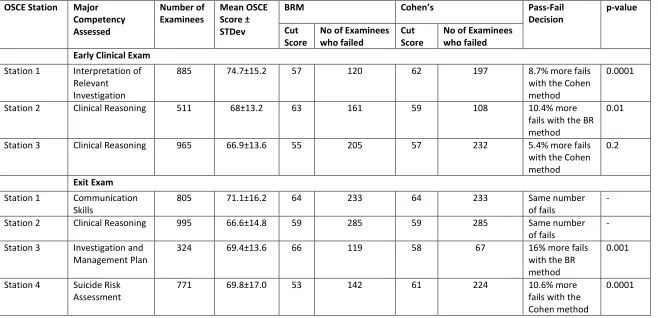
standard setting methods for the early clinical OSCE stations. Cohen’s method resulted in 6
higher cut scores and failure rates (p<0.01) than the BRM for two of the three stations used for 7
the early clinical exam (Table 1). The BRM yielded the highest cut score (63%) and failure rate 8
(32%) for station 2, which had the lowest number of examinees (n=511) in the early clinical 9
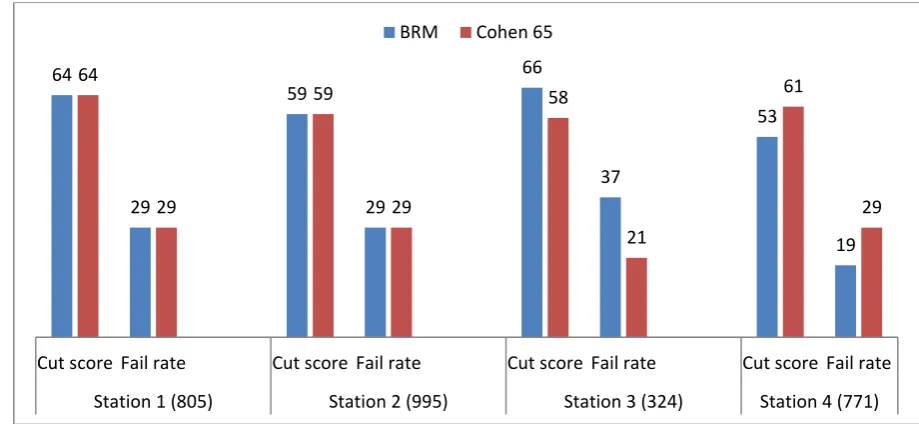
exam (Fig 1). A similar pattern was observed in the exit exam (Fig 2), where station 3 had the 10
lowest number of examinees (n=324) and the BRM resulted in the highest cut score (66%) and 11
failure rate (37%). For the exit exam, both BRM and Cohen’s method yielded the same cut 12
scores and failure rates for two of the four stations that were used (stations 1 and 2), and these 13
stations had the highest number of examinees, 805 and 995 respectively. 14
Table 1 also portrays the difference in fail decisions between the two standard setting 15
methods for each OSCE station. Cohen’s method generally resulted in a higher failure rate if 16
the examinee numbers were high. However, with lower examinee numbers on a station, the 17
BRM resulted in higher cut scores and larger difference margins in the fail decisions. In the 18
early clinical exam, there were 10.4% more fails on station 2 (n=511; p<0.01)) with the BRM, 19
while station 3 had only 5.4% more fails with Cohen’s method and the observed difference was 20
not significant. For the exit exam, there were 16% (p<0.001) more fails with the BRM than 21
with Cohen’s method on station 3, which had the lowest numbers of examinees. Cohen’s 22
11 were significant differences (p<0.001) in passing rates between schools for both methods. Table 1
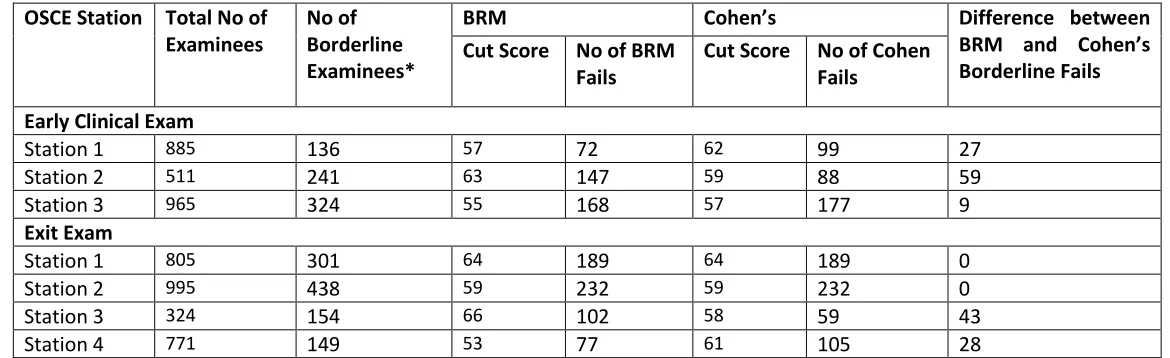
2 portrays the impact of the Borderline Regression and Cohen’s methods for borderline 2
examinees on each OSCE station. Overall, there were higher correlations between both standard 3
setting methods, in the pass-fail decisions for the borderline group on stations with higher 4
examinee numbers. There were no observable associations between the assessed competencies 5
and pass-fail decisions for both methods. Nevertheless, future research could explore this in 6
more detail. 7
Discussion
8
Validation of standard-setting methods has been a major part of quality assuring 9
assessment processes in medical education. This is to ensure fair representation of actual 10
examinee competence levels while providing an objective and defensible outcome (Kaufman 11
et al. 2000; Humphrey-Murto and MacFadyen 2002). Holistic standard-setting methods with a 12
set arbitrary passing mark (usually 50 or 60%) are considered inappropriate for OSCE 13
assessment as high failure rates can arise with their rigid application and arbitrary adjustments 14
of passing marks (Kaufman et al. 2000; George et al. 2006). 15
This research shows that selection of a standard-setting method has potentially severe 16
implications on perceived examinee performance. It has demonstrated that examinees could 17
pass or fail OSCE assessments with the same performance dependent on the standard-setting 18
method, supporting the findings of Boursicot et al (2006). This has implications affecting 19
comparability and benchmarking of examinees’ clinical competence between medical schools 20
and OSCE stations using different standard-setting methods. The observed differences in 21
passing rates across schools triangulates with published work in other settings (Boursicot et al. 22
12 schools. It also highlights the importance of case specificity. Consequently, selection of 1
standard-setting method should be a research-informed decision. 2
Nonetheless, the results of this study indicate that Cohen’s method results in similar 3
performance outcomes as the BRM, especially with large cohort sizes. According to Taylor 4
(2011), the score of the 95% percentile examinee is an accurate indicator of exam difficulty and 5
is consistent over time. These could be used to explain the similarities observed between the 6
cut scores and failure rates obtained for both BRM and Cohen’s methods at most of the OSCE 7
stations in this research. Both methods use all examinee data in setting the passing standard and 8
this provides a fair representation of examinees’ performance on the whole exam. The similar 9
pass-fail outcomes obtained for borderline examinees, particularly in cases with large total 10
examinee numbers, further confirms the utility of Cohen’s method for OSCEs. Our findings 11
suggest that the stability of the cutscore across the two standard setting methods is dependent 12
on the number of examinees. Cohen’s method relies on the performance of the examinees in 13
the higher cohort quartile and our results imply that with more examinee numbers in the higher 14
performance pool, the error margin shrinks, resulting in reduced heterogenity of variance and 15
therefore allowing for better correlations. Based on our findings, we would recommend the use 16
of Cohen’s standard setting method for multi-institutional OSCEs, where total examinee 17
numbers are over 800. The concordance between the two methods is encouraging, providing 18
some level of reassurance that the less resource-intensive Cohen’s method may be implemented 19
with high confidence, particularly for multi-site benchmarking of clinical performance, and also 20
in resource limited settings. The BRM has an added advantage of providing conceptual 21
assessment of the examinees’ clinical competence levels. However, the examinee ranking based 22
13 The recent global call by licensing bodies for the development of national frameworks 1
for standard setting of assessment in medical schools emphasises the need for benchmarking of 2
examinee performance across multiple sites and institutions (Wilkinson et al. 2014). Cohen’s 3
method has been implemented with great success in other educational settings (Dochy et al. 4
2009; Cohen-Schotanus and van der Vleuten 2010; Taylor 2011) and the fact that this method 5
uses the top performing examinees as the reference point ensures valid and accurate cut scores 6
because this top cohort of examinees is usually stable and performs equally well between 7
different year groups. The resulting similar cut scores and identification of failing examinees 8
for Cohen’s and BRM, particularly with larger examinee numbers, demonstrate that Cohen’s 9
method provides equally feasible and reproducible outcomes as the BRM. However, Cohen’s 10
method has the additional benefit that it is less cumbersome, requires shorter time and less 11
resources for its implementation and validation of examinee performance across multiple sites 12
and institutions. This standard setting approach is therefore recommended as a justifiable 13
standard setting method. 14
15
Research Strengths and Limitations
16
This research is the first study that compares the BRM and Cohen’s standard setting 17
approaches and also examines the outcome of standard setting methods across multiple 18
institutions, with large numbers of examinees. However, generalisations of the findings to other 19
settings are limited primarily from the use of data collected over only a single year of study. In 20
addition, whilst all attempts have been made to control for minor local differences in the 21
delivery of shared OSCE stations, these may have affected the obtained examinee performance 22
14 medical curricula, and assessments. Variability of these factors at other institutions may 1
produce different cuts. Practitioners should consider these factors in the decisions they make 2
based on those cuts. 3
Conclusion
4
Standard-setting methods have a profound effect in determining examinees’ clinical 5
competency and subsequent pass-fail decisions in OSCE assessments. However, this research 6
demonstrates that with higher examinee numbers, resultant pass-fail decisions are very similar 7
for BRM and Cohen’s methods. Future research using broad-scale comparisons in other settings 8
could be used to complement these research findings. 9
Acknowledgements
10
The authors would like to thank all participating ACCLAiM medical schools and their 11
administrative and academic staff, who supported the organisation and implementation of the 12
examinations. 13
Declaration of interest: The authors report no conflicts of interest. 14
Ethical approval: All participating schools obtained ethics approval from their local Ethics 15
Committee. All information was de-identified before data analysis. 16
15
Practice points
Standard setting method affects pass-fail decisions.
With higher examinee numbers, resultant pass-fail decisions are very similar for Cohen’s and BRM.
With similar outcomes, Cohen’s method has the attraction of using less resources 1
2
Glossary
Standard setting: Standard setting is the process of defining or judging the level of knowledge and skill required to meet a typical level of performance and then identifying a score on the examination score scale that corresponds to that performance standard
Relative Standards: Standards that are established based on a comparison of those who take the assessment to each other are relative standards.
Absolute Standards: Standards set by determining the amount of test material that must be answered (or performed) correctly in order to pass are absolute standards
Reference: McKinley, Danette W., and John J. Norcini. "How to set standards on performance-based examinations: AMEE Guide No. 85." Medical teacher 36.2 (2014): 97-110.
16
Notes on contributors
1
BUNMI MALAU-ADULI, BSc, MSc, PhD, is a Senior Lecturer in Medical Education and the 2
Academic Lead for Assessment and Evaluation at the College of Medicine and Dentistry, James 3
Cook University 4
5
PETA-ANN TEAGUE, MBChB, DRCOG, MRCGP, Dip Med Ed, FRACGP, is an Associate 6
Professor and the Director of the Generalist Medical Training (GMT) Program at James Cook 7
University 8
9
KAREN D’SOUZA, MBBS(Hons), is a Senior Lecturer in Medical Education (Clinical Skills) 10
and the Coordinator, Doctor and Patient Theme for the School of Medicine at Deakin University 11
12
CLARE HEAL, MBChB DRACOG, FRACGP, MPHandTM, Dip GU Med, PhD, is a Professor 13
of General Practice and Rural Medicine for James Cook University in Mackay 14
15
RICHARD TURNER, MBBS, BMedSc, FRACS, is a Professor of Surgery and the Director of 16
the Hobart Clinical School at the School of Medicine, University of Tasmania 17
18
DAVID GARNE, MBChB, MSC, MPhil, is an Associate Professor and the Associate Dean of 19
Community, Primary, Remote and Rural Health at the School of Medicine at the University of 20
Wollongong 21
22
CEES VAN DER VLEUTEN, MA, PhD, is the Scientific Director of the Graduate School of 23
Health Professions Education at Maastricht University 24
17
References
1
Barman A. 2008. Standard setting in examinee assessment: is a defensible method yet to come? 2
Ann Acad Med Singapore 37 (11):957-63. 3
Ben-David MF. 2000. AMEE Guide No. 18: Standard setting in examinee assessment. Med 4
Teach. 22 (2):120-130. 5
Boulet JR, De Champlain AF, McKinley DW. 2003. Setting defensible performance standards 6
on OSCEs and standardized patient examinations. Med Teach. 25 (3):245-249. 7
Boursicot KAM, Roberts TE, Pell G. 2006. Standard setting for clinical competence at 8
graduation from medical school: A comparison of passing scores across five medical 9
schools. Adv Health Sci Educ. 11 (2):173-183. doi: 10.1007/s10459-005-5291-8. 10
Boursicot KAM, Roberts TE, Pell G. 2007. Using borderline methods to compare passing 11
standards for OSCEs at graduation across three medical schools. Med Educ. 41 12
(11):1024-1031. doi: 10.1111/j.1365-2923.2007.02857.x 13
Cizek GJ. 2012. An introduction to contemporary standard setting. In: Setting performance 14
standards: Foundations, methods, and innovations. 2nd Ed; pp 3-14. New York: 15
Routledge. 16
Cizek, GJ. 1996. Setting passing scores. Educational Measurement: Issues and Practice 15. doi: 17
10.1111/j.1745-3992.1996.tb00809.x. 18
Cohen-Schotanus J, van der Vleuten CPM. 2010. A standard setting method with the best 19
performing examinees as point of reference: practical and affordable. Med Teach. 32 20
18 Cox EP. 1980. The optimal number of response alternatives for a scale: a review. J Marketing 1
Res, 17, 407–422 2
Cusimano, MD. 1996. Standard setting in medical education. Acad Med. 71 (10):S112-S120. 3
doi: 10.1097/00001888-199610000-00062. 4
Dochy F, Kyndt E, Baeten M, Pottier S, Veestraeten M. 2009. The effects of different standard 5
setting methods and the composition of borderline groups: A study within a law 6
curriculum. Studies in Educational Evaluation 35 (4):174-182. 7
Downing SM, Yudkowsky R. 2009. Assessment in health professions education: Routledge. 8
George, Sanju, M Sayeed Haque, and Femi Oyebode. 2006. Standard setting: comparison of 9
two methods. BMC Med Educ. 6 (1):46. 10
Hambleton, RONALD K, MARY J Pitoniak, and JENNA M Copella. 2012. "Essential steps in 11
setting performance standards on educational tests and strategies for assessing the 12
reliability of results." Setting performance standards: Foundations, methods, and 13
innovations:47-76. 14
Hodges B, McIlroy JH. 2003. Analytic global OSCE ratings are sensitive to level of training. 15
Med Educ. 37 (11):1012-1016. doi: 10.1046/j.1365-2923.2003.01674.x. 16
Humphrey-Murto S, MacFadyen JC. 2002. Standard setting: A comparison of case-author and 17
modified borderline-group methods in a small-scale OSCE. Acad Med. 77 (7):729-732. 18
doi: 10.1097/00001888-200207000-00019. 19
Kaufman DM, Mann KV, Muijtjens AMM, van der Vleuten CPM. 2000. A comparison of 20
standard setting procedures for an OSCE in undergraduate medical education. Acad 21
19 Keely E, Myers K, Dojeiji S. 2002. Can Written Communication Skills Be Tested in an 1
Objective Structured Clinical Examination Format? Acad Med. 77 (1):82-86. 2
Kramer A, Muijtjens A, Jansen K, Dusman H, Tan L, van der Vleuten CPM. 2003. Comparison 3
of a rational and an empirical standard setting procedure for an OSCE. Med Educ. 37. 4
doi: 10.1046/j.1365-2923.2003.01429.x. 5
Livingstone SA, Zieky MJ. 1982. Passing scores: A manual for setting standards of 6
performance on educational and occupational tests. Princeton: Educational Testing 7
Services. 8
Malau-Aduli BS, Mulcahy S, Warnecke E, Otahal P, Teague PA, Turner R, Van der Vleuten 9
C. 2012. Inter-rater reliability: Comparison of checklist and global scoring for OSCEs. 10
Creative Educ J, Special Issue, 3: 937-942. DOI:10.4236/ce.2012.326142 11
Malau-Aduli BS, Teague PA, Turner R, Holman B, D’souza K, Garne D, Heal C, Heggarty P, 12
Hudson JN, Wilson IG. 2016. Improving assessment practice through cross-institutional 13
collaboration: An exercise on the use of OSCEs. Med Teach. 38 (3):263-271. 14
McKinley DW, Boulet JR, Hambleton RK. 2005. A work-centered approach for setting passing 15
scores on performance-based assessments. Evaluation and the Health Pofessions 28 16
(3):349-369. 17
McKinley DW, Norcini JJ. 2013. How to set standards on performance-based examinations: 18
AMEE Guide No. 85. Med Teach. 36 (2):97-110. 19
Norcini JJ. 2003. Setting standards on educational tests. Med Educ. 37. doi: 10.1046/j.1365-20
20 Payne NJ, Bradley EB, Heald EB, Maughan KL, Michaelsen VE, Wang X, Corbett EC Jr. 2008. 1
Sharpening the Eye of the OSCE with Critical Action Analysis. Acad Med. 83 (10):900-2
905. doi: 10.1097/ACM.0b013e3181850990. 3
Taylor CA. 2011. Development of a modified Cohen method of standard setting. Med Teach. 4
33 (12):e678-82. doi: 10.3109/0142159x.2011.611192. 5
Wass V, van der Vleuten CPM, Shatzer J, Jones R. 2001. Assessment of clinical competence. 6
Lancet 357 (9260):945-9. doi: 10.1016/s0140-6736(00)04221-5. 7
Weijters B, Cabooter E, Schillewaert N. 2010. The effect of rating scale format on response 8
styles: The number of response categories and response category labels. Inter J Res 9
Marketing 27(3): 236–247. 10
Wilkinson D, Schafer J, Hewett D, Eley D, Swanson D. 2014. Global benchmarking of medical 11
examinee learning outcomes? Implementation and pilot results of the International 12
Foundations of Medicine Clinical Sciences Exam at The University of Queensland, 13
Australia. Med Teach 36 (1):62-67. 14
Wood TJ, Humphrey-Murto SM, Norman GR. 2006. Standard setting in a small scale OSCE: 15
A comparison of the modified borderline-group method and the borderline regression 16
method. Adv Health Sci Educ. 11 (2):115-122. doi: 10.1007/s10459-005-7853-1. 17
21 1
[image:22.595.103.503.89.306.2]2
Figure 1: Comparison of cut score (%) and failure rate (%) for early clinical OSCE stations. The 3
number of examinees included is shown in parentheses. 4
5
6
Figure 2: Comparison of cut score (%) and failure rate (%) for exit clinical OSCE stations. The 7
number of examinees included is shown in parentheses. 8
9
10
57
14
63
32
55
21 62
22
59
21
57
24
Cut score Fail rate Cut score Fail rate Cut score Fail rate
Station 1 (885) Station 2 (511) Station 3 (965)
BRM Cohen 65
64
29
59
29
66
37
53
19 64
29
59
29
58
21
61
29
Cut score Fail rate Cut score Fail rate Cut score Fail rate Cut score Fail rate
Station 1 (805) Station 2 (995) Station 3 (324) Station 4 (771)
[image:22.595.100.560.374.586.2]22
Table 1: Differences in standards between the Borderline Regression and Cohen’s methods for each OSCE station
OSCE Station Major Competency Assessed
Number of Examinees
Mean OSCE Score ± STDev
BRM Cohen’s Pass-Fail Decision
p-value Cut
Score
No of Examinees who failed
Cut Score
No of Examinees who failed Early Clinical Exam
Station 1 Interpretation of Relevant Investigation
885 74.7±15.2 57 120 62 197 8.7% more fails
with the Cohen method
0.0001
Station 2 Clinical Reasoning 511 68±13.2 63 161 59 108 10.4% more
fails with the BR method
0.01
Station 3 Clinical Reasoning 965 66.9±13.6 55 205 57 232 5.4% more fails
with the Cohen method
0.2
Exit Exam
Station 1 Communication
Skills
805 71.1±16.2 64 233 64 233 Same number
of fails
-
Station 2 Clinical Reasoning 995 66.6±14.8 59 285 59 285 Same number
of fails
-
Station 3 Investigation and Management Plan
324 69.4±13.6 66 119 58 67 16% more fails
with the BR method
0.001
Station 4 Suicide Risk Assessment
771 69.8±17.0 53 142 61 224 10.6% more
fails with the Cohen method
23
Table 2: Impact of the Borderline Regression and Cohen’s methods for borderline examinees on each OSCE station
OSCE Station Total No of Examinees
No of Borderline Examinees*
BRM Cohen’s Difference between
BRM and Cohen’s Borderline Fails Cut Score No of BRM
Fails
Cut Score No of Cohen
Fails
Early Clinical Exam
Station 1 885 136 57 72 62 99 27
Station 2 511 241 63 147 59 88 59
Station 3 965 324 55 168 57 177 9
Exit Exam
Station 1 805 301 64 189 64 189 0
Station 2 995 438 59 232 59 232 0
Station 3 324 154 66 102 58 59 43
Station 4 771 149 53 77 61 105 28