Intel
®
Technology Journal
APRIL 2015
Video-aware Wireless Networks
® TECHNOLOGY JOURNAL | VIDEO -A W
ARE WIRELESS NETWORKS
VOL 19 | ISSUE 01 | APRIL 2015
$49.95
Publisher Managing Editor
Cory Cox Stuart Douglas Content ArchitectDavid Ott and Jeff Foersters
Program Manager Technical Editor Technical Illustrators
Stuart Douglas David Clark MPS Limited
Technical and Strategic Reviewers
David Ott Jeff Foerster Xiaoqing Zhu Douglas S. Chan
Intel Technology Journal
Copyright © 2015 Intel Corporation. All rights
reserved. ISBN 978-1-934053-66-9, ISSN 1535-864X Intel Technology Journal
Volume 19, Issue 1
No part of this publication may be reproduced, stored in a retrieval system or transmitted in any form or by any means, electronic, mechanical, photocopying, recording, scanning or otherwise, except as permitted under Sections 107 or 108 of the 1976 United States Copyright Act, without either the prior written permission of the Publisher, or authorization through payment of the appropriate per-copy fee to the Copyright Clearance Center, 222 Rosewood Drive, Danvers, MA 01923, (978) 750-8400, fax (978) 750-4744. Requests to the Publisher for permission should be addressed to the
Publisher, Intel Press, Intel Corporation, 2111 NE 25th Avenue, JF3-330, Hillsboro, OR 97124-5961. E-Mail: [email protected].
This publication is designed to provide accurate and authoritative information in regard to the subject matter covered. It is sold with the understanding that the publisher is not engaged in professional services. If professional advice or other expert assistance is required, the services of a competent professional person should be sought.
Intel Corporation may have patents or pending patent applications, trademarks, copyrights, or other intellectual property rights that relate to the presented subject matter. The furnishing of documents and other materials and information does not provide any license, express or implied, by estoppel or otherwise, to any such patents, trademarks, copyrights, or other intellectual property rights.
Intel may make changes to specifications, product descriptions, and plans at any time, without notice.
Fictitious names of companies, products, people, characters, and/or data mentioned herein are not intended to represent any real individual, company, product, or event. Intel products are not intended for use in medical, life saving, life sustaining, critical control or safety systems, or in nuclear facility applications. Intel, the Intel logo, Intel Atom, Intel AVX, Intel Battery Life Analyzer, Intel Compiler, Intel Core i3, Intel Core i5, Intel Core i7, Intel DPST, Intel Energy Checker, Intel Mobile Platform SDK, Intel Intelligent Power Node Manager, Intel QuickPath Interconnect, Intel Rapid Memory Power Management (Intel RMPM), Intel VTune Amplifier, and Intel Xeon are trademarks or registered trademarks of Intel Corporation or its subsidiaries in the United States and other countries.
Software and workloads used in performance tests may have been optimized for performance only on Intel microprocessors. Performance tests, such as SYSmark and MobileMark, are measured using specific computer systems, components, software, operations and functions. Any change to any of those factors may cause the results to vary. You should consult other information and performance tests to assist you in fully evaluating your contemplated purchases, including the performance of that product when combined with other products.
For more complete information about performance and benchmark results, visit www.intel.com/benchmarks
†Other names and brands may be claimed as the property of others.
This book is printed on acid-free paper. ∞ Publisher: Cory Cox
Managing Editor: Stuart Douglas
Library of Congress Cataloging in Publication Data: Printed in China
10 9 8 7 6 5 4 3 2 1 First printing: April 2015
Notices and Disclaimers
ALL INFORMATION PROVIDED WITHIN OR OTHERWISE ASSOCIATED WITH THIS PUBLICATION INCLUDING, INTER ALIA, ALL SOFTWARE CODE, IS PROVIDED “AS IS”, AND FOR EDUCATIONAL PURPOSES ONLY. INTEL RETAINS ALL OWNERSHIP INTEREST IN ANY INTELLECTUAL PROPERTY RIGHTS ASSOCIATED WITH THIS INFORMATION AND NO LICENSE, EXPRESS OR IMPLIED, BY ESTOPPEL OR OTHERWISE, TO ANY INTELLECTUAL PROPERTY RIGHT IS GRANTED BY THIS PUBLICATION OR AS A RESULT OF YOUR PURCHASE THEREOF. INTEL ASSUMES NO LIABILITY WHATSOEVER AND INTEL DISCLAIMS ANY EXPRESS OR IMPLIED WARRANTY RELATING TO THIS INFORMATION INCLUDING, BY WAY OF EXAMPLE AND NOT LIMITATION, LIABILITY OR WARRANTIES RELATING TO FITNESS FOR A PARTICULAR PURPOSE, MERCHANTABILITY, OR THE INFRINGEMENT OF ANY INTELLECTUAL PROPERTY RIGHT ANYWHERE IN THE WORLD. Software and workloads used in performance tests may have been optimized for performance only on Intel microprocessors. Performance tests, such as SYSmark and MobileMark, are measured using specific computer systems, components, software, operations and functions. Any change to any of those factors may cause the results to vary. You should consult other information and performance tests to assist you in fully evaluating your contemplated purchases, including the performance of that product when combined with other products.
For more information go to http://www.intel.com/performance
Intel’s compilers may or may not optimize to the same degree for non-Intel microprocessors for optimizations that are not unique to Intel microprocessors. These optimizations include SSE2, SSE3, and SSE3 instruction sets and other optimizations. Intel does not guarantee the availability, functionality, or effectiveness of any optimization on microprocessors not manufactured by Intel. Microprocessor-dependent optimizations in this product are intended for use with Intel microprocessors. Certain optimizations not specific to Intel microarchitecture are reserved for Intel microprocessors. Please refer to the applicable product User and Reference Guides for more information regarding the specific instruction sets covered by this notice.
Notice revision #20110804 INFORMATION IN THIS DOCUMENT IS PROVIDED IN CONNECTION WITH INTEL PRODUCTS. NO LICENSE, EXPRESS OR IMPLIED, BY ESTOPPEL OR OTHERWISE, TO ANY INTELLECTUAL PROPERTY RIGHTS IS GRANTED BY THIS DOCUMENT. EXCEPT AS PROVIDED IN INTEL’S TERMS AND CONDITIONS OF SALE FOR SUCH PRODUCTS, INTEL ASSUMES NO LIABILITY WHATSOEVER AND INTEL DISCLAIMS ANY EXPRESS OR IMPLIED WARRANTY, RELATING TO SALE AND/OR USE OF INTEL PRODUCTS INCLUDING LIABILITY OR WARRANTIES RELATING TO FITNESS FOR A PARTICULAR PURPOSE, MERCHANTABILITY, OR INFRINGEMENT OF ANY PATENT, COPYRIGHT OR OTHER INTELLECTUAL PROPERTY RIGHT.
A “Mission Critical Application” is any application in which failure of the Intel Product could result, directly or indirectly, in personal injury or death. SHOULD YOU PURCHASE OR USE INTEL’S PRODUCTS FOR ANY SUCH MISSION CRITICAL APPLICATION, YOU SHALL INDEMNIFY AND HOLD INTEL AND ITS SUBSIDIARIES, SUBCONTRACTORS AND AFFILIATES, AND THE DIRECTORS, OFFICERS, AND EMPLOYEES OF EACH, HARMLESS AGAINST ALL CLAIMS COSTS, DAMAGES, AND EXPENSES AND REASONABLE ATTORNEYS’ FEES ARISING OUT OF, DIRECTLY OR INDIRECTLY, ANY CLAIM OF PRODUCT LIABILITY, PERSONAL INJURY, OR DEATH ARISING IN ANY WAY OUT OF SUCH MISSION CRITICAL APPLICATION, WHETHER OR NOT INTEL OR ITS SUBCONTRACTOR WAS NEGLIGENT IN THE DESIGN, MANUFACTURE, OR WARNING OF THE INTEL PRODUCT OR ANY OF ITS PARTS.
Intel may make changes to specifications and product descriptions at any time, without notice. Designers must not rely on the absence or characteristics of any features or instructions marked “reserved” or “undefined”. Intel reserves these for future definition and shall have no responsibility whatsoever for conflicts or incompatibilities arising from future changes to them. The information here is subject to change without notice. Do not finalize a design with this information.
The products described in this document may contain design defects or errors known as errata, which may cause the product to deviate from published specifications. Current characterized errata are available on request.
Contact your local Intel sales office or your distributor to obtain the latest specifications and before placing your product order.
Copies of documents which have an order number and are referenced in this document, or other Intel literature, may be obtained by calling 1-800-548-4725, or go to: http://www.intel.com/design/literature.htm
Towards Realizing Video Aware Wireless Networks ... 6 Perceptual Optimization of Large Scale Wireless Video Networks ... 26 Caching and Cross-Layer Design for Enhanced Video Performance ... 70 Femtocaching and D2D Communications: A New Paradigm for Video-Aware
Wireless Networks ... 92 Video Delivery over Wireless Networks: Exploiting Network Heterogeneity and
Content Commonality ... 120 Delivering Enhanced 3D Video ... 162 Improving Video Performance with Edge Servers in the Fog Computing Architecture ... 202
Articles
INTEL
®TECHNOLOGY JOURNAL
Contributors
This introductory article provides background on the formation of a unique industry-academic research initiative focused on the efficient delivery of video content across wireless networks. A multidisciplinary team of researchers from five leading US and international universities partnered with Intel, Cisco, and Verizon to explore novel approaches in this challenging area. Known as Video Aware Wireless Networks, or VAWN, the research program included experts in the areas of wireless communications, networking, video quality, and video processing. A key focus was optimizing the end user perceptual quality of experience while trying to minimize network resources. This article summarizes the market trends that motivated this research, provides industry perspectives from Verizon, Cisco, and Intel on the opportunities and challenges for realizing an end-to-end optimized video delivery system, and discusses standards and technical transfer considerations. The goal for this article and this special Intel Technical Journal issue is to summarize the key lessons and research ideas from this industry-university initiative and to motivate further work within the industry to realize many of these new ideas in practice.
Introduction
No matter which way you look at it, the trend in video content delivery over wireless networks would seem to be clear: up, up, and up. Whether it’s streamed video, Internet video, video on demand, personal video streaming, video sharing applications, video conferencing, live video broadcasting, video Twitter*, or video blogging, wireless network users have never been more interested in consuming and sharing digital video content over wireless networks. And by all indications, this interest will continue to expand rapidly as more users are enabled with more capable wireless devices.
To ground these observations in numbers, consider the Cisco Visual Networking
Index mobile forecast for 2014–2019.[1] According to measurement data, global
mobile data traffic grew by 69 percent in 2014 to 2.5 exabytes per month (one exabyte equals one billion gigabytes). Projections for 2019 anticipate an order of magnitude growth to a staggering 24.3 exabytes. Most importantly for our purposes, mobile video data is expected to grow at a compound annual growth rate (CAGR) of 66 percent between 2014 and 2019 to 17.4 exabytes. As a percentage of global mobile traffic data, mobile video data is expected to grow from 55 percent in 2014 to 72 percent in 2019. Whether seen in absolute terms (total number of bytes) or relative terms (percentage of total traffic), it’s clear that video traffic plays a major role in current wireless networks and that its role in future mobile networks can hardly be understated.
ToWARds ReAlIzINg VIdeo AWARe WIReless
NeTWoRks
Jeffrey Foerster Intel Corporation David Ott Intel Corporation Ozgur Oyman Intel Corporation Yiting Liao Intel Corporation Srinivasa Somayazulu Intel Corporation Xiaoqing Zhu Cisco systems Douglas S. Chan Cisco systems Chris Neisinger VerizonThe implications of this growth are significant. Demand for digital video content will continue to stress the capacity of both downlinks and uplinks in future wireless communications networks as users find new ways to consume and share video content. For instance, future graphics applications might utilize a mix of video and graphics content to provide an increasingly immersive effect for virtual reality, gaming, navigation, and other contexts yet to be invented. User device manufactures will need solutions to the problem of managing a rich user experience despite finite network resources, complexities that arise from variations in device resolution and processing capabilities, and the ever-present pressure of limited battery life. In general, the trend is for device platforms to become more capable and for users to demand video of increasingly higher quality (such as HD and 4k content).
In 2010, Intel, Cisco, and Verizon jointly established a research program entitled
Video Aware Wireless Networks (VAWN) to explore innovative solutions to these challenges through university research (see Figure 1). In particular, the program looked at three key vectors for enabling future video content delivery over
wireless networks: video transport optimizations, video processing optimizations,
and novel network architectures for video delivery. The first, video transport optimizations, looks at how wireless network elements, both within the network and at network endpoints, could be modified or redesigned to better serve the transport needs of digital video. The second, video processing optimizations, looks at how digital video itself and processing mechanisms at the source and destination could be redesigned to better comprehend the context of wireless transport. The last vector, novel network architectures, asks whether significant
“Demand for digital video content
will continue to stress the capacity of
both downlinks and uplinks in future
wireless communications networks as
users find new ways to consume and
share video content.”
Packet Loss Visibility Rate-Distortion Info. Video Side-Info. Unequal Error Protection Coding for BC/MC Multi-user Scheduling VQA Cache Error Concealment,
Frame Rate Conv. VQA
Interference Shaping
Carriers & Network Providers Content Providers &
CDNs VQA Transcoding VQA VQA Cache Cache Cache Cache Cache Error Concealment, Frame Rate Conv.
Error Concealment, Frame Rate Conv.
Multi-view Generation Het-Net Scheduling 3D Compression Transcoding Adaptive Streaming VQA P2P
Figure 1: Video Aware Wireless Networks (VAWN) (source: Intel Corporation, 2014)
advantages could be achieved if wireless network architectures were redesigned and what that experimental redesign would look like. All three vectors address
two key grand challenges within the program: increasing the capacity of future
wireless networks to deliver digital video content and improving the quality of experience for users accessing digital video over future wireless networks.
Universities participating in this initiative included Cornell University, Moscow State University, the University of California at San Diego, the University of Southern California, and the University of Texas at Austin. Working with multiple industry sponsors (Intel, Cisco, and Verizon), research was understood to be precompetitive and approaches were freely discussed by all participants throughout the program duration of three years. During that time, lead principal investigators, along with their collaborators and graduate students, published over 100 papers in leading conferences and journals and generated a wide spectrum of results that speak to program challenges.
In this edition of the ITJ, VAWN researchers and sponsors present an overview of key research results and recommendations for the industry on digital video transport over wireless networks.
Wireless Carrier Challenges and Opportunities
Wireless operators are experiencing tremendous network growth as a result of consumer demand for video services. This has been fueled by the advent of smartphones, tablets, high resolution screens, and the changing content on the Internet. As devices have improved, the demand for quality has also increased. For example, YouTube content has changed from home movie quality (cute cat videos) to professionally created mobile-specific content. Periodic blocking and stalling of this professional quality content is no longer tolerated. This leads to customer expectations of wire-line performance on a wireless network; customers want immediate delivery whenever they request it and wherever they happen to be. They also expect simple and affordable service offerings.
The operator is also under increasing pressure to improve efficiency. The unprecedented data growth over the past 10 years has come at a time when increased spectral efficiency technology improvements from 2G to 3G to 4G LTE have been sufficient to keep up with the demand and drive the telecom industry ecosystem. However, the spectral efficiency gains beyond 4G will be minimal. The wireless operator must find other methods that increase efficiency in order to keep up with consumer demand and maintaining profitability. The far right side of the chart in Figure 2 illustrates a potentially unstable ecosystem. The cost of the network exceeds the customer’s willingness to pay. Clearly the challenge is to find additional techniques to significantly improve efficiency and push the crossover as far to the right as possible. This improved efficiency will enable a stable ecosystem that will support the growth of wireless well into the future.
The challenge for the operator is to find network management techniques that
“…researchers and sponsors present an
overview of key research results and
recommendations for the industry on
digital video transport over wireless
networks.”
“The challenge for the operator is to
find network management techniques
that increase network efficiency while
maintaining or improving customer
Similar situations appeared when the fixed Internet transitioned toward video content. Prior to the introduction of content delivery networks (CDNs), the core was becoming uneconomical to augment. The answer was not to build a bigger core network to handle the traffic, but rather to change the architecture to be more efficient. The Internet edge had unused capacity but the core could not pass the traffic. CDNs rebalanced this to effectively increase the overall efficiency and capacity of the Internet. The purpose of the VAWN initiative is to find technology and architecture opportunities for unlocking capacity in the wireless Internet. Current measures of quality for wireless networks often revert to average speed tests. But speed is only a surrogate for quality. Speed tests are relatively simple to implement, report, and advertise. However, average speed is not always a good measure for true quality of experience (QoE). Average speed is a great way of indicating the quality of a network if the application is FTP. But the wireless Internet handles nearly zero FTP traffic. Since the majority of the traffic on the wireless network is video, it makes much better sense to measure the quality of a network by some methods that actually convey the user-perceived quality of video. Methods to improve network efficiency must be better balanced by placing more emphasis on QoE and reducing the
“The purpose of the VAWN initiative
is to find technology and architecture
opportunities for unlocking capacity in
the wireless Internet.”
4.5 4 3.5 3 2.5 2
Network Efficiency gain lags Demand Increase
B/S/Hz (nor maliz ed to squar e miles co ve ragee) Stable
Shannon Limit for typical Cellular SNR
4G LTE
EvDO CDMA2000
AMPS CDPD Some futurepoint in time
Demand (ill ustration) 1.5 1 0.5 0 1980 1990 2000 2010 Cellular Historical Projected Unstable
Figure 2: Network capacity demands and cellular technology trends (source: Verizon, 2014)
importance of average speed. Accompanying solutions will also be needed for the advertising positioning problem: using speed as a surrogate for quality makes it easier to craft a 6-second sound bite advertising network service. In general, consumers do not understand latency, jitter, frame error rate (FER), or macro block pixilation. As such, the industry needs to develop standard methods and procedures for conveying true quality of experience. These QoE metrics need to be technically accurate enough to drive real network improvements, yet easily communicated to the lay consumer.
Networking Challenges and Opportunities
The rapidly growing demand for wireless video content, along with elevated user expectations for video quality and viewing experience, calls for a fundamental change in the design of networking technologies and solutions. It will no longer suffice for the network device (such as the router, switch, or gateway) to simply act as a “dumb pipe” and diligently pump packets from point A to point B at the highest possible speed, regardless of what type of information those packets carry. Instead, it is our vision that intelligent participation from the network— when done right—can help to alleviate the video-induced bandwidth crunch over wireless networks while maximizing user QoE. Much of the research effort in the VAWN program has focused on figuring out how to do it right.
One way to realize such a vision is to open up a richer set of APIs (or information exchange channels) between network devices and video application endpoints. This will allow network devices at resource bottlenecks to make informed decisions to optimize for users’ quality of experience in lieu of optimizing for conventional quality of service metrics (for instance, bandwidth, loss, delay, and delay jitter). For example, in the presence of unforeseen network congestion, a video-aware router can choose to only drop video packets marked by endpoints at relatively low priority, either within an individual video flow or across multiple video flows, or only drop non-video packets, so as to mitigate the impact of packet drops on perceived video quality at the receiver. Alternatively, the information can flow along the reverse direction: from the network to the video endpoint. A video sender can benefit from explicit congestion notifications from network nodes that proactively learn and predict impending congestion, thereby adapting more swiftly to avoid congestion-induced packet losses in the first place. As discussed further in the section “Existing and Emerging Standards,” success in deploying such cross-layer approaches depends not only on the ingenuity of the specific technical solutions themselves, but also on successful adoptions of international standards that push for this direction in general.
Interestingly, while near-term transition to a QoE-optimized network needs to overcome foreseeable hurdles in standardization, the emerging software-defined networking (SDN) technologies may open up even greater opportunities for QoE-based network optimization in the long run. In SDN, the network controller is implemented as software. It is not only logically, but also physically separated from data-plane operations of packet forwarding that remains lightning fast and straightforward. In addition, one network controller
“…QoE metrics need to be technically
accurate enough to drive real
network improvements, yet easily
communicated to the lay consumer.”
“The rapidly growing demand for
wireless video content, calls for a
fundamental change in the design
of networking technologies and
solutions.”
may have a centralized view of the global network topology within its own domain. Such a novel architecture may therefore afford greater flexibility, visibility, and simplicity in defining and instantiating packet treatment policies per application or per flow. The networking industry is currently busy defining a new standard interface between network controllers and data-forwarding devices; the timing cannot be better for transporting the thinking and learning gained from the VAWN program to the yet-to-be-defined arena of SDN. Embedding intelligence within the network goes beyond improving existing networking functionalities. Technological advances have continued to improve the capability of computing and storage resources at ever-decreasing unit prices. It therefore makes perfect sense to push further the idea of CDNs and to augment today’s network edge nodes (such as WiFi* access points and cellular base stations) with affordable computing and storage resources. Intelligent network edge nodes can be leveraged to improve the wireless video transport in many ways: distributed content caching and pre-fetching, on-the-fly video transcoding based on wireless link quality of each client, intelligent soft handoff following users’ mobility patterns, and radio-aware resource management among competing video clients. The resulting networking infrastructure will be a diverse, distributed, and heterogeneous platform—fog computing—that complements today’s centralized cloud computing paradigm.
Mobile Device and End-to-end Considerations
It’s important to understand the end-to-end system in order to ensure a high quality of experience while at the same time minimizing the network resources needed to deliver that experience. Figure 3 shows three main elements
“The networking industry is currently
busy defining a new standard interface
between network controllers and
data-forwarding devices…”
Video Meta-data Value Added Services
/Ads/Interactive
Efficient E2E QoE Adaptation
SERVICE PROVIDER NETWORK Tiered Services Content Caching Location Sensors Remote display/ peripherals Context-aware Personalization/ Preferences Video quality enhancement QoE Management Network CDN Meta-data/ Side-information Congestion Control Device & Network
Optimization Multi-format Encapsulation Content Protection QoE Estimator Analytics Encode/Transcode
Figure 3: opportunities in an end-to-end system (source: Intel Corporation, 2014)
(simplified) to deliver a video streaming solution: (i) server, (ii) network, and (iii) client. Each element has a different responsibility in the end-to-end system, but can be improved through close cooperation between the elements which is one of the primary objectives of this university research and one of the significant challenges in the industry to realize.
Adaptive streaming applications are primarily driven by the client that requests a particular bandwidth representation from the server, which is then streamed in an appropriate format over the network to the client. When selecting the bandwidth representation, the client needs to estimate the available network bandwidth and can also take into account the amount of content in the buffer, battery life, environmental conditions, and user/device context information. The primary role of the server on the left is to host the cloud-based application, store content coming from a content provider, manage content protection requirements, and encapsulate the content into the appropriate format that the client application can understand. Today, there are three main adaptive streaming formats, Apple HTTP Live Streaming (HLS), Microsoft Smooth Streaming (MSS), and Adobe HTTP Dynamic Streaming (HDS). In addition, there is a new standard emerging, MPEG DASH, which will hopefully reduce and simplify the number of formats needed in the future. However, in the intermediate term, there will be a need for the servers to support multiple formats, and several server implementations do this through dynamic switching between formats in order to limit how many versions of the content need to be stored. In addition to the multiple formats that need to be supported in the cloud server, adaptive streaming inherently means that multiple bit rates need to be supported at the server. This can be done in one of two ways: (i) multiple versions of the content are stored each with a different bit rate, or (ii) the content is transcoded in real time to the requested bit rate from the mobile device. Approach (i) requires more memory while approach (ii) is more compute intensive. The tradeoff between memory and compute resources in the cloud is still an ongoing debate and the future will likely include both, depending on where the content is stored (in a data center or closer to the edge of the network) and the popularity of the content (frequently requested content might be best stored in multiple bit rates while less frequently requested content might be better to transcode on demand in order to free up more memory). As the cost of both memory and compute resources continue to go down, this tradeoff space will likely change over time.
In order to efficiently stream video content over the network, especially when multiple users are vying for the same congested resources, it’s important that the network have information on the content being streamed and the status of the client. This allows it to make appropriate decisions when dividing up and prioritizing resources fairly among the competing clients and applications. This is where industry cooperation and standards need to come into play to create a framework for information sharing so that the network can optimize the user experience for all users while managing its limited resources. These standards, enabling information exchange between the video
“Adaptive streaming applications
are primarily driven by the client
that requests a particular bandwidth
representation from the server…”
“…it’s important that the network
have information on the content being
streamed and the status of the client.”
server, network, and clients, has been a major focus within Intel and in the industry to help realize some of the opportunities highlighted by university research.
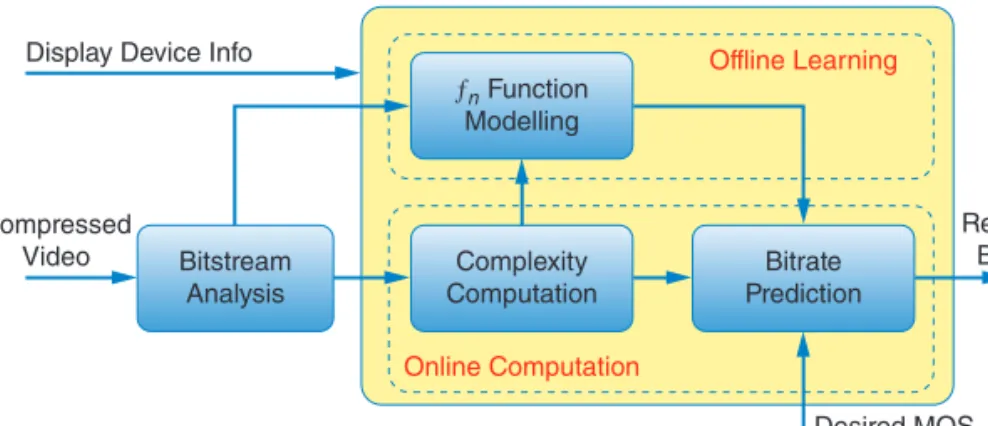
On the client, adaptive streaming requires the client to accurately estimate the available network bandwidth in order to request the appropriate segment bit rate to be sent by the server. This approximation becomes a challenge, since the available bandwidth is impacted by the other users in the network, the wireless radio channel conditions, and the impact of loss in the network—including the response of TCP back-off. The two main factors adversely impacting a user’s quality of experience for streaming applications at the client are number of rebuffering events (frame freezing) and poor video quality rendering. Therefore, the client’s objective is to request the highest quality representation from the video server while maintaining a very low probability of rebuffering. In order to do this, the client needs to make decisions based on several inputs: (i) the rate-distortion characteristics of the content, (ii) the status of the current playback buffer, and (iii) the current available network bandwidth. The rate-distortion characteristics of the content could either come from the server in the presentation description (to be discussed more in the section “Existing and Emerging Standards”) or be predicted by the client. To predict this at the client, some of the new non-reference video quality metrics could be useful, which received considerable focus by university researchers within the program. Motivated by the university research at UT Austin in this area, and assisted by interns, Intel has developed its own non-reference quality estimator along with a bit-rate estimator which could be used at the client. Figures 4 through 6 explain these algorithms and performance measured against a video quality database. Somewhat surprising is the fact that the non-reference video quality metrics were able to achieve correlations above 0.90, performing almost as well as reference-based quality metrics.
“…adaptive streaming requires
the client to accurately estimate the
available network bandwidth in order
to request the appropriate segment bit
rate to be sent by the server.”
eMOS = max (min (1 + 3.7 1 –
bitrate ƒ0 ƒ1 1+ 1 , 5),1) Display Device Info
Compressed
Video Bitstream
Analysis ComputationComplexity EstimationMOS Offline Learning Online Computation eMOS ƒn Function Modelling Compute ƒTC Where ƒ0 = 0i· ƒTC + 0i, ƒ1= 1i· ƒTC + 1i i n,ni Estimate
Figure 4: Non-Reference (NR) Mean opinion score (Mos) subjective quality estimator framework
In order for the client to deliver the best experience possible for a video streaming application, it needs to be cross-layer aware. This means that it is not sufficient just to estimate the available bandwidth and then stream at the maximum bit rate possible (as many existing solutions approach the problem). Rather, the client needs to use information from the application (playout buffer status and video quality characteristics), from the user and device context (environment lighting conditions and device battery state), from the radio (physical layer throughput), and from the transport layer (congestion state and back-off state). This requires close cooperation among elements on the platform, including hardware, firmware, and software. Figure 7 shows an example of how a client platform could become cross-layer aware. University researchers in VAWN have helped to identify and quantify the benefits of the various cross-layer optimization opportunities. Ideally, these ideas need to
5 4.5 4 3.5 3 MOS 2.5 2 1.5 1 5 4.5 4 3.5 3 MOS 2.5 2 1.5 1 1 2 3 NR-e-MOS Training PCC: 0.9078 MAE: 0.2663 PCC: 0.9408MAE: 0.2201 4 5 1 2 3 NR-e-MOS Test 4 5 HDTV Android Tablet Android Phone iPad iPhone HDTV Android Tablet Android Phone iPad iPhone
Figure 5: Performance evaluation (source: Intel Corporation, 2014)
Display Device Info
Compressed Video Bitstream Analysis Complexity Computation Bitrate Prediction Offline Learning Online Computation Required Bitrate Desired MOS ƒn Function Modelling
Figure 6: Bit-rate estimator framework based upon target desired quality (Mos) using the NR Mos estimator
be realized on a platform with minimal additional complexity and minimal information sharing between the blocks. This continues to be an active area of research.
Existing and Emerging Standards
The standardization of adaptive streaming over HTTP has made great progress recently, with the technical specifications being completed by various standards bodies. In particular, Dynamic Adaptive Streaming over HTTP (DASH) has recently been standardized by Moving Picture Experts Group (MPEG) and Third Generation Partnership Project (3GPP) as a converged format for
video streaming.[2][3] The standard has been adopted by other organizations,
including Digital Living Network Alliance (DLNA), Open IPTV Forum (OIPF), Digital Entertainment Content Ecosystem (DECE), World-Wide Web Consortium (W3C), and Hybrid Broadcast Broadband TV (HbbTV). DASH today is endorsed by an ecosystem of over 50 member companies at the DASH Industry Forum.
The scope of both MPEG and 3GPP DASH specifications[2][3] includes a
normative definition of a media presentation or manifest format (for an access client), a normative definition of the segment formats (for a media engine), a normative definition of the delivery protocol used for the delivery of segments (namely, HTTP/1.1), and an informative description of how a DASH client may use the provided information to establish a streaming service. In addition to the definition of media presentation and segment formats
standardized in the MPEG and 3GPP DASH specifications[2][3], MPEG has
also developed additional specifications[4][5][6] addressing implementation
guidelines, conformance and reference software, and segment encryption and
Multimedia Applications
(Interactive Voice/Video; Streaming Video; Upload/Sharing)
API Abstraction Cross-layer Dynamic Adaptation Engine
Modem Codec Memory CPU Graphics Security
Platf or m Har dw ar e Middl ew ar e Application OS Media
Components Multimedia• Quality Estimation • Error Concealment Network Transport • TCP/RTP Optimization • Congestion Detection PHY • Throughput estimation • Unequal Error Protect
UI Framework Multimedia Management
Figure 7: example of a cross-layer aware platform implementation framework (source: Intel Corporation, 2014)
authentication. Further discussion of MPEG and 3GPP standardization can be
found in articles by Sodagar[7], Stockhammer[8], and Oyman and Singh[9].
DASH provides a client with the ability to fully control a streaming session. That is, it can intelligently manage an on-time request and the smooth playout of a sequence of segments, potentially adjusting bit rates or other attributes in a seamless manner. The client can automatically choose initial content rate to match initial available bandwidth and dynamically switch between different bit-rate representations of media content as available bandwidth changes. Hence, DASH allows fast adaptation to changing network and link conditions, as well as user preferences and device states (for example, display resolution, CPU, and memory resources). Such dynamic adaptation provides better user quality of experience (QoE) with higher video quality, shorter startup delays, fewer rebuffering events, and so on. Intel has been involved in DASH standardization within both 3GPP SA4 and MPEG collaborations and has contributed to the development activity on numerous fronts. These standards enable the necessary exchange of
information between a video server, mobile network, and the end client so that each element in the end-to-end delivery system can make the more informed decisions on how best to manage the information flow. This, in turn, enables delivery of the best possible user experience while balancing the needs of every user across the network. With the ultimate goal of delivering the best DASH-based multimedia streaming experience, Intel has also been developing, prototyping, and demonstrating a number of DASH differentiation features. These prototypes serve to demonstrate how intelligent video adaptation algorithms can be constructed using DASH. These solutions are applicable to multimedia frameworks for many OS platforms, including Android*, Windows*, Chrome*, and Tizen*.
Promising New Ideas
The VAWN program committee appreciates the many new ideas and approaches generated by academic researchers throughout the life of the program. In this section, we highlight several promising new ideas that emerged and captured our attention. This list is by no means comprehensive
as subsequent articles in this issue of the ITJ, which describe program research
more fully, will demonstrate.
First, we believe there is considerable potential in the general idea of managing video applications over wireless networks using end user perceptual experience as a key control input. This is true for both video streaming and interactive video and is well-aligned with current industry trends of focusing on the end user experience. Program research has shown that it is possible to estimate and predict the quality of a user’s video experience through both reference-based and non-referenced-based algorithms. This result is noteworthy and remarkable since, at the beginning of the research initiative, it was unclear whether non-reference-based metrics could achieve even a correlation score of 0.7 when
“DASH provides a client with the
ability to fully control a streaming
session.”
“…there is considerable potential
in the general idea of managing
video applications over wireless
networks using end user perceptual
experience…”
compared to subjective scoring. In fact, later results far exceeded this target with generic non-reference scores going above 0.8 and codec-specific optimized solutions above 0.9. The effectiveness of these approaches was remarkably close to reference-based solutions. In addition, promising algorithms for wireless network resource allocations based on these metrics have been shown to yield significant gains compared to the current state of the art. Such results are highlighted in various articles to follow within this journal.
A second area of significant opportunity and far-reaching implications is the introduction of distributed, intelligent nodes within the network, especially at the network edge. Several of the universities demonstrated the potential value of caching content at the edge of the network, and even on mobile devices. While gains from the approach are dependent on the popularity of content that is cached and the ability to predict content popularity, the approach has been shown to be promising. Intelligent nodes could also process video content by transcoding or transrating it directly at the edge of the network. Such nodes could leverage platforms with significant compute capabilities and storage, a major focus within the industry ecosystem.
Another key idea highlighted by the program is the need for devices to communicate directly with one another in order to share content and to improve overall network efficiency. In addition to program research on this topic, device-to-device (D2D) communications is an active area of development within the industry, including standards efforts in both Wi-Fi and cellular/LTE. Understanding the most efficient and robust method for devices to directly communicate to deliver a high quality of experience for multiple applications remains an open research question. This includes the need to avoid impacting overall network efficiency, a key part of research on future 5G networks.
A fourth idea is that of cross-layer optimization. University researchers
demonstrated and quantified the value of cross-layer optimizations by showing how information within each layer of the OSI stack could be shared with different elements of the end-to-end network. Although cross-layer optimization research has existed in the academic world for decades, it hasn’t been fully embraced in the context of video and wireless networks. This is due to the complexity of creating standards to share information across the network and the need for efficient algorithms capable of using this information. University researchers in the VAWN program helped to motivate the value and need for standards changes. In fact, several changes have been realized in both 3GPP-based cellular standards and MPEG DASH standards that address this vision, as discussed in the previous section.
Finally, researchers in VAWN have significantly increased our knowledge and understanding of 3D video challenges and opportunities. Although a comprehensive understanding of how to objectively quantify 3D video quality remains an open problem, several good initial steps have been taken and achievements have been made. Eventually, it should be possible to apply the
“A second opportunity is the
introduction of distributed, intelligent
nodes within the network, especially at
the network edge.”
“…researchers demonstrated and
quantified the value of cross-layer
optimizations…”
same optimization techniques that have been developed for 2D video to 3D video. Since compression is critical for all video applications, it’s important to understand different compression options in terms of bandwidth and quality tradeoffs. University researchers in VAWN have identified promising ideas using a combination of depth map information and current multi-view video encoding optimizations. Although 3D video is still early in market adoption, our improved understanding of compression and 3D video quality impairments will be invaluable as research in this area continues.
Industry Technology Transfer Considerations
Although university researchers were highly successful in generating new ideas and approaches, and in demonstrating potential gains with respect to wireless network capacity and improved quality of user experience, there exist many challenges to realizing these promising techniques in real wireless networks. The VAWN program committee referred to this as the challenge of technical transfer of research results. Here, we highlight several areas that the committee identified as key obstacles to transferring approaches into industry practice.
As mentioned in the previous section, considerable advancements were made by VAWN researchers in video quality assessment and the development of objective metrics that effectively predict user experience of a given segment of natural scene video. This includes both reference and non-reference approaches to quality metrics. To facilitate industry technical transfer, however, there is a pressing need for a large-scale, open access database of video segments that can be used to further refine and optimize metrics for real devices and real network contexts. Segments in the database must span a variety of content types, include both pristine video and distortions, and have a complete set of subjective scores for use as a basis of comparison when evaluating an objective metric. Another challenge in this arena is the need to reduce the complexity of some quality assessment metrics for various applied contexts. Academic research within VAWN was correctly focused on unconstrained estimates of video quality. For example, estimates are independent of any particular codec. But the application of quality metrics is often highly applied and focused on a specific codec, application, and device. We believe that the particulars of a given context may create opportunities for simplifying algorithms, and thus facilitating deployment. For instance, most content today is encoded using the H.264 video coding standard and soon will be moving to H.265. Focusing metrics for this particular codec and then making additional simplifications for specific hardware platforms (such as handheld, tablet, or laptop) should be possible. The VAWN program committee also believes that video quality metrics will eventually need to be standardized in order to give both content vendors and service providers confidence in their accuracy for predicting user perceived quality. In general, further work will be needed before these new perceptual based video quality metrics can become pervasive in the industry.
“…there is a pressing need for a
large-scale, open access database of video
segments…”
“Another challenge is the need to
reduce the complexity of some quality
assessment metrics for various applied
contexts.”
The need for industry standards extends beyond the sphere of quality metrics to other areas of program research as well. It was mentioned earlier that standards are critical to communications systems since single vendors rarely make every element of an end-to-end system, and standards are needed to enable interoperability. A key approach explored in the VAWN program that relies on such interoperability is cross-layer optimization. The communications industry is still largely segmented according to the standard OSI stack; a set of vendors focus on hardware (for example, a radio chip), a different set of vendors focus on the operating system software stack, and yet a different set of vendors focus on applications. This segmentation creates a significant challenge for realizing cross-layer optimizations, which require standard APIs to enable information exchange between the different layers of the OSI stack. Without such information exchange, it is difficult for contributing layers within the end-to-end system to make more informed decisions. While some of these APIs are being discussed in standards, clearly more will be needed. In addition, more work will be needed to develop algorithms and implementations that exploit new information at various layers and to manage the interaction of layers. To illustrate the latter, rate adaptation decisions are currently made at the radio layer in response to wireless channel conditions, at the transport layer in response to congestion and errors, and at the application layer in response to end-to-end throughput estimates. A cross-layer optimization approach could be used to better coordinate the whole stack.
A third challenge to technical transfer of research results is how to modify the equipment in today’s wireless networks, which has already been widely deployed (and at great expense), yet often does not support new uses of information, cross-layer information, or information sharing. Perhaps incremental advancements within this problem sphere could be made by software-defined networking (SDN) approaches that promise increased programmability and more opportunity to orchestrate network changes across clusters of nodes. Broadly, this could enable intelligent algorithms within the network that act on new information being shared between elements of the end-to-end system (for example, video server and client devices) in new ways. As video traffic over wireless networks continues to grow, the efficient management of traffic will become increasingly important and provide incentive for better optimizing video applications in an end-to-end manner. As equipment deployments support new programmability, opportunities for application-specific and cross-layer optimizations will likewise increase.
Conclusions
The Video Aware Wireless Networks university research initiative was created to investigate fundamental improvements in the delivery of video data over tomorrow’s wireless networks. Given the complexity of this end-to-end challenge, program researchers found it essential to have industry perspectives and feedback throughout the course of the research.
“This segmentation creates a
significant challenge for realizing
cross-layer optimizations…”
“A third challenges is how to modify
the equipment in today’s wireless
networks…”
Furthermore, it was helpful that Intel, Cisco, and Verizon play different roles within the ecosystem, and thus could contribute a range of complementary viewpoints. Another observation is that the research greatly benefited from the multidisciplinary approach; it was decided early on that this kind of system level research would greatly benefit from bringing together a multidisciplinary team, including experts in wireless communications, networking, video quality, and video processing. This unique combination of industry-led, multidisciplinary university research not only led to valuable lessons for this particular problem space, but also created new connections among the universities as well as new connections across different disciplines within the universities. As the complexity of communication systems and next generation networks grows and focus moves towards optimizing end user quality of experience, we believe that industry collaboration and bringing together experts across disciplines will become increasingly important.
References
[1] Cisco Visual Networking Index: Global Mobile Data Traffic
Forecast Update, 2014–2019, http://www.cisco.com/c/en/us/ solutions/collateral/service-provider/visual-networking-index-vni/ white_paper_c11-520862.html
[2] ISO/IEC 23009-1: “Information technology — Dynamic adaptive
streaming over HTTP (DASH) - Part 1: Media presentation description and segment formats”
[3] 3GPP TS 26.247: “Transparent end-to-end packet switched
streaming service (PSS); Progressive download and dynamic adaptive streaming over HTTP (3GP-DASH)”
[4] ISO/IEC 23009-2: “Information Technology — Dynamic adaptive
streaming over HTTP (DASH) - Part 2: Conformance and Reference Software”
[5] ISO/IEC 23009-3: “Information Technology — Dynamic
adaptive streaming over HTTP (DASH) - Part 3: Implementation Guidelines”
[6] ISO/IEC 23009-4: “Information Technology — Dynamic adaptive
streaming over HTTP (DASH) - Part 4: Segment Encryption and Authentication”
[7] Sodagar, I., “The MPEG-DASH Standard for Multimedia
Streaming Over the Internet,” IEEE Multimedia, pp. 62–67,
Oct.–Dec. 2011.
[8] Stockhammer, T., “Dynamic Adaptive Streaming over HTTP:
Standards and Design Principles,” Proc. ACM MMSys2011, San
[9] Oyman, O. and S. Singh, “Quality of experience for HTTP
adaptive streaming services,” IEEE Communications Magazine., vol.
50, no. 4, pp. 20–27, Apr. 2012.
[10] Lark Kwon Choi, Yiting Liao, Barry O’Mahony, Jeffrey R Foerster, and Alan C. Bovik, “Extending The Validity Scope of ITU-T
P.1202.2,” Workshop on Video Processing and Quality Metrics for
Consumer Electronics (VPQM 2014).
[11] Ramamurthi, V. and O. Oyman “Link Aware HTTP Adaptive
Streaming for Enhanced Quality of Experience”, IEEE Globecom
2013, Atlanta, GA, Dec. 2013.
[12] Foerster, Jeff, “Transforming Mobile Multimedia Delivery,”
ACM MobiCom 2013, Panel: The Evolution of Wireless Video - Technology and Applications, invited presenter and panelist.
[13] Ramamurthi, V. and O. Oyman, “Video-QoE Aware Radio
Resource Allocation for HTTP Adaptive Streaming,” IEEE
ICC 2014 - Communication QoS, Reliability and Modeling Symposium.
[14] Zheng Lu, V. S. Somayazulu, H. Moustafa, “Context-Adaptive Cross-Layer TCP Optimization for Internet Video Streaming”,
ICC 2014, Communication Software, Services, and Multimedia Applications Symposium.
[15] Foerster, J. and M. Gong, “Industrial Column: Special Issue on Video Aware Wireless Networks,” Guest editor and organizer for
invited section for IEEE Multimedia Communications Technical
Committee (MMTC) E-Letters, published in Sep. 2013. [16] Oyman, O., U. Kumar, V. Ramamurthi, M. Rehan, and
M. Morsi, “Dynamic Adaptive Streaming over HTTP: Standards and
Technology,” invited paper for IEEE Multimedia Communications
Technical Committee (MMTC) E-Letters, published in Sep. 2013. [17] Oyman, O., “Dynamic Adaptive Streaming over HTTP (DASH)
Standardization at MPEG and 3GPP,” invited paper for IEEE
Multimedia Communications Technical Committee (MMTC) E-Letters, published in Sep. 2013.
[18] Lark Kwon Choi, Yiting Liao, and Alan C Bovik, “Video QoE
Models for the Compute Continuum,” invited paper for IEEE
Multimedia Communications Technical Committee (MMTC) E-Letters, published in Sep. 2013.
[19] O’Mahony, Barry A, Hassnaa Moustafa, Henry Bruce, Suman Sharma, and Shantidev Mohanty, “Enriching the Content Access
[20] Oyman, Ozgur, “Optimizing DASH Delivery over Wireless
Networks,” IEEE COMSOC MMTC E-Letter, March 2013.
[21] Kumar, U. and O. Oyman, “QoE Evaluation for Video Streaming
over eMBMS,” Journal of Communications, 2013.
[22] Marek, D., J. Gromada, H. Moustafa, J. Forestier, “A context-aware
architecture for IPTV services personalization,” in Journal of Internet
Services and Information Security(JISIS), Vol 3. No 1. Feb 2013. [23] Diallo, M., H. Moustafa, H. Afifi, and N. Marechal,
“Context-aware QoE for audio-visual service groups,” IEEE Comsoc MMTC
E-Letter, Vol.8 No. 2, March 2013.
[24] Oyman, Ozgur, “Video Streaming Enhancements for LTE
Advanced,” invited talk at UCSD ITA Workshop, March 2013
[25] Yiting Liao, “Achieving QoE across the compute continuum: how
compression, content, and devices interact,” presented at VPQM
2013.
[26] S. Song, H. Moustafa, H. Afifi, “Modeling an NGN authentication solution and improving its performance
through clustering,” PROCEEDINGS of IEEE Globecom 2012,
Dec 2012.
[27] Gupta, V. ; Somayazulu, S. ; Himayat, N. ; Verma, H. ; Bisht, M. ; Nandwani, V., “Design Challenges in Transmitting Scalable Video over Multi-Radio Networks,” 8th Broadband Wireless
Access Workshop, Globecom 2012.
[28] Foerster, Jeff, Ozgur Oyman, Yiting Liao, Mohamed Rehan, and Wafaa Taie, “Enhanced Adaptive Streaming over LTE-Advanced
Wireless Networks,” IEEE Asilomar Conference on Signals, Systems,
and Computers, 2012.
[29] Foerster, Jeff, “Video over Wireless: Disrupting Media Panel,” Texas Wireless Summit, presentation and panelist 2012. [30] Yiting Liao and Audrey Younkin, “Understanding and Adapting
Video Streaming Quality of Experience for the Compute Continuum,” presentation at IDF 2012, San Francisco.
[31] Wang, D., V. S. Somayazulu, J. R. Foerster, “Efficient Cross-layer Resource Allocation for H.264/SVC Video Transmission over
Downlink of an LTE System,” IEEE WoWMoM Workshop on Video
Everywhere, June 2012.
[32] Oyman, Ozgur, “Optimizing HTTP Adaptive Streaming for Enhanced Service Capacity and QoE,” invited talk at Cisco Adaptive Media Transport Workshop.
[33] Foerster, Jeff, “Optimizing Media Delivery in the Future Mobile
Cloud,” ICC 2012 workshop on Realizing Advanced Video
Optimized Wireless Networks.
[34] C-C Chiu, S.-Y. Chien, C.-H. Lee, V. S. Somayazulu, and Y.-K. Chen, “Hybrid Distributed Video Coding With Frame
Level Coding Mode Selection,” IEEE International Conference on
Image Processing, Oct. 2012.
[35] Oyman, Ozgur, “Video Optimization R&D for LTE Advanced,” presentation at USU-MIT-Verizon-Intel Wireless Technology Workshop.
[36] Oyman, O. and S. Singh, “On Capacity-Quality Tradeoffs in
HTTP Adaptive Streaming over LTE Networks,” UCSD ITA
Workshop 2012.
[37] Somayazulu, S., Shao-Yi Chien, P-K Tsung, Y-K Chen et al., “Power Optimization of Wireless Video Sensor Nodes in M2M
Networks,” 17th Asia-South Pacific Design Automation Conference,
Jan. 2012.
[38] Singh, S., O. Oyman, A. Papathanassiou, D. Chatterjee and J. G. Andrews, “Video Capacity and QoE enhancements over
LTE,” ICC 2012.
[39] Foerster, Jeff, “Optimizing Media Delivery in the Mobile Cloud,” PCCA workshop on The Mobile Cloud, 2011.
[40] Oyman, Ozgur, “Adaptive Video Streaming over Wireless Networks,” lecture session at IDF 2011 in San Francisco, CA.
Author Biographies
Dr. Jeff Foerster ([email protected]) is currently a principal engineer in the Wireless Communications Research Lab in Intel Labs. Jeff was one of the principal organizers of the Video Aware Wireless Networks (VAWN) university research program and currently manages a team focused on future emerging wireless technologies. Prior to joining Intel, he worked on Broadband Wireless Access (BWA) systems and standards (IEEE 802.16). He received his BS, MS, and PhD from the University of California, San Diego, where his thesis focused on adaptive interference suppression and coding techniques for CDMA systems. Jeff is an IEEE Fellow.
David Ott ([email protected]) is a research director for Intel’s University Research Office. His role is to identify opportunities for innovative technology development in the areas of computer security and communications. These form the basis for collaborative university research programs that bring together top academic researchers worldwide to explore new approaches. David Ott joined Intel in 2005 and has worked in a variety of technical roles over the
years focusing on enterprise computing, software aspects of Intel platforms, performance analysis, and computer security. David holds an MS and a PhD in Computer Science from the University of North Carolina at Chapel Hill.
Ozgur Oyman ([email protected]) is currently a senior systems architect at Intel’s Mobile and Communications Group, and is in charge of video over LTE research and standardization. He has been with Intel since 2005. He serves as the prime delegate for Intel in the 3GPP SA4 working group that specializes in mobile multimedia services, related codecs, protocol stacks, and file formats. He’s held several editorship and rapporteurship roles for 3GPP SA4 and MPEG DASH standardization, and has also been the principal Intel representative at the DASH Industry Forum. He holds a PhD and MS from Stanford University and a BS from Cornell University (all in electrical engineering).
Yiting Liao ([email protected]) is a research scientist in Wireless Communications Lab at Intel Labs in Hillsboro, Oregon, focusing on
multimedia communication technologies and wireless body area networks. She received her PhD in Electrical and Computer Engineering from the University of California, Santa Barbara and MS and BS in Electrical Engineering from Tsinghua University, China. She has published 20 journal/conference papers and book chapters, and holds over 10 pending patents. Her research interests include image and video quality assessment, video optimization techniques and QoE enhancement over wireless networks, machine learning and protocol design for wearables and body area networks.
V. Srinivasa Somayazulu (Zulu) ([email protected]) is a senior research scientist with the Wireless Communication Research Lab within Intel Labs. His research interests are in the areas of multimedia communications over wireless networks, low-power wireless body area and personal area networks (WBAN/WPAN) and sensor communications, as well as platform architecture optimizations for energy efficiency and QoE improvements for multimedia communications. He has previously contributed to the development of cross-layer optimized solutions for real-time video conferencing, wireless display solutions over Wi-Fi and WiGiG interfaces, Wimedia (UWB) PHY/MAC specifications and UWB spectrum regulations.
Xiaoqing Zhu ([email protected]) is a technical leader in the Chief Technology and Architecture Office (CTAO) at Cisco Systems Inc. She received the B.Eng. degree in Electronics Engineering from Tsinghua University, Beijing, China. She earned both an MS and a PhD in Electrical Engineering from Stanford University. Prior to joining Cisco, Dr. Zhu interned at IBM Almaden Research Center in 2003, and at Sharp Labs of America in 2006. Her research interests span multimedia applications, networking, and wireless communications. She received the best student paper award at ACM Multimedia 2007. She also won the best presentation award at the IEEE Packet Video Workshop in 2013.
Douglas S. Chan ([email protected]) is a Visiting Research Scholar in Electrical Engineering and Computer Science at the University of California, Berkeley. His work is affiliated with the Swarm Lab and Berkeley Wireless Research Center. Prior to that (2006–2014), Doug was a Technical Leader at Cisco Systems where he worked in R&D on wireless LAN products and their standardizations. Later at Cisco, Doug was a member of Cisco Advanced Architecture and Research (Enterprise Networking Labs) where he investigated emerging paradigms like fog computing, data analytics, and the Internet of Things. Doug received his M.Eng. and PhD in Electrical Engineering from Cornell University. Doug is a Senior Member of IEEE and has received recognitions from the IEEE Standards Association for his contributions to the 802.11n and 802.11y wireless LAN standards.
Chris Neisinger ([email protected]) is the executive director in the CTO Organization at Verizon. In this role, Mr Neisinger and his organization are responsible for the technical evolution of the wireline and wireless networks. This includes evaluation and development of new technologies and architectures. He has led Verizon’s efforts in 3G and 4G wireless architecture development, IMS and VoLTE, cloud, analytics, and M2M. His current focus on emerging technologies including SDN and NFV and how to use these new architectures to create new services and business opportunities. Chris has held various engineering and operational roles during his 20 years in the wireless industry. Chris’ previous industry experience includes leadership positions in joint ventures in Hungary and Malaysia. Chris holds a Bachelor of Science degree in Electrical Engineering from Washington State University.
Contributors
One of the greatest challenges facing wireless networks is the support of ubiquitous high quality video streaming. The problems begin with even defining what high quality means, since popular quantitative metrics are often misleading. Transmission of video differs from other types of data in that video data is delay-sensitive: every video packet must be delivered by a certain deadline to support continuous playback. Although real-time video is most sensitive to rate fluctuations and delays, stored video streaming is also challenging since it requires a long period of relatively consistent network performance, despite many diverse factors that make wireless network performance highly variable. The goal of this article is to provide an overview of the key challenges associated with wireless video transmission and to survey recent progress made by the authors in their collaborative research with Intel and Cisco in the Video Aware Wireless Networks program.
Introduction
The next generation of video networks will deliver unicast and multicast video content to mobile users, leveraging rapidly expanding wireless networks. To achieve the highest performance, wireless video transmission systems should be designed to optimize the video quality perceived by the end user. This task is challenging in several ways, which we classify in four overarching categories:
1. Perceptual video quality is subjective and hard to quantify. It is well known that the peak signal-to-noise ratio (PSNR) does not correlate well with
perceptual video quality as measured by large, human subjective studies.[1]
On the LIVE video database[2], the linear correlation between PSNR
and the perceptual quality is only 0.40.[3] In recent years, several
high-accuracy image quality assessment models such as SSIM[4] and VIF[5] have
been proposed. These operate by extracting perceptually relevant features from images and then using them to form predictions of perceptual quality. The experience of watching a video, however, is very different from that of viewing still images (pictures). Image quality predictors are not entirely adequate for assessing the perceptual quality of videos. For example, the high performance image quality predictor MS-SSIM only achieves a 0.72 correlation against human scores on the LIVE
database.[2][3][4] Moreover, nearly all existing video quality predictors are
full reference. In a practical video transmission system, reference videos are generally not available.
PercePTuaL OPTImIzaTION Of Large ScaLe WIreLeSS
VIdeO NeTWOrkS
Robert W. Heath Jr.
The university of Texas at austin
Alan C. Bovik
The university of Texas at austin
Gustavo de Veciana
The university of Texas at austin
Constantine Caramanis
The university of Texas at austin
Jeffrey Andrews
The university of Texas at austin
Chao Chen
The university of Texas at austin
Michele Saad
Intel corporation
Zheng Lu
The university of Texas at austin
Amin Abdel Khalek
freescale Semiconductor Inc.
Sarabjot Singh
2. Wireless networks have highly variable throughput. Most video services require playback concurrent with transmission. If the end-to-end throughput falls below the video source rate in a specified time interval, then the amount of video that is buffered at the receiver is less than the amount of video that is played out. These throughput variations can be caused by a myriad of factors including mobility (leading to different path loss, shadowing, or fading), bursty interference from other nearby users, or congestion at the serving access point or base station. Once all the video data buffered at the receiver has been exhausted, the playback process stalls, which has a negative effect on the viewer’s quality of
experience (QoE).[6] Similarly, in real-time streaming, the video reception
simply experiences an outage, which is equally unacceptable to QoE. Thus, the video source data rate needs to be somehow adapted according to the time-varying throughput. Although there exist adaptive video
streaming protocols such as MPEG-DASH[7], which allow a video user
to switch the video data rate every several seconds, finding an adaptation policy that optimizes QoE is complicated, since lowering the source rate also adversely affects QoE, and the current buffer state also should be factored in. All in all, adaptation of video streaming to a highly stochastic wireless network is a major challenge.
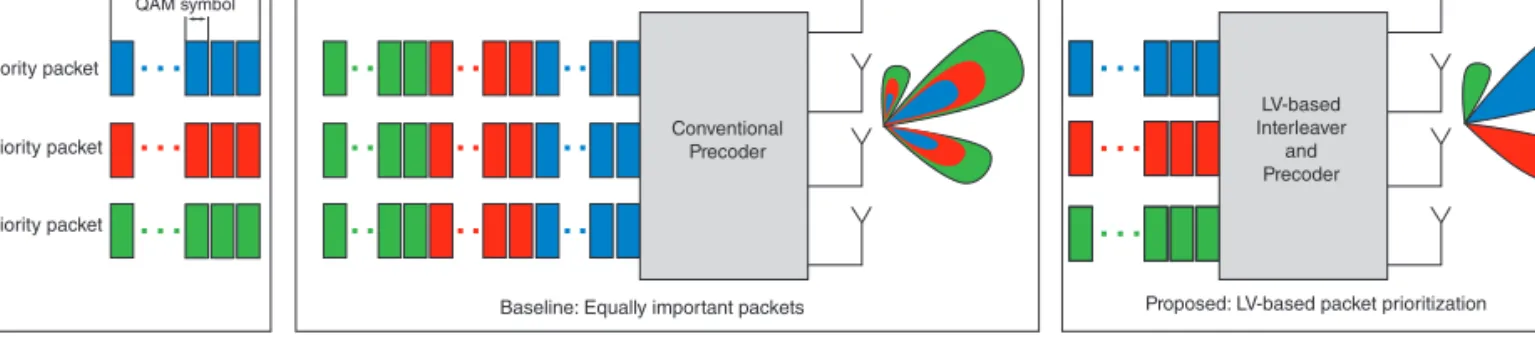
3. There are delay constraints, particularly for real-time video. Supplying real-time video service introduces additional difficulties in algorithmic design. As compared with stored video, real-time video applications, such as video telephony, necessitate tighter delay constraints. Channel variations over fine time scales may also cause playback interruptions. Hence, a video trans mission scheme operating in this environment must exploit adaptation mechanisms at the lower layers. For example, at the media access control (MAC) layer, transmission resource allocation amongst users can be adapted over intervals of tens of milliseconds. At the physical (PHY) layer, modulation and coding schemes can be adapted to minimize the impact of video packet errors on perceptual quality. Since the video packets in a video stream are predictively encoded, the impact of fine time-scale adaptations on perceptual video quality is difficult to characterize, which makes the design of fine time-scale adaptation schemes difficult. Moreover, unlike stored video streaming scenarios where video content is stored at the server before transmission, real-time video is generated at the time of transmission. Thus the video content to be transmitted in the future is not known. Such uncertainty further increases the difficulty of optimizing video transmission algorithms.
4. Networks are becoming increasingly more dense and complex. The application-agnostic paradigm of current data networks is not able to leverage the spatio-temporal bursty nature of video. Since video streams occupy much larger bandwidths than “ordinary” data applications, even moderate variations in the video user population being served may potentially cause huge fluctuations in video traffic. This may cause the traffic loads in
“Wireless networks have highly
variable throughput.”
“Networks are becoming increasingly
more dense and complex.”
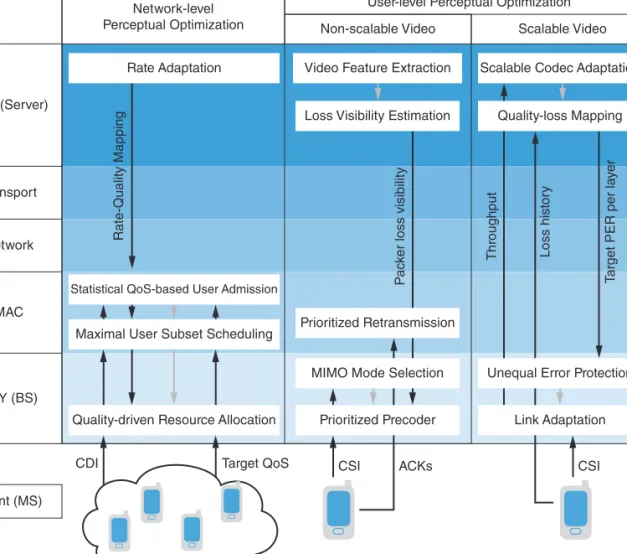
different wireless networks to become highly unbalanced, thereby reducing the utilization efficiency of the existing capacity. To address this problem, a coordination algorithm can be introduced that seeks to dynamically balance the load of video traffic across heterogeneous wireless networks. Devising a good load-balancing strategy, however, is challenging due to the following: 1) the complex geometric distribution of wireless nodes makes the load distribution difficult to model and the design of optimal load balancing policies intractable, and 2) the broadcast nature of the wireless medium causes interference between wireless networks. This interference depends on the load distribution and affects the data throughput to video users. The impact of traffic load on interference needs to be accurately modeled and properly considered in the design of effective load-balancing algorithms. This article summarizes key findings from a three-year project on video aware wireless networks with the objective of increasing (and defining a baseline) video capacity by at least 66x to meet projected capacity demands. Our research falls into four interconnected research vectors, corresponding to the above four challenges. They are briefly summarized as:
1. Video quality modeling and prediction. This included the development of
new models and algorithms for full-reference[8], reduced-reference[9], and
no-reference prediction[10][11][12] that achieve high correlation against human
judgments of quality recorded in large-scale subjective experiments. A dynamic system model was also created that captures the QoE on long
videos.[13][14] These models have been used to drive adaptation algorithms
developed as part of the other research vectors on spatio-temporal network adaptation.
2. Rate-adaptive transmission of stored video. This focused on the development
![Figure 2: diagram summarizing the Video BLIINdS framework in Saad and Bovik [12]](https://thumb-us.123doks.com/thumbv2/123dok_us/973234.2627623/32.1035.138.527.430.636/figure-diagram-summarizing-video-bliinds-framework-saad-bovik.webp)
![Figure 4: The performance of the dynamic system model for TVSQ prediction [14]](https://thumb-us.123doks.com/thumbv2/123dok_us/973234.2627623/34.1035.139.579.752.1066/figure-performance-dynamic-model-tvsq-prediction.webp)

![Figure 17: Graphical illustration of loss visibility optimized transmission policy for γ(H) = [10.1; 5.2; 2.7] dB and the Forman video sequence; (a) Obtain loss visibility (shown for the Foreman video sequence), (b) Decompose MIMO channel, (c) determine](https://thumb-us.123doks.com/thumbv2/123dok_us/973234.2627623/50.1035.136.624.666.925/graphical-illustration-visibility-optimized-transmission-visibility-decompose-determine.webp)