The Impact of Implementation of E-Accounting System on
Financial Performance with Effects of Internal Control Systems
Siamak Nejadhosseini Soudani
School of Accounting and Management, Islamic Azad University U.A.E. Branch PO Box: 502321, Block 4A, Knowledge Village, Dubai, UAE.
Tel: +97-14-295-3314 E-mail: [email protected]
Abstract
The advent of the information technology era has radically changed the way of accounting process to provide efficient decision making and it forced companies to react to the new changes in order to remain competitive. This study aimed at identifying the impact of implementation of e-accounting system on financial performance with effects of internal control systems in services industry. The population of the study consisted of all listed companies have been operating in United Arab Emirate. Questionnaires were distributed among them through e-mail; the researcher designed the questionnaire to target financial managers, accountants and internal auditors who worked at these companies. The hypotheses of the study were tested using the appropriate statistical methods, which are Cronbach Alpha, standards deviations and means, and One Sample T-(Test). The results of this study indicate that implementation of e-accounting system at these companies caused to effect on financial performance with effects of internal control systems. Results also show that measures of risk are more closely associated with internal controls and will effect on using e-accounting systems in these companies.
Keywords: E-accounting systems, Internal control systems, Financial performance, Risk. 1. Introduction
Technology plays a key role in today’s business environment. Many companies greatly rely on computers and software to provide accurate information to effectively manage their business. It is becoming increasingly necessary for all businesses to incorporate information technology solutions to operate successfully (Benjamin B. Bae and Paul Ashcroft, 2004). Information technology and systems have tremendous impact on the productivity and performance of both manufacturing and service organizations. Particularly, accounting has been affected to the highest degree. There is less paperwork and less guesswork (Leigh M, 2007). Tavakolian (1995) noted that an accounting package is usually one of the first major computer packages that a company purchases and it is one of the two business applications often used, with word processing being the other. It should not be a surprise because accounting plays a very significant role in the performance of organizations. However, using IT methods has its own troubles, as it might lead to ease of tampering with accounting information, which is difficult to detect unless the internal control systems (ICS) keep pace with the technological developments and are able to detect and to prevent occurrence of manipulation, which necessitates more attention from internal control and interest in the security and safety of information (Ali A. Ghani, 2012). Internal controls must be consolidated with the electronic systems in light of the huge development in the data electronic processing (Allaila and Tagreed Salem, 2002). Accordingly, internal control plays an important role in the prevention and detection of fraud. It is the process designed to ensure reliable financial reporting, effective and efficient operations, and compliance with applicable laws and regulations (Rezaee and Zabihollah, 2002).Internal control has critical task to monitoring financial data are relevant and accurate in electronic accounting system to avoid any fraud. In Fact, internal controls focused on the real risks of an organization to maintenance of value (Edward Chow, 2007). It is essential for a company to reduce risks concerning the achievement of its objectives and pursue lasting growth. As internal control is necessary for any company to carry out its business, it has been developed in each company (Yoshikazu Wakita et al., 2003). Therefore, Internal controls were looked at from the perspective of Control Environment, Internal Audit and Control Activities whereas Financial performance focused on Liquidity, Accountability and Reporting as the measures of Financial performance (Ssuuna P. Mawanda, 2008).
Despite the significance of e-accounting and its widespread use, there has been relatively little research in the area. Prior researches have shown that implementation of e-accounting system caused the increasing performance due to the improvement of decision-making process, quality of accounting information, internal
controls and facilitating company's transactions in Malaysia, Turkey, Iraq and UK (Wan Zakariaand Sheikh F. Rahman, 2011; SüleymanYükçü and SeçkinGönen, 2011; Halandy and Ghabban, 2009; Kevin Ahern and Rosario Esposito, 2012). Hence, this study has focused on 128 firms operating till the first quarter of 2012 as per listed companies in UAE (www.dfm.ae; www.adx.ae). The specific objectives are to assess the impact of implementation of e-accounting systems on financial performance among services industry in UAE, and to examine the effects of internal control systems on using e-accounting systems in these companies.
The structure of this article is as follows: Section 2 reviews the relevant literature and develops hypotheses about relationships between e-accounting systems, internal control systems, financial performance and risks. Section 3 describes the empirical methodology. Section 4 present results from the statistical analyses of hypotheses. Finally, section 5 presents the discussion and conclusion of this study, provides the limitations of the current study, and points out some directions for further research.
2. Literature Review
Information Technology (IT) has significantly been developed during the past 20 years, and the number of the institutions that heavily rely on the computer systems in the electronic operation of their statements has also increased. At the present time, most of the companies use the computer-dependent IT in operating their data, archiving them and delivering the same to their users (Ali A. Ghani, 2012), especially the e-accounting systems, which are significantly using IT. E-accounting refers to electronic accounting, a term used to describe an accounting system that relies on computer technology for capturing and processing financial data in organizations. (Mohammed Amidu et al, 2011). In fact, accounting systems are responsible for recording, analyzing, monitoring and evaluating the financial condition of companies. Financial condition refers to an assessment of the viability, stability and profitability of a business. It is performed by prepare reports using ratios such as return on equity (ROE), return on asset (ROA) and return on investment (ROI) that make use of financial information taken from accounting systems in financial statement parts to paint a more comprehensive picture of the firm's financial performance (A. Damodaran, 2007). These reports are usually presented to top management as one of their bases in making business decisions (Kieso et al., 2007). Hence, the use of the computerized accounting systems led to the development of the financial performance as they provided statistical methods and testing tools which help in evaluating the performance and taking decisions (Naesa, 2009). When organizations adopt e-accounting, they usually discover that even though computerized accounting systems handle financial data efficiently, their true value is that they are able to generate immediate reports regarding the organization (Hotch, 1992). But, accuracy and reliability of report is important to take comprehensive decision by manager. Therefore, Whittington and Pany (2001) define Internal control as “a process effected by the entity’s board of directors, management and other personnel, designed to provide reasonable assurance regarding the achievement of objectives in the following categories; reliability of financial reporting, effectiveness and efficiency of operations, and compliance with applicable laws and regulations.” Internal control plays an important role in the prevention and detection of fraud (Rezaee, 2002). This typically involves identifying scenarios in which theft or loss could occur and determining if existing control procedures effectively manages the risk to an acceptable level (www.wikipedia.org). Risk is the potential that a chosen action or activity will lead to a loss (an undesirable outcome). Stephen G. Ryan (2011) defines risk as a user’s belief about the potential uncertain negative outcomes from online transaction.
2.1 E-Accounting and Financial performance
The advancements in information technology have eventually led to the introduction of
computerized accounting systems in corporate reporting to help produce relevant and faithful
representative financial reports for both management and external users for decision making (Greuning, 2006). The computerized accounting is designed to automate and integrate all the business operations and helps the company handle all the business processes easily and cost-effectively. With computerized accounting the company will have greater visibility into the day-to-day business operations and greater access to vital information automatically (David H. Wang & Quang L. Huynh, 2012). It has the ability to handle huge volumes of transactions with speed or efficiency. The many advantages from the use of these systems have led many to conclude that computerized accounting systems in corporate reporting are the ‘engine of growth’ in business organizations (frenzel, 2006). Financial reporting can be defined as the process of presenting financial data about a company’s financial position, the company’s operating performance, and its flow of funds (rose & hudgins, 2008).
Financial reports are an essential source of information for the decision-making processes of economic agents. It’s allows decision to judge the results of business strategies and activities in objectivemonetary terms to evaluating the financial performance of a business (Cláudia Lopez et al., 2011). Financial performance evaluation will process data through financial statement that will provide from accounting system (Matt H. Evans, 2005) to assessing the profitability, operational efficiency and liquidity for a company by financial ratios (Bradley James Bryant, 2012).
H1: E-accounting system caused to increase financial performance.
2.2 E-accounting and ICS
Advances in technology and data analysis have led to the development of numerous tools which can automatically evaluate the effectiveness of internal controls. As described by Anderson (2008) internal control is defined as a process affected by an organization's structure, work and authority flows, people and management information systems, designed to help the organization accomplish specific goals or objectives. It is a means by which an organization's resources are directed, monitored, and measured. It plays an important role in preventing and detecting fraud and protecting the organization's resources, both physical (e.g., machinery and property) and intangible (e.g., reputation or intellectual property such as trademarks). Hence, the significance of internal controls in financial reporting is well documented (Hermanson, 2000) and one of the most comprehensive definition is given by Sawyer (2003) who stated that internal auditing is “a systematic, objective appraisal by internal auditors of the diverse operations and controls within an organization to determine whether (1) financial and operating information is accurate and reliable, (2) risks to the enterprise are identified and minimized, (3) external regulations and acceptable internal policies and procedures are followed. It is commonly acceptable that internal control systems need to be monitored in order to assess the quality of the system’s performance over time (Rezaee, 2001).When internal control is effective, you have reasonable assurance that your plan is achieving its financial reporting objectives. Based on previous study, internal control is the process designed to ensure reliable financial reporting, effective and efficient operations, and compliance with applicable laws and regulations (Simon, 2008). Although, the accounting system has a group of tasks in the organization represented by collecting, storing the data regarding the activities and the operations, processing data, producing information that helps managers to take their decisions and ensure sufficient control to guarantee recording and processing the work accurately (Qasim, 2010). But, reliability of financial information can only be achieved by implementing internal control procedures that promote faithful recording of all the organization’s operations. The more effective the entity’s computerized accounting and internal control systems are assessed to be, the lower the auditors’ assessment of control risk. Where auditors obtain satisfactory audit evidence from tests of control as to the effectiveness of the computerized accounting and internal control systems, the extent of substantive procedures may be reduced (www.frc.org.uk). Finally, it is commonly acceptable that internal control systems need to assessing risk, control environment and control activities in order to evaluate the quality of the system’s performance over time (Karagiorgos et al., 2009).
H2: E-accounting system led to improve internal control system.
H3: the improvement of internal control system led to reduce operational risk.
2.3 ICS and financial performance
Internal control is a dynamic integral process that is continually adapting to the changes an organization is facing. Management and personnel at all levels have to be involved in this process to address risks and to provide reasonable assurance of the achievement of the entity’s mission and general objectives. Gupta (2007) drawing from Statements of Standard Auditing Practices No. 6 (SAP 6) defines Internal control as “the plan of organization and all the methods and procedures adopted by the management of an entity to assist in achieving management objectives of ensuring as far as practicable, the orderly and efficient conduct of its business, including adherence to management policies, the safeguarding of assets, prevention and detection of fraud and error, the accuracy and completeness of accounting records and the timely preparation of reliable financial information”. Effectiveness of internal control on financial performance should be considered most important in every organization, because the task of internal control is to prevent and detect fraud in the organization. For this purpose organizations give much important to the internal audit which is generally a feature of large companies. It is a function provided either by employees of the entity of sourced from an external organization to assist management in achieving corporate objectives (COSO, 2008). According to Sunday Arthur et al. (2013),
performance refers to the ability to operate efficiently, profitability, survive grow and react to the environmental opportunities and threats. Muraleetharan P (2011) finds internal control system and financial performance are statistically significant in determining performance. Tomas A. Ratcliffe and Charles E. Landes (2009) find internal control promotes efficiency, reduces risks of asset loss, and helps ensure the reliability of financial statements and compliance with laws and regulations. Therefore, financial statements are important diagnostic tools for the informed manager to determining its operating performance (Jaims F. Zender, 2011).
H4: Internal control system has a significant impact on financial performance.
The Fig (2-1) is developed on the basis of theoretical framework as mentioned above (see Fig. 2-1).
To test the hypotheses, a multiple regression analysis is applied to investigate the impact of implementation of e-accounting system on financial performance with effects of internal control systems. Base on the information following model is formulated:
FP = β0 + β1 X1 + β2 X2 + α
Where:
β0, β1 and β2 are the regression co-efficient
FP = Financial performance X1 = E-Accounting system
X2 = Internal Control System
α = the difference between the predicted and observed value of EIP (the error)
Regression analyses are carried out to find out the significant effect of dependent variables (X1 and X2) on
independent variables (FP).
3. Research Methodology
The Ministry of Finance and Industry (MFI) introducing a new comprehensive financial management and accounting system starting January 2005 as one of the key priorities under the strategic UAE e-government project. Al Shamsi (2008) noted that "By adopting the e-accounting system we are aiming to gain international recognition for our accounting systems as well as strengthen our management reporting, resulting in an overall improvement in planning and control, while providing decision makers with crucial financial data" (www.ameinfo.com). In contrast to most prior research, we restrict our sample to a single industry. An important advantage of this choice is that we can implicitly control for the myriad of confounding variables that can substantively impact any results from a multi-industry, cross-sectional study. Although restricting the sample to a single industry limits our ability to generalize the results, we believe that a single industry analysis has substantially higher internal validity than a multi-industry analysis. Therefore, data were collected through questionnaire from 128 firms as per listed companies at Dubai Financial Market (DFM) and Abu Dhabi Securities Exchange (ADX) which is subset of one of the ministries and autonomous agencies that led by the federal government of United Arab Emirates (www.dfm.ae; www.adx.ae).
3.1 Measures
In this study, the data measured through the questions were on the five point Likert-type scales, with a choice of strongly agree to strongly disagree. Further the questionnaire consisted of 2 sections. The first section focused on
Using E-accounting Internal Control System Performance Financial
Risk
demographics of the target audience. The second section covers main questions. The questionnaire consisted of 19 questions, which were carefully designed to collect relevant data (see Appendix).
3.2 Data Collection
Primary and secondary data were used for the survey. Primary data were collected through questionnaire; secondary data were collected from books, journals and etc. So, in accordance with the objective of the study, required data were collected to examine the impacts of implementation of e-accounting on financial performance in services industry from the users’ perspective. The main questionnaire had three parts to measure the variables of interest. The first part was about impact of e-accounting system on financial performance. The second part was about impact e-accounting system on ICS. The last part was about impact of ICS on FP. The subsequent sections were constructed to seek respondents’ opinions on the role of decision making process, quality of the financial reports and facilitated the process of the company’s transactions on the success of e-accounting system. Totally, 468 questions sent to concern responses were listed as the accountants, financial managers and internal auditors of the firms sampled. A reminder was sent and non-respondents were followed up with two additional mailings. During the first questionnaire launching, 254 questionnaires were completed and returned. In the second and third mailings, a total of 198 more completed questionnaires were returned. Altogether 452 questionnaires were available for data analysis.
4. Empirical Results the Studies
4.1 Description the Demographic Profile of the Sample
In order to analyze the data, which was collected through questionnaires different statistical tools, were used. For that purpose, the information gathered was analyzed using the SPSS software. According to the results of the demographic questionnaire, the following summary information about the profile of the sample is presented. In terms of gender, 68.8 percent of the samples were men and 31.3 percent of them were women. In terms of education, 3.1 percentages had PhD degree, 33.8 percentages had Master degree, 51.6 percentages hold Bachelor degree and 11.6 percentages of surveyed Diplomas.
4.2 Measurement Variables and Testing Hypotheses
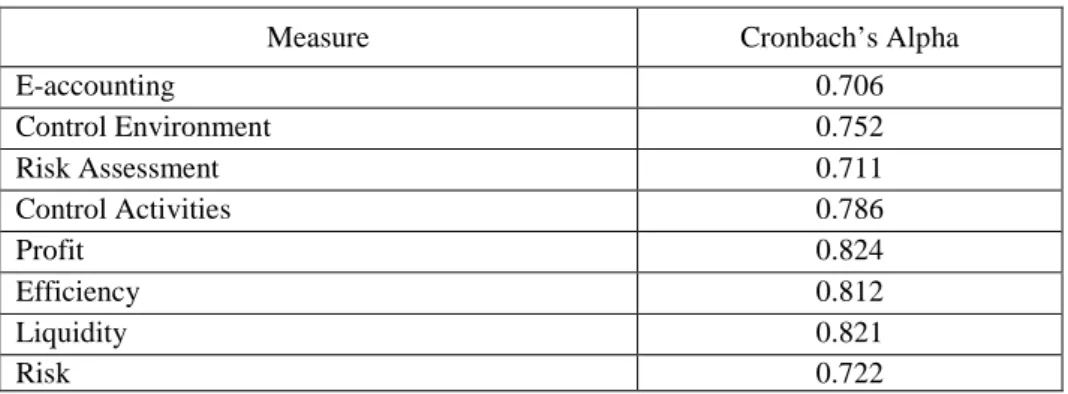
The reliability is a measuring instrument to test consistency and stability of a set of scale items (Francis, 2004; Ho, 2006; Sekaran & Bougie, 2010). The Cronbach’s alpha is an adequate test of internal consistency and reliability in almost all cases (Sekaran & Bougie, 2010), with the value between 0 and 1, but should be at least 0.7 and a value closer to 1 indicates more reliable (Francis, 2004). Therefore, the study conducted a reliability test to measure inter item correlation in each of the variables in the questionnaire. As shown in Table 1, the Cronbach’s alpha values ranged from 0.706 to 0.824 which is showing acceptable level.
Table 1. Reliability Statistics
Measure Cronbach’s Alpha
E-accounting 0.706 Control Environment 0.752 Risk Assessment 0.711 Control Activities 0.786 Profit 0.824 Efficiency 0.812 Liquidity 0.821 Risk 0.722
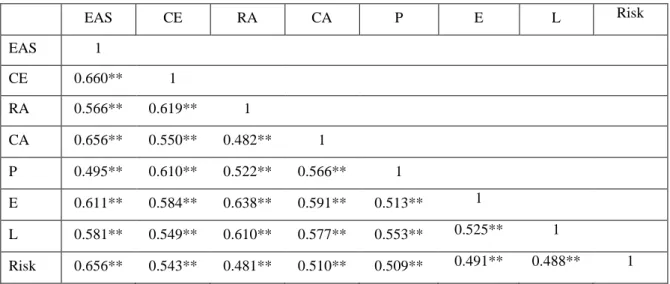
Apart from validity assessment of the measurement model, we performed a check for multicollinearity among the variables. Table 2 provides correlation coefficients between dependent variables and independent variables. Overall, e-accounting appears to have a significant and positive impact on performance due to the positive correlation between e-accounting system and components of financial performance and internal control systems.
Table 2. The Result of Pearson Correlation EAS CE RA CA P E L Risk EAS 1 CE 0.660** 1 RA 0.566** 0.619** 1 CA 0.656** 0.550** 0.482** 1 P 0.495** 0.610** 0.522** 0.566** 1 E 0.611** 0.584** 0.638** 0.591** 0.513** 1 L 0.581** 0.549** 0.610** 0.577** 0.553** 0.525** 1 Risk 0.656** 0.543** 0.481** 0.510** 0.509** 0.491** 0.488** 1
**. Correlation is significant at the 0.01 level. *. Correlation is significant at the 0.05 level.
To substantiate the findings of the research, Analysis Of Variance (ANOVA) statistical approach was conducted. Hence, to test the hypotheses of the study, multiple specified models according to the hypotheses developed were estimated that e-accounting expected to show significant impact on financial performance. Researcher identified the variables which are related to internal control through the extensive litliture survey, control environment, risk assessment and control activities are the more suitable factors to measure the internal control, because the researchers used these variables for the purpose of same study (Faudziah Hanim, 2005). Similarly profit, efficiency and liquidity are the most commonly used variables for the measurement of financial performance (Mark A. Huselid, 1995). Table 3 presents the summary of results on the basis of mean and Std. deviation in the study.
Table 3. Descriptive Statistic
Variables Mean Rank (Mean) Std. Deviation Rank (Std. Deviation)
E-accounting 12.44 1 3.352 1 Control environment 12.57 3 3.357 3 Risk assessment 12.23 5 3.346 2 Control activities 12.55 2 3.616 5 Profit 12.27 4 3.391 4 Efficiency 12.04 6 3.671 7 Liquidity 12.27 7 3.133 6 Risk 11.77 8 3.606 8
Table 3 shows the means and standard deviation of the e-accounting system and the components of the internal control system and financial performance. From the results, the control environment component of internal control system is a highly rated item with a mean value of 12.57 while Risk is the least rated items with a mean value of 11.77. The liquidity component of financial performance is highly rated item with Std. deviation value 3.133 while efficiency is the least rated item with Std. deviation 3.671.
In Table 4 analysis we tried to find out the impact of e-accounting system on financial performance with effects of internal control system for this purpose multiple regression analysis was used and the results are tabulated by the table 4.
Table 4. Result of hypothesis testing
Hypothesis Path Coefficient T-Value P-Value
H1 E-accounting Financial Performance 0.349 5.425 0.000
H2 E-accounting ICS 0.326 4.719 0.000
H3 ICS Risk 0.257 1.425 0.156
According to Table 4, the hypothesis H1 examines the link between E-accounting system (EAS) and financial
performance (FP). The result indicates that in the regression analysis consisting of EAS as dependent variable, and financial performance as independent variable, there is statistically significant positive linear relationship at p < .01 level (β=.349, T-value=5.425). It shows that the E-accounting system has a positive impact on financial performance (P < 0.01). Thus, this hypothesis is accepted.
The Table 3 reveals that the relationship between E-accounting system and internal control system are positively and significantly associated. So, the effect of ICS is significant, as indicated by path coefficient at p ≤ .01 level (β =.326, T-value=4.719). Thus, this hypothesis is accepted. The path coefficient (β = 0.257) shows between ICS and operational risk, there is also statistically significant (P < 0.01). Therefore, the hypothesis H3 is supported.
With regard to Table 5, the hypothesis H4 is rejected and null hypothesis is accepted because, there isn’t any
relationship between ICS and financial performance base on path coefficient result (β = 0.089; P < 0.01).
5. Discussion and Conclusion
An e-accounting system could be thought of as an inter-organizational system because of its capability to electronically integrate a set of firms through data integration on real time to provide timely management information for decision making (Gullkvist, 2010:537). The study carried out to find out the impact of implementation of e-accounting system on financial performance with effects of internal control in services industry. Through this study hypotheses are tested. It is apparent that the perceived e-accounting system has a significant impact on financial performance through effects of internal control system. The result shows that although, there isn’t direct influence between internal control system and financial performance in total. But, there is significant between some components of internal control system such as; control environment, risk assessment and control activities with components of financial performance such as; profitability, efficiency and liquidity. In addition, the implementation of e-accounting systems on financial performance is highlighted due to reliability of financial reporting, timely feedback on the achievement of operational goals and facilitated the process of the company’s transactions. Results also show that measures of risk are more closely associated with internal controls and will effect on using e-accounting systems in these companies.
In terms of functionality, the results of the study showed that almost all the listed companies at Dubai Financial Market (DFM) and Abu Dhabi Securities Exchange (ADX) in UAE using the e-accounting systems.
This study has its limitations. In examining the impacts of implementation of e-accounting on performance in services industry, only a few factors were highlighted in this study. So, in this study only involved the listed companies at Dubai Financial Market (DFM) and Abu Dhabi Securities Exchange (ADX) in field of services. As some other factors may also influence the impact of e-accounting on the effectiveness of tasks performance by the system, those factors also need to be included in any future study .Also, further studies should include other agencies in different field of industry in different areas and compare the performance of e-accounting between them. In addition, the role of risk to using e-accounting system and its effects on organizational performance should be allocated in further research.
References
Abu Dhabi securities exchange, (2012). Listed companies at Abu Dhabi securities exchange. Retrieved from
http://www.adx.ae/English/Securities/Pages/ListedCompanies.aspx
Accounting and internal control systems and audit risk assessments, (1995). Retrieved from http://www.frc.org.uk/Our-Work/Publications/APB/SAS-300-Accounting-and-Internal-Control-Systems-an.aspx Ali Abdul Ghani, (2012). Adaptation of the Internal Control Systems with the Use of Information Technology and its Effects on the Financial Statements Reliability: An Applied Study on Commercial Banks, International Management Review, Vol. 8 No. 1.
Allaila, Tagreed Salem Mahmoud (2002). Impact of electronic computer use in the Internal Control system on the government units as applied to University of Mousel (Unpublished Master theses), Faculty of Administration and Economy, University of Mousel.
Amidu, M. and Abor, J. (2005). Accounting Information and Management of SMEs in Ghana, The African Journal of Finance and Management, 14(1), pp. 15 – 23.
Anderson, Chris. Writing Accounting Procedures for Internal Control, Bizmanualz, November 17, 2008.
Ashwath Damodaran, (2007). Strategic Risk Taking – A framework for risk management, Wharton School Publishing.
Benita M Gullkvist, (2010). Diffusion of Digital Accounting Practice, 7th International Conference on Enterprise Systems, Accounting and Logistics (7th ICESAL 2010). 28-29 June 2010, Rhodes Island, Greece
Benjamin B. Bae and Paul Ashcroft, (2004). Implementation of ERP system; Accounting and auditing implications, Information systems control journal, volume 5.
Committee of Sponsoring Organizations (COSO) of the Treadway Commission (2008), Internal Control– Integrated Framework: Guidance on Monitoring Internal Control Systems, Volumes I, II and III retrieved from http://www.coso.org
David H. Wang & Quang L. Huynh, (2012). Effects of Environmental Uncertainty on Computerized Accounting System Adoption and Firm Performance, Feng Chia University, Taiwan.
Dubai Financial Market, (2012). Listed companies at Dubai Financial Market. Retrieved from http://www.dfm.ae/pages/default.aspx?c=1010
Edward Chow, (2007). Internal control from Risk-Based perspective, published by professional accountants in business committee, international federation of accountants.
Faudziah Hanim Hj. Fadzil, (2005). International Auditing practices and International Control System in Malaysian Listed Company, Managerial Auditing Journal Volume 20.
Francis et al. (2004). Constructing questionnaires based on the theory of planned behavior: A manual for health services researchers. UK: Centre for Health Services Research, University of Newcastle.
Frenzel, C. W., (2006). Management of Information Technology, ISBN-10: 0619034173
Gullkvist B. 2003. “Adoption and Impact of e-Accounting”, Frontiers of E- Business Research, pp. 536-544. Gupta, A. (2001). “Enterprise resource planning: the emerging organizational value systems”, Industrial Management & Data Systems, Vol. 100 No. 3, pp. 114-18. http://dx.doi.org/10.1108/02635570010286131 Halandy, Alan Ajeeb & Ghabban, Thaer Sabry (2009). Role of internal control under the electronic accounting Information system- applied study on a sample of the Kurdistan Banks- Iraq, Human Sciences Magazine; issue 45, pp. 1-39.
Hermanson, H. (2000). An analysis of the demand for reporting on internal control. Accounting Horizons 14 (September): 325–341. http://dx.doi.org/10.2308/acch.2000.14.3.325
Hotch, R. (1992). Accounting: Financial Software, Nation’s Business, March 1992, pp. 46.
Jaims F. Zender, (2011). Evaluating Financial Performance, University of Colorado. Retrieved from http://leeds-faculty.colorado.edu/zender/CEDIR/Session3-notes.ppt
Karagiorgos, T., Drogalas, G., Eleftheriadis, Ι. and Christodoulou, P. (2009) ‘Efficient Risk Management and Internal Audit’, International Journal of Management Research andTechnology, Vol. 3, No. 2, Serials Publications, pp.429-436.
Kevin Ahern and Rosario Esposito, (2012).Willis Implements e-Accounting with Zurich, Willis Associate. Kieso, D. E., Weygandt, J. J., & Warfield, T. D. (2007). Intermediate Accounting (12th ed.). Hoboken, NJ: John Wiley & Sons, p. 1320 ISBN 0-471-74955-9
Kushagra Gupta, (2007). Auditing and Assurance Standard, basic principles governing an audit, 4-May-2007. Leigh M, Electronic Accounting in Today's World, Published 5/18/2007.
Mark A. Huselid, (1995). The Impact of Human Resource Management Practices on Turnover, Productivity, and Corporate Financial Performance, The Academy of management Journal, Vol 8.
Matt H. Evans, (2005). Financial planning and forecasting, excellence in financial management retrieved from www.exinfm.com/training/pdfiles/course02.pdf
MFI introduces new federal accounting information system, retrieved December 20, 2004 from http://www.ameinfo.com/news/Detailed/50938.html
Mohammed A, John Effah, Joshua Abor, (2011). E-Accounting Practices among Small and Medium Enterprises in Ghana, Journal of Management Policy and Practice, vol. 12(4).
Muraleetharan P, (2011). Internal Control and Impact of Financial Performance of the organizations “special reference public and private organizations in Jaffna district”, University of Jaffna.
Naesa, Mohammad Saleem and Khamees, Basheer (2009), “The Impact of the Accountants’ Participation in Developing the Systems in the Success of these Systems and the Impact of their Application on the Financial Performance of the Companies”, Jordanian Journal for Business, Vol 5, Issue 2, 182-203.
O. Ray Whittington & Kurt Pany (2001). Principles of Auditing and Other Assurance Services, Irwin/McGraw- Hill. New York.
Qasim, Abdul Razaq Mohammed, (2004), Accounting Information Systems, Applied Sciences University, Economics Faculty, Damascus University, Damascus, Syria.
Rahman, M. and Halladay, M. (1988).Accounting Information Systems: Principles, Applications and Future Directions. New Jersey: Prentice Hall.
Rezaee, I and Zabihollah.B (2002).Financial statement Fraud, Prevention and Detection.Journal of fraud prevention, vol22, 23-4.
Rezaee, Z., Elam, R. and Sharbatoghlie, A. (2001).‘Continuous auditing: the audit of the future’, Managerial Auditing Journal, Vol.16, No.3, pp.150-158. http://dx.doi.org/10.1108/02686900110385605
Rose, P., and Hudgins, S., (2008). Bank Management and financial services; 7th Ed., McGraw-Hill, New York. Sawyer, L.B, Dittenhofer, M.A., Scheiner, J.H. sawyer’s internal auditing, 5th edition, USA: the institue of internal auditors, 2003, 1402 p.
Sekaran, U. & Bougie, R. (2010). Research methods for business. United Kingdom: John Wiley & Sons Ltd. Ssuuna P. Mawanda, (2008). Effects of Internal Control Systems on Financial Performance in an Institution of Higher Learning in Uganda, Uganda martyrs university, 2008-M102-20074.
Stephen G. Ryan (2011), Risk Reporting Quality: Implications of Academic Research for Financial Reporting Policy, a world leader of the accountancy and finance profession, Stern School of Business, New York University.
SüleymanYükçü and SeçkinGönen, (2011). Fraud auditıng in electronic accounting practices, African Journal of Business Management, Vol. 6(4), pp. 1222-1233. http://dx.doi.org/ 10.5897/AJBM11.2061
Sunday Arthur, Turyahebwa Abanis, Byamukama Eliab and Novembrieta Sumil, (2013). Financial Performance in the Selected Microfinance Institutions in Uganda, International Journal of Engineering Research & Technology, Vol. 2 Issue 2.
Tavakolian, H, (1995). PC-Based financial Software: Emerging Options, Industrial Management & Data Systems, 95(10), pp. 19-24.
Theofanis Karagiorgos, George Drogalas and Nikolaos Giovanis, (2009). Evaluation of the Effectiveness of Internal Audit in Greek Hotel Business, International Journal of Economic Sciences and Applied Research 4 (1): 19-34.
Tomas A. Ratcliffe and Charles E. Landes, (2009). Understanding of Internal Control and Internal Control Services, American Institute of certified public accountants (AICPA), New York, NY 10036-8775.
Wan Zakariaand, Sheikh F. Rahman and Mohamed Elsayed, (2011). An Analysis of Task Performance Outcomes through E-Accounting in Malaysia, Journal of Public Administration and Governance, Vol. 1, No. 2. http://dx.doi.org/ 10.5296/jpag.v1i2.946
Yoshikazu Wakita et al., (2003). Internal Control in the New Era of Risks, Study Group on Risk Management and Internal Control, Jun 20, 2003.
Appendix
Part II - Questionnaire
Latent Variables
No. Measurement
Sources
E-accounting
1
The firm is able maintain the financial report qualities of timeliness, reliability, accuracy because of computerized accounting system.
Byenkya D. Mark,2011
2
Data processing and analysis are faster and more accurate which meets the manager’s needs for accurate and timely feedback on the achievement goals for decision making
Mc Bride, 2000
3 the system has ability to facilitated the process of the company's
transaction Anderson Chris,2008
4
It has the tendency to reduce cost, enhance clerical works, provide sufficient space to store data and process information for management decision in a timely manner.
5 It leads to higher integration across an entire organization to
design effective strategies.
Alles, Kogan and vasarhelyi, 2008
6 Accounting systems are responsible for analyzing and
monitoring the financial condition of firms. Stefanou, 2006
Financial Performance
1
Computerized systems can also provide instant reports on stock evaluation, profit and loss, customer accounts and payroll and sales analysis, again, allowing faster adjustments in your business strategy.
Lisa Magloff, 2012
2
Because of its efficiency and ease of use, computerized accounting systems also allow you to improve inventory control and payment collection, saving time and improving cash flow.
3 The accounting system will help protection of assets records and
measurement of its performance.
4
Return on asset measures that assess profitability, size, and growth rates are essential to monitor overall organizational performance and progress.
Alan Miller, Michael Boehlje and Craig Dobbins, 2001 5
Return on equity is a key to provide useful information about the performance of debt in the capital structure that the general manager must try to influence in order to improve financial
performance.
6 The liquidity position by analyzing the financial statements of a
company and through financing decisions can examine. D. V. Ramana, 2012
7
Return on investment provide a snapshot of profitability, adjusted for the size of the investment assets tied up in the enterprise.
Phillip E. Pfeifer; David J. Reibstein, 2010 Internal Controls
1 Appropriate controls are in place to monitor and review
operations and programs. NASACT, 2011
2
There Are mechanisms to identify and react to changes that can have a dramatic and pervasive effect on the entity, and may demand the attention of management.
Sampson Anomah, 2013
3
This system provides a streamlined solution for organizing all accounting procedures and ensuring that the accounting cycle process properly.
4 It can prevent fraud and comply with laws and regulations. Julien P. A, 1998
5 It increases the reliability, accuracy and mobility level of
transaction and reporting.
6
The accounting systems will affect on the policies and procedures that help ensure management directives are carried out.