Enhanced Connectivity in Wireless
Mobile Programmable Networks
Author:
Luca Cominardi
In partial fulfilment of the requirements for the degree of Doctor in Telematics Engineering
Universidad Carlos III de Madrid
Advisor:
Dr. Carlos J. Bernardos
Enhanced Connectivity in Wireless
Mobile Programmable Networks
Author:
Luca Cominardi
In partial fulfilment of the requirements for the degree of Doctor in Telematics Engineering
Universidad Carlos III de Madrid
Advisor:
Dr. Carlos J. Bernardos
Copyright c⃝2019 Luca Cominardi
PUBLISHED BYUNIVERSIDADCARLOSIIIDEMADRID
Licensed under the Creative Commons Attribution-NonCommercial 3.0 Unported License (the “License”). You may not use this file except in compliance with the License. You may obtain a
copy of the License athttp://creativecommons.org/licenses/by-nc/3.0. Unless required
by applicable law or agreed to in writing, software distributed under the License is distributed on an “AS IS”BASIS,WITHOUT WARRANTIES OR CONDITIONS OF ANY KIND, either express or implied.
See the License for the specific language governing permissions and limitations under the License.
Opportunities are usually disguised as hard work,
so most people don’t recognize them
— Ann Landers
Talk is cheap. Show me the code.
Acknowledgements
The path that led me to the realisation of this thesis has been long and twisted and it spanned across several years and multiple countries with many ups and downs. It started in Madrid, Spain, as a PhD student at the IMDEA Networks Institute. Then, after a couple of years, it took a sharp turn that brought me to London, United Kingdom, at InterDigital Europe Labs in the position of senior research engineer in the field of 5G Radio Access Network (RAN). After the major event that occurred in the United Kingdom on 23 June 2016 (i.e., United Kingdom European Union membership referendum), the path took a second significant detour that conducted me back to Madrid, Spain. This time as a research assistant in the NETCOM research group of the Telematics Engineering department at the University Carlos III of Madrid. During this whole time, regardless of the country where I was living and the company for which I was working, I have been involved in several international projects that materialised in a fruitful collaboration with many people from different countries and continents: Italy, Spain, Germany, United States, Greece, Taiwan, Sweden, Brazil, China – just to name a few.
Among all the great people I have been working with, my exceptional gratitude and sincere appreciation goes to my advisor Carlos J. Bernardos and to Antonio de la Oliva who both flanked me throughout the development of this thesis. Their support and guidance has been fundamental for reaching the many achievements this thesis builds upon. A special thanks also goes to Alain Mourad who guided and advised me during the tumultuous times of my stay in London. I would also like to express my recognition to all my co-authors who have always fostered constructive discussion and distinctive point of views. I am also greatly indebted to my colleagues and friends that made this journey a pleasant one. Especially, I’m very grateful to have shared the path since the very beginning with Iñaki, with whom I discovered to have many more interests in common than networks and computers. Moreover, I would like to also thank Fabio and all my current colleagues and friends at the university who contributed to create a great working environment. Finally, this thesis would not have been possible without the support of my mother, father, and sister who have been visiting me around the world. Last but not least, this thesis is especially dedicated to Letizia, who followed me to Madrid and endured the ups and downs of this thesis on my side.
— Luca Cominardi Leganés, January 2019
Published and submitted content
In compliance with the principles referring to plagiarism in Law 14/2011 and in the Code of Good Practices of the UC3M Doctoral School, I hereby report a bibliography of articles or other contributions I have (co)authored that are included as part of the thesis and that have been published or submitted for publication.
Published content
J.A. Hernández, D. Larrabeiti, A. de la Oliva, M. Berg, C. Lu, F. Cavaliere, P. Iovanna, Thomas Deiß,L. Cominardi, P.-H. Kuo, M.F. Giunta, A. di Giglio, A. Paolicelli, L. Serra, R. Morro, L.A. Neto, P. Chanclou, W. Saint-Aubin, L. Bellot, T. Boukour, J.-C. Plumecoq, J.V. Galán, P. Farkas, V. Jungnickel, J. Baranda, J. Mangues, J. Núñez, M. Miozzo, P. Dini, J.M. Fabrega, M. Svaluto Moreolo, P. Ödling, S. Chang, K.-Y. Lin and R. Chen. Detailed analysis of the technologies to
be integrated in the XFE based on previous internal reports from WP2/3. Deliverable 2.1.
5G-Crosshaul consortium, June 2016. URL:http://5g-crosshaul.eu/wp-content/uploads/
2018/01/5G-CROSSHAUL_D2.1.pdf(Retrieved: 10th January 2019)
– This work is partly included and its content is reported in Chapter 2;
– The role of the author of this thesis in the included work relates to the analysis of the Southbound interfaces in the state-of-the-art;
– The material from this source included in this thesis is not singled out with typographic means and references.
L. Cominardi, C. J. Bernardos, P. Serrano, A. Banchs and A. de la Oliva. ‘Experimental evaluation of SDN-based service provisioning in mobile networks’. In:Computer Standards & Interfaces
58 (2018), pages 158–166. ISSN: 0920-5489. DOI: 10 . 1016 / j . csi . 2018 . 01 . 004. URL:
https://www.it.uc3m.es/pablo/papers/pdf/2018- cominardi- csi- evaluation.pdf
(Retrieved: 10th January 2019)
– This work is wholly included and its content is reported in Chapter 1, Chapter 3, Chapter 4, Chapter 5, and Chapter 6;
– The role of the author of this thesis in the included work relates to the design and experiment-ation of the proposed SDN-framework;
– The material from this source included in this thesis is not singled out with typographic means and references.
10 Published and submitted content
L. Cominardi, F. Giust, C. J. Bernardos and A. de la Oliva. ‘Distributed mobility management solutions for next mobile network architectures’. In:Computer Networks121 (2017), pages 124– 136. ISSN: 1389-1286. DOI: 10 . 1016 / j . comnet . 2017 . 04 . 008. URL: https : / / e
-archivo.uc3m.es/handle/10016/25830(Retrieved: 10th January 2019)
– This work is wholly included and its content is reported in Chapter 1, Chapter 3, Chapter 4, Chapter 5, and Chapter 6;
– The role of the author of this thesis in the included work relates to the design and experiment-ation of the proposed SDN-based Distributed Mobility Management (DMM) solution; – The material from this source included in this thesis is not singled out with typographic
means and references.
L. M. Contreras, L. Cominardi, H. Qian and C. J. Bernardos. ‘Software-Defined Mobility
Management: Architecture Proposal and Future Directions’. In:Mobile Networks and Applications
21.2 (April 2016), pages 226–236. ISSN: 1572-8153. DOI: 10.1007/s11036- 015- 0663- 7.
URL: https://link.springer.com/article/10.1007/s11036- 015- 0663- 7(Retrieved:
10th January 2019)
– This work is wholly included and its content is reported in Chapter 1, Chapter 4, Chapter 5, and Chapter 6;
– The role of the author of this thesis in the included work relates to the experimentation and analysis of the SDN controller implementing the proposed DMM solution;
– The material from this source included in this thesis is not singled out with typographic means and references.
T. Deiß,L. Cominardi, A. Garcia-Saavedra, P. Iovanna, G. Landi, X. Li, J. Mangues-Bafalluy, J. Núñez-Martínez and A. de la Oliva. ‘Packet forwarding for heterogeneous technologies for integrated fronthaul/backhaul’. In:2016 European Conference on Networks and Communications
(EuCNC). June 2016, pages 133–137. DOI: 10 . 1109 / EuCNC . 2016 . 7561019. URL: http :
//5g- crosshaul.eu/wp- content/uploads/2015/05/5G- Crosshaul- WP3- Latest.pdf
(Retrieved: 10th January 2019)
– This work is wholly included and its content is reported in Chapter 1, Chapter 7, and Chapter 9;
– The role of the author of this thesis in the included work relates to the analysis and design of the common frame format for packet-based crosshaul traffic;
– The material from this source included in this thesis is not singled out with typographic means and references;
L. Cominardi, J. Baranda, D. Larrabeiti, F. Cavaliere, P. Chanclou, J. Gomes, A. Di Giglio, P. Ödling and H.-W. Chang. ‘5G-Crosshaul: Towards a unified data-plane for 5G transport networks’. In:2016 European Conference on Networks and Communications (EuCNC). 2016.URL:
http://5g-crosshaul.eu/wp-content/uploads/2015/05/WP2-EuCNC16-Reviewers.pdf
(Retrieved: 10th January 2019)
– This work is wholly included and its content is reported in Chapter 1, Chapter 7, and Chapter 9;
– The role of the author of this thesis in the included work relates to the analysis of the various transport technologies suitable for an integrated fronthaul and backhaul network;
– The material from this source included in this thesis is not singled out with typographic means and references;
11
C. J. Bernardos, A. de la Oliva,L. Cominardi and L. M. Contreras. DETNET crosshauling
requirements. Draft draft-bernardos-detnet-crosshaul-requirements-00. Internet Engineering Task
Force (IETF), October 2016. URL: https : / / tools . ietf . org / html / draft bernardos
-detnet-crosshaul-requirements-00(Retrieved: 10th January 2019)
– This work is wholly included and its content is reported in Chapter 7;
– The role of the author of this thesis in the included work relates to the definition of the requirements for a crosshaul network;
– The material from this source included in this thesis is not singled out with typographic means and references;
L. Cominardi, A. Mourad, D.R. Castor and J.D. Kaewell.Methods and apparatus for common transport of backhaul and fronthaul traffic. Patent application WO2017100394A1. June 2017. URL:
https://patents.google.com/patent/WO2017100394A1/(Retrieved: 10th January 2019)
– This work is partly included and its content is reported in Chapter 7;
– The role of the author of this thesis in the included work relates to the design of a common architecture for fronthaul and backhaul networks;
– The material from this source included in this thesis is not singled out with typographic means and references.
L. Cominardi, A. Mourad, R.V. Pragada and D.R. Castor. Methods, apparatuses and systems
dir-ected to common transport of backhaul and fronthaul traffic. Patent application WO2017147076A1.
August 2017. URL: https://patents.google.com/patent/WO2017147076A1/(Retrieved:
10th January 2019)
– This work is partly included and its content is reported in Chapter 7;
– The role of the author of this thesis in the included work relates to the design of a common forwarding for fronthaul and backhaul networks;
– The material from this source included in this thesis is not singled out with typographic means and references;
L. Cominardi, L. M. Contreras, C. J. Bernardos and I. Berberana. ‘Understanding QoS Applicabil-ity in 5G Transport Networks’. In:2018 IEEE International Symposium on Broadband Multimedia
Systems and Broadcasting (BMSB). June 2018, pages 1–5. DOI:10.1109/BMSB.2018.8436847.
URL: https://e- archivo.uc3m.es/bitstream/handle/10016/27393/understanding_
BMSB_2018_ps.pdf(Retrieved: 10th January 2019)
– This work is wholly included and its content is reported in Chapter 1, Chapter 7, and Chapter 9;
– The role of the author of this thesis in the included work relates to the characterisation and simulation of the traffic requirements in 5G transport networks;
– The material from this source included in this thesis is not singled out with typographic means and references;
M. Perras,L. Cominardi, R.G. Gazda and A. Mourad. Open flow functionality in a
software-defined network. Patent application WO2017142862A1. August 2017.URL:https://patents.
google.com/patent/WO2017142862A1/(Retrieved: 10th January 2019)
– This work is partly included and its content is reported in Chapter 8;
– The role of the author of this thesis in the included work relates to the design of Operations, Administration and Maintenance (OAM) functionality in Open-flow networks;
12 Published and submitted content
– The material from this source included in this thesis is not singled out with typographic means and references;
L. Cominardi, O. I. Abdullaziz, K. Antevski, S. B. Chundrigar, R. Gdowski, P. Kuo, A. Mourad, L. Yen and A. Zabala. ‘Opportunities and challenges of Joint Edge and Fog Orchestration’. In:
2018 IEEE Wireless Communications and Networking Conference Workshops (WCNCW). April
2018, pages 344–349. DOI: 10.1109/WCNCW.2018.8369006.URL: https://e-archivo.uc3m.
es / bitstream / handle / 10016 / 27036 / opportunities _ WCNCW _ 2018 _ ps . pdf (Retrieved:
10th January 2019)
– This work is wholly included and its content is reported in Chapter 1, Chapter 10, and Chapter 12;
– The role of the author of this thesis in the included work relates to the analysis of a joint edge and fog orchestration system;
– The material from this source included in this thesis is not singled out with typographic means and references;
A. Mourad, P.-H. Kuo, D. Rapone, R. Quasso, C. Lu, D. Cederholm, J. M. Roldán Gil, A. Zabala,L. Cominardi, A. de la Oliva, A. Colazzo, G. Parmeggiani, S. Talat, R. Gdowski and S. Duqennoy. 5G-CORAL initial system design, use cases, and requirements. Deliverable 1.1.
5G-Coral consortium, February 2018. URL: http://5g- coral.eu/wp- content/uploads/
2018/04/D1.1_final7760.pdf(Retrieved: 10th January 2019)
– This work is partly included and its content is reported in Chapter 11;
– The role of the author of this thesis in the included work relates to the baseline edge and fog integrated architecture and to the evolution from cloud robotics towards fog-assisted robotics; – The material from this source included in this thesis is not singled out with typographic
means and references;
L. Cominardi, I. Úcar Marqués, G. Rigazzi, C. Turyagyenda, J.M. Roldán Gil, A. Zabala Oribe, R. Gdowski, S. Talat, S. Bilal Chundrigar, K.-L. Huang, I. Osamah, G. Baldoni, L.-H. Yen and H. Baghban.Initial design of 5G-CORAL orchestration and control system. Deliverable 3.1. 5G-Coral
consortium, June 2018. URL: http://5g- coral.eu/wp- content/uploads/2018/06/D3.
19802.pdf(Retrieved: 10th January 2019)
– This work is partly included and its content is reported in Chapter 10 and Chapter 11; – The role of the author of this thesis in the included work relates to the analysis of ETSI MEC
and ETSI NFV frameworks in the context of converged edge and fog computing scenarios; – The material from this source included in this thesis is not singled out with typographic
means and references;
Submitted content
L. Cominardi, S. González, A. de la Oliva and C. J. Bernardos. ‘Adaptive Telemetry for Software-Defined Mobile Networks’. In:Journal of Network and Computer Applications(2018). Submitted
– This work is wholly included and its content is reported in Chapter 1, Chapter 8, and Chapter 9;
– The role of the author of this thesis in the included work relates to the design and experiment-ation of telemetry functionalities in SDN-based mobile networks;
– The material from this source included in this thesis is not singled out with typographic means and references;
13
M. Groshev,L. Cominardi, K. Antevski, A. de la Oliva, C. J. Bernardos, A. Mourad and R. Gazda. ‘A novel approach for multi-access convergence leveraging Edge and Fog computing: an experimentation of a robotics use case’. In:IEEE Transactions on Services Computing(2019). To be submitted
– This work is partly included its content is reported in Chapter 1, Chapter 10, and Chapter 12; – The role of the author of this thesis in the included work relates to the design of a converged
Edge and Fog architecture;
– The material from this source included in this thesis is not singled out with typographic means and references;
Other research merits
This chapter first provides a list of additional publications I have (co)authored which are related to this thesis but not included therein. Next, it provides an overview of the various EU-funded projects I was involved in throughout the lifetime of this thesis as well as my role and participation. Finally, it highlights my participation and the role in the Standards Development Organisations and scientific conferences and congresses.
Related publications and submissions
F. Giust,L. Cominardiand C. J. Bernardos. ‘Distributed mobility management for future 5G networks: overview and analysis of existing approaches’. In: IEEE Communications Magazine
53.1 (January 2015), pages 142–149. ISSN: 0163-6804.DOI:10.1109/MCOM.2015.7010527
D. Wang, E. Katranaras, A. Quddus, N. Sapountzis, L. Cominardi, F. Kuo, P. Rost, C. J.
Bernardos and I. Berberana. ‘SDN-based joint backhaul and access design for efficient network layer operations’. In: 2015 European Conference on Networks and Communications (EuCNC).
June 2015, pages 214–218.DOI:10.1109/EuCNC.2015.7194071
F. Cavaliere, P. Iovanna, J. Mangues-Bafalluy, J. Baranda, J. Núñez-Martínez, K.-Y. Lin, H.-W. Chang, P. Chanclou, P. Farkas, J. Gomes,L. Cominardi, A. Mourad, A. de la Oliva, J.A. Hernández, D. Larrabeiti, A. Di Giglio, A. Paolicelli and P. Ödling. ‘Towards a unified fronthaul-backhaul data plane for 5G The 5G-Crosshaul project approach’. In:Computer Standards & Interfaces51 (2017),
pages 56–62. ISSN: 0920-5489.DOI:10.1016/j.csi.2016.11.005
X. Li, R. Casellas, G. Landi, A. de la Oliva, X. Costa-Perez, A. Garcia-Saavedra, T. Deiß,L. Com-inardiand R. Vilalta. ‘5G-Crosshaul Network Slicing: Enabling Multi-Tenancy in Mobile Trans-port Networks’. In:IEEE Communications Magazine55.8 (2017), pages 128–137. ISSN:
0163-6804.DOI:10.1109/MCOM.2017.1600921
T. Deiß, J. Baranda, L. Cominardi, L. M. Contreras, J. Gomes, S. González, P. Iovanna, J. Mangues-Bafalluy, N. Molner, J. Núñez-Martínez, A. de la Oliva and S. Stracca. ‘Dataplane Measurements on a Fronthaul (FH) and Backhaul (BH) integrated network’. In:5th International Workshop on Cloud Technologies and Energy Efficiency in Mobile Communication Networks
16 Other research merits
(CLEEN 2017). June 2017. URL:http://eprints.networks.imdea.org/1612/(Retrieved:
10th January 2019)
A. Reznik, R. Arora, M. Cannon,L. Cominardi, W. Featherstone, R. Frazao, F. Giust, S. Kekki, A. Li, D. Sabella, C. Turyagyenda and Z. Zheng. Developing Software for Multi-Access Edge
Computing. White Paper 20. European Telecommunications Standards Institute (ETSI), September
2017
M. Perras,L. Cominardi, R.G. Gazda and A. Mourad. Mitigating crc calculations in networks
that utilize segment routing. Patent application WO2017172681A1. October 2017.URL:https:
//patents.google.com/patent/WO2017172681A1/(Retrieved: 10th January 2019)
D. Rapone, R. Quasso, S. B. Chundrigar, S. T. Talat,L. Cominardi, A. De la Oliva, P. Kuo, A. Mourad, A. Colazzo, G. Parmeggiani, A. Z. Orive, C. Lu and C. Li. ‘An Integrated, Virtualized Joint Edge and Fog Computing System with Multi-RAT Convergence’. In:2018 IEEE International
Symposium on Broadband Multimedia Systems and Broadcasting (BMSB). June 2018, pages 1–5.
DOI:10.1109/BMSB.2018.8436927
J. Kim, L. M. Contreras, P. Greto, H. Magnusson, H. Woesner, D. Fritzsche,L. Cominardiand C. J. Bernardos. ‘GiLAN Roaming: Roam Like at Home in a Multi-Provider NFV Environment’.
In: IEEE International Symposium on Networks, Computers and Communications (ISNCC). June
2018
K. Antevski, M. Groshev,L. Cominardi, C.J. Bernardos, A. Mourad and R. Gazda. ‘Enhancing Edge robotics through the use of context information’. In: Workshop on Experimentation and
Measurements in 5G (EM-5G’18)(December 2018), pages 1–5.DOI:10.1145/3286680.3286682
L. Cominardi, A. Mourad and P.-H. Kuo. Slicing switch resources. Patent application
WO2018106868A1. June 2018.URL:https://patents.google.com/patent/WO2018106868A1/
(Retrieved: 10th January 2019)
J. Martín-Pérez,L. Cominardi, C. J. Bernardos, A. de la Oliva and A. Azcorra. ‘Modeling MEC deployments for low latency streaming scenarios’. In:IEEE Transactions on Broadcasting(2018). Submitted
Participation and role in collaborative international projects
iJOIN
The iJOIN project (2012-2015) was an EU-funded project (FP7-ICT-2011-8 grant agreement
317941) which introduced the novel concept RAN-as-a-Service (RANaaS), where RAN functional-ity is flexibly centralised through an open IT platform based on a cloud infrastructure. iJOIN aimed for a joint design and optimisation of access and backhaul, operation and management algorithms, and architectural elements, integrating small-cells, heterogeneous backhaul, and centralised pro-cessing. Additionally to the development of technology candidates across PHY, MAC, and the network layer, iJOIN studied the requirements, constraints, and implications for 3GPP LTE-A mobile networks. Finally, iJOIN designed new network operation and management algorithms in the context of RANaaS following the SDN paradigm.
17
The role and the activities of the author of this thesis in the project are the following: – Actively participating in the project since September 2013 to July 2015;
– Deputy leader of WP4 on the research and design of novel network layer management enabled by Software Defined Networking (SDN) in Radio Access and Backhaul networks; – Research and experimental validation of SDN-based Distributed Mobility Management
(DMM) mechanisms;
– Demonstration of SDN-based DMM mechanisms at EuCNC 2014, Bologna, Italy and at the Mobile World Congress 2015 (MWC2015), Barcelona, Spain, March 2015;
– The content included in Chapter 3, Chapter 4, and Chapter 5 is related to the scope of this project.
5G-Crosshaul
The 5G-Crosshaul project (2015-2017) was an EU-funded project (H2020- ICT-2014-2 grant
agreement 671598) aimed at developing a 5G integrated backhaul and fronthaul transport network enabling a flexible and software-defined reconfiguration of all networking elements in a multi-tenant and service-oriented unified management environment. This transport network will flexibly interconnect distributed 5G radio access and core network functions, hosted on in-network cloud nodes, through the implementation of: (i) a control infrastructure using a unified, abstract network model for control plane integration; (ii) a unified data plane encompassing innovative high-capacity transmission technologies and novel deterministic-latency switch architectures.
The role and the activities of the author of this thesis in the project are the following: – Actively participating in the project since September 2015 to February 2017;
– Research and design of a converged and SDN-based fronthaul and backhaul network with focus on millimetre wave transport links;
– Demonstration of long-distance millimetre wave transport links capable of multiplexing crosshaul traffic in outdoor scenario in Berlin, Germany, September 2016;
– The content included in Chapter 7 and Chapter 8 is related to the scope of this project. 5G Exchange
The5G Exchange(5GEx) project (2015-2018) was an EU-funded project (H2020-ICT-2014-2 grant
agreement 671636) with the goal of enabling cross-domain orchestration of services over multiple administrations or over multi-domain single administrations. This would allow end-to-end network and service elements to mix in multi-vendor, heterogeneous technology and resource environments. To that end, 5GEx aimed at enabling collaboration between operators with the view of introducing unification via NFV/SDN compatible multi-domain orchestration based on open source software tools and extensions that can be utilised outside the scope of 5GEx.
The role and the activities of the author of this thesis in the project are the following: – Actively participating in the project since March 2017 to June 2018;
– Prototyping and demonstration of an NFV-based multi-domain roaming solution at Mobile Virtual Network Operator World Congress 2018 (MVNO 2018), Madrid, Spain, April 2018. 5G-Transformer
The 5G-Transformer project (2017-2019) is an EU-funded project (H2020-ICT-2016-2 grant
agreement 761536) aiming at transforming today’s mobile transport network into an SDN/NFV-based Mobile Transport and Computing Platform (MTP), which brings thenetwork slicingparadigm into mobile transport networks by provisioning and managing MTP slices tailored to the specific needs of vertical industries. The technical approach of the project is twofold: (i) enable vertical industries to meet their service requirements within customised MTP slices, and (i) aggregate and federate transport networking and computing fabric, from the edge all the way to the core and cloud, to create and manage MTP slices throughout a federated virtualised infrastructure.
The role and the activities of the author of this thesis in the project are the following: – Actively participating in the project since July 2017 to date;
18 Other research merits
– Dissemination into ETSI MEC of project-related contributions on edge computing. 5G-CORAL
The5G-CORALproject (2017-2019) is an EU-Taiwan project (H2020-ICT-2016-2 grant agreement
761586) leveraging on the pervasiveness of edge and fog computing in the Radio Access Network (RAN) to create a unique opportunity for access convergence. This is envisioned by the means of an integrated and virtualised networking and computing solution where virtualised functions, context-aware services, and user and third-party applications are blended together to offer enhanced connectivity and better quality of experience. The proposed solution contemplates two major building blocks, namely (i) the Edge and Fog computing System (EFS) subsuming all the edge and fog computing substrate offered as a shared hosting environment for virtualised functions, services, and applications; and (ii) the Orchestration and Control System (OCS) responsible for managing and controlling the EFS, including its interworking with other (non-EFS) domains.
The role and the activities of the author of this thesis in the project are the following: – Actively participating in the project since September 2017 to date;
– Leader of WP3 on the research and design of orchestration and control systems for edge and fog computing;
– Research and experimental validation of distributed control systems for fog computing tailored to robotics applications;
– Demonstration of a fog-assisted robotics service for cooperative delivery in a commercial shopping mall in Taipei, Taiwan, November 2018;
– Dissemination into ETSI MEC of project-related contributions on edge computing; – The content included in Chapter 10 is related to the scope of this project.
Participation and role in Standards Development Organisations
ETSI MEC
The ETSI Mobile Edge Computing (MEC) Industry Specification Group (ISG) created the Work Item MEC024 for identifying the necessary support provided by Multi-access Edge Computing for network slicing and, in addition, how the orchestration of resources and services from multiple administrative domains could facilitate that. The work has the intent to collect and analyse the use cases relating to the deployment of MEC functions in combination with network slicing based on the findings from external SDOs, industry collaborations and regional projects, evaluate the gaps from the defined MEC features and functions, and identify the new requirements. When necessary, this may include identifying new MEC services or interfaces, as well as changes to existing MEC services or interfaces, data models, application rules and application requirements. The work item has the intent to recommend the necessary normative work to close these gaps.
The role and the activities of the author of this thesis in ETSI MEC are the following: – Rapporteur of the ETSI MEC024 Work Item since September 2017 to date.
Technical Programme Committee and Chairmanship
– Local Chair of the Fourth IFIP Conference on Sustainable Internet and ICT for Sustainability (SustainIT 2015), April 2015;
– TPC member of the IEEE 86th Vehicular Technology Conference (IEEE VTC 2017), Septem-ber 2017;
– TPC member of the First International Workshop on Experimentation and Measurements in 5G (EM-5G), December 2018;
– TPC member of the IEEE Wireless Communications and Networking Conference (IEEE WCNC 2019), April 2019;
– TPC member of the Seventh International Workshop on Cloud Technologies and Energy Efficiency in Mobile Communication Networks (CLEEN 2019), April 2019.
Abstract
Resumen
The architecture of current operator infra-structures is being challenged by the non-stop growing demand of data hungry services ap-pearing every day. While currently deployed operator networks have been able to cope with traffic demands so far, the architectures for the 5th generation of mobile networks (5G) are expected to support unprecedented traffic loads while decreasing costs associated with the network deployment and operations. Indeed, the forthcoming set of 5G standards will bring programmability and flexibility to levels never seen before. This has required introducing changes in the architecture of mobile networks, enabling different features such as the split of control and data planes, as required to support rapid programming of heterogeneous data planes. Network softwar-isationis hence seen as a key enabler to cope with such network evolution, as it permits controlling all networking functions through (re)programming, thus providing higher flex-ibility to meet heterogeneous requirements while keeping deployment and operational costs low. A great diversity in terms of traffic patterns, multi-tenancy, heterogeneous and stringent traffic requirements is therefore expected in 5G networks.
Software Defined Networking (SDN) and Network Function Virtualisation (NFV) have emerged as a basic tool-set for operators to manage their infrastructure with increased flexibility and reduced costs. As a result, new 5G services can now be envisioned and quickly programmed and provisioned
La arquitectura de las infraestructuras actuales de los operadores está siendo desafiada por la de-manda creciente e incesante de servicios con un elevado consumo de datos que aparecen todos los días. Mientras que las redes de operadores imple-mentadas actualmente han sido capaces de lidiar con las demandas de tráfico hasta ahora, se espe-ra que las arquitectuespe-ras de la quinta geneespe-ración de redes móviles (5G) soporten cargas de tráfico sin precedentes a la vez que disminuyen los costes asociados a la implementación y operaciones de la red. De hecho, el próximo conjunto de están-dares 5G traerá la programabilidad y flexibilidad a niveles nunca antes vistos. Esto ha requerido la introducción de cambios en la arquitectura de las redes móviles, lo que permite diferentes funcio-nes, como la división de los planos de control y de datos, según sea necesario para soportar una programación rápida de planos de datos heterogé-neos. La softwarisación de red se considera una herramienta clave para hacer frente a dicha evo-lución de red, ya que proporciona la capacidad de controlar todas las funciones de red mediante (re)programación, proporcionando así una mayor flexibilidad para cumplir requisitos heterogéneos mientras se mantienen bajos los costes operativos y de implementación. Por lo tanto, se espera una gran diversidad en términos de patrones de tráfico, multi-tenancy, requisitos de tráfico heterogéneos y estrictos en las redes 5G.
Software Defined Networking (SDN) y Network Function Virtualisation (NFV) se han convertido en un conjunto de herramientas básicas para que los operadores administren su infraestructura con mayor flexibilidad y menores costes. Como
resulta-20 Abstract
in response to user and market necessities, imposing a paradigm shift in the services design. However, such flexibility requires the 5G transport network to undergo a pro-found transformation, evolving from a static connectivity substrate into a service-oriented infrastructure capable of accommodating the various 5G services, including Ultra-Reliable and Low Latency Communications (URLLC). Moreover, to achieve the desired flexibility and cost reduction, one promising approach is to leverage virtualisation technologies to dynamically host contents, services, and ap-plications closer to the users so as to offload the core network and reduce the commu-nication delay. This thesis tackles the above challenges which are detailed in the following.
A common characteristic of the 5G ser-vices is the ubiquity and the almost permanent connection that is required from the mobile network. This really imposes a challenge in the signalling procedures provided to get track of the users and to guarantee session continu-ity. The mobility management mechanisms will hence play a central role in the 5G net-works because of the always-on connectivity demand. Distributed Mobility Management (DMM) helps going towards this direction, by flattening the network, hence improving its scalability, and enabling local access to the In-ternet and other communication services, like mobile-edge clouds. Simultaneously, SDN opens up the possibility of running a multi-tude of intelligent and advanced applications for network optimisation purposes in a cent-ralised network controller. The combination of DMM architectural principles with SDN management appears as a powerful tool for operators to cope with the management and data burden expected in 5G networks.
To meet the future mobile user demand at a reduced cost, operators are also look-ing at solutions such as C-RAN and differ-ent functional splits to decrease the cost of deploying and maintaining cell sites. The in-creasing stress on mobile radio access per-formance in a context of declining revenues for operators is hence requiring the evolu-tion of backhaul and fronthaul transport net-works, which currently work decoupled. The heterogeneity of the nodes and transmission
do, los nuevos servicios 5G ahora pueden planifi-carse, programarse y aprovisionarse rápidamente en respuesta a las necesidades de los usuarios y del mercado, imponiendo un cambio de paradigma en el diseño de los servicios. Sin embargo, dicha flexibilidad requiere que la red de transporte 5G experimente una transformación profunda, que evo-luciona de un sustrato de conectividad estática a una infraestructura orientada a servicios capaz de acomodar los diversos servicios 5G, incluso Ultra-Reliable and Low Latency Communications (URLLC). Además, para lograr la flexibilidad y la reducción de costes deseadas, un enfoque promete-dor es aprovechar las tecnologías de virtualización para alojar dinámicamente los contenidos, servi-cios y aplicaciones más cerca de los usuarios para descargar la red central y reducir la latencia. Esta tesis aborda los desafíos anteriores que se detallan a continuación.
Una característica común de los servicios 5G es la ubicuidad y la conexión casi permanente que se requiere para la red móvil. Esto impone un desafío en los procedimientos de señalización proporcionados para hacer un seguimiento de los usuarios y garantizar la continuidad de la sesión. Por lo tanto, los mecanismos de gestión de la movi-lidad desempeñarán un papel central en las redes 5G debido a la demanda de conectividad siempre activa. Distributed Mobility Management (DMM) ayuda a ir en esta dirección, al aplanar la red, lo que mejora su escalabilidad y permite el acceso local a Internet y a otros servicios de comunica-ciones, como recursos en “nubes” situadas en el borde de la red móvil. Al mismo tiempo, SDN abre la posibilidad de ejecutar una multitud de aplica-ciones inteligentes y avanzadas para optimizar la red en un controlador de red centralizado. La com-binación de los principios arquitectónicos DMM con SDN aparece como una poderosa herramienta para que los operadores puedan hacer frente a la carga de administración y datos que se espera en las redes 5G.
Para satisfacer la demanda futura de usuarios móviles a un coste reducido, los operadores tam-bién están buscando soluciones tales como C-RAN y diferentes divisiones funcionales para disminuir el coste de implementación y mantenimiento de emplazamientos celulares. El creciente estrés en el rendimiento del acceso a la radio móvil en un contexto de menores ingresos para los operadores requiere, por lo tanto, la evolución de las redes de
21
technologies inter-connecting the fronthaul and backhaul segments makes the network quite complex, costly and inefficient to man-age flexibly and dynamically. Indeed, the use of heterogeneous technologies forces operat-ors to manage two physically separated net-works, one for backhaul and one for fronthaul. In order to meet 5G requirements in a cost-effective manner, a unified 5G transport net-work that unifies the data, control, and man-agement planes is hence required. Such an integrated fronthaul/backhaul transport net-work, denoted as crosshaul, will hence carry both fronthaul and backhaul traffic operating over heterogeneous data plane technologies, which are software-controlled so as to adapt to the fluctuating capacity demand of the 5G air interfaces.
Moreover, 5G transport networks will need to accommodate a wide spectrum of services on top of the same physical infra-structure. To that end, network slicing is seen as a suitable candidate for providing the necessary Quality of Service (QoS). Traffic differentiation is usually enforced at the bor-der of the network in orbor-der to ensure a proper forwarding of the traffic according to its class through the backbone. With network slicing, the traffic may now traverse many slice edges where the traffic policy needs to be enforced, discriminated and ensured, according to the service and tenants needs. However, the very basic nature that makes this efficient manage-ment and operation possible in a flexible way – the logicalcentralisation– poses important challenges due to the lack of proper monitor-ing tools, suited for SDN-based architectures. In order to take timely and right decisions while operating a network, centralised in-telligence applications need to be fed with a continuous stream of up-to-date network statistics. However, this is not feasible with current SDN solutions due to scalability and accuracy issues. Therefore, an adaptive tele-metry system is required so as to support the diversity of 5G services and their stringent traffic requirements.
The path towards 5G wireless networks also presents a clear trend of carrying out com-putations close to end users. Indeed, pushing contents, applications, and network functions
transporte de backhaul y fronthaul, que actualmen-te funcionan disociadas. La heactualmen-terogeneidad de los nodos y las tecnologías de transmisión que inter-conectan los segmentos de fronthaul y backhaul hacen que la red sea bastante compleja, costosa e ineficiente para gestionar de manera flexible y diná-mica. De hecho, el uso de tecnologías heterogéneas obliga a los operadores a gestionar dos redes sepa-radas físicamente, una para la red de backhaul y otra para el fronthaul. Para cumplir con los requi-sitos de 5G de manera rentable, se requiere una red de transporte única 5G que unifique los planos de control, datos y de gestión. Dicha red de transporte fronthaul/backhaul integrada, denominada “cross-haul”, transportará tráfico de fronthaul y backhaul operando sobre tecnologías heterogéneas de plano de datos, que están controladas por software para adaptarse a la demanda de capacidad fluctuante de las interfaces radio 5G.
Además, las redes de transporte 5G necesita-rán acomodar un amplio espectro de servicios so-bre la misma infraestructura física y el network slicing se considera un candidato adecuado para proporcionar la calidad de servicio necesario. La diferenciación del tráfico generalmente se aplica en el borde de la red para garantizar un reenvío adecuado del tráfico según su clase a través de la red troncal. Con el network slicing, el tráfico ahora puede atravesar muchos fronteras entre “network slices” donde la política de tráfico debe aplicar-se, discriminarse y garantizaraplicar-se, de acuerdo con las necesidades del servicio y de los usuarios. Sin embargo, el principio básico que hace posible es-ta gestión y operación eficientes de forma flexible – la centralización lógica – plantea importantes desafíos debido a la falta de herramientas de super-visión necesarias para las arquitecturas basadas en SDN. Para tomar decisiones oportunas y co-rrectas mientras se opera una red, las aplicaciones de inteligencia centralizada necesitan alimentarse con un flujo continuo de estadísticas de red actua-lizadas. Sin embargo, esto no es factible con las soluciones SDN actuales debido a problemas de escalabilidad y falta de precisión. Por lo tanto, se requiere un sistema de telemetría adaptable para respaldar la diversidad de los servicios 5G y sus estrictos requisitos de tráfico.
El camino hacia las redes inalámbricas 5G también presenta una tendencia clara de realizar acciones cerca de los usuarios finales. De hecho, acercar los contenidos, las aplicaciones y las
fun-22 Abstract
closer to end users is necessary to cope with the huge data volume and low latency required in future 5G networks. Edge and fog frame-works have emerged recently to address this challenge. Whilst the edge framework was more infrastructure-focused and more mobile operator-oriented, the fog was more pervas-ive and included any node (stationary or mo-bile), including terminal devices. By further utilising pervasive computational resources in proximity to users, edge and fog can be merged to construct a computing platform, which can also be used as a common stage for multiple radio access technologies (RATs) to share their information, hence opening a new dimension of multi-RAT integration.
ciones de red a los usuarios finales es necesario para hacer frente al enorme volumen de datos y la baja latencia requerida en las futuras redes 5G. Los paradigmas de “edge” y “fog” han surgido recientemente para abordar este desafío. Mientras que el edge está más centrado en la infraestruc-tura y más orientado al operador móvil, el fog es más ubicuo e incluye cualquier nodo (fijo o móvil), incluidos los dispositivos finales. Al utilizar recur-sos de computación de propósito general en las proximidades de los usuarios, el edge y el fog pue-den combinarse para construir una plataforma de computación, que también se puede utilizar para compartir información entre múltiples tecnologías de acceso radio (RAT) y, por lo tanto, abre una nueva dimensión de la integración multi-RAT.
Table of Contents
List of Figures . . . 30
List of Tables . . . 31
Introduction
1 Mobile networks landscape . . . 35
1.1 Software-defined networking . . . 35 1.2 Distributed mobility management . . . 36 1.3 Fronthaul and backhaul . . . 37 1.4 5G services and network slices . . . 38 1.5 Edge and fog computing . . . 39 1.6 Thesis overview . . . 40
2 Background on software-defined networking . . . 43
2.1 Southbound interfaces for controlling the forwarding . . . 43 2.1.1 Forwarding and Control Element Separation Protocol . . . 44 2.1.2 OpenFlow protocol . . . 45 2.2 Southbound interfaces for managing the network elements . . . 45 2.2.1 OF-Config protocol . . . 46 2.2.2 Open vSwitch Database Management protocol . . . 47 2.2.3 Simple Network Management Protocol . . . 47 2.2.4 Network Configuration Protocol . . . 48 2.3 Southbound interfaces for interacting with legacy systems . . . 48 2.3.1 Border Gateway Protocol . . . 48 2.3.2 Extensible Messaging and Presence Protocol . . . 49 2.4 Southbound interfaces models for node abstraction . . . 49 2.4.1 Forwarding and Control Element Separation . . . 49 2.4.2 OpenFlow . . . 50
24 Table of Contents
2.5 Southbound interfaces models for forwarding abstraction . . . 51 2.5.1 Forwarding and Control Element Separation . . . 51 2.5.2 OpenFlow . . . 52 2.6 Southbound Interface selection . . . 52
I
Part One
3 A framework for SDN development . . . 57
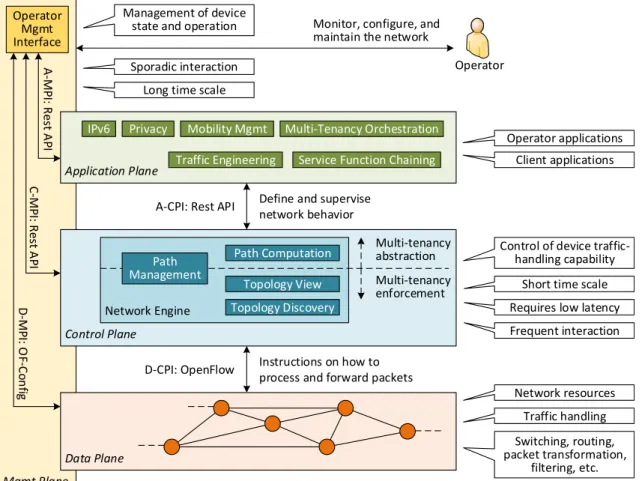
3.1 Exemplary use cases for SDN . . . 57 3.1.1 Location privacy . . . 57 3.1.2 Dynamic Service Composition with Network Function Virtualisation . . . 58 3.1.3 Multi-tenancy . . . 59 3.1.4 Smart and flexible mobility management . . . 59 3.2 A functional ONF-based architecture for quick service provisioning . . . 60 3.2.1 ONF-based architecture framework . . . 60 3.2.2 Control plane: design and implementation . . . 62 3.2.3 Application Plane: Design and Implementation. . . 64
4 An SDN-based Distributed Mobility Management . . . 67
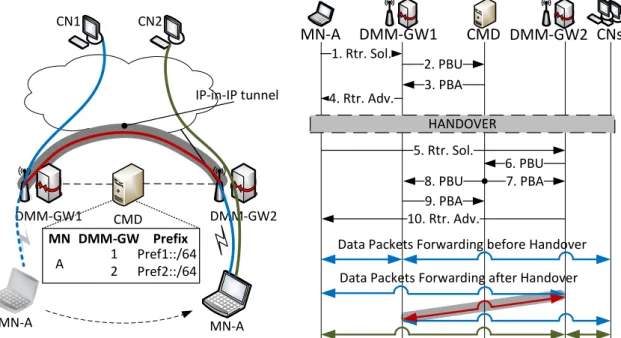
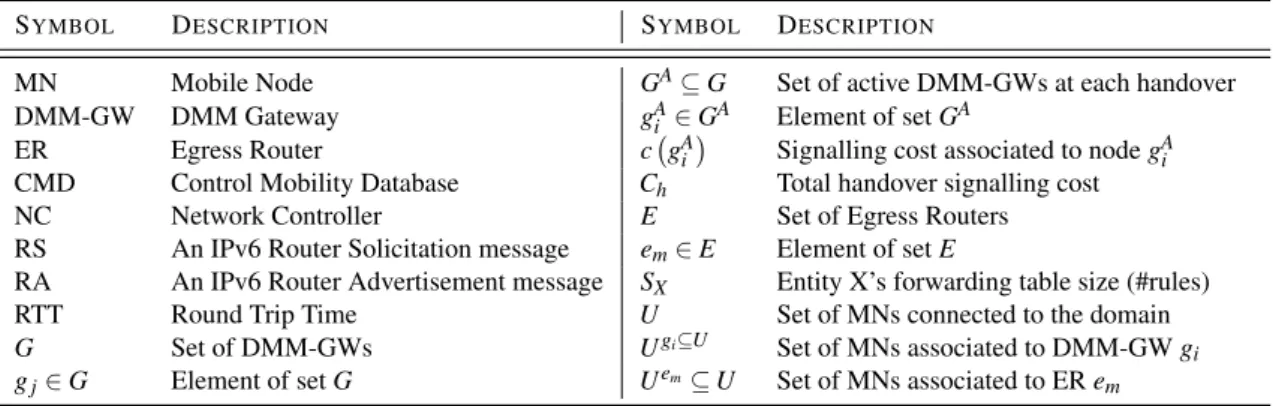
4.1 Evolution from IP mobility towards SDN . . . 69 4.1.1 IP mobility (PMIPv6) based DMM solution . . . 70 4.1.2 DMM design principles, SDN challenges and opportunities . . . 71 4.2 An SDN-based DMM solution . . . 74 4.3 Analytic evaluation . . . 76 4.3.1 Signalling cost . . . 76 4.3.2 Forwarding table size . . . 79 4.3.3 Handover latency . . . 80
5 Experimental assessment of the SDN framework . . . 83
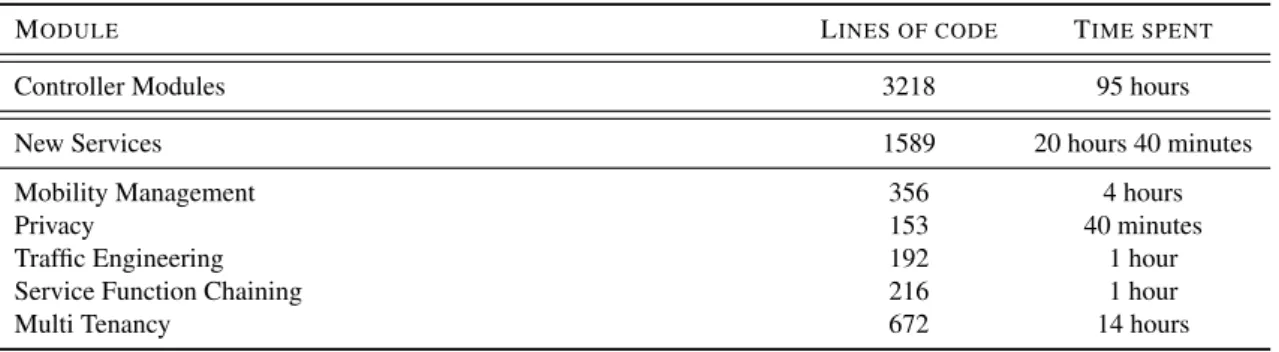
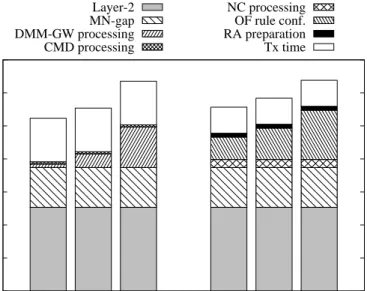
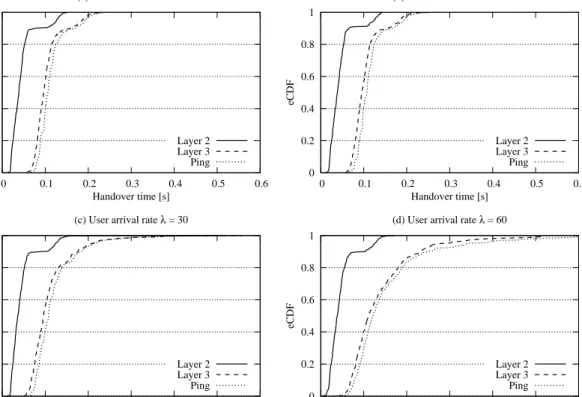
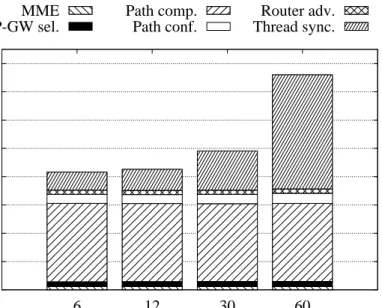
5.1 Evaluation of service creation effort . . . 83 5.2 Evaluation of DMM solutions . . . 85 5.2.1 Experimental results of PMIPv6- and SDN-based DMM solutions . . . 87 5.2.2 Comparison with existing SDN deployments with mobility support . . . 89 5.3 Evaluation of SDN controller scalability . . . 91
6 Conclusions of Part One. . . 95
II
Part Two
7 Designing a SDN-based 5G transport network . . . 99
7.1 Analysis of crosshaul requirements and transport technologies . . . 100 7.1.1 Fronthaul and backhaul traffic requirements . . . 100 7.1.2 Reference crosshaul network architecture . . . 101 7.1.3 Transport technologies for a crosshaul network . . . 101 7.1.4 Multiplexing strategies for a crosshaul network . . . 103
25
7.2 Delineating the main components of a crosshaul network . . . 104 7.2.1 Crosshaul multi-layer switch . . . 105 7.2.2 Crosshaul common frame . . . 106 7.3 Simulating a crosshaul network for understanding QoS applicability . . 109 7.3.1 Deriving the network slices requirements for the reference architecture . . . . 109 7.3.2 Simulation scenario, framework, and results . . . 112
8 Monitoring a SDN-based 5G transport network . . . 117
8.1 Current OAM protocols in a glimpse . . . 118 8.1.1 Continuity Check . . . 119 8.1.2 Loopback . . . 119 8.1.3 Link Trace . . . 119 8.2 Analysis of monitoring techniques in current SDN solutions . . . 119 8.2.1 Active monitoring with OpenFlow switches. . . 120 8.2.2 Towards a stateful OpenFlow?. . . 121 8.3 Design of an Adaptive Telemetry System . . . 123 8.3.1 ATS application . . . 123 8.3.2 ATS plug-in . . . 124 8.3.3 ATS agent . . . 124 8.4 Exemplary scenario . . . 124 8.4.1 ATS procedures modelling . . . 125 8.5 Experimental evaluation . . . 128 8.5.1 Delay measurement . . . 129 8.5.2 Connectivity status . . . 131 8.5.3 Bandwidth measurement . . . 132 8.6 Implementation and deployment considerations . . . 134
9 Conclusions of Part Two . . . 135
III
Part Three
10 A novel approach for multi-access convergence . . . 139
10.1 Towards a multi-domain environment . . . 140 10.2 Opportunities of integrating edge and fog computing . . . 142 10.2.1 Context-Aware Communications and Computations . . . 142 10.2.2 Resource Utilisation Enhancement . . . 142 10.2.3 Efficient Operation for Resource-Constrained Devices . . . 142 10.2.4 Flexible and Scalable Functionalities. . . 143 10.3 Challenges of integrating edge and fog computing . . . 143 10.3.1 Federation mechanisms . . . 143 10.3.2 Dynamic discovery of resources . . . 144 10.3.3 Multi-tenancy . . . 144 10.3.4 Multi-virtualisation technology coexistence . . . 145 10.3.5 Functions and applications placement . . . 145 10.3.6 Dynamic service placement and migration . . . 146 10.3.7 Dynamic Resource Management. . . 146 10.3.8 Security . . . 146
26 Table of Contents
11 An integrated edge and fog architecture . . . 147
11.1 The Edge and Fog computing System . . . 147 11.1.1 EFS services . . . 148 11.1.2 EFS applications . . . 148 11.1.3 EFS functions . . . 148 11.2 The Orchestration and Control System . . . 149 11.2.1 Virtualisation Infrastructure Manager . . . 150 11.2.2 EFS manager . . . 150 11.2.3 EFS orchestrator . . . 150 11.3 Application to multi-access convergence . . . 151 11.4 Reference points: similarities, differences, and extensions . . . 151 11.5 An exemplary use case: from cloud robotics to fog-assisted robotics . 155 11.5.1 Limitations of cloud robotics . . . 155 11.5.2 The need of shifting towards the edge and fog for robotics systems . . . 156 11.5.3 Exemplifying the fog-assisted robotics edge and fog system . . . 158 11.5.4 Interaction between EFS and OCS implementing a follow-me migration . . . . 160
12 Conclusions of Part Three . . . 163
Conclusions
13 Conclusions . . . 167
14 Future work . . . 171
Appendix
A SimPype: a simulation framework. . . 177
A.1 A simple simulation . . . 178 A.2 Logging system . . . 178 A.3 Pipeline . . . 180 A.4 Random variables . . . 182 A.5 Message . . . 184 A.6 Resource . . . 186 A.7 Pipe . . . 188 A.8 Queue . . . 190 A.9 A simulation with priority queues . . . 192
Bibliography
References . . . 197 Articles . . . 197 Books . . . 204 Patents . . . 205
27
Standards . . . 205 White papers . . . 212
List of Figures
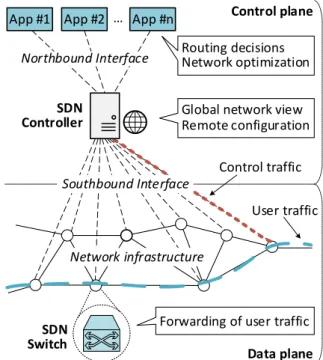
2.1 Software-defined networking (SDN) architecture. . . 44 2.2 OpenFlow switch architecture . . . 50 3.1 Implemented SDN architecture. . . 61 4.1 PMIPv6-based DMM solution. . . 71 4.2 SDN-based DMM solution. . . 75 4.3 Handover signalling cost for the two DMM solutions. . . 78 5.1 Test-beds used in the experimental evaluation. . . 86 5.2 Flow-recovery time eCDF. . . 87 5.3 Layer-3 latency composition. . . 88 5.4 Test-bed topology. . . 91 5.5 Flow-recovery time eCDF with differentλ values. . . 92 5.6 Processing time for different handover ratesλ at the network controller. 93 7.1 Reference 5G crosshaul network architecture based on [ITU18b]. . . 101 7.2 Crosshaul Packet Forwarding Element. . . 105 7.3 Crosshaul Common Frame and its mapping on 802.11 frames. . . 107 7.4 Packet size distribution for fixed and mobile scenarios. . . 112 7.5 Scenario under simulation for understanding packet multiplexing in a crosshaul network transporting eMBB, URLLC, and MIoT network slices. 113 7.6 End-to-end transmission and queueing delay for different traffic flows being terminated at M3 nodes. . . 114 8.1 SDN-based operation of current OAM protocols. . . 120 8.2 Adaptive Telemetry System components and exemplary scenario with mes-sage flow. . . 123 8.3 SDL Finite State Machine for CCM generation [ITU18a]. . . 125 8.4 Test-bed overview and components. . . 129 8.5 Scalability of one-way and two-way delay measurement with ping, legacy-SDN controller, and ATS. . . 130 8.6 Scalability of message generation for legacy-SDN controller and ATS. . 131
30 List of Figures
8.7 Bandwidth measurement with legacy-SDN controller, ATS, and Iperf. . . 133 10.1 Edge and fog resources and characteristics. . . 140 10.2 Edge and fog joint orchestration opportunities. . . 142 11.1 Integrated edge and fog concept including physical network and comput-ing infrastructure. . . 148 11.2 Integrated edge and fog computing architecture detailing EFS and OCS components. . . 149 11.3 Exemplary fog-assisted robotics logical system in a Shopping Mall environ-ment. . . 157 11.4 Potential physical mapping of integrated edge and fog system for the exemplary fog-assisted robotics use case. . . 158 11.5 Interaction between EFS and OCS for a follow-me migration. . . 160 A.1 SimPype logo . . . 177
List of Tables
2.1 OpenFlow versions comparison . . . 46 3.1 Control plane implementation details. . . 62 3.2 Application plane implementation details. . . 65 4.1 SDN-based DMM solution modules details. . . 75 4.2 Distributed Mobility Management notation. . . 76 4.3 DMM signalling messages cost. . . 77 5.1 Evaluation of implementation effort. . . 84 5.2 Programmer competency matrix. . . 84 5.3 Handover latency experimental results in milliseconds. . . 87 5.4 UE handover time results (in milliseconds) for different handover rateλ at the network controller. . . 91 7.1 Traffic flow composition per network slice, activity factor, and service area dimension. . . 109 7.2 Traffic load per AAU per scenario. . . 110 7.3 Traffic flow load per AAU for the different scenarios and slices. . . 110 7.4 Packet size for each traffic flow. . . 111 7.5 Jitter for motion control traffic flow terminated at M1, M2, and M3 nodes under different URLLC multiplexing configurations. . . 114 8.1 Adaptive Telemetry System RESTful API. . . 123 8.2 Statistical characteristics of the delay in milliseconds measured with ping, legacy-SDN controller, and ATS. . . 130 8.3 Statistical characteristics of the message generation interval in milliseconds with legacy-SDN controller and ATS. . . 131 8.4 Statistical characteristics of the bandwidth in Mbps measured with Iperf, legacy-SDN controller, and ATS with 1 active port. . . 133 11.1 Information exchanged between the EFS and OCS for implementing a follow-me migration procedure. . . 161
1
Mobile networks landscape . . . 35 1.1 Software-defined networking . . . 35 1.2 Distributed mobility management . . . 36 1.3 Fronthaul and backhaul . . . 37 1.4 5G services and network slices . . . 38 1.5 Edge and fog computing . . . 39 1.6 Thesis overview . . . 402
Background on software-definednet-working . . . 43 2.1 Southbound interfaces for controlling the for-warding . . . 43 2.2 Southbound interfaces for managing the net-work elements . . . 45 2.3 Southbound interfaces for interacting with leg-acy systems . . . 48 2.4 Southbound interfaces models for node
abstrac-tion . . . 49 2.5 Southbound interfaces models for forwarding abstraction . . . 51 2.6 Southbound Interface selection . . . 52
Introduction
1. Mobile networks landscape
Packet-based mobile networks have experienced a huge success in the last years, with the number of subscribers and traffic volume constantly growing. Several reports like1[CIS16]2 show that the mobile traffic growth will not decelerate, but increase 10-fold instead from 2015 by the end of 2020. The envisioned scenario will not only assume a large increase in data volume, but also a profound diversification of traffic and service demands, leading to a new environment for the telecommunication industry which has been identified as the 5th generation of mobile networks. On the one hand, 5G aims at improving the network infrastructure to meet users’ demands while reducing the associated deployment and operational costs for network operators. On the other hand, 5G enables a plethora of new services and business opportunities for solutions providers as documented by the 3rd Generation Partnership Project (3GPP)’s New Services and Markets Technology Enablers (SMARTER) [3GP16a]3. As a result, the 5G wireless networks are expected to support the needs of an hyper-connected society which is continuously demanding very high data rate access, requiring a wider coverage, and offering an increasing number of almost permanently connected devices. In order to cope with this ever-increasing traffic demands, nowadays network technologies are hence experiencing a shift towardssoftwarisation. The key idea is to bring the flexibility and reduced cost of software development to network deployment.
1.1 Software-defined networking
This idea is materialised by the Software Defined Networking (SDN) paradigm [ONF12]4, which moves the intelligence residing in the network elements to a central controller, which implements the network functionality through software. In traditional approaches, the network’s control plane is distributed throughout all network devices, while SDN logically centralises the control plane. This removes the need of complex and costly changes in equipment or firmware updates in order to introduce new characteristics in the network, as only a change in the software running at the controller is required. The communication between the centralised controller entity and the merely 1 This thesis uses the following citation style: [ref.id] is used to identify the reference of the work being cited. The
complete list and the extended description of the cited works can be found in the References section at the end of this document (pp. 197). Additionally, in order to help the reader, the full reference is reported as a footnote the first time a work is cited.
2 CISCO.Cisco Visual Networking Index: Global Mobile Data Traffic Forecast Update, 2015-2020. White Paper. June
2016.
3 3GPP. Service requirements for next generation new services and markets. Technical Specification (TS) 22.261
v1.0.0. 3rd Generation Partnership Project (3GPP), December 2016.
4 ONF.Software-Defined Networking: The New Norm for Networks. White Paper. Open Networking Foundation,
36 Chapter 1. Mobile networks landscape
traffic forwarding devices could be supported by what is called southbound interface protocols. One of the candidate protocols for it is OpenFlow, which is being standardised by the Open Networking Foundation (ONF). The main advantage of this approach is that operators can benefit from an increasedflexibilityto manage their networks and implement new services. Following this new technology (SDN), the 3GPP’s architectural study for next generation mobile systems, published in [3GP16b]5, focuses on enhancing the mobile network’s core part, considering the evolution of the network towards a distributed and softwarised ecosystem.
Initial work on SDN focused on wired networks, though its advantages are even more important for mobile wireless networks. Indeed, in mobile networks users may change their location over time, and therefore the flexibility provided by SDN is not only beneficial for optimising the traffic distribution inside the network, but it is also useful to adapt the way traffic is steered after users’ movement. In particular, some of the benefits of adopting SDN in mobile networks include the following:
– Modification of traffic engineering policies: With SDN, an operator can easily change the
traffic engineering policies implemented in the network. This can be useful for many reasons, such as for example: (i) to select a new gateway for outgoing traffic, (ii) route all traffic through a given firewall, or (iii) route certain traffic differently.
– Online traffic optimisation: SDN does not only allow to flexibly change the traffic engineering policies but it also allows to execute them a finer granularity in terms of (i) the timing involved in taking routing decisions, and (ii) the traffic flows affected by such decisions. This allows optimising the way traffic is distributed, adapting it as users move to new locations and load changes.
– Creation of novel services: SDN also allows treating packets differently based on the user or the application. This can be used to create novel services; for instance, the gateway providing connectivity to a user can be selected (among a pool of available ones) based on the location privacy preferences/requirements of the user. Mobile network services can thus be deployed on the fly, allowing network operators to quickly adapt their network to new requirements. Note that the above includes a fairly wide range of services which are enabled by SDN, like the ones identified by 3GPP in [3GP16a].
1.2 Distributed mobility management
One service of paramount importance in mobile networks, which intrinsically differentiates them from fixed networks, is the mobility management of the users. Indeed, mobile users are charac-terised by the fact that they move within the network and may change point of attachment while moving (e.g., antenna they are connected to). The control and data planes of these users are converged at the same Packet Data Network Gateway (PGW) in today’s 4G systems, making the 4G architecture highly centralised and hierarchical. The PGW hence is in charge of terminating the mobility signalling of the users as well as forwarding their traffic to and from the mobile network enforcing any policy functions. By doing so, the gateway acts as mobility anchor following the user movements by simply re-routing the packets over tunnels created with the access router where the user terminal is currently connected. But this simplicity comes with some penalties [Cha+14]6: the mobility anchor represents a single point of failure, it poses scalability issues overloading the network core, and, in general, it leads to sub-optimal paths between the mobile users, also known as Mobile Node (MN), and their communication peers, also known as Correspondent Node (CN). Flattening the network architecture is regarded as one of the most promising approaches to design the architecture of the next generation system, and the Distributed Mobility Management (DMM) paradigm goes precisely in such direction. Both 3GPP and Internet Engineering Task Force 5 3GPP.Study on Architecture for Next Generation System. Technical Report (TR) 23.799 v14.0.0. 3rd Generation
Partnership Project (3GPP), December 2016.
6 H. Chan et al.Requirements for Distributed Mobility Management. Request for Comments (RFC) 7333. Internet
1.3 Fronthaul and backhaul 37
(IETF), which are the main standardisation bodies in this area, have looked and are still looking at DMM-alike solutions.
As a matter of fact, signalling load is one of the most problematic aspects in existing mobile core networks [Met+14]7, [Net12]8. On the one hand, the number of mobile devices supported by the network (which is the final responsible for their reachability as they move) is ever increasing. On the other hand, the need to increase both capacity and coverage is fuelling the deployment of smaller cells that in turn produce more signalling because of more frequent handover events, regardless the users are actually generating data traffic or not. The main limitation today resides in the control part and not in the data plane, which has enough throughput capacity for traffic forwarding, then driving to a constant upgrade of the mobile core network elements. Specifically, the Mobility Management (MM) is a task that imposes serious constraints to the processing capacity of the existing mobile core network elements. Even if a mobile terminal is not active in a communication, the network should manage its mobility and provide the network resources for facilitating such communication when it is set up. In this situation it is reasonable to look for decoupling the control plane from the data plane in mobile core networks. In fact, mobile protocols already imply such conceptual separation. However, the common incarnation of the mobile core nodes today is the vertical integration of both control and data plane functions in special-purpose and monolithic hardware. A Mobile Packet Core (MPC) architecture based on SDN has been already proposed in [Sam+15]9 describing the evolution of the existing MPC architecture towards a new architecture with the separation of control and user plane by using a programmable network infrastructure.
1.3 Fronthaul and backhaul
The network infrastructure for mobile networks traditionally envisages a backhaul segment for assuring connectivity between the core network and access network. Such segment is typically composed of several sub-systems including heterogeneous wired/wireless forwarding networks and fibre-based aggregation/routing networks, thus including several packet nodes, such as switches, routers, aggregators, etc. This heterogeneity leads to the use of various transport protocols for transporting packets between these nodes such as carrier-grade Ethernet, Optical Transport Network (OTN), Synchronous Digital Hierarchy (SDH), Multiprotocol Label Switching (MPLS), Internet Protocol (IP), etc. The packets transmitted on the backhaul segment are also referred to as backhaul traffic. Recently, a new network segment called fronthaul has emerged, as the result of more centralised radio access network (C-RAN) architectures where the Evolved Node B (eNB) is split into two elements, a Remote Radio Head (RRH) and a Baseband processing Unit (BBU). The RRH simply keeps the RF functions necessary for the signal radiation at the cell site while the BBU takes all the baseband heavy computational functions to a separate location. The simplicity of the antenna sites would allow a more cost effective and flexible deployments of the 5G Radio Access Network (RAN), which is also expected to be denser so as to increase the spectrum re-utilisation and capillarity. To enable this functional split, new protocol interfaces have been designed, such as Common Public Radio Interface (CPRI) [CPR15]10, enhanced CPRI (eCPRI) [CPR18]11, Open Radio equipment Interface (ORI) [ETS14]12, and Next Generation Fronthaul Interface 7 F. Metzger et al. ‘Exploratory Analysis of a GGSN’s PDP Context Signaling Load’. In:Journal of Computer Networks
and Communications2014 (2014).DOI:10.1155/2014/526231.
8 Nokia Siemens Networks.Signaling is growing 50% faster than data traffic. White Paper. 2012.
9 M. R. Sama et al. ‘Software-defined control of the virtualized mobile packet core’. In: IEEE Communications Magazine53.2 (February 2015), pages 107–115.ISSN: 0163-6804.DOI:10.1109/MCOM.2015.7045398.
10 CPRI.CPRI Specification. Interface Specification v7.0. Common Public Radio Interface (CPRI), October 2015. 11 CPRI.Common Public Radio Interface: eCPRI Interface Specification. Interface Specification v1.2. Common Public
Radio Interface (CPRI), June 2018.
12 ETSI. Requirements for Open Radio equipment Interface (ORI). Group Specification (GS) GS ORI 001 V4.1.1.
38 Chapter 1. Mobile networks landscape
(NGFI) [IEE16b]13. The data generated by these interfaces and then transported on the fronthaul segment is referred to as fronthaul traffic. While the location of the RRH is determined by the physical environment and deployments, the physical location of the BBU is variable (e.g., fully at the edge, in a local cloud, or fully central cloud). This can create situations where fronthaul and backhaul traffic may eventually share the same physical segment of the transport network. Different functional splits, and hence interfaces, impose different requirements (e.g., bandwidth, latency, jitter, BER) on the fronthaul interface that must be guaranteed within the transport network, which comprises heterogeneous transmission technologies.
The expected heterogeneity requires a compromise between a dedicated control for each type of technology and a common abstraction layer so as to provision end-to-end services and monitor their Quality of Service (QoS) transparently to the underlying technologies. With traditional technologies, the plethora of nodes, their control elements, and the embedded technologies make the fronthaul and backhaul networks quite complex, expensive and inefficient to manage flexibly and dynamically. Moreover, the new considered functional splits further blur the borders between fronthaul and backhaul. Indeed, both fronthaul and backhaul traffic will have to be carried across the same transport infrastructure, even along with the traffic of fixed access networks. As a result, a common fronthaul/backhaul transport network is required to integrate the heterogeneous media and transport technologies, such as microwave, mmWave, dark fibre, leased lines, etc. To that end, 5G transport networks need to evolve towards an adaptive, flexible and software-defined architecture for integrating multi-technology fronthaul and backhaul segments. The resulting integrated fronthaul and backhaul architecture, also referred to as crosshaul, aims to enable a flexible and software-defined reconfiguration of all networking elements through unified data and control planes interconnecting distributed 5G radio access and core network functions. To tackle the above requirements from a network protocol perspective, Ethernet is considered a suitable candidate in terms of performance, costs, and management for providing packet-based services in a transport network [Oli+15]14. As a matter of fact, the IEEE is extending current Ethernet standards to (i)
support link speeds up to 200 Gbps [IEE17d]15, and to (ii) provide enhancements for time-sensitive traffic (i.e., fronthaul) [CPR18] which are of particular relevance for 5G. Consequently, transport networks will need to provide huge bandwidth, traffic differentiation, and tailored QoS.
1.4 5G services and network slices
In addition to the backhaul and fronthaul traffic, 5G transport networks will hence need to accom-modate different kind of services with very distinct requirements [ITU15a]16 on top of the same physical infrastructure. Specifically, these services span across a large variety of new use cases which go beyond the natural evolution of voice and data delivery in 4G mobile networks [3GP16c]17,
such as multi-access network integration, even across operators and less trusted networks, Internet of Things (IoT), localised real-time control, vehicular communication, etc. All of this poses signific-ant challenges to the 4G monolithic and centralised network architecture, both in terms of flexibility and scalability, making new services hard to introduce and scale. In addition, sharing the physical network assets through multi-tenancy is seen as a viable path for reducing the ever-increasing costs 13 IEEE.Standard for Packet-based Fronthaul Transport Networks. NGFI - Next Generation Fronthaul Interface 1914.1.
Institute of Electrical and Electronics Engineers (IEEE), August 2016.
14 A. D. La Oliva et al. ‘Xhaul: toward an integrated fronthaul/backhaul architecture in 5G networks’. In:IEEE Wireless Communications22.5 (October 2015), pages 32–40.ISSN: 1536-1284.DOI:10.1109/MWC.2015.7306535.
15 IEEE.Physical Layers and Management Parameters for 50 Gb/s, 100 Gb/s, and 200 Gb/s Operation. Standard for
Ethernet 802.3cd. Institute of Electrical and Electronics Engineers (IEEE), December 2017.
16 ITU-R.Framework and overall objectives of the future development of IMT for 2020 and beyond. M Series Mobile,
Radiodetermination, Amateur and Related Satellite Services M.2083. International Telecommunication Union -Radiocommunication Sector (ITU-R), October 2015.
17 3GPP. Study on New Services and Markets Technology Enablers. Technical Report (TR) 22.891 v14.2.0. 3rd
1.5 Edge and fog computing 39
involved in the deployment and management of future networks [SCS16]18. The above is key to understand the new QoS capabilities that are required to be supported in 5G transport networks so as to simultaneously fulfil the disparate traffic and tenant requirements.
The 3GPP groups 5G services in three main categories [3GP18i]19, namely enhanced Mobile Broadband (eMBB), Ultra-Reliable and Low Latency Communications (URLLC), and Massive Internet of Things (MIoT). Each of them present different inherent characteristics spanning from ultra-low latency to high bandwidth and high reliability. According to Next Generation Mobile Networks (NGMN) [NGM16]20, these multiple services may be provided by customised network slices, which provide the necessary traffic treatment over the same physical substrate. Traffic differentiation is enforced at the access border of the network in order to ensure a proper forwarding of the traffic according to its class through the backbone, where it is more feasible to have high capacity. While existing networks can be considered as a continuum from the access to the interconnections points forming an end-to-end path, network slicing breaks this situation since now the end-to-end path becomes a composition of segmented paths within different slices that could even pertain to distinct administrative organisations or providers. This means that the end-to-end path traverses now many edges where the traffic should be enforced, discriminated and ensured, according to the service and tenants needs. Thus, transport networks move from a single-edge continuum towards a multiple-edges structure in 5G. Apart from the technical complexity added, cost implications can be expected, since the specialised and more expensive hardware today used only in the border for implementing fine-grained QoS should be generalised throughout