risks to software as a service from a user’s
perspective
by
Frederick Ferdinand Ipland
December 2011
Thesis presented in partial fulfilment of the requirements for the degree MComm (Computer Auditing) at the University of Stellenbosch
Supervisor: Mr LP Steenkamp
Faculty of Economic and Management Sciences Department of Accounting
i | P a g e
Declaration
I, the undersigned, hereby declare that the work contained in this assignment is my original work and that I have not previously in its entirety or in part submitted it at any university for a degree.
Frederick Ferdinand Ipland December 2011
Copyright © 2011 University of Stellenbosch All rights reserved
ii | P a g e
Abstract
Software as a Service (SaaS) – which is a deployment model of cloud computing – is a developing trend in technology that brings with it new potential opportunities and consequently potential risk to enterprise. These incremental risks need to be identified in order to assist in risk management and therefore information technology (IT) governance.
IT governance is a cornerstone of enterprise-wide corporate governance. For many entities corporate governance has become a statutory requirement, due to the implementation of legislation such as Sarbanes-Oxley Act of the United States of America.
The research aims to assist in the IT governance of SaaS, by identifying risks and possible controls.
By means of an in-depth literature review, the study identified 30 key risks relating to the use and implementation of SaaS from the user’s perspective. Different governance and risk frameworks were considered, including CobiT and The Risk IT Framework. In the extensive literature review, it was found that CobiT would be the most appropriate framework to use in this study. Mapping the risks and technologies from the user's perspective to one or more of the processes of the CobiT framework, the research found that not all processes where applicable. Merely 18 of 34 CobiT processes where applicable.
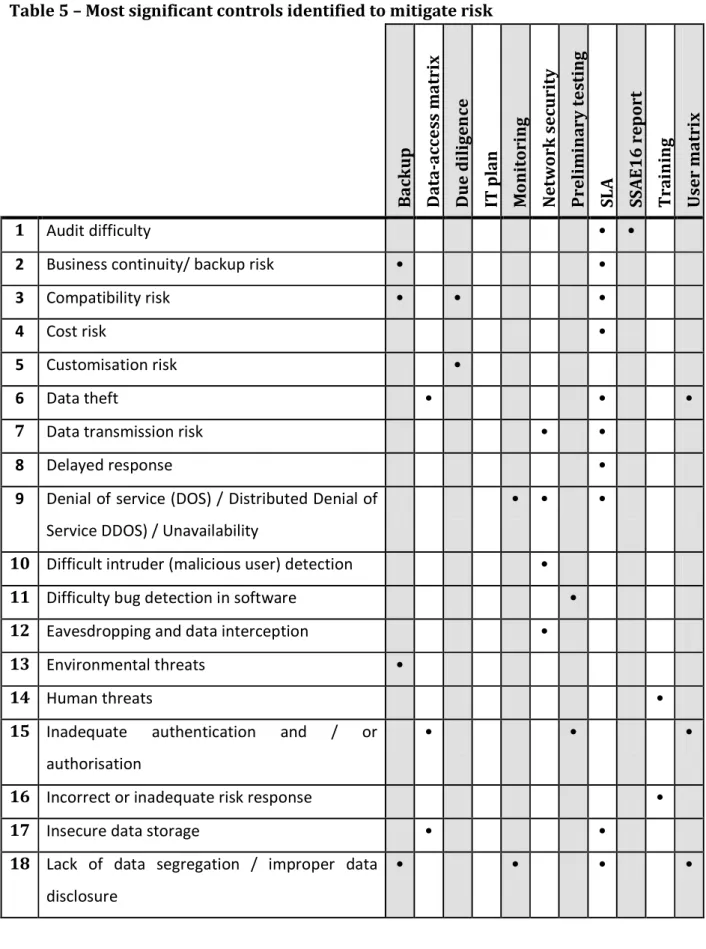
The study endeavoured to identify possible controls and safeguards for the risks identified. By using the technologies and risks that were mapped to the CobiT processes, a control framework was developed which included 11 key controls to possibly reduce, mitigate or accept the risks identified. Controls are merely incidental if it is not linked to a framework.
iii | P a g e
Opsomming
Software as a Service (SaaS) – ‘n ontplooiingsmodel van cloud computing – is ‘n ontwikkelende tegnologiese tendens wat verskeie moontlikhede, maar daarby ook verskeie risiko’s vir ondernemings inhou. Hierdie addisionele risiko’s moet geïdentifiseer word om te help met die bestuur van risiko’s en daarom ook die beheer van Informasie Tegnologie (IT).
IT beheer is ‘n belangrike deel van die grondslag van ondernemingswye korporatiewe beheer. As gevolg van die implimentering van wetgewing soos die Sarbanes-Oxley wetsontwerp van die Verenigde State van Amerika, het korporatiewe beheer ‘n statutêre vereiste geword vir verskeie ondernemings.
Hierdie studie poog om die IT beheer van SaaS by te staan, deur risiko’s en moontlike beheermaatreëls te identifiseer.
Deur middel van ‘n indiepte literatuur ondersoek het die studie 30 sleutelrisiko’s geïdentifiseer wat verband hou met die gebruik en implimentering van SaaS vanuit ‘n gebruikersoogpunt. Verskeie korporatiewe- en risiko raamwerke, insluitende CobiT en The Risk IT Framework, was oorweeg. Die literatuur ondersoek het egter bevind dat CobiT die mees toepaslikste raamwerk vir dié studie sal wees. Deur die risiko’s en tegnologieë vanuit ‘n gebruikers perspektief te laat pas met een of meer CobiT prosesse, het die navorsing bevind dat nie alle prosesse in CobiT van toepassing is nie. Slegs 18 van die 34 prosesse was van toepassing.
Die studie het ook gepoog om moontlike beheer- en voorsorgmaatreëls vir die risiko’s te identifiseer. Deur die tegnologieë en risiko’s te gebruik wat gepas is teen die CobiT prosesse, is ‘n beheer raamwerk ontwikkel wat 11 sleutel beheermaatreëls insluit, wat die geïdentifiseerde risiko’s kan verminder, temper of aanvaar. Beheermaatreëls is slegs bykomstig as dit nie direk aan ‘n raamwerk gekoppel is nie.
iv | P a g e
Table of Contents
Declaration ... i Abstract ...ii Opsomming ... iii Table of Contents ... iv List of Tables ... v List of Figures ... vi 1. Introduction ... 1 1.1 Problem Statement ... 41.2 Aims and objectives ... 5
1.3 Methodology ... 6
1.4 Scope ... 8
1.5 Subsequent chapters ... 9
2. Background to SaaS, incremental risk and IT governance ... 10
2.1 Software as a Service and related technology ... 10
2.2 Control framework and IT governance ... 15
2.3 Risk in the context of the research performed ... 16
3. Literature review and prior studies ... 18
4. Research design and methodology ... 21
4.1 Investigation into SaaS ... 21
4.2 Identification of existing and possible risk relating to SaaS ... 22
v | P a g e
4.4 Map technologies and risks to the selected framework ... 23
4.5 Investigation into possible controls and safeguards ... 24
5. Research findings ... 25
5.1 Investigation into SaaS ... 25
5.2 Risk identified by literature review ... 29
5.3 Framework selection ... 38
5.4 Identification of applicable CobiT processes to users of SaaS ... 42
5.5 Map risk to CobiT framework ... 48
5.6 Possible safeguards or controls ... 52
6. Conclusion and future research ... 74
6.1 Conclusion and findings ... 74
6.2 Future research ... 75
7. Bibliography ... 77
Appendix A – Glossary of terms ... 84
Appendix B –Common concepts and conventions used ... 85
List of Tables
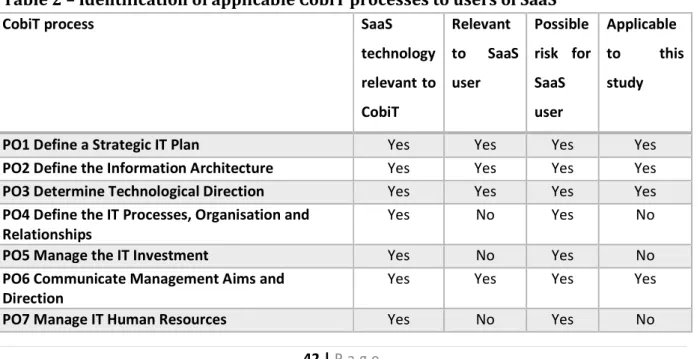
Table 1 – Risk identified and description ... 30Table 2 – Identification of applicable CobiT processes to users of SaaS ... 42
Table 3.1 – Risks relating to CobiT processes ... 49
Table 3.2 – Risks relating to CobiT processes (Continued) ... 50
Table 3.3 – Risks relating to CobiT processes (Continued) ... 51
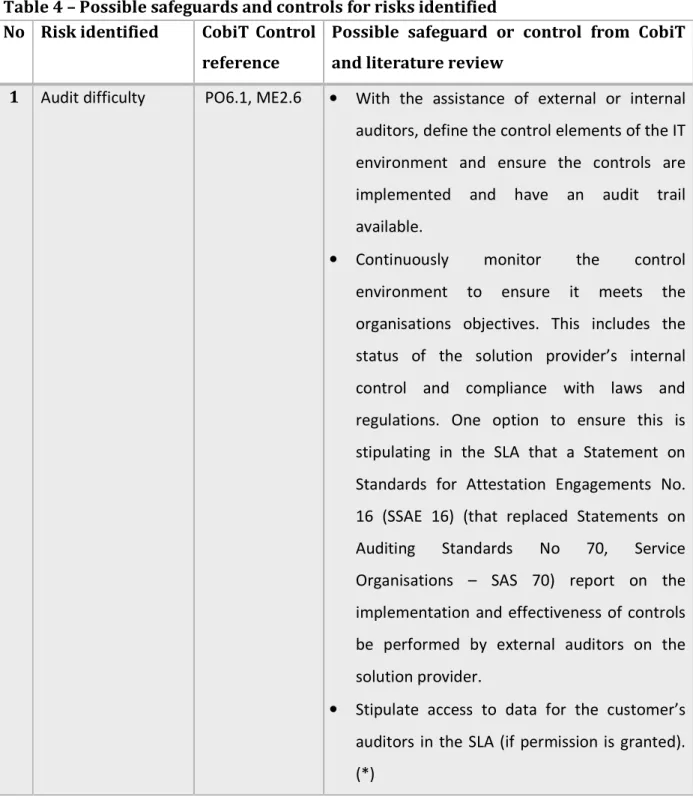
Table 4 – Possible safeguards and controls for risks identified ... 55
vi | P a g e
List of Figures
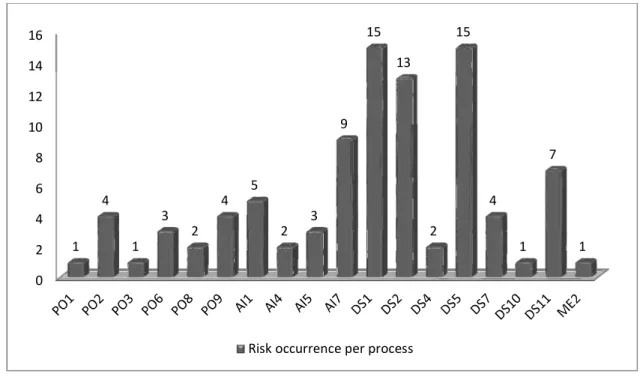
Figure 1 – Research and conclusion methodology ... 7 Figure 2 – Illustrative description of the NIST definition of cloud computing (Ahmad & Janczewski, 2011: 2) ... 15 Figure 3 – SaaS Production Architecture (Al Zabir, 2011: 1) ... 28 Figure 4 – Processes most likely to be affected by risk relating to use and implementation of SaaS. ... 52
1 | P a g e
1. Introduction
“IT risk is business risk” (ISACA, 2009a: 7). According to Stoneburner, Goguen and Feringa (2002: 1) Information Technology (IT) risk is not a technical issue to be dealt with by IT departments, but an essential part of business management. Research conducted by Grant Thornton LLC (Nefdt, Miller, Spivack & McGee, 2011: 14) found that 39% of surveyed Software as a Service (SaaS) companies did not have formal risk management programs (or corporate governance frameworks).
SaaS – which is a deployment model of cloud computing – is a developing trend in technology that brings with it new potential risks and consequently potential opportunities to enterprises (Nefdt et al., 2011: 16). Incremental risks to business occur because of the natural progression or evolution of technologies, which may have a negative impact on business due to losses or missed opportunities. Cloud computing – and therefore SaaS – is a new technology, and brings with it the potential of high risk (ISACA, 2009c: 4). This is the reason why potential risk needs to be identified, in order to assist businesses in risk management and to grasp opportunities. Greg Hughes, Chief Strategy Officer, Symatec Corporation (2008: 2) expressed this best: “IT Risk Management is more than using technology to solve security problems. With proper planning and broad support, it can give an organization the confidence to innovate, using IT to outdistance competitors”. Jensen, Schwenk, Gruschka and Iacono (2009: 110) state that there is demand for an in-depth discussion as regards the requirement for cloud computing; they found that recent surveys on cloud security issues focussed on data confidentiality, safety and privacy.
Legislation on corporate governance – including the Sarbanes-Oxley Act of the United States of America and the King Code of Governance for South Africa 2009 (King III) report’s requirement for all listed companies on the Johannesburg Stock Exchange (JSE) – purports that corporate governance has become a statutory requirement. For all other companies in South Africa the King III report is on a “comply or explain” basis, in essence the company should comply
2 | P a g e
therewith, or document why it is unable to do so. The Institute of Directors of Southern Africa (2009: 6) state that there is a link between good corporate governance and statutory requirements; this is due to the legal duties which include fiduciary duties and the duty of care, skill and diligence. It notes further that IT is now being used as an enabler of business, which is so pervasive it mandates IT governance.
ITGI (2007: 5) states that some of the key cornerstones of an enterprise’s governance includes the assurance about IT’s value, IT risk management and controls surrounding information. IT governance incorporates and institutionalises good practice to guarantee that the enterprise’s IT supports its business goals (ITGI, 2007: 5). According to ITGI (2007: 5) these goals require a framework of IT controls that matches the Committee of Sponsoring Organisations of the Treadway Commission’s (COSO) Internal Control – Integrated framework; which is the most widely accepted control framework for enterprises. In addition thereto, data is distributed over different data centres and furthermore data-ownership and control is distributed in SaaS, which requires a different approach to data management, security and governance (Accenture, 2011: 5).
SaaS applications and software are accessed via the internet over a private or public domain by a web browser. Cloud Computing is a model for enabling convenient, on-demand network access to a shared infrastructure of configurable computing resources (e.g., servers, storage, applications, and services) that can be rapidly provisioned and released with minimal management effort or service provider interaction. This Cloud model promotes accessibility and is composed of five essential characteristics:
• On-demand self-service • Wide-ranging network access • Resource amalgamation • Rapid elasticity
3 | P a g e This is also based on three delivery models:
• SaaS
• Platform as a Service (PaaS) • Infrastructure as a Service (IaaS)
Cloud computing can be deployed as a private cloud, community cloud, public cloud and a hybrid cloud (Mell & Grance, 2009: 1). This is further discussed in section 2.1. Cloud computing is further described and discussed in section 2.1. The definition of SaaS accepted for this study is that SaaS is the delivery of software or an application by a provider(s) over a network (Internet or intranet) for a pay per use or fixed per user rental fee and is accessed by a web browser. Refer to sections 2.1 and 4.1 for further discussions relating to SaaS and its definition.
The use of SaaS creates value by reducing costs of infrastructure investment and costs relating to software purchase, delivery time, agility and integration. SaaS will assist organisations to accomplish the future’s tasks today, securing IT’s role as an imperative for future success and growth (Accenture, 2011: 9). IT departments will be able to shift their focus from development and support to managing the services, which should provide more value as services can be aligned to business goals (Carraro & Chong, 2006). A significant advantage that SaaS has over perpetual licence software is that the provider can include updates and software enhancements as soon as it becomes available, in stark contrast to the decision by customers only to upgrade software once significant improvement is available (Choudhary, 2007a: 143).
Some of the risks identified and discussed in section 5.2 include opt-out risk, risk of data theft and data loss, business continuity risk etc. According to Nefdt et al. (2011: 7) there exists a lack of assessable information regarding the quality, magnitude and mitigation of risks relating to SaaS. Academic literature on SaaS has focused mostly on the pricing model (Choudhary, 2007a: 143).
4 | P a g e
The purpose of this study is to investigate incremental risk relating to the use or implementation of SaaS technology in an enterprise. Increment is defined as an increase, which could often be barely perceptible (Encarta Dictionary, 2011: 1). Risk in the context of this study includes the loss of opportunities for an enterprise or a negative impact on an enterprise. The evaluation of these risks will be performed by using internationally accepted frameworks. The study intends to recommend possible safeguards to identified risks, thereby developing a control framework for SaaS customers for integration into their enterprises overall corporate and IT governance framework. According to Accenture (2011: 14) enterprise architecture was historically created in an attempt for 100% security; however this must give way to a cascaded reactive security approach when implementing cloud solutions, including SaaS.
The remainder of this chapter is grouped as follows: The problem statement which identifies the necessity of the study along with the motivation thereof; from there the goals and purpose of the study is described. The remaining sections define the scope and methodology used in the study.
1.1 Problem Statement
The benefits arising from SaaS are widely available, as documented by some, including ISACA (2009c: 6); Jensen et al. (2009: 109); Petri (2010: 15, 20); Choudhary (2007b: 1); Benlian, Hess and Buxman (2009: 357) and Carraro and Chong (2006); however only limited risks or risk relating to specific aspects (such as service level agreement risk) have been identified. These risks relating to SaaS and the risks to related technologies were identified in texts such as Putri and Mganga (2011: 31); ISACA (2009c: 7); Rudman (2010: 3260); Walsh (2009: 7) & Raval (2010: 3). There is a need in the SaaS sector to quantify risks relating to SaaS (Nefdt et al., 2011: 1).
New technologies, such as SaaS, create incremental IT risks that affect businesses directly and should therefore be identified and managed. It is clear that the adoption or use of SaaS could lead to total enterprise failure, if the risks are not controlled or mitigated. This is due to the
5 | P a g e
reliance on the solution provider, which is one of many security concerns for possible customers. Many enterprises wish to implement SaaS, but are too concerned about the security issues relating to SaaS (Shey et al., cited in Subashini & Kavitha, 2010: 3). Feng, Chen and Liu (2010: 1) states that cloud computing security measures require more than those of conventional security measures.
Furthermore few safeguards and controls have been identified or developed in relation to the risks identified; some publications include Putri and Mganga (2010) and Raval (2010). The study aims to develop controls and safeguards for the risks identified, by linking the risks to a selected framework and developing controls from the framework. By linking the controls to the risks, a framework to govern risk could be developed.
1.2 Aims and objectives
The purpose of this study is to evaluate the most significant incremental risks for users of SaaS. Users of SaaS are the enterprises and people that make use of the software that is delivered to them by the solution provider. Enterprises that understand the incremental risks relating to SaaS will be able to adapt in order to mitigate these risks and to fulfil the full potential of implementing or using SaaS in their business.
It is not the purpose of the study to attempt to identify all risks relating to SaaS; therefore the risks identified cannot be used as a full, complete or comprehensive generic list of incremental risks. The users should assess whether all risks identified apply to them and whether other risks may also exist. The study will attempt to impose the importance of risks (relating to any facet of an enterprise), as noted by research conducted by Nefdt et al. (2011: 3): “In our work across industries, we have found that many companies do not appreciate how crucial it is to address and manage compliance risk “. The study will not pursue a definition of incremental risk relating to SaaS as it is a subjective observation.
6 | P a g e
The study will attempt to act as a catalyst for enterprises to assess whether SaaS may be a viable option for implementation into their enterprise. It may contribute to due diligence reporting, to assess whether SaaS should be adopted by an enterprise. From a client’s perspective, the purchase of perpetual software licence and hardware investment becomes a sunk cost, which makes the investigation and adoption of SaaS a more attractive business decision (Choudhary, 2007a: 145). The study could aid enterprises that have implemented SaaS to update their risk management processes and assist in deploying a risk management process, if none exist. It may also assist internal and external auditors in identifying significant audit risks (when performing risk assessment procedures). As Nefdt et al. (2011: 2) state, very little research has been conducted regarding the quality, magnitude and mitigation of risks relating to SaaS.
Guidance will also be provided in this study, based on a widely accepted framework(s), such as Control Objectives for Information and related Technology (CobiT), Risk IT and Enterprise Value: Governance of IT investments (Val IT) on how to manage the risks identified. The safeguards and controls identified in this framework cannot be accepted as complete, but rather as a baseline or checklist, as each type of risk response – and even risk itself – is unique to a situation, organisation or risk management.
1.3 Methodology
The study combined two research methods; firstly an extensive literature review was performed to define SaaS, to identify risks relating to SaaS and to identify a framework to assess risks. Refer to Chapters 3, 4 and Table 1 in section 5.2 for more details on this review. Secondly the information obtained relating to SaaS technologies and risks were analysed in the selected control framework (refer Table 2 in section 5.4), in order to map the technology to the framework. The literature review identified sources relating to the technologies of SaaS, risks identified in SaaS and whether safeguards have been identified.
7 | P a g e
For a complete review of literature on SaaS, other technologies were also considered, such as cloud computing and furthermore technologies that share some of the features of SaaS, such as Web 2.0 (Wang, Von Laszewski, Younge & He, 2008: 138). Risks identified from the literature review will be evaluated by mapping SaaS technologies against existing internationally accepted best practice frameworks. Mapping entails the allocation of technologies and risks to the most applicable process in the framework. SaaS in itself cannot be mapped against these frameworks; only the specific technology used for SaaS can be mapped against the processes in a framework.
An in-depth review of control frameworks available was performed, resulted in the most widely accepted framework to be identified, is noted in section 5.3. The research is focussed on the users of SaaS, therefore only technology and risks relating / applicable to the users will be considered. Finally recommended controls and safeguards for identified risks were devised in a framework, linking the control or safeguard to the framework’s process, as described in Table 4 of section 5.6.
The following diagram depicts the process, from risk identification to developing possible controls and safeguards:
SaaS technologies applicable to the user
Framework’s processes applicable to SaaS user
Controls and safeguards identified
A
B a 1
C b 2
c 3
Incremental risks identified d 4
i e 5
ii 6
iii
Figure 1 – Research and conclusion methodology
1.
2.
3.
8 | P a g e
The figure illustrates that from step 1: The research on SaaS and the technology relating thereto, is mapped to the process. Step 2 was the research conducted into existing risks identified relating to SaaS and related technologies. Step 3 evaluates which processes are applicable (Table 2, section 5.4). The risks applicable are then mapped to the process in step 4 (Table 3.1 – 3.3, section 5.5). Lastly controls can be designed based on the framework selected (Table 4, section 5.6). This process maps the technology and the risk to the applicable control to prevent, detect or correct risk (step 5). It is also clear from the figure that some technologies and risks affect more than one process and that some controls are applicable to more than one process.
1.4 Scope
The research is focused on the users of SaaS; however some of the risks may be shared with the solution providers. The risks identified were based specifically on incremental risks, however this list cannot be regarded as a complete list and each enterprise should evaluate if all the identified risks apply, or whether additional risks may exist. As mentioned, incremental risks to business occur because of the natural progression or evolution of technologies, which increase the frequency and magnitude of IT risk. Furthermore, SaaS has been selected for evaluation in this study, as it is an up and coming trend (Nefdt et al., 2011: 2).
To define SaaS and its related technologies, it was first necessary to investigate cloud computing. Several definitions were identified for cloud computing. The SaaS platform of cloud computing was selected due to the surge of interest in SaaS which is owing to macroeconomic circumstances that have put pressure on enterprises to cut spending (Accenture, 2009: 3).
Several well-known entities have implemented SaaS, including Citigroup (Accenture, 2009: 10). Other well-known entities are campaigning for the adoption of SaaS, such as SalesForce.com, 3Tera, Microsoft, and Amazon (Pervez, Lee & Lee, 2010: 214).
9 | P a g e
SaaS can be deployed in public, private or hybrid clouds. The study did not attempt to differentiate, however the risks identified are more applicable to a public or hybrid cloud, due to the increased risk of public and hybrid deployment models.
1.5 Subsequent chapters
The research study continues with Chapter 2, which contains a description and background to SaaS, a discussion on incremental risk and an overview of IT governance. These 3 sections are the foundation of the research. Chapter 3 includes the literature review and prior studies concluded on SaaS. The literature review contains risk relating to SaaS and available IT governance frameworks to address these risks. Chapter 4 documents the research design and methodology in detail. Divided into 5 sections it first addresses how SaaS will be defined, and the process of identifying risks, thereafter how the IT governance framework will be selected, mapping SaaS technologies to the selected framework and lastly how controls and safeguards will be identified. Chapter 5 documents the research findings, in the same order as Chapter 4, with an additional table that maps the risk to the processes applicable in the framework. Chapter 6 contains the conclusion and identifies possible future research.
10 | P a g e
2. Background to SaaS, incremental risk and IT
governance
This chapter endeavours to give the reader of the subject matter a broad understanding of the three core elements that were used to reach the conclusion, which include the risks and controls identified. The chapter will not focus on the technical aspects of these core elements, but will rather give a wide description.
2.1 Software as a Service and related technology
To define SaaS and its related technologies, it was first necessary to investigate cloud computing, as SaaS is a component of cloud computing. Several definitions were identified, some of which included:
• Accenture (2009: 4) who define cloud computing as IT capabilities over a network; • Wang et al. (2008: 138) who define cloud computing as a set of network enabled
services, which may be accessed pervasively; and
• Subashini and Kavitha (2010: 1) who define cloud computing as an alternative way to invest in capacity and capability, without investment in physical infrastructure.
This range of definitions for cloud computing is further underlined by IBM (2010: 2), Feng et al. (2010: 1) and Ahmad and Janczewski (2011: 1) in that there are different opinions of what cloud computing is. However, the definition that is widely accepted was developed by the National Institute of Standards and Technology (NIST) (Ahmad & Janczewski, 2011: 1; Petri, 2010: 5 & ISACA, 2009c: 4). The summarized NIST definition is as follows: Cloud Computing is a model for enabling convenient, on-demand network access to a shared infrastructure of configurable computing resources (e.g., servers, storage, applications, and services) that can rapidly be provisioned and released with minimal management effort or service provider interaction.
11 | P a g e
This cloud model promotes accessibility and is composed of five essential characteristics: • On-demand self-service;
• Wide-ranging network access; • Resource amalgamation; • Rapid elasticity;
• Measured Service.
This is also based on three service models: • SaaS,
• Platform as a Service (PaaS), and • Infrastructure as a Service (IaaS).
Cloud computing can be deployed as a private cloud, community cloud, public cloud and a hybrid cloud (Mell & Grance, 2009: 2 & Petri, 2010: 6). In a private cloud the infrastructure is deployed only for a single organisation, over an enterprise’s intranet. The organisation normally owns the infrastructure, whether it is on or off the premises or externally managed (Petri, 2010: 9; IBM, 2010: 3 & PricewaterhouseCoopers, 2010: 14). The opposite is true for a public cloud, where the cloud is accessed over the internet and the client and provider are two different organisations and the ownership of infrastructure is with the provider (Petri, 2010: 9; IBM, 2010: 4 & PricewaterhouseCoopers, 2010: 14). In a community cloud, the cloud infrastructure is shared by several enterprises and supports a specific community (Putri & Mganga, 2011: 13). Lastly a hybrid cloud may contain multiple public and private clouds; multiple clients and providers will most likely be supplied in a multi-tenant infrastructure (IBM, 2010: 4 & Putri & Mganga, 2010: 14). Fishteyn (2009: 1) describes a multi-tenant infrastructure as “one that uses common resources and a single instance of both the object code of an application as well as the underlying database to support multiple customers simultaneously”.
Due to the fact that SaaS is a deployment model of cloud computing, it was expected not to find a universal definition for it. The media has also labelled SaaS with a variety of names,
12 | P a g e
including on-demand computing, seamless computing and adaptive computing (Choudhary, 2007a: 142). In this study, SaaS is accepted as the most commonly used term. Nefdt et al. (2011: 2) states that the lack of clear criteria to define SaaS opened the door for solution providers to host widely different solutions and market these as SaaS. Several different descriptions for SaaS have been identified.
These definitions for SaaS include:
• Carraro and Chong (2006): a hosted service which is accessed via the internet. • Pervez et al. (2010: 214): business functionality delivered by a network as a service. • Petri (2010: 11): the capability to use a provider’s applications, which are cloud based. • IBM (2010: 7): an application delivered via a cloud where multiple enterprises share the
single application and the provider implements virtualisation technologies to ensure security and data privacy.
• Putri and Mganga (2011: 11): renting a suppliers software over a network, where the provider runs the application in a multi-tenant infrastructure.
• Sääksjärvi, Lassila and Nordström (2005: 177): SaaS is time and location independent, allows for multi-tenancy by the provider, has greater economy of scale and allows for continues innovation of software.
• Kang, Myung, Yeon, Ha, Cho, Chung and Lee (2010: 338): have a similar definition as Sääksjärvi et al. (2005: 177) with the addition that the software may be owned by more than one provider.
• The Cloud Security Alliance (2009, 15): capabilities supplied to the SaaS user, accessed through thin client services that are web browser enabled.
• Wang et al. (2008: 139): software or applications that is hosted by the provider and accessed by the client over the internet.
• Choudhary (2007a: 142): offers a subscription model where the upgrades of the software is free and performed by the provider, in contrast to perpetual licencing that has a once-off purchase price and may have additional payment requirements for updates.
13 | P a g e
The definitions for SaaS share key denominators. This research does not attempt to define SaaS, for this reason the most common denominators were accepted. Therefore, the definitions accepted for this study are:
• that SaaS is the delivery of software or an application, • by a provider(s),
• over a network (internet or intranet),
• for a pay per use or fixed per user rental fee, • which is accessed by a web browser.
The costing system is one of many advantages to SaaS. Some of the other benefits to SaaS include, but is not limited to (ISACA, 2009c: 6; Petri, 2010: 14; Carraro & Chong, 2006):
• Cost management – This includes scalability without initial investment, cost prediction and optimal use management (especially in the event of fixed price per user). It allows for accurate prediction of costs, with the reduced risk of variance.
• Cash-flow management – Enterprises can predict the monthly fee in advance and allow sufficient cash to be available, as well is lower fixed initial investment cost (which normally needs to be financed).
• Immediate deployment – Faster implementation to value delivery.
• Availability – The service is always available, from anywhere in the world and can be accessed by various connections (i.e. fixed line or wirelessly).
• Scalability – Providers can give unconstrained capacity, which means a business’ growth will not be limited to IT-investment.
• Efficiency – Data is less likely to be duplicated, information can be shared throughout the enterprise which may result in more innovation, which leads to business growth. • Resiliency – Providers utilise mirrored solutions; in the event of a natural or other
disaster, the service could continue unaffected.
• Resource pooling – The provider dedicates all resources to providing the solutions, which may be better than the resources which the client could afford to implement or would have implemented.
14 | P a g e
All these benefits vary between the solution-provider selected.
As IaaS and PaaS are not covered in this research a brief description follows, to enable the reader to differentiate the 3 deployment models (IBM, 2010: 7; Putri & Mganga, 2011: 12; Briscoe & Marinos, 2009: 3):
• IaaS – Infrastructure offered by a virtual machine to allow access to infrastructure services, servers and storage and clients are billed for amount of recourses used. These essentially behave like dedicated servers for the customer.
• PaaS – The provider leases access of their platform for the users to run their own software from, in essence renting of processing power.
In this study the term user and client is used interchangeably. The user is the enterprise or person that uses the software deployed by a solution provider; therefore the solution provider delivers the software, application and other software related services (such as email). The customer refers to an enterprise’s users.
The following figure depicts Cloud computing graphically, indicating the 3 delivery models, the deployment models and the essential characteristics per the NIST definition of cloud computing (Mell & Grance, 2009: 1):
15 | P a g e
Figure 2 – Illustrative description of the NIST definition of cloud computing (Ahmad & Janczewski, 2011: 2)
2.2 Control framework and IT governance
Governance is the responsibility of good practices by the board and executive management. This includes the system of balances and checks to ensure that those charged with governance add long-term value to the shareholders of an enterprise. IT governance falls within the realm of overall governance, as IT risk has an impact on the entire enterprise. This is best summarised by ISACA (2009a: 7) stating that “IT risk is business risk”. Therefore, the governance of all IT processes is critical to ensure value delivery to the enterprise (Kieviet, 2006: 3).
As with all aspect of governance, the governance should be implemented using an acceptable framework. According to Rudman (2010: 3251), the implementation of controls on their own is
16 | P a g e
merely ad hoc if these controls are not linked to a proper control framework. Therefore an investigation into acceptable frameworks was concluded in this study.
The frameworks considered were identified by the literature review (discussed in Chapter 3) and research into possible acceptable frameworks for IT governance and controls.
2.3 Risk in the context of the research performed
A lack of corporate governance automatically increases risk in an enterprise. Therefore a lack of IT governance increases risk in an enterprise. From this analogy it is argued that an enterprise needs IT governance and should implement sufficient controls to mitigate and reduce risk.
IT risk is part of the overall business risks to which an enterprise is subject to (ISACA, 2009b: 11). IT risk differs between every enterprise due to the fact that each enterprise has different risk appetite and risk tolerance. ISACA (2009b: 15) defines risk appetite as the overall risk which an enterprise will accept to pursue its mission. This is impacted by the enterprise’s ability and capacity to absorb losses and the risk-taking culture embedded in the enterprise. Risk tolerance is defined as the variation from the risk appetite to achieve a specific target. The IT risk is further affected by the frequency and the magnitude of the risk (ISACA, 2009b: 12). Frequency is defined as the “number of times an event occurs in a given time period” (ISACA, 2009b: 37).
From the research conducted, it is clear that risk differs substantially between enterprises. It is also concluded that IT risk differs; for instance where IT is a business imperative, IT affects all components of the enterprise, in comparison to a small business where IT is limited to a stand-alone computer for capturing invoices. Incremental risk is not defined in this study; it includes not only additional risk, but it includes significantly increased risk due to greater magnitude or frequency of a risk event.
17 | P a g e
Based on the overview of SaaS, control frameworks and risk, an extensive literature review on SaaS, frameworks available and risks were conducted. This is discussed in more detail in Chapter 3.
18 | P a g e
3. Literature review and prior studies
An extensive literature review was performed on SaaS and other technologies that share technological characteristics of SaaS as well as prior research conducted on SaaS and risks relating to SaaS. An in-depth literature review was also performed on possible control frameworks available to evaluate which framework would be acceptable for the purposes of this study; including Smit (2009); Kieviet (2006); Sherry (2007); Rudman (2010) and Putri and Mganga (2011). Lastly, an investigation was conducted on possible safeguards and control measures to prevent, detect or correct the risks identified, in accordance with a framework.
Resulting from extensive literature used in this study it is deduced that there are many articles detailing the risks of SaaS, however these articles were mostly based on general assumptions and observations (in essence not scientifically approached) or were in relation to a specific aspect of SaaS. It is noted that literature regarding the aspects of risk to cloud computing was found, but that these studies also focussed on specific identified risks and the impact thereof, especially security risks.
Not all literature reviewed in this study is discussed in this section, as some sources shared basic concepts as the literature chosen for the discussion below.
Literature used in this study relating to SaaS risk:
1. A study conducted by Grant Thornton LLC, utilising questionnaires issued to vendors and executives. The study groups risk relating to SaaS in financial, operating and compliance risk. The study identifies what respondents view as the most significant threats (Nefdt et al., 2011). The study was performed based on surveys of companies, SaaS clients and SaaS solution providers.
2. Subashini and Kavitha (2010) conducted a study focussing specifically on security issues relating to SaaS, PaaS and IaaS.
19 | P a g e
3. Fishteyn (2009) released a white paper on the challenges of implementing SaaS. This white paper did not list risks directly; however Aubert, Patry, and Rivard (1998: 3) noted that non-compliance of implementation can fall within the sphere of risk.
4. An article published on Network World magazine listed some hidden risks, these were mostly relating to Service Level Agreements (SLA’s) and data integrity risks (Thompson, H.H., 2006).
5. Putri and Mganga (2011) conducted an in-depth literature review on risks relating to SaaS, which yielded good insight into possible risks, but the risks were once again limited to SLA’s.
6. Carraro and Chong (2006) published an article in general of SaaS. The article included what SaaS is in general terms, what the benefits are, risks and possible architecture. 7. ISACA (2009c) is a white paper discussing the benefits to business when implementing
good governance and security to cloud computing, documenting some possible risks. 8. Web 2.0 and Virtual Private Networks (VPN) share some of the technological
characteristics of SaaS (Refer to section 5.1 for further discussion); therefore research conducted on risks to Web 2.0 and VPN’s were investigated to identify further possible risks (Rudman, 2010; Sherry, 2007).
From the literature review it was found that research, both scientific and non-scientific exists about SaaS. The focus seems to be on what SaaS actually is; what business model is most suitable for SaaS (Choudhary, 2007b: 1); general discussion papers of SaaS or review into specific risks such as service level agreements (SLA) or data risk. It is therefore deduced that an opportunity exposed itself to review the overall risk relating to SaaS.
Literature relating to the use of Control Objectives for Information and related Technology (CobiT) to evaluate risks and governance:
1. Sherry (2007) conducted research as to whether it is possible to use the CobiT framework to identify risks relating to a Virtual Private Network (VPN). Sherry (2007: 50) established: “It was concluded that the CobiT framework is a suitable evaluation tool to
20 | P a g e
assist in the governance of VPN’s, as all VPN risks identified could be associated with a CobiT control objective”.
2. Rudman (2009) applied CobiT to Incremental risks relating to Web 2.0 applications and found CobiT to be suitable for the evaluation of risks.
3. Putri and Mganga (2011) conducted an in-depth literature review on possible framework to evaluate risks in SaaS; they found that CobiT was the most useful framework after completing a criteria evaluation of 8 possible frameworks identified. 4. Kieviet (2006) applied CobiT in an enterprise resource environment to evaluate whether
it may be used as a governance and control model.
5. Smit (2009) attempted to use CobiT to reduce the gap between management’s goals and IT goals (referred to as the IT gap).
6. No research could be identified that used the Risk IT Framework in a scientific study or a study that verified that the framework is acceptable in IT governance.
This study’s aim was not to investigate whether a specific framework would work in the SaaS environment, rather which control framework could assist in the identification of risk and the implementation of controls to mitigate, prevent or detect those risks.
The literature review further underlined the necessity for a study on overall risks for the SaaS user, in the context of IT governance and the possible identification of controls and safeguards to prevent, detect and / or correct the risks identified.
The following section documents the process and procedures followed in the study in order to achieve the findings of Chapter 5 and finally the conclusion in Chapter 6.
21 | P a g e
4. Research design and methodology
This chapter of the research will depict and explain the research approach. It will also illustrate how the literature review and evaluation thereof against the selected framework will assist in the conclusions drawn as well as other findings made in this study. The Chapter describes how SaaS will be researched, followed by the risk identification methodology. Thereafter the control framework consideration, evaluation and selection are discussed and how SaaS will be mapped to this framework. Lastly, this chapter will describe how possible controls will be developed based on the framework selected.
4.1 Investigation into SaaS
An extensive literature review was performed to identify what SaaS is, including an identification of other technologies that share the same characteristics as SaaS. Possible risks relating to SaaS have been identified by prior research on SaaS and the technologies thereto, however other risks established from the literature review on technologies related to SaaS will also be included.
SaaS is a delivery model of cloud computing, which has two other delivery models commonly accepted as IaaS and PaaS. The research investigated whether there is a possible definition of SaaS accepted across the board. Technologies related to SaaS were identified and noted; this included a review of possible architectures for SaaS deployment, possible software used and also the users involved. The research will not be conducted on a highly technical level into the technologies of SaaS, but rather as an overview of technologies in order to assist in the mapping of SaaS to the selected framework, as will be discussed in section 4.4.
22 | P a g e
4.2 Identification of existing and possible risk relating to SaaS
An extensive literature review was performed to identify risks relating to SaaS, cloud computing and other technologies that may share the same or some of the same characteristics. From the literature review and further research conducted on prior risk identification a list of risks were developed from the studies performed. From these studies the risks applicable only to SaaS were documented. The research found that many of the research articles had overlapping risks which shared the same characteristics. In order to condense these risks, the common denominator of each risk was documented (from the literature review). Section 5.2 illustrates the abbreviated list of risks and their detailed descriptions from the research. The detailed description of the risk indicates the original reference to all sources and the applicable definition of the risk.
The study has not indicated frequency or magnitude of the risks identified, it is up to the user of the framework to evaluate whether the risk applies to its environment and thereafter what the impact and magnitude of the risks could be. This evaluation of the risks would assist management in deciding what controls, if any, should be implemented.Well implemented and monitored IT risk management practices will provide business opportunities while decreasing risks to which an entity is susceptible (ISACA, 2009a: 31). Magnitude and impact in terms of The Risk IT Framework (Risk IT) is defined as: “A measure of the potential severity of loss or the potential gain from a realised IT-related event” (ISACA, 2009a: 101).
Some risks were not specifically identified from the extensive literature review, these were identified by the use of the control framework or other sources of information and research not linked to a particular source.
23 | P a g e 4.3 Control framework evaluation and selection
Ahmad and Janczewski (2011: 2) defines IT governance in cloud computing as“the governance of application, services and processes between the two main entities; user and provider, by creating a balance between the shared set of responsibilities and liabilities for better control and accountability to sustain governance”.
A literature review on control frameworks was performed to identify the most used and widely accepted framework to implement, which may be used to evaluate and control risk. Several frameworks were identified; however only the frameworks considered for this study will be listed in Chapter 5. The framework selection was based solely on the acceptability thereof in prior studies. The framework selected is discussed in section 5.3.
4.4 Map technologies and risks to the selected framework
In order to ascertain which processes in the framework are applicable, it was necessary to map the technologies deployed in SaaS to the associated control objectives. Only the technologies deployed in SaaS can be mapped against the selected framework (Rudman, 2009: 211).
After the investigation into SaaS is completed in section 5.1 and the technologies identified, a table will be created listing all 34 processes included in CobiT, with 3 criteria ranges to evaluate whether the control objective is applicable.
The 3 criteria will include mapping SaaS technologies to CobiT, to evaluate whether the process is applicable to the technology; consideration whether the process has relevance to the SaaS client / user or to the solution provider; lastly it will consider whether there is a possible risk explicitly to the SaaS user. If all these are present, it can be assumed that the process is relevant to this study. The 34 processes, criteria and findings are documented in Table 2 (Section 5.4).
24 | P a g e
Subsequent to Table 2 (Section 5.4), the processes are described in a very brief matter. Where the process was considered not to be applicable to the SaaS user, the reason for this is included in the description of the process. This way the reader can familiarise him / herself with the thought process in the evaluation.
The risks identified (based on the condensed description) were then allocated to the framework’s selected process(es) that could be affected. The risk identified will be evaluated based on the most likely impact of the risk as defined, as all risk impact a process, but not all processes are impacted by all risks. Most risks identified affected more than one of the processes of the framework.
4.5 Investigation into possible controls and safeguards
Possible safeguards were identified during the extensive literature review performed; however some of the controls identified were in relation to cloud computing as a whole or to the related technologies identified in Web 2.0 and VPN’s etcetera. Not all of these identified controls are applicable to the client or user in the SaaS environment.
The controls to be implemented relate to section 4.2, the selection of a control framework. As mentioned before in this study, Rudman (2010: 3251) deduced that general controls that are not linked to a framework will be insufficient. Therefore the control or safeguard identified was developed based on the relation the risk had to the framework’s identified process, in essence the process to which the risk relates was linked to the framework’s controls. Subsequent to mapping the technologies of SaaS to the selected framework, the risks can also be mapped to the process it is most likely to affect. The framework selected will have guidance on possible controls to be implemented.
25 | P a g e
5. Research findings
This chapter presents the research findings. It follows the same order as chapter 4’s research design and methodology, however it distinguishes the evaluation of applicable processes and the risks mapped to the selected framework.
Section 5.1 documents the technical aspects behind SaaS, including a possible architectural outlay thereof (figure 3). Section 5.2 documents the literature review findings on the risks. Section 5.3 documents the frameworks considered followed by the evaluation of applicable processes. Section 5.5 links the risks identified in section 5.2 to the applicable processes, followed by safeguards identified from the framework.
5.1 Investigation into SaaS
The investigation was not concerned by the detail or technical technologies deployed in SaaS; it focussed more on the overall elements included in the model, in order to evaluate the technologies against the selected control model. Risk cannot be evaluated without an overall understanding of these technologies. Furthermore the research was conducted from the perspective of the client, which – from the discussion below – will indicate that the provider implements and maintains most of the technologies used in SaaS.
The solution provider will design the SaaS architecture; this entails that the client is unaware of the technical architecture applied. The provider’s architecture is influenced by factors such as the number, nature and needs of tenants – which are a cluster of clients, such as the various enterprises that use the service, but this may be subdivided to control data and other access within such an organisation (Chong, Carraro & Wolter, 2006). The user does however have different access paths to the cloud services. Jensen et al. (2009: 109) documented that there are two main technologies employed, web servers are commonly used for IaaS, whereas SaaS users use web browsers. PaaS on the other hand uses a combination of both these
26 | P a g e
technologies. This is an important differential, as it has an impact on the risks and controls affecting the user.
There are different methods of data division and access segregation by the service provider. Data can be segregated by storing it in separate databases; another method is having multiple tenants share the same database, with data-tables separating tenants; a third approach is to share the database and tables, but to include a user ID in the table (Chong et al., 2006) by virtualisation, which is the partitioning of hardware by the solution provider (Wang et al., 2008: 142). The providers implement virtualisation technology in order to partition hardware between tenants and allowing the multi-tenant architecture to exist. The techniques used include VMware and Xen (Wang et al., 2008: 142).
To implement the web services, the service providers implement Web Services Description Language (WSDL), Simple Object Access Protocol (SOAP) and Universal Description, Discovery, and Integration (UDDI) (Wang et al., 2008: 142).
WSDL is an Extensible Markup Language (XML) which is a base to describe the services offered by the provider, by way of electronic access (Kooi, 2001) and what functions the enterprise or individual client can use. XML is a flexible way to create shared information formats and share the information on the World Wide Web (WWW) and intranets (Doszkocs, Hill, Lindgren & Yashinsky, 2001).
SOAP is the communication integrator between different programmes via the WWW, by using the WWW’s Hypertext Transfer Protocol (HTTP) (Sivaram, 2000). HTTP is a protocol for the transfer of files on the WWW. HTTP is an application protocol which runs on Transmission Control Protocol/Internet Protocol (TCP/IP) (HTTP, 2000). TCP/IP is the basic communication protocol of the internet (TCP/IP, 2000).
27 | P a g e
UDDI is an XML-based registery for all enterprises in the world, in order to streamline transaction and set a standard protocol for their internet communication (UDDI, 2000).
The software is hosted by the provider over the internet with data stored centrally or distributed. There is an integration architectural structure, where external data may be accessed by the software and integrated into the logical infrastructure of the provider in order to interoperate the service and the data (Carraro & Chong, 2006). For data to be integrated, it will need to be synchronised by an integration broker. An integration broker unifies internal and external data as a whole (Carraro & Chong, 2006).
The SaaS user interface uses a standard web browser application (which comes standard on most operating systems), which is based on standardised protocols such as the HTTP-protocol (Cusumano, 2010: 28). Jensen et al. (2009: 112) documents that web browsers use techniques such as Asynchronous JavaScript and XML (AJAX). The user is all case in point a thin client of the cloud. The cloud application or software can be accessed in a variety of ways, whether it is with a desktop computer, laptop or handheld device. Jensen et al. (2009: 112) depicts the user interface as mere authentication and authorising device, with inputs and outputs to the solution provider.
28 | P a g e
29 | P a g e
From the illustrating figure, the user’s technological resources are fairly simple, as it only needs network access and a web browser.
5.2 Risk identified by literature review
Many risks were identified during the extensive literature review performed. The risks identified had specific relation to SaaS and some had an indirect relation to SaaS, such as to cloud computing, VPN’s and Web 2.0 technology. The multi-tenant deployment model is often used in Web 2.0 development, in which applications facilitate the sharing of information from different data sources (Fishteyn, 2009: 1; Jensen et al., 2009: 112). Therefore risks identified by research into Web 2.0 may be used. Virtualisation technologies are also applied to VPN’s to allow access to cloud services (Wang et al., 2008: 138). Therefore some of the risks identified by prior VPN research may be used.
The risks identified will be discussed below. Section 5.3 illustrates the risk in relation to CobiT’s processes. Table 2 (section 5.3) contains an evaluation of which processes are applicable to this study, but this will be expanded in section 5.3.
The table below lists the shortened description of the risk (for use in the mapping section 5.3), a detailed description of the risk and the source(s) of the risk identified. These risks are the incremental risks to enterprises using and / or adopting SaaS. The risks were ordered alphabetically and not in relation to possible impact or magnitude. Risks identified from general information will be marked with an asterisk.
30 | P a g e
Table 1 – Risk identified and description No Abbreviated
Description
Detail of the risk Original
source 1 Audit difficulty • The risk that an enterprise cannot be
audited or restrictions to the data or audit trail exist. Putri and Mganga, 2011: 57 2 Business continuity / backup risk
This risk includes:
• Unavailability of the service or unavailability of data due to loss in connection.
• Improper backup of data in the event of data loss.
• Risk over the solution provider going out of business.
• Risk of data loss due to multi-tenancy architecture collapse. Putri and Mganga, 2011: 56; ISACA, 2009c: 7; Rudman, 2010: 3264; Walsh, 2009: 7; & Raval, 2010: 4
3 Compatibility risk This risk includes:
• The risk that in-house applications are not compatible with the SaaS functionality. • The risk of data inconsistency between the
provider and the client which may result in corrupt data. Carraro and Chong, 2006; Putri and Mganga, 2011: 56; & Raval, 2010: 3
31 | P a g e
No Abbreviated Description
Detail of the risk Original
source
4 Cost risk • The risk of hidden or overhead costs from service providers and leverage risk, in essence where the solution provider has all the leverage in negotiations when price increases are necessary.
• No upper lever or maximum charge is set, which could lead to unexpected high charges, especially if the service was flooded by a denial of service attack.
Aubert et al., 1998: 1; Accenture, 2011: 10 & Jensen et al., 2009: 115 5 Customisation risk
• Risk that the solution cannot be tailored to every user’s needs or to all the needs of an enterprise. Most solution providers do not have the functionality to allow general customisation, but do allow some configuration to aspects of the software, such as the user interface or reporting requirements.
Sääksjärvi et al., 2005: 183
6 Data theft This risk includes:
• Unencrypted data stored by the solution provider that may be subject to theft. • Inadvertent exposure of confidential
information.
• Theft of proprietary data by the solution provider from the customer.
• Inadvertent disclosure of a customer’s personal details. Putri and Mganga, 2011: 57; Carraro and Chong, 2006; ISACA, 2009c: 7; Rudman, 2010: 3263 & Jensen et al., 2009: 109; Feng et al., 2010: 1
32 | P a g e
No Abbreviated Description
Detail of the risk Original
source 7 Data transmission
risk
This risk includes:
• Limited bandwidth or latency in communication.
• Data loss, corruption or theft during transmission.
Carraro and Chong, 2006; Feng et al., 2010: 1
8 Delayed response • The risk that information processing or data retrieval has latency due to data being distributed across various data warehouses or poor infrastructure from the internet provider or the solution provider.
ISACA, 2009c: 7 9 Denial of service (DOS) / Distributed Denial of Service (DDOS) / Unavailability
This risk includes:
• Attack from hackers and viruses make the web-based software susceptible to unavailability.
• Insufficient resource capacity of the solution provider. Putri and Mganga, 2011: 56; Symatec Corporation, 2008: 4; Sääksjärvi et al., 2005: 183; Jensen et al., 2009: 115; Briscoe et al., 2009: 3 & Feng et al., 2010: 1 10 Difficult intruder (malicious user) detection
• Risk that an unauthorised or malicious user can access the data or service and is undetected or unprevented, this will give rise to other risks such as data theft.
Putri and Mganga, 2011: 57; Raval, 2010: 3
33 | P a g e
No Abbreviated Description
Detail of the risk Original
source 11 Difficult in bug
detection in software
This includes:
• Difficulty of detecting bugs due to the size of data and the transactions processed. • The customer cannot directly observe the
provider to identify possible malicious or unseen problems. Putri and Mganga, 2011: 57; Aubert et al., 1998: 4 & Rudman, 2010: 3264 12 Eavesdropping and data interception
This risk includes:
• The interception of non-encrypted data. • Transfer of data on insecure infrastructure.
Putri and Mganga, 2011: 56; Rudman, 2010: 2363 & Gadia, 2009: 7 13 Environmental threats
• This is the risk of prolonged power outages at either the client or the solution provider due to natural disasters.
Stoneburner et al., 2002: 13
14 Human threats This risk includes:
• Problems due to unintentional acts or malicious acts.
• Employment off inadequately-skilled personnel at the solution provider.
• Improper training of users.
• Inadvertent disconnection, such as a break in the undersea communications cable between the customer and provider.
Stoneburner et al., 2002: 13; Accenture, 2011: 10
34 | P a g e
No Abbreviated Description
Detail of the risk Original
source 15 Inadequate
authentication and / or authorisation
This risk includes:
• Authorised users performing unauthorised activities or has access to unauthorised information.
• Compromise to data security due to improper controls implemented by the solution provider.
• Insufficient controls or not all controls agreed are implemented by the solution provider. Rudman, 2010: 3264; Putri and Mganga, 2011: 56 & Cloud Security Alliance, 2010: 9 16 Incorrect or inadequate risk response
• The risk that the solution provider does not respond to a threat or that the response is inadequate.
Rudman, 2010: 3261
17 Insecure data storage
• The risk that the solution provider stores data in an insecure cloud, which may compromise security and confidentiality.
Putri and Mganga, 2011: 57; Feng et al., 2010: 1 18 Lack of data segregation / improper data disclosure
This risk includes:
• In a multi-tenancy environment there is a risk that the tenants have improper access to other tenant’s data.
• Information is improperly disclosed. • Loss of business critical information. • Improper disposal of “old” backup data (*).
Putri and Mganga, 2011: 56; Rudman, 2010: 3264; Sääksjärvi et al., 2005: 183 & Gadia, 2009: 7
35 | P a g e
No Abbreviated Description
Detail of the risk Original
source 19 Legal obligation
risk
This risk includes:
• Non-compliance to regulatory requirements, such as regulations to where data must reside.
• Lack of clear ownership of data or lack of clear responsibilities.
• Legal liability in the event of improper disclosure of a customer’s client information. Symatec Corporation, 2008: 4; Putri and Mganga, 2011: 56; Rudman, 2010: 3263 & ISACA, 2009c: 7 20 Loss of innovative capacity
• This risk results in the outsourcing decision of the IT process, which could lead to loss of innovation in the IT of an enterprise.
Aubert et al., 1998: 1.
21 Malicious code imbedded in software
This risk includes:
• Malicious code implanted by the provider. • Malware attacks that inject malware into
the code, such as rootkit attacks, Trojans and viruses.
Rudman, 2010: 3256; Jensen et al., 2009: 114
36 | P a g e
No Abbreviated Description
Detail of the risk Original
source 22 Non-compliance
with policies
This risk includes:
• Non-compliance by the solution provider of service level agreements.
• Underperformance, diminished business value or low productivity by the solutions provider.
• Non-compliance of enterprise policies and procedures internally implemented by the users of the organisation.
• Policy is not effectively implemented at the solution provider or at the client.
ISACA, 2009c: 7; Symatec Corporation, 2008: 4 & Rudman, 2010: 3260 23 Non-compliance with reporting or legal requirements
This risk includes:
• Difficulty to enforce rules or regulations at the solution provider if data is stored off-site.
• Solution provider does not comply with reporting standards set or the reports are non-compatible. Putri and Mganga, 2011: 57; Carraro and Chong, 2006 & Raval: 2010: 4
37 | P a g e
No Abbreviated Description
Detail of the risk Original
source 24 Opt-out risk This risk includes:
• The solution provider has tailored the application to such an extent that the client cannot change to a different solution provider.
• Data recovered from the solution provider may not be usable by the client or another solution provider due to different meta- data and domain administration.
• Risk that the data is irrecoverable due to data ownership disputes.
• Poor solution provider selection from project initiation or moving to another solution provider. Cusumano, 2010: 28; Carraro and Chong, 2006; Accenture, 2011: 10; Aubert et al., 1998: 4 & Briscoe et al., 2009: 4 25 Out-dated access rights
• The risk that access rights are not updated with change in user’s access rights or change in functionality. Rudman, 2010: 3264 26 Over-reliance of controls at the solution provider
• Over-reliance on ineffective or insufficient controls of the solution provider which could lead to unauthorised access.
Rudman, 2010: 3264
27 Phishing attack This risk includes:
• User’s identity theft and the risk of improper data disclosure or data theft. • Phishing or social engineering attack on the
solution provider.
Putri and Mganga, 2011: 57; Huang, Zhang and Hou, 2009: 237; Jensen et al. 2009: 111
38 | P a g e
No Abbreviated Description
Detail of the risk Original
source 28 Unauthorised
access
This risk includes:
• Access by unauthorised users to data or unauthorised access to data by the service provider’s personnel.
• Rogue users gain access to restricted data. • Risk of data manipulation by unauthorised
parties.
• Poor security measures in the development of the software. Rudman, 2010: 3262; Putri and Mganga, 2011: 56; Symatec Corporation, 2008: 4; Gadia, 2009: 7 & Cloud Security Alliance, 2010: 10 29 Unauthorised modification to software
• The risk that the solution provider makes unauthorised changes to software images due to lack of controls (or maliciously).
Putri and Mganga, 2011: 56
30 Updating and installation risk
• The risk that the service provider does not update the software sufficiently.
Rudman, 2010: 3262
5.3 Framework selection
Several possible frameworks for the evaluation of risk and / or the implementation of controls were identified during the literature review. These include but are not limited to:
• CobiT: This framework sets out good practices for the means of risk management (ISACA, 2009a: 7).
• The Goal/Question/Metric Method (GQM), which is focussed on the improvement of software development (The Goal/Question/Metric Method (GQM), 1999).
• NIST SP800-55 is a practical approach to measure IT security (Lennon, 2008). • Risk IT Framework, which identifies IT risk (ISACA, 2009a: 7).