DEVELOPING A GENERIC SAFETY PERFORMANCE EVALUATION PROTOTYPE FOR CONSTRUCTION PROJECTS IN MALAYSIA
ALI ASGHAR BAVAFA
A thesis submitted in fulfilment of the requirements for the award of the degree of
Doctor of Philosophy (Civil Engineering)
Faculty of Civil Engineering Universiti Teknologi Malaysia
iii
This thesis lovingly dedicated to my Mom and Dad .
Their support, encouragement, and constant love
iv
ACKNOWLEDGEMENT
First and above all, I praise God, the almighty for providing me this opportunity and granting me the capability to proceed successfully. This thesis appears in its current form due to the assistance and guidance of several people. I would therefore like to offer my sincere thanks to all of them.
My sincere thanks goes to my supervisor Associate Professor Dr. Abdul Kadir Bin Marsono for the continuous support of my Ph.D study and related research, for his patience, motivation, and immense knowledge. His guidance helped me in all the time of research and writing of this thesis. Besides my supervisor, I would like to thank my co-supervisor and Associate Professor Aziruddin Ressang and Dr. Norhisham Bin Bakhary for their insightful comments and encouragement.
My sincere thanks also go to my Mom and Dad. Their support, encouragement, quiet patience and unwavering love were undeniably the bedrock upon which the past eight years of my life have been built.
v
ABSTRACT
Despite recent efforts that have been made to improve construction safety, this industry yet considered unsafe (hazardous) due to high number of recorded accident. Based on the statistics released by Department of Occupational Safety and Health (DOSH) in Malaysia, between 2009 to 2015 the highest rate of fatality is for construction sector. To avoid accidents in construction projects there is a need to implement proper safety and health program and ensure that safe working practice is in place. Moreover, safety performance must be monitored and evaluated. This research addresses the interactions among safety factors during evaluation process which have not been considered before. Moreover, majority of the measurement techniques disregards the (pivotal) role of parties such as owner, designer and subcontractors who have consequential affecting the construction safety and health. This research aims to develops a Generic Safety Performance Evaluation Prototype (GSPEP) for construction projects in Malaysia. The first objective is to identify and verify, the significant safety performance factors and sub-factors that affect the construction projects in Malaysia. The second objective is to obtain the interactions between safety performance factors through Decision Making Trial and Evaluation Laboratory (DEMATEL) method while the decision model is developed. The results indicate that “Safety Commitment” is the most influential safety factor while, “Management Implementations” has the highest total effect rate. In the third objective, the Analytic Network Process (ANP) is employed to derive weightage of factors and sub factors of new safety framework. The GSPEP is developed in objective 4, which comprises 11 factors, 53 sub factors and 125 indicators that carry weightage according to their effectiveness in preventing of the occurring of construction accidents. The score of a project safety would be calculated according to evaluation of indicators in complying to safety standards. As the last objective, the GSPEP is then implemented in real case studies and evaluated through the judgments of two groups of construction safety experts and academic researchers to determine its applicability and validity level in evaluating safety and health performance of construction projects in Malaysia. The experts in both groups recognized the performance and effectiveness of the GSPEP as a new method for safety evaluation. The GSPEP evaluate the safety level of a construction project and its weaknesses within the construction organization. The GSPEP also be able to facilitate the awareness in improving safety culture on construction projects, since it involves the cooperation of all personnel from top management to ordinary workers. This research on GSPEP is a comprehensive decision maker that can be employed as a new system to benchmark the safety and health performance level of construction companies in Malaysia.
vi
ABSTRAK
Disamping usaha terkini yang telah dibuat bagi meningkatkan keselamatan pembinaan, industri ini masih lagi lagi dianggap tidak selamat (berbahaya) kerana ketinggian bilangan kemalangan yang telah direkodkan. Berdasarkan statistik yang dikeluarkan oleh Jabatan Keselamatan dan Kesihatan Pekerjaan (DOSH) di Malaysia, di antara 2009-2015, kadar tertinggi kematian adalah untuk sektor pembinaan. Untuk mengelakkan kemalangan dalam projek-projek pembinaan, perlaksanaan program keselamatan dan kesihatan yang baik dan pemastikan amalan kerja yang selamat adalah sangat perlu. Selain itu, prestasi keselamatan juga perlu dipantau dan dinilai secara berterusan. Kajian ini mengambil kira interaksi di antara faktor-faktor keselamatan semasa proses penilaian keselamatan yang tidak pernah dipertimbangkan sebelum ini. Selain itu, sebahagian besar teknik pengukuran keselamatan sedia ada tidak mengambil kira peranan pihak pemilik, pereka dan sub-kajian ini bertujuan untuk membangunkan Prototaip Penilaian Keselamatan Am Prestasi (GSPEP) untuk menilai keselamatan projek pembinaan di Malaysia. Objektif pertama kajian adalah untuk mengenal pasti dan mengesahkan faktor-faktor utama dan sub-faktor prestasi keselamatan yang memberi kesan kepada keselamatan projek pembinaan di Malaysia. Objektif kedua adalah untuk mendapatkan interaksi antara faktor prestasi keselamatan melalui Kaedah Penilaian Makmal Pembinaan Percubaan dan Keputusan (DEMATEL). Keputusannya menunjukkan bahawa komitmen keselamatan adalah faktor semasa yang paling berpengaruh, sementara perlaksanaan pengurusan adalah faktur yang mempunyai kadar kesan tertinggi terhadap keselamatan. Pada objektif ketiga, Proses Analitik Rangkaian (ANP) diambil kerja untuk memperolehi wajaran faktor dan sub faktor rangka kerja keselamatan yang baru. Prototaip GSPEP dibangunkan dalam objektif 4, yang terdiri daripada 11 faktor, 53 faktor sub dan 125 petunjuk yang membawa wajaran mengikut keberkesanannya dalam mencegah daripada berlaku kemalangan pembinaan. Status keselamatan projek dikira mengikut penilaian petunjuk dalam mematuhi piawaian keselamatan. Pada objektif terakhir, GSPEP ini dilaksanakan di kajian kes sebenar dan dinilai melalui timbangtara dua kumpulan pakar keselamatan pembinaan dan penyelidik akademik untuk menentukan tahap kebolehgunaan dan kesahihannya dalam menilai prestasi keselamatan dan kesihatan projek pembinaan di Malaysia. Kedua-dua kumpulan penilai ini mengiktiraf prestasi dan keberkesanan GSPEP sebagai kaedah baru untuk penilaian keselamatan. GSPEP berupaya menilai tahap keselamatan projek pembinaan dan kelemahan dalam perlaksanaan keselamatan organisasi pembinaan. GSPEP juga memberi kesedaran dalam meningkatkan budaya keselamatan dalam projek pembinaan, kerana ia melibatkan kerjasama semua pihak pengurusan atasan sehingga ke peringkat pekerja biasa. Dalam kajian ini, GSPEP telah berupaya membuat keputusan keselamatan yang komprehensif dan ia adalah satu sistem baru kepada penanda aras tahap prestasi keselamatan dan kesihatan syarikat pembinaan di Malaysia.
vii
TABLE OF CONTENTS
CHAPTER TITLE PAGE
DECLARATION ii
DEDICATION iii
ACKNOWLEDGMENT iv
ABSTRACT v
ABSTRAK vi
TABLE OF CONTENTS vii
LIST OF TABLES xiii
LIST OF FIGURES xv
LIST OF ABBREVIATIONS xviii
LIST OF APPENDICES xx
1 INTRODUCTION 1
1.1 Research Background 1
1.2 Problem Statement 5
1.3 Research Aim and Objectives 8
1.4 Significance of Study 9 1.5 Scope of Study 10 1.6 Research Questions 11 1.7 Structure of Thesis 12 2 LITERATURE REVIEW 15 2.1 Introduction 15
2.2 Accidents in Construction Sites 16
viii 2.4 Why Safety and Health Is Important? 21
2.5 Causes of Construction Accident 23
2.6 Safety and Health in Malaysian Construction Industry 26 2.6.1 Construction Industry Master Plan (CIMP) 28 2.6.2 Safety Laws and Regulations in Construction 29 2.6.3 Safety and Heal Assessment System in
Construction (SHASSIC) 31
2.7 Safety Performance Measures in Construction Industry 32 2.7.1 Reactive (Lagging) Indicators 34 2.7.2 Proactive (Leading) Indicators 37 2.8 Review of Existing Safety and Health Measurement
Systems and Limitations 38
2.9 Theoretical Development of the Research 44 2.9.1 Review of Different Methods Adopted for
Safety Performance Measurement 44 2.9.2 Multi Criteria Decision Making Methods 46 2.9.3 Justification of using ANP and DEMATEL 47 2.9.4 Decision Making Trial and Evaluation
Laboratory (DEMATEL) 49
2.9.4 Analytic Hierarchy Process (AHP) and
Analytic Network Process (ANP) 51
2.10 Summary 55
3 FACTORS IN CONSIDERATION OF SAFETY
PERFORMANCE EVALUATION 56
3.1 Introduction 56
3.2 Factors Affecting Safety Performance in Construction
Projects 56
3.2.1 Resource Allocation to Safety
3.2.2 Training for Safety 60
3.2.3 Employment of Safety Supervisor and
Professionals 61
3.2.4 Management Commitment to Safety 61
ix 3.2.6 Emergency Response Plan (ERP) 62 3.2.7 Personnel Protective Equipment (PPE) 62 3.2.8 Pre-Task Planning for Safety 64
3.2.9 Safety Incentive 64
3.2.10 Alcohol and Substance Abuse Programs 65 3.2.11 Accident/Incident Investigations 65
3.2.12 Safety Policy 66
3.2.13 Site Safety Plan 66
3.2.14 Toolbox Meeting 67
3.2.15 Safety Audit 67
3.2.16 Safety Inspection 68
3.2.17 Safety Design 68
3.2.18 Contractor Selection 69
3.2.19 Establishment of Safety Committee 69
3.2.20 Hazard Identification 70
3.2.21 Safety in Construction Contract 71 3.3 Initial List of Safety Performance Factors and Sub
Factors 71
3.5 Summary 73
4 RESEARCH METHODOLOGY 75
4.1 Introduction 75
4.2 Research Instrument 75
4.2.1 Desktop Research Review 75
4.2.2 Questionnaire Surveys 77
4.3 Sampling Method and Defining Target Population 79
4.4 Reliability and Validity 82
4.5 Data Collection 84
4.6 Data Analysis Techniques 88
4.6.1 Mean Index Analysis 88
4.6.2 DEMATEL Procedure 93
4.6.3 AHP Procedure 93
4.6.4 ANP Procedure 100
x
4..6.5 The Superdecision Software 107
4.6.6 Rapid Prototyping 107
4.7 Validation of GSPEP 109
4.8 Research Framework 109
4.9 Summery 111
5 DATA ANALYSIS AND DISUCSSIONS 112
5.1 Introduction 112
5.2 Section A: Identification of Safety Performance Factors
and Sub-Factors 113
5.2.1 Questionnaire Design and Validation 113
5.2.2 Survey Sample Size 115
5.2.3 Questionnaire Return Rate 115
5.2.4 Respondent Demography 116
5.2.5 Mean Index Analysis and Scoring 117
5.2.6 Results and Discussion 121
5.3 Section B: Investigation and Determination of
Interactions Between Safety Performance Factors and
Development of Decision Model 123
5.3.1 Decision Model Development and Problem
Structuring 123
5.3.2 DEMATEL Questionnaire Design 126 5.3.3 DEMATEL Questionnaire Validation 126 5.3.4 DEMATEL Questionnaire Return Rate 127
5.3.5 The Steps of DEMATEL 128
5.3.6 DEMATEL Results and Discussion 131 5.3.6.1 Cause Factors Analysis 132 5.3.6.2 Effect Factors Analysis 134 5.3.6.3 Dispatched and Received Arrows 135 5.3.6 Insertion of Dispatch and Receive Arrows to
ANP Model 136
5.4 Section C: Analysis of weights and priorities of the
safety performance factor and sub factors 137
xi 5.4.2 ANP Questionnaire Validation 138 5.4.3 ANP Questionnaire Return Rate 139 5.4.4 Pairwise Comparison Matrices 140 5.4.5 The Unweight, Weighted and Limit Super
Matrix 147
5.4.6 ANP Results and Discussion 148
5.5 Summary 153
6 DEVELOPMENT AND IMPLEMENTATION OF
GENERIC SAFETY PERFROMANCE EVALUATION
PROTOYPE (GSPEP) 154
6.1 Introduction 154
6.2 Section A: Development of Construction Safety
Performance Evaluation Prototype (GSPEP) 154 6.3 Section B: Implementation of GSPEP 159
6.3.1 Case Study 160
6.3.2 Result and Discussion 162
6.4 Summary 165
7 EVALUATION OF GSPEP 166
7.1 Introduction 166
7.2 Prototype Validation Method 166
7.3 Validation Approach 168 7.4 Validation Result 169 7.5 Discussion 171 7.1.1 Expert Feedback 171 7.1.2 Prototype Benefits 173 7.1.3 Prototype Limitation 173
7.1.4 Recommendation for Improvement 174
7.6 Summary 174
8 CONCLUSION 176
8.1 Introduction 176
xii And Sub-Factors
8.3 Investigation and Determination of Interactions
Between Safety Performance Factors 177
8.4 Analysis of Weights and Priorities of Safety
Performance Factors and Sub-Factors 178
8.5 Development of GSPEP 179
8.6 Implementation and Evaluation of GSPEP 180
8.7 Contribution to Knowledge 180
8.8 Limitation of Research 183
8.9 Recommendation for Future Research 183
REFERENCES 185
xiii
LIST OF TABLES
TABLE NO. TITLE PAGE
2.1 Root Causes of Construction Accident 24
2.2 Onsite and Offsite Causes of Accidents 26
2.3 Safety Performance Reactive (Lagging) Indicators 36 2.4 Safety Performance Proactive Indicators (Razuri, 2007) 37 2.5 Limitations of Existing Safety Performance Evaluation System 43
2.6 Summary of Studies Using DEMATEL Method 51
2.7 Summary of The Application Areas of The ANP/AHP as an
Evaluation or Selection Tool 54
3.1 List of Literature References for Safety Performance Factors
Associated with International Construction Projects 57 4.1 Defined Sample Sizes for AHP/ANP Methods in Past Studies 81 4.2 Defined Sample Sizes for DEMATEL Methods in Past Studies 82 4.3 Cronbach’s Alpha Coefficient Range and Its Reliability Levels 84 4.4 The Fundamental Scale for Making Judgments 97
4.5 The Average Consistency Index 99
4.6 General Structure of Supermatrix 104
5.1 Samples of Expert Criteria and Qualifications Participated in
Pilot Study 114
5.2 Comparison Among the Distributed, Returned, Valid, Invalid
and Unreturned Questionnaires 116
5.3 Results of Mean Scores, Ranking, and Cranach’s Alpha Test 117 5.4 Regarding the Determination of Safety Performance Factors
and Sub-Factors 118
5.5 Cronbach's Alpha of Reliability for DEMATEL Questionnaire 127 5.6 Comparison Among the Distributed, Returned, Valid, Invalid
xiv 5.7 DEMATEL Questionnaire Initial Direct Matrix (Average
Matrix) 129
5.8 Normalized Initial Direct Relation Matrix for Dependencies of
Each Safety Factors 129
5.9 Total Relation Matrix 130
5.10 Total Relation Matrix After Isolating Minor Effects 130 5.11 Results of the (R+C) and (R-C) (Influence) 131
5.12 Dependency Matrix for Safety Factors 131
5.13 The Dispatches and Received Arrows for Construction Safety
Performance Factors 136
5.14 Cronbach's Alpha of Reliability for ANP Questionnaire 139 5.15 Comparison Among the Distributed, Returned, Valid, Invalid
and Unreturned Questionnaires 140
5.16 Pair-Wiser Rules (Data transformation) 141
5.17 Pairwise Comparison Matrix Related to Safety Training Sub
Factors 142
5.18 Pairwise Comparison Matrix Related to Contractors and
Personnel’s Selection Sub Factors 143
5.19 Pairwise Comparison Matrix Related to Employee Involvement
Sub Factors 143
5.20 Pairwise Comparison Matrix Related to Management
Implementations Sub Factors 144
5.21 Pairwise Comparison Matrix Related to Safety Audit and
Performance Assessment Sub Factors 144
5.22 Pairwise Comparison Matrix Related to Safety Commitment
and Responsibilities Sub Factors. 145
5.23 Pairwise Comparison Matrix Related to Safety Design Sub
Factors 145
5.24 Pairwise Comparison Matrix Related to Safety in Contracts Sub
Factors 145
5.25 Pairwise Comparison Matrix Related to Safety Incentive Sub
Factors 146
5.26 Pairwise Comparison Matrix Related to Safety Inspections and
xv 5.27 Pairwise Comparison Matrix Related to Safety Supervisor and
Professionals Sub Factors 146
5.28 Part of the Limit Super-Matrix 148
5.28 Final Weights of Safety Factors and Sub Factors Analyzed by
Super Decision Software 148
6.1 Scores and Stars Ranking (SHASSIC) 155
xvi
LIST OF FIGURES
FIGURE NO. TITLE PAGE
1.1 Researchers Publications in Construction Safety Through
Years 3
1.2 Construction Fatality Accidents Rate in Malaysia from
2009 To 2015 6
1.3 Research Objectives and Methodologies 12
2.1 Heinrich Domino Theory 20
2.2 Updated Domino Theory 21
2.3 Direct and Indirect Cost of Accident (Iceberg) 22 2.4 OH&S Management System Model for OHSAS Standard
(OHSAS 18001, 2007) 34
3.1 List of Construction Safety Performance Factor and Sub
Factors 73
4.1 Flow Chart of Data Collection Process 85
4.2 The Difference Between Cause Factors, Central Roles and
Effect Factors 90
4.3 DEMATEL Procedure 91
4.4 The Analytical Hierarchy Process Steps 95
4.5 General Guidelines for Constructing Hierarchy 96 4.6 Structural Difference Between Hierarchy and Network
Models 102
4.7 Proposed Framework of the Model Developed for Evaluating the Safety Performance of Construction
Projects 103
4.8 Prototype Development Process 108
4.9 Research Methodology Flow 110
xvii And Sub Factors
5.2 ANP Decision Model for the Safety Performance
Evaluation in Super Decision Software 125 5.3 The Cause-Effect Diagram for Dependency of Safety
Performance Factors 135
5.4 Demonstration of Interactions Among Safety Performance
Factors in Super Decision Software 137
5.5 Local Weights and Inconsistency of Safety Training
Calculated in Super Decisions Software 142 5.6 Ranking and Weights of Safety Performance Sub Factors 152
6.1 The First Sheet of GSPEP 156
6.2 First Sample of Score Calculation for Safety Performance
Indicators 157
6.3 Second Sample of Score Calculation for Safety
Performance Indicators 157
6.4 Third Sample of Score Calculation for Safety Performance
Indicators 158
6.5 Final Scores Sheet of GSPEP 159
6.6 Location of Case Selected for Prototype Implementation
and Evaluation 161
6.7 The Malaysia International Trade and Exhibition Centre
(MITEC), State of Kuala Lumpur on 21th, August 2015. 161 6.7 The Malaysia International Trade and Exhibition Centre
(MITEC), Safety Signs at Construction Site 162
6.8 Final Scores of GSPEP for the Case Study 163
6.9 Screenshot of GSPEP Results for Case Study 160
7.1 The Validation Framework for Evaluation of GSPEP 167 7.2 Experts Viewpoint on Prototype Applicability 171
7.3 Experts Viewpoint on Prototype Performance 172
xviii
LIST OF ABBREVIATIONS
AHP - Analytic Hierarchy Process ANP - Analytic Network Process BBS - Behavioural Based Safety
BS - British Standard
CIDB - Construction Industry Development Board
DEMATEL - Decision Making Trial and Evaluation Laboratory DOSH - Department of Safety and Health
DSS - Decision Support System
HIRARC - Hazard Identification, Risk assessment and Risk Control MCDM - Multiple Criteria Decision Methods
OHSAS - Occupational Health and Safety Assessment Series OSHA - Occupational Safety and Health Act
OSHA - Occupational Safety and Health Administration PASS - Performance Assessment Scoring System PDSS - Pay for Safety Schemes
PHA - Preliminary Hazard Analysis PPE - Personal Protective Equipment
ST - Safety Training
UK - United Kingdom
CEO - Chief Executive Officer
CIMP - Construction Industry Master Plan
SHASSIC - Safety and Health Assessment System in Construction GSPEP - Generic Safety Performance Evaluation Prototype SHO - Safety and Health Officer
SSS - Site Safety Supervisor FMA - Factories and Machinery Act
BOWEC - Building Operation of Work Engineering and Construction CIS - Construction Industry Standard
xix OHSMS - Occupational Health and Safety Management System
ILO - International Labour Organisation
SC - Score Card
IR - Incidence Rate
US - United States
SMS - Safety Management System
SCSH - Sustainable Construction Safety and Health EMR - Experience Modification Rate
WSM - Weighted Sum Model
WPM - Weighted Product Model
IRM - Impact Relation Map
CSF - Critical Success Factors FBR - Faulty Behaviour Risk
CII - Construction Industry Institute
xx
LIST OF APPENDICES
APPENDIX TITLE PAGE
A Questionnaire Survey: Identification of Significant Safety Performance Factors and Sub-Factors Which Affect
Construction Projects in Malaysia 211
B DEMATEL Questionnaire: Investigation of Interactions
Between Construction Safety Performance Factors 219 C ANP Questionnaire: Determination of Weight and Priorities
of Safety Performance Factors and Sub-Factor 224 D Questionnaire of Semi-Structure Interview for GSPEP
Evaluation 232
E Full Sheet of Generic Safety Performance Evaluation
CHAPTER 1
INTRODUCTION
1.1 Research Background
The construction industry in Malaysia is currently being recognized as a major economic deriving force to generates the country development. Various studies have pointed out to the important role of construction industry in the economy of developing countries (Anaman and Osei‐ Amponsah, 2007). However, despite the rapid advancement of technology in the construction industry, it is accepted that construction industry is one of the most hazardous in comparison to other industries. Researchers in different studies have revealed that fatality rate in construction industry is extremely high (Im et al., 2009). A construction site is more dangerous than other places of work according to the UK Health and Safety Executive (HSE), those who spend their working lives on construction sites have a 1 in 300 chance of being killed at work (Wamuziri, 2006).
A research conducted by Murie (2007) revealed that in developing countries proportion of accidents on construction sites are relatively high. Malaysian construction industry also has been identified as one of the most dangerous industries. Apart from global prospective of construction safety, records show only in 2015, the construction sector in Malaysia experienced 88 deaths, which was the highest rate of death in comparison to other industries, 11 permanent disability cases and 138 non-permanent disability cases (DOSH, 2016). The Department of Occupational Safety and Health (DOSH) is a department under the Ministry of Human Resources. This department is responsible for ensuring the safety, health and welfare of people at work as well as protecting other people from the safety and
2 health hazards arising from the activities sectors which include: Manufacturing Mining, Construction, Agriculture, Transport, Public Services and Utilities. As a government agency, DOSH is responsible for the administration and enforcement of legislations related to occupational safety and health of the country, with a vision of becoming an organization which leads the nation in creating a safe and healthy work culture that contributes towards enhancing the quality of working life.
Safety and health which is one of the essential aspect of the construction industry, has lacked the attention it deserves (Alpmen, 2013). Due to absolute concentration on the time and budget, safety has rarely considered as a first priority in construction projects. While, construction accidents and injuries bring on human tragedies, direct and indirect expenses which is also not appropriate. Direct Expenses include medical costs and workers’ compensation insurance, while indirect expenses contain delay progress disruption construction processes, workers motivation diminishing, adverse effects on reputation of the construction companies (Mahmoudi et al., 2014; Wang et al., 2006). A study by Darshi De Saram and Tang (2005) revealed the non-material expenses of accidents, i.e. pain, suffering expenses and loss of life quality, and mentioned that these expenses were almost 30% of direct accident expenses. With the increasing costs of accidents, professionals have realized that even one incident might bankrupt the company due to the lawsuits and claims against the owner (Alpmen, 2013). Most importantly, it has been also made clear that no project is worth losing a human life.
The other aspect that has been recognized by the professionals is that the projects that are driven by safety are expected to stay on budget and be completed on time (Cooper, 2000). Nonetheless, the importance of construction safety has been realized in the last few decades and it has improved. Researchers strongly emphasize the idea that safety is not a luxury anymore and must be considered as a necessity. Every individual in life whether one is employed or not, both at the workplace and outside the workplace has the intrinsic need to be safe. Correspondingly, for evaluation of a construction projects success, the safety has become a new index beside the triangulation of cost, time and quality (Ngacho and Das, 2014; Alzahrani
3 and Emsley, 2013). Figure 1.1 demonstrates the construction safety researches published between 1996 and 2015 (Web of Science, 2015).
Figure 1.1: Researchers Publications in Construction Safety Through Years (Web of Science, 2015)
The major causes of construction accidents are related to the unique nature of the industry. Unique characteristics, distinguish the construction industry from other industries and contribute to a high accident rate construction sites (Fredericks et al., 2005). Characteristics such as dynamic work environments, extensive use of sophisticated plants, heavy equipment and multiplicity of operations turned construction sites to a hazardous place. A study by Jannadi and Bu-Khamsin (2002) mentioned that the major causes of construction accidents are unique nature of industry, various workplace conditions, inappropriate safety management and human behavior, which bring up unsafe work procedures and equipment.
With the continuous pressures for speed, productivity and competitiveness, the challenge for construction researchers and practitioners is to develop work systems that are simultaneously highly productive and reliable. Systems that function safely and effectively in construction projects that are dynamic, complex and competitive conditions (Mitropoulos et al., 2009). Therefore, preventing occupational injuries and illness should be a primary concern and responsibilities of
4 all parties including owner, designer contractor/subcontractors in construction projects. As various studies have pointed out to the important role of construction industry in economy of developing countries (Anaman and Osei‐Amponsah, 2007), subsequently the necessity of safety becomes more noticeable and preparations must be made to enhance the safety in construction projects.
In Malaysian construction industry, the safety and health regulated by three main acts: Occupational Safety and Health Act 1994 (Act 514) (OSHA), Factories & Machineries Act 1967 (Act 139) (FAMA) and Construction Industry Development Act of 1994 (Act520) (CIDB) (Marhani et al., 2013). OSHA is an Act to make provisions for securing the safety, health and welfare of person at work. The long-term goal of the Act is to create a healthy and safe working culture among all Malaysian employees and employers (Bakri et al., 2006). With the purpose of gearing up the Malaysian construction industry towards globalization and competitiveness, the government had launched the Construction Industry Master Plan 2006 to 2015 (CIMP) initiated by the Construction Industry Development Board (CIDB) Malaysia. The CIMP contains seven strategic thrusts and the third, is emphasizes on striving for the highest standard of quality, occupational safety and health, and environmental practices. Following that, in November 2008, CIDB with the assistance of a technical committee on safety and health in construction has developed a Safety and Health Assessment System in Construction (SHASSIC). It is an independent system that tries to assess and evaluates the safety and health performance of construction contractors in Malaysia. SHASSIC was also published as Construction Industry Standard (CIS 10, 2008).
Evaluation of safety performance is a fundamental segment of any safety program. It assists to avoid or reduce to a minimum of the possibility and loss through an accident by providing information about the system’s quality in terms of development, implementation and results (Sgourou et al., 2010). The literature revealed that construction safety in Malaysia lacks an extensive evaluation system. Hence, a comprehensive method is essential to cover all proactive and reactive factors, which affect worker’s safety and health throughout the project lifecycle. Moreover, not only the role of contractor but also influence of parties such as owner,
5 designer and subcontractors who have consequential control on construction safety and health should be pondered (Rajendran and Gambatese, 2009). While, one the main limitations of SHASSIC method is the disregarding the roles of owner, designer and subcontractors in safety performance measurement.
1.2 Problem Statement
The creation of the sustainable development is one of the main priorities of Malaysian construction industry (Ramli et al., 2014). In the following, this the question up that: “Is a project sustainable, while a death or injury happens during the construction?”. To reach a sustainable development in construction industry, the safety and health of workers must be significantly involved during the construction (Rajendran and Gambatese, 2009).
Even though injury rates have declined dramatically since the introduction of OSHA 1994 in Malaysia, but safety performance in the Malaysian construction industry has lagged behind most other industries, as is evidenced by its disproportional high rate of accidents. Based on the DOSH, as shown in Figure 1.2, from 2009 through 2015 the highest rate of fatality was belonged to construction industry sector. The statistics also showed that although construction sector accounted for only 5% of occupational accidents, most of them have ended as fatality.
6
Figure 1.2: Construction Fatality Accidents Rate in Malaysia From 2009 to 2015 (DOSH, 2015)
In last decade, many efforts have been done to enhance safety culture in Malaysian construction industry as Kamar et al. (2014) in his study revealed that most of the class A contractors are aware of occupational safety and health management. It is a necessity to achieve zero rate of accident at construction sites. Implementation of OHSAS 18001 which defined as Occupation Health and Safety Assessment Series for health and safety management systems is one of the efforts, while it is not a legal requirement (Marhani et al., 2013). Considering attempts have been made to improve safety, still results are far from satisfactory as construction accidents continue to dominate. Hence, adequate monitoring and control of construction hazards is essential to decrease the level of risks and enhance employees’ safety.
As measuring performance assist management to provide feedback and implement continuous improvement strategies, the roles of safety performance factors become vital (Webster and Hung, 1994). While the basic issue attributed is to study those factors and find out which affects performance level and by how much. The traditional approach to evaluate safety performance is through measurement and
7 statistical analysis of incident-related data (such as number of injuries and ill-health, accident frequency and severity rates and accident costs), which are often referred to as retrospective or lagging indicators (Sgourou et al., 2010). To achieve a world-class performance, leading or proactive indicators of safety management must be realized for safety evaluation phase (Hallowell et al., 2013) while lagging indicators shall be adopted as a complementary measures (Jafri et al., 2005). Proactive indicators such as management involvement, safety training and hazard identifications are metrics to identify and control the potential hazards before they result in injuries at construction sites.
SHASSIC is the main method to assess and evaluates the safety and health performance of construction contractors in Malaysia. Disregarding some critical safety performance factors is one of the tangible weaknesses of SHASSIC method. Factors such as Employee Involvement, Pre-task Planning, Substance Abuse Programs and Choosing Competent Sub-contractors are not available in SHASSIC. Moreover, the weightage of all of safety performance factors in SHASSIC method are equal to one, which it means the level of importance and effectiveness of each factor is undetermined.
It is the responsibility of the contractors to ensure proper implementation and to follow the safety standards, legislations requirement and guidelines in construction projects (Toole, 2002). However, it is also necessary to consider the impact of owner, designer and subcontractors on construction workers safety and health to have a sustainable safety performance measurement system (Rajendran and Gambatese, 2009). Various studies revealed that involvement of client could positively influence the safety performance through choosing safe contractors, allocating safety budget and managing safety in different phases of construction (Huang and Hinze, 2006; Ilias et al.) . Moreover, it was concluded that 42% of the construction fatalities and 22% of the injuries are related to decisions made during the design (Hallowell et al., 2013). For instance, safety can be considered during the design of the permanent facility and it can be integrated into the constructability reviews (Yi and Langford, 2006; Gambatese et al., 2005). While, the literature also suggests that the impact of main parties involved on safety and health performance evaluation of construction
8 project has almost ignored in Malaysia. This study can also narrow that gap with considering influences of all parties involved on worker’s safety and health in construction progress.
Additionally, it is widely recognized that the empirical validation of how the key enablers are inter-related within a safety performance-based model is limited in previous literature (Feng et al., 2014). As Hallowell and Gambatese (2009) and Li and Li (2009) mentioned that, interaction between safety program factors have not been investigated specifically and suggested this issue as future research.
Moreover, Tuan Omar Mat director of Johor Department of Occupational Safety and Health (DOSH) believed that Fatal accidents at construction sites is a major concern. He mentioned that conducting regular safety evaluation at sites by related department is necessary to ensure contractors and construction companies are following occupational safety rules and regulations. Subsequently, sites that are identified to be unsafe could be presented with a stop-work order until the issue is resolved whilst the company involved could be given a fine or be charged in court
This study seeks to bridge the gap in the existing body of knowledge regarding study the current safety measurement models and propose a generic safety performance evaluation prototype (GSPEP) for construction projects in Malaysia. The interactive effects between main safety performance factors were applied during the development of the GSPEP. With the aid of GSPEP, not only safety performance of contractors but also the safety commitment level of main parties including owner, subcontractors and designer can be assessed. This would allow a strategic move towards a high and continuously safety performance improvement as emphasized in Construction Industry Master Plan (CIMP).
1.3 Research Aim and Objectives
This research has categorized the construction safety performance factors and sub factors in Malaysia. The interactions and relationships between safety
9 performance factors were explored to determine accurate weight of each factor for better estimation of project safety performance. Therefore, the aim of the research is to propose a generic prototype to evaluate safety performance of construction projects in Malaysia. This will be realized through the following objectives:
• To identify the significant safety performance factors and sub-factors which affect construction projects in Malaysia
• To investigate and determine the interactions between safety performance factors
• To analyze weightage and priorities of safety performance factors and sub-factors by considering interactions between sub-factors
• To develop a generic safety performance evaluation prototype (GSPEP) for construction projects in Malaysia
• To validate proposed generic safety performance evaluation prototype (GSPEP)
1.4 Significance of Study
Despite the availability of safety legislation and regulative institutions, improving occupational health and safety in the Malaysian construction industry is not an easy task (Ismail et al., 2012). Although interest in safety awareness among construction companies has greatly increased in the past decade but still the accident records are high. It was the construction accidents that were costly in both financial and human terms. The ever increasing cost of medical treatment and the potential for lawsuits can lead to higher insurance premiums, and thus have a negative impact on a company's profit (Wilson and Koehn, 2000).
10 To avoid accidents in construction projects there is a need to implement proper safety and health program. The research is answering the question of “Is the safety and health program implementing successfully or not?”. To ensure that safe working practice is being observed, after identification of safety and health hazards, assessment with certain actions must be taken to eliminate or decrease the probability of happening accident (Ahmad, 2000).
Commitment of all parties in a construction project is another vital aspect to run a successful safety and health program. Previous studies revealed that it is feasible by involving owner, designer and subcontractor in measuring safety performance (Rajendran, 2006). For instance, role of owner in choosing competent contractor who consider safety as a priority is absolutely critical (Huang and Hinze, 2006). Also, safety needs to be looked at and treated with the same kind of thoughtful project planning that goes into other project aspects. At the commencement stage of project, design and construction, professionals should be aware of related safety and health hazards while try to eliminate them in advance (Rajendran and Gambatese, 2009).
The core intention of this research is to propose a prototype to evaluate safety performance of construction projects in Malaysia. It will help to achieve one of CIMP objectives, which is strengthening occupational safety and health activities within the industry to reach a sustainable construction. It also will facilitate to increase awareness and identifying areas of deficiencies in construction safety.
1.5 Scope of Study
This research focused on only the safety and health performance of construction projects in Malaysia and performed after a careful study of relevance safety performance evaluation systems applied in construction industry.
This research focuses only on G7 construction companies and civil/building construction projects. The selected construction companies in Malaysia were Class A
11 contractors, with current project of RM20 million or above. Study carried out from 2013 to 2016 and data collection conducted when the actual physical work progress on construction projects had achieved or falls within 25% to 75%.
This research was carried out among academic professionals in construction management area, industrial safety officers/ supervisors and safety managers hired in construction sites, Construction Industry Development Board (CIDB) and Department of Occupational Safety and Health (DOSH) in Malaysia. This research focuses only on building/civil construction projects.
1.6 Research Questions
This research is the answer to the following questions:
1. How does the evaluation of safety performance being implemented for construction projects in Malaysian?
2. What are the safety performance factors and sub-factors for construction projects in Malaysia?
3. What are the interactions and relationships between major safety performance factors?
4. How much is the weightage and effectiveness of each safety performance sub-factor?
5. How to develop a prototype for evaluating the safety and health performance for construction projects in Malaysia?
6. How well the developed prototype is applicable in evaluation safety performance of Malaysian construction projects?
12 1.7 Structure of Thesis
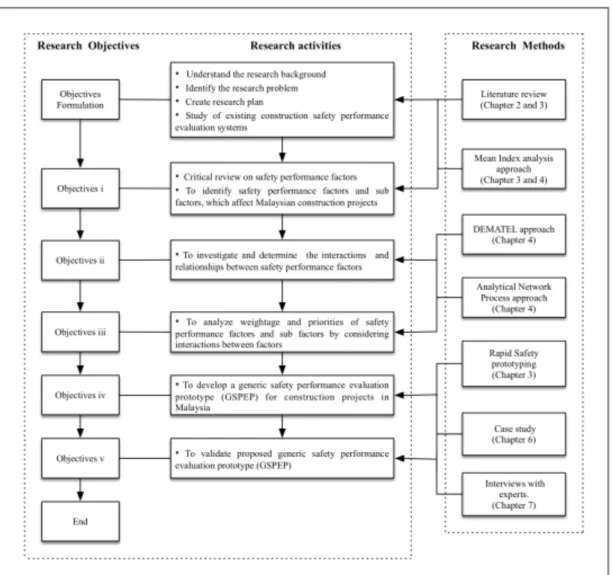
This thesis included of eight chapters and the following is a brief explanation for each chapter. A framework regarding objectives and research methodologies is shown in Figure 1.3.
Figure 1.3: Research Objectives and Methodologies
Chapter 1 Introduction: This chapter presents a research background and states the problem of research. It also includes the aim and objectives of the research, significance of study, scope of study, research methodology, research questions and a brief summary of thesis structure.
13 Chapter 2 Literature Review: This chapter starts with presenting different accident causation models. It also discusses the importance of workplace safety and the causes of construction accident. In the following, this chapter looks into safety and health in Malaysian construction industry and provides a critical review of current construction safety performance evaluation methods. Lastly, this chapter discusses the theoretical development of research.
Chapter 3 Safety Performance Factors: This chapter provides an extensive literature review to extract the construction safety factors and sub factors for development of generic safety performance evaluation prototype.
Chapter 4 Research Methodology: This chapter present the methodologies applied in the study according to the objectives. It also looks into research instruments, sampling method, reliability and validity tests. In the following, this chapter discusses the process of data collection and data analysis techniques (i.e. Mean Index Analysis, Decision-Making Trial and Evaluation Laboratory and Analytical Network Process). In addition, the rapid prototyping method for GSPEP development and process of GSPEP evaluation was explained. Lastly, a research framework was demonstrated to highlight the steps to be taken in order to achieve the research aim and objectives.
Chapter 5 Data analysis and discussions: This chapter discusses the different sections of the data collection and analysis process. It includes three sections i.e. section A: Determination of safety performance factors and sub-factors, Section B: Development of decision model and investigate interactions between safety performance factors and Section C: Analysis of weightage and priorities of the safety performance factor and sub factors.
Chapter 6 Development and implementation of GSPEP: This chapter describes in detail the steps of GSPEP development through rapid prototyping method. It also discusses the implementation of GSPEP in real cases and demonstrates the results analyzed by the prototype for the case study.
14 Chapter 7 Evaluation of GSPEP: This chapter presents the process of GSPEP evaluation. It also discusses the analysis of evaluation results according to the questionnaires answered by the experts. Lastly, the limitation and benefits of GSPEP are discussed.
Chapter 8 Conclusion and Recommendations: This chapter provides the summary and conclusion of this thesis. It also indicates the extent to which objectives of study have been achieved. Lastly, it discusses research findings and provides recommendations for future research.
REFERENCES
Abdelhamid, T. S. and Everett, J. G. (2000). Identifying root causes of construction accidents. Journal of Construction Engineering and Management. 126 (1): 52-60.
Abdul-Aziz, A.-R. and Kassim, P. J. (2011). Objectives, success and failure factors of housing public–private partnerships in Malaysia. Habitat International. 35 (1): 150-157.
Abdullah, A. (2003). Intelligent selection of demolition techniques. © Arham Abdullah
Abreu, P. E. N. M. d. (2013). An ANP model to support decision-making in a Portuguese pharmaceutical supply chain.
Abreu, P. E. N. M. d. (2013). An ANP model to support decision-making in a Portuguese pharmaceutical supply chain.
Abudayyeh, O., Fredericks, T. K., Butt, S. E. and Shaar, A. (2006). An investigation of management’s commitment to construction safety. International Journal of Project Management. 24 (2): 167-174.
Agarwal, A., Shankar, R. and Tiwari, M. (2007). Modeling agility of supply chain. Industrial Marketing Management. 36 (4): 443-457.
Ahmad, R. K. (2000). Developing a proactive safety performance measurement tool (SPMT) for construction sites. © Kunju Ahmad R.
Aksorn, T. and Hadikusumo, B. (2008). Critical success factors influencing safety program performance in Thai construction projects. Safety Science. 46 (4): 709-727.
Al Haadir, S. and Panuwatwanich, K. (2011). Critical success factors for safety program implementation among construction companies in Saudi Arabia. Procedia Engineering. 14: 148-155.
186 Al-Rafati, M. H. (2008). The Use of Analytic Hierarchy Process in Supplier Selection: Vendors of Photocopying Machines to Palestinian Ministry of Finance as a Case Study. The Islamic University-Gaza
Alawamleh, M. J. A. (2010). Collaboration Risk Evaluation and Management for Small and Medium Size Enterprises in Virtual Organisations.
Almulhim, T. S. M. (2014). Development of a hybrid fuzzy multi-criteria decision making model for selection of group health insurance plans. University of Manchester
Alphonce, C. B. (1997). Application of the analytic hierarchy process in agriculture in developing countries. Agricultural systems. 53 (1): 97-112.
Alpmen, A. S. (2013). Development and implementation of a proactive safety performance evaluation system for general contractors.
Alzahrani, J. I. and Emsley, M. W. (2013). The impact of contractors’ attributes on construction project success: A post construction evaluation. International Journal of Project Management. 31 (2): 313-322.
Anaman, K. A. and Osei‐Amponsah, C. (2007). Analysis of the causality links between the growth of the construction industry and the growth of the macro‐ economy in Ghana. Construction Management and Economics. 25 (9): 951-961.
Ananda, J. and Herath, G. (2003). The use of Analytic Hierarchy Process to incorporate stakeholder preferences into regional forest planning. Forest policy and economics. 5 (1): 13-26.
Antillon, E. I., Alarcón, L. F., Hallowell, M. R. and Molenaar, K. R. (2010). A research synthesis on the interface between lean construction and safety management. Masters Abstracts International.
Anumba, C., Marino, B., Gottfried, A. and Egbu, C. (2004). Health and safety in refurbishment involving demolition and structural instability. HSE Books. Aragonés-Beltrán, P., Aznar, J., Ferrís-Oñate, J. and García-Melón, M. (2008).
Valuation of urban industrial land: An analytic network process approach. European Journal of Operational Research. 185 (1): 322-339.
187 Assaf, S. A., Al-Khalil, M. and Al-Hazmi, M. (1995). Causes of delay in large building construction projects. Journal of management in engineering. 11 (2): 45-50.
Babbie, E. and Rubin, A. (1997). Research methods for social work, New York: Longman Publishers.
Bakri, A., Mohd Zin, R., Misnan, M. S. and Mohammed, A. H. (2006). Occupational Safety and Health (OSH) management systems: towards development of safety and health culture.
Bashir, A. M. (2013). A framework for utilising lean construction strategies to promote safety on construction sites.
Baxendale, T. and Jones, O. (2000). Construction design and management safety regulations in practice—progress on implementation. International Journal of Project Management. 18 (1): 33-40.
Bayazit, O. and Karpak, B. (2007). An analytical network process-based framework for successful total quality management (TQM): An assessment of Turkish manufacturing industry readiness. International Journal of Production Economics. 105 (1): 79-96.
Bellamy, L., Geyer, T. and Williams, J. (1992). Organisational, Management and HumanFactors in Quantified Risk Assessment: Report 1. HM Stationery Office.
Bello, M. A. (2012). Minimizing Impediments to Design for Construction Safety (DFCS) Implementation on Capital Projects. Carnegie Mellon University Bhagwat, R. and Sharma, M. K. (2007). Performance measurement of supply chain
management: A balanced scorecard approach. Computers & Industrial Engineering. 53 (1): 43-62.
Boud, D., Rooney, D. and Solomon, N. (2009). Talking up learning at work: Cautionary tales in co‐opting everyday learning. International Journal of Lifelong Education. 28 (3): 323-334.
188 Bu-Khamsin, M. A. S. (1999). Safety performance measuremnts: a PC-basd evaluation tool for industrial contractors in Saudi Arabia. King Fahd University of Petroleum and Minerals
Bu-Qammaz, A. S., Dikmen, I. and Birgonul, M. T. (2009). Risk assessment of international construction projects using the analytic network process. Canadian Journal of Civil Engineering. 36 (7): 1170-1181.
Cambraia, F. B., Saurin, T. A. and Formoso, C. T. (2010). Identification, analysis and dissemination of information on near misses: A case study in the construction industry. Safety Science. 48 (1): 91-99.
Cameron, I. and Duff, R. (2004). A Report on Research Investigating the Practical Usefulness of Current Fall Prevention and Protection Methods when Working at Heights. Construction Safety Management Systems: 332.
Chan, F. T. S. and Chan, H. (2004). Development of the supplier selection model—a case study in the advanced technology industry. Proceedings of the Institution of Mechanical Engineers, Part B: Journal of Engineering Manufacture. 218 (12): 1807-1824.
Chan, K. C. G. (2012). The use of virtual reality for visualizing construction safety management process. The Hong Kong Polytechnic University
Chand, N. B. (2011). Production efficiency of community forestry in Nepal: a stochastic frontier analysis. Lincoln University
Chang, B., Chang, C.-W. and Wu, C.-H. (2011). Fuzzy DEMATEL method for developing supplier selection criteria. Expert Systems with Applications. 38 (3): 1850-1858.
Cheng, E. W. and Li, H. (2001). Development of a conceptual model of construction partnering. Engineering Construction and Architectural Management. 8 (4): 292-303.
Cheng, E. W. and Li, H. (2002). Construction partnering process and associated critical success factors: quantitative investigation. Journal of management in engineering. 18 (4): 194-202.
Cheng, E. W. and Li, H. (2004). Contractor selection using the analytic network process. Construction management and Economics. 22 (10): 1021-1032.
189 Cheng, E. W., Li, H. and Yu, L. (2005). The analytic network process (ANP) approach to location selection: a shopping mall illustration. Construction Innovation. 5 (2): 83-97.
Cheung, F. K., Kuen, J. L. F. and Skitmore, M. (2002). Multi-criteria evaluation model for the selection of architectural consultants. Construction Management & Economics. 20 (7): 569-580.
Chi, C.-F., Chang, T.-C. and Ting, H.-I. (2005). Accident patterns and prevention measures for fatal occupational falls in the construction industry. Applied ergonomics. 36 (4): 391-400.
CIS. (2008). Safety Health Assessment System in Construction. CIDM Malaysia. Chong, H. Y. and Low, T. S. (2014). Accidents in Malaysian construction industry:
statistical data and court cases. International Journal of Occupational Safety and Ergonomics. 20 (3): 503-513.
Chow, L. J., Then, D. and Skitmore, M. (2005). Characteristics of teamwork in Singapore construction projects. Journal of Construction Research. 6 (01): 15-46.
Cohen, J. M. (2002). Measuring safety performance in construction. Occupational hazards. 64 (6): 41-48.
Cooper Ph. D, M. (2000). Towards a model of safety culture. Safety science. 36 (2): 111-136.
Crane, B. L. (2005). Steps To Effective Leadership-Five steps for motivating people. Fire Engineering. 158 (8): 89-94.
Dağdeviren, M., Yüksel, İ. and Kurt, M. (2008). A fuzzy analytic network process (ANP) model to identify faulty behavior risk (FBR) in work system. Safety Science. 46 (5): 771-783.
Darshi De Saram, D. and Tang, S. (2005). Pain and suffering costs of persons in construction accidents: Hong Kong experience. Construction management and economics. 23 (6): 645-658.
190 Davies, P. H. (2001). Spies as informants: triangulation and the interpretation of elite interview data in the study of the intelligence and security services. Politics. 21 (1): 73-80.
De Boer, L., Labro, E. and Morlacchi, P. (2001). A review of methods supporting supplier selection. European Journal of Purchasing & Supply Management. 7 (2): 75-89.
Demirkesen, S. and Arditi, D. (2015). Construction safety personnel's perceptions of safety training practices. International Journal of Project Management. Dikmen, I. and Birgonul, M. T. (2006). An analytic hierarchy process based model
for risk and opportunity assessment of international construction projects. Canadian Journal of Civil Engineering. 33 (1): 58-68.
Donaghy, R. (2009). One Death is Too Many: Inquiry Into the Underlying Causes of Construction Fatal Accidents: Rita Donaghy's Report to the Secretary of State for Work and Pensions.
DOSH (2015). Workers statistic Records. . D. o. O. S. a. H. Malaysia. Malaysia., dosh.
Duke, J. M. and Aull-Hyde, R. (2002). Identifying public preferences for land preservation using the analytic hierarchy process. Ecological Economics. 42 (1): 131-145.
Easterby-Smith, M., Thorpe, R. and Lowe, A. (1991). An Introduction to Management Research, Sage Publications, London.
Egbu, C. O. (1999). Skills, knowledge and competencies for managing construction refurbishment works. Construction Management & Economics. 17 (1): 29-43. El-Mashaleh, M. S., Al-Smadi, B. M., Hyari, K. H. and Rababeh, S. M. (2010a). Safety management in the Jordanian construction industry. Jordan Journal of Civil Engineering. 4 (1).
El-Mashaleh, M. S., Rababeh, S. M. and Hyari, K. H. (2010b). Utilizing data envelopment analysis to benchmark safety performance of construction contractors. International Journal of Project Management. 28 (1): 61-67.
191 Elbeltagi, E. and Hegazy, T. (2002). Incorporating safety into construction site management. First International Conference on Construction in the 21st Century. 25–26 April 2002, Miami, Florida, USA.
Elkan, C., Berenji, H., Chandrasekaran, B., De Silva, C., Attikiouzel, Y., Dubois, D., Prade, H., Smets, P., Freksa, C. and Garcia, O. (1994). The paradoxical success of fuzzy logic. IEEE expert. 9 (4): 3-49.
Enserink, B. (2001). Integral assessment—putting safety on the agenda for mitigation and preparedness. Safety science. 39 (1): 93-105.
Fang, D., Huang, X. and Hinze, J. (2004). Benchmarking studies on construction safety management in China. Journal of Construction Engineering and Management. 130 (3): 424-432.
Fang, D., Xie, F., Huang, X. and Li, H. (2004). Factor analysis-based studies on construction workplace safety management in China. International Journal of Project Management. 22 (1): 43-49.
Farooqui, R. U. (2011). Achieving Zero Accidents–A Strategic Framework for Continuous Safety Improvement in the Construction Industry.
Fellow, R. and Liu, A. (2003). Research methods for construction, Blackwell Publishing, Oxford.
Fellows, R. F. and Liu, A. M. (2015). Research methods for construction. John Wiley & Sons.
Feng, Y., Teo, E. A. L., Ling, F. Y. Y. and Low, S. P. (2014). Exploring the
interactive effects of safety investments, safety culture and project hazard on safety performance: An empirical analysis. International Journal of Project Management. 32 (6): 932-943.
Fernández-Muñiz, B., Montes-Peón, J. M. and Vázquez-Ordás, C. J. (2007). Safety management system: Development and validation of a multidimensional scale. Journal of Loss Prevention in the process Industries. 20 (1): 52-68. Findley, M., Smith, S., Kress, T., Petty, G. and Enoch, K. (2004). Injury & Cost
Control-Safety Program Elements in Construction: Which Ones Best Prevent Injuries, Control Costs? Construction remains the most dangerous of all US industries based on the rate of. Professional safety. 49 (2): 14-21.
192 Fong, P. S.-W. and Choi, S. K.-Y. (2000). Final contractor selection using the analytical hierarchy process. Construction Management & Economics. 18 (5): 547-557.
Fredericks, T. K., Abudayyeh, O., Choi, S. D., Wiersma, M. and Charles, M. (2005). Occupational injuries and fatalities in the roofing contracting industry.
Journal of Construction Engineering and Management. 131 (11): 1233-1240. Gambatese, J. (2000). Owner involvement in construction site safety. Proceedings of
the ASCE 2000 Construction Congress VI.
Gambatese, J. A., Behm, M. and Hinze, J. W. (2005). Viability of designing for construction worker safety. Journal of construction engineering and management. 131 (9): 1029-1036.
Gambatese, J. A., Hinze, J. W. and Haas, C. T. (1997). Tool to design for construction worker safety. Journal of Architectural Engineering. 3 (1): 32-41.
Geethan, K. A. V., Jose, S. and Chandra, C. (2011). Methodology for performance evaluation of reverse supply chain. International Journal of Engineering and Technology. 3 (3): 213-224.
Gencer, C. and Gürpinar, D. (2007). Analytic network process in supplier selection: A case study in an electronic firm. Applied Mathematical Modelling. 31 (11): 2475-2486.
Ghasemi, F., Mohammadfam, I., Soltanian, A. R., Mahmoudi, S. and Zarei, E. (2015). Surprising Incentive: An Instrument for Promoting Safety Performance of Construction Employees. Safety and Health at Work.
Glaser, B. (2002). Efficiency versus sustainability in dynamic decision making: advances in intertemporal compromising. Springer Science & Business Media.
Gordon, T. J. (1994). The delphi method. Futures research methodology. 2.
Grabowski, M., Ayyalasomayajula, P., Merrick, J. and Mccafferty, D. (2007). Accident precursors and safety nets: leading indicators of tanker operations safety. Maritime Policy & Management. 34 (5): 405-425.
193 Gunhan, S. and Arditi, D. (2005). Factors affecting international construction.
Journal of construction engineering and management.
Hanafin, S. (2004). Review of literature on the Delphi Technique. Dublin: National Children’s Office.
Hallowell, M. R. (2008). A formal model for construction safety and health risk management. ProQuest.
Hallowell, M. R. (2010). Risk-based framework for safety investment in construction organizations. Journal of Construction Engineering and Management.
Hallowell, M. R. (2011). Safety-knowledge management in American construction organizations. Journal of Management in Engineering. 28 (2): 203-211. Hallowell, M. R. and Gambatese, J. A. (2009). Construction safety risk mitigation.
Journal of Construction Engineering and Management. 135 (12): 1316-1323. Hallowell, M. R. and Gambatese, J. A. (2009). Construction safety risk mitigation.
Journal of Construction Engineering and Management. 135 (12): 1316-1323. Hallowell, M. R., Hinze, J. W., Baud, K. C. and Wehle, A. (2013). Proactive
construction safety control: measuring, monitoring, and responding to safety leading indicators. Journal of Construction Engineering and Management. 139 (10).
Hämäläinen, P., Takala, J. and Saarela, K. L. (2006). Global estimates of occupational accidents. Safety Science. 44 (2): 137-156.
Hammer, W. and Price, D. (2001). Occupational safety management and engineering. Pearson College Division.
Hansen, M. D. (2006). Management systems. Professional safety. 51 (10): 34.
Hasan, A. and Jha, K. N. (2013). Safety incentive and penalty provisions in Indian construction projects and their impact on safety performance. International journal of injury control and safety promotion. 20 (1): 3-12.
Haslam, R. A., Hide, S. A., Gibb, A. G., Gyi, D. E., Pavitt, T., Atkinson, S. and Duff, A. (2005). Contributing factors in construction accidents. Applied Ergonomics. 36 (4): 401-415.
194 Hassan, C., Basha, O. and Hanafi, W. (2007). Perception of building construction workers towards safety, health and environment. Journal of Engineering Science and technology. 2 (3): 271-279.
Heinrich, H. W., Petersen, D. and Roos, N. (1950). Industrial accident prevention. McGraw-Hill New York.
Herath, G. (2004). Incorporating community objectives in improved wetland management: the use of the analytic hierarchy process. Journal of environmental management. 70 (3): 263-273.
Herath, G. (2004). Incorporating community objectives in improved wetland management: the use of the analytic hierarchy process. Journal of Environmental Management. 70 (3): 263-273.
Hinze, J. (1978). Turnover, new workers, and safety. Journal of the Construction Division. 104 (4): 409-417.
Hinze, J. (2002a). Safety incentives: do they reduce injuries? Practice Periodical on Structural Design and Construction. 7 (2): 81-84.
Hinze, J. (2002b). Safety plus: Making zero accidents a reality. CII Research Rep: 160-111.
Hinze, J. and Gambatese, J. (2003). Factors that influence safety performance of specialty contractors. Journal of Construction Engineering And Management. 129 (2): 159-164.
Hinze, J. and Godfrey, R. (2003). An evaluation of safety performance measures for construction projects. Journal of Construction Research. 4 (01): 5-15.
Hinze, J., Devenport, J. N. and Giang, G. (2006). Analysis of construction worker injuries that do not result in lost time. Journal of Construction Engineering and Management. 132 (3): 321-326.
Hinze, J., Hallowell, M. and Baud, K. (2013a). Construction-safety best practices and relationships to safety performance. Journal of Construction Engineering and Management. 139 (10).
195 Hinze, J., Hallowell, M. and Baud, K. (2013b). Construction-safety best practices and relationships to safety performance. Journal of Construction Engineering and Management. 139 (10): 04013006.
Hinze, J., Thurman, S. and Wehle, A. (2013). Leading indicators of construction safety performance. Safety science. 51 (1): 23-28.
Hislop, R. D. (1999). Construction site safety: a guide for managing contractors. CRC Press.
Hoonakker, P., Loushine, T., Carayon, P., Kallman, J., Kapp, A. and Smith, M. J. (2005). The effect of safety initiatives on safety performance: A longitudinal study. Applied Ergonomics. 36 (4): 461-469.
Huang, J.-J., Tzeng, G.-H. and Ong, C.-S. (2005). Multidimensional data in multidimensional scaling using the analytic network process. Pattern Recognition Letters. 26 (6): 755-767.
Huang, R.-H., Yang, C.-L., Lin, C.-C. and Cheng, Y.-J. (2012). Performance evaluation model for reverse logistics-the case of recycled computers. Journal of Statistics and Management Systems. 15 (2-3): 323-343.
Huang, W., Luukkanen, O., Johanson, S., Kaarakka, V., Räisänen, S. and Vihemäki, H. (2002). Agroforestry for biodiversity conservation of nature reserves: functional group identification and analysis. Agroforestry systems. 55 (1): 65-72.
Huang, X. and Hinze, J. (2003). Analysis of construction worker fall accidents. Journal of Construction Engineering and Management. 129 (3): 262-271. Huang, X. and Hinze, J. (2006). Owner’s role in construction safety. Journal of
construction engineering and management.
Hughes, P. and Ferrelt, E. (2008). Introduction To Health And Safety In Construction Industry, Butterworth-Heinemann, Imprint of Elsevier, USA.
Hussey, J. and Hussey, R. (1997). Business research. A practical guide for undergraduate and postgraduate students. Houndsmills: Macmillan.
196 Hwa Hsu, S. and Lee, C.-C. (2012). Safety management in a relationship-oriented culture. International Journal of Occupational Safety and Ergonomics. 18 (1): 35-45.
Ilias, S., SHAFIEI, M. W. M. and OMRAN, A. The Roles Of Clients In Enhancing Construction Safety.
Im, H.-J., Kwon, Y.-J., Kim, S.-G., Kim, Y.-K., Ju, Y.-S. and Lee, H.-P. (2009). The characteristics of fatal occupational injuries in Korea’s construction industry, 1997–2004. Safety Science. 47 (8): 1159-1162.
Ismail, F., Ahmad, N., Janipha, N. A. I. and Ismail, R. (2012). Assessing the Behavioural Factors’ of Safety Culture for the Malaysian Construction Companies. Procedia-Social and Behavioral Sciences. 36: 573-582.
Ismail, Z. and Somarin, S. D. Safety Management System; A Developed Measurement of Safety Factors in Construction Projects.
Ismail, Z., Doostdar, S. and Harun, Z. (2012). Factors influencing the implementation of a safety management system for construction sites. Safety Science. 50 (3): 418-423.
Jafri, H., Ali, M. W., Ahmad, A. and Kamsah, M. Z. (2005). Effective occupational health and safety performance measurements.
Jannadi, O. A. and Bu-Khamsin, M. S. (2002). Safety factors considered by industrial contractors in Saudi Arabia. Building and Environment. 37 (5): 539-547.
Jennings, G. (2001). Tourism research. John Wiley and sons Australia, Ltd. Kamar, I. M., Lop, N., Salleh, N. M., Mamter, S. and Suhaimi, H. (2014).
Contractor’s Awareness on Occupational Safety and Health (OSH)
Management Systems in Construction Industry. E3S Web of Conferences, EDP Sciences.
Kangas, J. and Kuusipalo, J. (1993). Integrating biodiversity into forest management planning and decision-making. Forest Ecology and Management. 61 (1): 1-15.