PRODUCTION, PURIFICATION AND BIOCHARACTERIZATION OF XYLANASE FROM
1Chemistry Department, Faculty of Sciences and Arts, University of Jeddah, Khulais, P.O. Box 355, Khulais, 21921, Saudi Arabia 2Chemistry Department, Faculty of Applied Science, Taiz University, Taiz, Yemen
ARTICLE INFO ABSTRACT
The current study describes the purify and characterize xylanase from (Xy1a) was purified to homogeneity 47.6
estimated by gel filtration was once 20 kDa with 24.7% recovery. SDS-PAGE and a single band was observed.
and at
higher affinity for Birchwood xyla respectively. Metallic cations, such as Ca the purified Xy1a, while Cu
cations, such as Hg
it could be confirmed that the purified enzyme has potential role in some application such as the food, feed, pharmaceutical and paper industries.
Copyright©2019, Yaaser Almulaiky. This is an open access distribution, and reproduction in any medium, provided
INTRODUCTION
Plant biomass should be investigated as a noteworthy wellspring of segments that can be changed over into items utilized in mechanical preparing. It is the most plenteous inexhaustible wellspring of vitality and for the most part comprises of lignocellulose, the muddled heterogeneous complex made up of hemicellulose, lignin and cellulose et al., 2012). As of late, analysts have concentrated on creating distinctive imaginative advancements to change over lignocellulosic materials into valuable mechanical items (Thanaporn et al., 2015). The lignocellulosic materials and their proficient biodegradation are among the best zones of enthusiasm for scientists because of their potential application in mechanical exercises (Govumoni et al.,
them, the real part of hemicellulose, xylan has a high capacity for change to pertinent items. Xylanase is the class of catalysts produced by microorganisms which break down hemicellulose. Hemicellulose comprises of polymer glucose known as xy and after cellulose, xylan was second most copious sustainable biomass present on earth after. Xylanases (3.2.1.8) catalyze the breakdown of xylan into xylooligosaccharides and D
Xylan is a heterogeneous polysaccharide and comprises of a direct backbone of β-1, 4-D-xylopyranoside buildups and quick side-chain branches (Thmoas et al.,
application in one-of-a-kind sectors has improved markedly in the past decade. Due to its hydrolysis and different properties,
ISSN: 0975-833X
Article History: Received 16th May, 2019 Received in revised form 14th June, 2019
Accepted 10th July, 2019
Published online 31st August, 2019
Citation: Yaaser Q. Almulaiky, 2019. “Production, purification and biocharacterization of xylanase from Trichoderma virens
Current Research, 11, (08), .6306-6310. Key Words:
Xylanase, Trichoderma Virens, Solid-State Fermentation, Purification.
*Corresponding author:
Yaaser Q. Almulaiky
RESEARCH ARTICLE
PRODUCTION, PURIFICATION AND BIOCHARACTERIZATION OF XYLANASE FROM
TRICHODERMA VIRENS
1, 2, *
Yaaser Q. Almulaiky
Sciences and Arts, University of Jeddah, Khulais, P.O. Box 355, Khulais, 21921, Saudi Arabia Chemistry Department, Faculty of Applied Science, Taiz University, Taiz, Yemen
ABSTRACT
The current study describes the purify and characterize xylanase from (Xy1a) was purified to homogeneity 47.6-fold via sephacryl S-estimated by gel filtration was once 20 kDa with 24.7% recovery.
PAGE and a single band was observed. The highest activity of the Xy1a was observed at and at temperature 50°C. The Xy1a enzyme was very stable up to 50
higher affinity for Birchwood xylan with Km and Vmax of 5.83 mg/ml and 0.575µmol min respectively. Metallic cations, such as Ca2+ and Ni2+ were found to enhance the enzymatic activity of
the purified Xy1a, while Cu2+, Co2+, Pb2+and Zn2+ ions were found to be partially inhibitory. cations, such as Hg2+ and Cd2+ were found to be strongly inhibited the enzyme. Based on the results, it could be confirmed that the purified enzyme has potential role in some application such as the food, feed, pharmaceutical and paper industries.
access article distributed under the Creative Commons Attribution the original work is properly cited.
Plant biomass should be investigated as a noteworthy wellspring of segments that can be changed over into items utilized in mechanical preparing. It is the most plenteous inexhaustible wellspring of vitality and for the most part of lignocellulose, the muddled heterogeneous complex made up of hemicellulose, lignin and cellulose (Tuck . As of late, analysts have concentrated on creating distinctive imaginative advancements to change over valuable mechanical items . The lignocellulosic materials and their proficient biodegradation are among the best zones of enthusiasm for scientists because of their potential application et al., 2013). Among them, the real part of hemicellulose, xylan has a high capacity for change to pertinent items. Xylanase is the class of catalysts produced by microorganisms which break down hemicellulose. Hemicellulose comprises of polymer glucose known as xylan and after cellulose, xylan was second most copious sustainable biomass present on earth after. Xylanases (3.2.1.8) catalyze the breakdown of xylan into xylooligosaccharides and D-xylose. Xylan is a heterogeneous polysaccharide and comprises of a xylopyranoside buildups and et al., 2015). Xylanases kind sectors has improved markedly in the past decade. Due to its hydrolysis and different properties,
Xylanases are broadly used in many industrials such as and paper, food, textiles, bio
(Bajpai, 1999). Recently Awalgonkar
xylanase additionally aid pleasant of papads, an Indian usual food based on black gram
Xylanases for industrial use are produced mostly from filamentous fungi (Sunna et al.,
al., 2010) in solid state fermentation (SSF) or submerged fermentation (SmF). The current finds out about descr
production, purification and biochemical characterization of xylanase with the aid of Trichoderma virens
fermentation.
METHOD AND MATERIALS
Chemicals: Birchwood xylan, oat spelts xylan, xylose and
dinitrosalicylic acid were acquired from Sigma Chemicals. Other chemicals for column chromatography and electrophoresis were obtained from Amersham Pharmacia Biotech.
Microorganisms: Trichoderma virens
Plant Pathology Unit, National Research Centre, Cairo, Egypt.
Solid-state fermentation: Ten gm of citrus orange strip was
utilized to develop Trichoderma virens
Two ml of spore suspension was utilized to inoculate International Journal of Current Research
Vol. 11, Issue, 08, pp.6306-6310, August, 2019
DOI: https://doi.org/10.24941/ijcr.36118.08.2019
Production, purification and biocharacterization of xylanase from Trichoderma virens
PRODUCTION, PURIFICATION AND BIOCHARACTERIZATION OF XYLANASE FROM
Sciences and Arts, University of Jeddah, Khulais, P.O. Box 355, Khulais, 21921, Saudi Arabia Chemistry Department, Faculty of Applied Science, Taiz University, Taiz, Yemen
The current study describes the purify and characterize xylanase from Trichoderma virens. Xylanase -200. The molecular mass of Xy1a estimated by gel filtration was once 20 kDa with 24.7% recovery. Purity was proven by means of The highest activity of the Xy1a was observed at pH 5.5 . The Xy1a enzyme was very stable up to 50°C. The purified xy1a showed n with Km and Vmax of 5.83 mg/ml and 0.575µmol min-1 mg-1, were found to enhance the enzymatic activity of ions were found to be partially inhibitory. Metallic were found to be strongly inhibited the enzyme. Based on the results, it could be confirmed that the purified enzyme has potential role in some application such as the food,
License, which permits unrestricted use,
broadly used in many industrials such as –pulp and paper, food, textiles, bio-fuel, animal feed and drinks . Recently Awalgonkar et al. mentioned that xylanase additionally aid pleasant of papads, an Indian usual food based on black gram (Awalgaonkar et al., 2016). Xylanases for industrial use are produced mostly from et al., 2007) and bacteria (Bajaj et in solid state fermentation (SSF) or submerged fermentation (SmF). The current finds out about describes the production, purification and biochemical characterization of Trichoderma virens using solid-state
METHOD AND MATERIALS
Birchwood xylan, oat spelts xylan, xylose and acquired from Sigma Chemicals. Other chemicals for column chromatography and electrophoresis were obtained from Amersham Pharmacia
Trichoderma virens was provided from Plant Pathology Unit, National Research Centre, Cairo, Egypt.
Ten gm of citrus orange strip was Trichoderma virens for 7 days at 28 °C. Two ml of spore suspension was utilized to inoculate
INTERNATIONAL JOURNAL OF CURRENT RESEARCH
Erlenmeyer flasks (25 ml). The flask was aseptically vaccinated with 2 ml of spore suspension of T. virens. On revolving shaker, the cultures were incubating at 28°C at 150 rpm for 7 days.
Purification of T. virens xylanase: Ion exchange
chromatography was performed using DEAE-Sepharose column at a 0.5 ml/min flow rate with 20 mM Tris-HCl buffer, pH 7.2. the elution enzyme was done with a 0.0–3 M NaCl stepwise gradient in the same buffer. The eluted fractions were assayed for enzyme activity and protein concentration. The eluted fractions exhibiting high xylanase activity were pooled. Xylanase (Xy1) was concentrated through dialysis against solid sucrose and was loaded into a Sephacryl S-200 column with 20 mM Tris-HCl buffer, pH 7.2 at 30 ml/h flow rate. The active fractions were pooled and used for the characterization experiments.
Xylanase assay: Xylanase activity was estimated by deciding
the liberated reducing end products using xylose as standards (Miller, 1959). The reaction mixture containing 0.5ml: 125 µl Birchwood xylan (1%), 250 µl of 200mM acetate buffer (pH 5.5) and an amount of crude extract. The assay was completed at 37 °C for 1 h. At that point 0.5 ml dinitrosalicylic acid reagent was included and warmed in a bubbling water bath for 10 min. The absorbance was estimated at 560 nm. One unit of xylanase activity was determined as the measure of compound which freed 1 μmol of xylose for every min under standard examine conditions.
Protein determination: Bradford method was used to
determine the protein (Bradford, 1976), bovine serum albumin (BSA) was used as a standard.
Molecular weight determination: To determine the
molecular weight, gel filtration technique using a Sephacryl S-200 and SDS-PAGE were employed as described by Laemmli (Laemmli, 1970).
Characterization of xylanase
pH optimum: The activity of xylanase was determined using
different pH buffers as follow: sodium acetate (pH 4.0 - 6.0) and Tris-HCl (6.5 - 9) at 50 mM. The maximum activity was taken as 100% and % relative activity was plotted against different pH values.
Temperature optimum: At temperature range of 30-80 °C,
the activity of xylanase was investigated. 100% is the maximum activity which was being taken.
Thermal stability: The enzyme was incubated at a
temperature range of 30- 80°C for 15 min prior to Birchwood xylan addition. The % relative activity was plotted against different temperatures.
Kinetic constant (Km): The Km values were determined from
Lineweaver-Burk plots by using Birchwood xylan and oat spelts xylan concentrations.
Effect of metal ions: The enzyme before the addition of the
Birchwood xylan substrate was incubated with 2 and 5 mM solution of different metal ions for 15 min. 100% has been taken as an enzyme activity without metal ion. The relative
enzyme activity in the presence of each metal ion was determined.
RESULT AND DISSECTION
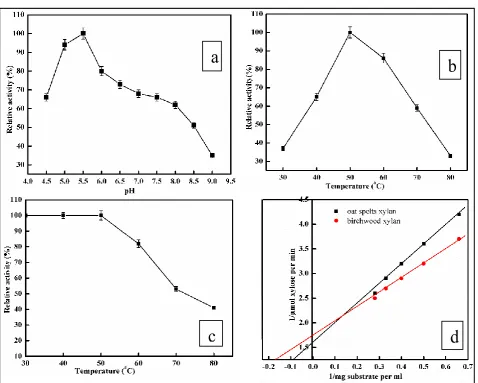
The various enzymes production and secondary metabolites can be made by fermentation on a solid substrate (SSF). The benefits of the procedure are plant material usage with at the same time high production of the ideal item or gathering of items. In our investigation, we utilized citrus orange strips as a development medium. Expansive amounts of citrus strips stay from the generation of juices, purees and sticks. As indicated by Marin (Marin et al., 2007), the strips of ready orange natural products principally are involved in 37.08% of cellulose, 23.02% gelatin, 11.04% hemicellulose, 9.75% free sugars and 9.06% protein, in view of dry weight. The purification scheme is summarized in Table 1. DEAE-Sepharose chromatography of xylanases from T. virens separated five isoenzymes (Xy1, Xy2, Xy3, Xy4 and Xy5 with specific activities 843.8, 122.7, 56.7, 38.6 and 20 units /mg protein, respectively) (Figure 1). The Xy1 isoenzyme showing maximum activity was concentrated by sucrose, loaded on a Sephacryl S-200 gel filtration column, pre-equilibrated with 20 mM Tris-HCl buffer (pH 7.2). The final Xy1a obtained (Figure 2a) showed a single peak with the highest specific activity of 2633 units /mg protein, 46.5-fold purification and 24.7% recovery (Table 1). Many research of xylanase purification with specific activities had been also separated from special organisms, Aspergillus tamarii Kita (specific activities 1215 units /mg protein with 7.43 fold) (Heinen et al., 2018), Aspergillus niger SCTCC 400264 (xynB with specific activities 1201.7 units/mg protein) (Yi et al., 2010) and A. niger GS1 (specific activities 522 units/mg protein) (Amaro-Reyes et al., 2011). The purified xylanase (Xy1a) confirmed a single band of protein using SDS-PAGE, in addition, the molecular weight was decided to be 20 kDa the usage of Sephacryl S-200 column (Figure 2a and b). A similar result was bought for the xylanase from Aspergillus tamarii Kita (19.5 kDa) (Heinen et al., 2018), Aspergillus terreus NRRL1960 (19.0 kDa) (Kocabas et al., 2011) and Scytalidium thermophilum ATCC No. 16454 (21 kDa) (Kocabas et al., 2015). The outcomes have proven in Fig. 3a current that the purified Xy1a enzyme has maximum activity at pH 5.5. quite a few research stated that many xylanases from microorganism had an optimum pH ranging from 5 and 8. A similar result was once said for xylanase produced with the aid of Aspergillus tamarii Kita and Aspergillus kawachii, which showed optimal activity at pH 5.5 (Heinen et al., 2018; Ito et al., 1992).
Table 1. Purification scheme for T. virens xylanase
Recovery 100% Fold purification
S.A Unit/mg protein T. Protein mg
T. units* Steps
100 1
56.6 11.3
640 Crude extract
42.2 14.9
843.8 0.32
270
Chromatography DEAE-sepharose
0.0 M NaCl (Xy1)
14.4 2.17
122.7 0.75
92 0.05M NaCl (Xy 2)
10.6 1.00
56.7 1.2
68 0.1M NaCl (Xy 3)
8.4 0.68
38.6 1.4
54 0.2M NaCl (Xy 4)
5.9 0.35
20 1.9
38 0.3M NaCl (Xy 5)
Gel filtration on sephacryl S-200
24.7 46.5
2633 0.06
158 Xy 1a
* One unit of enzyme activity was defined as the amount of enzyme which liberated 1 μmol of xylose per minute under standard assay conditions.
Table 2. Effect of metallic cationsand EDTA on the activity of purified Xy1a
5 mM 2 mM
Effect of metals
Relative activity (%)
100 100
Control
111 98
Ca2+
123 102
Ni2+
63 75
Pb2+
73 81
Co2+
17 45
Hg2+
80 96
Cu2+
59 87
Zn2+
32 51
Cd2+
89 93
[image:3.595.174.421.213.522.2]EDTA
Figure 1. A typical elution profile for the chromatography of xylanase using a DEAE-Sepharose column
Figure 2. Gel filtration of Xy1a DEAE-Sepharose fractions using a Sephacryl S-200 column (A), SDS-PAGE for homogeneity and molecular weight determination of Xy1a (B)
A
[image:3.595.76.521.549.765.2]The Vmax values for the hydrolysis of these substrates found 0.627 and 0.575µmol min-1 mg-1, respectively. The Km values indicated that the purified enzyme had greater affinity for birchwood than for oat spelts xylan. Silva et al. said that the two xylanase enzyme of Trichoderma inhamatum expressed the Km values of 1.6 and 14.5 mg/ml for xylanase I the usage of birchwood xylan and oat spelt xylan, respectively, whereas the Km values of xylanase II for these substrates had been 4 and 10.7 mg/ml (Silva et al., 2015). Another study revealed that the Km values of Penicillium sclerotiorum xylanase using oat spelt xylan and birchwood xylan had been 2.6 and 6.5 mg/ml, respectively (Knob and Carmona, 2010). The impact of unique metal cations at 2 and 5 mM on the activity of the purified xylanase Xy1a from T. virens is introduced in Table 2. These metal cations confirmed activation and/or partial/strong inhibition outcomes on the xylanase Xy1a activity. At the attention of 5 mM, the metal cations (Cu2+, Co2+, Pb2+and Zn2+) presented a partial inhibitory effect on xylanase, while Hg2+ and Cd2+ were a sturdy inhibitor of the xylanase even at 2mM. The inhibition with the aid of Hg2+ appears to be a common feature of xylanases, showing the presence of cysteine thiol groups near or in the active site of the enzyme (Lappalainen et al., 2000). Activation impact was found via Ni2+ and Ca2+ at 5 mM with improvement in activity by way of 23 and 11%, respectively. EDTA at both concentrations shown slightly lowered the activity of purified enzyme. The impact of EDTA on enzyme recommends that they may require divalent ion for catalysis. Similarly, EDTA had no impact on the xylanase activity from A. niger (Naganagouda et al., 2009).
In addition, metallic cations, such as (Co2+, Cu2+, Hg2+, Pb2+and Zn2+) have been stated to have inhibitory effect on xylanase from Aspergillus tamarii Kita, which was once activated by Ca2+ and Ni2+. A Talaromyces thermophilus Xylanase was once activated by using Co2+, and Cu2+, and inhibited by using Hg2+, Ba2+, and Mn2+ (Maalej et al., 2008).
Conclusion
This is the first file about two-step chromatography purification of Trichoderma virens xylanase consisting of anion exchange and gel filtration. This is the first report about the usage of solid state fermentation to produced xylanase by T. virens. T. virens xylanase produced via SSF showed that the highest activity reached 2633 unit/mg protein. Biochemical characteristics of the purified Xy1a defined that it works at an excessive optimum temperature and prefers acidic conditions, and thermo stability at multiplied temperature are fabulous for industrial application. Moreover, the low molecular weight of the enzyme presents an extra benefit of its handy penetration into the lignocellulosic shape and efficient degradation of xylan.
Acknowledgements
Not Applicable.
Competing interests
[image:4.595.61.540.51.434.2]The author declares that he has no competing interests.
Figure 3. Optimum pH (a), effect of temperature on activity (b), the thermal stability (c), Kinetics parameters (Km) (d) of purified Xy1a
a
b
REFERENCES
Amaro-Reyes A, Garcia-Almendarez BE, Vazquez-Mandujano DG, Amaya-Llano S, Castano-Tostado E, Guevara-Gonzalez RG, Loera O, Regalado C. 2011. Homologue expression of a fungal endo-1,4-β-D-xylanase using submerged and solid substrate fermentations, Afr. J. Biotechnol., 10: 1760-1767.
Awalgaonkar G, Sarkar S, Bankar S and Singhal R S. 2016. Xylanase as a processing aid for papads, an Indian traditional food based on black gram. Food Sci. Technol., 62, 1148-1153.
Bajaj B K and Singh N P. 2010. Production of xylanase from analkali tolerant Streptomyces sp.7bunder solid-state fermentation, its purification, and characterization. App. Biochem. Biotechnol., 162, 1804-1818.
Bajpai P. 1999. Application of enzymes in the pulp and paper industry. Biotechnol. Progress, 15, 147–157.
Bradford MM. 1976. A rapid and sensitive method for the quantitation of microgram quantities of protein using the principle of protein-dye binding. Anal Biochem, 72: 248– 54.
Chen, L.L., Zhang, M., Zhang, D.H., Chen, X.L., Sun, C.Y., Zhou, B.C. et al. 2009. Purification and enzymatic characterization of two β-endoxylanases from Trichoderma sp. K9301 and their actions in xylooligosaccharide production. Bioresour Technol., 100: 5230–6. http://dx.doi. org/10.1016/j.biortech.2009.05.038.
Govumoni, S. P., Koti, S., Kothagouni, S. Y., Venkateshwar, S., and Linga, V. R. 2013. Evaluation of pretreatment methods for enzymatic saccharification of wheat straw for bioethanol production. Carbohydr. Polym., 91, 646–650. doi: 10.1016/j.carbpol.2012.08.019
Heinen, P. R., Bauermeister, A., Ribeiro, L. F., Messias, J. M., Almeida, P. Z., Moraes, L. A. B. and Jorge, J. A. 2018. GH11 xylanase from Aspergillus tamarii Kita: Purification by one-step chromatography and xylooligosaccharides hydrolysis monitored in real-time by mass spectrometry. International Journal of Biological Macromolecules, 108, 291-299.
Ito K., Ogasawara H., Sugimoto T., Ishikawa, T. 1992. Purification and properties ofacid stable xylanases from Aspergillus kawachii, Biosci. Biotechnol. Biochem., 56; 547–550.
Knob, A., Carmona, E.C. 2010. Purification and characterization of two extracellular xylanases from Penicillium sclerotiorum: A novel acidophilic xylanase. Appl. Biochem.
Kocabas A. , D.S. Kocabas, U.B. Bolukbasi, 2011. One-step purification and characterization of a low molecular weight xylanase from Aspergillus terreus NRRL 1960, J. Appl. Environ. Biol. Sci., 5 pp. 61-65
Kocabas, D.S., Güderb, S. and Özben, N. 2015. Purification strategies and properties of a low-molecular weight xylanase and its application in agricultural waste biomass hydrolysis, Journal of Molecular Catalysis B: Enzymatic, 115; 66–75
Laemmli UK. 1970. Cleavage of structural proteins during the assembly of the head bacteriophage T4. Nature. 227:680–5. Lappalainen, A., Siika-Aho, M., Kalkkinen, N., Fegerström, R., Tenkanen, M. 2000. Endoxylanase II from Trichoderma reesei has several isoforms with different isoelectric points. Biotechnol Appl Biochem., 31:61–8. http://dx.doi.org/10. 1042/BA19990066. Biotechnol., 162: 429-443.
Maalej, I., Belhaj, I., Masmoudi, N. Belghith, H. 2008. Highly Thermostable Xylanase of the Thermophilic Fungus Talaromyces thermophilus: Purification and Characterization. Appl. Biochem. Biotechnol., 158: 200-212.
Marin FR, Soler-Rivas C, Benavente-Garcıa O, Castillo J, Perez-Alvarez J. 2007. By-products from different citrus processes as a source of customized functional fibers. Food Chem 100: 736–741. DOI: 10.1016/j.foodchem.2005. 04.040.
Miller, G.L. 1959. Use of dinitrosalicylic acid reagent for the determination of reducing sugar. Anal. Chem., 31, 426– 429.
Naganagouda K, Salimath PV, Mulimani VH. 2009. Purification and characterization of endo-beta-1,4 mannanase from Aspergillus niger gr for application in food processing industry. J. Microbiol. Biotechnol., 10: 1184-1190.
Silva, L.A.O., César Rafael Fanchini Terrasan, Eleonora Cano Carmona, 2015. Purification and characterization of xylanases from Trichoderma inhamatum, Electronic Journal of Biotechnology, 18: 307–313.
Silveira, F.Q.P., Sousa, M.V., Ricart, C.A.O., Milagres, A.M.F., Medeiros, C.L., Filho, E.X.F. 1999. A new xylanase from a Trichoderma harzianum strain. J Ind Microbiol Biotechnol., 23: 682–5. http://dx.doi.org/10. 1038/sj.jim.2900682.
Sunna A, Antranikian G. 1997. Xylanolytic enzymes from fungi and bacteria. Cri. Rev. Biotechnol., 17, 39-67. Thanaporn, L., Benjarat, B., Surisa, S., Lily, E., and Verawat,
C. 2015. Synergistic action of recombinant accessory hemicellulolytic and pectinolytic enzymes to Trichoderma reesei cellulase on rice straw degradation. Bioresour. Technol., 198, 682–690. doi: 10.1016/j.biortech.2015.09. 053
Thmoas, L., Ushasree, M. V. and Pandey, A. 2015. An alkali thermo stable xylanase from Bacillus pumilus functionally expressed in Kluyveromyces lactis and evaluation of its deinking efficiency. Biores. Technol., 65, 309-313.
Tuck, C. O., Perez, E., Horvath, I. T., Sheldon, R. A., and Poliakoff, M. 2012. Valorization of biomass: deriving more value from waste. Science, 337, 695–699. doi: 10.1126/ science.1218930
Yi X, Shi Y, Xu H, Li W, Xie J, Yu R, Zhu J, Cao Y, Qiao D. 2010. Hyper expression of two aspergillus niger xylanase genes in Escherichia coli and characterization of the gene products. Braz. J. Microbiol., 41: 778-786.