Any correspondence concerning this service should be sent
to the repository administrator:
[email protected]
This is an author’s version published in:
http://oatao.univ-toulouse.fr/25022
To cite this version: Washha, Mahdi and Qaroush, Aziz and
Mezghani, Manel and Sèdes, Florence Unsupervised Collective-based
Framework for Dynamic Retraining of Supervised Real-Time Spam
Tweets Detection Model. (2019) Expert systems with Applications, 135.
129-152. ISSN 0957-4174
Official URL
DOI :
https://doi.org/10.1016/j.eswa.2019.05.052
Open Archive Toulouse Archive Ouverte
OATAO is an open access repository that collects the work of Toulouse
researchers and makes it freely available over the web where possible
Unsupervise d collective-base d framework for dynamic retraining
of
supervised real-time spam tweets detection model
Mahdi
Washha
a, ∗,
Aziz
Qaroush
b,
Manel
Mezghani
a,
Florence
Sedes
aaIRIT, University of Toulouse, CNRS, INPT, UPS, UT1, UT2J, France
bDepartment of Electrical and Computer Engineering, Birzeit University, Ramallah, Palestine
Keywords: Twitter Real-time Spam Social spammers Twitter stream
a
b
s
t
r
a
c
t
Twitterisone ofthemostpopularsocialplatforms.Ithaschangedthewayofcommunicationand in-formationdissemination throughits real-timemessagingmechanism.Recently,ithasbeenused byre-searchersand industriesas anew sourceofdata forvariousintelligentsystems, suchastweetsentimentanalysisandrecommendationsystems, whichrequire highdataquality. However,duetoitsflexibilityand popularity,Twitterhasbecomethemain targetforspamming activitiessuchas phishing legitimateusersorspreadingmalicioussoftware,whichintroducesnewsecurityissuesand wasteresources.There-fore, researchershavedeveloped variousmachine-learningalgorithmstorevealTwitterspam.However,as spammershavebecome smarterand morecrafty,thecharacteristicsofthespamtweetsarevaryingovertimemakingthesemethodsinefficientto detectnew spammerstricksand strategies.Inaddition,someoftheemployed methods(e.g.blacklisting)orspammerfeatures (e.g.graph-basedfeatures)areextremelytime-consuming, whichhinderstheabilityto detectspammeractivitiesinreal-time.In thispaper,weintroduceaframeworktodealwiththevolatilityofthespamcontentsandnew spammingpatterns,calledthe spamdrift. Theframeworkcombinesthe strengthofunsupervisedmachinelearningapproach,whichlearnsfromunlabeled tweets,to retrainareal-timesupervisedtweet-levelspamdetec- tionmodel inabatch mode.Aset ofexperimentsona large-scaledatasetshowtheeffectivenessoftheproposedonline unsupervisedmethodinadaptivelydiscovers andlearns the patternsofnewspamactivitiesandachievestablerecall valuesreachingmorethan95%.Althoughtheaveragespamprecision ofourmethodisaround60%,thehighspamrecallvaluesshowtheabilityofourproposedmethodinreducingspamdrift problemscomparedtotraditional machinelearningalgorithms.
1. Introduction
The new great characteristics of Social Web that involve users as information producers have exposed different information qual- ity (IQ) problems ( Agarwal & Yiliyasi, 2010). For example, Twit- ter, which is the most popular microblogging sites, has a real-time messaging mechanism that makes it more popular and suitable for handling real-time public events and updates. In addition, due to its popularity, social-based researchers adopt it as a main source of information in performing their experiments on related re- search areas ( Abascal-Mena,Lema,&Sèdes,2015;Hoang&Mothe, 2016; Mezghani et al., 2015; Mezghani, Zayani, Amous, Péninou, & Sèdes, 2014; Zubiaga, Spina, Amigó,& Gonzalo,2012; Zubiaga, Spina, Fresno, & Martínez-Unanue,2011). However, the simplicity
∗ Corresponding author.
and flexibility of using these sites, and the absence of any effective restrictions on content posting action might be viewed as addi- tional challenges for having IQ issues. Indeed, social spam content, which is published by a well-known kind of ill-intentioned users, so-called social spammers, is one of the most common noises appearing on online social media (OSM) sites and is categorized under IQ problems. Social spammers intensively post nonsensical contents such as advertisements, porn materials, viruses, malware, and phishing websites in different contexts (e.g., topics) and in an automated and systematic way ( Benevenuto,Magno,Rodrigues,& Almeida,2010;Washha,Qaroush,&Sèdes,2016). Moreover, Social spammers exploit trending topics and available services or APIs to lunch their spammy content in short periods (e.g., one day) to maximize their monetary profits and speed up their spamming be- havior. For example, on Twitter, social spammers leverage different set of provided services to launch their spam attacks through: URL, Hashtag , and Mention services. Besides these services, Twitter pro- vides APIs for developers to be used in their third-party applica- E-mailaddresses:[email protected] (M.Washha),[email protected](A.
Qaroush),[email protected](F.Sedes). https://doi.org/10.1016/j.eswa.2019.05.052
tions. Social spammers exploit this distinctive service as an oppor- tunity to automate their spamming behavior.
Social spam might be defined as a piece of irrelevant informa- tion; however, this interpretation is quite not accurate. We jus- tify this misinterpretation through the definition of information re- trieval (IR) systems ( Manning,Raghavan,&Schütze,2008) in which the relevancy of the retrieved documents in the IR systems is de- pendent on the input search query. Thus, irrelevant documents with respect to an input query are “not” necessary to be a spam content. Hence, as an additional definition, social spam might be viewed as irrelevant information that doesn’t have an interpreta- tion in any context as long as the input query is not a spam con- tent. Since social spam is a pure IQ problem, we project the prob- lem on five IQ dimensions including accuracy, believability, repu- tation, value-added, and relevancy. Indeed, spam content does not represent real-world data, and thus it has a low degree in accu- racy and believability dimensions. Also, the reputation of spam is also low because normal users tend to circulate accurate informa- tion in general. Finally, spam content doesn’t deliver any benefit for the OSM users in terms of value-added and relevancy dimen- sions. Although projecting social spam problems on IQ world pro- vides more insights regarding handling the problem efficiently; so- cial spammers spend great effort s to increase the degree of IQ di- mensions. Therefore, understanding and knowing facts about social spammers and their behaviors can contribute to providing effective solutions for the social spam problem. The work of spam detection is very important to both industries and academia because social spam is also very critical in other social media platforms.
Social media platforms, including Twitter, has recently been used as a new data source by researchers which potentially could have many applications within emergency management and crisis coordination, making the streaming of high-quality tweets a seri- ous challenge with the continuous presence of ill-intentioned indi- viduals ( Imran,Castillo, Diaz,& Vieweg,2015). Among these plat- forms, Twitter API is more open and accessible, which makes Twit- ter more favorable to developers to building tools to access data. In addition, Twitter data can contain valuable metadata including geospatial data. Research and applications on Twitter data ranges from sentiment analysis, time series analysis, and Network analy- sis which can be exploited in relating intelligent systems applied in industry, government, and universities ( Giachanou & Crestani, 2016). For example, Twitter uses artificial intelligence techniques to determine what tweet recommendations to suggest on users timelines. Also, several companies use Twitter Sentiment Analysis to develop their business strategies, to find out customers feelings towards products or brand, and to predict the stock market move- ments ( Mittal,2011).
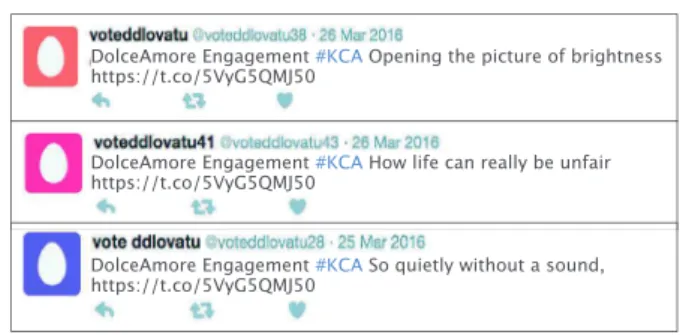
Several methods were presented in the recent research litera- ture for detecting spamming activities on Twitter. However, these methods have several weaknesses that make them below the de- sired level of efficiency in detecting dynamic spammer activities in real-time. These weaknesses could be summarized as follows: (i) most of these methods are based on supervised machine learn- ing approach which is trained on static, human-annotated datasets which is very human-labor cost, (ii) reliance on small and static annotated datasets to build a model to follow-up social spammers’ patterns and their tricks, is not an efficient solution because of the lack of information in the tweet object itself, information fabri- cation problem, and the variation in social spammers’ behaviors ( Chen,Zhang,Xiang, Zhou,&Oliver, 2016;Grier,Thomas, Paxson, &Zhang,2010). For example, Fig.1shows a sequence of streamed spam tweets that attacked the “KCA” event by three correlated spam accounts (social spammers). From this example, various pat- terns might be elicited: (1) same URL used in posting tweets; (2) the same prefix was exploited in filling screen-name attribute “voteddlovatu”; and (3) there was a high similarity in the
user-Fig.1. An example of three correlated spam tweets posted in a consecutive way by three different spam accounts.
name attribute among the three accounts, and (iii) previous studies didn’t provide sufficient analysis and formulations regarding the features used by the spam detection model to work in real-time.
In spite of the volatility of the spam content and new spam- ming patterns, we can exploit the high correlation among spam- mers’ behavior when they launch their spam campaigns for aggre- gating and analyzing continuously-streamed tweets using unsuper- vised methods to produce annotated datasets of tweets that can be used for repetitively retraining and updating spam classifica- tion models. In this paper, we introduce and experiment a frame- work that leverages an unsupervised method in providing, auto- matically and periodically, an annotated dataset for updating su- pervised real-time spam tweet detection model. More precisely, our framework is mainly composed of two main modules: (i) an online collective-based unsupervised spam tweet model; and (ii) a supervised real-time spam tweet detection model. The first mod- ule collects and stores streamed tweets. Then, it applies clustering methods on the stored tweets, followed by a rule-based method that labels each cluster of tweets to provide annotated tweets. The second module is responsible for classifying instantly every streamed tweet into spam or non-spam, with periodically leverag- ing the annotated datasets that come from the first module to re- train and update the current classification model. We demonstrate the effectiveness of the proposed framework through a series of intensive experiments conducted on a dataset streamed from 50 different Twitter trending topics consisting of more than 2 million tweets. Compared to two known methods designed for real-time spam tweets detection, the experimental evaluation shows the ef- ficiency of the proposed framework in detecting spam tweets in terms of precision, recall, and F -measure performance measures. Also, it provides the ability to have control of the target quality of the tweets. In summary, the main contributions of the work in- troduced in this paper are: (i) provide an up-to-date survey and analysis regarding related studies organized in a hierarchy way, (ii) we have collected and labeled a large Twitter dataset of around 2 million Tweets from 50 different Twitter trending topics to be used in data analysis and experimental evaluation we will also make this dataset available for others researchers to use, (iii) pro- viding a complete framework based on an online unsupervised learning method to deal with spam drift problems, by automati- cally and periodically preparing annotated training datasets to re- train a supervised tweet-level spam detection model, (iv) the pro- posed tweet-level classification model didn’t require pre-training on the prepared annotated datasets. Additionally, no human inter- vention is required; which saves time, cost, and resources. (v) in- troducing an optimized set of discriminative, hardly manipulated, and lightweight features extracted only from the streamed tweets, without requiring any external information from Twitter’s servers, (vi) compared to the state-of-the-art methods, the experimental evaluation shows the efficiency of the proposed framework in re- ducing the impact of spam drift problems.
Fig.2. A taxonomy for Social spam detection methods in Twitter ( Kabakus&Kara,2017;Washha,Shillehetal.,2017;Wu,Wenetal.,2017).
2. Relatedwork
Twitter gives its users the opportunity to report spam accounts through clicking ”Report: they are posting spam” option that is available in all accounts. When an account is being reported, Twit- ter’s administrators manually review and deeply analyze that ac- count to make later suspension decision. However, such reporting mechanism is inefficient for fighting social spammers, because it needs significant effort s from both users and administrators when considering billions of users. Moreover, many users may provide fake reports and thus not all reports are necessary true. As an ad- ditional attempt to address the social spam problem, Twitter has a set of rules with permanently suspending the accounts that vio- late those rules ( Twitter,2016). Unfortunately, social spammers are smart enough to bypass Twitter’s rules. For instance, social spam- mers may coordinate multiple accounts by distributing the desired workload among these accounts to mislead the detection. Con- sequently, Twitter’s approaches are ineffective for reducing spam drift in real-time spam filtering.
The shortcomings in Twitter’s anti-spam mechanism have mo- tivated researchers to introduce more robust methods to increase data quality for the applications that use Twitter as a main source of information. After a deep look into a wide range of scientific re- search related to the spam detection methods on Twitter, we build a detailed taxonomy for these methods as shown in Fig.2, which is based on different criteria, including: (i) type of the detection ap- proach (Honeypot, Blacklist, and Machine Learning) and (ii) level of detection (Tweet, Account, and Campaign) exploited in the de- tection methods ( Kabakus& Kara,2017;Wu, Wen,Xiang,&Zhou, 2017).
2.1. Honeypot approach
Traditional supervised learning methods require an initial hu- man labeled dataset which cannot work efficiently with spam drift issues. Alternatively, some spam discovery approaches rely on community reporting mechanism by using Social honeypot. A so- cial honeypot is viewed as an information system resource that can monitor social spammers’ behavior through logging their in- formation such as the information of their accounts and any avail- able content ( Lee, Caverlee, & Webb, 2010). Social honeypots are valuable tool for gathering and understanding spamming activities, specifically community-based online activities. However, there is no significant difference between Twitter’s anti-spam mechanism and the social honeypot approach. Both of them need administra- tive control to make a decision regarding the accounts that have been fallen into the honeypot trap to reduce the false positive rate, which in turns is time-consuming. Lee et al. (2010) deployed a set of honeypots for MySpace and Twitter and they used an up- dated trained classifier to identify spammers. Stringhini, Kruegel, andVigna (2010) deployed 900 honeypots in Facebook, MySpace, and Twitter and they manually identified spammers from all re- quests.
2.2. Blacklist approach
Most spammers promote their services/products by embedding URL links in the spam tweet. Therefore, an effective way of spam detection is to detect tweets containing spam links which rely on the third party blacklisting techniques. For example, Twitter em- ployed Googles Safe Browsing API to prevent malicious links ( Grier et al., 2010). In fact, blacklist methods detect spam by searching the list and it can be applied for domain level rather than spe- cific URL. Blacklisting techniques are commonly deployed in web filtering services such as Twitter spam detection or for dataset labeling. In addition, it provides a lightweight approach with a lower cost than existing classifiers ( Ma, Saul, Savage, & Voelker, 2011). However, it cannot deal with the dynamic behavior of spam- ming activities and thus it’s not appropriate for real-time detec- tion because in average it takes 4 days for the blacklist to include the new spam URLs. In addition, many spammers try to embed- ded shortened URLs, which disable the performance of blacklisting techniques ( Wu,Wenetal.,2017). Moreover, some URLs detection techniques are based on the correlations between the extracted URLs from several tweets in which require more time to retrieve tweets from Twitter servers ( Lee&Kim,2013).
2.3. Machine learning approach
To automate the task of spam detection, most of the Twitter spamming detection methods are based on machine learning tech- niques. However, the main difference between these methods is in the selected features along with their formulations. In fact, almost every paper in these methods introduce a group of distinct features and apply a set of well-known machine learning methods to detect spamming activities. Features used by machine learning methods for Twitter spam detection are varying and differ in terms of their level (e.g account, tweet, and campaign), formulations, powerful- ness, ease of manipulation, and their suitability for real-time detec- tion. Authors in SedhaiandSun(2017a)and Yang,Harkreader,and Gu (2013) provide a comprehensive study and analysis regarding hashtag, tweet, account, graph, and timing features with respect to their performance in Twitter spam detection.
Selection of the machine learning method (e.g. supervised, un- supervised, or semi-supervised) is mainly based on the availability of annotated dataset. In fact, most of the spam detection meth- ods have employed supervised machine learning algorithms, which are trained on one or more types of spam features, that are distributed between tweet-based features, account-based features, and campaign-based features. Account-based methods are based on the features extracted from a Twitter account such as user name, creation date, location, number of followings, number of tweets, number of mentions, number of moments, number of likes, and number of retweets. The works introduced in Benevenutoetal. (2010), Washha et al. (2016), Wu, Liu, Zhang, and Xiang (2017), Wang (2010), McCord andChuah (2011), Stringhini et al.(2010), Medaetal.(2016), Bara,Fung,andDinh(2015), Hu,Tang,andLiu
(2014) and Hu,Tang,Zhang,andLiu(2013)have been focused on extracting features (e.g., the number of friends, number of follow- ers, similarity between tweets, and ratio of URLs in tweets) from users’ accounts. In more dedicated studies, the works presented in Cao andCaverlee (2015) and Wang andPu (2015) have iden- tified the spam URLs through analyzing the behavior of shorten- ing URLs such as the number of clicks and the length of the redi- rection chain. Features extracted from a single Twitter account are simple and lightweight. However, they are easily manipulated by social spammers using a group of bots. In addition, account-level detection is less effective for spammers who may act as legitimate users by posting nonspam content regularly. This behavior moti- vated researchers to leverage graph theory to extract more com- plex features from a set of Twitter accounts. For instance, the stud- ies presented in Yang,Harkreader,andGu(2011), Yang,Harkreader, Zhang, Shin,andGu(2012) and Almaatouqetal.(2016) have ex- amined the relation among users through using some graph the- ories and metrics to measure three features, including node be- tweenness, local clustering, and bi-directional relation ratio. Lever- aging such complex features gives high spam accounts detection rate; however, they are not suitable for real-time Twitter-based ap- plications, because of the huge volume of data that must be re- trieved from Twitter’s servers as well as graph operations, that re- quire exponential time.
Tweet-level spam detection is a lightweight method that re- quires instant analysis and they are based on the features ex- tracted from tweets such as tweet contents (e.g. text and links), sender, mentions, hashtags, links, number of retweets, number of replays, send dates, location ( Kabakus & Kara, 2017; Wu, Wen etal.,2017). Tweet-level spam detection is essential to fight against spamming activities at a more fine-grained level. Most of these methods are based on using language models (e.g TF-IDF and bag- of-words) to compute the similarity between a tweet and other tweets in the same trending topic, or based on detecting malicious URLs embedded in the tweets ( Lee& Kim, 2012; Martinez-Romo & Araujo, 2013;Thomas, Grier, Ma, Paxson,& Song, 2011). How- ever, these methods may not be suitable for real-time filtering be- cause it needs the tweets that have been posted on the same topic from Twitter’s servers. Moreover, the traditional ways to filter URLs are based on blacklisting and HTML parsing which cannot handle shortened URLs, and take significant time to update blacklist. Other tweet features like sender, mentions, hashtags, links, number of retweets, number of replays, send dates, and location are simple and lightweight.
In campaign-level, researchers treated spam problem from a collective perspective view. Therefore, instead of detecting spam tweets one by one, they clustered spam into a set of groups ac- cording to their similarity on tweet contents or URLs ( Wu, Wen et al., 2017). Chu, Widjaja, and Wang (2012) clustered a set of desired accounts according to the URLs available in the posted tweets. Then, a defined set of features from the accounts clus- tered is designed to build a binary classification model using ma- chine learning algorithms to identify spam campaign. Chu, Gian-vecchio, Wang, and Jajodia (2012) have proposed a classification model to capture the difference between bot, human, and cyborg with taking into consideration the content of tweets and spam- ming behavior. Campaign-based methods are not appropriate for real-time filtering due to the high volume of data required from Twitter’s servers. In addition, some campaigns are classified man- ually which is extremely time-consuming ( Thomas, Grier,Song,& Paxson, 2011). Finally, in hybrid-based methods, researchers use a combination of features extracted from Twitter accounts and tweets contents in order to provide more robust spam detection method ( Chen, Zhang,Chen, Xiang, & Zhou, 2015;Chu, Gianvec-chio,Wang,&Jajodia,2010;Inuwa-Dutse,Liptrott,&Korkontzelos, 2018;Wang,Zubiaga,Liakata,&Procter,2015). However, using hy-
brid features, requires careful features selection to make a trade- off between detection rate and detection time, in addition to the needed information from Twitter servers to compute features.
In general, supervised machine learning methods that have been used to detect spam tweets in real-time require a set of dis- criminative, lightweight, and not easy manipulated features, in ad- dition to the existence of an annotated datasets for the training phase ( Benevenutoetal.,2010;Chen,Zhang,Xieetal.,2015). Since tweet object has a limited amount of content or information, a few numbers of the features described in Table1are adopted in real- time spam tweet detection. Moreover, the major drawback of this approach is in the process of training classifiers, which is based on static datasets that reflect current spammer strategies without paying attention to the spam drift issues. To overcome this prob- lem, we need to retrain classifiers periodically based on up-to- date datasets that catch the new spamming strategies ( Chenetal., 2017). Authors in Chen,Zhang, Xiang, andZhou (2015) proposed asymmetric self-learning method to update classifier periodically. They added the incoming classified tweets, which were classified using an initial trained model to the training dataset. Then, after a defined period (e.g., 1 day or 2 days), the classification model is retrained using the old training tweets along with the recent clas- sified tweets. However, this approach is completely dependent on the initial trained model, and there is no guarantee about its per- formance in effectively detecting new social spammers’ patterns. Similar approach are proposed in Lee et al. (2010). The authors employed honeypots as an information resource to monitor and collect spammers behaviors and log their information. They pass detected candidate spam profiles to the trained classifier and then return back profiles that are classified as a spammer to periodi- cally update classifiers. However, the initial dataset used for train- ing classifier is small. In addition, the approach includes human inspectors for validating the quality of the extracted spam candi- dates. Surendra and Aixin ( Sedhai&Sun,2017b) proposed a semi- supervised spam detection method consisting of two main mod- ules: four-level spam tweet-based detection module which oper- ates in real-time mode and an updating module which operates in batch mode. After finding the confidently labeled tweets, the detection module including blacklisted, near-duplicate, ham tweet detector, and tweet classification models are updated accordingly. The proposed detector uses tweet-based features which are suit- able for real-time detection. However, some discriminative features that can be derived from the user account and historical tweets of the users are missing. In addition, among four detectors, the classi- fication model contributes to 87% of tweets labeling, for which the performance is dependent on the initial data set. Chao et. al. ( Chen et al., 2017) proposed a scheme called Lfun that can automati- cally detect changed spam tweets from new unlabeled tweets and incorporate them into classifiers retraining process. The proposed method employed 12 lightweight features and uses two compo- nents to extract changed spam tweets including learn from de- tected spam tweets and learn from human labeling. However, the performance of the scheme is mainly dependent on the first com- ponent which trained on an initialized labeled dataset. In addition, human labeling is time consuming.
To sum up, the above studies have the following weaknesses: (i) they assume that all pre-information (e.g., a blacklist of spamming domains and annotated dataset or trained classification models) to label tweets exist, (ii) most of them are based on updating dataset using the output of the classifier which can’t guarantee to learn new spamming activities, since the classifier is trained on an initial dataset, and (iii) some of them are missing important lightweight account-level features, and (iv) some of them require human in- spectors for validating the quality of the detector. Unlike these studies, our proposed framework have the following strengthens: (i) it didn’t require pre-information like e.g., a blacklist of spam-
Table1
A description of content and user features exploited in spam tweets detection, with classifying them based on their suitability for real-time filtering.
Feature Name Description Real-Time Suitability
Content Features
Number of Hashtags The number of words that begin by “#” symbol ( Benevenutoetal.,2010;Chen,Zhang,Xiangetal., 2015;Chen,Zhang,Xieetal.,2015;Martinez-Romo&Araujo,2013).
√
Number of URLs The number of links, including shorten links ( Benevenutoetal.,2010;Chen,Zhang,Xiangetal.,2015; Chen,Zhang,Xieetal.,2015;Martinez-Romo&Araujo,2013).
√
Number of Words The number of words written in tweet where white-space is used a separator among words ( Benevenutoetal.,2010;Chen,Zhang,Xiangetal.,2015;Chen,Zhang,Xieetal.,2015;Martinez-Romo &Araujo,2013).
√
Number of Characters The number of characters used in creating the tweet, including numbers and symbols ( Benevenuto etal.,2010;Chen,Zhang,Xiangetal.,2015;Chen,Zhang,Xieetal.,2015;Martinez-Romo&Araujo, 2013).
√
Number of Mentions The number of accounts mentioned in the tweet through looking for words starting by “@”
( Benevenutoetal.,2010;Chen,Zhang,Xiangetal.,2015;Chen,Zhang,Xieetal.,2015;Martinez-Romo &Araujo,2013).
√
Number of Retweets The number of retweets that the tweet has gained ( Benevenutoetal.,2010). √
Number of Spam Words The number of spam words that exist in the tweet according to a define list of spam words ( Benevenutoetal.,2010;Martinez-Romo&Araujo,2013).
√
Number of Trending Topics The number of words that represent trending topics circulated in Twitter ( Benevenutoetal.,2010; Martinez-Romo&Araujo,2013).
√
Number of hashtags per words The ratio of the number of hashtags to the number of words in the tweet ( Benevenutoetal.,2010). √ Number of URLs per Words The ratio of the number of URLs to the number of words in the tweet ( Benevenutoetal.,2010). √ Number of Numeric Characters The number of numeric digits in the tweet ( Benevenutoetal.,2010;Chen,Zhang,Xiangetal.,2015;
Chen,Zhang,Xieetal.,2015;Martinez-Romo&Araujo,2013).
√
Number of Replies The number of times that the tweet has been replied by other users ( Benevenutoetal.,2010; Martinez-Romo&Araujo,2013).
√
Number of Favourites The number of accounts/users that have favorited the tweet ( Chen,Zhang,Xiangetal.,2015;Chen, Zhang,Xieetal.,2015).
√
Tweet and URL Page Title Divergence The Kullback Leibler Divergence value computed between the text of the tweet and the title of the URL website, if any ( Martinez-Romo&Araujo,2013).
✗ Tweet and Topic Content Divergence The average value of the Kullback Leibler Divergence values computed between each tweet of the
considered tweet topic and the text of the considered tweet, if any ( Martinez-Romo&Araujo,2013). ✗ Tweet and User’s Tweets Divergence The average value of the Kullback Leibler Divergence values computed between each tweet posted by
the tweet user and the considered tweet content ( Martinez-Romo&Araujo,2013).
✗
User Features
Number of Followings The number of accounts/users that the user of the tweet follows ( Chen,Zhang,Xiangetal.,2015; Chen,Zhang,Xieetal.,2015).
√
Number of Lists The number of accounts/users that has listed the user of the tweet ( Chen,Zhang,Xiangetal.,2015; Chen,Zhang,Xieetal.,2015).
√
Number of Followers The number of accounts/users that follow the user of the tweet ( Chen,Zhang,Xiangetal.,2015;Chen, Zhang,Xieetal.,2015).
√
Account Age The number of milliseconds spent since the creation date of the account of the tweet ( Chen,Zhang, Xiangetal.,2015;Chen,Zhang,Xieetal.,2015).
√
Number of Tweets The number of tweets that the user of the tweet has tweeted ( Chen,Zhang,Xiangetal.,2015;Chen, Zhang,Xieetal.,2015).
√
ming domains and trained classifier, (ii) our proposed framework is capable of continuously updating itself by using unsupervised learning method, which is based on a set of discriminative account and tweet-level features without any human intervention, and (iii) introducing an optimized set of discriminative, and lightweight ac- count and tweet-level features extracted from only the streamed tweets, without requiring any external information from Twitter’s servers.
3. Problemdefinitionandformalization
Any Twitter stream can be represented as a finite set of chrono- logically sorted tweets, defined as S t=
{
T 1,T 2,...,T t−1,T t}
, wheret ∈N+represents the number of seconds since starting the stream- ing process, and T 1 and T t are the first and latest tweets that
has been streamed. Indeed, the Tweet object contains different at- tributes related to the tweet content and its user. Therefore, we represent the tweet element T • by a 6-tuple of attributes, T •=
(
User,# Retweets , # Replies , # Favourites, Text, Time ), where # Retweets represents the number of retweets that the tweet has gained, # Replies is the number of comments performed as a reply on the tweet, # Favourites is the number of likes that the tweet has, T ime ∈Z≥0 is the posting date of the tweet in seconds time unit
computed since January 1, 1970, 0 0:0 0:0 0 GMT, while the Text and User attributes are defined as follows:
• Text: The textual content of the tweet is represented as a finite
set of ordered words, T ext =
{
w 1,w 2,...}
. This set of words isextracted by segmenting the tweet content using the whites- pace separator. The word element w •might be a hashtag, URL,
user’s account mentioned, and more.
• User: Twitter provides simple meta-data about the user who
posted a tweet. Hence, we further represent the user object by 7-tuple of attributes defined as, U ser =
(
SN,U N,UA,# Tweets , # Followers , # Followees , # Lists ), where # Tweets is the number of tweets that the user has posted on his account, # Followers is the number of accounts that follow the user, # Followees is the number of accounts that the user follows, # Lists is the number of accounts that list the user. The rest of the attributes, SN, UN, UA , are further defined as follows:– Username (UN): Twitter allows users to name their ac- counts with a maximum length of 20 characters. Users can use whitespace, symbols, special characters, and numeric numbers in filling their username attribute. This field is not necessary for being unique and thus the users can name their accounts by already used names. We represent this
attribute as a set of ordered characters, defined as UN =
{
d 1,...,d i}
, where d •∈{ Printable Characters } 1 is the charac-ter and i ∈Z
≥0 is the position inside the username string.
– ScreenName (SN): This attribute is a mandatory field and
it must be filled at the creation time of the account. Users must choose a unique name that hasn’t been used previ- ously by other users, with a maximum length of 16 char- acters. Twitter also restricts the space of allowed charac- ters to include only the alphabetical letters, numbers, and “ _ ” character. Similar to the username attribute, we rep- resent this field as an ordered set of characters, defined as UN =
{
d 1,...,d i}
, where d –∈{ Printable Characters } is thecharacter and i ∈Z
≥0 is the position inside the username
string.
– UserAge(UA): When a user creates an account on Twitter,
the creation date of the account is registered on Twitter’s servers without providing any permissions to modify it in the future. We exploit the creation date, as an accessible and available property in the user’s object, to compute the age of the account. Formally, we calculate the age in days time unit through subtracting the current time from the creation date of the account, define as UA =Timenow−Timecreation
864∗105 , where
T ime now,T ime creation∈Z≥0are number of milliseconds com-
puted since January 1, 1970, 0 0:0 0:0 0 GMT.
According to this representation, the problem of real-time tweet-level spam detection can be defined as follows; Given a tweet streamed at time t, T t, and a set of already streamed tweets,
S t−1, our problem is to predict whether the tweet T tis a spam or
non-spam, with leveraging only the available information in both T tand the set of already streamed tweets S t−1. More formally, we
aim at designing a model, F : x→
{
spam,non −Spam}
, which takes a feature vector of the streamed tweet T •as an input and predictsits class label as an output.
4. Datasetdescriptionandgroundtruth
A dataset with ground-truth is required to train and evalu- ate a supervised machine learning spam detection methods. In fact, most of the researchers use their own dataset and some of them didn’t make it publicly available ( Benevenuto et al., 2010; Martinez-Romo & Araujo, 2013). In addition, for privacy reasons, when social-network-based researchers publish a dataset, they only provide the target object IDs (e.g., tweets and accounts) to retrieve them from servers of the desired social network. However, providing the IDs of the spam tweets or accounts is not enough because Twitter might already have suspended the corresponding accounts and thus nothing to retrieve from the servers.
The most challenging task in creating a large dataset is the an- notation process. Currently, researchers are using four ways to gen- erate ground truth, including: manual inspection, blacklists, sus- pended accounts, and clustering ( Chen, Zhang,Chen etal., 2015; Hu et al., 2014; Hu et al., 2013; Sedhai & Sun, 2017a; Thomas, Grier,Songetal.,2011;Wu,Liuetal.,2017). Manual inspection is costly, time-consuming, and some times subjective. Blacklists (e.g. google safebrowsing) are an effective automated method. However, not all spam tweets contain URLs and also some spam tweets con- tain URLs that may direct to legitimate content. Therefore, Black- list can be applied only for tweets containing URLs. On the other hand, suspended accounts are also automated method and work by labeling all of the suspended accounts tweets as spam. In fact, Twitter decides to suspend an account if it engaging spamming ac- tivities including posting misleading, deceptive, or malicious links. 2
1http://web.itu.edu.tr/sgunduz/courses/mikroisl/ascii.html. 2https://help.twitter.com/en/rules-and-policies/twitter-rules.
However, sometimes, suspended accounts may contain non-spam tweets. Finally, in clustering methods (e.g. near-duplicate and ex- pectation maximization), all tweets in the same cluster will be an- notated with the same label. Up to our knowledge, there are two publicly available datasets suitable for tweet-level spam detection ( Chen, Zhang, Chen et al., 2015; Sedhai & Sun, 2015). In Chen, Zhang, Chen etal. (2015) the authors used the blacklist method to annotate collected tweets, and thus they are concerned only on tweets containing URLs. On the other hand, authors in Sedhaiand Sun(2015)used four main stages in the annotation process. How- ever, due to the way the tweets were collected, the collection does not contain full user profiles, which limits extracting account-level features. In addition, the data set was collected based on popu- lar hashtags, not on user basis, which does not guarantee to con- tain all tweets of any user. Therefore, since our methodology: (i) uses hybrid features (tweet-level and account-level) to train a real- time spam detection model, (ii) deals with all tweets not only the tweets having URLs, and (iii) uses tweets writing style simi- larity and tweets posting behavior similarity features to label new streamed tweet which require retrieving user tweets, both datasets are not suitable for our proposed approach. As a result, we decided to collect our own dataset and generate ground-truth.
Building large tweet dataset consists of two main stages, the collection stage, and the annotation stage. For the collection stage, we have developed a crawler that uses the Twitter Streaming APIs. Actually, real-time spam detection methods are applied on a stream of tweets related to one or more entities (hashtag, user- name, and URL). Therefore, to simulate and investigate such cases, we have chosen the hashtag as a target entity since most of the researches and applications stream the tweets from a particular hashtag or topic ( Chellal, Boughanem, & Dousset, 2016;Hoang& Mothe,2016;Sedhai& Sun,2015; Zubiaga etal., 2012). We have launched our crawler for four months, started since 1/Jan/2015, where 2.1 million of relevant tweets from 50 trending hashtags have been collected and also stored based on their posting time. In the annotation stage, since manual labeling is expensive and black- lists are used only for tweets containing URLs, we have leveraged the suspended accounts method which is widely used in social spam detection to annotate our collected tweets ( Huetal., 2014; Huetal.,2013;Thomas,Grier,Songetal.,2011;Washha,Qaroush, Mezghani,&Sèdes,2017a;Wu,Liuetal.,2017). The process checks whether the user of each tweet was suspended by Twitter. In case of suspension, both the user and his tweets are labeled as spam. We have performed this process for one year after crawling the tweets in order to have a large number of spam users and their tweets.
In total, as reported in Table 2, we have found about 78,0 0 0 users (accounts) labeled as social spammer, and 881,0 0 0 legitimate users. Also, the number of spam tweets existing in our dataset is more than 208,0 0 0 tweets, forming about 10% of 2.1 million tweets. The number of tweets posted is obviously greater than the number of tweets retrieved since the former number represents the tweets that have been streamed into the hashtags selected, while the latter number corresponds to the ultimate tweets that have been posted since the creation of the accounts. As the dataset is not balanced at the class level, we compute the normalized ver- sion of the statistics per 100 users to have a more fair compari- son between social spammers and legitimate users. The normal- ized version of the number of URLs shows an obvious misusing of URLs in spreading social spammers’ content, compared to the le- gitimate users. It is expected that the number of verified users is zero since having a verified account requires to contact Twitter’s administrators; thus the spam accounts are too difficult to be veri- fied. Another interesting possible conclusion is that the distribution of spam tweets is not necessary to be uniform, meaning that social spammers may have some hidden preferences for selecting hash-
Table2
Distribution of different statistics for social spammers (spam accounts) and legitimate users (non-spam accounts) existing in our dataset.
Social spammers Legitimate users
Statistic Name Number Percentage Number (per 100 users) Percentage Number Percentage Number (per 100 users) Percentage
Number of users 78,074 8.1% – – 881,207 91.9% – –
Number of geo-enabled users 5986 1.8% 8 18.2% 316,617 98.2% 36 81.8%
Number of verified users 0 0.0% 0 0.0% 2978 100% 1 100%
Number of users’ followers 78,143,567 2.9% 100,089 25.8% 2,526,736,521 97.1% 286,735 74.2%
Number of users’ followees 50,839,084 3.6% 651,165 81.5% 1,302,269,081 96.4% 147,782 18.5%
Number of tweets posted 944,566,070 5.4% 1,209,834 39.1% 16,604,525,699 94.6% 1,884,293 60.9%
Number of tweets retrieved 208,546 10.1% 267 55.8% 1,857,479 89.9% 211 44.1%
Number of retweeted tweets 80,773 9.1% 104 53.3% 808,263 90.9% 92 46.6%
Number of replied tweets 855 2.4% 1 33.3% 24,895 97.6% 3 66.6%
Number of URLs 127,655 1.9% 163 55.1% 1,166,666 98.1% 133 44.9%
Table3
Distribution of 50,0 0 0 spam and non-spam tweets streamed into the top 20 hashtags existing in our dataset, showing an obvious variation in the number of spam tweets of 20 hashtags.
Non-spam tweets Spam tweets Non-spam tweets Spam tweets
Topic name Number Percentage Number Percentage Topic name Number Percentage Number Percentage
#iHeartAwards 39,478 78.9% 10,522 21.1% #Harmonizers 38,844 77.7% 11,156 22.3% #KCA 38,992 77.9% 11,008 22.1% #quote 46,076 92.2% 3924 7.8% #BestFanArmy 40,982 81.2% 9018 18.8% #NowPlaying 47,841 95.7% 2159 4.3% #TreCru 49,541 99.1% 459 0.9% #BTS 48,798 97.6% 1202 2.4% #Periscope 48,831 97.7% 1169 2.3% #VoteMaineFPP 47,756 95.5% 2244 4.5% #SoundCloud 46,709 93.4% 3291 6.6% #gameinsight 45,492 90.9% 4508 9.1% #np 47,150 94.3% 2850 6.7% #VoteKathrynFPP 47,427 94.8% 2573 5.2% #RT 36,922 73.8% 13,078 26.2% #android 46,162 92.3% 3838 7.7% #5SOSFam 41,476 82.9% 8524 17.2% #love 46,802 93.6% 3198 6.4% #Directioners 44,704 89.4% 5296 10.6% #giveaway 47,602 95.2% 2398 4.8%
tags. More precisely, Table3 reports the distribution of the spam and non-spam tweets streamed into top 20 hashtags and shows a clear variation in the number of spam tweets. The stream of some hashtags such as # RT has been intensively polluted with an esti- mated ratio of 1 spam tweet to 3 non-spam tweets, while there are hashtags that haven’t been polluted too much like # TreCru . In- deed, there is no clear interpretation behind this high variation in the distribution of spam tweets; however, the importance of the hashtag, and how long time the hashtag has been trending are the most possible reasons.
5. Unsupervisedcollective-basedandreal-timespamfiltering
model
5.1. Model design: an overview
Supervised learning methods are the classical approach adopted in literature for building spam tweets detection models. As com- monly known in the machine learning field, applying these meth- ods need an annotated dataset. Unfortunately, having such data is often very expensive in terms of annotation time, and/or hu- man resources. In addition, social spam classification models re- quire continuous adaption using new training datasets to follow- up new social spammers’ patterns and behaviors. Thus, obtaining a static training dataset to train a classification model is not an ef- ficient solution at all.
Therefore, we propose a design of an online collective-based spam tweets classification framework that utilizes the great bene- fits of unsupervised machine learning methods, to periodically and automatically provide an annotated dataset by which updated su- pervised classification models can be produced. The model em- ploys the correlation between social spammers’ tweets in a short period to predict spamming behavior. As described in Fig. 3, our framework consists of two main modules: (i) real-time tweet filter- ing model; and (ii) periodic classification model learning. The first module prepares a feature vector for a streamed tweet through ex-
tracting a set of predefined light features and then passes the vec- tor to an already learned classification model to predict the class label of the streamed tweet. The second module, which is the core of the framework, stores incrementally the streamed tweets in a storage component (e.g., database) and then frequently creates a newly labeled training dataset using unsupervised methods once a certain number of new tweets is stored in the storage component. Upon satisfying the condition of streamed tweets, a new feature space is prepared using all annotated tweets in the storage compo- nent. Finally, a classical supervised learning method (e.g., Random Forest, SVM, J48) is applied to the new labeled feature space to build a binary classification model to replace the current classifier model.
5.2. Collective-based unsupervised predictive model
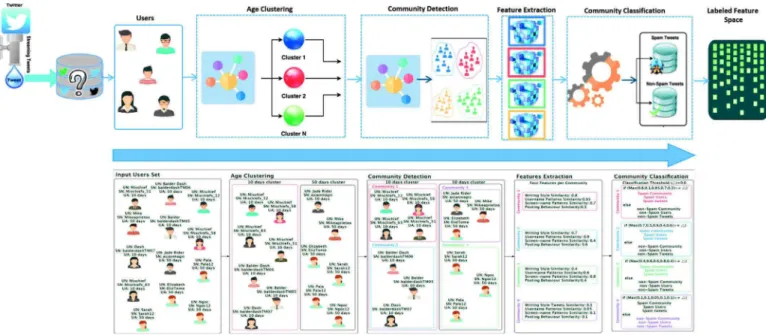
Leveraging Twitter REST APIs to retrieve more information about users of the streamed tweets is the best solution to pre- cisely label each tweet as spam or not. However, the impractically of this approach in terms of time brings serious challenges to de- sign an efficient method suitable for processing large scale (some- times endless) of streamed tweets. Therefore, instead of inspecting each tweet individually, we overcome this shortcoming by propos- ing an automatic approach that inspects the correlation between spam accounts and their tweets at different levels using unsuper- vised clustering methods. The design of the proposed approach comes in five-stages as illustrated through an example in Fig.4. For a given set of streamed tweets, the first stage extracts the users who posted the tweets streamed. The second stage clusters the users set based on the age of each user’s account. In the next stage, for each generated cluster, a defined number of communities is de- tected through an optimization process. In the fourth stage, we ex- tract hand-designed features for each community using only users’ tweets and accounts information. The last stage makes a decision about each community using a simple discriminative feature-based
Fig.3. A diagram showing the flow and the steps of the two main components in our framework: (i) periodic classification function learning; (ii) and real-time tweet detection or filtering.
Fig.4. An example describing the functionality of the 5-stage unsupervised classification: (i) user set extraction; (ii) account age clustering; (iii) community detection; (iv) community-based features extraction; (v) and community-based classification.
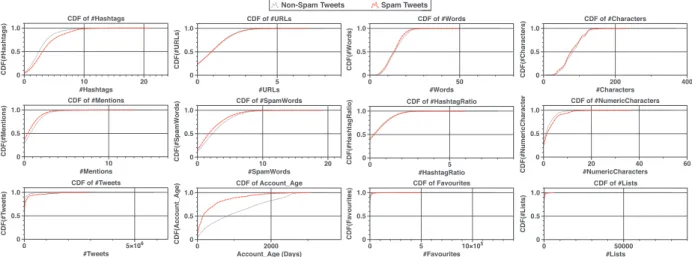
Fig.5. CDF of 12 tweet features drawn for a randomly selected 10 days of streaming spam and non-spam tweets.
classification model that labels each tweet of spam communities as spam tweets.
Stage1:UsersSetExtraction. We design the clustering and the community detection stages based on leveraging the users’ infor- mation that is available in the streamed tweets. Formally, for the latest streamed tweets set, S t, the unique set of users is defined as
Users =
{
T .User|
T ∈S t}
where | Users | ≤| S t|.Stage2:UserAge-basedClustering. Social spammers have the
ability to create hundreds or thousands of the Twitter accounts in a short period not exceeding few days, for launching their spam campaigns ( Benevenutoetal.,2010;Washhaetal.,2016). Also, the impact of the creation time has shown its effectiveness in detect- ing spam accounts so that when a set of accounts have a close and recent creation date, the probability of being a spam accounts increased. Fig.5show the Cumulative Distribution Function (CDF) of 12 tweet-level features which extracted for spam and non-spam tweets. These CDFs are computed for a randomly selected 10 days of tweet streaming to study the strength of these features. The CDF of the features shows that social spammers tend to behave exactly as legitimate users to avoid detection. An interesting point worth to mention is that the CDF of account age feature is the most ro- bust one compared to the rest of the features since the creation date of accounts is non-editable by users.
Thus, the creation date of Twitter accounts can be an effec- tive means for grouping the spam accounts that might have a cor- relation between them. According to that, the Users set is clus- tered based on the user age (UA) attribute. In a formal way, let C aAge=
{
u|
u ∈Users,u.UA = a}
be a day-cluster containing the userswho have an account age equaling a ∈Ages , where Ages =
{
u.UA|
u ∈ Users}
is a set of distinct users ages. Obviously, the number of day clusters is dynamically determined, which exactly equals to the size of the Ages set (i.e., | Ages |).Stage3:Community Detection. Social spammers might create
uncorrelated spam campaigns at the same time ( Stringhiniet al., 2010;Wang&Pu,2015;Washha,Shilleh,Ghawadrah,Jazi,&Sèdes, 2017). In other words, we might have an age cluster containing spam accounts belonging to different spam campaigns. Also, many non-spam users join Twitter daily, which increase the probabil- ity of having non-spam users created on the same day as the spam ones. Therefore, to distinguish between different uncorre- lated spam campaigns and non-spam accounts, a community de- tection stage is performed on each cluster resulted by age-based clustering stage. We define each spam campaign as a community having a high correlation between its users, where the correla-
tion in a given community can be measured over naming accounts level, duplicated tweets content, or similar posting behavior.
In this paper, we adopt the Non-negative Matrix Factorization (NMF) as an unsupervised method, to infer communities’ struc- ture because of its outstanding performance in clustering problems ( Yang&Leskovec,2013). NMF has turned into one of the preferable tools for decomposing data into low-rank factorizing matrices to yield a parts-based representation. It has distinct features of pre- serving the structure of the original input data and keeping the non-negativity in both weight and basis. The latent semantic space of the NMF method has a very intuitive explanation in some clus- tering problems. For instance, in NMF based document clustering, each axis of the latent semantic space stands for the basic topic of a particular cluster where each document is represented by the additive combination of the basic topics.
For the given community detection problem, NMF works through partitioning or factorizing one or more information matri- ces into hidden factor matrices for an aging cluster, C a, a ∈Ages , of
users. Formally, the factorization of information matrices is mathe- matically defined as an optimization minimization problem as:
min H≥0
||
X−HH T||
2 F =minH ≥0
v
u
u
t
|CAge a | X i=1 |CAge a | X j=1|
xi j−hihTj|
2
2 =min H≥0 |CaAge| X i=1 |CaAge| X j=1|
xi j−hihTj|
2 (1)where || •|| F is the Frobenius norm of the considered matrix, X∈
R |CaAge|×|CaAge| is an information matrix representing the strength of the social connections (i.e., similarity among a pair of users) be- tween users, H=[ h1...hK] ∈R |C
Age
a |×K is the community structure
hidden factor matrix of K communities, and the j th row vector hj=[ h j1,...,h jK] ∈ R 1×K. The entry x ij reflects the strength of the
social connection between the u i∈C aAgeuser and u j∈C aAgeuser. The
entry h ijin the hidden factor matrix can be interpreted as the con- fidence degree of user u i∈C aAge belonging to the j thcommunity. It
is important to mention that each user belongs to one community only, not more than one.
Obviously, inferring the hidden matrix H requires a formal def- inition of the information matrix X. For example, X might be an adjacency matrix representing the social connections or the links among users of a given age cluster C Agea . However, obtaining the
adjacency matrix in our case is not possible since the available information about users is limited to simple meta-data that de- scribe accounts, which did not give enough information about the
followers and the followees. Hence, in this paper, we leverage the available and accessible information to estimate social connections between users through proposing three definitions of the informa- tion matrix X denoted as XSN,XUN, and XWS where each of which is formally defined as follows:
• Screen Name Similarity ( X SN): Since the screen name field must
be unique, social spammers tend to adopt a particular fixed pattern when creating multiple accounts acting as a spam cam- paign. For example, in Fig. 1, the spammer has adopted the name “voteddlovatu” as a fixed pattern and repeated it in fill- ing the screen name field. Intuitively, the high matching in the screen name between users (or accounts) increases the proba- bility of the users to belong to the same community. Therefore, we define the information matrix XSNto measure the degree of matching between the screen name attribute. More precisely, for each two users u i,u j∈C aAge, a ∈Ages , the degree of match-
ing for a particular entry in the matrix XSNis defined as: xSN
i j =
max
{|
m|
:m∈N−gram(
ui.SN)
∩N−gram(
uj.SN)
,N∈{
1,...,min(
|
ui.SN|
,|
uj.SN|
)
}}
min
(
|
ui.SN|
,|
uj.SN|
)
(2)
where | •| is the cardinality of the considered set, N −gram
(
•)
is a function that returns a set of contiguous sequence of char- acters for a given name (set of ordered characters) based on the value of N . For better understanding, the 3-gram (or tri- gram ( Cavnar & Trenkle, 1994)) of the screen name “vote” is {“vot ”, “ote ”}. The above definition can detect the matched pat- tern wherever it appears in the screen name attribute. For in- stance, let “vote12” and “tovote” be screen names for two dif- ferent spam users, the degree of matching according to Eq. (2)is around
(
46)
66 .6% , which resulted from the use of pattern “vote”, regardless the position of the pattern.• User Name Similarity ( X UN): Conversely the screen name at-
tribute, spammers may duplicate username attribute as many as they wish. In fact, they aim to use a structured and represen- tative (not random) names to attract legitimate users ( Washha, Qaroush,Mezghani,&Sèdes,2017b). Therefore, fully or partially matching among users based on such an attribute increases the probability of being in the same community. Thus, we define the information matrix XUN to measure the degree of similarity among users based on the user name attribute. Formally, given two users u i,u j∈C ageAge, the degree of similarity is defined as:
xUNi j =max
{|
m|
:m∈N−gram(
ui.UN)
∩minN−(
gram(
uj.UN)
,N∈{
1,...,min(
|
ui.UN|
,|
uj.UN|
)
}}
|
ui.UN|
,|
uj.UN|
)
(3)
• Names Writing Style Similarity ( X WS): Based on our observa-
tions, social spammers may follow a particular style in writ- ing the username and screen name attributes. For instance, in these two real spam accounts ( u 1=
{
SN =“v
ote 5 soss 33 ′′,US = “v
ote 5 sos ′′}
, and u 2={
SN = “ sav
ed028 ′′,US =“ sav
ed ′′}
), the so- cial spammer has used the username attribute in filling the screen-name attribute with putting the username value in the beginning. Hence, as these two accounts belong to the same spam campaign, modeling such behavior can efficiently con- tribute to identifying spam communities. In order to model thissimilarity between a pair of users, we firstly define a function, Pos ( Str 1, Str 2), that takes two strings as an input and then it
finds the location ( Start, Inside, End) of the string Str 2 in the
string Str 1, written as:
Pos
(
Str1,Str2)
=
SE|
Str1∩Str2|
=|
Str2|
=|
Str1|
S|
Str1∩Str2|
=|
Str2|
and•1∈Str1∩Str2 E|
Str1∩Str2|
=|
Str2|
and•|Str1|∈Str1∩Str2 I|
Str1∩Str2|
=|
Str2|
and•1∈/Str1∩Str2and•|Str1|∈/Str1∩Str2 (4)where the two strings are represented as a finite set of or- dered characters Str •=
{
d 1,d 2,...}
, d •∈{ Printable Characters },the symbol •1 represents any character written at the begin-
ning of a given string, while•|Str
1| corresponds to the character
written at the end of the string Str 1.
Therefore, for a pair of users u i,u j∈C aAge,a ∈Ages, belonging to
an age cluster, we define a writing style similarity matrix XWS based on the equality of the pair in the Pos function value. For a particular entry in the matrix XWS, the similarity is defined as: xWS i j =
½
1 Pos(
ui.SN,ui.UN)
=Pos(
uj.SN,uj.UN)
0 otherwise (5)where here 1 means that the pair of users has same writing style, while 0 represents dissimilar writing style. For better understanding, when applying the Pos func- tion on the given example of a pair of spam accounts (users), ( u 1=
{
SN = “v
ote 5 soss 33 ′′,US =“v
ote 5 sos ′′}
, andu 2=
{
SN =“ sav
ed 028 ′′,US =′′sav
ed ′′}
), the “S” location is re- turned for the both users (i.e., Pos(
“v
ote 5 soss 33 ′′,“v
ote 5 sos ′′)
= S,Pos(
“ sav
ed028 ′′,“ sav
ed ′′)
=S) since the username “vote5sos” appears in the beginning of screen name “vote5soss33” of the user u 1, and similar for the “saved” username of the user u 2.Thus, the writing style similarity equals to 1.
Non-negative matrix factorization method allows to integrate these three information matrices together in the same objective function. According to this, the objective function is defined as:
min H≥0
||
X SN −HHT||
2 F+||
X UN −HHT||
2 F+||
X WS −HHT||
2 F (6)Obviously, the objective function in Eq. (6) infers the hidden factor matrix H to represent consistent community structure of re- lated users. Indeed, this objective function is not jointly convex and has no closed form solution exists. Hence, we propose the use of a gradient descent approximation method as an alternative opti- mization approach. Since we have one matrix free variable ( H), the gradient descent method updates it iteratively until the variable
converge. Formally, let L
(
H)
denotes the objective function given in Eq.(6). So, at iterationτ
, updating Eq.(6)is given by:Hτ=Hτ−1 −
η
.∂
L(
H τ−1)
∂
(
H)
=H τ−1 −2η
¡
6Hτ−1(
Hτ−1)
THτ−1 −(
XSN+XUN+XWS)
Hτ−1−((
XSN)
T+(
XUN)
T+(
XWS)
T)
Hτ−1¢
(7)where the parameter
η
denotes the gradient descent step in up- dating the matrix H. We assign the value ofη
to a small con-stant value (i.e. 0.05). Also, since the gradient descent method is an iterative process, a stop condition is required in such a case. For this, we used two stop conditions: (i) the number of itera- tions, denoted as M ; and (ii) the absolute change in the H ma- trix for two consecutive iterations to be less than a threshold, i.e.,
|
(
||
H τ||
F−
||
H τ−1||
F)
|
≤ǫ
.One might view that the proposed information matrices and the age-clustering stage can be easily manipulated by social spam- mers to evade the detection. Indeed, this view could be correct when a social spammer creates very small spam bot consisting of no more than 5 spam accounts. Also, social spammers did not pre- fer to use a random function to generate screen names and user- names since the main objective of the social spammers is to lure legitimate users. Thus, social spammers have to use names suit- able for the target that they want to achieve. For instance, if a social spammer wants to promote for a product ”X” through de- voting large spam bots, he must name the spam accounts using keywords related to the intended product. Social spammers have the option to create the accounts before the attack; however, they couldn’t change the creation date attribute. Moreover, the purpose of using the age feature is to increase the difficulty in front of the social spammers to create thousands of accounts in short a period so that social spammers need to spend months to create a thou- sand of spam accounts. As the purpose of launching spambots is a monetary benefit, social spammers could not wait for this long time in creating their accounts as well as leaving them inactive may subject them for suspension from Twitter itself.
Stage 4: Community-Based Feature Extraction. In order to
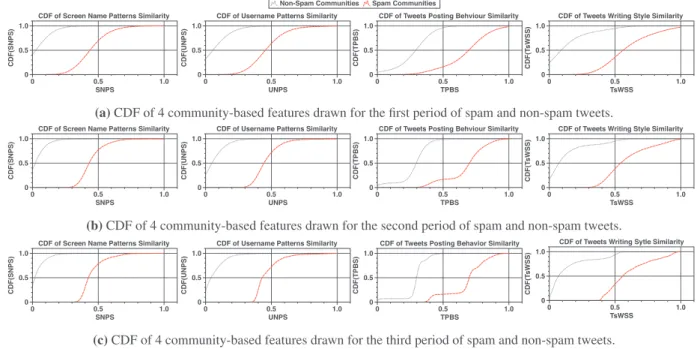
predict the class (spam or non-Spam) of each community, one or more features must be extracted from each community such that these features can effectively discriminate between spam and non-spam communities. Since social spammers may follow com- plex and different spamming strategies, no single feature can ef- fectively discriminate between spam and non-spam communities. In addition, the design of such features must rely only on the available information in each community to avoid using REST APIs. Thus, we introduce a design of four community-based features that take into account the community’s users along with their tweets. The four introduced features are distributed between account- based and tweet-based features. The username patterns similar- ity ( UNPS), and the screen name patterns similarity ( SNPS) are two features extracted using the username and screen name of the user attributes. On the other hand, Tweets writing style similar- ity ( TsWSS), and Tweets posting behavior correlation ( TsPBC), are tweet-based features which only leverage the available content in the tweets of a community. It is important to mention that there is a strong intuition behind the design of each feature, which will be illustrated statistically through different graphs of cumulative density function (CDF).
The total number of formed communities is dependent on the number of age clusters (| Ages |) beside the number of predefined communities K . Therefore, the ultimate number of communities is | Ages | ×K , where the community detection stage is applied to each age cluster. We represent the j th inferred community in the hidden matrix, H , by 7-tuple of attributes C j=
(
Users,T weets,UNP S,SNPS,TsWSS, TsPBC, Label ) where Users is a finite set of the users be- longing to the inferred community, Tweets ⊆S tis all tweets that are
posted by the users of the community, and Lable ∈
{
spam,non − spam}
is the class label of the community. The remaining attributes are defined and formulated as follows:• UsernamePatternsSimilarity (UNPS)andScreen Name
Pat-ternsSimilarity(SNPS): Social spammers may adopt a partic-
ular pattern (e.g., “voteddlovatu”) in creating their spam cam- paigns and therefore the probability of having spam commu- nities biased toward a particular pattern used in creating ac-
counts is relatively high. Since there is no obvious correlation among communities at the pattern level, nor a prior knowledge about the length and the name of the patterns, we must have a generic and independent way to determine whether the com- munity has a spammy pattern. Thus, we rely on an intuitive and generalized fact which states that the probability distribu- tion of the patterns in non-spam communities is close to the uniform distribution, while the spam communities have the op- posite behavior. More precisely, we measure the degree of simi- larity between string patterns probability distribution extracted from users of a particular community with the uniform proba- bility distribution of the patterns.
Formally, let PT UN and PT SN be two finite sets of string pat-
terns extracted from the username and the screen name attributes for users of the j th community, C
j. Also, let P DUN
and P SN
D be the corresponding probability distributions of
the username and the screen name patterns, respectively. For the uniform distribution, let P UN
uni, P uniSN be the corre-
sponding uniform distributions of username and screen name patterns, respectively. For instance, for a particu- lar community, let P T SN=
{
“ mischie f ′′,“ isch ′′,“ _ 12” ,“ _ 14”}
and P SN
D =
{
(
“ mischie f ′′,0 .7)
,(
“ _ 15” ,0 .1)
,(
“ _ 14” ,0 .1)
,(
“ _ 12”, 0.1)} be a set of screen name patterns along with its probability distribution, and {(“mischief ′′, 0 .25
)
,(
“ _ 15” ,0 .25)
,(
“ _ 14” ,0 .25)
,(
“ _ 12” ,0 .25)
}
be the uni- form probability distribution of these patterns. To extract and catch all string patterns, the N-gram method is applied since social spammers may define patterns varying in their length and position. To perform the N-gram method, different values of N ranging from three to the length of the string are used, with ignoring low N values (one and two) because they provide meaningless patterns. For the j th community’s users, represented as C j, we extract the string patterns used in theusername and screen attributes as follows: PTUN = [ u∈Cj·Users [ N∈{3, ... , |u.UN|} N−gram
(
u.UN)
PTSN = [ u∈Cj·Users [ N∈{3, ... , |u.SN|} N−gram(
u.SN)
(8)The double unification ( S S) can be viewed as a double “for” loops where the inner unification is responsible about return- ing all patterns, as a finite set of strings, that a single user has, while the outer unification unifies all sets of users’ string pat- terns to have only one single set of the string patterns repre- senting the community itself.
Since the pattern is a categorical random variable in which the string has not a meaningful order of magnitudes, we adopt the Kullback–Leibler divergence ( Kullback& Leibler,1951) ( KL ) method as a suitable and a fast way to measure the similar- ity between any two probability distributions of categorical ran- dom variables. However, the classical version of KL method can- not be directly exploited in computing similarity among ( P T UN
D
and P T UN
uni) or ( P T DSN and P T uniSN) since the ∞ and 0 values cor-
respond to dissimilar, and similar distributions, respectively. Hence, we perform a few modifications on the current version of KL method to inverse the semantic meaning of KL values (i.e., 0 ⇒ dissimilar and 1 ⇒ similar) and taking into account bound- ing its values. Thus, for the j th community, the value of the
UNPS and SNPS features are computed using the customized KL equation as follows: C j.UNPS = log