To link to this article :
http://www.jus.org.uk/
This is an author-deposited version published in: http://oatao.univ-toulouse.fr/
Eprints ID: 5977
To cite this version:
Tchangani, Ayeley Bipolar aggregation method for fuzzy nominal
classification using Weighted Cardinal Fuzzy Measure (WCFM). (2013)
Journal of Uncertain Systems, vol. 7 (n°2). pp. 138-151. ISSN 1752-8909
O
pen
A
rchive
T
oulouse
A
rchive
O
uverte (
OATAO
)
OATAO is an open access repository that collects the work of Toulouse researchers and
makes it freely available over the web where possible.
Any correspondence concerning this service should be sent to the repository
administrator:
[email protected]
Bipolar Aggregation Method for Fuzzy Nominal Classification
Using Weighted Cardinal Fuzzy Measure (WCFM)
Ayeley P. Tchangani
∗Universit´e de Toulouse; Toulouse III - UPS; IUT de Tarbes; 1, rue Lautr´eamont, 65016 Tarbes Cedex, France Universit´e de Toulouse; Laboratoire G´enie de Production - LGP; 47 Avenue d’Azereix
BP 1629, 65016 Tarbes Cedex, France
Abstract
The issue of designing a procedure to assign objects (candidates, projects, decisions, options, etc.) characterized by multiple attributes or criteria to predefined classes characterized by fuzzyly defined mul-tiple features, conditions or constraints, is considered in this paper. Such assignment problems are known in the literature as nominal or non ordered classification problems as opposed to ordinal classification in which case classes are ordered according to some desires of decision maker(s). Because of the importance of these problems in many domains such as social, economics, medical, engineering, mangement etc., there is a need to design sound and appropriate evaluation algorithms and methods to deal with them. In this paper we will consider an approach based on an evaluation strategy that consists in aggregating separately elements that act in the same sens (either contributing to the exlusion of a class from assignment or its consideration for inclusion given an object) that we refer to as bipolar analysis. Then, relying on the fact that elements to aggregate have synergetic relationships (they are complementary), we propose to use Choquet integral as the appropriate aggregation operator with a proposed fuzzy measure or capacity known as weighted cardinal fuzzy measure (WCFM) which tractability permits to overcome difficulties that dissuade the use of Choquet integral in practices. Furthermore, bipolar property results in evalau-tion by two degrees: classifiability measure that measures to what extent an object can be considered for inclusion in a class and rejectability measure, a degree that measures the extent to which one must avoid including an object to a class rendering final choice flexible as many classes may be qualified for inclusion of an object. Application of this approach to a real world problem in the domain of banking has shown a real potentiality.
Keywords: nominal classification, multi-attributes, multi-features, bipolar aggregation, Choquet integral, WCFM, classifiability, rejectability
1
Introduction
Many decision problems rising in different domains such as social, economics or engineering, among others, concern the assignment or classification of objects according to their scores for a certain number of criteria or attributes to classes that are characterized by some features. These problems constitute, therefore, multi-criteria or multiattributes (attributes of the object to classify) and multi-objectives (multi-features classes to choose) decision making problems, a unified framework that is being developed (see [21, 22, 23]) to overcome the fact that the two paradigms (multicriteria and multi-objectives) have been almost always considered sep-arately in the literature, see for instance [2, 3, 9, 12, 13, 14, 15, 16, 18, 24]. The majority of contributions to classification problems encountered in the literature concern mainly the ordered classification case, classes must be ordered, let say, from most/least desired class to least/most desired one, see for instance [4]. The purpose of classification methods or algorithms is then to establish a procedure that linearly rank classes and assign objects to them; one may notice that this is a relative decision making process as objects are finally compared with each other. But the case of non ordered classification where classes are just defined by some
features, conditions or constraints over the attributes or criteria is of great importance in many domains. In finance and banking for instance, decision maker(s) face the problem of classifying customers for a credit or service into classes defined by entrance thresholds with regard to their performance in some attributes for instance, see [13]; in international finance or commerce, countries are often classified in different categories in terms of risk to which potential investors will be exposed in these countries (country risk classification) by using a certain number of attributes such as GDP per unit of energy use, telephone mainlines per 1000 people, human development index (HDI), percentage of military expenditure of the central government expenditure and others, see [25]; in medical domain, a medical practitioner classifies a patient as suffering a fever if its temperature is beyond a threshold and/or if it presents some other symptoms; in engineering a design must satisfy some objectives and constraints; in academic, a student will get his/her diploma or degree if his/her marks in some different disciplines are beyond some thresholds, etc..
Formally the nominal classification problems considered in this paper are defined by the following materials.
• An objectuto be classified is characterized by a set of mattributes or criteria and the value (numeric or rendered numeric by a certain procedure) of attribute l is given by xl so that this object can be
designated by its attributes vector x ∈ Rm (where Rm represents the set of vectors of dimension m
with real entries). For instance in the case of financial portfolio management, an objectuis a portfolio constituted by massets andxlis the amount of budget allocated to assetl.
• The former defined object must be assigned to one of thenclasses of the setC=
c1, c2, ..., cn ; each
class or category cj is defined bynj fuzzy features, conditions or constraints through scalar functions
flj(x), l= 1,2, ..., nj,of the attributes vectorx∈Rm.
The aim of this paper is to derive a classification algorithm using the materials defined above. A number of multicriteria decision aid (MCDA) methods have been developed for nominal classification. They include multicriteria filtering [11], a method based on concordance and non-discordance principles; PROAFTN, see [1], a multicriteria fuzzy classification method; a method based on fuzzy integrals, see for instance [8]; TRINOMFC method [10] that computes local concordance; or the stochastic multicriteria acceptability analysis (SMAA) method that supports incomplete or inaccurate preference, see [26]. If these methods have been successfully applied in practice, many of them do have usability limitation (with regard to final users) such as complexity of how parameters must be specified by the users. The intention of this paper is to add a method to the panorama of existing methods that we hope will be easier (because of its flexibility) to use by the final users who in general are non specialists. In this paper we consider a method of nominal classification that is based, for a given object and a given class, on two measures corresponding respectively to what extent the object can be included in the class and to what extent it should be excluded, similar to satisficing games theory approach [19].
One of the contribution of this paper consists in a procedure that defines, for each feature flj(x), two zones namely classification zone (that we refer to as C zone), rejectability zone (referred to as R zone) and an overlapping zone that we call doubtful zone with their respective membership functionsmj,lC
fkj(x) andmj,lR
fkj(x).These memberships functions are then aggregated separately for each pair constituted by a classcj and an objectuusing Choquet integral; with another contribution being the definition of a tractable
fuzzy measure named weighted cardinal fuzzy measure (WCFM) based on the synergetic nature of attributes to aggregate to obtain classifiability and rejectability measures,ψjC(u) andψ
j
R(u) respectively. Main indices
associated with a fuzzy measure namely interaction indexIij between two elementsiandjand Shapley index
φiof elementiare completely characterized for this WCFM. Then for each objectu, the setCq(u) is defined
as the set of classes in which the object u can be included at the caution indexq because the classifiability measure exceeds the rejectability measure multiplied byq.The final class in which it will be included can be chosen to optimize a certain ultimate criterion (maximization of the difference between the classifiability and the rejectability or maximization of caution index for instance). In terms of usability, one can notice that this approach can be totally transparent to the final user who may be concerned only in fuzzy parameters specification of classes and relative importance of feature within a class.
The novelty brought by this paper to the field of nominal classification can be highlighted trough the following points:
• fuzzy characterization of classes: this characterization has a practical perspective as most of the time decision makers and/or experts may have difficulties characterizing classes by crisp features;
• possible indecision of decision makers between classes: indeed, because of the use of two measures in the classification process, it may happen that decision makers are not able to clearly decide the suitable class for inclusion of a given object so that this approach is more closed to how humans proceed in practice;
• homogeneuous aggregation: by clustering constraints to obtain homogenuous behavior of features (work-ing toward classification or against), Choquet integral with a synergetic fuzzy measure named weighted cardinal fuzzy measure (wcfm) leads to a straightforward aggregation formula overcoming the traditional difficulty to use Choquet integral as an aggregation operator.
The remainder of this paper is organized as follows: in the second section, main contribution of this paper is presented going through fuzzyfication of features with regards to classes and the obtainment of the corresponding membership functions on a bipolar basis; definition of a tractable fuzzy measure in terms of WCFM based on synergetic behavior of features and determination of interaction index and Shapley index associated to this measure; derivation of a formula for related Choquet integral as the appropriate aggregation operator; definition of classifiability and rejectability measures; and finally presentation of a classification procedure; third section considers a real world application to show potential applicability of the approach developed so far and finally a conclusion is presented in the fourth section.
2
Bipolar Fuzzy Nominal Classification
Bipolarity is pervasive in human decision activities; indeed, cognitive psychologists observed for long time that humans usually evaluate alternatives by comparing their positive aspects and their negative aspects. Bipolarity has been already considered in multicriteria decision and classification problems; for instance concordance and discordance indices in ELECTRE approach (see [24] and references therein) falls in this framework though in this paper the final classification scheme differs from that of ELECTRE. In this section we will formulate a non ordered classification problem as defined in the introductory section using bipolar analysis. This approach, (see for instance [20, 21, 22, 23]), building on satisficing game theory [19], is showing promising application in various domains.
Formulating nominal classification problem considered in this paper in the framework of bipolar analysis return to establishing a procedure to compute classifiability measureψjC(u) and rejectability measure ψ
j R(u)
given an objectuand a classcj; in the following subsection, we will show how to obtain these parameters from
problem specifications. Advantages of this approach are as the following: there is no need to normalize data, only the specification of parameters to define the doubtful zone for each class by experts counts; it is possible to classify using partial information, for instance if there is a total ignorance about a feature or condition of a class, one can disregard it in the classification process; information may arrive sequentially so that decision maker can revise its classification results at each information arrival.
2.1
Classifiability and Rejectability Measures Derivation Procedure
Bipolar reasoning is pervasive in decision analysis and constitutes a sort of divide to better apprehend paradigm. The stepping stones in bipolar analysis approach, for nominal classification, are the classifia-bility and rejectaclassifia-bility measuresψCj(u) andψ
j
R(u) given a class c
j and an objectu; so their derivation is an
important step towards a sound classification algorithm. These measures must be established considering the performance of the considered object with regard to the considered class. As mentioned above, each feature
k characterizing a class cj is fuzzily described; as the characterization functions of features are scalar (or
rendered scalar), this fuzzy description consists generally in four types. Thus, to consider that the objectu
characterized by vectorxbelongs to the classcj if one were to decide only based on featurek, we consider
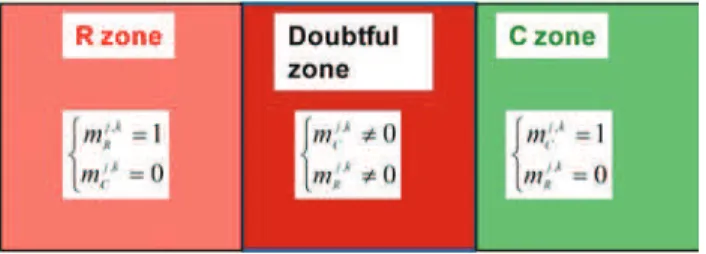
the range offkj(x) to be partitioned into two labels or zones: rejection zone (R zone), that is iffkj(x) belongs to this zone one should categorically exclude including objectuin the corresponding class and classification zone (C zone) where iffkj(x) lays in, one should consider including the objectu in this class; finally there is an overlapping zone where decision of including or excluding is not obvious that we refer to as doubtful zone. Let use define by mj,kR
fkj(x)and mj,kC
fkj(x)the membership degrees of these zones respectively, then description given above is illustrated by Figure 1.
Figure 1: Characterization of R zone, C zone and doubtful zone ofcj with regrads to featurek
Remark 1: The partition of the range offkj(x) in two zones is not necessary a fuzzy discretization, that is, it is not required to have in the doubtful zone the equalitymj,kR
fkj(x)+mj,kC
fkj(x)= 1.
The membership function mj,k×
fkj(x)where × stands forR or C is a degree that measure the extent to which one should reject or consider classifying objectuin the classcj; given an objectuand its attribute
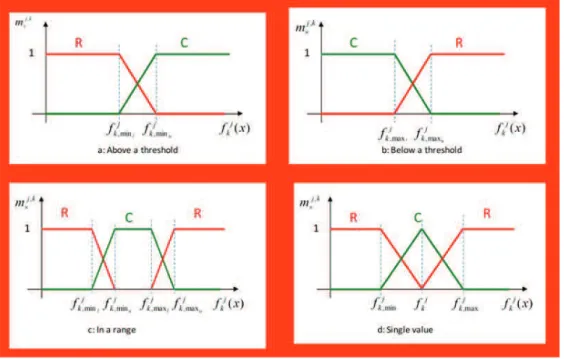
vector x, these membership functions depends on the value of fkj(x); four main typologies characterize the behavior offkj(x) that conditions the classification of objectuin the classcj.
• Above a threshold, that is to consider including the object u in the class cj using only the featurek,
fkj(x) must be greater than a given threshold. To determinemj,kR
fkj(x)andmj,kC
fkj(x)in this case, one must specify a valuefk,jmin
l (lstands for lower) below which classc
j is definitely rejected (R zone)
and the valuefk,jmin
u (ustands for upper) above which one must definitely include the objectuin the
classcj (C zone).
• Below a threshold, that is to consider including the object u in the class cj using only the featurek,
fkj(x) must be less than a given threshold. Determination ofmj,kR
fkj(x)andmj,kC
fkj(x)necessitates specifying a valuefk,jmax
l below which classc
j is definitely considered for inclusion of objectu(C zone)
and the valuefk,jmax
uabove which one must exclude the classc
jfrom the inclusion of objectu(R zone).
• In a range, to consider including the objectuin the classcj using only the featurek,fj
k(x) must belongs
to an interval; here four values must be specified to determine mj,kR
fkj(x)and mj,kC
fkj(x), fk,jmin
l
the value below which andfk,jmax
u the value above which one must exclude the classc
jfor the inclusion
(R zone) of objectuandfk,jmin
u andf
j
k,maxl the values between which one must classify the considered
object in the classcj (C zone).
• Targeted or single value, to consider including the objectuin the classcjusing only the featurek,fj k(x)
must be equal to a given value; three parameters are necessary in order to determinemj,kR
fkj(x)and
mj,kC
fkj(x),fk,jmin the value below which andfk,jmax the value above which one excludes the the class
cj (R zone) and the valuefj
k,min for which one definitely classifies the object in the classcj (C zone). Description of the four typologies determining (R zone) and (C zone) memberships functions is illustrated on Figure 2.
Given an objectuand a classcj,the overall classifiability degree Ψj
C(u) and the overall rejectability degree
ΨjR(u) of the classcjare obtained by aggregating the memberships degreesm j,k
C (.) andm j,k
R (.) for all features k= 1,2, ..., nj as given by equations (1)-(2) ΨjC(u) =GC mj,C1(.), m j,2 C (.), ..., m j,nj C (.) , (1) ΨjR(u) =GR mj,R1(.), m j,2 R (.), ..., m j,nj R (.) , (2)
Figure 2: Characterization of the main typologies of a class feature
where GC and GR are some aggregation operators. Aggregation problem is an important subject in many domains where for a final decision purpose one has to aggregate many values. Many aggregations approach do exist and depend on the behavior of entities to aggregate and the perception of decision maker. In the following paragraph we will review some aggregation operators highlighting the Choquet integral that permits to take into account interactions between entities being aggregated.
2.1.1 Aggregation Operators
Let us consider a set ofnnumeric valuesθi, i= 1,2, ..., n,to be aggregated andGan aggregation operator; many aggregation operators exist in the literature [5], the very basic one being the arithmetic mean; main aggregation operators used in decision analysis literature are recalled below.
• Arithmetic mean: the aggregated value is obtained by equation (3) below
G(θ1, θ2, ..., θn) =
Pn i=1θi
n . (3)
• Quasi arithmetic means (geometric, harmonic, etc.): in this case, the aggregated value is given by equation (4) G(θ1, θ2, ..., θn) =f−1 1 n n X i=1 f(θi) ! , (4)
where f is any continuous strictly monotonic function; one can introduce relative importance weights with regards to elements to aggregate to obtain an aggregated value as given by equation (5) below
G(θ1, θ2, ..., θn) =f−1 n X i=1 ωif(θi) ! (5)
• Median: this is an ordinal operator where the aggregated value is given by the following equation (6) G(θ1, θ2, ..., θn) = ( θ σ(n+1 2 )ifnis odd 1 2 θσ(n 2)+θσ( n 2+1) ifnis even, (6)
whereσ is a permutation over thenvalues such thatθσ(1)≤θσ(2)≤ · · · ≤θσ(n).
• Weighted minimum and weighted maximum: in this caseθiare normalized so that they must belong to
0, 1
and the aggregated values are given by equations (7)-(8)
Gmin(θ1, θ2, ..., θn) = min
i (max (1−ωi, θi)), (7)
Gmax(θ1, θ2, ..., θn) = max
i (min (ωi, θi)), (8)
where the weightsωi are normalized such that maxi(ωi) = 1.
• Ordered weighted averaging operators (OWA): this operator permits the possibility to aggregate with respect to vague statement such as ”at least some criteria must be met” because the relative weights depend on the rank of the corresponding element and the aggregated value is obtained by equation (9)
G(θ1, θ2, ..., θn) =
n X i=1
ωiθσ(i) (9)
where σ is a permutation over the n values such that θσ(1) ≤ θσ(2) ≤ · · · ≤ θσ(n) and ωi ≥ 0 ∀ i,
Pn
i=1ωi= 1;
These operators do have some drawbacks mainly when considering classification problems; they do not cope with interactions between criteria whereas this is common in practice. The aggregation operator known to cope with such interaction is the Choquet integral, see [7]. For this reason we will introduce it in the subsequent paragraphs.
2.1.2 Choquet Integral
When a setN={1, 2, ..., n}of attributes with numerical measures vectorθ=
θ1 θ2 ... θn must be aggregated using Choquet integral, the first and primary thing to do is to define a fuzzy measure or a capacity over the setN; definition of such fuzzy measure or capacity is given below.
Definition 1. [7] LetN ={1,2, ..., n}be a set of nelements. A capacity or fuzzy measure overN is a set functionµ: 2N →[0,1]verifyingµ(∅) = 0, µ(N) = 1, andµ(A)≤µ(B)wheneverA⊆B.
From a capacityµ overN one can determine the interaction index Iij between two elements iand j as given by equation (10) Iij= X A⊆N−{i,j} (|N| − |A| −2)!|A|! (|N| −1)! [µ(A∪ {i, j})−µ(A∪ {i})−µ(A∪ {j}) +µ(A)] , (10)
where|Ω|is the cardinality of the discrete set Ω. This interaction index does have the following meanings.
• Iij>0 means that attributesiandjconsidered individually are not important whereas when considered together they become important; thus there is synergy or complementarity between them.
• Iij < 0 means that attributes i and j are individually important but taken together the importance does not increase much more that is these attributes are substitutable, there is redundancy.
Another interesting index associated with a fuzzy measure and that measures the importance of a given elementiis the so called Shapley indexφi and is defined by equation (11), see [17],
φi= X A⊆N−{i} (|N| − |A| −1)!|A|! |N|! [µ(A∪ {i})−µ(A)] . (11)
Given a capacity overN, the Choquet integral of numerically evaluated vector of attributesθ(that is the global score of the corresponding object) is given as the following definition.
Definition 2. [7]Letµbe a capacity or fuzzy measure overN andθthe numerical values vector of elements ofN. The Choquet integral of θwith regard to µis given by equation (12)
Cµ(θ) = n X i=1
θσ(i)−θσ(i−1)µ(Ai), (12)
whereσ is a permutation overN such that the order of equation (13) is respected
θσ(1)≤θσ(2)≤ · · · ≤θσ(n)andθσ(0)= 0, (13) and the subsetAi is given by equation (14)
Ai={σ(i), σ(i+ 1), ..., σ(n)}. (14) One can see immediately that difficulty of using Choquet integral as an aggregation operator in practice comes from the necessity to define a fuzzy measure that necessitates specifying 2|N|−2 coefficients representing
the measure of subsets of N other than∅ and N. Thus, if the interaction nature (synergy, redundancy or
independence) between elements to aggregate and their importance in terms of Shapley index, for instance, are known, this can guide fuzzy measure definition. Rightly, elements to aggregate in nominal classification are synergetic elements; indeed selection or rejection of a class by two features of an object is better than by a single feature; this observation will be considered in the following paragraph to define a tractable fuzzy measure named weighted cardinal fuzzy measure or WCFM in short.
2.1.3 Weighted Cardinal Fuzzy Measure
As stated in previous paragraph, the difficulty of computing Choquet integral is to define a fuzzy measure over the set N that necessitates obtaining 2|N|−2 coefficients that represent the measure of subsets of N
other than∅ andN. This can be done by experts if the setN is not too large, otherwise by some practical
considerations, such ask-additive fuzzy measure, one can obtain this integral with less computational effort through interaction indices, see [6]. Given the observation made in the previous paragraph concerning the nature of interaction between elements for classification in or rejection of a class, the fuzzy measure of a subset of features should be proportional to the length or cardinality of that subset. A capacity or fuzzy measureµ
overN is said to be cardinal if and only if the following conditions of equation (15) are verified
µ(A) =µ(B) if |A|=|B|,∀A, B⊆N; (15) by so doing only the cardinality of a subset matters and not its content; in addition, this measure is additive. To overcome this inconvenient and the difficulty to obtain a general fuzzy measure for a large set N, we introduce the notion of weighted cardinal measure where the cardinality of the subset is modulated by the relative importance of its elements; indeed some elements may be more or less important for the classification or rejection action. Let us suppose that a relative importance weightωi (with the conditionP
i∈Nωi = 1)
with regards to classification goal is obtained for each element i of N using approaches such as analytic hierarchy process (AHP), see [15]; then we propose to define a fuzzy measure that we refer to as weighted cardinal fuzzy measure (WCFM) by the following equation (16),
µ(A) = |A| |N| ! X i∈A ωi " , ∀A⊆N. (16)
Theorem 1. The measure defined by equation (16) has the following properties. i) It is a non additive fuzzy measure.
ii) It is a synergetic fuzzy measure where the interaction index Iij between two elements iandj associated to it is proportional to the sumωi+ωj of their relative importance weights and is given by equation (17)
Iij= ωi+ωj
|N| . (17)
iii) The Shapley index of elementiassociated with measure (16) is linear in the relative importance degree
ωi of that element and is given by equation (18)
φi= |N|ωi+ 1 2|N| = ωi 2 + 1 2|N|. (18)
Proof. i) It is obvious that relations of equation (19) are verified by measureµdefined in equation (16)
µ(∅) = 0 andµ(N) = 1; (19)
now let us suppose that A⊂B⊆N, then it means that there exists a non empty subsetC ⊂N such thatB=A∪C and A∩C=∅.So we have result of equation (21) forµ(B)
µ(B) = |A|+|C| |N| X i∈A ωi+X i∈C ωi ! (20) =µ(A) +µ(C) + |C| |N| X i∈A ωi ! + |A| |N| X i∈C ωi ! , (21)
meaning that conditions of equation (22) are valid
µ(B)> µ(A) +µ(C), (22)
because asC6=∅,we have condition of (23)
|C| |N| X i∈A ωi ! + |A| |N| X i∈C ωi ! >0. (23)
Conditions of equations (19) and (22) imply thatµreally defines a non additive fuzzy measure. ii) One can easily verify result of equation (24)
µ(A∪ {i, j})−µ(A∪ {i})−µ(A∪ {j}) +µ(A) = ωi+ωj
|N| , (24)
so that the interaction indexIij as defined by equation (10) is given by equation (26)
Iij= X A⊆N−{i,j} (|N| − |A| −2)!|A|! (|N| −1)! ωi+ωj |N| (25) = ωi+ωj |N| X A⊆N−{i,j} (|N| − |A| −2)!|A|! (|N| −1)! . (26)
But there are (|N| −2)!/(|N| − |A| −2)!|A|! subsets ofN− {i, j}containing|A|elements, thus we have following results of equations (27)-(28)
X A⊆N−{i,j} (|N| − |A| −2)!|A|! (|N| −1)! = |N|−2 X |A|=0 (|N| −2)! (|N| − |A| −2)!|A|! (|N| − |A| −2)!|A|! (|N| −1)! (27) = |N|−2 X |A|=0 (|N| −2)! (|N| −1)! = 1 (|N| −1) |N|−2 X |A|=0 {1}= 1, (28)
iii) One can verify easily equation (29) µ(A∪ {i})−µ(A) = ωi |N|+ |A| |N|ωi+ P k∈A(ωk) |N| , (29)
so that the Shapley index as given by equation (11) is reduced to (37)
φi= X A⊆N−{i} (|N| − |A| −1)!|A|! |N|! ωi |N|+ |A| |N|ωi+ P k∈A(ωk) |N| (30) = ωi |N| X A⊆N−{i} (|N| − |A| −1)!|A|! |N|! + ωi |N| X A⊆N−{i} (|N| − |A| −1)!|A|! |N|! |A| + X A⊆N−{i} (|N| − |A| −1)!|A|! |N|! P k∈A(ωk) |N| (31) = ωi |N| |N|−1 X |A|=0 (|N| − |A| −1)!|A|! |N|! (|N| −1)! |A|! (|N| −1− |A|)! + ωi |N| |N|−1 X |A|=0 (|N| − |A| −1)!|A|! |N|! (|N| −1)! |A|! (|N| −1− |A|)! |A| + X A⊆N−{i} (|N| − |A| −1)!|A|! |N|! P k∈A(ωk) |N| (32) = ωi |N|+ ωi |N| |N|−1 X |A|=0 |A| |N| + X A⊆N−{i} (|N| − |A| −1)!|A|! |N|! P k∈A(ωk) |N| (33) = ωi |N|+ ωi |N| |N|(|N| −1) 2|N| + X A⊆N−{i} (|N| − |A| −1)!|A|! |N|! P k∈A(ωk) |N| (34) = ωi(|N|+ 1) 2|N| + X A⊆N−{i} (|N| − |A| −1)!|A|! |N|! P k∈A(ωk) |N| . (35)
By rearranging the second term of equation (35) considering the fact that each weight ωk will appear
|A|
|N|
(|N|−1)!
|A|!(|N|−1−|A|)!
times in subsets of dimension|A|we obtain the following equations (36)-(37)
φi= ωi(|N|+ 1) 2|N| + |N|−1 X |A|=0 ( (|N| − |A| −1)!|A|! |N|! |A| |N| −1 (|N| −1)! |A|! (|N| −1− |A|)! P k∈N−{i}(ωk) |N| !) (36) = ωi(|N|+ 1) 2|N| + |N|−1 X |A|=0 ( |A| |N|(|N| −1) P k∈N−{i}(ωk) |N| !) . (37) But we haveP
k∈N−{i}(ωk) = 1−ωi so thatφiis given by equation (41) which concludes the proof of
φi= ωi(|N|+ 1) 2|N| + 1−ωi |N| |N|−1 X |A|=0 |A| |N|(|N| −1) (38) = ωi(|N|+ 1) 2|N| + 1−ωi |N| 1 |N|(|N| −1) |N|(|N| −1) 2 (39) = ωi(|N|+ 1) 2|N| + 1−ωi 2|N| (40) φi= ωi|N|+ 1 2|N| = ωi 2 + 1 2|N| (41)
It is straightforward that this index fulfills one of the important point of Shapley index axioms that is we have result of equation (42)
|N| X i=1 φi= |N| X i=1 ωi|N|+ 1 2|N| = |N|+|N| 2|N| = 1. (42)
Furthermore, we see that the Shapley index (a sort of absolute importance) is not null even for an element with a null relative importance, this is due to synergetic property.
Calculating the Choquet integral with a weighted cardinal fuzzy measure is straightforward and depend only on the relative weight vectorωand the numericalndimension vectorθof values to aggregate; denoting this integral byCwcf m
ω (θ),it is therefore given by equation (43)
Cωwcf m(θ) = n X k=1 n−(k−1) n X j∈Ak ωj θσ(k)−θσ(k−1) , (43)
where σ is a permutation over N such that the order of equation (13) is realized and Ak is defined by in equation (14).
2.1.4 Classifiability and Rejectability Measures
Based on results of equation (43), given an object u characterized by its attributes vector and a class cj
with its features vector fkj(x) for k = 1 : nj and their relative importance vector ωj one first determines
classifiability and rejectability membership functions vectors mjC(.) and m j
R(.) as defined previously and
compute the aggregated classifiability index ΨjC(u) and the aggregated rejectability index Ψ j
R(u) as Choquet
integral of mjC(.) and m j
R(.) based on a WCFM represented by relative weight vector ωj as given by the
following equations (44)-(45): ΨjC(u) =C wcf m ωj (m j C(.)) = nj X k=1 (( nj−(k−1) nj ! X l∈Ak ωl ") mj,σC (k)(.)−m j,σ(k−1) C (.) ) , (44) ΨjR(u) =C wcf m ωj (m j R(.)) = nj X k=1 (( nj−(k−1) nj ! X l∈Ak ωl ") mj,σR (k)(.)−m j,σ(k−1) R (.) ) . (45)
But the classifiability or rejectability is a relative operation so that one must ultimately establish a sort of inter classes adequacy measures. To this end the ultimate classifiability measure ψCj(u) and rejectability
measureψRj(u) of an objectuwith regard to the classcj are given by equation (46)
ψjC(u) = ΨjC(u) Pn k=1 n ΨjC(u) o andψ j R(u) = ΨjR(u) Pn k=1 n ΨjR(u) o. (46)
In the following subsection, we will sketch some classification procedures, based on measuresψCj(u) and ψjR(u), that may be used for final assignment purpose.
2.2
Classification Procedure
Given an object u, possible classes where it can be included are those for which the classifiability measure exceeds the rejectability measure to some extents. To ensure some security when including an object, one may introduce a caution index q so that one can consider including an objectu in a class cj if and only if
the classifiability measureψjC(u) exceeds the rejectability measureψ j
R(u) multiplied by the index of caution q; thus the possible inclusion setCq(u) for the objectuat the caution indexq is given by equation (47)
Cq(u) = n cj ∈ C:ψCj(u)≥qψ j R(u) o . (47)
Remark 2: In fact the indexq may be an increasing function of rejectability measure ψRj(u) in order to
take into account misclassification aversion of decision maker who may want to penalize large rejectability measure.
For final class selection, one may consider optimizing some performance index. For instance if decision makers are able to specify the caution indexq, then the final optimal classc∗(u) for a given objectu can be
considered to be themaximum discriminant one that is given by equation (48)
c∗(u) = arg max cj∈Cq(u) n ψCj(u)−qψ j R(u) o . (48)
On the contrary, when there is no information about the desired caution index, the assigned classc∗(u) can
naturally be chosen to maximize this index (maximum index of caution) that in return minimize risk of misclassification; in this case the optimal inclusion classc∗(u) for a given objectu is given by the following
equation (49) c∗(u) = arg ( max cj∈U ( ψCj(u) ψRj(u) )) . (49)
In the next section we will consider an application in the domain of banking to show potential applicability of the approach developed in this paper.
3
Application
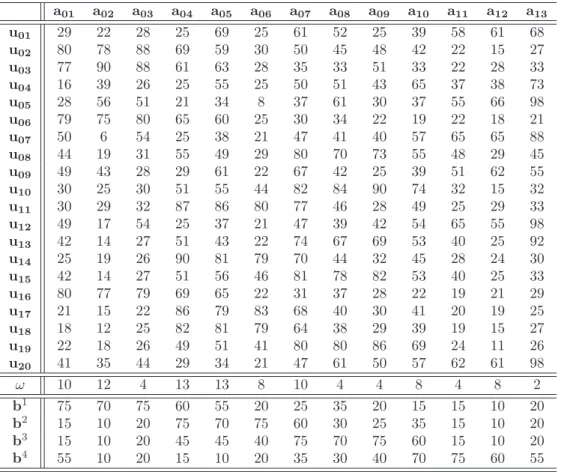
This application is extracted from [13] and concerns the problem of assigning retailers that use EFTPoS (Electronic Fund Transfer at Point of Sale) service of a bank to some classes in order for the bank manager to consider their appropriate strategic treatment. Any retailer is characterized by 13 attributes or criteria, see [13] for their significance and there are four classes which are characterized by conditions in the form of above a threshold on each attribute in terms of parameterbj. Raw data of this application is shown on the
following Table 1.
To fit our model we consider the doubtful zone of each attribute to range fromδ% of the threshold to the threshold so that the the parameterδ can be used to do a sensitivity analysis. Let denote byX the 20×13 matrix representing the characterization of units to classify as shown on the previous table. From this table classifiability and rejectability membership functions dataXC andXR are obtained by equation (50)
mj,kC (u) = 0 andm j,k R (u) = 1 ifX(u, j)≤ δ 100b k(j) mj,kC (u) = 1 andm j,k R (u) = 0 ifX(u, j)≥b k(j) mj,kC (u) = 1 bk(j)− δ 100bk(j) X(u, j)− δ 100b k(j) if δ 100b k(j)< X(u, j)<bk(j) mj,kR (u) =− 1 bk(j)− δ 100bk(j) X(u, j)−bk(j) if δ 100b k(j)< X(u, j)<bk(j). (50)
Classifiability and rejectability indices are then given by equation (51) ψjC(u) = Cwcf m ω mjC(u) P l n Cωwcf m mlC(u) o andψ j R(u) = Cwcf m ω mjR(u) P l n Cωwcf m mlR(u) o, (51)
where the weighted cardinal fuzzy measure µis related to weighting vector ω obtained by normalization of original weighting vector as given by equation (52)
ω(j) =P13ω(j)
j=1ω(j)
. (52)
Table 1: Raw data
a01 a02 a03 a04 a05 a06 a07 a08 a09 a10 a11 a12 a13 u01 29 22 28 25 69 25 61 52 25 39 58 61 68 u02 80 78 88 69 59 30 50 45 48 42 22 15 27 u03 77 90 88 61 63 28 35 33 51 33 22 28 33 u04 16 39 26 25 55 25 50 51 43 65 37 38 73 u05 28 56 51 21 34 8 37 61 30 37 55 66 98 u06 79 75 80 65 60 25 30 34 22 19 22 18 21 u07 50 6 54 25 38 21 47 41 40 57 65 65 88 u08 44 19 31 55 49 29 80 70 73 55 48 29 45 u09 49 43 28 29 61 22 67 42 25 39 51 62 55 u10 30 25 30 51 55 44 82 84 90 74 32 15 32 u11 30 29 32 87 86 80 77 46 28 49 25 29 33 u12 49 17 54 25 37 21 47 39 42 54 65 55 98 u13 42 14 27 51 43 22 74 67 69 53 40 25 92 u14 25 19 26 90 81 79 70 44 32 45 28 24 30 u15 42 14 27 51 56 46 81 78 82 53 40 25 33 u16 80 77 79 69 65 22 31 37 28 22 19 21 29 u17 21 15 22 86 79 83 68 40 30 41 20 19 25 u18 18 12 25 82 81 79 64 38 29 39 19 15 27 u19 22 18 26 49 51 41 80 80 86 69 24 11 26 u20 41 35 44 29 34 21 47 61 50 57 62 61 98 ω 10 12 4 13 13 8 10 4 4 8 4 8 2 b1 75 70 75 60 55 20 25 35 20 15 15 10 20 b2 15 10 20 75 70 75 60 30 25 35 15 10 20 b3 15 10 20 45 45 40 75 70 75 60 15 10 20 b4 55 10 20 15 10 20 35 30 40 70 75 60 55
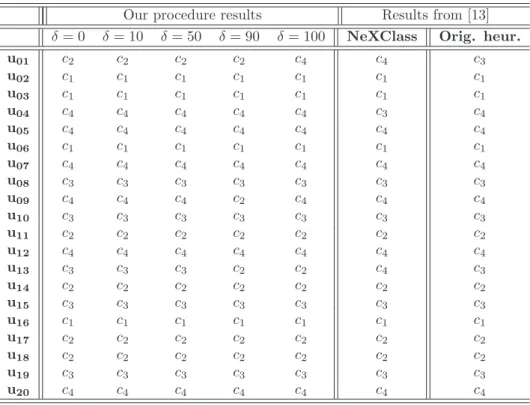
The two classification approaches in terms of equation (48) with a caution indexq= 1 and equation (49) lead to the same results given on the following Table 2; on this table are also reported results obtained by the classification approach developed in [13] and namedNeXClassas well as original heuristic used by managers before approach developed in [13].
When comparing to the heuristic originally used by mangers as a benchmark, we see that our approach performs better than the NexClass algorithm developed by [13] with in general less than 3 misclassification whereas results of [13] present 3 misclassifications. Though, the main goal of this paper is not to propose a numerically superior algorithm for nominal classification, (it rather proposes a structured framework to capture practical aspects of near human ways to classify), this application nevertheless shows that the proposed approach performs well numerically.
Table 2: Results of application
Our procedure results Results from [13]
δ= 0 δ= 10 δ= 50 δ= 90 δ= 100 NeXClass Orig. heur. u01 c2 c2 c2 c2 c4 c4 c3 u02 c1 c1 c1 c1 c1 c1 c1 u03 c1 c1 c1 c1 c1 c1 c1 u04 c4 c4 c4 c4 c4 c3 c4 u05 c4 c4 c4 c4 c4 c4 c4 u06 c1 c1 c1 c1 c1 c1 c1 u07 c4 c4 c4 c4 c4 c4 c4 u08 c3 c3 c3 c3 c3 c3 c3 u09 c4 c4 c4 c2 c4 c4 c4 u10 c3 c3 c3 c3 c3 c3 c3 u11 c2 c2 c2 c2 c2 c2 c2 u12 c4 c4 c4 c4 c4 c4 c4 u13 c3 c3 c3 c2 c2 c4 c3 u14 c2 c2 c2 c2 c2 c2 c2 u15 c3 c3 c3 c3 c3 c3 c3 u16 c1 c1 c1 c1 c1 c1 c1 u17 c2 c2 c2 c2 c2 c2 c2 u18 c2 c2 c2 c2 c2 c2 c2 u19 c3 c3 c3 c3 c3 c3 c3 u20 c4 c4 c4 c4 c4 c4 c4
4
Conclusion
The problem of fuzzy nominal classification, that consists in an assignment of objects characterized by many attributes to predefined classes characterized by fuzzy features or conditions, has been considered in this paper. The method considered to formulate the classification model highlights the bipolarity that exist between the realization of a feature and the inclusion of the considered object in a class. As humans proceed in practice by balancing “pros” and “cons” during a decision process, this approach proposes, for a pair constituted by an object to be classified and a class, derivation of two measures: theclassifiability that is a degree measuring to what extent this object can be included in that class and therejectability that measures the degree to which one should avoid including the considered object into the specified class. As these measures are obtained using Choquet integral as an aggregation operator and based on the fact that elements to aggregate behave in synergetic way, an easy to compute fuzzy measure known as weighted cardinal fuzzy measure (WCFM) has been proposed; interaction index and Shapley index associated to this measure have been completely characterized. The application of this approach to a real world problem has shown real potentiality.
References
[1] Belacel, N., Multicriteria assignment method PROAFTN: methodology and medical applications,European Jour-nal of OperatioJour-nal Research, Elsevier, vol.26, pp.22–34, 2000.
[2] Brans, J.P., B. Mareschal, and Ph. Vincke, PROMETHEE: a new family of outranking methods in multicriteria analysis,Operational Research, vol.84, pp.477–490, 1984.
[3] Brans, J.P., B. Mareschal, and Ph. Vincke, How to select and how to rank projects: the PROMETHEE method,
European Journal of Operational Research, vol.24, pp.228–238, 1986.
[4] Doumpos, M., and C. Zopounidis, Multi-criteria classification methods in financial and banking decisions, Inter-national Transactions in Operations Research, vol.9, pp.567–581, 2002.
[5] Grabisch, M., The application of fuzzy integrals in multicriteria decision making,European Journal of Operational Research, vol.89, no.3, pp.445–456, 1996.
[6] Grabisch, M.,k-order additive discrete fuzzy measures and their representation, Fuzzy Sets & Systems, vol.92,
pp.167–189, 1997.
[7] Grabisch, M., A graphical interpretation of the Choquet integral,IEEE Transactions on Fuzzy Systems, vol.8, no.5, pp.627–631, 2000.
[8] Guzman, L.M.,Fuzzy Measures and Integrals in MCDA Sorting Problematic: Methodology and Application to Diagnostics of Firms, Ph.D. Thesis, University of Brussels, 2003.
[9] Hurson, C., and C. Zopounidis,Gestion de Portefeuilles et Analyse Multicrit`ere, Economica, 1997.
[10] Leger, J., and J.-M. Martel, A multicriteria assignment procedure for nominal sorting problematic, European Journal of Operational Research, vol.138, pp.175–183, 2002.
[11] Perny, P., Multicriteria filtering methods based on concordance and non-discordance principles,Annals of Oper-ations Research, vol.80, no.1, pp.137–166, 1998.
[12] Pomerol, J.-C., and S. Barba-Romero,Choix Multicrit`ere Dans L’entreprise, Principe et Pratique, Hermes, Paris, 1993.
[13] Rigopoulos, G., J. Psarras, and D.Th. Anskounis, A decision support system for supervised assignment in banking decisions,Journal of Applied Science, vol.8, no.3, pp.443–452, 2008.
[14] Roy, B., and D. Bouyssou,Aide Multicritere a la Decision: Methodes et Cas, Edition Economica, 1993.
[15] Saaty, T.,The Analytic Hierarchical Process: Planning, Priority, Resource Allocation, McGraw Hill, New York, 1980.
[16] Saaty, T., The Analytic Network Process: Decision Making with Dependence and Feedback, RWS Publications, Pittsburgh, 2005.
[17] Shapley, L.S., A value for n-person games, Contribution to the Theory of Games, vol.2, pp.307–317, Princeton University Press, 1953.
[18] Steuer, R.E.,Multicriteria Optimization: Theory, Computation, and Application, Wiley, New York, 1986. [19] Stirling, W.C.,Satisficing Games and Decision Making: with Applications to Engineering and Computer Science,
Cambridge University Press, 2003.
[20] Tchangani, A.P., Selectability/rejectability measures approach for nominal classification, Journal of Uncertain Systems, vol.3, no.4, pp.257–269, 2009.
[21] Tchangani, A.P., Considering bipolarity of attributes with regards to objectives in decisions evaluation,Inzinerine Ekonomika-Engineering Economics, vol.21, no.5, pp.475–484, 2010.
[22] Tchangani, A.P., and F. P´er`es, BOCR Framework for Decision Analysis,Proceedings of 12th IFAC Symposium on Large Scale Complex Systems Theory and Applications, vol.9, Part 1, 2010.
[23] Tchangani, A.P., Y. Bouzarour, and F. P´er`es, Evaluation model in decision analysis: bipolar approach, INFOR-MATICA: an International Journal, vol.23, no.3, pp.461–485, 2012.
[24] Vincke, Ph.,L’aide Multicritere a la Decision, Editions de l’Universite Libre de Bruxelles, 1989.
[25] Wang, X.,Country Risk Classification and Multicriteria Decision-aid, MSc. Thesis, School of Graduate Studies, McMaster University, 2004.
[26] Yevseyeva, I., K. Miettinen, P. Salminen, and R. Lahdelma, SMAA-Classification: a new method for nominal classification, Helsinki School of Economics, Working Paper, http://hsepubl.lib.hse.fi/pdf/wp/w422.pdf, 2007.