An Endogenous Threshold Analysis
Fabrizio Coricelli, Paris School of Economics and CEPR Nigel Driffield, Aston Business School
Sarmistha Pal*, Brunel University & IZA
Isabelle Roland, London School of Economics 19 April 2013
Abstract: The paper aims to bridge the gap between the literature on optimal capital structure and the wider macro literature on finance-growth nexus. On the basis of the trade-off theory of capital structure, we posit a non-linear relationship between leverage and productivity growth at the firm level. We test this hypothesis using a threshold regression model of Hansen (2000). Estimates for a sample of Central and Eastern European countries confirm that TFP growth increases with leverage until the latter reaches a critical threshold beyond which leverage becomes “excessive” and lowers TFP growth. This result points to the existence of an optimal leverage ratio where the net benefits of debt in terms of productivity gains are exhausted. Despite some variation depending on the sample and the measure of leverage, the estimates seem quite robust.
Keywords: Trade-off theory; optimal leverage; TFP growth; non-linear relationship; threshold regression; Instrumental variable.
JEL classification: G32, O16
* Corresponding author Sarmistha Pal: [email protected]. An earlier version of the paper has been circulated as ‘Excess Leverage and Productivity Growth in Emerging Economies: Is there a threshold effect?. Financial support to Nigel Driffield and Sarmistha Pal from ESRC grant RES-062-23-0986 is gratefully acknowledged. We are very grateful to Sourafel Girma and Michael Henry for assistance with the estimation of the threshold model. We thank Yama Temouri for research assistance and Erik Berglof, Ralph de Haas, Bruce Hansen, Peter Sanfey, Ilya Strebulaev, Jeffrey Wooldridge, Jeromin Zettelmeyer and seminar participants at Aston Business School, UCL, EBRD and CICM conference, London for helpful comments and suggestions on an earlier draft. The usual disclaimer applies.
When Does Leverage Hurt Firm Performance?
An Endogenous Threshold Analysis
1. Introduction
The global financial crisis has revived the interest on the “excesses” in financial markets and in particular on the risks of excessive expansion of credit at the macroeconomic level. In a recent paper titled “Too much finance”, Arcand et al. (2011) find a threshold level of domestic credit to the economy, after which output begins to fall. Similar non-linearity in the relationship between debt and growth is found by Reinhart and Rogoff (2010) for the case of public debt. In this paper we search for possible non-linearities and threshold effects at the firm-level.
Corporate leverage decisions are among the most important decisions made by firm executives, and have been the focus of intense scrutiny since Modigliani and Miller (1958). Financial conditions in the corporate sector not only affect firm performance but, as macroeconomists have long recognized, they can have a powerful effect on macroeconomic outcomes. The literature on “financial accelerators” is concerned with the role of financial conditions in amplifying shocks to the economy (see e.g. Bernanke et al. (1999)) while the literature on the finance-growth nexus (e.g., see Ang (2008) for a recent survey) is concerned with their contribution to long-term growth. The present paper aims to bridge the gap between the literature on optimal capital structure and the macro literature on finance-output-growth linkages. We employ endogenous threshold regressions to investigate the impact of leverage on total factor productivity (TFP) growth at the firm level, and the extent to which this varies across types of firms. Our focus on productivity growth as an index of firm performance is further justified in view of a recent McKinsey Global Institute Report (2010) which argues that productivity rather than profitability needs to be the focus of the companies during a period of public spending austerity in Europe because increased productivity will directly result in improved profitability. Estimates for a sample of Central and Eastern European countries suggest that TFP growth increases with leverage until the latter reaches a critical threshold that we label optimal leverage beyond which leverage becomes “excessive” and lowers TFP growth. In what follows, we show how our paper relates to and contributes to the literature on optimal capital structure and finance-growth literature.
Our paper builds upon trade-off theories of optimal capital structure, which explain firms’ choice of leverage by a trade-off between the benefits and costs of debt. The hypothesis goes back to Kraus and Litzenberger (1973) who weigh bankruptcy costs against the benefits of interest tax shields. The benefits of debt also include the mitigation of agency problems. In particular, debt has a disciplining role due to the associated reduction in free cash flow (Jensen, 1986). The costs of debt include debt overhang (Myers (1977)), risk-shifting (Jensen and Meckling (1976)), bankruptcy costs (Warner (1977)), and asset fire sales (Schleifer and Vishny (1992)). The trade-off theory predicts that net benefits to debt financing rise for companies with low debt but decrease as leverage becomes high, implying that net benefits are a nonlinear function of leverage. The empirical literature tests this hypothesis (against the competing pecking order theory) by typically running cross-sectional or panel regressions of leverage on various firm-level, industry-level and market characteristics that determine optimal leverage (see Frank and Goyal (2009) for a review of the literature). While the literature has explored the relationship between leverage and firm value or performance (e.g., McConnell and Servaes (1995); Berger and di Patti (2006); Driffield, Mahambare and Pal (2007)), it has remained silent on the relationship between leverage and productivity. With both benefits and costs to leverage, we posit a hump-shaped relationship between leverage and productivity growth at the firm level. At low levels of leverage, higher leverage is likely to be associated with higher TFP growth as the benefits to leverage outweigh the costs and debt is used to finance productive investment. As leverage increases, the costs of debt become larger and erode the net benefits to leverage. Highly-levered firms not only suffer from a debt overhang problem, which reduces their incentives to invest in productive investment, their attention is also diverted from productivity improvements by the need to generate cash flow in order to service their debts.
Central and eastern European transition countries are an important case in point, that have been characterized by episodes of credit boom prior to the global financial crisis, followed by a bust during the latest financial crisis. The transition experience has long been described as a “natural experiment” (see for example, Eicher and Schreiber (2010)). While transition countries started the transition process from similar (though not identical) positions in terms of liberalisation, institutional reform has progressed in varying ways and to different degrees. Even after more than a decade of reforms, there is a growing feeling that the latter have failed to spur adequately the
development of corporate financing opportunities. There is a striking proportion of firms in our sample with zero outstanding debt, including both short- and long-term debt. The “mystery of zero-leverage firms” (Strebulaev and Yang (2006)) is very pronounced in transition countries. This puzzle is augmented by another one: among those firms with outstanding debt, many tend to have very high, potentially excessive, leverage. Unlike much of the literature on developed countries, the literature on capital structure in developing and transition countries has highlighted the importance of excess leverage (e.g. see Driffield and Pal (2010)). Second, many CEE countries have experienced rapid credit growth in recent years, in particular the Baltic States, Southern Eastern Europe and Ukraine. While the benefits of rapid credit growth have been recognized, the risks related to credit booms have been highlighted by the recent financial crisis, which has hit some CEE countries very hard. Assessing the sustainability of firm-level credit growth and developing appropriate policy tools remains one of the priorities of many policymakers and international organizations active in this region. In addition, the continued practice of soft budget constraints in this region may contribute to the negative impact of excessive leverage on TFP growth1 in our
sample. Soft budget constraints (SBCs) imply that government or financial institutions are willing to provide additional financing to firms with negative NPV projects (see e.g. Dewatripont and Maskin (1995)). If firms take advantage of SBCs, borrowed funds may be used inefficiently rather than for productive investment. Research has indeed shown that one of the detrimental impacts of SBCs on the economy is a lack of R&D (Kornai (2001) and Brücker et al. (2005)). The sample thus provides sufficient inter-temporal and cross-sectional variation to be informative, without generating excessive heterogeneity.
Our estimates confirm that TFP growth increases with leverage until the latter reaches a critical threshold beyond which leverage becomes “excessive” and lowers TFP growth. We confirm the robustness of this result by estimating an alternative threshold model using lagged leverage. All results point to the existence of an optimal leverage ratio where the net benefits of debt in terms of productivity gains are exhausted. Our paper reaches some qualitatively similar conclusions to Korteweg (2010). Using a different methodology and a market-based assessment of the net benefits to leverage, the author finds that as leverage increases, net benefits to leverage first increase and then decrease, and finally turn negative for distressed firms. In addition, our analysis sheds light on
1
how optimal leverage varies with firm characteristics, particularly profitability and size. Our results provide support for the trade-off theory of capital structure. In particular, they highlight a positive (negative) relationship between profitability (size) and optimal leverage, unlike existing studies that use traditional cross-sectional or panel regressions. The threshold model allows us to determine optimal leverage despite firms’ temporary deviations from the optimum in contrast to existing empirical evidence, which is based on observed leverage ratios (e.g. Korajczyk and Levy (2003)). Korteweg (2010) reaches similar conclusions.
Our paper also contributes to the burgeoning maco literature on finance-growth nexus. Best practice in the recent literature on finance and growth uses industry-level data to overcome endogeneity problems typical of analyses that rely on aggregate data and identify the channel through which finance affects growth. In their seminal contribution, Rajan and Zingales (1998) find that industries that are relatively more dependent on external finance grow disproportionately faster in countries with more developed financial markets. Our paper provides an alternative approach for studying the finance-growth nexus by directly linking firms’ financial structure to TFP growth. In addition, our paper is related to the literature on the macroeconomic risks associated with lending booms. Kiyotaki and Moore (1997) show how increases in corporate leverage lead to higher costs of external financing due to a higher default probability. This could lower investment and therefore output. Kiyotaki and Moore (1997) and Bernanke et al. (1999) show how high indebtedness in the corporate sector can induce severe slowdowns by amplifying and propagating adverse shocks to the economy. Our analysis provides a tool for policy-makers to identify the point at which corporate sector indebtedness becomes a cause for concern. Indeed, whether a firm is below or above the threshold can be seen as a measure of “sustainability” of a firm’s leverage. The recent financial crisis has highlighted the risks of lending booms and the associated buildup of excessive indebtedness. Policy makers need to be able to assess the sustainability of leverage, both in order to prevent similar crises in the future and to identify those firms or sectors of the economy that need to go through a deleveraging process following a crisis. The empirical literature on lending booms has generally focused on various aggregate measures of indebtedness such as various debt-to-GDP ratios (e.g. see Gourinchas et al. (2001)), or the growth rate of the domestic credit to GDP ratio as in the literature on banking and currency crises (e.g. see Kaminsky and Reinhart (1999)). Our paper extends this literature by looking at the sustainability of credit at the firm level.
The remainder of the paper is structured as follows. In Section 2, we describe the data set and the variables used in the empirical analysis. In Section 3, we discuss the empirical methodology and present our results. Section 4 summarizes our main results.
2. Data set and descriptive statistics
2.1. Sample and sources
The empirical test of our central hypothesis is based on firm-level data for a group of Central and Eastern European (CEE) countries. Data used for the analysis is primarily taken from Orbis, a rich firm-level dataset, which is provided by Bureau van Dijk electronic publishing. Firm-level data have been supplemented by country-level institutional data from the European Bank for Reconstruction and Development (EBRD). Our sample consists of manufacturing firms from sixteen transition countries, namely, Bosnia and Herzegovina, Bulgaria, Croatia, the Czech Republic, Estonia, Hungary, Latvia, Lithuania, Poland, Republic of Moldova, Romania, Russia, Serbia, the Slovak Republic, Slovenia and Ukraine over the period 1999-2008. As can be seen from Figure 1, all these countries have on average experienced strong growth of domestic credit between 1998 and 2008. The effects of the Russian crisis, the bursting of the dotcom bubble and the financial crisis starting in 2007 visibly translated into a slowdown.
[Insert Figure 1 here]
2.2. Leverage measures and descriptive statistics
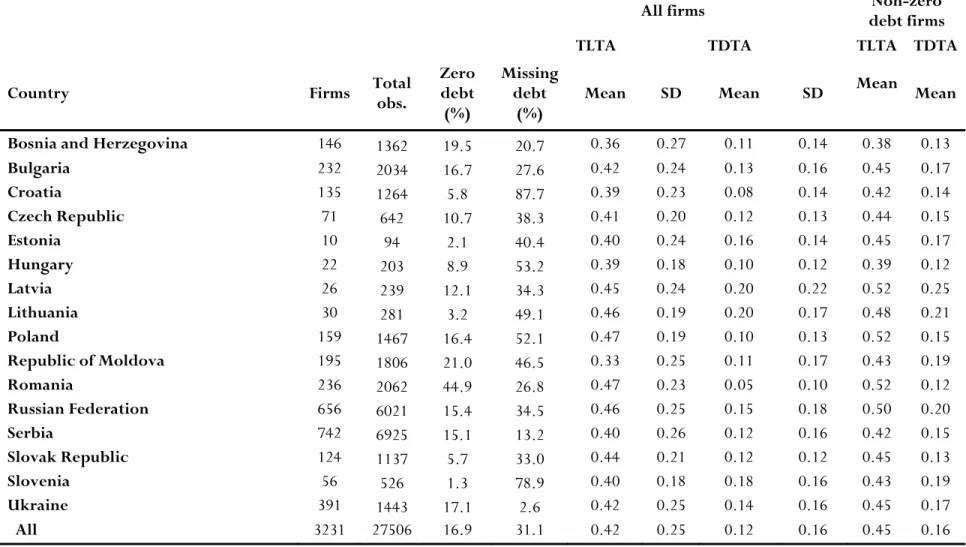
We use two different measures of leverage, generally dictated by data availability. First, we use the ratio of total debt (short-term and long-term debt) to total assets (abbreviated as TDTA). Second, we use the ratio of total liabilities to total assets (abbreviated as TLTA)2. As can be seen from Table
1, there is a significant proportion of zero-leverage firms, without any outstanding debt, as well as a
2
While we do not observe the market value of equity, there is information on the book value of equity; there are however too many missing observations for this data to be of use.
significant proportion of firms for which debt data is missing. This reflects the fact that many firms still do not have access to debt markets in these economies and instead make heavy use of internal finance, trade credit and other kinds of liabilities. Accordingly, the sample size is larger when leverage is measured by TLTA.
[Insert Table 1 here]
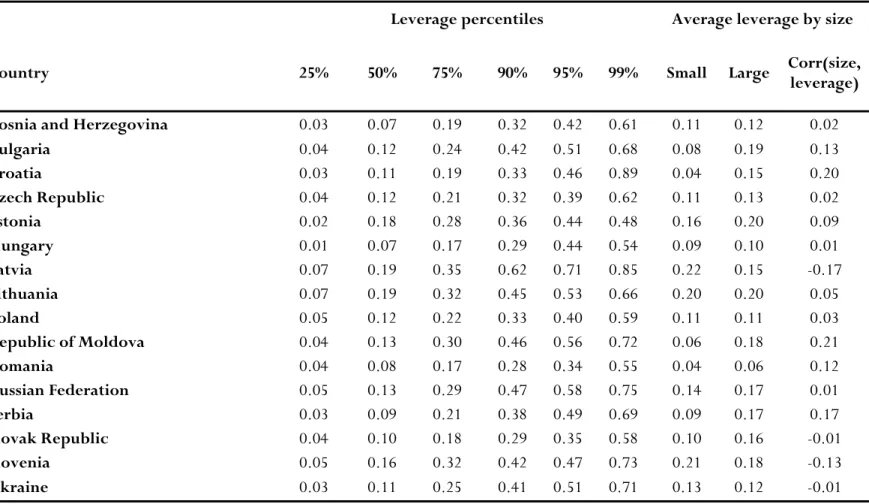
Table 1 shows the two average leverage ratios for each sample country. The table shows the average leverage ratios for two subsamples, “all firms”, including zero-leverage firms, and “non-zero debt firms”, excluding zero-leverage firms. Among all firms, the average ratios of total liabilities to total assets range between 0.33 (Moldova) and 0.47 (Poland, Romania), while average debt ratios range between 0.05 (Romania) and 0.20 (Latvia and Lithuania). Among non-zero debt firms, the average debt ratios are unsurprisingly higher in all the sample countries, ranging from 0.13 in Romania to 0.25 in Latvia3. Table 2 shows the percentile distribution of debt ratios in each country. One can
identify a general trend from these distributions; clearly, the debt ratios increase monotonically as we move from the lowest quartile to the top end of the distribution. In particular, debt ratios among the top 1% firms tend to be significantly higher than those for the median firms. Debt ratios for this group of firms exceed 50% in all but one country (Estonia). The maximum average leverage for this group is 89% in Croatia, closely followed by 85% in Latvia.
[Insert Table 2 here]
Table 2 also summarizes the distribution of debt by firm size. We split the sample between “small” and “large” firms, where small firms are defined as those in the first two quartiles of the distribution of total assets. The correlation between firm size and the debt ratio is mostly positive, although it is quite small in some cases. A large positive correlation is found in Bulgaria, Croatia, Moldova, Serbia, which is in line with the US and international cross-sectional evidence that large firms tend to have higher leverage ratios than small firms4.
3 We have also experimented with alternative leverage measures, namely, debt and liability ratios net of cash-flow, which yield comparable results to those presented here.
As mentioned earlier, institutional reforms in the financial sector have progressed at varying speeds across countries in our sample. Table 3 summarizes the average values of the EBRD banking sector reform index and stock market capitalization to GDP for the period 1999-2008. The extent of stock market capitalization as a share of GDP is generally limited in most of the sample countries, especially in Bulgaria, Latvia, Romania and the Slovak Republic. Therefore, firms’ external financing opportunities may depend crucially on the size and efficiency of the banking sector. The extent of banking sector reforms varies widely across countries as can be seen from Table 3.
[Insert Table 3 here]
Although a full investigation of the role of institutions is beyond the scope of this paper, we will include these two “institutional” variables in the threshold regression. It can be argued that a more efficient banking sector is better able to screen out bad loans while a better developed stock market not only offers an alternative source of external finance, but also contributes to improved corporate governance practices. Given the variation in the extent of institutional reforms across our sample countries, it may be important to control for the quality of financial institutions when assessing the effect of leverage on TFP growth.
3. Empirical model of leverage and productivity growth
We use the threshold regression framework of Hansen (2000) in order to test the hypothesis of a non-linear relationship between leverage and productivity growth5. As a robustness check, we
account for the potential endogeneity of leverage using an instrumental variable (IV) threshold model following Kourtellos et al. (2009). Finally, we look at the relationship between the identified threshold and firm characteristics, namely profitability and size.
3.1. Total factor productivity estimates
5
In order to identify the non-linear effects of leverage on total factor productivity growth, one could use a fixed-effects regression of total factor productivity growth on leverage and its non-linear terms, after controlling for other
covariates. However this conventional method does not allow one to endogenously determine the existence and significance of a threshold beyond which TFP growth is negatively affected by further increases in debt.
TFP estimates are generated using the well-known Levinsohn-Petrin method (Levinsohn and Petrin (2003)). This method allows us to address a potential endogeneity problem which arises because firms anticipate shocks to productivity and accordingly adjust inputs throughout the production process. Appendix 1 explains how the Levinsohn-Petrin method helps to address this problem. 3.2. A threshold regression model
The current approach to threshold analysis was pioneered by Hansen (2000). The fundamental advantage of this approach is that the threshold model endogenously determines the existence and significance of one or more breaks (and the corresponding confidence intervals around the values), if one believes there exist nonlinearities in relationships between variables. In this case, we investigate the threshold values in the relationship between leverage and tfp growth, which in turn enables us to obtain a direct estimation of optimal leverage (despite allowing for firm’s temporary deviations from the optimum). Denoting the leverage of the i-th firm in year t by Lit, the simplest
threshold model of TFP growth for the period [t, t+1] is given by
ΔTFPit+1 = α1 Lit + β’Xit+ νit if Lit ≤γ (3a)
ΔTFPit+1 = α2 Lit + β’Xit+ νit if Lit >γ (3b)
where νit is an error term and is the threshold parameter to be estimated. Xit is a set of lagged
explanatory variables, including: firm size (dummy for small and medium firms that includes firms in the first two quartiles of total assets), age (dummy for young firms established in or after 1995), the share of intangible assets in total assets (IFATA), foreign ownership (a dummy indicating whether the firm is foreign-owned), lagged TFP to account for convergence effects (Barro (1998)), and sectoral dummies. As mentioned above, we also include two variables that capture the quality of financial market institutions: the EBRD index of banking sector reforms and stock market capitalization as a share of GDP. In order to minimize the potential endogeneity bias, if any, of our threshold estimates using current debt ratio, we also experiment with lagged and fitted debt ratios and compare these alternative estimates (see further discussion in section 3.6).
ΔTFPit+1 = β’ Xit +α1 Lit I(Lit ≤γ) + α2 Lit I(Lit >γ)+ νit (4)
I(.) is an indicator function, indicating whether the leverage of the i-th firm at time t is less than, equal to, or greater than the threshold parameter . The errors νit are assumed to be independent and identically distributed with mean zero and finite variance. Depending on whether the actual leverage is smaller, equal to, or larger than the threshold value ( ) to be estimated, observations are divided into two “regimes” where the regimes are distinguished by different regression slopes,
1
and2. Let Sn(β, α()) represent the sum of squared errors for equation (4), where n is the
sample size. Given that the parameters α depend on the threshold parameter, we denote them by
α( ). Because of this dependence, Sn(.) is not linear in the parameters but rather a step function
where steps appear at some distinct values of the threshold variable . However, conditional on a given threshold value, say = 0, Sn(.) is linear in β and α. Accordingly, Sn(β, α( 0)) can be
minimised to yield the conditional OLS estimates βˆ( 0) and αˆ( 0). Among all possible values for the leverage threshold, the estimate of the threshold corresponds to that value of α, which minimises the sum of squared errors Sn(β,α(0)) for = 0. This minimisation problem is solved by a grid search over 393 leverage quantiles {1%, 1.25%, 1.50% … 98.75%, 99%}. Once the sample splitting value of is identified, the estimates of the slope parameters are readily available. If a threshold is identified, i.e. α1 ≠ α2, one can form a confidence interval for the particular
threshold value . This amounts to testing the following null hypothesis: H0: γ= γ0
Under the normality assumption, the likelihood ratio test statistic is routinely used in standard econometric applications to test for particular parametric values. But Hansen (2000) shows that LRn(γ) does not have a standard chi-square distribution in the threshold model. The correct
distribution function and the appropriate asymptotic critical values need to be obtained from the bootstrapped standard errors (see Girma (2005) for further details).
On the basis of the trade-off theory of capital structure, we expect a single threshold, which is equivalent to an optimal level of leverage where TFP growth is maximized. However, the confidence interval around the point estimate allows us to identify three bands of leverage. Suppose that the limits of the confidence interval around γ0 are given by 1 (lower limit) and 2 (upper
limit). The first band corresponds to a leverage ratio below the lower limit (i.e. leverage ≤ 1), the second to an intermediate leverage ratio (i.e. 1< leverage ≤ 2), and the third to “excessive” leverage (i.e. leverage > 2). Accordingly, we modify equation (4) as follows
ΔTFPit+1 = α1 Lit I(Lit ≤γ1) + α2 Lit I(1<Lit ≤ 2) +α3 Lit I(Lit >2)+ β’ Xit +νit (5)
The final step in our estimation strategy is to establish the asymptotic distribution of the slope coefficients. Although these parameters depend on the estimated threshold limits 1 and 2, Hansen (2000) demonstrates that this dependence is not of first-order asymptotic importance. Consequently, the usual distribution theory (i.e. asymptotically normal) can be applied to the estimated slope coefficients so that one can use the asymptotic p-values to test whether there is a significant threshold effect, i.e. whether α1= α2= α3=0. Rejection of this null hypothesis would confirm the presence of a significant threshold effect. 6
3.3. Baseline threshold estimates
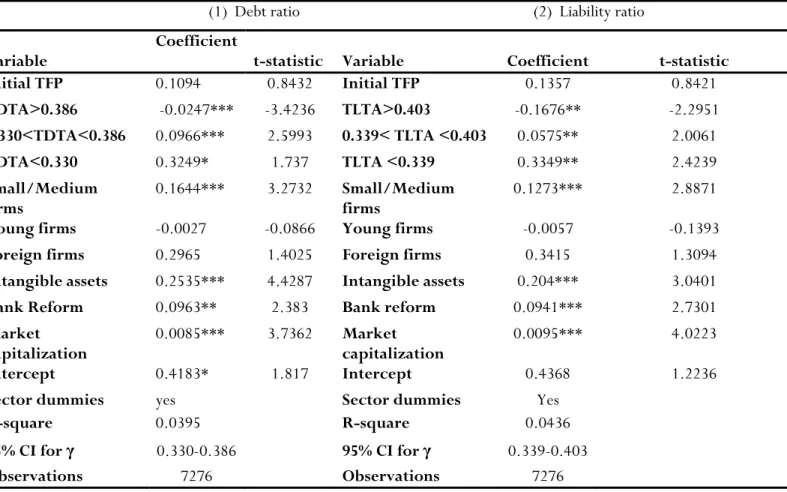
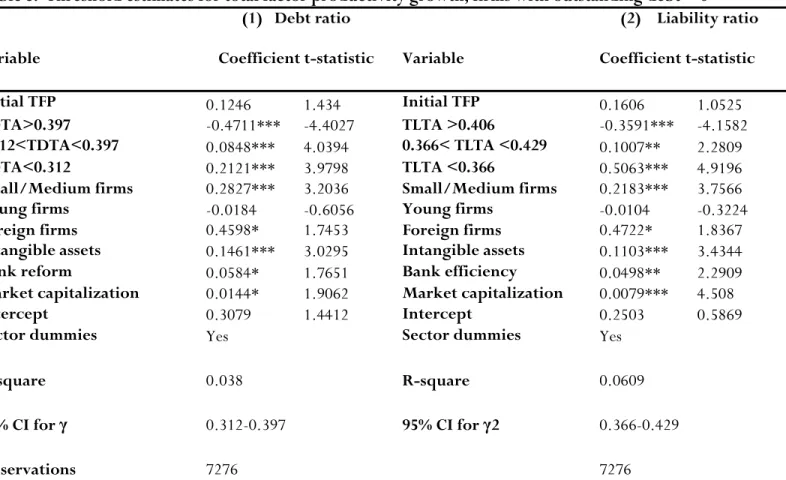
The threshold estimates of model (5) are summarized in Tables 4 and 5 for all firms and non-zero debt firms respectively. The tables report the coefficient estimates for all the explanatory variables (except sectoral dummies), including the slope coefficients for the three bands of leverage identified by the 95% confidence interval around the threshold. Despite some variation depending on the sample and the measure of leverage, the confidence interval estimates seem quite robust. The upper threshold limits are 0.386 for the debt ratio and 0.403 for the liability ratio for all firms. For indebted firms, the corresponding ratios are 0.397 and 0.429 for the debt and liability ratios respectively7. The initial value of TFP is insignificant, indicating the absence of convergence effects.
Importantly, the slope coefficients for the three endogenously identified bands of leverage are all significant, irrespective of the sample and measure of leverage used. The slope coefficients provide
6 This procedure is explained in detail in Girma et al. (2003) and Girma (2005).
7
Although average observed TLTA is higher than average observed TDTA (see Table 1), the upper threshold limit for the liability ratio is only slightly higher than for the debt ratio (about 39-40% for debt and 40-43% for liabilities), after controlling for all other factors.
evidence that moderate leverage (leverage ≤2) boosts TFP growth (α1and α2 are positive), while
excessive leverage (leverage> 2) lowers it (α3 is negative), after controlling for firm-level, sectoral and market characteristics.
[Insert Tables 4 and 5 here]
The marginal effect of leverage on TFP growth decreases as leverage increases from the lower band through the intermediate one to the upper band where the effect finally becomes negative. In other words, at low levels of leverage an increase in leverage has a large positive impact on TFP growth. This impact diminishes as leverage increases and ultimately turns negative. Based on the estimates of Table 5, a firm with a debt ratio (liability ratio) of 0.2 (i.e. below the lower threshold), for example, reaps net benefits from leverage in the form of 4.24% (10.13%) extra TFP growth compared with an unlevered firm. For a firm with a debt ratio (liability ratio) of 0.37 (in the mid-range), the net benefits amount to 3.14% (3.73%) of extra TFP growth. Finally, a firm with a debt ratio (liability ratio) of 0.5 (i.e. an overlevered firm) has negative net benefits amounting to 23.56% (17.96%) of forgone TFP growth compared with an unlevered firm.
Clearly leverage is not the only factor affecting TFP growth. Among the firm-specific factors, firm size, share of intangible assets and ownership are significant determinants of TFP growth. In general, TFP growth is significantly higher for small and medium sized firms, foreign firms (this is significant at 10% level for indebted firms only) and firms with large intangible assets. The role of institutional factors is also worth highlighting here. A higher efficiency of the banking sector (as captured by a higher index of banking sector reforms) significantly increases TFP growth. The marginal effect of banking sector reforms is about 10% for all firms and 5-6% for indebted firms. In comparison, the marginal effect of market capitalization is small (about 1% for both samples), but positive and statistically significant too. These estimates confirm the beneficial role of better financial institutions on TFP growth in our sample.
3.4. Optimal leverage and firm characteristics
firms and subsequently focusing on a subsample of large firms. In addition to confirming the robustness of the threshold, these robustness checks allow us to investigate the relationship between optimal leverage and firm characteristics. The trade-off theory predicts a positive relation between optimal leverage and profitability. An increase in earnings increases the tax advantage to debt and reduces the expected costs of distress and bankruptcy, and hence results in an increase in leverage (Strebulaev (2007)). In addition, the trade-off theory predicts a negative relation between optimal leverage and size (e.g. Kurshev and Strebulaev (2006)). However, previous studies using cross-sectional or panel regressions tend to find a negative (positive) relation between profitability and leverage (size) (see e.g. Frank and Goyal (2009)). These conflicting results may be driven by the fact that studies typically rely on the implicit assumption that firms are always at their optimal capital structures. By contrast, the threshold model allows us to determine optimal leverage despite firms’ temporary deviations from the optimum and may therefore enable us to examine the empirical validity of the theoretical relationships.
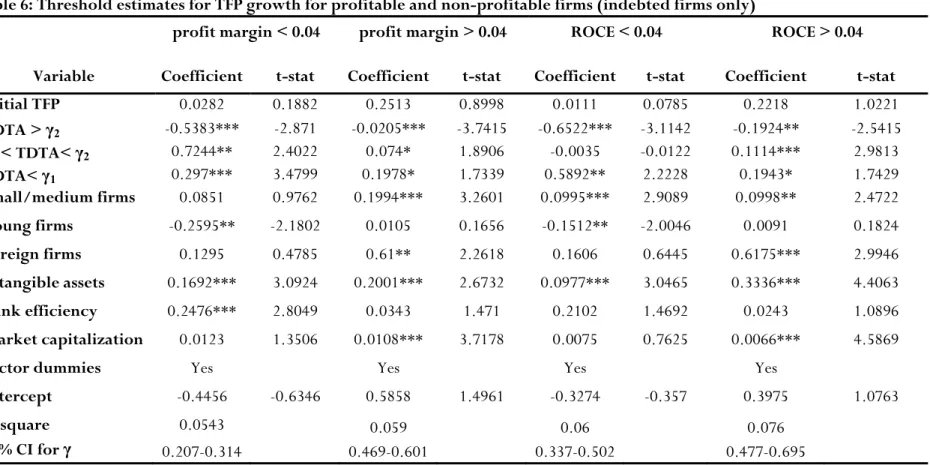
We use two alternative measures of profitability, namely a firm’s profit margin and return on capital employed (ROCE). We split the sample based on the median values of those two profitability measures, i.e. a less (more) profitable firm is defined as one with a profit margin or ROCE below (above) the median profit margin or ROCE (approx. 0.04 for both measures). The threshold estimates for more and less profitable firms (indebted firms only) are presented in Table 6.
[Insert Table 6 here]
These estimates confirm the significant adverse effect of excessive leverage (beyond the upper threshold) on TFP growth and the positive benefits to leverage below that point. Interestingly, the estimated threshold parameters differ significantly for more or less profitable firms. The upper and lower threshold values of the debt and liability ratios are significantly higher for more profitable firms. For example, the upper (lower) threshold limit is approx. 60% (47%) for more profitable firms as opposed to approx. 30% (20%) for less profitable firms when profitability is measured by the profit margin. In addition, Table 6 shows that the negative effect of excessive leverage on TFP growth is significantly higher in absolute value for less profitable firms. In other words, more
profitable firms are able to sustain significantly higher level of debts without hurting their productivity growth. This suggests a positive relationship between profitability and optimal leverage in line with the trade-off theory and the empirical results of Korteweg (2010). Previous studies using cross-sectional or panel regressions tend to find a negative relation between profitability and leverage (see e.g. Frank and Goyal (2009)). This is because high profits mechanically lower observed leverage ratios and previous studies rely on the implicit assumption that firms are always optimally levered. Strebulaev (2007) shows formally that cross-sectional regressions will produce misleading results on the relation between leverage and profitability. Specifically, he shows that even if firms in simulated economies follow the prescriptions of the dynamic trade-off theory, higher profitability lowers the current leverage of a firm unless it refinances in that period. Hence, the presence of frictions that result in firms diverging from their optimal capital structures may complicate empirical work on the trade-off theory. By contrast, the threshold model allows us to determine optimal leverage despite firms’ temporary deviations from the optimum.
Finally, we focus on the subsample of relatively larger firms, defined as firms with total assets above the sample median. Again, we restrict our attention to non-zero debt firms. The confidence interval for the debt ratio is 0.263-0.4468, against 0.312-0.397 for all non-zero debt firms. The
upper threshold is larger than in the full sample, indicating that large firms are able to carry more debt. However, the lower threshold, 0.263, is significantly lower for large firms than in the full sample. This suggests that on average debt starts hurting the productivity of large firms earlier. In other words, the net benefits to leverage in terms of productivity gains fade away earlier for large firms, suggesting a negative relationship between size and optimal leverage. Again, this contradicts the results of prior studies that tend to find a positive relation between firm size and leverage and our descriptive statistics in section 2.2. This is in line with Kurshev and Strebulaev (2006) who show that despite having a relatively higher optimal leverage ratio, small firms have lower observed ratios on average because they wait longer between refinancings.
3.5. Incidence of excess leverage
8
For brevity, we do not report the full results. There was no significant threshold for smaller firms, i.e. firms with total assets below the median.
We use the leverage threshold estimates to calculate the percentage of firms above the upper threshold for the debt ratio (TDTA) in each of our sample countries. We obtain these estimates for all non-zero debt firms, but also for more and less profitable non-zero debt firms (where profitability is based on the profit margin). The results are summarized in Table 7.
[Insert Table 7 here]
There is evidence of a significant proportion of firms in most of our sample countries with debt ratios in excess of the upper debt threshold. There is also pronounced inter-country variation: considering all non-zero debt firms, the proportion of firms with excessive leverage is the highest in Russia (above 20% of firms), closely followed by Bulgaria (about 19% of firms). In contrast, the proportion of non-zero debt firms with excessive leverage is the lowest in Hungary (little less than 3%), closely followed by Slovakia (little above 3%). These results combined with the finding that many firms have zero leverage (see section 2.2) highlight the presence of a double puzzle, the puzzle of zero-leverage firms and the puzzle of overlevered firms. In columns 2 and 3 of Table 7, we split the sample to focus on more and less profitable firms. The figures suggest that the proportion of firms with excessive leverage is higher among relatively less profitable firms in most sample countries. This result may point to an inefficient allocation of corporate loans in the CEE region. However, Korteweg (2010) finds that the degree of overleverage is higher for low-profit firms in a US sample, so this may not be a phenomenon that is limited to transition countries. 3.6. Robustness of threshold estimates
One criticism of the Hansen (2000) approach is that often the variable of interest is one subject to the decision making process of the firm, and is therefore endogenous. As such, the threshold estimates of current debt ratio may be biased or rendered inconsistent. In order to check the robustness of our original estimates we now replace the current debt ratio by its possible instrumental variables and re-estimate the threshold model.
that are correlated with debt ratios, but uncorrelated with firm level productivity. Typically the literature has resorted to employing lags to resolve this problem and this is what we try first. In addition, we employ a two stage method where we first obtain the fitted value of the debt ratio using the estimates of equation (A2) in Appendix 29 and then replace current debt ratio by the fitted
debt ratio obtained to estimate the threshold model again.
Clearly, both lagged and fitted debt ratios are strongly correlated with the actual debt ratios. In particular, the correlation between the current firm-level debt ratio and its lagged value is 0.2188 while that between current debt ratio and fitted debt ratio is 0.8091. In addition, both lagged and fitted debt ratios are uncorrelated with the error term in the TFP growth equation. This can be seen from the low correlation between these alternative leverage measures and the estimated error from the TFP growth equation (5). In particular, the correlation between the lagged debt ratio and the estimated residual is 0.035 and the correlation between the fitted debt ratio and the residual is 0.0945 in the sample of all firms.
These alternative threshold estimates for the debt ratio (TDTA) are summarised in Table 8 for all firms and also indebted firms in the sample. Again they confirm the non-linear effects of leverage on TFP growth: while moderate leverage boosts productivity growth, excessive leverage (beyond the upper threshold limit) hampers productivity growth. The estimated confidence interval for lagged debt ratio is 0.326-0.407 for all firms and 0.366-0.437 for indebted firms. Similar threshold estimates are obtained when we replace current debt ratio by its fitted value. These are 0.339-0.419 and 0.357-0.431 respectively for all firms and all indebted firms. The corresponding estiamtes from the original threshold model were 0.330-0.386 and 0.312-0.397 respectively for all firms and indebted firms respectively. In other words, these alternative threshold estimates for debt ratio for all firms and all indebted firms are within less than 5 percentage points of the estimates (0.386 and 0.397) using current debt ratio.
[Insert Table 8 here]
When leverage is instrumented using lagged leverage (fitted leverage), ceteris paribus, a firm with a
9
Note that the variables that explain the fitted debt ratio in equation (A2) are not exactly the same as those determining TFP growth in equation (5). In particular, the log of total assets and the inflation rate are included in equation (A2), but not in equation (5). In addition, equation (5) includes initial TFP and also different bands of leverage depending on the two threshold limits obtained from the estimation of the threshold model. See further discussion in Appendix 2.
debt ratio of 0.2 (i.e. below the lower threshold) reaps net benefits from leverage in the form of 13.1% (12.1%) extra TFP growth compared with an unlevered firm. For a firm with a debt ratio of 0.37 (in the mid-range), the net benefits amount to 2.5% (3.23%) of extra TFP growth. Finally, a firm with a debt ratio of 0.5 (i.e. an over-levered firm) has negative net benefits amounting to 15.2% (16%) of forgone TFP growth compared with an unlevered firm.
Table 9 provides an overview of all the debt ratio threshold estimates that we have obtained so far. All the results point to the existence of a non-linear relationship between leverage and TFP growth. The presence of a single threshold in each case is compatible with the theory of optimal capital structure, where the threshold is associated with maximum TFP growth. The estimates are robust to alternative leverage measures used in our analysis. The threshold estimates vary somewhat with firm characteristics, in particular profitability and size, in a way consistent with the trade-off theory of capital structure.
3.7. Threshold estimates for 2000-2006
Given that the sample period 1999-2008 includes two crises, namely the Russian crisis of 1998-99 and the recent financial crisis of 2007, that had impact on the CEE region, we also estimate the threshold model for the subsample of “normal years” 2000-2006. We also compare these threshold estimates for current debt ratio with those for lagged and fitted debt ratios with a view to examine their robustness. These threshold estimates for 2000-2006 are summarized in Table 9.
[Insert Table 9 here]
2000-2006 threshold estimates appear to be in line with those for the full sample 1999-2008 irrespective of whether we consider all firms or only indebted firms. For example, the lower threshold estimate is 0.336 in the full sample of all firms as opposed to 0.342 in the corresponding 2000-2006 sample. Similarly, the estimate of the upper threshold is 0.386 in the full sample of all firms as opposed to 0.377 in the 2000-2006 sample. In conclusion, the results do not appear to be driven by the choice of sample period.
4. Conclusions
The paper aims to bridge the gap between the literature on optimal capital structure and the wider macro literature on finance-growth nexus. On the basis of the trade-off theory of capital structure, we posit a non-linear relationship between leverage and productivity growth at the firm level. We test this hypothesis using a threshold regression model following Hansen (2000). Estimates for a sample of Central and Eastern European countries confirm that TFP growth increases with leverage until the latter reaches a critical threshold beyond which leverage becomes “excessive” and lowers TFP growth. This result points to the existence of an optimal leverage ratio where the net benefits of debt in terms of productivity gains are exhausted. Despite some variation depending on the sample and the measure of leverage, the estimates seem quite robust. The estimates of the slope coefficients for the three bands of leverage (low, intermediate and excessive) suggest that the productivity gains (costs) to leverage are substantial for underlevered (overlevered) firms.
We examine the link between the endogenously determined leverage thresholds and firm characteristics, in particular profitability and size. Our results highlight a positive (negative) relationship between profitability (size) and optimal leverage, unlike existing studies that use traditional cross-sectional or panel regressions. In contrast to existing empirical evidence based on observed leverage ratios, the threshold model allows us to endogenously determine optimal leverage despite firms’ temporary deviations from the optimum. Korteweg (2010) reaches similar conclusions.
Using the leverage threshold estimates, we find evidence of a significant proportion of firms with debt ratios in excess of the upper debt threshold. Our results suggest that the proportion of firms with excessive leverage is higher among relatively less profitable firms in most sample countries. This result may point to an inefficient allocation of corporate loans in the CEE region. However, Korteweg (2010) finds that the degree of overleverage is higher for low-profit firms in a US sample, so this may not be a phenomenon that is limited to transition countries.
Further we confirm the robustness of our debt threshold estimates by using two alternative measures of debt ratio, namely the lagged debt ratio and also a fitted value of the debt ratio. Our
results suggest that the baseline estimates only slightly underestimate the upper threshold estimates, beyond which further increases in debt lowers productivity growth. However, whether one uses the baseline model or the alternative measures matters for the estimated magnitude of the benefits to leverage. Finally, we show that our results are robust to the choice of sample period, by excluding from our sample two crisis episodes that significantly affected the CEE region.
References
Ang, J. B., 2008, A survey of recent developments in the literature of finance and growth, Journal of Economic Surveys, 22, 536–576.
Arcand, J.L., E. Berkes and U.Panizza, 2011, “Too Much Finance?”, mimeo
Barro, Robert, 1998, Determinants of Economic Growth: A Cross-Country Analysis, MIT Press. Berger, A. and di Patti, E. B., 2006, Capital structure and firm performance: a new approach to
testing agency theory and an application to the banking industry, Journal of Banking and Finance, 30, 1065-1102.
Bernanke, Ben S., Mark Gertler, and Simon Gilchrist, 1999, The financial accelerator in a quantitative business cycle framework, Handbook of Macroeconomics, in: J. B. Taylor & M. Woodford (ed.), Handbook of Macroeconomics, edition 1, volume 1, chapter 21, pages 1341-1393
Brücker, H. Schröder, P.J.H. and Weise C., 2005, Can EU conditionality remedy soft budget constraints in transition countries?, Journal of Comparative Economics, 33, 371-386.
Driffield, N. and S. Pal., 2010, ‘Evolution of Capital Structure in East Asia: Corporate Inertia or Endeavours?, Journal of the Royal Statistical Society (Series A), 173, 1–29.
Dewatripont, Mathias and Eric Maskin, 1995, Credit and Efficiency in Centralized and Decentralized Economies, The Review of Economic Studies, 62, 541-55.
Eicher, T.S. and T. Schreiber, 2010, Structural policies and growth: Time series evidence from a natural experiment, Journal of Development Economics, 91, 169-179.
Flannery, M.J. and K. Rangan, 2006, Partial adjustment toward target capital structures, Journal of Financial Economics, 79, 469-506.
Frank, Murray Z., and Vidhan K. Goyal, 2009, Capital Structure Decisions: Which Factors are Reliably Important? Financial Management, 38, 1-37.
Girma, Sourafel, 2005, Absorptive Capacity and Productivity Spillovers from FDI: A Threshold Regression Analysis, Oxford Bulletin of Economics and Statistics, 67, 281-306.
Girma, Sourafel, M. Henry, R. Kneller and C. Milner, 2003, Threshold and Interaction Effects in the Openness-Productivity Growth Relationship: The Role of Institutions and Natural Barriers GEP working paper 2003/32, Nottingham.
Gourinchas, Pierre-Olivier, Rodrigo Valdes, and Oscar Landerretche, 2001, Lending Booms: Latin America and the World, Economia, Spring, 1, 47-99.
Griffith, R., 1999, Using the ARD establishment level data to look at foreign ownership and productivity in the United Kingdom, Economic Journal, 109, 416-42.
Hansen, Bruce E., 2000, Sample splitting and threshold estimation, Econometrica, 68, 575–603. Jensen, Michael C., 1986, Agency costs of free cash flow, corporate financing, and takeovers,
Jensen, Michael C., and William H. and Mecklin, 1976, Theory of the firm: Managerial behavior, agency costs, and ownership structure, Journal of Financial Economics, 3, 305-360.
Kaminsky, G. and C. Reinhart, 1999, The Twin Crises: The Causes of Banking and Balance-of-Payments Problems, American Economic Review, 89, 473-500.
Kiyotaki, N. and J. Moore, 1997, Credit Cycles, Journal of Political Economy, 105, 211-248.
Konings, J., Rizov, M and Vandenbussche, H., 2003, Investment and financial constraints in transition economies: micro evidence from Poland, the Czech Republic, Bulgaria and Romania, Economics Letters, 78, 253-258.
Korajczyk, Robert A., and Amnon Levy, 2003, Capital structure choice: Macroeconomic conditions and financial constraints, Journal of Financial Economics, 68, 75–109.
Kornai, J., 2001, Hardening the budget constraint: the experience of the post-socialist countries, European Economic Review, 45, 1095-1136.
Korteweg, Arthur, 2010, The Net Benefits to Leverage, Journal of Finance, 65, 2137-2170.
Kourtellos, A., T. Stengos and C. Tan, 2009, THRET: Threshold Regression with Endogenous Threshold Variables, Journal of Econometrics (forthcoming)
Kraus, Alan, and R. Litzenberger, 1973, A state-preference model of optimal financial leverage, Journal of Finance 28, 911-922.
Kurshev, Alexander, and Ilya A. Strebulaev, 2006, Firm size and leverage, Working paper, Stanford University.
Levinsohn, J. and Petrin, A., 2003, Estimating production functions using inputs to control for unobservables, Review of Economic Studies, 70, 317-341.
McKinsey Global Institute. 2010. Beyond Austerity: A path to economic growth and renewal in
Europe’, October.
Myers, Stewart C., 1977, Determinants of Corporate Borrowing, Journal of Financial Economics, 5,147-75
Olley, S. and A. Pakes, 1996, The Dynamics of Productivity in the Telecommunications Equipment Industry, Econometrica, 64, 1263-98.
Rajan, Raghuram and Luigi Zingales, 1995, What Do We Know About Capital Structure? Some evidence from international data, Journal of Finance, 50, 1421-1460.
Rajan, Raghuram and Luigi Zingales, 1998, Financial dependence and growth, American Economic Review, 88, 559-586.
Reinhart, C. M. and K. S. Rogoff, 2010. "Growth in a Time of Debt," NBER Working Papers 15639
Schleifer, Andrei, and Robert W. Vishny, 1992, Liquidation values and debt capacity: A market equilibrium approach, Journal of Finance, 47, 1343-1366.
Strebulaev, Ilya, and Baozhong Yang, 2006, The Mystery of Zero-Leverage Firms, Working Paper, Stanford Graduate School of Business, Stanford University
Strebulaev, Ilya, 2007, Do Tests of Capital Structure Theory Mean What They Say?, Journal of Finance, 62, 1747-1788.
Table 1: Cross-country variation in leverage 1999-2008
All firms debt firms Non-zero
TLTA TDTA TLTA TDTA
Country Firms Total obs. Zero debt (%)
Missing debt
(%) Mean SD Mean SD Mean Mean Bosnia and Herzegovina 146 1362 19.5 20.7 0.36 0.27 0.11 0.14 0.38 0.13
Bulgaria 232 2034 16.7 27.6 0.42 0.24 0.13 0.16 0.45 0.17 Croatia 135 1264 5.8 87.7 0.39 0.23 0.08 0.14 0.42 0.14 Czech Republic 71 642 10.7 38.3 0.41 0.20 0.12 0.13 0.44 0.15 Estonia 10 94 2.1 40.4 0.40 0.24 0.16 0.14 0.45 0.17 Hungary 22 203 8.9 53.2 0.39 0.18 0.10 0.12 0.39 0.12 Latvia 26 239 12.1 34.3 0.45 0.24 0.20 0.22 0.52 0.25 Lithuania 30 281 3.2 49.1 0.46 0.19 0.20 0.17 0.48 0.21 Poland 159 1467 16.4 52.1 0.47 0.19 0.10 0.13 0.52 0.15 Republic of Moldova 195 1806 21.0 46.5 0.33 0.25 0.11 0.17 0.43 0.19 Romania 236 2062 44.9 26.8 0.47 0.23 0.05 0.10 0.52 0.12 Russian Federation 656 6021 15.4 34.5 0.46 0.25 0.15 0.18 0.50 0.20 Serbia 742 6925 15.1 13.2 0.40 0.26 0.12 0.16 0.42 0.15 Slovak Republic 124 1137 5.7 33.0 0.44 0.21 0.12 0.12 0.45 0.13 Slovenia 56 526 1.3 78.9 0.40 0.18 0.18 0.16 0.43 0.19 Ukraine 391 1443 17.1 2.6 0.42 0.25 0.14 0.16 0.45 0.17 All 3231 27506 16.9 31.1 0.42 0.25 0.12 0.16 0.45 0.16
Table 2: Distribution of debt among firms with positive debt 1999-2008 in our sample
Leverage percentiles Average leverage by size
Country 25% 50% 75% 90% 95% 99% Small Large Corr(size, leverage) Bosnia and Herzegovina 0.03 0.07 0.19 0.32 0.42 0.61 0.11 0.12 0.02
Bulgaria 0.04 0.12 0.24 0.42 0.51 0.68 0.08 0.19 0.13 Croatia 0.03 0.11 0.19 0.33 0.46 0.89 0.04 0.15 0.20 Czech Republic 0.04 0.12 0.21 0.32 0.39 0.62 0.11 0.13 0.02 Estonia 0.02 0.18 0.28 0.36 0.44 0.48 0.16 0.20 0.09 Hungary 0.01 0.07 0.17 0.29 0.44 0.54 0.09 0.10 0.01 Latvia 0.07 0.19 0.35 0.62 0.71 0.85 0.22 0.15 -0.17 Lithuania 0.07 0.19 0.32 0.45 0.53 0.66 0.20 0.20 0.05 Poland 0.05 0.12 0.22 0.33 0.40 0.59 0.11 0.11 0.03 Republic of Moldova 0.04 0.13 0.30 0.46 0.56 0.72 0.06 0.18 0.21 Romania 0.04 0.08 0.17 0.28 0.34 0.55 0.04 0.06 0.12 Russian Federation 0.05 0.13 0.29 0.47 0.58 0.75 0.14 0.17 0.01 Serbia 0.03 0.09 0.21 0.38 0.49 0.69 0.09 0.17 0.17 Slovak Republic 0.04 0.10 0.18 0.29 0.35 0.58 0.10 0.16 -0.01 Slovenia 0.05 0.16 0.32 0.42 0.47 0.73 0.21 0.18 -0.13 Ukraine 0.03 0.11 0.25 0.41 0.51 0.71 0.13 0.12 -0.01
Table 3: Quality of Financial Institutions, 1999-2008
Country Stock market capitalization Banking reform index Bosnia & Herzegovina 44.54 2.53 Bulgaria 15.74 3.38 Croatia 32.62 3.7 Czech Republic 23.97 3.74 Estonia 30.03 3.85 Hungary 25.10 4 Latvia 9.4 3.58 Lithuania 18.18 3.34 Poland 23.87 3.46 Moldova 26.92 2.56 Romania 13.04 2.91 Russia 59.49 2.15 Serbia 23.21 2.09 Slovakia 7.09 3.41 Slovenia 26.17 3.3 Ukraine 21.54 2.46 All 31.08 2.65
Note: Banking reform index: Average EBRD index of banking sector reform (1 to 4.3, with a higher number indicating a better score); Stock market
Table 4: Threshold estimates for total factor productivity growth, all firms
(1) Debt ratio (2) Liability ratio
Variable Coefficient t-statistic Variable Coefficient t-statistic
Initial TFP 0.1094 0.8432 Initial TFP 0.1357 0.8421
TDTA>0.386 -0.0247*** -3.4236 TLTA>0.403 -0.1676** -2.2951
0.330<TDTA<0.386 0.0966*** 2.5993 0.339< TLTA <0.403 0.0575** 2.0061
TDTA<0.330 0.3249* 1.737 TLTA <0.339 0.3349** 2.4239
Small/Medium
firms 0.1644*** 3.2732 Small/Medium firms 0.1273*** 2.8871
Young firms -0.0027 -0.0866 Young firms -0.0057 -0.1393
Foreign firms 0.2965 1.4025 Foreign firms 0.3415 1.3094
Intangible assets 0.2535*** 4.4287 Intangible assets 0.204*** 3.0401
Bank Reform 0.0963** 2.383 Bank reform 0.0941*** 2.7301
Market capitalization 0.0085*** 3.7362 Market capitalization 0.0095*** 4.0223 Intercept 0.4183* 1.817 Intercept 0.4368 1.2236
Sector dummies yes Sector dummies Yes
R-square 0.0395 R-square 0.0436
95% CI for γ 0.330-0.386 95% CI for γ 0.339-0.403
Observations 7276 Observations 7276
Table 5: Threshold estimates for total factor productivity growth, firms with outstanding debt > 0 Variable
(1) Debt ratio
Coefficient t-statistic Variable
(2) Liability ratio Coefficient t-statistic Initial TFP 0.1246 1.434 Initial TFP 0.1606 1.0525 TDTA>0.397 -0.4711*** -4.4027 TLTA >0.406 -0.3591*** -4.1582 0.312<TDTA<0.397 0.0848*** 4.0394 0.366< TLTA <0.429 0.1007** 2.2809 TDTA<0.312 0.2121*** 3.9798 TLTA <0.366 0.5063*** 4.9196
Small/Medium firms 0.2827*** 3.2036 Small/Medium firms 0.2183*** 3.7566
Young firms -0.0184 -0.6056 Young firms -0.0104 -0.3224
Foreign firms 0.4598* 1.7453 Foreign firms 0.4722* 1.8367
Intangible assets 0.1461*** 3.0295 Intangible assets 0.1103*** 3.4344
Bank reform 0.0584* 1.7651 Bank efficiency 0.0498** 2.2909
Market capitalization 0.0144* 1.9062 Market capitalization 0.0079*** 4.508
Intercept 0.3079 1.4412 Intercept 0.2503 0.5869
Sector dummies Yes Sector dummies Yes
R-square 0.038 R-square 0.0609
95% CI for γ 0.312-0.397 95% CI for γ2 0.366-0.429
Observations 7276 7276
Table 6: Threshold estimates for TFP growth for profitable and non-profitable firms (indebted firms only)
profit margin < 0.04 profit margin > 0.04 ROCE < 0.04 ROCE > 0.04
Variable Coefficient t-stat Coefficient t-stat Coefficient t-stat Coefficient t-stat Initial TFP 0.0282 0.1882 0.2513 0.8998 0.0111 0.0785 0.2218 1.0221 TDTA > γ2 -0.5383*** -2.871 -0.0205*** -3.7415 -0.6522*** -3.1142 -0.1924** -2.5415 γ1 < TDTA< γ2 0.7244** 2.4022 0.074* 1.8906 -0.0035 -0.0122 0.1114*** 2.9813 TDTA< γ1 0.297*** 3.4799 0.1978* 1.7339 0.5892** 2.2228 0.1943* 1.7429 Small/medium firms 0.0851 0.9762 0.1994*** 3.2601 0.0995*** 2.9089 0.0998** 2.4722 Young firms -0.2595** -2.1802 0.0105 0.1656 -0.1512** -2.0046 0.0091 0.1824 Foreign firms 0.1295 0.4785 0.61** 2.2618 0.1606 0.6445 0.6175*** 2.9946 Intangible assets 0.1692*** 3.0924 0.2001*** 2.6732 0.0977*** 3.0465 0.3336*** 4.4063 Bank efficiency 0.2476*** 2.8049 0.0343 1.471 0.2102 1.4692 0.0243 1.0896 Market capitalization 0.0123 1.3506 0.0108*** 3.7178 0.0075 0.7625 0.0066*** 4.5869
Sector dummies Yes Yes Yes Yes
Intercept -0.4456 -0.6346 0.5858 1.4961 -0.3274 -0.357 0.3975 1.0763
R-square 0.0543 0.059 0.06 0.076
95% CI for γ 0.207-0.314 0.469-0.601 0.337-0.502 0.477-0.695
Table 7: Distribution of firms above the upper threshold limits
Non-zero debt firms
All firms Profitable firms Non-profitable firms (by profit
margin) (by profit margin) Debt ratio γ2>
0.399 Debt ratio γ2>
0.577 Debt ratio
γ2>0.301
Bosnia and Herzegovina 0.1519 0.0146 0.0467
Bulgaria 0.1886 0.0204 0.0856 Croatia 0.1042 0.0127 0.0540 Czech Republic 0.1088 0.0107 0.0565 Estonia 0.0841 0.0144 0.0456 Hungary 0.0290 0.0004 0.0145 Latvia 0.1276 0.0082 0.1152 Lithuania 0.1119 0.0198 0.0263 Poland 0.0625 0.0069 0.0104 Republic of Moldova 0.0875 0.0004 0.0875 Romania 0.1129 0.0090 0.0063 Russian Federation 0.2008 0.0515 0.0448 Serbia 0.1014 0.0074 0.0713 Slovakia 0.0322 0.0092 0.0115 Slovenia 0.0934 0.0083 0.0603 Ukraine 0.0830 0.0102 0.0462
Table 8: Threshold estimates using alternative debt ratios
All firms Firms with debt > 0
lagged debt Fitted debt lagged debt Fitted debt
Variable coeff t-stat coeff t-stat coeff t-stat coeff t-stat Initial TFP 0.25159 14.720*** 0.2207 11.867*** 0.1021 0.786 0.1392 0.8186 TDTA > γ2 ‐0.44552 ‐1.959** ‐0.4898 ‐2.366*** ‐0.3033 ‐6.342*** ‐0.3181 ‐6.393*** γ1 < TDTA< γ2 0.486717 3.868*** 0.4755 3.590*** 0.0675 2.906*** 0.0875 3.414*** TDTA< γ1 1.030365 4.933*** 1.0161 4.621*** 0.6554 2.351*** 0.6039 3.174*** Small/Medium firms ‐0.18087 ‐5.48*** ‐0.1759 ‐4.910*** 0.1062 4.255*** 0.1645 3.245*** Young firms ‐0.07179 ‐1.781* ‐0.0793 ‐1.895* ‐0.0274 ‐0.5310 ‐0.0278 ‐0.474 Foreign firms 0.023277 0.664 0.0222 0.6134 0.3048 1.3246 0.4695 1.459 Intangible assets 0.504725 1.645 0.5821 1.750* 2.3119 4.554*** 2.3388 4.075*** Bank reform 0.570564 11.595 0.6247 10.247*** 0.0478 1.782* 0.0662 1.1439 Market capital ‐0.00079 ‐0.645 ‐0.0007 ‐0.5376 0.0076 4.858*** 0.0091 4.416*** Intercept ‐0.3853 ‐2.192** ‐0.4729 ‐2.534*** 0.2694 0.6791 0.3919 0.7168
Sector dummies Yes Yes yes yes
R-square 0.033 0.031 0.045 0.036
95% CI for γ 0.326-0.407 (mid = 0.354) 0.339-0.419 (mid = 0.369) 0.366-0.437 (mid= 0.394) 0.357-0.431 (mid = 0.382)
Table 9: A summary of threshold estimates
Debt ratio thresholds
Lower limit Upper limit
All firms 0.336 0.386
All firms (2000-2006) 0.342 0.377
All firms (lagged debt ratio) 0.326 0.407
All firms (fitted debt ratio) 0.339 0.419
Non-zero-debt firms 0.312 0.397
Non-zero-debt firms (2000-2006) 0.328 0.376
Non-zero-debt firms (lagged debt ratio) 0.366 0.437
Non-zero-debt firms (fitted debt ratio) 0.357 0.431
Non-zero-debt firms 2000-06 (lagged debt ratio) 0.369 0.421
Non-zero-debt firms 2000-06 (fitted debt ratio) 0.377 0.434
Non-zero debt firms only
More profitable firms 0.469 0.601
Less profitable firms 0.207 0.314
More profitable firms(2000-2006) 0.472 0.599
Less profitable firms(2000-2006) 0.248 0.301
Figure 1: Percentage changes in domestic credit in the CEE region 1998-2008
Source: EBRD
Appendix 1
Calculation of TFP
The approach for estimating TFP is based on the existing literature (see e.g., Griffith 1999). This essentially involves estimating the following
production function:
(A1)
where subscripts i, and t refer to firm and year; yit, kit, lit, and mit represent the logarithm of a firm’s output (sales) and the production inputs: capital
(measured as the book value of fixed assets), labor (number of employees) and material costs respectively. We estimate it from (A1) as TFP and
then compute log(TFP). To deflate monetary values we use the consumer price index due to the lack of available industrial price deflators for many of our sample countries.
One of the most common econometric problems with the estimation of TFP is endogeneity. Typically, the regressors will be correlated with the error term because firms change their factor inputs in the anticipation of TFP changes. If that is the case, then profit maximization implies that the realization of the error term is expected to influence the decision on factor inputs. Consequently the OLS estimates could be inconsistent. Therefore, we use the Levinsohn-Petrin correction. Levinsohn and Petrin (2003) extend Olley and Pakes (1996) by using material inputs as a proxy to control for unobservable productivity shocks.
Appendix 2: Estimation of a fitted debt ratio
Our approach is based on the existing literature, which identifies a number of firm-specific factors that determine corporate leverage (e.g. see Rajan
and Zingales, 1995; Flannery and Rangan, 2006; Driffield and Pal, 2010).Following our discussion in section 2, we also include some country
specific institutional variables, namely an index of banking sector reforms (that captures banking sector efficiency) and stock market capitalization as a share of GDP. Accordingly, we estimate the following leverage equation for firm i in year t (t=1999… 2008):
Leverageit = β0 + β1 log(assets)it-1 + β2 Ageit-1 + β3 (Intangible Fixed Assets/Total Assets)it-1 + β5 (EBIT/Total Assets)it-1 + β6 Inflation it-1 + β7 (Bank efficiency) it-1 +
β8 (Stock market capitalization) it-1 + β9 Industry Median Leveraget1+ νi + uit
(A2)
where EBIT stands for earnings before interest and taxes, νi is a firm-specific fixed effect and uit is the error term 10. The firm-specific fixed effects
account for various unobserved firm-specific factors that may also influence leverage. We use panel data fixed effects to estimate equation (A2), using both debt and liability ratios as alternative measures of leverage. In order to mitigate a potential simultaneity bias, we follow the general convention (e.g., see Driffield and Pal (2010)) and use (one year) lagged explanatory variables. For simultaneity to bias the estimates, all firms need to correctly predict productivity one year in advance, which we rule out. The fixed effects estimates are summarized in Table A1 below. In general, more profitable firms tend to have lower leverage. Foreign firms and firms in industries with higher median leverage tend to have higher leverage. The bank reform coefficient is positive but remains insignificant. The coefficient on stock market capitalization to GDP is however positive and significant for both measures of leverage, thus highlighting a leverage premium for firms operating in countries with better stock market development.
10
Note that we do not have data on market-to-book ratios. In alternative specifications, the growth of total assets was included and always found to be insignificant. Fixed assets as a share of total assets are also excluded from (A2) because there could also be a problem of multicollinearity with the share of intangible fixed assets.
Table A1: Determinants of Leverage: Fixed effects estimates of debt and liability ratios, 1999-2008 VARIABLES Debt ratio Liability ratio
Total assets 0.00170 -0.0133 (0.00360) (0.0131) Small/medium firms -0.0256*** -0.0105 (0.00579) (0.00918) Young firms 0.00103 -0.000113 (0.00122) (0.00240) Foreign 0.0736*** 0.107*** (0.00677) (0.0178) Median debt 0.257*** (0.0593) Median liability 0.189* (0.103)
Share of intangible assets 0.0501 -0.110
(0.0339) (0.0694) Profitability -0.0535** -0.166*** (0.0228) (0.0479) Inflation -0.000343 -0.00368*** (0.000224) (0.000883) Market capitalization 0.000702*** 0.000869* (0.000196) (0.000441) Banking reforms 0.00526 0.0217 (0.00750) (0.0332) Constant 0.0129 0.410** (0.0747) (0.176) Observations 9310 10433 R-squared 0.090 0.132 Number of firms 2243 2379