MPRA
Munich Personal RePEc Archive
Development of Direct Democracy in
Swiss Cantons between 1997 and 2003
Justina AV Fischer
University of Hohenheim
8. July 2009
Online at
http://mpra.ub.uni-muenchen.de/16140/
MPRA Paper No. 16140, posted 10. July 2009 00:42 UTC
Development of Direct Democracy in Swiss Cantons
between 1997 and 2003
Justina AV Fischer University of Hohenheim
Abstract
This paper describes institutions of direct democracy between 1997 and 2003 in 26 Swiss cantons (states), specifically the statutory initiative and referendum, the constitutional initiative, and the fiscal referendum. In particular, it discusses their applications, but also the legal requirements for making use of them, including the signature requirements, the time available for their collection, and the financial thresholds. Optional and mandatory forms of these direct-legislative institutions are distinguished.
This paper also provides calculations of the index and sub-indices of direct democracy for the additional years 1997 to 2003, in continuation of Stutzer (1999), using the identical methodology. Extending Trechsel and Serdült (1999) and Stutzer (1999) this paper includes the political institutions of the so-called Landsgemeinde cantons. Description of these institutions is based on the author‟s reading of 26 cantonal constitutions in their versions between 1997 and 2003.
JEL-codes: H11; H73; K19; H40; H72; N40; D70; I31
Keywords: institutions; direct democracy; direct legislation; initiative; referendum; fiscal referendum; constitution; Switzerland: culture
[email protected] and [email protected] , at the time of writing: University of St. Gallen, Switzerland. Current main affiliation: Chair for Household and Consumer Economics, University of
1
Introduction
1.1 Scope of paper
For an empirical analysis, the accuracy of data plays a decisive role. This paper tries to aid researchers interested in the study of direct democracy (1) by briefly introducing the institutions of direct legislation in all 26 Swiss cantons 1997 – 2003 and (2) by providing the necessary data for continuing empirical research. In particular, it describes the formal requirements (and changes therein) for the constitutional initiative, the statutory initiative, the statutory referendum, and the fiscal referendum for all 26 cantons between 1997 and 2003. Furthermore, this paper presents the corresponding values of the index of direct democracy (and its sub-indices for the single institutions). Given that the Swiss household panel, which constitutes the most important source of individual data in Switzerland, started in 1999, this period of investigation is of particular importance. Finally, the aspect of language should not be neglected: most of the literature on the Swiss institutions of direct democracy is still written in German or French (and so are the cantonal constitutions). Since there appears to be a void of English-speaking literature on this subject, this paper fills this gap by providing information on institutions of direct democracy in Swiss cantons to the Anglophone world, with the aim to facilitate the scientific discussions and the ongoing empirical research. Thus, this paper might equally serve as a bridge between local researchers and the international scientific community.
1.2. Definition of direct democracy
'Direct democracy', or more precisely, „direct legislation‟, implies the direct influence of the people on the political decision-making process whose outcomes gain shape in both laws and decrees of the parliament. 'Direct democracy' means that a modern democracy, which takes place solely through representative institutions of political decision-making, is complemented by direct-democratic institutions. As economists, why should we care about political institutions such as means of direct legislation? Political decisions made in political (legislative and executive) organs influence economic processes and outcomes, and – according to political economic theory - means of direct legislation influence the political outcome in favor of the preferences of the citizenry (Besley and Coate, 2001; Feld and
Kirchgässner, 2001; Hug, 2004). The typical institutions of direct legislation are referenda and initiatives.
Few countries in the world offer direct-legislative opportunities to their people, particularly the opportunity to influence the daily political decision-making processes. Basically, only two nations offer an extensive range of such direct-democratic means: the United States of America and Switzerland1. The political system of Switzerland is shaped by two important characteristics. First, in this federal country, direct legislative institutions exist on all three levels – i.e. the federal level, the cantonal ('state') level, and the communal level. Second, Switzerland shows a very strong fiscal decentralization, which, in contrast to Austria and Germany, gives each level in the state its own tax sources. Therefore, direct democracy provides an institutional link between the power to tax and the power to spend - providing local citizens with the political means to influence both sides of the local budget equally.
From an econometric viewpoint, Switzerland can be regarded as a perfect laboratory for studying the impact of direct democracy on political outcomes (see also e.g. Kirchgässner, 2002a, 2000): Switzerland provides a set of 26 cantons, of which each can be treated as one observation, with 26 varying degrees of direct democracy laid down in its state constitution. All the cantons, however, share an identical macroeconomic and political framework at a higher level, so that some difficulties arising in cross-national comparisons can be avoided. This common framework is shaped by policy-making at the federal level, international politics, and the economic situation of the rest of the world.
The statutory initiative and the fiscal referendum
In the case of Swiss cantons, particularly the statutory initiative and the fiscal referendum play decisive roles (see Frey and Stutzer, 2000a, 2000c; Feld et al., 2007; see the review by Kirchgässner, 2002b, for more fiscal aspects). Whereas the fiscal referendum is of a reactive nature, the statutory initiative provides citizens with an agenda-setting power. Another difference between these institutions is their focus: the fiscal referendum deals with expenditure projects of the cantonal government – i.e. it is related to administrative acts; in contrast, the statutory initiative directly influences the law-making process – i.e. it is either
1
In many other countries, however, such as Austria, Canada, France, Italy, Ireland, Liechtenstein, a popular votes are held only on constitutional amendments.
used for proposing new laws or for revising/eliminating already existing laws2. Other important institutions of direct legislation are the constitutional initiative and the statutory referendum3.
1.3. Theoretical context
Some strands of economic theory suggest that in a representative system resources are wasted and allocations of goods and resources occur that deviate strongly from the median voter's position. On the one hand, overspending is caused by (a) politicians who exploit the budget (and implicitly the tax base) to satisfy the needs of the electorate in their local districts ('pork-barrel legislation')4; (b) the forming of broad coalition governments leading to an inefficient expansion of budgets by the spending ministers ('budget as a common pool')5; or (c) logrolling in the political decision-making process, which brings about the financing of minority projects that would otherwise not have gained support from the parliamentary majority6. Moreover, (d) government administrations are headed by bureaucrats who aim at maximizing their budget and extracting rents, potentially leading to a preference for those expenditure projects that also cause a relative increase in administrative spending (e.g. through the foundation of new departments, etc.)7. Whatever the case, politico-economic theory predicts that in a purely representative system, expenses are undertaken that are not preferred by the median voter, leading possibly to an unwanted growth in budget, the provision of public goods that are not the first priority for, or are supplied in a way undesirable to, the median voter, or a deteriorating quality of the public good due to fewer means available for its provision.
2 The constitutional initiative aims at changing, eliminating, or adding a new constitutional law. Usually, the requirements for this initiative are the same as those for the legislative one, so that in econometric analyses the impact of the two cannot be distinguished.
3
In some cantons, even more specialized forms of referenda exist, such as those on highway expenditure or international treaties. Examples are given.
4 According to Weingast, Shepsle and Johnsen (1981), this leads to a preference of projects in districts of the winning party at the expense of those of the loosing party. See also Tullock (1959).
5
See Roubini and Sachs (1989), de Haan and Sturm (1997), Kontopoulos and Perotti (1999), or Volkerink and de Haan (2001). See Feld et al. (2003) for an empirical test with Swiss data.
6 See also Besley and Coate (1997, 1998) on inefficiencies in representative democracies, particularly through allowing the politicians to pursue their own goals between elections and the activities of interest groups. In addition, Besley and Coate (2001) on the role of initiatives to break up bundling of projects. See also footnote 10.
Nevertheless, direct democratic institutions, many of their supporters argue, can serve as means to discipline the behavior of politicians and bureaucrats. Using a model of political economy, Feld and Kirchgässner (2001) show that the mere existence of such institutions (playing the role of a 'credible threat') leads to an allocation of goods and resources that is closer to the median voter's preferences than otherwise8. Therefore, three characteristics should be expected in direct democracies: first, less money is wasted on undesired projects because voters veto them through fiscal referenda and initiatives9; second, governmental budgets should be smaller because fewer financial projects or laws triggering new expenses are approved by the electorate - if voters are fiscally conservative10; and third, public goods might be provided more efficiently as bureaucrats' discretionary power is also limited11. In a more direct democratic political system smaller governmental budgets should, in turn, bring about lower income and/or property tax rates, thereby relaxing the individual's budget constraint. In addition, because of the resulting increase in individual utility, persons living in a system with strong direct democracy should experience a higher level of well-being than those living under a purely representative political regime12.
1.4. Some empirical findings
Most of the empirical analyses for Switzerland, but equally for the United States, provide supportive evidence. For example, an allocation closer to the median voter's preferences regarding fiscal issues is observed by Pommerehne (1975, 1978) for Switzerland and Matsusaka (2000) for the U.S.A. A shift of policy outcomes toward the median voter position
8 Deviation from the desired allocation could also be caused by the level of information asymmetry between politicians and citizens (Kessler, 2001), which might also be mitigated through the existence of institutions of direct legislation. For a discussion on the influence of interest groups, as well as why a mitigation of information asymmetry might take place in the Swiss political system,, see Feld and Kirchgässner (2001) and Kirchgässner (2000).
9 For theoretical arguments, see Besley and Coate (1998, 2001, 2003); see also Feld at al. (2007) for arguments relating to welfare expenditures and tax revenue in Swiss cantons, and its final impact on income redistribution.
10 For more theoretical arguments, see Feld and Kirchgässner (2001), and Fischer (2008, 2005c).
11 See the discussion in Fischer (2005c, 2008) on student performance and educational spending in Switzerland and the references for the USA therein. A contrasting view on the impact of logrolling on the production of public goods is presented in Breton (1996). He argues that in direct democracies an inefficiently low level of provision might be achieved because referenda on single projects prevent gains from vote trading. A strong counterargument can be found in Feld and Kirchgässner (1998).
12
See the various papers by Frey and Stutzer (2002, 2000a, 2000b, 2000c), also discussed in Dorn et al. (2008) on happiness. The well-being raising effect is also discussed in analyses of suicide in Swiss cantons, e.g. Fischer and Rodriguez-Andrés (2008).
on non-budgetary issues like parental consent laws and capital punishment is detected by Gerber for the U.S. (1996, 1999).
As regards the budget and debt lowering impacts of direct legislation, to name some of the most important contributions, see e.g. Feld and Kirchgässner (2001a, 2001b) for the effect on cantonal and local revenue, expenditures and debt; Feld and Kirchgässner (1999) for Swiss municipalities; Feld and Matsusaka (2003) on sub-federal expenditure; Kirchgässner and Hauser (2001) on cantonal expenditure for administration; Schaltegger (2001) for the impact on various sub-federal budget components, Fischer (2005c) on educational spending and Feld et al (2007) on welfare spending and tax revenue; Pommerehne (1978) for Swiss municipalities; Schneider and Pommerehne (1983) on expenditure growth in Swiss municipalities.13 Similar empirical results have been obtained for the United States, for U.S. states, see e.g., Matsusaka (1995), Kiewiet and Szakaly (1996), Rueben (1997), Holcombe (1980), and the work by Shadbegian (1999, 2000, 2003) for local districts with TELs.14 Further, and possibly as a result of the budgetary impact, Feld et al. (2003) show that income tax and property tax rates are lower in more direct democratic Swiss cantons.15 In addition, Feld and Savioz (1997) as well as Freitag and Vatter (2000) observe that GDP per capita is also greater in such cantons.
Yet, given the spending dampening effect of direct democracy on sub-federal budgets, how is the regional and local provision of public goods affected by direct legislation?16 The empirical evidence is ambiguous in that respect. For a stronger reliance on user charges, see Feld and Matsusaka (2000) and Matsusaka (1995)17; for efficiency gains in general, see Kirchgässner and Hauser (2001); for quality gains occurring in the provision of garbage collection service, see the seminal paper by Pommerehne (1983)18; and for composition of educational spending, see Fischer (2005c); for income redistribution, see Feld et al. (2007). A detrimental impact on
13 An (incomplete but informative) overview can be found in Feld and Kirchgässner (2000). For evidence on the fiscal conservatism of voters in the U.S., see Peltzman (1992). For contrasting empirical evidence, see Matsusaka (2000).
14
See also an overview in Kirchgässner et al. (1999).
15 In addition, the studies conducted by Pommerehne and Weck-Hannemann (1996, 1989) reveal also a lower level of tax evasion (see next section for discussion). A decentralizing impact of direct democracy on tax revenue, income, and property tax revenues in particular, was detected in Schaltegger and Feld (2001), i.e. in direct democratic cantons tax collection occurs more at the local level.
16 Lower spending alone is not a valid indicator of efficiency gains; it might be caused by inefficiencies through insufficient vote trading in the political decision-making process (see Breton, 1996).
17 See also Pommerehne (1978, 1983) and Feld and Matsusaka (2000).
18 In addition, Pommerehne (1983) reveals that institutions of direct democracy decrease the costs of garbage collection in Swiss municipalities.
health (infant mortality rate) and equally educational outcomes (share of pupils with maturité
/ Matura) is found by Barankay (2002), while a deleterious budgetary effect which transmits into lower student performance in Mathematics and Reading is detected by Fischer (2005b, 2008).
The works by Frey and Stutzer (2000a, 2002) support the utility increasing aspect of direct democracy (see also Dorn et al., 2008; see Bjørnskov et al., 2008, for an international perspective; see Stutzer and Frey, 2003, for a focus on procedural utility). Similarly, significantly less tax evasion occurs than in more representative systems, as the studies by Weck-Hannemann and Pommerehne suggest (1989, 1996) 19, possibly indicating a higher satisfaction of tax payers with the policy-making carried out by their governments and administrations. Thus, the analysis of the influences of direct democracy in political processes and outcomes remains an important and interesting research area.
1.5. Structure of paper
The rest of this paper is organized as follows. The next section describes briefly and very generally the main institutions of direct democracy in Switzerland, its various forms and requirements. Sections 3 to 6 form the core part of this paper, providing an overview of the changes in the cantonal constitutions from 1997 to 2003. Each section separately examines the institutional changes for one relevant direct democratic institution and describes its actual provisions. Addressed by section 3 the initiative (constitutional and statutory), the mandatory and the optional statutory referendum by section 4, and, finally, the mandatory and the optional fiscal referendum in section 5.
The outcome of this research is organized in the form of tables by type of institution, intended to serve as a 'manual' for information on the relevant constitutional requirements and for further consultation. These tables also allow construction of further controls of direct democratic institutions, such as the signature or the financial threshold requirements for various time points between 1997 and 2003. Finally, the implications of these changes for the construction of the index are discussed in section 6 and the changes of the index are described in section 7. The paper concludes with a brief discussion of some aspects of the index with
section 8. Values of the index and sub-indices for 1997 – 2003 are presented in the end of this paper.
2
Introduction to institutions of direct democracy in Swiss cantons
In general, institutions of direct democracy are initiatives and referenda that are usually regulated in constitutional stipulations. This section contains a brief introduction to these instruments of direct democracy and a description of the so-called „index of direct democracy‟ that measures the strength of these institutions at the cantonal level in Switzerland.
2.1. The initiative
The people‟s initiatives constitute an element of active electoral participation in the political decision-making process. They allow the electorate to place a proposal for a law or constitutional amendment on the political agenda. The requirement for a successful launch of any initiative is that a specific number of signatures is collected from among the electorate during a certain period of time. It is not uncommon for the signature requirement to increase proportionally to the importance of the legislative act to which the initiative pertains (e.g. law, partial revision of constitution, total revision of constitution).
Accordingly, we speak of a statutory initiative for altering laws and a constitutional initiative
for a constitutional amendment. In Switzerland, any proposed revision of the cantonal constitution must be approved by the electorate, i.e. any successfully launched constitutional initiative directly brings about a popular vote, as stipulated in the national constitution (art. 51, l Swiss Federal Constitution (SC)). In contrast, a people‟s initiative that proposes a cantonal law (or changes thereof) is subject to a popular vote only if the cantonal parliament rejects the initiative or makes a counterproposal (hereby rejecting the initiative); only in some cantons does a popular vote generally follow a successfully launched initiative (i.e. without a government rejection/counterproposal). Non-rejection of (= agreement to) the people‟s initiative by the cantonal government constitutes an act of legislating. In any case, the new law may then be challenged through a mandatory or optional statutory referendum, depending on the state constitution.
2.2. The referendum: mandatory or optional, ordinary or extraordinary
Referenda (Referendums), on the other hand, constitute a reactive element of direct legislation because they can only take the form of a reaction to preceding activities of the legislative body, putting government decisions on the ballot. Like an initiative, a referendum is usually triggered by collecting a certain number of signatures within a specific time window after (publication of the) the government decision.
Referenda at the cantonal level are, in general, applicable to laws, decrees, international and intercantonal treaties (concordats), and fiscal issues such as expenditure projects. Accordingly, we speak of a so-called statutory referendum for laws (Gesetzesreferendum), an administrative referendum for decrees (as they constitute an administrative act –
Verwaltungsreferendum), a referendum for treaties (Staatsvertragsreferendum), and the fiscal referendum (Finanzreferendum). In theory, all referenda could exist in either a mandatory or an optional form: a mandatory referendum triggers a popular vote automatically following a decision by the representative body, whereas an optional referendum must be held only if some specific requirements have been met by the electorate – usually a signature requirement20. In theory, all referenda can also exist in an ordinary or extraordinary form. If a referendum is ordinary, its (potential) application is directly stipulated in the cantonal constitution; it is, in a sense, part of the daily political decision-making process. An extraordinary referendum, however, can only be held if a minority of the representative organ members of the canton demands it: in this case, the requirements of this extraordinary optional referendum are stipulated in the legal act to which it refers. In general, not all types of referenda exist in one canton, and there is a huge variation in requirements between them.
2.3. The minimum of direct-legislative institutions
To ensure a minimum level of direct democracy in each Swiss canton, the federal constitution rules which institutions of direct legislation must exist at the cantonal level. Article 51, 1 SC states that 'each canton shall stipulate a democratic constitution', where 'democratic ' refers to the organization of the canton, particularly the division of power, and to the fact that the cantonal parliament is elected by the cantonal citizenry (Ehrenzeller et al. 2002, p. 624, no. 8).
As regards institutions of direct legislation, as already mentioned above21, only the constitutional referendum and the constitutional initiative (both for a partial and total revision of the constitution) are required in addition by art. 51, 1 SC (Ehrenzeller et al., 2002, p. 624, no. 9). Although at the federal level a statutory referendum for federal laws is stipulated in its optional form (art. 141 SC), this institution is not prescribed for the 26 Swiss cantons. Nevertheless, all Swiss cantons guarantee their citizens more direct democratic rights than the required minimum. In fact, the statutory referendum of direct legislation exists in all 26 Swiss cantons, as do most of the other institutions such as the fiscal referendum and the administrative referendum22. In addition, changes in cantonal territory are subject to approval through a popular vote of the affected populations and cantons (art. 53, 3 SC), as are secessions or unifications of cantons (art. 53, 2 SC).
2.4. The index of direct democracy and scope of this paper
As regards the institutions of direct democracy to be analyzed in this paper, they are restricted mainly to those that serve as a basis for constructing the so-called index of direct democracy
as developed by Stutzer (1999). This index is an unweighted average of four sub-indices that measure the strength of four specific institutions of direct legislation; in particular, the initiatives for constitutional and statutory changes, the fiscal referendum (ordinary optional and mandatory) on expenditure projects, and the (ordinary optional and mandatory) referendum for laws (and decrees)23. To follow this paper‟s development more easily, the reader should recall that these sub-indices are based on an evaluation of the requirements for each institution: on the one hand, the signature requirements (number, time) necessary for optional referenda and initiatives, and, on the other, the financial threshold for the (optional and mandatory) fiscal referenda. In order to provide as complete a picture of constitutional changes in institutions of direct democracy as possible, however, the discussion also lists most of the changes in administrative referenda and any extraordinary referenda. The
21
Changes in the cantonal constitutions must be in accordance with the federal law that is ensured by the approval by the federal assembly (art. 51, 2 SC; art. 172, 2 SC). The federal assembly consists of two chambers: the federal parliament (Nationalrat) and the representatives of the 26 cantons (Ständerat) (art. 148, 2 SC). In general, any cantonal stipulation should not contradict federal law (federal law breaks cantonal law, art. 49, 1 SC).
22 For an overview of the (non)existence of the most important institutions of direct legislation in Swiss cantons, see Lutz and Strohmann (1998).
23
In many cantons, the requirements for the statutory and administrative referendum are identical. However, in some cantons they differ, and Stutzer (1999) used either their average or either one of them to construct the sub-index of the statutory referendum.
administrative referenda are listed in the section on statutory referenda, because with respect to their political intention, they are closely related to the statutory referendum.
The original values of the index of direct democracy were calculated by Stutzer (1999) for the years 1970, 1992, and 1996 and were then updated for the missing years between 1980 and 1998 by Feld and Schaltegger (see their articles in the list of references). The relevant information on institutions of direct democracy for its construction up to 199624 can be found in Trechsel and Serdült (1999) (hereafter cited as T/S), in which the authors analyze the changes of these institutions from 1970 onwards (T/S 1999, p. 8). The index of direct democracy has since then been employed in various time-series cross-sectional analyses of the impact of direct democracy in Switzerland and is thus essential25. It should also be noted that neither Trechsel and Serdült (1999) nor Stutzer (1999) describe the political institutions of the so-called Landsgemeinde cantons, i.e. those cantons that knew no form of legislative representation or delegation by 1996 but voted on everything in an open meeting26. These
Landsgemeinde cantons were Appenzell Innerrhoden (AI), Appenzell Ausserrhoden (AR),
Nidwalden (NW), Obwalden (OW), and Glarus (GL) (see T/S 1999, p. 727). This paper also includes a description of these cantons.
2.5. Acknowledgement
This paper would not have been possible without the actual wording of the constitutional changes between 1996 and 2003 provided by courtesy of various cantonal legal services and administrations. Therefore, at this point I would like to thank again all the various civil servants and honorary collaborators, most particularly, among others, Mr. Jürg Fehner (ZH), Mr. Urs Rüegg (ZH), Ms. Elisabeth Vetter (LU), Ms. Kathrin Graber (LU), Ms. Judith Lauber (LU), Mr Georg Zemp (LU), Mr. Heinz Bachmann (LU), Mr. Peter Huber (UR), Mr. René Zehnder (SZ) and Mr. Peter Gander (SZ), Mr. Notker Dillier (OW), Mr. Josef Baumgartner (NW), Mr. Hansjörg Dürst (GL), Mr. Bruno Zimmermann (ZG), Mr André Schoenenweid (FR), Ms. Yolanda Studer (SO), Dr. Denise Mangold (BS), Mr. René Bolliger (BL), Mr.
24 Sporadically, the description of the changes reaches 1998, particularly in the second part in Trechsel and Serdült (1999) which focuses on single cantonal constitutions.
25 E.g., see the literature cited in Kirchgässner (2002a, 2002b, 2001, 2000).
26 In various papers by Stutzer and Frey (e.g. 2000) index values for the Landsgemeinde cantons are also reported, without, however, a detailed description of their relevant constitutional stipulations.
27
Today (2003), 2 cantons (Glarus (GL) and Appenzell Innerrhoden (AI)) are still Landsgemeinden; Nidwalden (NW) ceased before 1996, Appenzell Ausserrhoden (AR) in 1997, and Obwalden (OW) in 1998.
Christian Ritzmann (SH), Mr. Joe Müggler (AR), Mr. Köbi Frei (AR), Gabriela Küpfer (SG), Mr. Walter Frizzoni (GR), Mr. Urs Meier (AG), Mr. Claudio Franscini (TI), Mr. Alex Depraz (VD), Ms. Séverine Despland (NE), and Mr. Jean-Jacques Tombet (GE). I also thank Alois Stutzer, the creator of this index, for helpful comments and clarifications.
2 .6. Constitutional changes between 1997 and 2003
The time span between 1997 and 2003 appears to have been a period favoring the adoption of new cantonal constitutions. Table 1 displays a list of all 26 cantons and their constitutional changes that affect those direct democratic institutions on which the index of direct democracy is based (state: 18th Aug 2004). The cantons Freiburg (FR), Schaffhausen (SH), St .Gallen (SG), Graubünden (GR), Tessin (TI), Waadt (VD), and Neuenburg (NE) – about one fourth of all Swiss cantons – all passed new, totally revised constitutions between 1997 and 2004 (the canton of Luzern (LU) is also currently drafting a new constitution, which should be voted upon in 200728). The reason for this 'clustering' could lie both in a "Year 2000" effect combined with a "200-years jubilee" effect of membership in the Swiss federation, which emerged from a confederation of single independent states. However, not all of these new constitutions necessarily brought about alterations in the existing direct democratic institutions: some of the new constitutions aimed primarily at rewriting the outdated nineteenth-century wording and giving it a more modern and accessible structure without altering its legal content. The rest of this section is devoted to an assessment of how these amendments affect the strength of direct democratic rights.
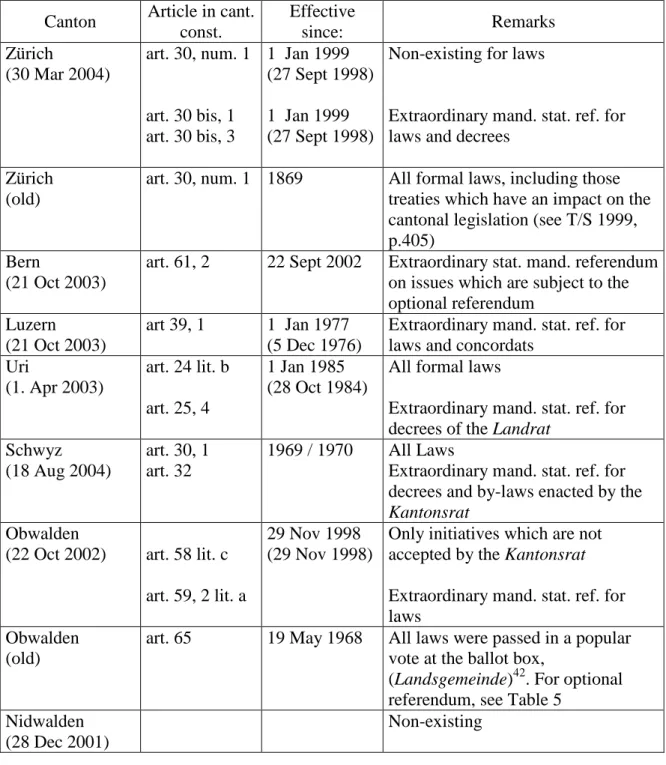
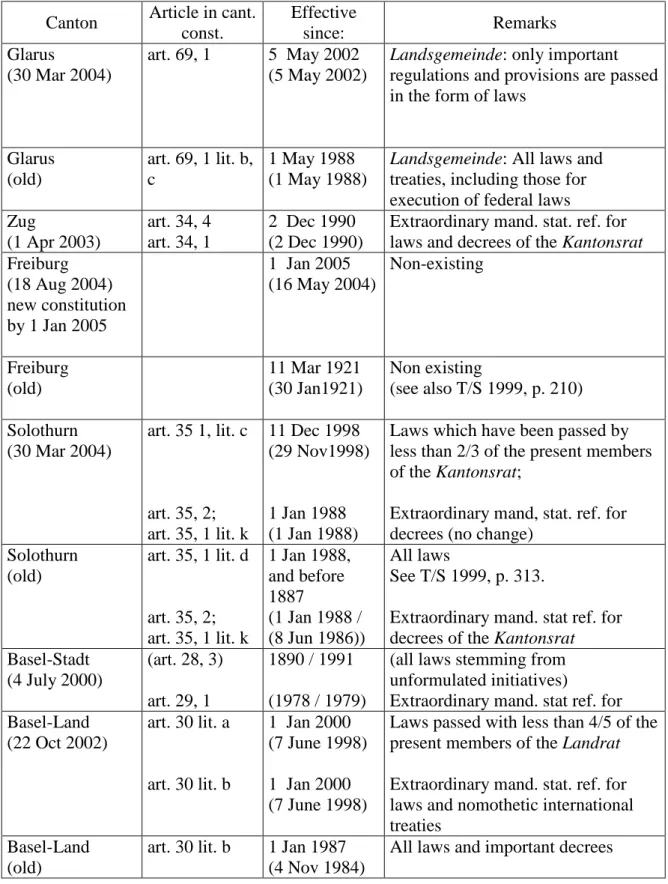
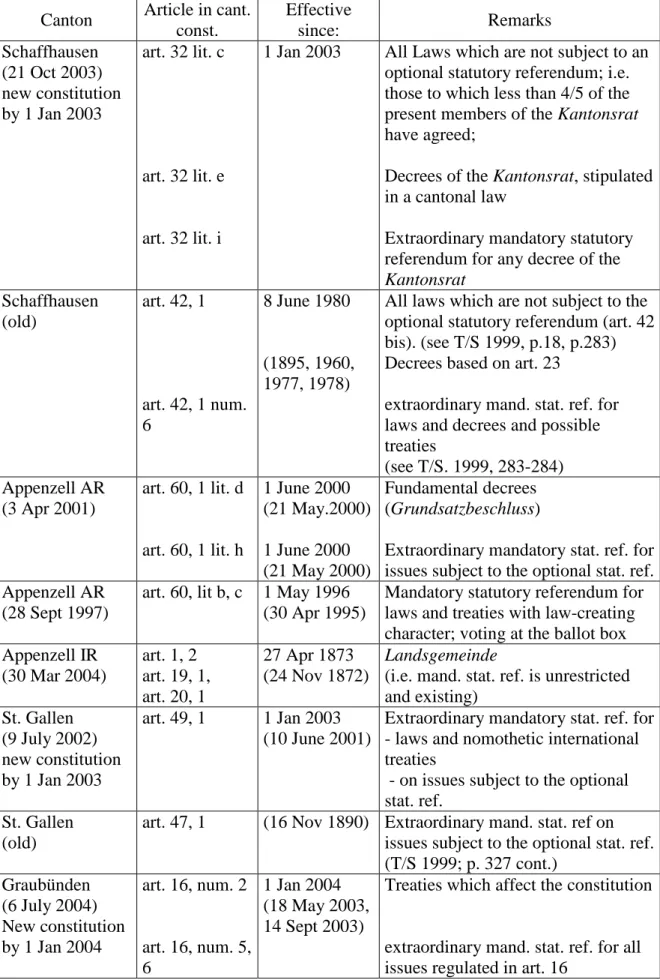
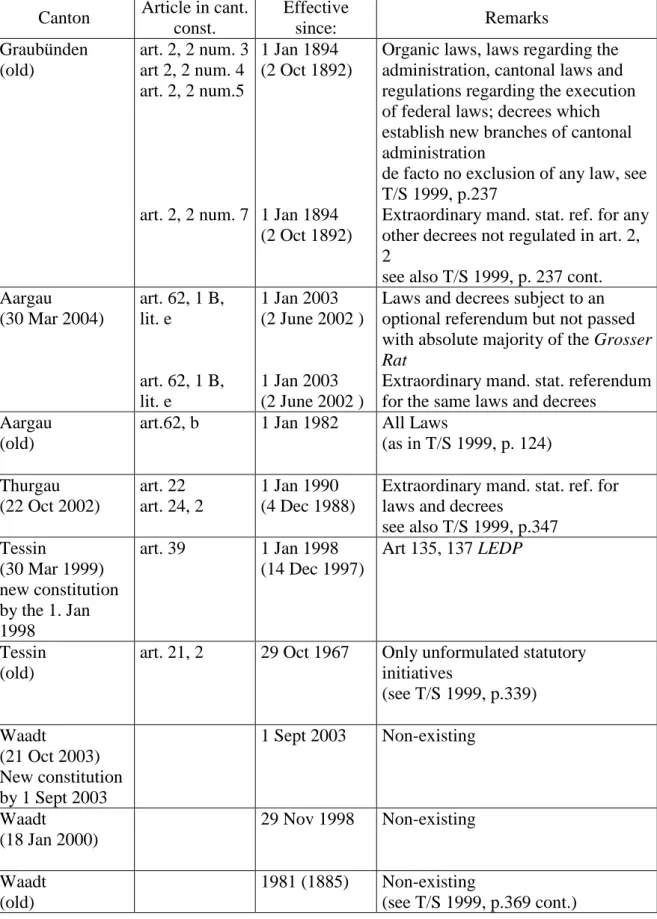
As regards the statutory referendum, in several cantons a shift of the political power from the electorate toward the cantonal parliament occurred, resulting in a weakening of direct democratic institutions. Quite often, the application of the mandatory statutory referendum has been restricted by the inclusion of a constitutional majority requirement of the cantonal parliament (Solothurn (SO), Appenzell Ausserrhoden (AR), Graubünden (GR), Schaffhausen (SH)) or by restriction of the issues subject to legal stipulation (Glarus (GL))29.
28 This paper was originally written in 2003. Constitutional changes after 2003 are not taken into account. See www.neueverfassung.lu.ch (07.10.2004) and personal communication with Mr. Zemp (20 Apr, 2005). 29 In case the majority restriction serves only as a means for disciplining the cantonal parliament, the introduction
of such a majority restriction has to be regarded as equivalent to a de facto elimination of the mandatory referendum. Only observation of the daily political usage over a longer period of time can provide a basis for a correct evaluation of this new institution.
Table 1: Changes of the institutions of direct democracy 1997 – 2003 Canton Institutional Changes
between 1997 and 2003 Comments
Index (1996) Index (2003) ZH GRR*: 1 Jan 1999, FRR*: 1 Jan 1999 4.417 3.500 BE 3.020 3.021 LU 4.420 4.417
UR VIR, GIR, GRR: 1 Oct 1997
FRR: 1 Oct 1997 5.290 5.125 SZ 4.990 4.927 OW GIR, GRR*: 29 Nov 1998 FRR*: 8 June 1997, 29 Nov 1998 Abolishment of Landsgemeinde (29 Nov 1998) 4.625 NW 4.438 GL GRR*: 5 May 2002 FRR: 5 May 2002 Landsgemeinde 5.500 ZG 4.420 4.479
FR New constitution by 1 Jan 2005 2.850 2.792
SO GRR*: 11 Dec 1998
FRR: 11 Dec 1998 5.670 5.250
BS FRR: 1 Jan 1998 Change in cantonal law 4.400 4.396
BL GRR*: 1 Jan 2000 5.690 5.479
SH GRR*: 1 Jan 2003 FRR: 1 Jan 2003
New constitution by 1 Jan 2003
5.210 5.021
AR GRR*: 1 June 2000 Abolishment of the
Landsgemeinde (28 Sept 1997) 4.917
AI FRR: 28 Apr 2002 Landsgemeinde 5.438
SG VIR, GIR: 1 Jan 2003 GRR: 1 Jan 2003 FRR: 1 Jan 2003
New constitution by 1 Jan 2003
Einheitsinitiative 3.580 3.521
GR New constitution by 1 Jan 2004 4.750 4.833
AG GRR*: 1 Jan 2003
FRR: 1 Jan 2003 5.460 5.438
TG 4.330 4.333
TI GRR: 1 Jan 1998 FRR: 1 Jan 1998
New constitution by 1. Jan1998
2.100 2.250
VD VIR, GIR: 1 Sept 2003 FRR*: 1 Sept 2003, 29 Nov 1998
New constitution by 1 Sept 2003
2.420 2.417
VS 3.580 3.583
NE GRR: 1 Jan 2002, FRR*: 1 Jan 2002
New constitution by 1 Jan 2002
2.190 2.729
GE 1.750 1.750
JU 4.020 3.708
Notes. Empty cells indicate that no relevant revision of the constitution or relevant cantonal law had been observed30. FRR: Fiscal Referendum, GIR: Statutory Initiative, GRR: Statutory Referendum (laws), VIR: Constitutional Initiative. *indicates abrogation or restriction of a mandatory referendum. The dates are dates of effectiveness. The index values of 1996 are taken from Stutzer (1999).
30
The constitutions and their tracked changes are based on the versions as of the 18th of Aug, 2004. Updated cantonal constitutions can be obtained from http://www.admin.ch/ch/d/sr/13.html#131.
A complete abolishment of the mandatory statutory referendum has happened in four cantons
(Zürich (ZH), Obwalden (OW), Appenzell Ausserrhoden (AR), Graubünden (GR)); in these cantons it has been replaced by an optional statutory referendum. In general, such changes lead to a decline in the index of direct democracy.
Looking at the development of the statutory initiative and the constitutional initiative, three interesting changes should be noted. First, more and more cantons present these two existing types of initiatives jointly under the identical heading („initiative‟) in their constitution, in order to group them together and indicate them as two possible variations of a people's initiative. This technical integration is particularly true for most of the new constitutions, and is part of a trend to make constitutions more transparent to the average citizen. In contrast, in the old constitutions, the organization of the people's rights was subject to a strict juristic way of thinking that reflected the organization of the state as understood in the nineteenth century. Traditionally, stipulations regarding revisions of the state constitution (including revisions initiated by the people) were given a separate paper in the back part of the constitution, signaling hat revising the constitution was considered as being outside the daily law-making process (framed by the existing constitution). The statutory initiative, in contrast, was placed in the middle in the constitution, signaling its link to the legislative process. For this reason, integrating both types of (statutory and constitutional) initiatives under one heading constitutes not only a formal change but indicates a change in the underlying philosophy and understanding of the purpose of a constitution.
Linked to this change is a second most recent phenomenon: the introduction of the so-called
unitary initiative (Einheitsinitiative) (e.g. in St. Gallen (SG)) art. 43 of the new constitution), which also aims to make it easier for the citizens to influence the legislative process. The unitary initiative is a binding motion of the electorate for which no specific legal form is required. During the readings (Lesungen) for the new cantonal constitution in St. Gallen, the introduction of the Einheitsinitiative was under hot debate and the most important aspects of this institution were discussed (Protocol 2000b, Protocol 2000a). According to the various speakers, this new type of initiative offers two advantages to its citizens: first, it is said to be relatively easy to carry out and, second, it is the legislative organ and not the initiator who decides whether a change in cantonal law or in cantonal constitution is the appropriate (re)action. This latter means that unitary initiatives can no longer be turned down on the formal ground that the wrong level of law-making had been chosen by the initiators, e.g. the proposal of a change in cantonal law when an amendment of the constitution would have been
correct, and vice versa. Additionally, the Einheitsinitiative allows the development of the cantonal law and the constitution in a juristically consistent and systematic way.
Nevertheless, the Einheitsinitiative should not be seen as a perfect substitute for the traditional initiatives. Both (traditional) statutory and constitutional initiatives are viewed as stronger instruments because the legal level of application and the content of the change are precisely specified. In addition, depending on the cantonal constitution, the Einheitsinitiative may serve as a mere suggestion of the electorate, and the cantonal parliament can decide whether to follow it or not: only if the parliament decides against it, a legislating referendum must be held. If it decides in favor and passes a cantonal law, no popular vote is needed, albeit this law may then be subject to the optional statutory referendum.31 Overall, some speakers in the cantonal parliament of St. Gallen pointed out, a hierarchy of types of initiatives can be construed in which the unitary initiative is at the lowest level of influence. Because of this hierarchy of initiatives, differences in the signature requirements appear justified, with the lowest number for the weakest instrument of direct legislation. There are, however, cantonal constitutions in which no differentiation is made between the number of signatures required for the unitary versus the statutory initiative32.
The third phenomenon linked to the new treatment of the statutory and the constitutional initiatives is that more and more cantons tend to regulate the time period for collecting signatures in the constitution itself and not in a cantonal (by-)law (usually a law on political rights of its citizenry). The advantage of this development could be increased transparency because now all requirements concerning one institution are laid down in the same legal act. Another advantage might be that any change in constitution must be approved by the electorate through a mandatory referendum33, whereas an alteration of a simple cantonal law might only be subject to an optional statutory referendum, depending on the cantonal constitution. In this latter situation, political economic theory predicts larger deviations from the median voter‟s preferences than in the former (Feld and Kirchgässner, 2001). On the other hand, again depending on whether differences exist regarding the signature requirements for a statutory or constitutional initiative, it might have equally become more difficult for the
31
However, if a constitutional amendment is chosen, the cantonal people must have the final say in a popular vote, as stipulated in the federal constitution.
32 Because of its potentially low level of political influence and because it only complements the existing traditional initiatives, the Einheitsinitiative does not (yet) form part of the index of direct democracy. Only the future will show how important the institution becomes to the daily political process and whether it should be included in the index construction or not.
electorate to change that requirement to its favor if regulated in a constitution. In political practice, however, between 1980 and 1998, time periods for signature collection, whether regulated by a law or the constitution, were rarely changed. Additionally, for all cantons during our investigation period, regulation at a new, higher level of lawmaking failed to bring about a different (shorter) time period for signature collection34.
Table 1 provides information on how the index of direct democracy changed between 1996 (as found in Stutzer, 1999) and 2003 (based on own calculations). It must be noted that not all institutional changes automatically cause a change in its total index-value: index points are awarded for each institution based on ranges of signature requirements or financial thresholds so that relatively small alterations in the requirements do not necessarily translate into a change in category. In addition, the reader should keep in mind that each institution influences the composite index by only 25%: e.g. the change in signature requirement in Basel-Land (BL) for the optional statutory referendum caused a total change of just about 0.21 index points. At this point, I would like to emphasize that because the index is constructed on a yearly basis, revisions of the cantonal constitution becoming effective after April 1st are always counted as changes in the index of the subsequent year. Moreover, it is also possible that several, contrasting institutional changes – either occurring simultaneously or subsequent to each other – might cause a compensating impact. For example, in the canton Uri (UR), a partial revision of the statutory and constitutional initiative and the fiscal referendum lead, overall, to no considerable change in the total value. Finally, it should be noted that small alterations in the index can be caused by changes in the residential population or the electorate, as some requirements enter the sub-index in the form of per capita values.
34
A similar situation can be found in St. Gallen (SG) where the expenditure thresholds for the mandatory and the optional fiscal referendum are laid down in a cantonal law but not in the constitution.
3
The initiative
3.1 The constitutional initiative
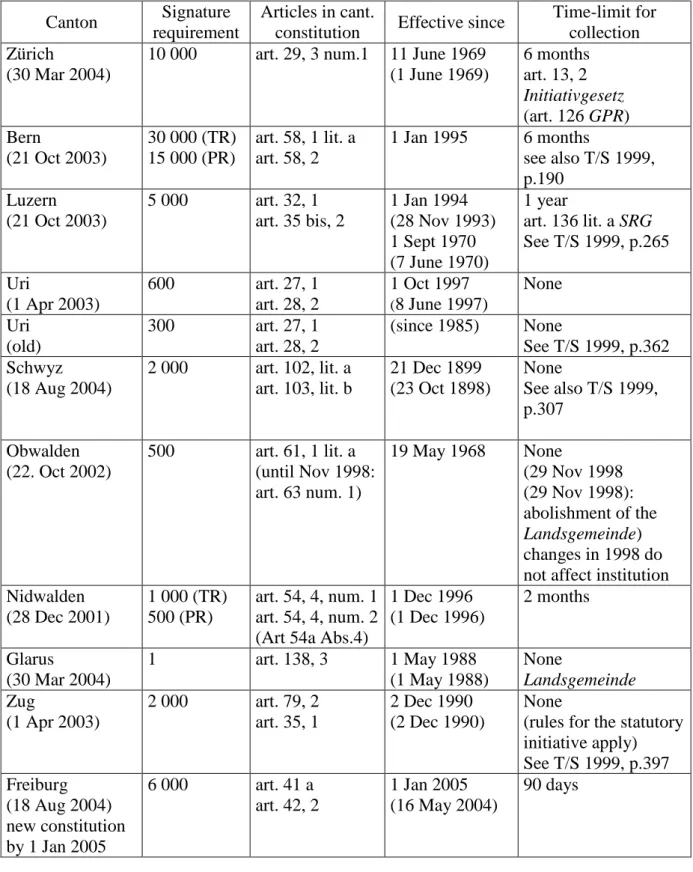
Table 2: The constitutional initiative 1997 - 2003
Canton Signature
requirement
Articles in cant.
constitution Effective since
Time-limit for collection Zürich
(30 Mar 2004)
10 000 art. 29, 3 num.1 11 June 1969 (1 June 1969) 6 months art. 13, 2 Initiativgesetz (art. 126 GPR) Bern (21 Oct 2003) 30 000 (TR) 15 000 (PR) art. 58, 1 lit. a art. 58, 2 1 Jan 1995 6 months see also T/S 1999, p.190 Luzern (21 Oct 2003) 5 000 art. 32, 1 art. 35 bis, 2 1 Jan 1994 (28 Nov 1993) 1 Sept 1970 (7 June 1970) 1 year art. 136 lit. a SRG See T/S 1999, p.265 Uri (1 Apr 2003) 600 art. 27, 1 art. 28, 2 1 Oct 1997 (8 June 1997) None Uri (old) 300 art. 27, 1 art. 28, 2 (since 1985) None See T/S 1999, p.362 Schwyz (18 Aug 2004) 2 000 art. 102, lit. a art. 103, lit. b 21 Dec 1899 (23 Oct 1898) None See also T/S 1999, p.307 Obwalden (22. Oct 2002) 500 art. 61, 1 lit. a (until Nov 1998: art. 63 num. 1) 19 May 1968 None (29 Nov 1998 (29 Nov 1998): abolishment of the Landsgemeinde) changes in 1998 do not affect institution Nidwalden (28 Dec 2001) 1 000 (TR) 500 (PR) art. 54, 4, num. 1 art. 54, 4, num. 2 (Art 54a Abs.4)
1 Dec 1996 (1 Dec 1996) 2 months Glarus (30 Mar 2004) 1 art. 138, 3 1 May 1988 (1 May 1988) None Landsgemeinde Zug (1 Apr 2003) 2 000 art. 79, 2 art. 35, 1 2 Dec 1990 (2 Dec 1990) None
(rules for the statutory initiative apply) See T/S 1999, p.397 Freiburg (18 Aug 2004) new constitution by 1 Jan 2005 6 000 art. 41 a art. 42, 2 1 Jan 2005 (16 May 2004) 90 days
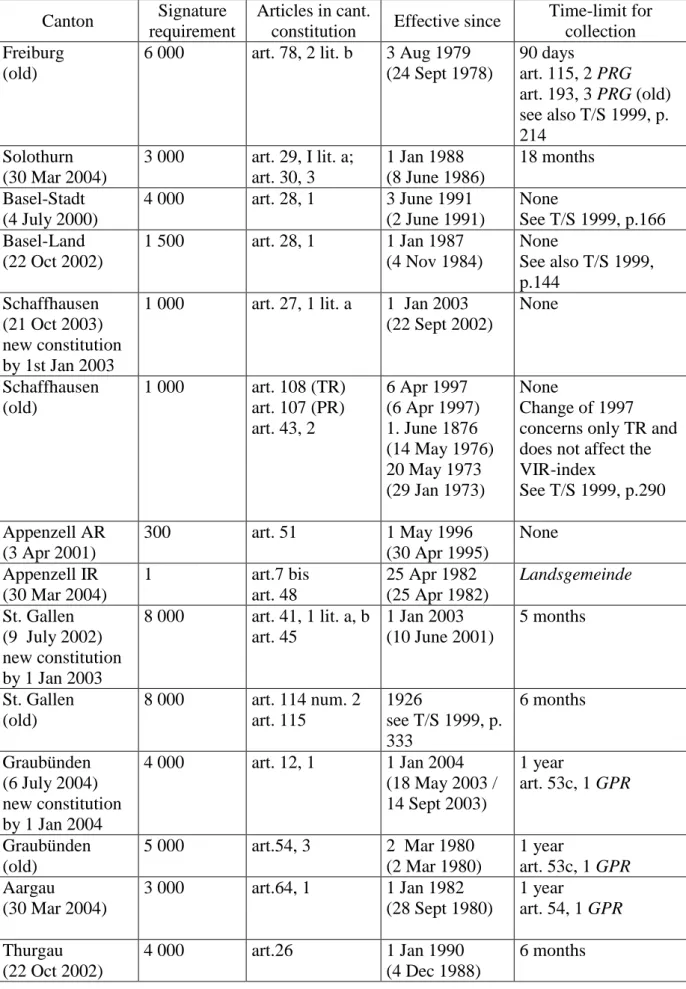
Table 2: The constitutional initiative 1997 - 2003 (cont.)
Canton Signature
requirement
Articles in cant.
constitution Effective since
Time-limit for collection Freiburg
(old)
6 000 art. 78, 2 lit. b 3 Aug 1979 (24 Sept 1978) 90 days art. 115, 2 PRG art. 193, 3 PRG (old) see also T/S 1999, p. 214 Solothurn (30 Mar 2004) 3 000 art. 29, I lit. a; art. 30, 3 1 Jan 1988 (8 June 1986) 18 months Basel-Stadt (4 July 2000) 4 000 art. 28, 1 3 June 1991 (2 June 1991) None See T/S 1999, p.166 Basel-Land (22 Oct 2002) 1 500 art. 28, 1 1 Jan 1987 (4 Nov 1984) None See also T/S 1999, p.144 Schaffhausen (21 Oct 2003) new constitution by 1st Jan 2003
1 000 art. 27, 1 lit. a 1 Jan 2003 (22 Sept 2002) None Schaffhausen (old) 1 000 art. 108 (TR) art. 107 (PR) art. 43, 2 6 Apr 1997 (6 Apr 1997) 1. June 1876 (14 May 1976) 20 May 1973 (29 Jan 1973) None Change of 1997 concerns only TR and does not affect the VIR-index See T/S 1999, p.290 Appenzell AR (3 Apr 2001) 300 art. 51 1 May 1996 (30 Apr 1995) None Appenzell IR (30 Mar 2004) 1 art.7 bis art. 48 25 Apr 1982 (25 Apr 1982) Landsgemeinde St. Gallen (9 July 2002) new constitution by 1 Jan 2003 8 000 art. 41, 1 lit. a, b art. 45 1 Jan 2003 (10 June 2001) 5 months St. Gallen (old) 8 000 art. 114 num. 2 art. 115 1926 see T/S 1999, p. 333 6 months Graubünden (6 July 2004) new constitution by 1 Jan 2004 4 000 art. 12, 1 1 Jan 2004 (18 May 2003 / 14 Sept 2003) 1 year art. 53c, 1 GPR Graubünden (old) 5 000 art.54, 3 2 Mar 1980 (2 Mar 1980) 1 year art. 53c, 1 GPR Aargau (30 Mar 2004) 3 000 art.64, 1 1 Jan 1982 (28 Sept 1980) 1 year art. 54, 1 GPR Thurgau (22 Oct 2002) 4 000 art.26 1 Jan 1990 (4 Dec 1988) 6 months
Table 2: The constitutional initiative 1997 - 2003 (cont.)
Canton Signature
Requirement
Articles in cant.
constitution. Effective since
Time-limit for collection Tessin (30 Mar 1999) new constitution by 1 Jan 1998 10 000 art. 83 (art. 119, 2 LEDP) 1 Jan 1998 (14 Dec 1997) 60 days art. 119, 1 LEDP Tessin (old) 10 000 art. 54, 1 lit. c art. 56 1970 (31 May 1970) 60 days art. 3 LIRR see T/S 1999, p.342 Waadt (21 Oct 2003) new constitution by 1 Sept 2003 12 000 (PR) 18 000 (TR) art. 78 lit. a art. 79, 2 1 Sept 2003 (22 Sept 2002) 4 months (contradicts LEDP, art. 92, 1) Waadt (old) 12 000 art. 100 1961 (11 June 1961) see T/S 1999, p.373 3 months art. 92, 1 LEDP Wallis (21 Oct 2003) 6 000 art. 100, 1 1 June 1994 (24 Oct 1993) None Neuenburg (16 Oct 2001) new constitution by 1 Jan 2002 10 000 (TR) 6 000 (PR) art. 101, 1 art. 102, 1 1 Jan 2002 (24 Sept 2000) 6 months art. 105, 1 LDP Neuenburg (old) 10 000 (TR) 6 000 (PR) art. 83, 1 art.84, 1 and 2 1959 see T/S 1999, p.275 6 months art. 105, 1 LDP Genf (21 Oct 2003) 10 000 art.64 art. 65 A (7 Mar 1993) 4 months art. 89, 1 c LEDP Jura (4 July 2000) 2 000 art.75, 1 1 Jan 1979 (20 Mar 1977) 12 months Art 89, 1 LDP
In the column „Canton‟, the date of the version of the cantonal constitution (or the date of the download, the 18th of Aug, 2004) is displayed in brackets. In case of Freiburg (FR) the source was http://www.fr.ch/constituante/doc/fichiers/proj_def/proj.pdf (18 Aug 2004). TR denotes „total revision‟ and PR „partial revision‟ of the cantonal constitution; if not otherwise indicated, the signature requirement applies to both initiatives equally. Signature requirements relate to the corresponding cantonal electorate. The Einheitsinitiative, which does not enter the index of direct democracy, has been excluded. In the column „Effective since‟ the date of the popular vote is given in brackets. For an explanation of the abbreviation of the cantonal laws on political rights and their dates of enactment, see Table A.1 in the Appendix
3.2 The statutory initiative
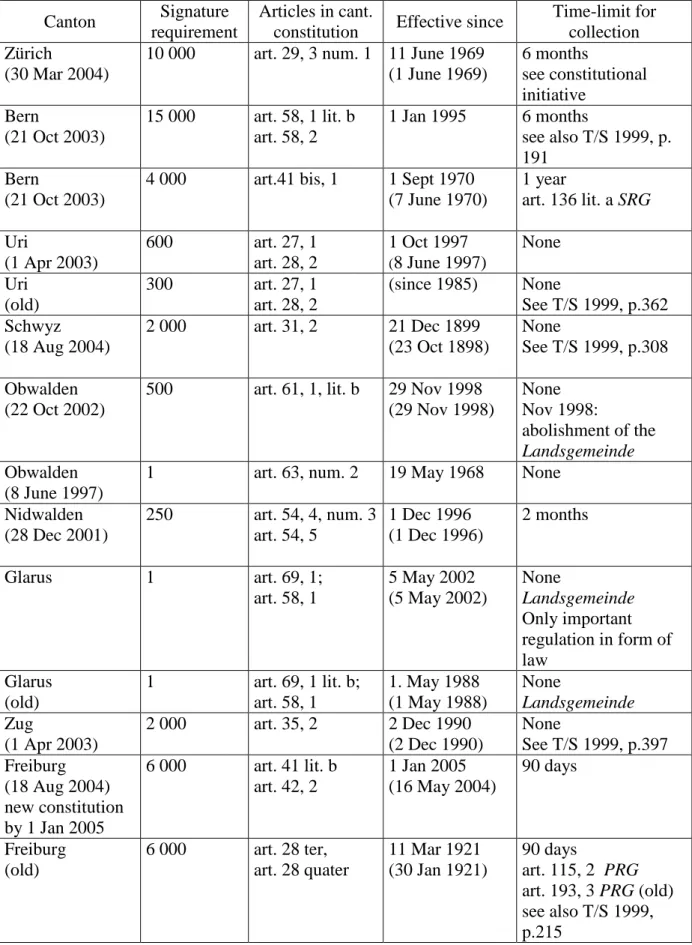
Table 3: The statutory initiative 1997 - 2003
Canton Signature
requirement
Articles in cant.
constitution Effective since
Time-limit for collection Zürich
(30 Mar 2004)
10 000 art. 29, 3 num. 1 11 June 1969 (1 June 1969) 6 months see constitutional initiative Bern (21 Oct 2003) 15 000 art. 58, 1 lit. b art. 58, 2 1 Jan 1995 6 months see also T/S 1999, p. 191 Bern (21 Oct 2003)
4 000 art.41 bis, 1 1 Sept 1970 (7 June 1970) 1 year art. 136 lit. a SRG Uri (1 Apr 2003) 600 art. 27, 1 art. 28, 2 1 Oct 1997 (8 June 1997) None Uri (old) 300 art. 27, 1 art. 28, 2 (since 1985) None See T/S 1999, p.362 Schwyz (18 Aug 2004) 2 000 art. 31, 2 21 Dec 1899 (23 Oct 1898) None See T/S 1999, p.308 Obwalden (22 Oct 2002)
500 art. 61, 1, lit. b 29 Nov 1998 (29 Nov 1998) None Nov 1998: abolishment of the Landsgemeinde Obwalden (8 June 1997)
1 art. 63, num. 2 19 May 1968 None
Nidwalden (28 Dec 2001) 250 art. 54, 4, num. 3 art. 54, 5 1 Dec 1996 (1 Dec 1996) 2 months Glarus 1 art. 69, 1; art. 58, 1 5 May 2002 (5 May 2002) None Landsgemeinde Only important regulation in form of law Glarus (old) 1 art. 69, 1 lit. b; art. 58, 1 1. May 1988 (1 May 1988) None Landsgemeinde Zug (1 Apr 2003) 2 000 art. 35, 2 2 Dec 1990 (2 Dec 1990) None See T/S 1999, p.397 Freiburg (18 Aug 2004) new constitution by 1 Jan 2005 6 000 art. 41 lit. b art. 42, 2 1 Jan 2005 (16 May 2004) 90 days Freiburg (old) 6 000 art. 28 ter, art. 28 quater 11 Mar 1921 (30 Jan 1921) 90 days art. 115, 2 PRG art. 193, 3 PRG (old) see also T/S 1999, p.215
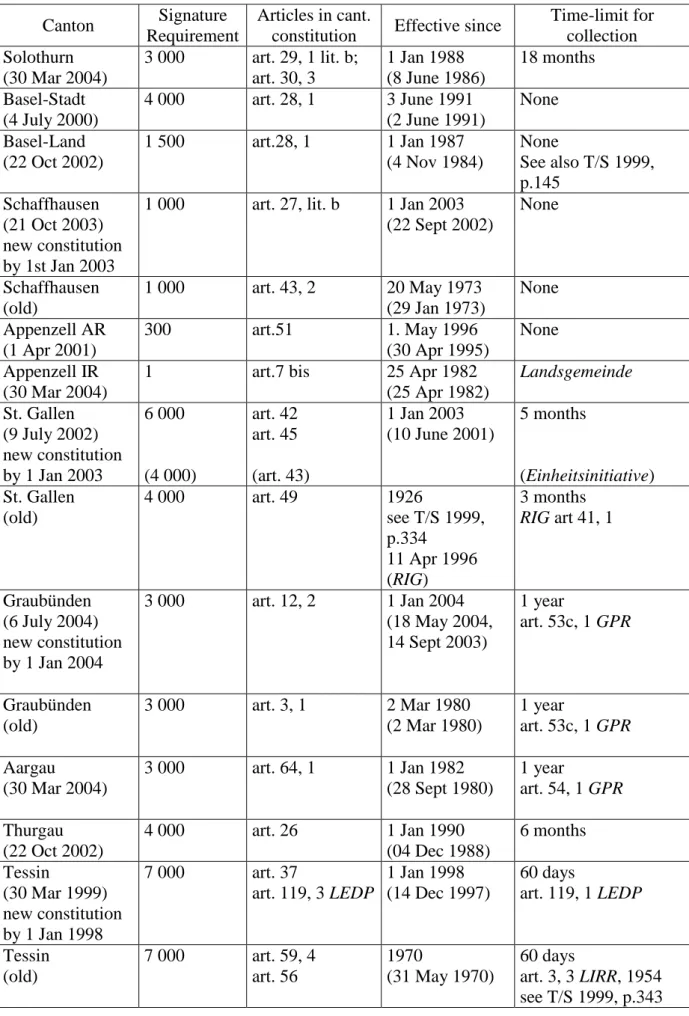
Table 3: The statutory initiative 1997 - 2003 (cont.)
Canton Signature
Requirement
Articles in cant.
constitution Effective since
Time-limit for collection Solothurn (30 Mar 2004) 3 000 art. 29, 1 lit. b; art. 30, 3 1 Jan 1988 (8 June 1986) 18 months Basel-Stadt (4 July 2000) 4 000 art. 28, 1 3 June 1991 (2 June 1991) None Basel-Land (22 Oct 2002) 1 500 art.28, 1 1 Jan 1987 (4 Nov 1984) None See also T/S 1999, p.145 Schaffhausen (21 Oct 2003) new constitution by 1st Jan 2003
1 000 art. 27, lit. b 1 Jan 2003 (22 Sept 2002) None Schaffhausen (old) 1 000 art. 43, 2 20 May 1973 (29 Jan 1973) None Appenzell AR (1 Apr 2001) 300 art.51 1. May 1996 (30 Apr 1995) None Appenzell IR (30 Mar 2004)
1 art.7 bis 25 Apr 1982
(25 Apr 1982) Landsgemeinde St. Gallen (9 July 2002) new constitution by 1 Jan 2003 6 000 (4 000) art. 42 art. 45 (art. 43) 1 Jan 2003 (10 June 2001) 5 months (Einheitsinitiative) St. Gallen (old) 4 000 art. 49 1926 see T/S 1999, p.334 11 Apr 1996 (RIG) 3 months RIG art 41, 1 Graubünden (6 July 2004) new constitution by 1 Jan 2004 3 000 art. 12, 2 1 Jan 2004 (18 May 2004, 14 Sept 2003) 1 year art. 53c, 1 GPR Graubünden (old) 3 000 art. 3, 1 2 Mar 1980 (2 Mar 1980) 1 year art. 53c, 1 GPR Aargau (30 Mar 2004) 3 000 art. 64, 1 1 Jan 1982 (28 Sept 1980) 1 year art. 54, 1 GPR Thurgau (22 Oct 2002) 4 000 art. 26 1 Jan 1990 (04 Dec 1988) 6 months Tessin (30 Mar 1999) new constitution by 1 Jan 1998 7 000 art. 37 art. 119, 3 LEDP 1 Jan 1998 (14 Dec 1997) 60 days art. 119, 1 LEDP Tessin (old) 7 000 art. 59, 4 art. 56 1970 (31 May 1970) 60 days art. 3, 3 LIRR, 1954 see T/S 1999, p.343
Table 3: The statutory initiative 1997 – 2003 (cont.)
Canton Signature
Requirement
Articles in
cant. const. Effective since
Time-limit for collection Waadt (21 Oct 2003) new constitution by 1 Sept 2003 12 000 art. 78 lit. b art. 79, 2 1 Sept 2003 (22 Sept 2002) 4 months (contradicts LEDP, art. 92, 1) Waadt (old) 12 000 art. 27, 1 1978 (4 Dec 1977) see T/S 1999, p.373 3 months art 92, 1 LEDP see also T/S 1999, p.373 Wallis (21 Oct 2003) 4 000 art. 33, 1 1 June 1994 (24 Oct 1993) None Neuenburg (16 Oct 2001) new constitution by 1 Jan 2002 6 000 art. 40, 1 art. 40, 2 1 Jan 2002 (24 Sept 2000) 6 months art. 105, 1 LDP Neuenburg (alt) 6 000 art. 38, 2 art. 38. 3 1960 see T/S 1999, p.276 6 months art. 105, 1 LDP Genf (21 Oct 2003) 10 000 art. 64 art. 65 B (art. 65) (7 Mar 1993) 4 months art. 89, 1 c LEDP (Einheitsinitiative) Jura (4 July 2000) 2 000 art.75,1 1 Jan 1979 (20 Mar 1977) 12 months Art 89, 1 LDP
Notes: See Table 2.
3.3 Comments on the changes in constitutional and statutory initiatives
Tables 2 and 3 provide an overview of the 26 Swiss cantons and their constitutional stipulations concerning the constitutional and the statutory initiative between 1997 and 2003. In several cantons, alterations in these institutions of direct legislation have occurred since 1997. In the constitution of Zürich (ZH), the time period available for constitutional and statutory initiatives is not fixed (art. 29, 4 cantonal constitution (CC))35; instead, it is stipulated that a cantonal law should determine this limit. As of the 1st of June, 1969, the time period for signature collection was set at 6 months for people's initiatives (art. 13, 2 of the
Initiativgesetz). On the 1st of September, 2003, a new cantonal law on political rights (Gesetz über die politischen Rechte, GPR) was passed in the Kantonsrat that fixed an identical time
period (art. 126, 1 GPR) and became effective the 1st of January, 2005. In other words, in terms of the requirements for statutory and constitutional initiatives, no changes that affect the index of direct democracy have been undertaken in Zürich since 1969, despite the enactment of a new cantonal law on political rights.
Uri (UR) is one of the cantons in which important changes in the requirements for the constitutional and statutory initiatives occurred after 1997. In this canton, the number of required signatures doubled from 300 to 600 as of the 1st October, 1997 (art. 28, 2 CC; art. 27, 1 CC), which caused a duplication of the relative signature requirement from 1.18 per voter to 2.36 per voter and, finally, lowered the sub-index for either initiative from 1998 onwards. Since the identical stipulations are valid for both initiatives, an identical drop is noted for the sub-index relating to either types of initiatives (VIR and GIR). The time period for collection, however, was not altered by this constitutional revision.
In the canton of Obwalden (OW), on the 29th of November, 1998, the electorate decided against maintaining the status of Landsgemeinde. This choice meant that (a) the open vote in a yearly citizens' meeting was replaced by a secret vote at the ballot box and (b) the role of the representative organ of legislation was strengthened. As regards the constitutional initiative, however, no change in institutional requirements occurred after 1968 except for a formal renumbering of articles in the constitution. In contrast, as regards the statutory initiative, the abolishment of the Landsgemeinde in November 1998 brought about a substantially higher signature requirement than before. As a result, the stipulated number of supporters rose from 1 in June 1997 to 500 in November 1998, which caused a jump in the relative signature hurdle from about 0.005 to 2.27. The time period available for collection, however, remained the same. In effect, this change led to a substantial decline in the sub-index for the statutory initiative (GIR).
For the canton of Nidwalden (NW), there have been no apparent changes in the institutional requirements for either initiative since 1996. It might be interesting to point out, however, that in addition to the usual initiatives, the citizens can also make a counterproposal to an existing decision of the Kantonsrat either to revise the constitution or to make a new/change in cantonal law. This institution is very similar to the initiative – in a way it can be viewed as a reactive initiative. The requirements for the counterproposals are identical to that for the statutory initiative and the constitutional initiative, respectively (see art. 54a, 4 CC).
The canton of Glarus (GL) is one of the two cantons in which direct democracy in the form of the Landsgemeinde still exists. In this canton every citizen has the right to make a motion to the Landsgemeinde, the assembly of its citizens, on issues that concern the Landsgemeinde
(art. 58, 1 CC). Hence, according to art. 58, 1 CC and art. 138, 3 CC, it takes one vote to launch a constitutional or statutory initiative. Art. 69 CC then specifies the fields on which the
Landsgemeinde can exert its decision-making power, which is comprised of the constitution and cantonal laws. Art. 69 CC, however, was amended in May 2002, leading to a seemingly indirect restriction of the statutory initiative36, because only fundamental regulations should be determined in the form of laws, whereas before 2002 any issue could have been in a statutory form. The intention of this new regulation was to give the cantonal parliament the power to regulate organizational issues, particularly the execution of the federal law, which the Swiss federal constitutions stipulates to be carried out in Switzerland by cantonal administrations in the form of parliamentary decrees that, as administrative acts, cannot be challenged by direct democratic rights37. This change in the scope of the statutory initiative, however, does not affect the value of the index of direct democracy because no distinction is made between a statutory initiative that includes or excludes implementations of federal acts. In the same period, the requirements of the constitutional initiative remained unchanged.
In the canton of Freiburg (FR), a new constitution took effect on the 1st of January, 2005. Regarding the institutional setup of either the statutory or the constitutional initiative, however, no change was introduced. Thus, the index of direct democracy remains unaffected. The sole difference to the old legal system is that for both types of initiatives the signature requirements are now explicitly stated in the constitution instead of being regulated exclusively by a cantonal law. In general, a complete regulation at the constitutional level makes the requirements for these initiatives more transparent to the citizenry; it does not, however, diminish the power of the electorate to change these requirements through an initiative because in Freiburg the requirements for launching a statutory initiative and a constitutional one are identical, also before and after 2005.
36 As well as of the mandatory statutory referendum – see section 4.
37 According to Mr. Dürst, Ratsschreiber in the Regierungskanzlei of Glarus, in practice this restriction was only carried out to solve an academic battle over whether all executions of federal laws needed to be based on a so-called cantonal introductory law ('Einführungsgesetz') that would, under the old constitution, have been subject to a mandatory referendum. In political practice, he emphasizes, no restriction of direct democratic rights was caused by this amendment in May 2002.
The people of Schaffhausen (SH) adopted a new constitution that came into force on the 1st of January, 2003. This new constitution is one of those total revisions that aimed to modernize the structure and wording without changing the legal content – at least as far as the initiatives are concerned. In the new constitution, both types of initiatives are now regulated in one article (art. 27 CC) rather than being dispersed within the constitution (art. 108, 107 old CC and art. 43 old CC). Therefore, no change is observed in the values of the subindices of either the constitutional or the statutory initiative.
During the time period under investigation, the people of St. Gallen (SG) also adopted a new constitution in 2002, which took effect on the 1st of January, 2003. This new constitution brought about decisive changes for the statutory and constitutional initiatives. Specifically, in the new constitution, the time for collecting signatures was fixed at 5 months for either initiative (for reasons of 'harmonization'38), while the number of signatures was raised substantially (from 4,000 to 6,000) for the statutory initiative, but maintained at 8,000 for the constitutional initiative. Hence, the time requirement has become stricter for the constitutional initiative (6 months => 5 months) but more relaxed for the statutory one (3 months => 5 months). As a consequence, the sub-index for the constitutional initiative (VIR) stayed the same39, but the sub-index for the statutory initiative (GIR) declined from 4 points down to 3.66 points. One new feature in this constitution is the introduction of the so-called
Einheitsinitiative (unitary initiative), which is easier to launch in comparison to a traditional statutory or constitutional initiative (4,000 signatures in 5 months, art. 43, 1 CC and art. 45 CC). The advantages and disadvantages of this kind of initiative have already been described in the previous section. As a final change, the minimum time gap between passing a new law and starting a new initiative appears to have been erased in the new constitution. Neither the unitary initiative nor the change in minimum time gap is reflected in the sub-index for the statutory initiative.
Like many other cantonal people, the citizens of Graubünden (GR) also opted for a new constitution, which became effective on the 1st of January, 2004, the reason for which it is outside the scope of this investigation. The new stipulations brought about a rise in the people's empowerment through a decrease in the number of signatures necessary for a constitutional initiative (from 5,000 signatures down to 4,000). This development should be well reflected in a higher value of the sub-index of the constitutional initiative (from 4.333 up
38 See Protocol 1 and Protocol 2.
to 4.666). Regarding the statutory initiative, however, the old requirements remained unchanged at 3,000. For both initiatives, the time for collecting signatures is set at one year in a cantonal law (art. 53c, 1 GPR), which has remained unaltered since 1962.
Also counted among the new cantonal constitutions has to be that of the Italian-speaking canton of Tessin (TI), which was adopted in December 1997 and became effective on the 1st of January, 1998. Regarding both constitutional and statutory initiatives, no changes are observable in the constitutional stipulations. The sole observed change is that the time period available for collection is now regulated at the constitutional level and not (exclusively) through a cantonal law (art. 3, 3 LIRR for the old constitution; art. 137, 1 LEDP since 1 Jan, 1999). Hence, the index of direct democracy is unaffected. As the number of signatures for launching a constitutional initiative is significantly higher than the number necessary for a statutory one (10,000 vs. 7,000), it is now more difficult for the people to induce a change in the requirement of the time period for collection than prior to the new constitution. At this point, it should be noted that the information given in T/S 1999, p. 343, on the signature requirement for the statutory initiative in the proposed constitution does not reflect the number actually set in the new constitution.
The canton Waadt (VD) also experienced the introduction of a new constitution, which entered into force on the 1st of September, 2003. As in many other cases, however, only small institutional changes were introduced through this process. The time period for collecting signatures for either initiative was increased from 3 months to 4 months for all initiatives (art. 79, 2 CC)40; however, the number of signatures was augmented to 18,000 for a initiating total revision of the constitution but stayed the same for the launching a partial revision and the statutory initiative. Since the index of direct democracy does not take into account a total revision of the constitution (which occurs less than once in a human lifetime on average), its value is not affected by that latter change. Nevertheless, due o the more flexible time limit, the sub-indices for either initiative (GIR, VIR) should increase from 2004 onwards. In addition, as in many other cantons and in contrast to the old legal setup, the time period for collecting signatures is now regulated at the constitutional level. As, however, the requirements for changing a cantonal law and amending the constitution are identical in Waadt, regulating such
40 The new constitutional stipulation contradicts the time limit laid down in the cantonal law on political rights (LEDP, art. 92, 1). The Grand Conseil of Waadt, however, amended this law on the 5th of Apr, 2005. This revision will come into force after a delay of 40 days if the electorate of Waadt does not carry out a statutory referendum to overrule this change.
an issue in the constitution does not weaken the institution-setting power of the people. The old regulatory setup facilitated, in theory, changes by the parliament to their advantage because cantonal laws were then subject only to an optional statutory referendum. The cantonal parliament in the past, however, has never abused its power as can be concluded from the unchanged stipulation of 3 months signature collection time, having been unchanged at least since 197841.
Finally, the people of Neuenburg (NE) also totally revised their old constitution and voted on a new one on the 16th of October, 2001, which took effect on the 1st of January, 2002. In the new constitution, the stipulations are more transparently and logically structured, but this did not cause any change in the institutional setup for either initiative. Therefore, the two subindices of the statutory and the constitutional initiatives remain unchanged. Additionally in this case, the requirement of the time period, originally solely regulated in the cantonal law
LDP, became part of the constitutional provisions. Given that signature and time limit requirements are identical for both types of initiatives, and also prior and after the constitutional change, the electorate‟s influence on the institutional framework remained unaffected.
4
The statutory referendum
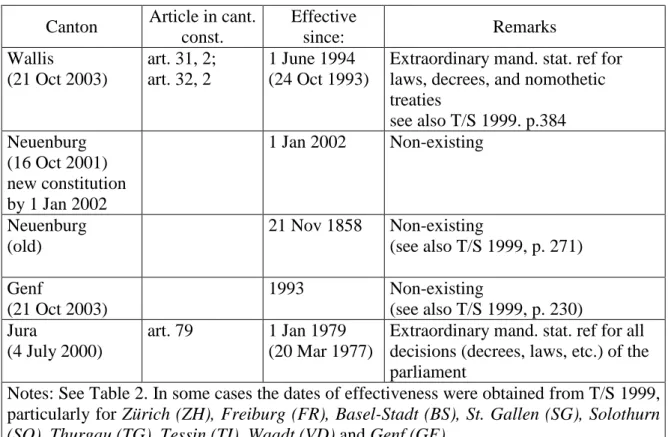
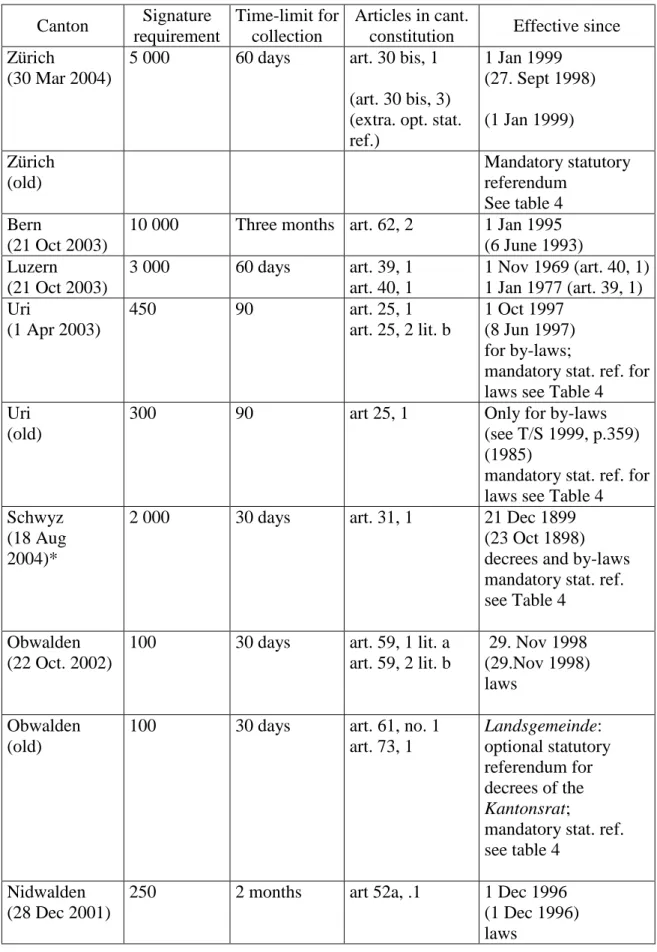
Tables 4 and 5 describe the legal status quo and recent amendments concerning the mandatory and optional statutory referenda, referring either to laws, decrees, or by-laws, as they influence the degree of direct democracy in a canton as measured by the sub-index of the statutory referendum (GRR). For reasons of completeness, I have also included information on the extraordinary statutory referendum. Not reported are referenda referring to international or intercantonal treaties or on special issues. To understand the impact of these requirements on the composite index of direct democracy, it must be recalled that in most cases, the sub-index of the statutory referendum (GRR) is constructed either (1) based on the optional statutory referendum only, in case of non-existence of the mandatory referendum, or, (2) as an average of the optional and the (restricted) mandatory statutory referendum; a restriction usually pertains to a majority in the legislating organ or the type of laws/by-laws.