© 2017, IRJET | Impact Factor value: 6.171 | ISO 9001:2008 Certified Journal | Page 960
Association Rule Mining using RHadoop
Anurag Agrahari
1, Prof D.T.V. Dharmaji Rao
21
M.tech Student, Deptt. Of Computer Sci & Engg, AITAM College, Tekkali, Srikakulam, Andhra Pradesh, India.
2Professor, Deptt of Computer Sci & Engg, AITAM College, Tekkali, Srikakulam, Andhra Pradesh, India.
---***---Abstract -
With the advancement of computer relatedtechnology, the world is generating several Exabyte of data per year. Data generated through many sources like business processes, transactions, social networking sites, web servers, and many other source are remains in structured as well as unstructured form increased by exponential rates. Processing of huge amount of data or extracting hidden information is always a challenging and tuff task. Many Data Mining and statistical techniques are being used to find out the hidden pattern hidden in it. Association Rule Mining is one of core Data mining techniques being widely used in Big Data Analytics. Many tools are used in the Big Data Analysis. R is statistical language, widely used in the analysis. Hadoop can be integrated with R known as RHadoop. In this paper, we will briefly discuss what is big data, Hadoop, integration with R and analysis of result on training data set using association Rule.
Key Words
:
Big Data, Data mining, Association Rule mining, RHadoop, Ambari.
1. INTRODUCTION
Today large datasets are a part of every field that somehow involves digital information. Companies, programs and network sensors produce huge amount of fresh data, around 2.5 EBs (Exabyte’s) every single day. The total amount of data in the world was 4.4 zettabytes in 2013. According to prediction, this is set to rise steeply to 44 zettabytes by 2020[1].A lot of statistical techniques and data mining techniques are used to analysis the Big data set. Big Data analysis refers to data that exceeds the typical storage, processing, and computing capacity of conventional databases using data analysis techniques [17]. Most popular distributed computing paradigms nowadays uses Hadoop framework for handling the large scale data. Data mining, a technique to understand and find out the hidden knowledge from raw data and convert into useful information, is increasingly being used in a variety of fields like marketing, business intelligence, scientific discoveries, biotechnology, Internet searches, and multimedia. Data mining is an interdisciplinary field combining ideas from statistics, machine learning, and natural language processing. Data mining in such environments requires a utilization of the available resources. The application of Big data in expert system in
agriculture for making of decision support system, will open the new research area [21][22].
2. RELETED WORKS
Association rule mining works was carried out by [2] where she applied association rule with Map Reduce concept in cloud. Cloud itself provides the platform to analysis the Big Data. Most of Organization is using cloud for their application. Furthermore a lot of work for Association Rule Mining (ARM) is one of important and popular technique of data mining which find interesting correlation or association between set of items or attributes and also frequent patterns. in large database [3].Association Rule mining is widely used in Many other area like business application, bi-informatics, medical diagnosis, text analysis and business Intelligence and consumer behavior. A lot of works carried out using Hadoop and Association Rule mining.
Furthermore, very few and limited works carried out using Rhadoop. The concept of Rhadoop is discussed by[4],where they conclude the concept of Rhadoop, how it work with the Hadoop Component, integration with the hadoop, ODBC and other component. Memory-Sensitive Heterogeneous Earliest Finish Time (MSHEFT) algorithms were implemented by [5] where he used the Hadoop and spark platform with R to analysis and performance evaluation of the algorithms. Being well known statistical language, open source software, and new package can be developed for computation of large and complex data, large genotype–phenotype datasets [6]. A new tool was developed by [6] named BlueSNP using R and Hadoop for large scale cluster. Linear regression analysis was developed by Bogdan Oancea using R and Hadoop[7]. A state of art research on sentiment analysis was done by [8][9] using Rhadoop of twitter data. R is also providing the API interface for extracting the twitter data. Furthermore, R can be integrated with other Big data other Hadoop technology such as Spark known SparkR[10].Comparative study between the Rapriori and spark was done by[34].
© 2017, IRJET | Impact Factor value: 6.171 | ISO 9001:2008 Certified Journal | Page 961 all nonempty subsets of a frequent itemset must also be
frequent [2]. Many sequential and parallel algorithms have been proposed to improve the performance of Apriori algorithm. Some popular sequential approaches are Hash-based technique, Transaction reduction, Partitioning, Sampling and Dynamic itemset counting (DIC) [26][27][28][29][30]. A algorithms proposed for three parallel version of Apriori algorithm,Count Distribution (CD), Data Distribution (DD) and Candidate Distribution[32].
3. ASSOCIATION RULE MINING
Association rule mining (ARM) is a popular method of data mining method for discovering interesting relations between terms in the dataset. The concept of strong rules was used by Agarwal et al [11] to find association rules in items. An association rule defines relation between two set of items for e.g.
{A, B} => {C}.
In a purchase relation this would indicate if a person buys A and B together, he/she is more likely to also buy C. Mining association rule consists of following two steps:
Finding the item set which are frequent in the data set: The frequent item sets are set of those items whose support (sup (item)) in the data set is greater than the minimum required support (min_sup). Considering the above example all three A, B and C belongs to frequent item set and sup {A, B} and sup {C} would be greater than the min_sup. The support of an item set is defined as proportion of transactions which contains the item set.
Generating association rule from frequent item set: Generating the interesting rules from the frequent item sets on the basis of confidence (conf). The confidence of the above rule will be sup {A, B} divided by sup{C}. If the confidence of the rule is greater than the required confidence, the rule can be considered as an interesting one.
The frequent item set required for generation of association rule can be generated using Apriori algorithm. If the confidence of the rule is greater than the required confidence, then the rule can be considered as an interesting one.
Fig 1. Map/reduce at n node showing n iterations [33].
The following Step in association mining will take place in Map reduce
.
As figure 1 show that data submitted to the process will have the multiple phase/step. Those step/phase are as below[23][24][25]. Hadoop paradigm have two function i.e. mapper and reducer.The input and output of these functions must be in form of (key, value)pairs. The Mapper takes the input (k1, v1) pairs from HDFS and produces a list of intermediate (k2, v2) pairs. An optional Combiner function is applied to reduce communication cost of transferring intermediate outputs of mappers to reducers.
Phase 1
Mapper (key, value) // key: TID
// value: itemsets in transaction Ti for each transaction Ti
assigned to Mapper do for each itemset in Ck
do
if itemset ∈ Ti output (itemset, 1); end if
end for end for
Phase 2
Combiner (key, value) // key: itemset // value: list (1) for each itemset do
for each 1 in list (1) of
[image:2.595.309.551.94.293.2]© 2017, IRJET | Impact Factor value: 6.171 | ISO 9001:2008 Certified Journal | Page 962 end for
output (itemset,itemset.local_sup); end for
Phase 3
Reducer (key, value) // key: itemset
// value: list (local_sup) for each itemset do
for each local_sup in list (local_sup) of
corresponding itemset do itemset.sup + = local_sup; end for
if itemset.sup ≥ minimum support;
output (itemset, itemset.sup); end for
These algorithms can be classified in two categories: 1-phase of map-reduce and k-1-phase of mapreduce [2]. Some algorithms used all the three functions mapper, reducer and combiner while some used only mapper and reducer function.
4. RHADOOP
4.1 Integrating with R with Hadoop
R is a language and environment for statistical computing was developed at Bell Laboratories (formerly AT&T, now Lucent Technologies) by John Chambers and colleagues [12]. It is upgraded version of S. R was initially written by
Robert Gentleman and Ross Ihaka—also known as “R & R” of the Statistics Department of the University of Auckland[13].
There are several approaches to integrate R and Hadoop: R and Streaming, Rhipe and RHadoop but in this paper we will present only RHadoop. RHadoop is an open source project developed by Revolution Analytics (http://www.revolutionanalytics.com/) that provides client-side integration between R and Hadoop. This allows running Map Reduce jobs within R and consists of a collection of several packages:
plyrmr - provides plyr like processing functions for
structured data type, having capabilities of handling large data sets stored with Hadoop;
rmr - contains a collection of functions that provide Map Reduce model implementation in R;
rdfs - is an interface between R and HDFS, providing file
management operations in R for data stored in HDFS;
rhbase - is an interface between R and Hbase, and
provides management functions in R for Hbase databases;
ravro -A package that adds the ability to read and write
[image:3.595.390.492.153.277.2]avro files from local and HDFS file system and adds an avro input format for rmr2[16].
Fig 2. RHadoop Framework[14]
As figure 1 clearly show the working with different component of Mapreduce and HDFS. The package rhdfs is used to read and write function used for data in cluster. Same wise,rmr2 and rmr is used to do task of instruction with Mapreduce programming paradigm. The rhdfs package provides the mechanism to store and fetch the data from HDFS. It only installed at the each data node of the cluster. The rmr2 and rmr(for hadoop version 1) provide the facilities to do map reduce in cluster. R script or program only runs over the rmr and rhdfs package. Running the R script need some other package of R, will be discussed on next subsection.
4.2 R Programming With Rhadoop
Fig 3. R interface RHadoop over Hadoop [15].
[image:3.595.321.553.497.651.2]© 2017, IRJET | Impact Factor value: 6.171 | ISO 9001:2008 Certified Journal | Page 963 provided over the RHadoop via R is act through Rhadoop
to Hadoop. The next layer is a layer that provides an interface for data analysis. Interface layer which having streaming component to other language like c,c++,Python and other programming language. R script communicates to hadoop component through the Rhadoop libraries which defined above section. We can use Rhipe or Rhadoop libraries that build an interface between Hadoop and R, allowing users to access data from the Hadoop file system and write their own scripts for implementing Map and Reduce jobs [15].R con not communicate to hadoop component, al through it need some more and necessary component of R core language detailed discussed on next section of Project setup.
5. PROJECT SETUP
For implementing the concept, we had created the environment of 8 node cluster AITAM Central Library. Ambari, open source tools for managing the cluster, monitor the cluster and installing the component of Hadoop component. For the implementing the concept the Horton work’s HDP 2.2 ware used along with Ambari Version 1.7.1 over the Cent Os version 6.6 using the Virtual Platform.
Commodity Specification detail-
For implementing the algorithms, we had used different node with different processor based system, memory, RAM, cache Size, Different clock speed, and different core system. This is heterogeneous kind of system cluster. Along with this we have used the VMware for some system (n0.exmple.com, n1.example.com, n2.example.com). No.example.com machine have two installation i.e one for ambari server of RAM size 2 GB and rest for the Name node server based on the window 7 base operating system. The guest operating system was cent os 6.6.
Name Core Ip address RAM
N0.example.com 8(i7)
172.16.6.181
7.67 GB
N1.example.comN2.example.com 8(i7) 8(i7) 172.16.6.182 172.16.6.183
3.73 GB
3.73 GB
N3.example.comN4.example.com N5.example.com N6.example.com N7.example.com N8.example.com
4(i3)
172.16.6.184 172.16.6.185 172.16.6.186 172.16.6.187 172.16.6.188 172.16.6.190
[image:4.595.310.562.388.477.2]3.73 GB
Table 1. Cluster commodity Hardware Specification
Ambari Installation A completely open source
management platform for provisioning, managing,
monitoring and securing Apache Hadoop clusters [18][17]. Ambari enables System Administrators to:
Provision a Hadoop Cluster Ambari provides a step-by-step wizard for installing Hadoop services across any number of hosts. It handles configuration of Hadoop services for the cluster.
Manage a Hadoop Cluster Ambari provides central management for starting, stopping, and reconfiguring Hadoop services across the entire cluster.
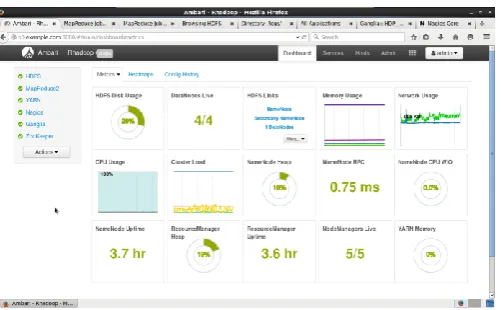
Monitor a Hadoop Cluster Ambari provides a dashboard for monitoring health and status of the Hadoop cluster. Ambari leverages Ambari Metrics System for metrics collection. Ambari leverages Ambari Alert Framework for system alerting and will notify you when your attention is needed (e.g., a node goes down, remaining disk space is low, etc).
Apart from this, Ambari is very useful in large scale cluster setup because it provide consistent, secure platform for operational control.
Fig 4. Conceptual Layout Of Ambari server installation
It is Simplified Installation and Configuration and Management, Centralized Security Setup, Full Visibility into Cluster Health and Highly Extensible and Customizable [17].
[image:4.595.311.562.573.728.2]© 2017, IRJET | Impact Factor value: 6.171 | ISO 9001:2008 Certified Journal | Page 964 More node can be add and remove from ambari server
dashboard. Service can start and stop from same dash board. For installing the Ambari we need to create repo for installation of hadoop service over node/client.
name Address/base Url
HDP-2.2 http://n0.example.com/hdp/HDP/cent os6/2.x/GA/2.2.0.0
HDP-UTILS-1.1.0.20 http://n0.example.com/hdp/HDP-TILS-1.1.0.20/repos/centos6
Table 2- Ambari repo base Url(Cent os6.6)
We have to provide the repositories’ for hadoop. In our case we have used Horton work product HDP 2.2 and other hadoop utilities. The components of HDP 2.2 are summarized in Table 2.
SERVICE VERSION DESCRIPTION
Zookeeper 3.4.6.2.2.0.0 Centralized service which provides highly reliable
distributed coordination HDFS 2.6.0.2.2.0.0 Apache Hadoop
Distributed File System
YARN +
MapReduce2 2.6.0.2.2.0.0 Apache Hadoop NextGen MapReduce (YARN)
Ganglia 3.5.0 Ganglia Metrics Collection system (RRDTool will be installed too) Nagios 3.5.0 Nagios
Monitoring and Alerting system
Table 3- HDP 2.2 Cluster Stack Descriptions
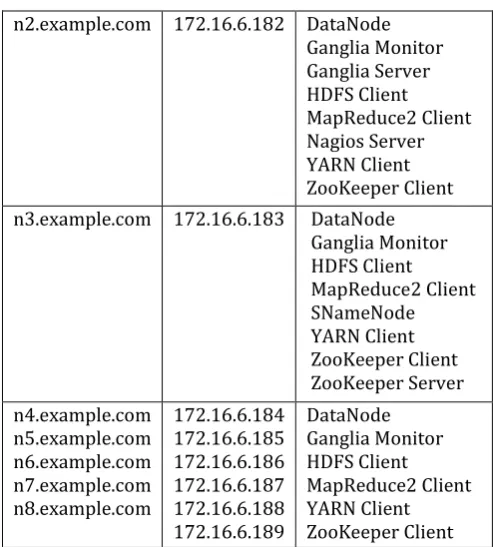
Name ip address services
n1.example.com 172.16.6.181 App Timeline Server Ganglia Monitor HDFS Client History Server NameNode NodeManager ResourceManager
n2.example.com 172.16.6.182 DataNode Ganglia Monitor Ganglia Server HDFS Client MapReduce2 Client Nagios Server YARN Client ZooKeeper Client n3.example.com 172.16.6.183 DataNode
Ganglia Monitor HDFS Client MapReduce2 Client SNameNode YARN Client ZooKeeper Client ZooKeeper Server n4.example.com
n5.example.com n6.example.com n7.example.com n8.example.com
172.16.6.184 172.16.6.185 172.16.6.186 172.16.6.187 172.16.6.188 172.16.6.189
[image:5.595.310.557.94.368.2]DataNode Ganglia Monitor HDFS Client MapReduce2 Client YARN Client ZooKeeper Client
Table 4- Description of service running at nodes
Rhadoop And R installation- R and Rhadoop installation
is easy task. Before installing Rhadoop, The dependent package of Rhadoop should be installed in each node of cluster. Revolution R Open (RRO) is the enhanced distribution of R from Revolution Analytics. It is a complete open source platform for statistical analysis and data science. RRO 8.0.1 is based on (and 100% compatible with) version 3.1.2 of the R language, and includes additional capabilities for performance, reproducibility and platform support. Along with this Rstudio ware integrated with R. The concerning package of the Rhadoop and R software shown in table 3.
SERVICE/Package Version Description
© 2017, IRJET | Impact Factor value: 6.171 | ISO 9001:2008 Certified Journal | Page 965 functional 0.6 Master, client
httr 0.6.1 Master, client stringr 0.6.2 Master, client memoise 0.2.1 Master, client whisker 0.3-2 Master, client evaluate 0.5.5 Master, client rstudioapi 0.2 Master, client brew 1.0-6 Master, client roxygen2 4.1.0 Master, client reshape2 1.4.1 Master, client plyr 1.8.1 Master, client devtools 1.7.0 Master, client caTools 1.17.1 Master, client R.methodsS3 1.7.0 Master, client RColorBrewer 1.1-2 Master, client pryr 0.1 Master, client proto 0.3-10 Master, client dichromat 2.0-0 Master, client gtable 0.1.2 Master, client colorspace 1.2-4 Master, client scales 0.2.4 Master, client munsell 0.4.2 Master, client labeling 0.3 Master, client DBI 0.3.1 Master, client ggplot2 1.0.0 Master, client acepack 1.3-3.3 Master, client latticeExtra 0.6-26 Master, client
lhs
0.10
Master, client [image:6.595.45.278.102.503.2]rmr2
3.3.1
Master, client sp 1.0-17 Master, client Hmisc 3.15-0 Master, client hydroPSO 0.3-4 Master, client plyrmr 0.6.0 Master, clientTable 5. R and Rhadoop Package Description in Node/master
6. RESULT AND ANALYSIS
Data Set was taken from well known source UCI data set repository and other source. The dataset named chess,
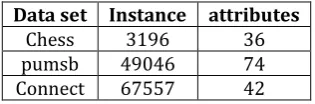
connect, and mushroom ware downloaded from UCI data set repository [19][20]. The short description about the data set summarized in table 4.
Data set Instance attributes Chess 3196 36 pumsb 49046 74 Connect 67557 42
Table 6. Data set And there Description [19][20].
The dataset provided by [19] are in integer form and space delimiter. Each row of the dataset represents the new data in the file.
For the conceptualizing the concept, we had fix the support value as (.5) and count value as (.9). Table 5 show the result of training data set with same support and count value in without hadoop and 2 node, 4 node, 6 node and 8 node cluster. Running time count in second and process run 4 times each to find out the average running time of the cluster.
Dataset Without
[image:6.595.308.562.239.307.2]hadoop 2 node 4 node 6 node 8 node chess
31.157
24
12
10
7
pumsb271.117 37
36
34
25
connect82.150
42
40
25
18
Table 7. Result showing in different node
Result may have difference because of the network and one single system is running logically two system. The reduction of execution time is more evident for those datasets which have longer execution time. Moreover, we can see that when the size of the dataset increases, the performance on multi-node Hadoop also gets better. The result could get better if the ambari server is running on separate system and master node running separately in the cluster and having more RAM size. The value of running time is average mean value and round of value in second.
7. CONCLUSIONS
We implemented the improved Apriori Algorithm on MapReduce programming model on the Hadoop platform. The R language is widely used in the hadoop due to easy and comfort for the analyst. Moreover, this distributed algorithm can also cater to the distributed nature of the input data. Furthermore, details of the management of the distributed systems, such as data transferring among nodes and node failures are taken care by Hadoop, which adds a great deal of robustness and scalability to the system. The performance could be enhanced if we have the facilities to increase the RAM and high performing Machine.
ACKNOWLEDGEMENT
[image:6.595.83.241.649.701.2]© 2017, IRJET | Impact Factor value: 6.171 | ISO 9001:2008 Certified Journal | Page 966
REFERENCES
[1] D. Kornack and P. Rakic, “Cell Proliferation without Neurogenesis in Adult Primate Neocortex,” Science, vol. 294, Dec. 2001, pp. 2127-2130, doi:10.1126/science.1065467.
[2] Pallavi roys(2012), MINING ASSOCIATION RULES IN CLOUD, MS thesis, North Dakota State University of Agriculture and Applied Science, Fargo, North Dakota August 2012Mr.
[3] Neeraj Raheja, Ravish Kumar(2012) , Optimization of Association Rule Learning in Distributed Database using Clustering Technique,International Journal of Scientific and Research Publications, Volume 2, Issue 12, December 2012 ,ISSN 2250-3153.
[4] HARISH D,ANUSHA M.S ,Dr. DAYA SAGAR K.V(2015).,”BIG DATA ANALYSIS USING RHADOOP”, ISSN: 2349-2163,Issue 4, Volume 2 (April 2015) pp 180-85.
[5] Bao Rong Chang, Yun-Da Lee, and Po-Hao Liao, “Development of Multiple Big Data, Analytics Platforms with Rapid Response” https://doi.org/10.1155/2017/6972461.
[6] H.Huang et al., BlueSNP: R package for highly scalable genome-wide associationstudies using Hadoop clusters, BIOINFORMATICS APPLICATIONS NOTE , Vol. 29 no. 1 2013, pages 135–136 doi:10.1093/bioinformatics/bts647.
[7] Bogdan OANCEA, LINEAR REGRESSION WITH R AND HADOOP, Challenges of the Knowledge Society. IT in Social Sciences.
[8] Thasnim K M1, M Sudheep Elayidom, IMPLEMENTATION OF A NOVEL SENTIMENT ANALYSIS TECHNIQUE FOR TWITTER DATA USING RHADOOP,IJRET: International Journal of Research in Engineering and Technology, eISSN: 2319-1163 | pISSN: 2321-7308.
[9] Shubham S. Deshmukh et al(2017)., Twitter Data Analysis using R, International Journal of Science, Engineering and Technology Research (IJSETR) Volume 6, Issue 4, April 2017, ISSN: 2278 -7798.
[10] Shivaram Venkataraman et al(2016), SparkR: Scaling R Programs with Spark, SIGMOD ’16, June 26–July 1, 2016, San Francisco, CA, USA., ISBN 978-1-4503-3531-7/16/06.
[11] R. Agrawal and R. Srikant(1994). Fast algorithms for mining association rules. In Proc.
1994 Int. Conf.Very Large Data Bases, pages 487-499, Santiago, Chile, September 1994.
[12] https://www.r-project.org/about.html access on 03/09/17.
[13] R project,Cran project https://www.r-project.org/contributors.html access on 05/09/17.
[14] Bao Rong Chang, Yun-Da Lee, and Po-Hao Liao(2017), Development of Multiple Big Data Analytics Platforms with Rapid Response, Hindawi Scientific Programming Volume 2017,
Article ID 6972461,
https://doi.org/10.1155/2017/6972461.
[15] Bogdan OANCEA, Raluca Mariana DRAGOESCU(2014), Integrating R and Hadoop for Big Data Analysis, Romanian Statistical Review nr. 2 / 2014.
[16] Rhadoop wiki
https://github.com/RevolutionAnalytics/RHadoo p/wiki access on 03/09/2017.
[17] Anurag Agrahari, Prof D.T.V. Dharmaji Rao(2017), “A Review paper on Big Data: Technologies, Tools and Trends,” www.irjet.net,Volume: 04 Issue: 10,Oct -2017,e-ISSN: 2395-0056 pp 640-649.
[18] Ambari wiki,https://ambari.apache.org/ access on 2/08/2017.
[19] http://fimi.ua.ac.be/data/ access on 12-04-2015.
[20] Lichman, M. (2013). UCI Machine
Learning Repository
[http://archive.ics.uci.edu/ml]. Irvine, CA: University of California, School of Information and Computer Science.
[21] Violeta nicoleta opriş & ciprian racuciu(2015), the expert systems analysis using the concept of big data and cloud computing services, Military Technical Academy, Faculty of Military Electronic and Information Systems, Bucharest, Naval Academy Scientific Bulletin, Volume XVIII – 2015 – Issue 2.
© 2017, IRJET | Impact Factor value: 6.171 | ISO 9001:2008 Certified Journal | Page 967 [23] Li L. & Zhang M. (2011). The Strategy of
Mining Association Rule Based on Cloud Computing. Proceeding of the 2011 International Conference on Business Computing and Global Informatization (BCGIN ’11). Washington, DC, USA, IEEE: 475- 478.
[24] Li N., Zeng L., He Q. & Shi Z. (2012). Parallel Implementation of Apriori Algorithm Based on MapReduce. Proc. of the 13th ACIS International Conference on Software Engineering, Artificial Intelligence, Networking and Parallel & Distributed Computing (SNPD ’12). Kyoto, IEEE: 236 – 241.
[25] Lin M., Lee P. & Hsueh S. (2012). Apriori-based Frequent Itemset Mining Algorithms on MapReduce. Proc. of the 16th International Conference on Ubiquitous Information Management and Communication (ICUIMC ’12). New York, NY, USA, ACM: Article No. 76.
[26] Yang X.Y., Liu Z. & Fu Y. (2010). MapReduce as a Programming Model for Association Rules Algorithm on Hadoop. Proc. of the 3rd International Conference on Information Sciences and Interaction Sciences (ICIS ’10). Chengdu, China, IEEE: 99 – 102
[27] S. Park, Ming-Syan and P. S. Yu, “Using a Hash-Based Method with Transaction Trimming for Mining Association Rules,” in IEEE Transactions on Knowledge and Data Engineering, vol. 9, no. 5, pp. 813-825, 1997.
[28] J. S. Park, Ming-Syan and P. S. Yu, “An Effective Hash-Based Algorithm for Mining Association Rules,” in SIGMOD ACM, vol. 24, no. 2, pp. 175-186,1995.
[29] M. J. Zaki, S. Parthasarathy, W. Li and M. Ogihara, “Evaluation of Sampling for Data Mining of Association Rules,” in Proceedings IEEE 7th International Workshop on Research Issues in Data Engineering, 1997, pp. 42-50.
[30] A. Savasere, E. Omiecinski and S. Navathe, “An Efficient Algorithm for Mining Association Rules in Large Databases,” in Proceedings 21st VLDB Conference,Switzerland, 1995, pp. 432-444.
[31] S. Brin, R. Motwani, J. D. Ullman and S. Tsur, “Dynamic Itemset Counting and Implication Rules for Market Basket Data,” in ACM SIGMOD Record, vol. 26, no. 2, pp. 255-264, 1997.
[32] R. Agrawal and J.C. Shafer, “Parallel Mining of Association Rules,” in IEEETransactions on Knowledge and Data Engineering, vol.8, no. 6, pp.962-969,1996.
[33] Poonam Modgi et al, / (IJCSIT) International Journal of Computer Science and Information Technologies, Vol. 5 (3) , 2014, pp 3093 – 3097.
[34] Sanjay Rathee, Manohar Kaul, Arti Kashyap, R-Apriori: An Efficient Apriori based
Algorithm on Spark,
![Fig 1. Map/reduce at n node showing n iterations [33].](https://thumb-us.123doks.com/thumbv2/123dok_us/8149401.802074/2.595.309.551.94.293/fig-map-reduce-n-node-showing-n-iterations.webp)
![Fig 3. R interface RHadoop over Hadoop [15].](https://thumb-us.123doks.com/thumbv2/123dok_us/8149401.802074/3.595.390.492.153.277/fig-r-interface-rhadoop-hadoop.webp)