© 2017, IRJET | Impact Factor value: 5.181 | ISO 9001:2008 Certified Journal
| Page 206
ANALYZING THE INTERACTION OF ASCENT WITH IEEE 802.11e MAC IN WIRELESS
SENSOR NETWORK
A.Sundar Raj
1, S. Kavya
2, K.G. Devi Priyanka
3Associate Professor,
E.G.S. Pillay Engineering College, Nagapattinam,
India
1E.G.S. Pillay Engineering College, Nagapattinam,
India
2,3[email protected]
2, [email protected]
3---***---Abstract— A wireless sensor network (WSN) consists of a number of sensors distributed in the sensor field. These sensors monitor physical or environmental conditions. In Adaptive Self-Configuring sEnsor Networks Topologies (ASCENT) the nodes can coordinate to exploit the redundancy provided by the high density, so as to extend overall system lifetime. When the nodes detect high message loss, it requests additional nodes in the region to join the network in order to relay messages. This reduces nodes duty cycle if it detects high message losses due to collisions. Due to dense deployment congestion becomes more common phenomenon from simple periodic traffic to unpredictable bursts of messages triggered by external events. Congestion causes huge packet loss and thus blocks reliable event perception. Congestion in wireless sensor networks causes packet loss, and thus also leads to excessive energy consumption. So we need to control congestion in WSN in order to prolong system lifetime. In order to reduce the congestion, we have implemented MAC layer 802.11e instead of CSMA. It is observed that the proposed scheme performs well in terms of packet delivery ratio, throughput and energy consumption.
Keywords— Wireless Sensor Networks, ASCENT, Topology, MAC layer, Lifetime Improvement factor, NS2.
I. INTRODUCTION
Wireless Sensor Network consists of large number of sensor nodes deployed either uniformly or randomly in the field. These nodes will always be wasting energy as they will be in active state. Hence the main goal is to put some of the sensor nodes in sleep state and some other nodes in active state. Battery life, sensor update rates, and size are all major design considerations in wireless sensor networks. Recent advances have resulted in the ability to integrate sensors, radio communications, and digital electronics into a single integrated circuit package, which reduces size and complexity of the node. This capability is enabling networks of very low cost sensors that are able to communicate with each other using low power wireless data routing protocols. A wireless sensor network consists of a base station that can communicate with a number of wireless sensors. Data is collected at the wireless sensor node, transmitted to the gateway directly or uses other wireless sensor nodes to forward data to the gateway. The transmitted data is then given to the system by the gateway connection.
We have carried out an extensive survey on wireless sensor networks and topology management schemes [2],
[6]. There are many topology management schemes for sensor network, like ASCENT, SPAN, BEES, STEM and GAF [1], [3], [9], [12]. They help the network to perform better by their management of controlling data packets, reducing energy consumption and so on. We also surveyed many congestion control schemes [8], [10], [11] to improve the topologies.
In our work we have taken the ASCENT (Adaptive Self Configuring sEnsor Network Topologies) topology management scheme [1], which is an adaptive network topology for mobile network. It can dynamically choose ACTIVE nodes to send messages successfully in the network. In ASCENT the limitation is the packet loss due to congestion. Hence the energy consumed will be higher and throughput will be less. To overcome this we use IEEE 802.11e MAC layer and we analysis the performances like packet delivery ratio, system throughput and energy consumption and will be comparing ASCENT with CSMA.
The paper is organised as follows, section II discusses the related work in topology of wireless sensor network, section III explains ASCENT, section IV explains the interaction of ASCENT with MAC 802.11e, in section V results and analysis are discussed and conclusion is givenin the final section.
II. RELATED WORK
C. Wang et al have proposed Upstream Congestion Control in Wireless Sensor Networks through Cross-Layer Optimization [10]. In this congestion is classified as node level congestion and link level congestion. Node level congestion causes packet loss and queuing delay and this leads to retransmission, so consumes additional energy. Link level congestion increases service time which leads to decrease in both link utilization and overall throughput. In this Priority-based congestion control protocol (PCCP) is proposed. This employs packet based computation to optimize congestion control.
© 2017, IRJET | Impact Factor value: 5.181 | ISO 9001:2008 Certified Journal
| Page 207
upstream nodes. This access pattern is controlled with local values and is made load adaptive to cope up with various application scenarios. In WRRF Downstream node allows all of its upstream nodes to transmit their weighted-share amount of packets. To avoid congestion, before transmitting a packet each upstream node must be aware whether there is sufficient free buffer space at the downstream node. To implement this notion, they restrict an upstream node from delivering packets when its downstream node has not sufficient amount of free buffer space. This was achieved by their proposed source count based weighted round robin forwarding (WRRF). The data transmission in a network is termed as unreliable if the packet delivery ratio decreases to very low value so that the event cannot be detected reliably. Thus an efficient way is proposed to reduce congestion within the sensor network to ensure good delivery ratio for reliable event detection. Integrated effort of their proposed source count based HMAC and WRRF reduces packet drop due to collision and avoids packet drop due to buffer overflow and finally achieves more delivery ratio which is good enough for reliable event perception.
Chen et al have proposed a new technique called Span which is a topology control protocol that allows nodes that are not involved in a routing backbone to sleep for extended periods of time [3]. In this topology, certain nodes assign themselves the position of “coordinator”. These coordinator nodes are chosen to form backbone network, so that the capacity of the backbone approaches the potential capacity of the complete network. Periodically, nodes that have not assigned themselves the coordinator role initiate a procedure to decide if they should become a coordinator. The criterion for this transition is if the minimum distance between any two of the node’s neighbours exceeds three hops.
III.ASCENT
Adaptive Self Configuring sEnsor Network Topology is a wireless sensor topology management scheme that has four states of nodes namely ACTIVE, PASSIVE, TEST and SLEEP. In the active state transceivers will be active all the time and participates in the communication. An enough number of active state nodes will be required to transmit the data successfully to the sink. In passive and test states, the nodes receiver will be turned on. It will listen for the messages flooded in the network and these states will seek to change as active states whenever needed to participate in the network. Sleep state is the energy saving mode in which transceivers will be turned off.
When a node detects an event, it will be routed through active state nodes. In case if a node detects message loss it will send help messages to the neighbours. Node which is in passive state receives these messages and checks for the conditions to become active node if needed.
Figure 1. ASCENT state transition
The state transition in ASCENT is shown in the Figure 1. Each and every node in ascent first enters in the test state, then it will check to go weather active or passive state depends on the conditions. It goes to passive state if the number of active state nodes is greater than the threshold value and loss is less than the threshold value. Otherwise it will go to active state after the time Tt. From passive state it
will go sleep or test state depending upon the following condition, if the number of active state nodes is less than the threshold active state nodes and loss is greater than the threshold loss or loss is less but help message is received from the neighbour then it will go to test state, otherwise it will go to sleep state after the time Tp. From sleep state it
will go to passive state after the time Ts. By this way the
required number of active state nodes will be maintained in the network for the reliable transfer of data.
When a node sends message to the sink, the sink may be at the border of radio range so message loss will occur. In this case the sink starts sending help messages to the neighbours that are in listen-only (passive) mode. When the node receives help message it may join the network by becoming active state from the conditions shown in the Figure 1. When a node decides to join the network, it signals the existence of a new active neighbour to other passive neighbours by sending a neighbour announcement message. After the required number of active state nodes are obtained the delivery of data from source to sink is now more reliable.
Notation and definition:
1. Tt – Test timer, time required to check the
condition specified in Figure 1.
2. NT – Number of Neighbour threshold, we assume this as 4.
3. LT – Maximum amount of data loss it can tolerate depends on application.
4. Ts – Sleep timer.
5. Tp – Passive timer
For conserving energy the node must remain in sleep state, but if Ts is large then that node can’t participate in the
network when required. If the node remains in the passive state it can make transition to active state whenever required, but if Tp is large energy consumed will be high. So,
there must be a tradeoff between Tp and Ts for proper
network operation.
Neighbors < NT and Loss > LT Loss < LT and help
Neighbors > NT Loss < LT
After Tp After Tt
After Ts
Test Active
© 2017, IRJET | Impact Factor value: 5.181 | ISO 9001:2008 Certified Journal
| Page 208
The probability of nodes in passive or sleep state is given by
1 ) passive ( P
(1)
) passive ( P 1 ) sleep (
P (2)
The probability of x nodes in the passive state is given by
1 1 . 1 1 1 ) x ( p
x n
(3)
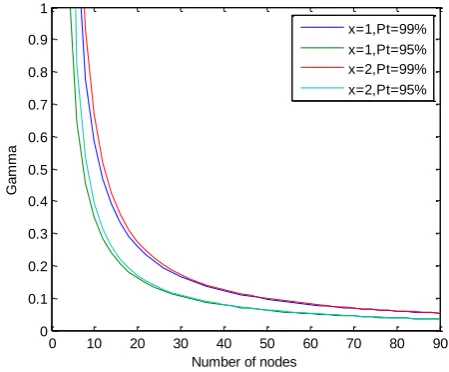
Here ‘γ’ is the ratio of passive time Tp to the sleep time Ts
and ‘n’ is number of nodes.
By taking x=1 and x=2 we can find the minimum value of γ as γ 1 and γ 2 respectively. The solution is given by
1 10nlog(1 p)
1
1
t
(4)
1 101 nlog(1 p)
1
2
t
(5)
Where pt is minimum probability threshold.
With these values we can set the sleep time (Ts) and
passive time (Tp).
IV.INTERACTION OF ASCENTWITH IEEE802.11℮
In our proposed work we have analysed the interaction of ASCENT with IEEE 802.11e MAC layer. This MAC layer is specially designed to provide quality of service in a network [5]. To achieve this, a new coordination function is used namely hybrid coordination function (HCF). The HCF combines the functions of DCF and PCF with some enhanced QoS-specific mechanisms and frame subtypes to allow a uniform set of frame to exchange sequences during both the contention period (CP) and contention free period (CFP). The HCF uses both contention-based channel access methods, called the enhanced distributed channel access (EDCA) mechanism and controlled channel access, referred to as the HCF controlled channel access (HCCA) mechanism. The EDCA mechanism provides differentiated and distributed access to the wireless medium for QSTAs (quality of service station) using eight different user priorities (UP). The EDCA mechanism defines four access categories that provide support for the delivery of traffic with UPs at the QSTAs.
Higher priority traffic has a more chance of being sent than low priority traffic, a station with high priority traffic waits for less time before it sends its packet, than a station with low priority traffic which as to wait little more [5]. This is achieved by using a shorter contention window (CW) and shorter arbitration inter-frame space (AIFS) for higher priority packets. EDCA also provides contention-free access to the channel to a period called a Transmit Opportunity (TXOP). A TXOP is a time interval during which a station can send many frames without congestion. The frame has to be fragmented, when the frame size is very large that can’t be transmitted in a single TXOP.
V. RESULTS AND ANALYSIS
We have implemented ASCENT and then combined ASCENT with IEEE 802.11e and thereby performance is analysed by comparing ASCENT with CSMA. The ASCENT with IEEE 802.11e scheme has better performance in terms of packet delivery ratio, throughput and energy conservation when compared to ASCENT with CSMA MAC layer.
A. Simulation Environment
Simulation is carried out using Network simulator (NS2). In our simulation we have considered random deployment of nodes with mobility. We have taken the number of nodes as 20, 40, 60, 80 and 100 and plotted against various parameters like packet delivery ratio, throughput and energy consumption. Their performance evaluation is discussed below. We have taken initial energy for each node as 1000 J.
B. Dependency of γ value on Pt
0 10 20 30 40 50 60 70 80 90
0 0.1 0.2 0.3 0.4 0.5 0.6 0.7 0.8 0.9 1
Number of nodes
G
a
m
m
a
[image:3.595.321.546.349.535.2]x=1,Pt=99% x=1,Pt=95% x=2,Pt=99% x=2,Pt=95%
Figure 2. Dependency of γ value on Pt
From Figure 2 it is inferred that for higher value of Pt the γ value remains high for corresponding node density, for lower values of Pt the γ value are low. Thus the estimation of γ value has more dependency on Pt values.
© 2017, IRJET | Impact Factor value: 5.181 | ISO 9001:2008 Certified Journal
| Page 209
20 40 60 80 100 120
0 10 20 30 40 50 60 70 80 90 100
Packet Delivery Ratio
Number of nodes
P
a
c
k
e
t
D
e
liv
e
ry
r
a
ti
o
%
[image:4.595.59.256.103.312.2]CSMA IEEE 802.11e
Figure 3. Packet Delivery Ratio
The packet delivery ratio for different number of nodes is studied and plotted for ASCENT with IEEE 802.11e MAC and with CSMA MAC as shown in Figure 3. It is observed that in both the cases the packet delivery ratio drops as the number of nodes increases. Since the collision is minimised in ASCENT with IEEE 802.11e, packet delivery ratio increases substantially.
D. Throughput
20 40 60 80 100 120
0 500 1000 1500
Throughtput of the system
Number of nodes
T
h
ro
u
g
h
p
u
t
(B
/s
)
[image:4.595.333.527.138.338.2]CSMA IEEE 802.11e
Figure 4. Throughput
Throughput of the network is analysed and it is shown in Figure 4. The throughput of the network is higher in ASCENT with IEEE 802.11e when compared with ASCENT with CSMA. From this it is inferred that ASCENT with IEEE 802.11e MAC provides higher system capacity.
E. Energy Consumption
20 40 60 80 100
200 300 400 500 600 700 800 900 1000
Energy consumed
Number of nodes
C
o
n
s
u
m
e
d
e
n
e
rg
y
CSMA IEEE 802.11e
Figure 5. Energy consumption.
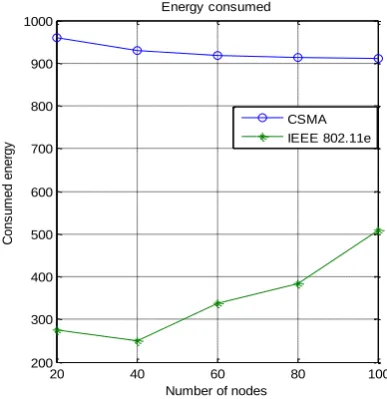
Figure 5 shows energy consumed by ASCENT with IEEE 802.11e and ASCENT with IEEE CSMA MAC layer. The energy consumed by ASCENT with IEEE 802.11e is much lesser than energy consumed by ASCENT with CSMA MAC layer. From this we can infer that ASCENT with IEEE 802.11e consumes very less energy.
VI.CONCLUSIONS
In this paper we have implemented ASCENT with CSMA. We have integrated ASCENT with IEEE 802.11e MAC layer. We analysed the parameters namely packet delivery ratio, system throughput and energy consumption for both CSMA and IEEE 802.11e MAC layers. It is inferred that ASCENT with IEEE 802.11e MAC layer provides higher packet delivery ratio, increased system throughput and lower energy consumption when compared to ASCENT with CSMA MAC layer. Thus ASCENT with IEEE 802.11e performs better in wireless sensor network.
REFERENCES
[1] Alberto Cerpa and Deborah Esttrin, ‘ASCENT: Adaptive Self-Configuring sEnsor Networks Topologies’, IEEE Transactions on mobile computing, Vol.3, July-September 2004.
[2] Akyildiz. I.F, Su. W, Sankarasubramaniam. Y, Cayirci. E, “Wireless sensor networks: a survey”, 2002 Published by Elsevier Science B.V, Computer Networks 38 (2002) pp.392-422.
[3] Chen. B, Jamieson. K, Balakrishnan. H, Morris.R (2002), ‘Span: An Energy-Efficient Coordination Algorithm for Topology Maintenance in Ad Hoc Wireless Networks’ Springer, 8(5).
[4] Curt Schurgers, Vlasios Tsiatsis, Mani B. Srivastava, “STEM: Topology Management for Energy Efficient Sensor Networks,” IEEEAC paper #260, Updated Sept 24, 2001.
[5] IEEE Std 802.11e™-2005
[image:4.595.73.253.491.697.2]© 2017, IRJET | Impact Factor value: 5.181 | ISO 9001:2008 Certified Journal
| Page 210
[7] Miguel A. Labrador and Pedro M. Wightman, ‘Topology Control inWireless Sensor Networks’, Springer April 2009
[8] Mamun-Or-Rashid. Md, Muhammad Mahbub Alam, Abdur Razzaque. Md, and Choong Seon Hong, ‘Reliable Event Detection and Congestion Avoidance in Wireless Sensor Networks’,HPCC 2007, LNCS 4782, pp521-532, 2007.
[9] Rong Yu, Zhi Sun, and Shunliang Mei (2007), ‘Scalable Topology and Energy Management in Wireless Sensor Networks’, in the proceedings of the IEEE WNCA.
[10] Wang. C, Li. B, Sohraby. K, Daneshmand. M and Hu. Y, ‘Upstream Congestion Control in Wireless Sensor Networks Through Cross-Layer Optimization’, IEEE Journal On Selected Areas In Communications, Vol. 25, No. 4, May 2007
[11] Xiang-Yang Li, Kousha Moaveni-Nejad, Wen-Zhan Song, Wei-Zhao Wang, ‘Interference-Aware Topology Control for Wireless Sensor Networks’, IEEE SECON 2005 proceedings.
[12] Y. Xu, J. Heidemann, D. Estrin, “Geography-informed energy conservation for ad hoc routing,” MobiCom 2001, Rome, Italy, pp.