A FRAMEWORK OF AN EXPERT SYSTEM FOR CROP PEST
AND DISEASE MANAGEMENT
1KAMARUDIN SHAFINAH, 2NORAIDAH SAHARI, 3RIZA SULAIMAN, 4MOHD SOYAPI
MOHD YUSOFF, 5MOHAMMAD MOHD IKRAM
1,2Center of Artificial Intelligence Technology, Faculty of Information Science and Technology, Universiti
Kebangsaan Malaysia (UKM), 43600 Bangi, Selangor, Malaysia. 3,4
Institute of Visual Informatics, Universiti Kebangsaan Malaysia (UKM), 43600 Bangi, Selangor, Malaysia.
1Faculty of Agriculture and Food Sciences, Universiti Putra Malaysia Bintulu Sarawak Campus (UPMKB),
Nyabau Road, P.O. Box 396, 97008 Bintulu, Sarawak, Malaysia. 5
Faculty of Science, Universiti Putra Malaysia (UPM), 43400 UPM Serdang, Selangor, Malaysia. E-mail: [email protected], [email protected], [email protected], [email protected],
ABSTRACT
Crop pest and disease diagnosis are amongst important issues arising in the agriculture sector since it has significant impacts on the production of agriculture for a nation. The applying of expert system technology for crop pest and disease diagnosis has the potential to quicken and improve advisory matters. However, the development of an expert system in relation to diagnosing pest and disease problems of a certain crop as well as other identical research works remains limited. Therefore, this study investigated the use of expert systems in managing crop pest and disease of selected published works. This article aims to identify and explain the trends of methodologies used by those works. As a result, a conceptual framework for managing crop pest and disease was proposed on basis of the selected previous works. This article is hoped to relatively benefit the growth of research works pertaining to the development of an expert system especially for managing crop pest and disease in the agriculture domain.
Keywords: Agriculture, Document Analysis, Expert Systems, Framework, Pest And Disease Diagnosis
1. INTRODUCTION
Incidence of crop pest and disease is one of the major concerns faced by farmers. For example, in late 2004, soybean rust (SBR) had largely threatened the soybean crops in the United States, thus reducing its soybean yields [1]. Such aforementioned incidence can present negative impacts on the quantity [2; 3; 4] and quality of any crop production [4]. In dealing with this sort of incidence, farmers initially necessitate to useful advices for diagnosing the various pest or disease confronted before being able to implement a suitable treatment or control onto the affected crop. On the other hand, much of the literatures have addressed that farmers undertake a prolonged period of time to acquire appropriate advice for conducting the suitable treatment or control, due to issues of human resource and knowledge [5; 3; 6; 7]. Besides, with inappropriate and perhaps misleading advice gained by farmers, it might escalate to the use of harmful substances such as pesticides without having regards of the pesticides
proper use and protocol [7], and subsequently leading to matters like environmental pollution.
assistants to human decision makers [13], capable in the gathering of vast numbers of information and experience from multiple human experts of numerous discipline, and providing valuable recommendations to users [14]. Ultimately, an expert system has the advantage of speeding up pest and disease diagnosis [13].
Then again, it had been mentioned in the literature that most existing diagnosis programs have been rather confined to human medical fields [15]. Research works focusing on advisory expert system for supporting agriculture practitioners is yet limited [16]. Likewise, the development of an expert system and previous research works alike in relations to diagnosing and managing the pest and disease problems of a certain crop is also scarce [17, 18, 13, 12] in spite of the expert system being able to aid farmers, agriculture officers and human experts. Moreover, the majority of expert system at hand concentrated on a single crop (usually tomato) or mainly one aspect of the crops problem (e.g. fungal diseases or nutritional disorders) [13].
This work aims to determine the trends of methodology used in several previous works and proposing a new framework suitable for managing crop pest and disease. The study can also relatively benefit the extension of research works associated with expert system in the agriculture domain and serves as a baseline reference for future implementation and application.
2. METHODOLOGY
An expert system is intended to process knowledge where the knowledge can be achieved from a variety of sources viz. books, journals, reports, case study and knowledge from human expertise [19]. In this study, twenty one (21) of the English language literatures indexed in Sciencedirect and Google Scholar database were selected for review. Despite having only 21 literatures chosen, these previous works were exclusively related to expert systems for crop pest and disease management.
The information provided in the literatures was thereof scrutinized in order to determine the distribution of methodologies used when dealing with matters of crop pest and disease. This method is also known as document analysis. The analysis was merely carried out using Microsoft Excel 2007 where the information was organized and map according to the year of publication of the selected literature. The discussion of the analysis is elaborated in the following section. In succession, an expert system framework for crop pest and
disease was later designed and proposed. Principle information for instance the basic components to an expert system were adopted when designing the proposed framework.
3. RESULTS AND DISCUSSION
This section discusses the findings of the document analysis and the proposed conceptual framework.
3.1 Diversity of Methodologies Used in Previous Works
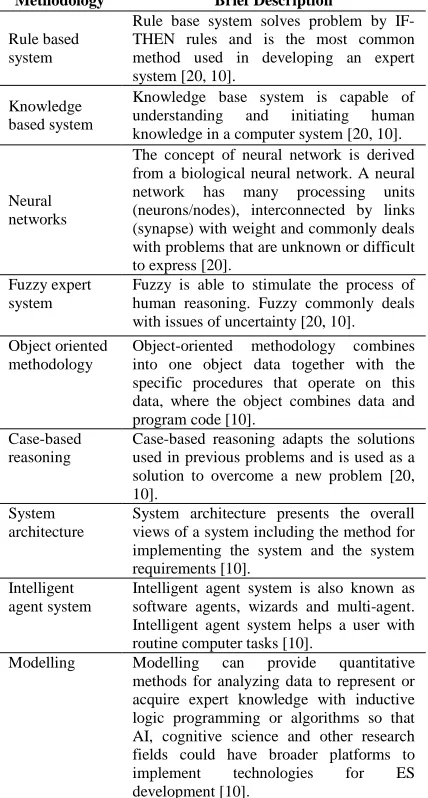
[image:2.612.309.523.328.727.2]Table 1 depicts a brief description on eleven (11) different methodologies that were typically used within an expert system based on Chen et al. [20] and Liao [10].
Table 1: Description of Expert System Methodologies
Methodology Brief Description
Rule based system
Rule base system solves problem by IF-THEN rules and is the most common method used in developing an expert system [20, 10].
Knowledge based system
Knowledge base system is capable of understanding and initiating human knowledge in a computer system [20, 10].
Neural networks
The concept of neural network is derived from a biological neural network. A neural network has many processing units (neurons/nodes), interconnected by links (synapse) with weight and commonly deals with problems that are unknown or difficult to express [20].
Fuzzy expert system
Fuzzy is able to stimulate the process of human reasoning. Fuzzy commonly deals with issues of uncertainty [20, 10]. Object oriented
methodology
Object-oriented methodology combines into one object data together with the specific procedures that operate on this data, where the object combines data and program code [10].
Case-based reasoning
Case-based reasoning adapts the solutions used in previous problems and is used as a solution to overcome a new problem [20, 10].
System architecture
System architecture presents the overall views of a system including the method for implementing the system and the system requirements [10].
Intelligent agent system
Intelligent agent system is also known as software agents, wizards and multi-agent. Intelligent agent system helps a user with routine computer tasks [10].
Modelling Modelling can provide quantitative
Methodology Brief Description
Ontology Ontology is synonym with vocabulary.
Ontology is used to describe a task or domain knowledge and acts as a communication basis between human experts and knowledge engineers [10]. Database
methodology
A database is an organized collection of data and is capable of dealing with redundancy issues [10].
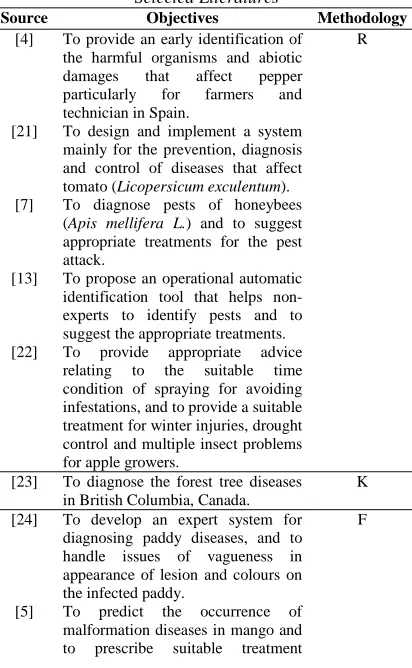
[image:3.612.91.297.403.737.2]It is worthwhile to note again that the 21 selected literatures were narrated specifically to expert systems for crop pest and disease management. Based on Table 2, it was determined that eleven (11) literatures used more than one methodology in solving their problems. The combination of two and more methodologies or known as the hybrid expert system may be the latest in trend owing to four (4) literatures that proposed of the hybrid methodology as of 2011. While the application of a single methodology during construction of an expert system may serve some limitations, a hybrid expert system is therefore suggested to overcome the drawbacks of using only one methodology when developing an expert system [20].
Table 2: Distributions of the Methodologies Used in the Selected Literatures
Source Objectives Methodology
[4] To provide an early identification of the harmful organisms and abiotic
damages that affect pepper
particularly for farmers and technician in Spain.
R
[21] To design and implement a system mainly for the prevention, diagnosis and control of diseases that affect tomato (Licopersicum exculentum).
[7] To diagnose pests of honeybees
(Apis mellifera L.) and to suggest appropriate treatments for the pest attack.
[13] To propose an operational automatic identification tool that helps non-experts to identify pests and to suggest the appropriate treatments.
[22] To provide appropriate advice
relating to the suitable time condition of spraying for avoiding infestations, and to provide a suitable treatment for winter injuries, drought control and multiple insect problems for apple growers.
[23] To diagnose the forest tree diseases in British Columbia, Canada.
K
[24] To develop an expert system for diagnosing paddy diseases, and to handle issues of vagueness in appearance of lesion and colours on the infected paddy.
F
[5] To predict the occurrence of
malformation diseases in mango and to prescribe suitable treatment
Source Objectives Methodology
packages.
[ 2] To propose the use of fuzzy decision trees for coffee rust warnings. [25] To diagnose multi-diseases that
affect tomato.
N
[26] To identify the diseases and disease management in garlic productions, and to provide appropriate advice to users.
R, K
[ 27] To investigate the potential of an expert system in managing seed potato production based on various symptoms.
[28] To identify the pests, diseases and weeds that affect olive crops, and to provide information on the harmful organisms commonly found in olive crops for farmers and technician in Spain.
[29] To manage pest and diseases of coffee in developing countries. [30] To diagnose the common diseases
occurring in rice plants.
[31] To diagnose the diseases and disease management for garlic production through online in obtaining standardized yields.
[6] To diagnose forest insects and to provide an appropriate treatment in reducing the spread of insects and minimizing forest damage.
K, R, O
[ 12] To identify tomato diseases, to propose new system with additional concerns to the user interface and to manipulate the corresponding knowledge based as a database.
K, D, F
[ 3] To diagnose and to control the diseases that affect pulse crops.
R, K, F, D
[32] To provide a new approach in
diagnosing diseases that affect oilseed-crops.
K, F, OO
[33] To discuss the interface designed for knowledge acquisition subsystem with dynamic disease knowledge base, intelligent disease diagnosis subsystem with object-oriented intelligent-inference model, and intelligent tutor for crop disease with audio-visual graphical user web interface, as well as to describe the design features; functionality and development of intelligent multimedia web interface.
Methodology:
R= Rule Based/ K= Knowledge Based/ F= Fuzzy/ D= Database/ O= Ontology/ OO= Object Oriented/ N= Neural Networks
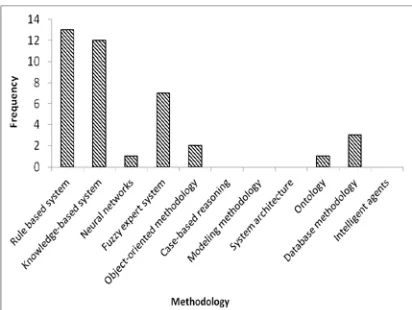
values for the other methodologies given in descending order were fuzzy expert system (7 frequencies), database methodology (3 frequencies), object oriented methodology (2 frequencies), whereas for neural networks and ontology, the frequency value was found to be similar with the value of 1 frequencies, respectively. The case-based reasoning, modeling, system architecture and intelligent agents are the methodologies that were not used in the selected literatures.
Figure 1: The Frequency of Methodologies Used in the Selected Literatures
According to the document analysis findings, it can be delineated that rule based system remains to be the most common methodology used to manage crop pest and disease as well as being amidst the earliest methodology in usage for developing an expert system [34]. Rule based system uses IF-THEN rules (Table 1). These rules have ‘condition’ (IF) and ‘action’ (THEN) parts and is mainly applied in the inference engine component of an expert system. Chen et al. [20] stated that rule based system has a working memory for the containment of information concerning a problem, a pattern matcher and an applier for rules.
There are two modes of rule based system, forward chaining and backward chaining rules system. Forward chaining is data driven where it starts from the initial facts, and then draws conclusion by using rules. Conversely, backward chaining mode works by beginning with the highest level rules. The highest level of rules is located nearest to the main goal. Backward chaining then searches and determines the rules that are allowed to be further sustained. Backward chaining is hence known as goal driven. The rule based system is fairly easy to be implemented if expert system developers are able to gain a comprehensive knowledge from domain expertise. Even though the
rule based system is mostly used for diagnosing crop pest and disease [20], but in certain cases, the uncertainty issue does arise such as when users are unable to provide accurate inputs at the time of answering questions that have been addressed to them by the expert system for diagnosis of pest or disease.
Knowledge based system began to be implemented for crop pest and disease management since 1990s [27]. The definition between knowledge based system and rule based system cannot literally be explained since knowledge based system also requires the IF-THEN rules to produce results and moreover this IF-THEN rules has mainly been used in the rule based system. Additionally, knowledge based system is assumed to be an extension concept derived from the rule based system where the knowledge based system is more concerned about human reasoning as to produce an appropriate solution for a specific problem.
Fuzzy expert system also has the IF-THEN rules, but nonetheless it is able to handle vagueness and imprecise information or data. Fuzzy expert system uses fuzzy set membership where it has to attain values between 0 and 1. The challenges in applying the fuzzy expert system are in the determination of a good membership function. The frequency value presented in Figure 1 shows that a hybrid expert system using rule based, knowledge based and fuzzy expert system are potentially recommended during the development of an expert system for crop pest and disease management area.
3.2 The Framework for Crop Pest and Disease Management
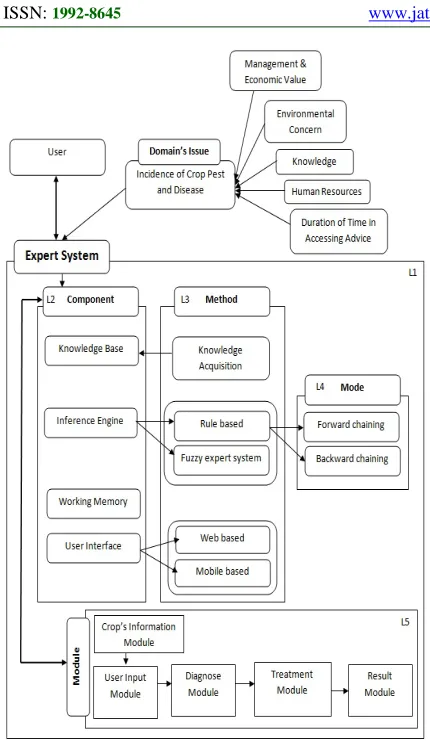
develop this proposed framework which is knowledge base, inference mechanism and user interface, whereas the component of knowledge acquisition was embedded as part of the knowledge base. In addition, a working memory component [13] was included to store temporary information such as facts, user input and results. This proposed framework of an expert system model for crop pest and disease management is illustrated in Figure 2. Developments of the proposed framework was motivated and piloted on basis of the document analysis conducted and concerns over the occurring crop pest and disease incidence.
The target users of the proposed framework were also made ascertained where the framework would be considering two groups of respondents. The first group of respondents or end user can principally be referred to as the main target user because of their major potential to use the proposed expert system. Agriculture officers, farmers and students will be categorized and selected as this end user. Agriculture officers and farmers are selected since these clusters of individuals were usually the current practitioners in the agriculture sector. Although agriculture officers are likely to be experts in the agriculture sector due to their field experience, the situation in a country such as Malaysia somehow depicts that the main task of an agriculture officer is to deliver and convey knowledge attained from agriculture experts (special expert units) to agriculture practitioners (farmers, crop planters, etc.)1. Students pursuing their education relevant to agricultural based studies will also be selected since these clusters of individuals have the potential to use the expert system model sometime in future.
The second group of respondents can be referred to as the experts in the domain. These experts are clusters of individuals working in special units where their job specifications are primarily focused on research and development within their particular domain. In view of a Malaysian scenario, experts in a domain would usually provide and give training to the agriculture officers approximately once in every two weeks2. Three to five individual experts from the crop pest and disease unit will be considered and selected to
1 Mohammad Syahril Abdul Rashid. Agriculture Officer, Malaysian Department of Agriculture, Hilir Perak District, Teluk Intan, Perak, Peninsular Malaysia. Personal communication, 17 November 2011.
2 Shahroladli Arbaai. Agriculture Officer, Malaysian Department of Agriculture, Sungai Manik/Labu Kubong, Cenderong Balai, Perak, Peninsular Malaysia. Personal communication, 18 November 2011.
represent the expert group during the course of this work.
Based on Figure 2, L1 represents the entire processes that will be implicated when developing an expert system model for crop pest and disease management. L2 shows the basic components to the expert system. L3 shows the most common method used for diagnosing pest and disease. L4 shows the modes of rule based methodology. L5 shows the modules that might be considered by system developers during construction and development of an expert system.
L1 in the proposed framework shows that the expert system for crop pest and disease management comprises of four parts: component, method, mode and module. In L2, knowledge base which is among components of the expert system, concerns in the storage of expert knowledge within the system. Prior to the construction of a knowledge base, knowledge acquisition ought to be conducted to gain expert knowledge. At this point, knowledge acquisition was considered important to increase the reliability of an expert system because with a good quality of knowledge in the knowledge base, an expert system would be capable of producing high quality solutions [28]. There are a few methods that can be employed when conducting the knowledge acquisition process which includes obtaining knowledge from end users, the experts themselves and textual information sources [3; 28, 6, 29].
Figure 2: The Framework of an Expert System for Crop Pest and Disease Management
Another component to the expert system is the inference engine. An effective design for the inference engine is anticipated since it will be performing in the intricate task of producing a proper reasoning during diagnosis and in the searching of a suitable treatment or control as an alternative solution to overcome matters of pest and disease on a selected crop. Moreover, a working memory as referred from Chen et al. [20] is to be included as part of the inference engine in this proposed framework. The working memory will function to store the inputs from a user [13] where the situation commences upon the user initiating the use of the expert system. The input from the user is afterwards used for the reasoning processes in the inference engine.
Further, in L3 it is shown that rule based and fuzzy expert system are the methods that entail the inference engine. This rule based and fuzzy expert system methodologies were combined together. Meanwhile, two modes of reasoning entail the use of the rule based method which is shown in L4. The
two modes of reasoning that use the rule based are: forward chaining and backward chaining. Both of these reasoning can be used in the diagnosis of crop pest and disease. The forward chaining mode is suitable for use when an expert system requires several inputs from a user. Following the inputs given, the system will attempt to generate the result. However, the backward chaining mode begins from the main goal. For example, the proposed expert system already has the target disease (main goal) and then requires a set of rules to prove whether the target disease exists nor otherwise. This mode of reasoning is suggested for use in an expert system as it can concern in the diagnosis of one disease or one pest of a selected crop. Furthermore, in certain cases, the diagnostic knowledge can be vague and incomplete and gravitate into some degree of uncertainty [13]. Thus, this proposed framework suggests the use of fuzzy expert system to represent and compensate for the incomplete information in the inference engine while explaining the need to combine rule based with fuzzy expert system.
The user interface is also among other components to the expert system as shown in L2. The user interface component serves as an important medium of interactive between users and the expert system. Designing of the user interface is a crucial concern to many expert system researchers [3, 28, 29, 23]. The interface is required to be user friendly and follows the principal of ‘minimum works’ [37]. A user friendliness approach for the user interface design is recommended and should be considered in developing a usable expert system that is easily access by end users.
In L5, it is shown that five modules are suggested for implementation in the proposed framework. The five modules are crop’s information module, user input module, diagnose module, treatment module and result module. The crop’s information module serves to store information of a selected crop. The information may include general information on the crop like scientific names, local names, soil types, information about the pest and disease such as symptoms, and the suitable treatment or control for each disease or pest attack. Information is usually compiled and stored in the form of linguistic base. As mentioned earlier, pictorial base can also be considered if such information was available. The crop’s information module is interconnected with the knowledge base component of the expert system.
interface component of the expert system. Appropriate designs for the user interface by elucidating the method of deployment via either web based or mobile based (shown in L3) should be made and put into consideration for the expert system because both web and mobile methods may have their constraints. For the user input module, suitable questions for instance regarding crop pest and disease symptoms should be constructed when designing this module. Apart from that, if the expert system were to employ a pictorial base, the file size of the pictures and images needs to be considered especially if the expert system is deploying the mobile based method. The result module on the other hand functions to present the results to users encompassing of the diagnosis result which is based on the occurring symptoms, whereas the suggested solutions for overcoming the crop pest and disease incidence would be based on the diagnosis result.
The diagnosis module is considered to be the main operation of the expert system. This module is interconnected with the inference engine component of the expert system which integrates the working memory, rule based and fuzzy expert system. Once the user input module captures an input from users, the input is instantaneously kept and retained in the working memory. The input is then used to run the reasoning processes using the rule based and fuzzy expert system methodologies in the inference engine to generate a diagnosis result. This diagnosis result is eventually stored back into the working memory where in sequence it is retrieved from the working memory by a treatment module. The treatment module will function to regain information on the suitable treatment or control to be presented simultaneously with the diagnosis result back to the user. The latter is accomplished by the result module of the expert system.
On the whole, Figure 2 illustrated the general flow for a conceptual framework currently being carried out in this ongoing research work. The proposed framework presented in brief the various principle concepts involved in the development of an expert system model particularly for crop pest and disease management. The proposed framework can be implemented for other relevant expert systems to deal with research works of similar domain attention.
4. CONCLUSION
The continues expansion of ICT will thrive the use of expert systems to a broader community of
users including agriculture practitioners and especially farmers to access appropriate advice when dealing with issues such as crop pest and disease incidences. It was determined from the document analysis, that rule based, knowledge based and fuzzy expert system are the most common methodologies used when constructing an expert system related to agriculture domain. Furthermore, the hybrid expert system is highly recommended in overcoming the weaknesses of using one methodology alone. With respects to knowledge attained from this proposed framework, the information provided might help researchers to highlight issues in the agriculture domain, the trends of methodologies available for use, and put forth recommendations that can be of considerable value in future research works for the development of an expert system pertaining to the agriculture domain.
ACKNOWLEDGEMENTS
The authors wish to acknowledge the financial support provided by the Faculty of Information Science and Technology, Universiti Kebangsaan Malaysia (UKM). The authors also wish to acknowledge sincere gratitude to Fatihah Ramli (Universiti Malaysia Sarawak), Amelia Natasya Abdul Wahab (Universiti Kebangsaan Malaysia), Dr. Mohd Zafri Hassan (Universiti Putra Malaysia Bintulu Campus) and colleagues for rendering their support and assistance. The authors thank the anonymous reviewers for their helpful comments.
REFERENCES:
[1] M.J. Roberts, D. Schimmelpfenning, E. Ashely, M. Livingston, M. Ash, and U. Vasavada, ‟The Value of Plant Disease Early-Warning Systems”, Economic Research Report, Economic Research Service, United States Department of Agriculture, Report No. 18, 2008, pp. 1-46.
[2] M.E. Cintra, C.A.A. Meira, M.C. Monard, H.A. Camargo, and L.H.A. Rodrigues, ‟The use of fuzzy decision trees for coffee rust warning in Brazilian crops”, 11th International Conference on Intelligent Systems Design and Applications
(ISDA)
,
November 22-24, 2011, pp. 1347-1352.[4] L. Gonzalez-Diaz, P. Martínez-Jimenez, F. Bastida, and J.L. Gonzalez-Andujar, ‟Expert system for integrated plant protection in pepper (Capsicum annuun L.)”, Expert Systems with
Applications, Vol. 36, No. 5, 2009, pp.
8975-8979.
[5] P. Chakraborty, and D.K. Chakrabarti, ‟An Example of Agricultural Expert Systems Being Used in India”, Georgian Electronic Scientific Journal: Computer Science and Telecommunications, 2008, pp. 10-12.
[6] S. Kaloudis, D. Anastopoulos, C.P. Yialouris, N.A. Lorentzos, and A.B. Sideridis, ‟Insect identification expert system for forest protection”, Expert Systems with Applications, Vol. 28, No. 3, 2005, pp. 445-452.
[7] B.D. Mahaman, P. Harizanis, I. Filis, E. Antonopoulou, C.P. Yialouris, and A.B. Sideridis, ‟A diagnostic expert system for honeybee pests”, Computers and Electronics in Agriculture, Vol. 36, No. 1, 2002, pp. 17-31. [8] F. Zetian, X. Feng, Z. Yun, and Z. XiaoShuan,
‟Pig-vet: a web-based expert system for pig disease diagnosis”, Expert Systems with Applications, Vol. 29, No. 1, 2005, pp. 93-103. [9] Y. Duan, J.S. Edwards, and M.X. Xu,
‟Web-based expert systems: benefits and challenges”,
Information and Management, Vol. 42, No. 6,
2005, pp. 799-811.
[10]S.-H. Liao, ‟Expert system methodologies and applications—a decade review from 1995 to 2004”, Expert Systems with Applications, Vol. 28, No. 1, 2005, pp. 93-103.
[11]R. Prasad, K.R. Ranjan, and A.K. Sinha, ‟AMRAPALIKA: An expert system for the diagnosis of pests, diseases, and disorders in Indian mango”, Knowledge-Based Systems, Vol. 19, No. 1, 2006, pp. 9-21.
[12]C.P. Yialouris, and A.B. Sideridis, ‟An expert system for tomato diseases”, Computers and Electronics in Agriculture, Vol. 14, No. 1, 1996, pp. 61-76.
[13]B.D. Mahaman, H.C. Passam, A.B. Sideridis, and C.P. Yialouris, ‟DIARES-IPM: a diagnostic advisory rule-based expert system for integrated pest management in Solanaceous crop systems”, Agricultural Systems, Vol. 76, No. 3, 2003, pp. 1119-1135.
[14]Y. Chen, C.-Y. Hsu, L. Liu, and S. Yang, ‟Constructing a nutrition diagnosis expert system”, Expert Systems with Applications, Vol. 39, No. 2, 2012, pp. 2132-2156.
[15]D. Li, Z. Fu, and Y. Duan, ‟Fish-Expert: a web-based expert system for fish disease diagnosis”,
Expert Systems with Applications, Vol. 23, No.
3, 2002, pp. 311-320.
[16]P.-Y. Le Gal, P. Dugué, G. Faure, and S. Novak, ‟How does research address the design of innovative agricultural production systems at the farm level? A review”, Agriculture Systems Vol. 104 No. 9, 2011, pp. 714-728.
[17]N.D. Clarke, J.L. Shipp, A.P. Papadopoulos, W.R. Jarvis, S. Khosla, T.J. Jewett, and G. Ferguson, ‟Development of the Harrow Greenhouse Manager: a decision-support system for greenhouse cucumber and tomato”, Computers and Electronics in Agriculture, Vol. 24, No. 3, 1999, pp. 195-204.
[18]Y. Koumpouros, B.D. Mahaman, M. Maliappis, H.C. Passam, A.B. Sideridis, and V. Zorkadis, ‟Image processing for distance diagnosis in pest management”, Computers and Electronics in Agriculture, Vol. 44, No. 2, 2004, pp. 121-131. [19]S.S. Hasan, and R.K. Isaac, ‟An integrated
approach of MAS-CommonKADS, Model– View–Controller and web application optimization strategies for web-based expert system development”, Expert Systems with Applications, Vol. 38, No. 1, 2011, pp. 417-428. [20]S.H. Chen, A.J. Jakeman, and J.P. Norton,
‟Artificial Intelligence techniques: An introduction to their use for modelling environmental systems”, Mathematics and
Computers in Simulation, Vol. 78, No. 2–3,
2008, pp. 379-400.
[21]V. López-Morales, O. López-Ortega, J. Ramos-Fernández, and L.B. Muñoz, ‟JAPIEST: An integral intelligent system for the diagnosis and control of tomatoes diseases and pests in hydroponic greenhouses”, Expert Systems with
Applications, Vol. 35, No. 4, 2008, pp.
1506-1512.
[22]J. Roach, R. Virkar, C. Drake, and M. Weaver, ‟An expert system for helping apple growers”,
Computers and Electronics in Agriculture, Vol.
2, No. 2, 1987, pp. 97-108.
[23]A.J. Thomson, E. Allen, and D. Morrison, ‟Forest tree disease diagnosis over the World Wide Web”, Computers and Electronics in Agriculture, Vol. 21, No. 1, 1998, pp. 19-31. [24]S. Abdullah, A.A. Bakar, N. Mustafa, M.
Bandung (Indonesia)
,
June 17-19, 2007, pp. 642-644.[25]K. Zhang, Y. Chai, and S.X. Yang, ‟Self-organizing feature map for cluster analysis in multi-disease diagnosis”, Expert Systems with
Applications, Vol. 37, No. 9, 2010, pp.
6359-6367.
[26]M.S.P. Babu, and N.T. Roa, ‟Implementation of Artificial Bee Colony (ABC) Algorithm On Garlic Expert Advisory System”, International Journal of Computer Science and Research, Vol. 1, No. 1, 2010, pp. 69-74.
[27]D.W. Boyd, and M.K. Sun, ‟Prototyping an expert system for diagnosis of potato diseases”, Computers and Electronics in Agriculture, Vol. 10, No. 3, 1994, pp. 259-267.
[28]J.L. Gonzalez-Andujar, ‟Expert system for pests, diseases and weeds identification in olive crops”, Expert Systems with Applications, Vol. 36, No. 2, Part 2, 2009, pp. 3278-3283.
[29]G. Mansingh, H. Reichgelt, and K.-M.O. Bryson, ‟CPEST: An expert system for the management of pests and diseases in the Jamaican coffee industry”, Expert Systems with Applications, Vol. 32, No. 1, 2007, pp. 184-192. [30]S.K. Sarma, K.R. Singh, and A. Singh, ‟An Expert System for diagnosis of diseases in Rice Plant”, International Journal of Artificial Intelligence, Vol. 1, No. 1, 2010, pp. 26-31. [31]A.A.L. Selvakumar, and G.M. Nazer, ‟An
Implementation of Expert Systems in Garlic using (ABC) Algorithm”, 3rd International Conference on Electronics Computer Technology, Kanyakumari (India)
,
April 8-10, 2011, pp. 45-48.[32]S. Kolhe, R. Kamal, H.S. Saini, and G.K. Gupta, ‟A web-based intelligent disease-diagnosis system using a new fuzzy-logic based approach for drawing the inferences in crops”, Computers and Electronics in Agriculture, Vol. 76, No. 1, 2011, pp. 16-27.
[33]S. Kolhe, K. Raj, H.S. Saini, and G.K. Gupta, ‟An intelligent multimedia interface for fuzzy-logic based inference in crops”, Expert Systems
with Applications, Vol. 38, No. 12, 2011, pp.
14592-14601.
[34]J. Zeleznikow, and J.R. Nolan, ‟Using soft computing to build real world intelligent decision support systems in uncertain domains”, Decision Support Systems, Vol. 31, No. 2, 2001, pp. 263-285.
[35]E.A. Feigenbaum, ‟Personal View of Expert Systems: Looking Back and Looking Ahead”, Knowledge Systems Laboratory, Department of Computer Science, Stanford University, Report No. KSL 92-41, April, 1992, pp. 1-20.
[36]D.T. Pham, and P.T.N. Pham, ‟Expert Systems in Mechanical and Manufacturing Engineering”, The International Journal of Advanced Manufacturing Technology, Vol. 3, No. 3, 1988, pp. 3-21.