RECOGNIZING GENDER THROUGH FACIAL IMAGE USING
SUPPORT VECTOR MACHINE
1FITRI DAMAYANTI,2AERI RACHMAD
1,2Faculty of Engineering, University of Trunojoyo Madura, Indonesia
E-mail: 2[email protected]
ABSTRACT
The face is one part of the human body that has special characteristics, which is often used to distinguish the identity of one individual and another. Facial recognition is very important to be developed since this application is applied in the security system. The recognition of sex is one part of the face recognition. Gender plays an important role in our interactions in the community and with the computer. Classification gender of the face image can be applied in the field of demographic data collection, human-computer interface (customize the behavior of software in connection with the sex of the user) and others. The purpose of this study is to make implementation of the system in recognizing the gender on facial image or filling the form with the Gender Recognition face image that is able to recognize a person's sex quickly and accurately, and run well. This study used methods of Two Dimensional Linear Discriminant Analysis (TDLDA) for feature extraction, which directly assess within-class scatter matrix of the transformation matrix without any image into a vector image, and this resolves the singular problem within-class scatter matrix. To obtain optimal recognition results of the classification method, it used the classification Support Vector Machine. This study integrates TDLDA and SVM methods for the introduction of gender based on facial image. The combination of both methods proves the optimal results with an accuracy of 74% to 92% with a test that uses a database of faces taken from http://www.advancedsourcecode.com.
Keywords:Support Vector Machine, Two Dimensional Linear Discriminant Analysis, Gender
1. INTRODUCTION
The face is one of the easiest physiological measure and often used to distinguish the identity of one individual to another. The human brain has the ability to recognize and distinguish between those which face each other with a relatively quick and easy. Face recognition man is one field that is developing today. Application of face recognition can be applied in the field of security system such as room access permission.
One part of face recognition that has been developed is the recognition of sex (gender recognition). It has similarities between gender recognition and face recognition that lies in its extraction process. However, there is still a little difference in the classification process. All of these recognitions which are used to calculate how many people are male or female who are coming to a store or a public agency are still processed manually, so it takes a longer time. To facilitate what advertisements are displayed on electronic billboards in public places or roadside, it can be adjusted with the sex of the person who passed the advertisements. That is why, this software for the introduction of gender based on facial image was
created to facilitate and speed up the processing time.
The difficulties in the process of gender recognition is mainly because of the complexities of the condition of the face, such as the position of the image, lighting and expression of different images that have a high dimension that must go through the process of the compression / extraction prior to the data processed by the method of classification. The previous research which was associated with this research is the research conducted by Burhan Ergen and Serdar Abut entitled "Gender Recognition Using Facial Images". In that study, it conducted the recognition of gender-based facial image using GLCM. The trial results have an accuracy rate of 60% by using Face FEI database consisting of 100 female face images and the facial image 100 men [1].
Another research which was conducted by Nafin Fenanda, Rima Tri Wahyuningrum, Fitri Damayanti entitled "Introduction to Gender Based Facial Image Method Using Local Binary Pattern (LBP) and Fisherface", presented the recognition of gender-based facial image using LBP and Fisherface. The trial results have the highest degree of accuracy by 75% by using a database drawn from http://www.advancedsourcecode.com [3]. The last research which was conducted by Fitri Damayanti entitled "Introduction to Gender Based Facial Image Method Using Two-Dimensional Linear Discriminant Analysis", proved the recognition of gender-based facial image using TDLDA and ED. The trial results have the highest degree of accuracy by 89% by using a database taken from http://www.advancedsourcecode.com [4].
This study integrates LDA and SVM for the introduction of gender-based facial image. TDLDA is used as a feature extraction method that directly assess within-class scatter matrix of images without image transformation matrix into a vector. Moreover, it is used to overcome the problem of singular matrices within-class scatter. TDLDA wears fisher criterion to find the optimal discriminating projections which are obtained from all the features of the selected faces which are looking eigen-values and the greatest eigenvectors. Classification method which is used is the classifier Support Vector Machine (SVM). SVM classifier uses a function or hyperplane to separate the two classes of patterns. SVM will try to find the optimal hyperplane in which two classes of patterns can be separated to the maximum.
2. SYSTEM DESIGN
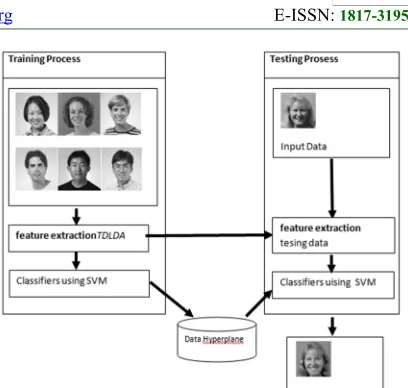
Broadly speaking, this system consists of two parts, namely the image of the training process and the testing process. In Figure 1, it is an outline of the picture recognition system based on the sex of the face image. In the training process TDLDA there is a process used to extract features, the features that are selected during the training process used in the classification process and is also used to get features that are selected in the trial data. Each face data base used is divided into two, partly used for training process and the rest was used for the testing process.
Figure 1. System Introduction to Gender Based Facial Image.
2.1 Feature extraction
Extraction feature in the training process is done using Two-Dimensional Linear Discriminant Analysis. This stage aims to get the features that are selected from the data enter training. These features are selected to obtain from all the facial features, look for eigen-values and eigen-vectors greatest. Features that are selected will be used for the classification process is used for training and testing data feature extraction.
Extraction feature in the testing process is done by taking the feature extraction results on the training process which was applied to the test data. Feature extraction results on this test data is used as input to the classification process testing.
2.2 Algorithm Design TDLDA
Here are the steps in the process TDLDA against a database of training images [5]:
1. If a database of facial images are a set of n training imageAi= [A1, A2, ..., An] (i = 1,2, ..., n) with dimensions of image (RXC), then the total set of all the image matrix are:
An=
rc n r
n r n
c n n
n
c n n
n
A A
A
A A
A
A A
A
) ( 2 ) ( 1 ) (
2 ) ( 22 ) ( 21 ) (
1 ) ( 12
) ( 11 ) (
... ... ... ... ...
... ...
(1)
2. Determining the value 1 (dimension projection
lines) and 2 (dimensional projection column). ≤
value ≤ r and c.
3. The next step is the calculation of the average image of classroom training to i:
i
X i
i n X
M 1 (2)
[image:2.612.317.521.74.268.2]M= n
1
k
i1 X iX
(3)
5. Establish the transformation matrix R size (c,2)
which is obtained from a combination of the identity matrix size (2, 2) with zero matrix size
(c-2,
2 ).6. Calculate the between class scatter matrix R in accordance with equation (4).
SbR = T
i T k
i ni Mi M RR M M
) (
) (
1
the size of the
matrix (r x r) (4)
7. Counting within class scatter matrix R in accordance with equation (5).
SWR = ( ) ( ) ,
1
T i T i k
i x
M X RR M X
i
the size of the
matrix (r x r) (5)
8. Calculate the generalized eigenvalue (
i) of SR
b andSWR using SVD in accordance with equation
(6)
J4(L) = maxtrace((LTSWR L)-1(LTSbRL)), maxtrace
size of the matrix (r x r) (6)
9. Take as much eigenvector1 from step 8 as a
transformation matrix of rows (L). L = [
1L, ...,L
1
] as the size of the matrix (rx 1).10. Calculate the range class scatter matrix L according to equation (7).
SbL= ( ) ( )
1
M M LL M M
n T T i
k
i i i
,the size of the
matrix (cxc). (7)
11. Counting within class scatter matrix L according to equation (8).
SWL= ( ) ( ),
1 i
T T i k
i x
M X LL M X
i
the size of
the matrix (c x c). (8)
12. Calculate the generalized eigenvalue (
i ) ofSL
b andSWLusing SVD in accordance with equation
(9).
J5(R)=maxtrace((RTSWLR)-1(RTSbLR)),the size of the
matrix(c x c). (9)
13. Take as much eigenvector
2 of step 12 as the transformation matrix column (R). R = [ R1
, ...,R
2
], the size of the matrix (c x2).14. Calculate the extraction feature matrix Bi=LTAiR, the size of the matrix (1 x 2)
15. Output: Bi extraction feature matrix, line matrix transformation L, and the transformation matrix columnR.
2.3 Classification
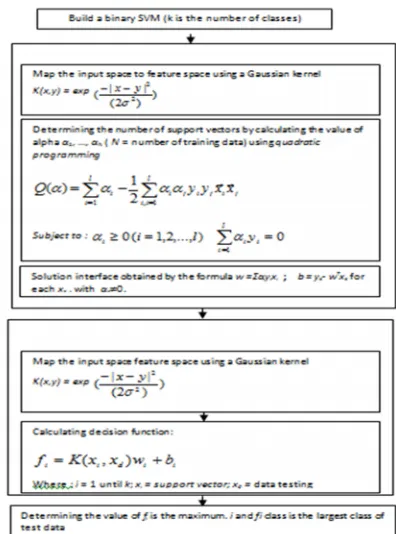
The classification of SVM is divided into two processes, namely the processes of training and testing process. In the SVM, training process uses the feature matrix which is generated in the extraction process as input features. While in test SVM, utilizing the projection matrix is generated in the process of feature extraction which is then multiplied by the test data (test samples) as input. The classification of SVM for Multiclass One Against All will build a number of binary SVM k (k is the number of classes). The decision has a function that has a maximum value, indicating that the dataxdis the members of the class of functions
[image:3.612.318.516.325.592.2]of that decision. Block diagram SVM training and testing process is shown in Figure 2 [6].
Figure 2. Block diagram of the process of training and classification using SVM.
usually has a higher dimension of the input vector (input space). This resulted in computing the feature space may be very large, because there is the possibility of feature space can have a number of features that are not infinite. So on SVM used "kernel trick". Kernel functions used in this study is a Gaussian shown in equation 10. [7]
K(x,y)=exp
)
)
2
(
|
|
(
2 2
y
x
. (10)
A number of support vector at each training data to look for to get the best solution interface. The issue of the best interface solutions can be formulated in equation 11.
li
i i j i j i j
l
i i
x
x
y
y
Q
1 , 1
2
1
)
(
, (11)Where: 0( 1,2,..., ) 0
1
i
l
i i
i i l
y
.Data
x
iwere correlated with αi> 0 iscalled a support vector. Thus, it can be obtained the value which will be used to find w. Solution interface obtained by the formula: w =Σαiyixi; b
= yk- wTxkfor everyxk, withαk0.
The testing process or classification is carried out on every binary SVM use the value w, b, and xi
generated in the training process in any binary SVM. The resulting function for the testing process is shown in Equation 12.
,
)
,
(
i d i ii
K
x
x
w
b
f
(12)where:i= 1 tok;xi= support vector;xd= test data.
The output is in the form of an index i with the greatestfiwhich is a class of test data.
2.4 Data Used
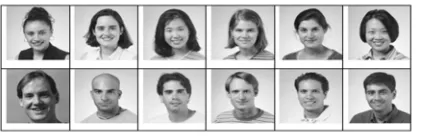
[image:4.612.313.528.189.356.2]Testing the system in this study uses the test data a 200x200 pixel image 400 of 200 images of 200 male and female image. Trial data are taken from http://www.advancedsourcecode.com and has been used in previous studies. The data is the data of these trials tested testing using SVM classification with training data. Figure 3 shows several examples of facial images that are used as a data testing and training data.
Figure 3. Example Of Facial Imagery Used For Data Trial
[image:4.612.317.525.587.695.2]Scenario experiments performed in this study are divided into eight scenarios, the scenario 1, scenario 2 scenario 3, scenario 4, 5 scenario, scenario 6, 7 scenario, the scenario 8. The difference of those eight scenarios lie in the amount of training data and data testing used. More details can be seen in Table 1.
Table 1 Simulation Scenarios In System
Scenario Data Training Data Testing
1 300
images 150 Female150 Male 100images 50 Female50 Male
2 280
image 140 Female140 Male 120images 60 Female60 Male
3 260
image 130 Female130 Male 140images 70 Female70 Male
4 240
images 120 Female120 Male 160images 80 Female80 Male
5 160
images 80 Female80 Male 240images 120 Female120 Male
6 140
images 70 Female70 Male 260images 130 Female130 Male
7 120
images 60 Female60 Male 280images 140 Female140 Male
8 100
images 50 Female50 Male 300images 150 Female150 Male
3. EXPERIMENTS AND RESULTS
The methods which are used in this test are divided into three groups. The first group uses the Local Binary Pattern (LBP) for preprocessing, it is Fisherface method for feature extraction and classification methods Euclidean Distance (ED) as the research done by Nafin Fenanda, Rima Tri Wahyuningrum, Damayanti Fitr [3]. The second group uses methods TDLDA as feature extraction and classification methods Euclidean Distance as [4]. The third group uses methods TDLDA as feature extraction and SVM as the classification method. The third group was a study done by researchers. Table 2 shows the comparison of the test results from previous studies and research undertaken by researchers.
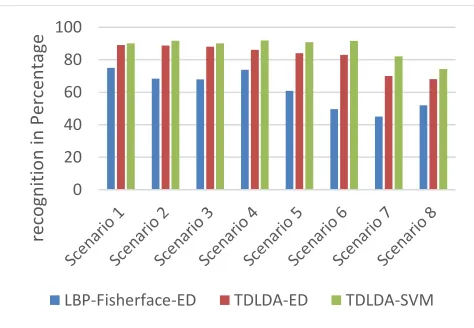
[image:4.612.93.304.636.704.2]Table 2 shows that the percentage introduction TDLDA - SVM is higher than the method TDLDA-ED and methods LBP-Fisherface-ED. It would be easier to see the difference between the trial results TDLDA-SVM method with other methods by using bar charts. Figure 4 shows the results of testing against a database
which is taken from
[image:5.612.68.305.229.393.2]http://www.advancedsourcecode.com to see the differences of TDLDA-SVM method to the other methods.
Figure 4. Graph recognition success rate for each test variations on Database taken from
http://www.advancedsourcecode.comu using TDLDA-SVM method and other methods.
The excellence of TDLDA method – SVM is compared to other methods like follows:
i. TDLDA - SVM compared with TDLDA - ED. In the ED, it did not concern to the distribution of the data which is only based on the distance of the new data into multiple data / nearest neighbor. It could be data / nearest neighbor which was not a group, so that the resulting classification is wrong. In SVM, the distribution of data is trying to find a function separator (classifier) which is optimum that can separate the two sets of data from two different classes. Each class has a different pattern and is separated by a dividing function, so that if there is new data that will be known, the classes are classified according to the new data. Thus the resulting classification is more perfect than the other classification methods.
ii. TDLDA - SVM compared with Fisherface. In Fisherface pre-processing procedures to reduce the dimension using PCA may cause the loss of some important discriminant information for LDA algorithm is applied after PCA.
In TDLDA take full advantage of the information that is discriminatory on the scope of the face (face space), and did not throw some subspace which may be useful for the introduction.
From the results of experiments which were conducted, there were some incorrect recognition, like women were recognized as men in the recognition results, and vice versa. Some recognition that were caused by several factors, namely the shape of the head, the hair shape and expression between the image of women and men.
4. CONCLUSION
From the experiments that have been done can be drawn conclusions as follows:
1. Method TDLDA - SVM was able to show that the optimal recognition accuracy which is compared to other methods (TDLDA ED, LBP -Fisherface - ED). This is because the singular TDLDA is able to overcome the problem, to maintain the existence of discriminatory information, and to maximize the distance between classes and minimizes inter-class distance. While SVM has the ability to discover the function of separator (classifier) which is optimum.
2. There are three important variables that affect the success rate of introduction, that is the use of sequence variations of training samples per class, the use of the number of training samples per class, and the number of dimensions of projection.
3. From the test results using TDLDA-SVM method, it obtained recognition accuracy rate of between 74% to 92%.
4. Incorrect classification of the trials was caused by the head shape, the hair style and face expressions between the image of women and men.
5. SUGGESTION
This research will be continued to recognize phrases that will be applied in the form of multi face images. In addition to the field of digital image processing.
REFERENCES:
[1]. Ergen B, Abut S. Gender Recognition Usiang Facial Images. International Conference on Agriculture and Biotechnology. 2013. Vol 60 : 112-117.
0 20 40 60 80 100
re
co
gn
itio
n
in
P
erc
en
ta
ge
[2]. Khryashchev V, Priorov A, Shmaglit L, and Golubev M. Gender Recognition Via Face Area Analysis. Proceedings of The World Congress on Engineering and Compuer Science. 2012. Vol 1 .
[3]. Fenanda N, Wahyuningrum RT, Damayanti F. Introduction of Gender Based Facial Image Method Using Local Binary Pattern (LBP) and Fisherface. Bangkalan. Informatics Engineering University of Trunojoyo Madura. 2015.
[4]. Damayanti F. Introduction of Gender Based Facial Image Method Using Two-Dimensional Linear Discriminant Analysis. National Conference Nasional System & Informatics. 2015.
[5]. Quan XG, Lei Z, and David Z. Face Recognition Using FLDA With Single Training Image Per Person. Applied Mathematics and Computation. 2008. Vol 205 : 726-734.
[6]. Burges JC. A Toturial on Support Vector Machines for Pattern Recognition, Data Mining and Knowledge Discovery. 2 (2) : 955-974. 1998.