International Journal of Emerging Technology and Advanced Engineering
Website: www.ijetae.com (ISSN 2250-2459,ISO 9001:2008 Certified Journal, Volume 3, Issue 11, November 2013)
601
Image Analysis Based On Segmentation Algorithms.
Aarti Abasaheb Sawant
1, Prof. V. N. Kshirsagar
21Department of Electronics and Telecommunication engineering, RMD Sinhgad School Of Engineering, Pune, India. 2Head, Department of Electronics and Telecommunication engineering, RMD Sinhgad School Of Engineering, Pune, India.
Abstract— Image segmentationis the process of
partitioning a digital image into multiple segments. Segmentation is fundamental step in analyzing and understanding an image. In this paper, different segmentation algorithms are implemented.
Watershed transform is region based segmentation technique. It changes your image into another image whose catchment basins are the objects you want to identify. Whereas, quadtree segmentation uses region splitting tool which allows to divide an image within a complete tree
representation, including neighboring information . But
both this algorithms causes over segmentation. Therefore, labeling watershed algorithm has been applied. Marker based watershed transform segments an image using internal and external markers. But, as the large number of regions are formed, hence seed region growing algorithm is used to solve the problem caused by marker based watershed transform.
Keywords— Image segmentation, Watershed algorithm, Quadtree algorithm, Marker based watershed algorithm, Seed region growing algorithm.
I. INTRODUCTION
Image segmentation is an important part in computer vision and image analysis. In recent years, it has a wide range of applications in industry, agriculture, medical, military and other fields [5]. People are only interested in certain parts of the image in the research and application of the image. These parts are frequently referred as a target or foreground (other part is called background),they generally correspond to the image in a specific and unique nature of the area. It needs to extract and separate them in order to identify and analyze object[11].
Image segmentation is a technique and process which divides the image into different features of regions and extract out the interested target. The features can be pixel grayscale, color, texture, etc. Pre-defined targets can correspond to a single region or multiple regions[11].
Watershed has been widely applied to various kinds of image segmentation task due to its fast computing speed and high accuracy in locating the weak edges of adjacent regions. But, the classical watershed transform is sensitive to noise, which may lead to serious Oversegmentation[3].
The quadtree segmentation is based on region splitting. Region splitting technique groups together similar pixels based on some criteria. Each pixel is examined against this criteria and region is formed. If pixel satisfies the criteria then it is added to the region otherwise leave as it is[10].Similar to watershed algorithm, quadtree algorithm also faces problem of oversegmentation.
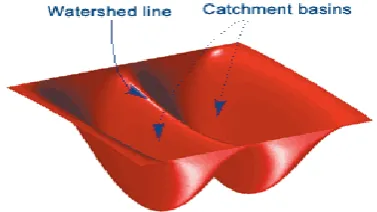
In order to circumvent this problem, we proposed the marker-controlled watershed algorithm based on morphological opening-closing and reconstruction. In watershed segmentation, altitude is represented by the gray level of the pixels. All pixels throughout the same catchment basin are connected with the minimum altitude region of the basin. The watershed lines divides individual catchment basins. The high gradient regions correspond to watershed lines and low gradient regions correspond to catchment basins[9].But, the number of regions formed are more.Hence in order to reduce the regions, Seed region growing algorithm is used.
Seed region growing (SRG) is an image segmentation method which begins with a set of "seed" point and attach the adjacent pixels which has the similar properties with the seed to every seed on the growth of the region [9]. This paper proposes a new region growing algorithm on the basis of traditional seed region growing algorithm, it starts from the region formed by watershed algorithm, selecting some region as seed region to carry on the growth of region according to certain rules[8].
II. WATERSHED ALGORITHM
The watershed transform is the method of image segmentation in the field of mathematical morphology. Image segmentation is the process of isolating objects in the image from the background, i.e., partitioning the image into disjoint regions such that each region is homogeneous with respect to some property such as grey value or texture[15].
International Journal of Emerging Technology and Advanced Engineering
Website: www.ijetae.com (ISSN 2250-2459,ISO 9001:2008 Certified Journal, Volume 3, Issue 11, November 2013)
602
Figure 1:General concept of watershed algorithm
The original image taken for segmentation is shown in Fig. 4(a). First, the colour image is converted into grayscale image.Then,watershed function is used to convert original grayscale image into the image consisting of watershed lines and catchment basins.The final result of watershed algorithm is shown in Fig. 4(c).
III. QUADTREE ALGORITHM
The quadtree structure allows to divide an image within a complete tree representation including neighboring information The quadtree-based segmentation is described as followed-
(i) Define a criteria for image segmentation, generally setting a threshold and a minimum partition scale. The threshold is used as a standard to determine whether the study region has the same property.
(ii) Calculate the maximum pixel gray scale difference in the study area.
(iii)If the difference is greater than the set threshold, indicating the property of pixels is different in the region, cross-segmentation is performed to divide the region into four equal parts. Then each partition is considered as study area and go to step ii.
[image:2.595.70.259.135.241.2](iv)If the difference is smaller than the set threshold or the size of study region is equal to the minimum partition scale, segmentation is ended[6].
Figure 2:General concept of quadtree algorithm[7]
The original image taken for segmentation is shown in Fig. 4(a). It is a image with size of 5l2x5l2 pixels.First,the colour image is converted into grayscale image. Then, whole image is converted into image with the smaller blocks based on some predefined threshold value. The final result of watershed algorithm is shown in Fig. 4(d).
IV. MARKER BASED WATERSHED ALGORITHM
Image Preprocessing:
The original image needs reasonable preprocessing to make it suitable for watershed segmentation. We here first, convert the image into grayscale and then use a morphological filter which combines disk-shaped structuring element to enhance the contrast of the image[1].
Morphological reconstruction is a very useful operator based on mathematical morphology . Morphological reconstruction can be conceptually regarded as repeated dilations of an image called the marker image, until the contour of the marker image fits under a second image called the mask image. Morphological reconstruction turns out to be particularly effective to extract marked objects, detect or remove objects touching the image border and filter out spurious or low points. Based on the morphological reconstruction,a filter combining opening-by-reconstruction operation and closing-by-reconstruction operation is utilized to smooth image and eliminate the noise. The opening-by-reconstruction is erosion followed by a morphological reconstruction while closing-by-reconstruction is a dilation followed by a morphological reconstruction. Compared to simple opening and closing, reconstruction-based opening and closing can restore the original shapes of the objects after erosion or dilation[1].
Markers:
An alternative approach to watershed is to imagine the landscape being immersed in a lake with holes pierced in local minima. Basins (also called `catchment basins') will fill up with water starting at these local minima and at points where water coming from different basins would meet, dams are built. When the water level has reached the highest peak in the landscape, the process is stopped. As a result, the landscape is partitioned into regions or basins separated by dams called watershed lines or simply watersheds[11].
[image:2.595.53.280.515.711.2] [image:2.595.52.278.616.720.2]International Journal of Emerging Technology and Advanced Engineering
Website: www.ijetae.com (ISSN 2250-2459,ISO 9001:2008 Certified Journal, Volume 3, Issue 11, November 2013)
603
1) Foreground markers- Foreground markers can be defined as- Region surrounded by points of higher altitude.
Points in region form connected component.
All the points in the region have same intensity[11].
We compute the foreground markers by extracting the local maxima of the preprocessed image. Local maxima are connected components of pixels with a constant intensity value, and whose external boundary pixels all have a lower value.
2) Background markers- External markers can be defined as-
Each external marker consists of single internal marker and part of background[11].
The background marker extraction can be achieved by computing the watershed transform of the distance transform of the foreground marker image. The distance transform converts a binary image into a distance map where every background pixel has a value corresponding to the minimum distance from the light points. The background marker extraction can be achieved by computing the watershed transform of the distance map of the foreground marker image [1] . The final result of using internal and external markers for this algorithm is shown in Fig. 4(e)&(f).
Segmentation:
The watershed transform is implemented on the gradient image. The gradient defines the first partial derivative of an image and contains a measurement for the variation trend of gray levels. It is better to reflect the variation trend of the image than the original image[12].Sobel operator is adopted to calculate the gradient magnitude of the gray image. The extracted foreground markers and background markers are imposed on the original gradient magnitude image so that its region minima only occur at foreground and background marker pixels.Finally, the ideal segmentation result is achieved by computing the watershed transform on the modified gradient magnitude image[1]. The final result of watershed algorithm is shown in Fig. 4(g).
V. SEED REGION GROWING ALGORITHM
Seed Region Growing is an algorithm used for image segmentation. Initial seeds are selected based on some criteria and then segmentation is done by region growing process.
Region growth is done by comparing the seed pixel with all the neighboring pixels with a threshold and pixels which are above the threshold are grouped to form a single region.Initial seeds may be a single pixel or group of pixels called cluster or region[2].
But, the region growing method is rarely used alone. It is often used with other segmentation methods. The practical method of this subject combines the watershed algorithm and region growing algorithm[8].As the number of regions formed from marker based watershed algorithm are more hence seed region growing algorithm is used to select some region as seed region and carry on the growth of region according traditional region growing algorithm[8]. The final result of seed region growing algorithm is shown in Fig. 4(h).
VI. AN OVERVIEW OF ALL ALGORITHMS
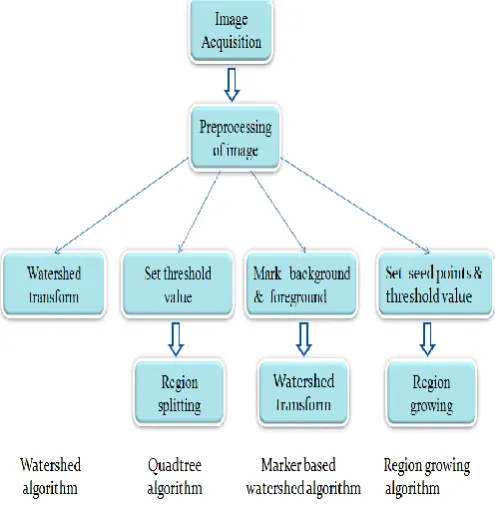
[image:3.595.317.565.415.668.2]Figure 3 shows flowchart of all the algorithms that are used. We started with traditional watershed algorithm then implemented quadtree algorithm. Then to overcome problem caused by both algorithms, we implemented marker based watershed algorithm and region growing algorithm.
International Journal of Emerging Technology and Advanced Engineering
Website: www.ijetae.com (ISSN 2250-2459,ISO 9001:2008 Certified Journal, Volume 3, Issue 11, November 2013)
604
VII.
EXPERIMENTAL RESULTS(a) (b)
(c) (d)
(e) (f)
(g) (h)
Figure 4: (a)original image. (b)original grayscale image. (c)final result of watershed algorithm. (d)final result of quadtree algorithm.
(e)&(f)result obtained after use of internal & external markers in marker based watershed algorithm. (g)final result of marker based
watershed algorithm. (h)final result of seed region growing algorithm.
VIII. CONCLUSION
The application of image processing has widely applied in our life, in which the digital image processing technology is widely used in all aspects of life.Image segmentation is most practical approach among virtually all automated image recognition systems. In this paper, different algorithms such as watershed, quadtree, marker based watershed and seed region growing algorithm are analysed. The watershed algorithm performs well w.r.t complex images. Also, speed of operation is high. The quadtree algorithm is mostly suitable for simple images. Also, it requires that image should be integer power of two. The marker based watershed algorithm provides better suppression to noise. It removes the problem of oversegmentation. Also, it has high accuracy and speed of operation is also high but large number of regions are formed using this algoritm. Hence, when marker based watershed algorithm is used with seed region growing algorithm it yields best results.
REFERENCES
[1] Lulu Xu, Huaxiang Lu, “Automatic Morphological Measurement of the Quantum Dots Based on Marker Controlled Watershed Algorithm”, IEEE Transaction On Nanotechnology,vol 10,No 1,pp 51-56,Jan 2013.
[2] M.Mary Synthuja Jain, Dr.L.Padma Suresh, M.John Bosco, “Image Segmentation Using Seeded Region Growing”, in IEEE International Conference on Computing, Electronics and Electrical Technologies,pp.576-583, 2012.
[3] Yuncai Zhou, Hui Ren, “Segmentation Method for Rock Particles Image Based on Improved Watershed Algorithm”, in International Conference on Computer Science and Service System, IEEE -2012.
[4] Lina Yi, Guifeng Zhang, and Zhaocong Wu, “A Scale-Synthesis Method for High Spatial Resolution Remote Sensing Image Segmentation”, IEEE transactions on geoscience and remote sensing, vol. 50, no. 10, october 2012.
[5] Wei Zhang, DaLing Jiang, “The Marker-Based Watershed Segmentation Algorithm of Ore Image”,IEEE -2011.
[6] Liu Jinmei, Wang Guoyu, “A Refined Quadtree- based Automatic Classification Method for Remote Sensing Image”,IEEE International Conference on Computer Science and Network Technology,2011.
[7] Haiyang Yu, Yumin Zhang, Gang Cheng, Xiaosan Ge, “Rural Residential Building Extraction from Laser Scanning Data and Aerophotograph Based on Quadtree Segmentation” ,IEEE -2011. [8] Jun Tang, “A Color Image Segmentation algorithm Based on
Region Growing”, in IEEE 2nd International Conference On Computer Engineering And Technology, Vol.6,pp.634-637,2010. [9] Dr. G. Padmavathi, Mr. M. Muthukumar, Mr. Suresh Kumar
Thakur, “Implementation and Comparison of Different Segmentation Algorithms used for Underwater Images Based on Nonlinear Objective Assessments”, in IEEE 3rd International Conference on Advanced Computer Theory and Engineering(ICACTE),Vol.2,pp.393-397,2010.
[10] Saliha AOUAT, Slimane LARABI, “Indexing Binary Images using quad-tree Decomposition” ,IEEE -2010.
International Journal of Emerging Technology and Advanced Engineering
Website: www.ijetae.com (ISSN 2250-2459,ISO 9001:2008 Certified Journal, Volume 3, Issue 11, November 2013)
605
[12] Wen-Xiong Kang, Qing-Qiang Yang, Run-Peng Liang, “The Comparative Research on Image Segmentation Algorithms”, First International Workshop on Education Technology and Computer Science, vol. 2, pp.703-707, 2009.
[13] Gary J. Sullivan and Richard L. Baker, “Efficient Quadtree Coding of Images and Video”, IEEE transactions on image processing, vol. 3, no. 3, May 1994.
[14] L. Lucchese and S.K. Mitra, “Color Image Segmentation: A State-of-the-Art Survey”.
[15] Ashwin Kumar, Pradeep Kumar, “A New Framework for Color Image Segmentation Using Watershed Algorithm”.