D
E
V
E
LO
P
M
E
N
T
INTRODUCTION
The retinoblastoma susceptibility gene (Rb; also known as Rb1) is functionally inactivated in most human solid tumors (reviewed by Lipinski et al., 2001; Liu et al., 2004; Stevaux and Dyson, 2002). The tumor-suppressing activity of Rb has been attributed to its ability to block cell proliferation. Specifically, the RB protein can bind to heterodimers composed of a member of the DP protein family and an ‘activating’ member of the E2F family of sequence-specific DNA-binding proteins (E2F1, E2F2, E2F3) (E2F-DP); this blocks the ability of E2F-DP to activate the transcription of genes, the products of which are required for G1–S phase transition (reviewed by Attwooll et al., 2004; Dimova and Dyson, 2005). Independently of its role in cell proliferation, Rbalso plays a role in other processes such as differentiation and apoptosis (reviewed by Chau and Wang, 2003; Lipinski and Jacks, 1999; Liu et al., 2004; Stevaux and Dyson, 2002).
The inactivation of the apoptotic pathway contributes to tumorigenesis in many types of cancers (reviewed by Cory and Adams, 2002; Danial and Korsmeyer, 2004). In mice lacking a functional Rb gene (Rb–/–), ectopic apoptosis is observed in the peripheral and central nervous system as well as the ocular lens, indicating that Rb can block apoptosis in these tissues. The fact that
Rbhas anti-apoptotic activity seems counterintuitive for a tumor suppressor, as it suggests that the loss of Rbfunction not only results in increased proliferation, but also increased apoptosis. Indeed, in many Rb-deficient tumors, the apoptotic pathway is found to be inactivated by mutation as well, thus suggesting that the loss of Rb
function induces tumorigenesis through a mechanism that is dependent on the inactivation of the apoptotic pathway (Chau and
Wang, 2003). However, in certain tissues, the loss of Rbfunction appears to be sufficient for tumorigenesis, which indicates that Rb
might not have anti-apoptotic activity in all tissues and that its role in apoptosis might therefore be tissue-specific (reviewed by Sherr and McCormick, 2002).
The genetic analysis of the role of mammalian Rb in apoptosis has been hampered by the fact that apart from Rb, two Rb-like genes [p107(Rbl1) andp130(Rbl2)] exist. Furthermore, mammals have at least three Dp-like genes and eight E2f-like genes (Attwooll et al., 2004; Christensen et al., 2005; Dimova and Dyson, 2005; Logan et al., 2005; Maiti et al., 2005; Milton et al., 2006). By contrast, the C. elegansgenome encodes one ortholog of RB, LIN-35, one ortholog of DP, DPL-1, and two E2F-like proteins, EFL-1 and EFL-2 (Ceol and Horvitz, 2001; Lu and Horvitz, 1998). lin-35,dpl-1 andefl-1are members of the class B synthetic multivulval (synMuv) genes, which were originally identified because of their role in vulval development: synMuv B genes act redundantly with class A and class C synMuv genes to antagonize let-60RAS,mpk-1MAPK signaling in the vulval precursor cells (VPCs), thereby blocking vulval differentiation (Ceol and Horvitz, 2004; Ferguson and Horvitz, 1989). The fact that the loss of lin-35,dpl-1 or efl-1function causes similar rather than opposite phenotypes suggests that, at least during vulval differentiation, lin-35, dpl-1 and efl-1 function together to repress gene transcription.
Animals lacking lin-35function are viable and overall have a wild-type appearance, although they are less fertile and show enhanced sensitivity to the inactivation of gene function by RNA interference (Boxem and van den Heuvel, 2001; Fay et al., 2002; Lu and Horvitz, 1998; Thomas and Horvitz, 1999; Wang et al., 2005). Furthermore, lin-35functions redundantly in a number of processes other than vulval differentiation, such as cell cycle progression, larval development, somatic gonad development, pharynx differentiation and transgene expression (Bender et al., 2004; Boxem and van den Heuvel, 2001; Cardoso et al., 2005; Chesney et al., 2006; Cui et al., 2004; Fay et al., 2002; Fay et al., 2003; Fay et al.,
C. elegans
orthologs of components of the RB tumor
suppressor complex have distinct pro-apoptotic functions
Claus Schertel and Barbara Conradt*
To obtain insight into the role of the retinoblastoma susceptibility gene (Rb; also known as Rb1) in apoptosis, we analyzed Caenorhabditis elegansmutants lacking a functional lin-35RB gene. We found that the loss of lin-35function results in a decrease in constitutive germ cell apoptosis. We present evidence that lin-35promotes germ cell apoptosis by repressing the expression of ced-9, an anti-apoptotic C. elegans gene that is orthologous to the human proto-oncogene BCL2. Furthermore, we show that the genes dpl-1DP, efl-1E2F and efl-2E2F also promote constitutive germ cell apoptosis. However, in contrast to lin-35, dpl-1(and probably also efl-1 andefl-2) promotes germ cell apoptosis by inducing the expression of the pro-apoptotic genes ced-4and ced-3, which encode an APAF1-like adaptor protein and a pro-caspase, respectively. Based on these results, we propose that C. elegans orthologs of components of the RB tumor suppressor complex have distinct pro-apoptotic functions in the germ line and that the transcriptional regulation of components of the central apoptosis machinery is a critical determinant of constitutive germ cell apoptosis in C. elegans. Finally, we demonstrate that lin-35, dpl-1and efl-2, but not efl-1, function either downstream of or in parallel to cep-1p53 (also known as TP53) and egl-1BH3-only to cause DNA damage-induced germ cell apoptosis. Our results have implications for the general mechanisms through which RB-like proteins control gene expression, the role of RB-, DP- and E2F-like proteins in apoptosis, and the regulation of apoptosis.
KEY WORDS: C. elegans, Apoptosis, Germ line, lin-35 RB Development 134, 3691-3701 (2007) doi:10.1242/dev.004606
Dartmouth Medical School, Department of Genetics, Norris Cotton Cancer Center, 7400 Remsen, Hanover, NH 03755, USA.
*Author for correspondence (e-mail: [email protected])
D
E
V
E
LO
P
M
E
N
T
2004; Hsieh et al., 1999; Wang et al., 2005). Therefore, like mammalian Rb, C. elegans lin-35plays a role in cell proliferation and differentiation. Whether lin-35also plays a role in apoptosis has not previously been investigated.
During C. elegansdevelopment, 131 of the 1090 somatic cells that are formed undergo apoptosis, a process referred to as ‘developmental apoptosis’ (Sulston and Horvitz, 1977; Sulston et al., 1983). Developmental apoptosis is determined by the essentially invariant somatic cell lineage of C. elegansand is executed through a conserved apoptotic pathway (reviewed by Horvitz, 2003; Lettre and Hengartner, 2006). Specifically, developmental apoptosis is dependent on the pro-apoptotic genes ced-4 and ced-3, which encode an APAF1-like adaptor protein and a pro-caspase, respectively. In cells destined to live, the ability of the CED-4 protein to induce pro-CED-3 activation and, hence, the execution of apoptosis, is blocked by the anti-apoptotic protein CED-9, the C. elegansortholog of the human proto-oncoprotein BCL2. In cells destined to die, the pro-apoptotic gene egl-1, which encodes a BH3-only (BH3, BCL2 homology domain 3) protein, is upregulated at the transcriptional level. EGL-1 protein can interact with and block CED-9, thereby allowing CED-4 activation.
Apoptosis also occurs in the germ line of adult C. elegans
hermaphrodites (Sulston, 1988), where more than 50% of all germ cells in the pachytene stage of prophase of meiosis I undergo apoptosis, a process referred to from hereon as ‘constitutive germ cell apoptosis’ (Gumienny et al., 1999). Like developmental apoptosis, constitutive germ cell apoptosis is dependent on the genes ced-4and ced-3and is blocked by ced-9. However, unlike developmental apoptosis, constitutive germ cell apoptosis is not dependent on egl-1(Gumienny et al., 1999). Finally, the exposure of adult C. eleganshermaphrodites to genotoxic agents, such as ionizing radiation (IR), causes large numbers of germ cells in the pachytene stage to undergo apoptosis, a process referred to as ‘DNA damage-induced germ cell apoptosis’ (Gartner et al., 2000). DNA damage-induced germ cell apoptosis is at least partially dependent on egl-1, which is transcriptionally upregulated in response to DNA damage in a manner that is dependent on the C. elegansortholog of the mammalian p53 gene (also known as Tp53),
cep-1 (Derry et al., 2001; Hofmann et al., 2002; Schumacher et al., 2001).
In this article, we report that lin-35RB as well asdpl-1DP,efl-1
E2F and efl-2E2F, are required for germ cell apoptosis in C. elegans. Surprisingly, however, the pro-apoptotic role of lin-35appears to be distinct from the pro-apoptotic roles of dpl-1,efl-1and efl-2.
MATERIALS AND METHODS General methods and strains
C. elegansstrains were cultured at 20°C as described (Brenner, 1974). The wild-type strain used was C. elegansvar. Bristol (N2). Alleles used are listed below and are described (Riddle, 1997), except where noted otherwise. LGI:
lin-35(n745,n2996) (Lu and Horvitz, 1998),cep-1(lg12501) (Schumacher et al., 2001), hus-1(op241) (Hofmann et al., 2002), ppw-1(pk1425) (Tijsterman et al., 2002), rrf-1(pk1417) (Simmer et al., 2003).LGII: dpl-1(n3643, n3316) (Ceol and Horvitz, 2001),unc-4(e120),unc-52(e444), dpy-10(e128), rrf-3(pk1426) (Simmer et al., 2002), efl-2(tm2359) (National BioResource Project, Tokyo, Japan) (tm2359 is a 332 bp deletion with a 47 bp insertion that removes sequences 5⬘to the predicted transcriptional start site of the efl-2gene and most of exon 1. Exon 1 encodes the putative dimerization domain and DNA-binding domain of the EFL-2 protein. For this reason, tm2359is predicted to be a strong loss-of-function or null allele of the efl-2gene). LGIII: ced-9(n1653ts,n2812) (Hengartner and Horvitz, 1994),ced-6(n2095),dpy-19(e1259),glp-1(q339) (Edgley et al., 1995), ceh-13(sw1) (Brunschwig et al., 1999), dpy-17(e164), nDf20, nDp2[unc-86(e1416)] (III;f) (Finney et al., 1988). LGIV: dpy-20(e1282).LGV: bcIs39
(Plim-7ced-1::gfp) (Schumacher et al., 2005; Zhou et al., 2001),
dpy-21(e428), unc-76(e911), efl-1(n3318) (Ceol and Horvitz, 2001), rde-1(ne300) (Tabara et al., 1999).
Quantification of germ cell apoptosis
For constitutive germ cell apoptosis, hermaphrodites were synchronized at the fourth larval (L4) stage and analyzed 12, 24, 36 and 48 hours post the L4 stage. Animals were anesthetized using 80 mM sodium azide and mounted on slides using 2% agarose pads. Apoptotic germ cells were detected using DIC and epifluorescence. For ced-9(n1653ts)-induced germ cell apoptosis, animals were synchronized at the L4 stage, cultivated at 20°C for 12 hours and shifted to 25°C for 24 hours before being analyzed. For ced-9(n2812)/+-induced germ cell apoptosis, animals were synchronized at the L4 stage and analyzed by DIC 40 hours post the L4 stage. For DNA damage-induced germ cell apoptosis, hermaphrodites were synchronized at the L4 stage and exposed to 120 Gy using a 137Cs source
(J. L. Shepherd, San Fernando, CA) with a dose rate of 10 Gy/minute. 24 hours post-irradiation, apoptotic germ cells were scored using DIC. efl-1(n3318) and efl-2(tm2359) animals were irradiated 12 hours post the L4 stage and analyzed 24 hours post-irradiation.
Transgenic animals
The Plim-7lin-35 plasmid was constructed by fusing the lin-35cDNA to the
lim-7promoter (2.23 kb upstream of transcriptional start site) (Hall et al., 1999). This fusion was blunt-cloned into the EcoRI site of vector pPD95.67 (gift from Dr A. Fire, Stanford University School of Medicine, CA). The resulting plasmid was injected at a concentration of 1 ng/l using the plasmid pRF4 [rol-6(dm)] as co-injection marker at a concentration of 100 ng/l (Kramer et al., 1990). The cosmid C32F10[lin-35(+)] was injected at a concentration of 10 ng/l using the plasmid pPD93.97 (Pmyo-3gfp) (gift
from Dr A. Fire) as co-injection marker at a concentration of 50 ng/l.
RNAi experiments
RNAi experiments were performed by feeding as described (Timmons et al., 2001). Briefly, animals were exposed to RNAi plates containing 6 mM IPTG. Animals of the F1 generation were synchronized at the L4 larval stage, transferred to fresh RNAi plates and analyzed after the indicated time. An unrelated gene (F53B3.2) was used as control RNAi.
Semi-quantitative and quantitative expression analyses
For semi-quantitative RT-PCR, hermaphrodites were synchronized at the L4 stage and irradiated with 100 Gy 24 hours post the L4 stage. Total RNA was isolated from 200 animals 3 hours post-irradiation using Trizol (Invitrogen) and purified by chloroform extraction and isopropanol precipitation. 1 g of total RNA was treated with DNase and reverse transcribed into cDNA using the SuperScript III First Strand Kit (Invitrogen) and oligo-dT primers. Equal amounts of cDNA were used as template for gene-specific PCR with appropriate primers. A plasmid containing the egl-1cDNA was used as positive control. Water was used as negative control. tbg-1(encoding ␥-tubulin) RT-PCR was performed as a control. For quantitative real-time RT-PCR, total RNA was isolated from about 40 gonads dissected from hermaphrodites 27 hours post the L4 stage as described for semi-quantitative RT-PCR. 400 ng of total RNA was reverse transcribed into cDNA. Gene-specific PCR reactions using equal amounts of cDNA, appropriate primers and TaqMan probes were performed with an Opticon DNA Engine (MJ Research). tbg-1was used as external control. Test gene CT values were normalized to tbg-1CT values
and relative expression levels were derived with the comparative CT method
(Livak and Schmittgen, 2001).
Western analysis
D
E
V
E
LO
P
M
E
N
T
RESULTS
The loss of lin-35RB function results in a decrease in constitutive germ cell apoptosis
To determine whether the C. elegansLIN-35 RB protein plays a role in developmental apoptosis, we analyzed animals homozygous for the lin-35loss-of-function (lf) mutation n745. n745is a nonsense mutation predicted to truncate the 961 amino acid LIN-35 protein after amino acid 150. For this reason, it has been proposed that n745
might completely eliminate the function of the lin-35gene (Lu and Horvitz, 1998). We found no defect in developmental apoptosis in
[image:3.612.320.557.63.404.2]lin-35(n745) animals, indicating that lin-35RB is not required for developmental apoptosis at least in a wild-type background (see Table S1 in the supplementary material; data not shown). However, it has recently been demonstrated that in a sensitized genetic background, lin-35promotes developmental apoptosis (Reddien et al., 2007).
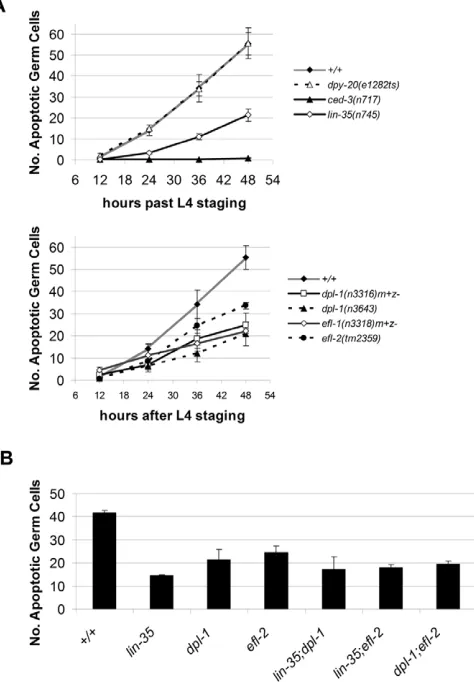
Next we analyzed constitutive germ cell apoptosis in lin-35(n745) animals. Germ cells undergoing apoptosis become refractile and are engulfed by the sheath cells, which are part of the somatic gonad and which express the scavenger receptor-like protein CED-1 on their cell surface (Zhou et al., 2001). Therefore, constitutive germ cell apoptosis was quantified using a combination of DIC and CED-1::GFP (Plim-7ced-1::gfp, bcIs39) fluorescence microscopy. As a result of the efficient engulfment of apoptotic germ cells by the sheath cells, the number of apoptotic germ cells per gonad arm that can be detected at any given time is very low [4.0 apoptotic germ cells on average in hermaphrodites 48 hours post the fourth larval (L4) stage] (Gumienny et al., 1999). For this reason, we analyzed constitutive germ cell apoptosis in the background of ced-6(n2095). n2095is a loss-of-function mutation in ced-6, a gene which is required for the efficient engulfment of apoptotic germ cells (Ellis et al., 1991). In the ced-6 mutant background, apoptotic germ cells accumulate, resulting in a greatly increased number of apoptotic germ cells that can be detected at any given time (55.3±5.4 apoptotic germ cells on average in hermaphrodites 48 hours post the L4 stage) (Fig. 1A, +/+). We found that lin-35(n745) reduced the number of apoptotic germ cells in ced-6(n2095) animals by more than 50% [Fig. 1A, lin-35(n745)]. Similarly, the lin-35loss-of-function mutation n2996, a nonsense mutation predicted to truncate the LIN-35 protein after amino acid 304, reduced the number of apoptotic germ cells in ced-6(n2095) animals by more than 50%. For comparison, in ced-6(n2095) animals homozygous for a loss-of-function mutation in the ced-3
gene, almost no apoptotic germ cells were detected [Fig. 1A, ced-3(n717)].
When compared with wild-type hermaphrodites, lin-35(n754) hermaphrodites are less fertile (Boxem and van den Heuvel, 2001; Fay et al., 2002; Lu and Horvitz, 1998; Thomas and Horvitz, 1999). Therefore, the decrease in the number of apoptotic germ cells in lin-35(n745) animals might be the result of a decrease in constitutive germ cell apoptosis or, alternatively, a decrease in germ cell proliferation. To distinguish between these two possibilities, we assessed constitutive germ cell apoptosis in animals homozygous fore1282, a loss-of-function mutation in the
dpy-20gene, which encodes a novel, BED zinc-finger protein required for normal body morphology (Clark et al., 1995). Germ cell proliferation in dpy-20(e1282) animals is compromised to a degree similar to that in lin-35(n745) animals (see Table S2 in the supplementary material); however, the dpy-20(e1282) mutation had no effect on the number of apoptotic germ cells [Fig. 1A, dpy-20(e1282)]. This finding indicates that the decrease in the number of apoptotic germ cells detected in lin-35(n745);
ced-6(n2095) animals is a result of a decrease in constitutive germ cell apoptosis rather than a decrease in germ cell proliferation. This conclusion is supported by the following two observations: first, a partial loss-of-function mutation in the gene dpl-1, n3643, does not compromise germ cell proliferation but, like lin-35(n745), decreases the number of apoptotic germ cells in ced-6(n2095) animals by more than 50% (see below); second, the loss of lin-35function completely blocks DNA damage-induced germ Fig. 1. The loss of lin-35,dpl-1, efl-1 or efl-2function results in a reduced level of constitutive germ cell apoptosis. (A) Time-course analysis of constitutive germ cell apoptosis, which was analyzed in C. eleganshermaphrodites of the indicated genotypes. Average numbers of apoptotic germ cells per gonad arm of four independent
experiments are shown. Error bars represent standard deviations. For each experiment, a minimum of ten animals per genotype and time point was scored double blind. All strains analyzed were homozygous for the mutation ced-6(n2095). Except for the strain efl-1(n3318), all strains were also homozygous for the Plim-7ced-1::gfpintegration
bcIs39. m+z–indicates that animals analyzed were homozygous mutant
D
E
V
E
LO
P
M
E
N
T
cell apoptosis (see below). Based on these observations, we conclude that the lin-35/Rbgene promotes constitutive germ cell apoptosis.
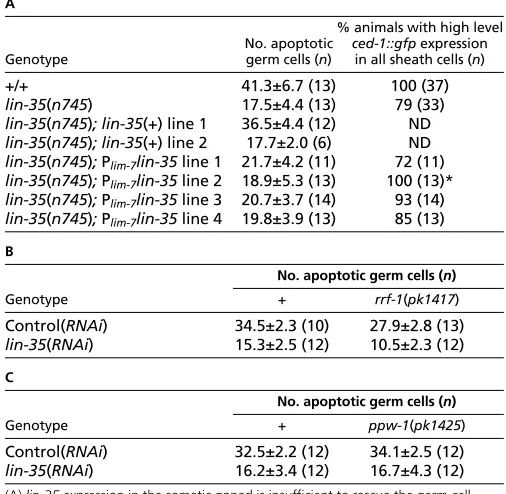
To determine where lin-35 function is required to promote constitutive germ cell apoptosis, we generated transgenic lin-35(n745) animals carrying extrachromosomal arrays composed of cosmid C32F10, which contains the wild-type lin-35locus [ lin-35(+)], or a transgene expressing the wild-type lin-35cDNA under the control of the lim-7promoter (Plim-7lin-35). We found that lin-35(+), which has been shown to rescue lin-35function in the somatic
gonad as well as the germ line (Fay et al., 2002), but not Plim-7lin-35, which presumably rescues lin-35function specifically in the somatic gonad (Hall et al., 1999), was able to rescue the germ cell apoptosis phenotype of lin-35(n745) animals (Table 1A). Furthermore, reducing lin-35function by RNAi in a rrf-1mutant background, which is defective for RNAi in somatic tissues, or a ppw-1mutant background, which is defective for RNAi in the germ line, reduced constitutive germ cell apoptosis by about 50% (Table 1B and C). These results demonstrate that lin-35expression in either somatic gonad or germ line is insufficient to promote constitutive germ cell apoptosis. Therefore, we propose that lin-35function is required in both the somatic gonad and the germ line to promote constitutive germ cell apoptosis.
lin-35RB promotes constitutive germ cell
apoptosis by blocking the function of ced-9BCL2 In an otherwise wild-type background, the temperature-sensitive, partial ced-9 loss-of-function mutation n1653 causes massive germ cell apoptosis at the non-permissive temperature (25°C), often resulting in gonad arms with severely damaged germ lines (Gumienny et al., 1999; Hengartner et al., 1992). We found that
lin-35(n745) reduced the number of gonad arms with severely damaged germ lines in ced-9(n1653ts) animals from 83% [n=30;
ced-9(n1653ts)] to 20% [n=40; lin-35(n745); ced-9(n1653ts)] (Fig. 2A). In addition, in gonad arms with undamaged germ lines,
lin-35(n745) reduced the number of apoptotic germ cells detectable from 26.0±7.2 [ced-9(n1653ts); n=14] to 4.1±2.8 [lin-35(n745); ced-9(n1653ts); n=47]. Furthermore, we found that
lin-35(n745) completely suppresses germ cell apoptosis induced by the loss of one copy of the ced-9 gene (see below). The potential ced-9-null allele, n2812, is a nonsense mutation predicted to truncate the 280 amino acid CED-9 protein after amino acid 45 (Hengartner and Horvitz, 1994). ced-9(n2812) causes massive germ cell apoptosis resulting in 100% (n>40) gonad arms with severely damaged germ lines at all growth temperatures (Gumienny et al., 1999; Hengartner et al., 1992).
lin-35(n745) failed to suppress the massive germ cell apoptosis in ced-9(n2812) hermaphrodites and did not affect the percentage of gonad arms with severely damaged germ lines (100%; n>40).
The finding thatlin-35(n745) suppresses the partial but not complete loss of ced-9function is consistent with the model that
lin-35 acts upstream of ced-9 to block ced-9 function. Alternatively, lin-35might act downstream of ced-9and the failure of lin-35(n745) to suppress the complete loss of ced-9function might be due to irreversible germ line damage. To distinguish between these two possibilities, we analyzed germ cell apoptosis in ced-9(n2812) animals homozygous for n2427, a weak loss-of-function mutation of the ced-3 gene, which acts downstream of
ced-9. ced-3(n2427) partially suppressed the germ line phenotype caused by ced-9(n2812): in ced-3(n2427); ced-9(n2812) animals, 0% of the gonad arms were severely damaged (n>40), but when compared with wild-type animals (+/+), an elevated level of germ cell apoptosis could be detected [Table 2, ced-3(n2427); ced-9(n2812)]. We found that lin-35(n745) failed to suppress the elevated level of germ cell apoptosis in ced-3(n2427); ced-9(n2812) animals [Table 2, lin-35(n745); ced-3(n2427); ced-9(n2812)]. Therefore, the ability of lin-35(n745) to reduce constitutive germ cell apoptosis is dependent on the presence of a
[image:4.612.47.300.86.333.2]ced-9gene that is at least partially functional. Based on these results, we conclude that the lin-35RB gene acts upstream of ced-9BCL2 to inhibit its function.
Table 1. lin-35is required in the germ line and the somatic gonad to promote constitutive germ cell apoptosis A
% animals with high level No. apoptotic ced-1::gfpexpression
Genotype germ cells (n) in all sheath cells (n)
+/+ 41.3±6.7 (13) 100 (37)
lin-35(n745) 17.5±4.4 (13) 79 (33)
lin-35(n745); lin-35(+) line 1 36.5±4.4 (12) ND lin-35(n745); lin-35(+) line 2 17.7±2.0 (6) ND lin-35(n745);Plim-7lin-35 line 1 21.7±4.2 (11) 72 (11) lin-35(n745); Plim-7lin-35 line 2 18.9±5.3 (13) 100 (13)* lin-35(n745); Plim-7lin-35 line 3 20.7±3.7 (14) 93 (14) lin-35(n745); Plim-7lin-35 line 4 19.8±3.9 (13) 85 (13)
B
No. apoptotic germ cells (n)
Genotype + rrf-1(pk1417)
Control(RNAi) 34.5±2.3 (10) 27.9±2.8 (13) lin-35(RNAi) 15.3±2.5 (12) 10.5±2.3 (12)
C
No. apoptotic germ cells (n)
Genotype + ppw-1(pk1425)
Control(RNAi) 32.5±2.2 (12) 34.1±2.5 (12) lin-35(RNAi) 16.2±3.4 (12) 16.7±4.3 (12) (A) lin-35expression in the somatic gonad is insufficient to rescue the germ cell apoptosis phenotype of lin-35(n745) animals. Transgenic animals were generated and the presence of apoptotic germ cells determined 40 hours after the L4 stage. All strains were homozygous for the mutation ced-6(n2095) and the stable Plim-7
ced-1::gfpintegration bcIs39. Average numbers of apoptotic germ cells per gonad arm±standard deviation (left column) and percentage of animals with high level of
ced-1::gfpexpression in all sheath cells (right column) are shown. Not all sheath cell pairs express high levels of ced-1::gfpin lin-35(n745) mutants. We used this defect as a measure of the rescuing ability of the Plim-7lin-35 transgene. (B,C) Reducing
lin-35 activity in either the somatic gonad (B) or the germ line (C) reduces constitutive germ cell apoptosis. The presence of apoptotic germ cells was determined 40 hours after the L4 stage. All strains were homozygous for the mutation ced-1(e1735) (B) or the mutation ced-6(n2095) and the stable Plim-7ced-1::gfpintegration bcIs39(C). Average numbers of apoptotic germ cells per gonad arm±standard deviation are shown. F53B3.2(RNAi) was used as control(RNAi).
ND, not determined.
*The frequency of ced-1::gfp(+) sheath cells is significantly greater in lin-35(n745);
Plim-7lin-35 line 2 than in lin-35(n745) (P<0.05; z-test).
Table 2. Suppression of germ cell apoptosis in ced-9(n2812); ced-3(n2427) animals
Genotype No. apoptotic germ cells n
+/+ 3.0±0.4 44
ced-9(n2812); ced-3(n2427) 13.9±3.2 61
[image:4.612.49.299.647.712.2]D
E
V
E
LO
P
M
E
N
T
The loss of lin-35RB function results in increased levels of ced-9mRNA and CED-9 protein in the germ line
C. elegansLIN-35 RB most probably functions by regulating gene transcription. Therefore, using quantitative real-time reverse transcriptase (RT)-PCR, we determined whether the loss of lin-35
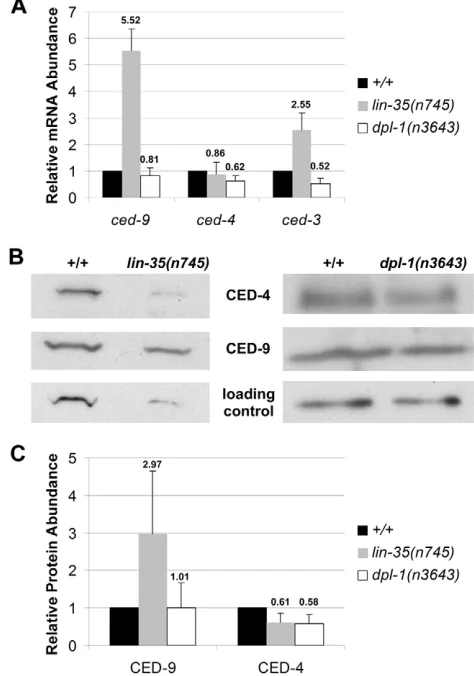
function has an effect on the level of ced-9mRNA in the germ line. We found that ced-9mRNA was on average 5.5-fold more abundant in the germ line of lin-35(n745) animals than in the germ line of wild-type (+/+) animals (Fig. 3A). In addition, ced-3mRNA was on average 2.5-fold more abundant in the germ line of lin-35(n745) animals than in the germ line of wild-type animals. By contrast, the abundance of ced-4mRNA was not affected by lin-35(n745).
[image:5.612.317.554.62.400.2]We also determined the level of CED-9 protein in the germ line of lin-35(n745) animals. We found that the level of CED-9 protein was on average 3.0-fold higher in the germ line of lin-35(n745) animals than in the germ line of wild-type (+/+) animals (Fig. 3B,C and see Fig. S1 in the supplementary material). In addition, we found that in the germ line of lin-35(n745) animals, the level of CED-4 protein was slightly reduced. [Owing to the lack of a CED-3-specific antibody, we were unable to determine the level of endogenous CED-3 protein in the germ line of lin-35(n745) and wild-type animals.] We conclude that the lin-35RB gene is required to directly or indirectly repress the transcription of ced-9BCL2 in the germ line. Furthermore, lin-35RB might also play a role in controlling the expression of ced-4APAF1 and ced-3caspase in the germ line. Fig. 2. Role of ced-9in lin-35-dependent germ cell apoptosis.
(A) The loss of lin-35 function suppresses germ cell apoptosis caused by the partial loss of ced-9function. DIC and fluorescence images of gonad arms of ced-9(n1653ts) and lin-35(n745); ced-9(n1653ts)C. eleganshermaphrodites. Both strains were homozygous for the P lim-7ced-1::gfpintegration bcIs39.White arrows point to apoptotic germ
cells. (Aa) Gonad of a ced-9(n1653ts) hermaphrodite that is severely damaged. (Ab) Gonad of a ced-9(n1653ts) hermaphrodite that is not severely damaged but contains a large number of apoptotic germ cells. (Ac,Ad) Gonads of lin-35(n745); ced-9(n1653ts) hermaphrodites that are not severely damaged and contain low numbers of apoptotic germ cells. (B) The dosage of ced-9determines the level of constitutive germ cell apoptosis. Constitutive germ cell apoptosis was analyzed 40 hours post the L4 stage. Average numbers of apoptotic germ cells per gonad arm are shown. Error bars represent standard deviations of three independent experiments. For each genotype, a minimum of 20 animals was scored blind (n=20-51). The complete genotype of the animals was: ced-1(e1735) [control (+/+)], ced-1(e1735); nDf20; nDp2[unc-86(e1416)] (+/–), ced-1(e1735); nDf20/dpy-17(e164); nDp2[unc-86(e1416)] (+/+) and ced-1(e1735); dpy-17(e164); nDp2[unc-86(e1416)] (+/+/+).
[image:5.612.52.295.63.340.2]D
E
V
E
LO
P
M
E
N
T
The dosage ofced-9determines the level of germ cell apoptosis
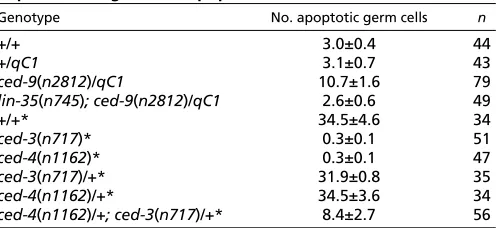
Hermaphrodites trans-heterozygous for the potential ced-9-null mutation n2812 and the balancer chromosome qC1 [ ced-9(n2812)/qC1] overall are wild type. However, we found that, when compared with wild-type animals (+/+) or animals heterozygous for
qC1(+/qC1), ced-9(n2812)/qC1 animals had an increased number of apoptotic germ cells (Table 3). This observation indicates that the
ced-9 gene is haploinsufficient for the repression of constitutive germ cell apoptosis. To further characterize the effect of ced-9
dosage on germ cell apoptosis, we analyzed germ cell apoptosis in engulfment-defective animals with one (+), two (+/+) or three (+/+/+) copies of the ced-9gene. With increasing ced-9dosage, we detected decreasing numbers of apoptotic germ cells (Fig. 2B). Thus, changes in the dosage of ced-9BCL2 and, hence, most likely in the expression of ced-9BCL2, strongly affect the level of germ cell apoptosis. Furthermore, the increase in apoptotic germ cells observed in animals of the genotype ced-9(n2812)/qC1 was completely suppressed by lin-35(n745) (lin-35(n745); ced-9(n2812)/qC1(Table 3). Therefore, we conclude that the decreased level of constitutive germ cell apoptosis detected in animals lacking
lin-35RB function is a consequence of increased ced-9expression in the germ line.
dpl-1DP, efl-1E2F and efl-2E2F promote constitutive germ cell apoptosis
C. elegansLIN-35 RB protein has been shown to physically interact with the DP ortholog DPL-1 and the E2F-like protein EFL-1 (Ceol and Horvitz, 2001). Therefore, we determined the effect of decreasing
dpl-1, efl-1or efl-2function on constitutive germ cell apoptosis. [As observed for the loss of lin-35function, decreasing dpl-1, efl-1or efl-2function did not affect developmental apoptosis (see Table S1 in the supplementary material).] We found that a partial (n3643) or strong (n3316) loss-of-function mutation in the dpl-1 gene reduced constitutive germ cell apoptosis in a ced-6(n2095) background by more than 50% [Fig. 1A, dpl-1(n3643), dpl-1(n3316)]. Furthermore, strong loss-of-function mutations in efl-1, n3318, or efl-2, tm2359, decreased constitutive germ cell apoptosis in a ced-6(n2095) background by about 40-50% [Fig. 1A, efl-1(n3318), efl-2(tm2359)]. To determine whether efl-1 and efl-2 have partially redundant functions in constitutive germ cell apoptosis, we attempted to construct a C. elegansstrain lacking both efl-1and efl-2function. However, we were unable to obtain such a strain (our unpublished observations). For this reason, we consider it likely that efl-1and
efl-2have redundant functions in an essential process.dpl-1(n3316) and
efl-1(n3318) animals are sterile; however, dpl-1(n3643) and efl-2(tm2359) animals are fertile and their fertilities are comparable to the fertility of wild-type animals (Ceol and Horvitz, 2001) (see Table S2 in the supplementary material; data not shown). Therefore, we propose that, like lin-35RB, the genes dpl-1DP, efl-2E2F and most likely also efl-1E2F promote constitutive germ cell apoptosis.
Reducing the function of dpl-1in lin-35(n745);ced-6(n2095) animals (lin-35; dpl-1) or efl-2(tm2359);ced-6(n2095) animals ( dpl-1; efl-2) or reducing the function of lin-35inefl-2(tm2359); ced-6(n2095) animals (lin-35; efl-2) did not result in a further decrease in the number of apoptotic germ cells (Fig. 1B). These observations suggest that the inactivation of C. elegansorthologs of components of the RB complex reduces constitutive germ cell apoptosis by about 50%.
The roles of dpl-1DP and efl-2E2F in constitutive germ cell apoptosis are distinct from the role of lin-35RB
In contrast to lin-35(n745), reducing the function of dpl-1or efl-2
decreased the number of apoptotic germ cells detected in ced-9(n2812); ced-3(n2427) animals by 56% and 60%, respectively (Table 2). [We have been unable to construct a strain of the genotype
efl-1(n3318); ced-9(n2812); ced-3(n2427), and consider it likely that animals of this genotype are not viable (our unpublished observations).] Furthermore, we found that the levels of ced-9
mRNA and CED-9 protein in the germ line of dpl-1(n3643) animals were not greater than in the germ line of wild-type (+/+) animals (Fig. 3). These results demonstrate that dpl-1 and efl-2 do not promote constitutive germ cell apoptosis by inhibiting ced-9
expression. Therefore, the pro-apoptotic roles of dpl-1DP and efl-2
E2F (and possibly efl-1E2F) are distinct from that of lin-35RB. By contrast, we found that dpl-1(n3643) reduced the levels of ced-3and ced-4mRNAs in the germ line by about 40% and 50% (Fig. 3A), respectively, and the level of CED-4 protein by 40% (Fig. 3B,C). To determine whether a reduction of ced-3 or ced-4
expression by about 50% has an effect on constitutive germ cell apoptosis, we analyzed engulfment-defective animals heterozygous for strong loss-of-function mutations in ced-3[ced-3(n717)/+], ced-4 [ced-4(n1162)/+] or ced-3 and ced-4 [ced-4(n1162)/+; ced-3(n717)/+]. We found that the lack of one functional copy of either
ced-3or ced-4was not sufficient to reduce constitutive germ cell apoptosis, but the lack of one functional copy of both ced-3and ced-4 reduced constitutive germ cell apoptosis by 75% (Table 2). Therefore, the simultaneous reduction by 50% of the dosage of ced-3and ced-4and, hence, most likely of the expression of ced-3and
ced-4, strongly reduces constitutive germ cell apoptosis. Based on these results, we conclude that the reduction in constitutive germ cell apoptosis observed in animals lacking dpl-1function is a result of decreased levels of ced-3and ced-4mRNA. Therefore, dpl-1DP, and most likely also efl-1E2F and efl-2E2F, promotes constitutive germ cell apoptosis by inducing the expression of the genes ced-4
APAF1 and ced-3caspase in the germ line.
lin-35RB, dpl-1DP and efl-2E2F are required for DNA damage-induced germ cell apoptosis
[image:6.612.51.299.79.193.2]Next, we determined whether lin-35, dpl-1, efl-1 andefl-2also promote DNA damage-induced germ cell apoptosis (Gartner et al., 2000). Since the exposure to genotoxic agents induces massive germ cell apoptosis, DNA damage-induced germ cell apoptosis was analyzed in a wild-type background rather than the ced-6(n2095) background. The gene cep-1 is required for DNA Table 3. The gene dosage of ced-9, ced-4 and ced-3 is
important for germ cell apoptosis
Genotype No. apoptotic germ cells n
+/+ 3.0±0.4 44
+/qC1 3.1±0.7 43
ced-9(n2812)/qC1 10.7±1.6 79
lin-35(n745); ced-9(n2812)/qC1 2.6±0.6 49
+/+* 34.5±4.6 34
ced-3(n717)* 0.3±0.1 51
ced-4(n1162)* 0.3±0.1 47
ced-3(n717)/+* 31.9±0.8 35
ced-4(n1162)/+* 34.5±3.6 34
ced-4(n1162)/+; ced-3(n717)/+* 8.4±2.7 56
The presence of apoptotic germ cells was determined 40 hours post the L4 stage by DIC. Average numbers of apoptotic germ cells per gonad arm±standard deviations are shown.
D
E
V
E
LO
P
M
E
N
T
damage-induced germ cell apoptosis and encodes the C. elegans
ortholog of p53 (Derry et al., 2001; Schumacher et al., 2001). We found that, like the loss of cep-1function, reducing lin-35, dpl-1
or efl-2 function completely blocked DNA damage-induced germ cell apoptosis [Fig. 4A, lin-35(n745), dpl-1(n3643), efl-2(tm2359)]. By contrast, reducing efl-1function had no effect on this process [efl-1(n3318)]. Furthermore, the loss of lin-35, dpl-1
or efl-2function did not result in a defect in DNA damage-induced cell-cycle arrest, indicating that lin-35, dpl-1and efl-2are not required for the DNA-damage checkpoint (see Fig. S2 and Table S3 in the supplementary material; data not shown). Based on these results, we conclude that lin-35RB, dpl-1DP and efl-2E2F, but not efl-1E2F, are specifically required for DNA damage-induced germ cell apoptosis.
The loss of lin-35RB, dpl-1DP or efl-2E2F function does not affect the cep-1p53-dependent expression of egl-1BH3-only in response to DNA damage DNA damage-induced germ cell apoptosis is in part mediated by the
cep-1-dependent upregulation at the transcriptional level of the BH3-only gene egl-1(Hofmann et al., 2002). To determine whether the block in DNA damage-induced germ cell apoptosis caused by the loss of lin-35, dpl-1 or efl-2 function is a result of a defect in the upregulation of egl-1, we analyzed the level of egl-1mRNA in the germ line of lin-35(n745), dpl-1(n3643) and efl-2(tm2359) animals. Using semi-quantitative and quantitative real-time RT-PCR, we found that in response to DNA damage the levels of egl-1mRNA increased to similar levels in the germ line of wild-type (+/+) and lin-35(n745) animals (Fig. 4B,C). Similarly, using semi-quantitative real-time RT-PCR, we found that the levels of egl-1mRNA increased to similar levels in the germ line of wild-type (+/+), dpl-1(n3643) and efl-2(tm2359) animals (Fig. 4B). Therefore, the loss of lin-35, dpl-1 or
efl-2function does not affect the cep-1-dependent upregulation of egl-1transcription. These results are consistent with the model that lin-35
RB, dpl-1DP and efl-2E2F act downstream of or in parallel to cep-1
p53 and egl-1BH3-only to promote DNA damage-induced germ cell apoptosis.
DISCUSSION
C. elegans lin-35RB promotes constitutive germ cell apoptosis by repressing the transcription of ced-9BCL2
C. elegans lin-35has pro-apoptotic activity in the hermaphrodite germ line. This pro-apoptotic activity is mediated by the transcriptional repression in the germ line of the anti-apoptotic ced-9BCL2 gene (Fig. 5A). In support of this conclusion, microarray-based expression profiling of germ lines identified the ced-9gene as a transcriptional target of LIN-35 that is repressed by lin-35activity (Chi and Reinke, 2006). Furthermore, our results indicate that the pro-apoptotic activity of lin-35in the germ line is dependent on the expression of lin-35not only in the germ line but also the somatic gonad. Hence, lin-35acts in both a cell-autonomous and cell non-autonomous manner to promote constitutive germ cell apoptosis. lin-35appears to be expressed in the germ line (Reinke et al., 2004) and it has previously been shown to play a role in the somatic gonad (Bender et al., 2004). Furthermore,
lin-35has been shown to act in a cell non-autonomous manner to antagonize vulval differentiation in the VPCs (Cui et al., 2006; Myers and Greenwald, 2005). Therefore, the LIN-35 protein might function in the germ line to directly or indirectly cause the repression of ced-9
[image:7.612.51.299.61.504.2]transcription in the germ line and it might also affect an activity of the somatic gonad that non-autonomously promotes the repression of ced-9 transcription in the germ line.
Fig. 4. Response to DNA damage in lin-35,dpl-1,efl-1and efl-2 mutants. (A) Analysis of DNA-damage-induced germ cell apoptosis. For the data represented by the black bars, hermaphrodites were synchronized and irradiated at the L4 stage and germ cell apoptosis analyzed 24 hours post-irradiation. For the data represented by the gray bars, hermaphrodites were synchronized at the L4 stage, irradiated 12 hours post the L4 stage, and germ cell apoptosis analyzed 24 hours post-irradiation. Average numbers of apoptotic germ cells per gonad arm of four (black bars; n=61-79) or three (gray bars; n=38-54) independent experiments are shown. Error bars represent standard deviations. Strains were scored blind. m+z–indicates that animals
analyzed were homozygous mutant progeny of heterozygous animals. (B) Semi-quantitative egl-1RT-PCR experiments using cDNAs isolated from unirradiated (0 Gy) or irradiated (100 Gy) wild-type (+/+), lin-35(n745) [lin-35(lf)],dpl-1(n3643) or efl-2(tm2359) animals. Purified cDNA was used as positive control (+), water as negative control (–). tbg-1RT-PCR was performed as the control. Representative experiments of three [lin-35(n745)] and two [dpl-1(n3643), efl-2(tm2359)]
D
E
V
E
LO
P
M
E
N
T
The loss of lin-35function also consistently resulted in an increase in the level of ced-3mRNA and a decrease in the level of CED-4 protein. We speculate that rather than being a specific effect of the loss of lin-35function, the changes in ced-3and ced-4expression observed might be the result of lin-35-dependent changes in the somatic gonad. Furthermore, the increase in ced-3 expression observed in lin-35(n745) animals might explain why the loss of lin-35function only blocks 50% of constitutive germ cell apoptosis and why the defect in constitutive germ cell apoptosis observed in lin-35(n745); dpl-1(n3643) animals is not stronger than in lin-35(n745) animals.
C. elegans dpl-1DP, efl-1E2F and efl-2E2F promote constitutive germ cell apoptosis
Like lin-35, C. elegans dpl-1,efl-1and efl-2 have pro-apoptotic activities, at least in the hermaphrodite germ line. However, in contrast to the pro-apoptotic activity of lin-35, the pro-apoptotic activity of dpl-1, and most likely ofefl-1 andefl-2, is mediated through the transcriptional enhancement of the pro-apoptotic genes
ced-4 APAF1 and ced-3 caspase (Fig. 5A). Microarray-based expression profiling of germ lines failed to identify ced-4and ced-3
as transcriptional targets of EFL-1 and DPL-1 (Chi and Reinke, 2006). However, we believe that this failure can be explained by the relatively small decrease in the levels of ced-4and ced-3mRNAs caused by the loss of dpl-1or efl-1function and the threshold level used in this study. efl-1and dpl-1both are expressed in the germ line (Ceol and Horvitz, 2001; Page et al., 2001). Therefore, we propose that the DPL-1, EFL-1 and EFL-2 proteins act in a cell-autonomous manner to either directly or indirectly enhance the transcription in the germ line of ced-4and ced-3.
The overexpression of the mammalian E2f1gene in tissue culture cells can induce apoptosis. Furthermore, E2f1 overexpression results in the transcriptional activation of a number of pro-apoptotic genes, such as the genes encoding the BH3-only proteins NOXA and PUMA, APAF1 and Caspase 3, 7, 8 and 9 (Attwooll et al., 2004; Dimova and Dyson, 2005). Furthermore, studies on the role of the
DrosophilaE2F-like protein dE2F1 in apoptosis indicate that it has pro-apoptotic activity, at least in cells of the intervein region of wing discs, where dE2F1 promotes apoptosis in response to DNA damage, which probably results from the transcriptional upregulation of a pro-apoptotic gene(s) (Moon et al., 2005). Therefore, the activation of apoptosis by the E2F-DP-dependent transcriptional activation of pro-apoptotic genes is a mechanism conserved among C. elegans,Drosophilaand mammals.
The pro-apoptotic function of lin-35RB in
constitutive germ cell apoptosis is independent of dpl-1DP and efl-2E2F
The function of lin-35RB in constitutive germ cell apoptosis is independent of the functions of dpl-1DP, efl-2E2F and probably also ofefl-1E2F. This notion is supported by microarray-based expression profiling of germ lines, which revealed that there is extensive overlap between the target genes of DPL-1 and EFL-1, but not between the target genes of LIN-35 and DPL-1 or EFL-1 (Chi and Reinke, 2006). Mammalian RB protein is thought to control gene expression almost exclusively through binding to E2F-DP complexes. However, mutant RB proteins that are unable to bind to E2F-DP complexes retain certain aspects of RB function (Sellers et al., 1998). This observation suggests that RB could have functions that are independent of E2F-DP activity. Indeed, RB can interact with a variety of transcription factors other than E2F-DP, such as MyoD, AP-2, C/EBPs and Pax5 (Eberhard and Busslinger, 1999; Macaluso et al., 2006; Macleod, 1999; Sato et al., 2001). However, the significance of these interactions is unclear. Interestingly, egl-38
and pax-2, two C. elegansgenes related to mammalian Pax2/5/8, promote ced-9expression in somatic tissues and in the germ line and possibly encode direct activators of ced-9transcription (Park et al., 2006). Thus, we speculate that the LIN-35 RB protein might interact with the EGL-38 and PAX-2 proteins and antagonize their ability to promote ced-9BCL2 transcription.
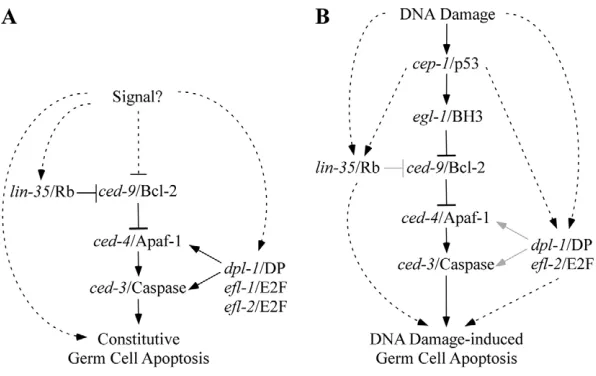
[image:8.612.51.349.60.248.2]The levels of CED-9 BCL2, CED-4 APAF1 and CED-3 caspase control constitutive germ cell apoptosis In contrast to developmental apoptosis, which is determined by the essentially invariant somatic cell lineage and is dependent on the pro-apoptotic gene egl-1BH3-only, constitutive germ cell apoptosis is a stochastic event that is coupled to meiotic cell-cycle progression and which occurs in an egl-1BH3-only-independent manner (Conradt and Horvitz, 1998; Gumienny et al., 1999). We found that the levels of CED-9, CED-4 and CED-3 proteins are critical for constitutive germ cell apoptosis: lowering the dosage of the ced-9 gene increases constitutive germ cell apoptosis, whereas increasing the dosage of ced-9or lowering the dosage of ced-4 and ced-3decreases constitutive germ cell apoptosis. Therefore, the amount of CED-9 protein is a limiting factor in a germ cell’s quest for survival and, conversely, the amounts of CED-4 and CED-3 proteins are limiting factors in a germ cell’s quest for demise. We propose that the combination of lin-35 -dependent repression of ced-9transcription and dpl-1-dependent Fig. 5. Genetic pathways for germ cell apoptosis in C. elegans.(A) The genetic pathway for constitutive germ cell apoptosis. The genes lin-35, dpl-1, efl-2and, most likely, efl-1, promote constitutive germ cell apoptosis by blocking the function of the anti-apoptotic gene ced-9or by enhancing the function of the pro-apoptotic genes ced-4and ced-3, respectively.
Furthermore, a lin-35, dpl-1, efl-1and efl-2-independent pathway most likely acts in parallel to lin-35, dpl-1, efl-1 and efl-2to promote constitutive germ cell apoptosis. Solid lines represent confirmed genetic interactions. (B) The genetic pathway for DNA damage-induced germ cell apoptosis. lin-35, dpl-1and efl-2function
D
E
V
E
LO
P
M
E
N
T
enhancement of ced-4and ced-3transcription ensure that the relative levels of CED-9, CED-4 and CED-3 proteins are such that more than 50% of the germ cells undergo apoptosis. How the pro-apoptotic activities of lin-35and dpl-1are regulated remains to be determined. Furthermore, it remains to be determined whether lin-35and dpl-1are targets of apoptotic signaling pathways that determine the extent of germ cell apoptosis or whether they are components of a general machinery that sets the level of ced-9, ced-3and ced-4mRNAs in the germ line. Finally, because the loss of lin-35and dpl-1,efl-1 orefl-2
function causes a 50% decrease in constitutive germ cell apoptosis, the activities of additional, as yet uncharacterized factors must contribute to the life-versus-death decision within germ cells (Fig. 5A).
The regulation at the transcriptional level of members of the family of pro- and anti-apoptotic BCL2-like protein is a well-established mechanism to control apoptosis (Cory and Adams, 2002). However, at least to our knowledge, the regulation at the transcriptional level of APAF1-like proteins and caspases has so far not been demonstrated to be a physiologically important mechanism for apoptosis regulation (Adams, 2003; Danial and Korsmeyer, 2004). It will be of interest to determine whether the transcriptional regulation of Apaf1-like or caspase genes controls apoptosis in species other than C. elegans.
lin-35RB,dpl-1DP andefl-2E2F are required for DNA damage-induced germ cell apoptosis
lin-35, dpl-1 andefl-2, but not efl-1, are required for DNA damage-induced germ cell apoptosis. Interestingly, in response to DNA damage, the level of ced-9mRNA increases about 2-fold and the levels of ced-4and ced-3mRNAs decrease by about 50% in the germ line of wild-type hermaphrodites (our unpublished observations). Therefore, the transcriptional regulation of ced-9,
ced-4 and ced-3does not appear to be a determinant of DNA damage-induced germ cell apoptosis. Instead, we propose that in response to DNA damage, lin-35, dpl-1 and efl-2 control the expression of different target genes that encode critical determinants of DNA damage-induced germ cell apoptosis (Fig. 5B). Candidate genes are cep-1p53 and egl-1BH3-only, which are required for DNA damage-induced germ cell apoptosis. However, we found that
lin-35,dpl-1and efl-2act downstream of or in parallel to cep-1and
egl-1to cause DNA damage-induced germ cell apoptosis (Fig. 5B). Finally, we have evidence that apart from lin-35 and dpl-1, additional synMuvB genes are required for DNA damage-induced germ cell apoptosis (our unpublished observations). Orthologs of synMuvB proteins in other species have been implicated in chromatin remodeling and transcriptional repression (reviewed by Korenjak and Brehm, 2005; Lipsick, 2004). Therefore, we speculate that in response to DNA damage, LIN-35, DPL-1, EFL-2 and additional synMuvB proteins might assemble to form a transcriptional repressor complex, which represses the transcription of a gene or genes, the product(s) of which can block DNA damage-induced germ cell apoptosis (Fig. 5B).
Implications for the role in apoptosis of
mammalian Rb
Currently, the prevailing model is that mammalian Rbhas anti-apoptotic activity. This model is based on the observation that mice lacking Rbfunction exhibit ectopic apoptosis. However, the fact that ectopic apoptosis in Rb–/–mice is observed only in a limited number of tissues suggests that the role of Rbin apoptosis might be tissue-specific. This notion is supported by observations indicating that mutations in the Rbgene are sufficient to cause pituitary and thyroid
tumors in mice and small-cell lung cancer in humans, and that tumorigenesis in these types of tumors does not appear to depend on the concomitant inactivation by mutation of the apoptotic pathway (Chau and Wang, 2003; Hitchens and Robbins, 2003; Hu et al., 1994; Lipinski and Jacks, 1999; Sherr and McCormick, 2002; Williams et al., 1994). Based on these facts and on our finding that
C. elegans lin-35RB has pro-apoptotic activity in the germ line, we hypothesize that mammalian Rbfunctions to promote apoptosis in certain tissues, such as tissues giving rise to pituitary and thyroid tumors, and small-cell lung cancer. Furthermore, we hypothesize that in these tissues, the pro-apoptotic activity of Rbcontributes to the tumor-suppressing activity of Rb, which so far has mainly been attributed to its anti-proliferative activity. We also speculate that, in analogy to LIN-35 RB, the putative pro-apoptotic activity of the RB protein could be mediated by the transcriptional repression of anti-apoptotic Bcl2-like genes (Cory and Adams, 2002). A comprehensive understanding of the role in apoptosis of mammalian
Rbin different tissues and contexts will almost certainly improve our knowledge of the tumor-suppressing activity of Rband, hence, tumorigenesis in Rb-deficient tumors.
We thank J. Hatzold, E. Lambie, M. Miller and S. Rolland for comments on the manuscript; E. Lambie, T. Schedl and Y. Ahmed for discussions; D. Mayka for excellent technical support; V. Ambros and R. Lee for use of their Opticon DNA Engine; H. R. Horvitz for providing antibodies; A. Fire for plasmids; S. Mitani at the National BioResource Project (Tokyo, Japan) for deletion strains and the C. elegansGenetics Center (CGC, supported by the NIH National Center for Research Resources) for strains. C.S. was the recipient of a Studienstiftung des Deutschen Volkes Predoctoral Fellowship and a Rosaline Borison Memorial Predoctoral Fellowship. This work was supported by NIH grant R01-GM069950.
Supplementary material
Supplementary material for this article is available at http://dev.biologists.org/cgi/content/full/134/20/3691/DC1
References
Adams, J. M.(2003). Ways of dying: multiple pathways to apoptosis. Genes Dev.17, 2481-2495.
Attwooll, C., Lazzerini Denchi, E. and Helin, K.(2004). The E2F family: specific functions and overlapping interests. EMBO J. 23, 4709-4716.
Bender, A. M., Wells, O. and Fay, D. S.(2004). lin-35/Rb and xnp-1/ATR-X function redundantly to control somatic gonad development in C. elegans. Dev. Biol. 273, 335-349.
Boxem, M. and van den Heuvel, S.(2001).lin-35Rb and cki-1 Cip/Kip cooperate in developmental regulation of G1 progression in C. elegans. Development128, 4349-4359.
Brenner, S.(1974). The genetics of Caenorhabditis elegans. Genetics77, 71-94. Brunschwig, K., Wittmann, C., Schnabel, R., Burglin, T. R., Tobler, H. and
Muller, F.(1999). Anterior organization of the Caenorhabditis elegansembryo by the labial-like Hox gene ceh-13. Development126, 1537-1546.
Cardoso, C., Couillault, C., Mignon-Ravix, C., Millet, A., Ewbank, J. J., Fontes, M. and Pujol, N.(2005). XNP-1/ATR-X acts with RB, HP1 and the NuRD complex during larval development in C. elegans. Dev. Biol. 278, 49-59.
Ceol, C. J. and Horvitz, H. R.(2001). dpl-1DP and efl-1E2F act with lin-35Rb to antagonize Ras signaling in C. elegansvulval development. Mol. Cell 7, 461-473. Ceol, C. J. and Horvitz, H. R.(2004). A new class of C. eleganssynMuv genes
implicates a Tip60/NuA4-like HAT complex as a negative regulator of Ras signaling. Dev. Cell6, 563-576.
Chau, B. N. and Wang, J. Y.(2003). Coordinated regulation of life and death by RB. Nat. Rev. Cancer3, 130-138.
Chen, F., Hersh, B. M., Conradt, B., Zhou, Z., Riemer, D., Gruenbaum, Y. and Horvitz, H. R.(2000). Translocation of C. elegans CED-4 to nuclear membranes during programmed cell death. Science287, 1485-1489.
Chesney, M. A., Kidd, A. R., III and Kimble, J.(2006). gon-14functions with class B and C synMuv genes to control larval growth in C. elegans. Genetics172, 915-928.
Chi, W. and Reinke, V.(2006). Promotion of oogenesis and embryogenesis in the C. elegansgonad by EFL-1/DPL-1 (E2F) does not require LIN-35 (pRB). Development 133, 3147-3157.
D
E
V
E
LO
P
M
E
N
T
Clark, D. V., Suleman, D. S., Beckenbach, K. A., Gilchrist, E. J. and Baillie, D. L. (1995). Molecular cloning and characterization of the dpy-20gene of Caenorhabditis elegans. Mol. Gen. Genet.247, 367-378.
Conradt, B. and Horvitz, H. R.(1998). The C. elegansprotein EGL-1 is required for programmed cell death and interacts with the Bcl-2-like protein CED-9. Cell93, 519-529.
Cory, S. and Adams, J. M.(2002). The Bcl2 family: regulators of the cellular life-or-death switch. Nat. Rev. Cancer2, 647-656.
Cui, M., Fay, D. S. and Han, M.(2004). lin-35/Rb cooperates with the SWI/SNF complex to control Caenorhabditis eleganslarval development. Genetics167, 1177-1185.
Cui, M., Chen, J., Myers, T. R., Hwang, B. J., Sternberg, P. W., Greenwald, I. and Han, M.(2006). SynMuv genes redundantly inhibit lin-3/EGF expression to prevent inappropriate vulval induction in C. elegans. Dev. Cell10, 667-672.
Danial, N. N. and Korsmeyer, S. J.(2004). Cell death: critical control points. Cell 116, 205-219.
Derry, W. B., Putzke, A. P. and Rothman, J. H.(2001). Caenorhabditis elegansp53: role in apoptosis, meiosis, and stress resistance. Science294, 591-595.
Dimova, D. K. and Dyson, N. J.(2005). The E2F transcriptional network: old acquaintances with new faces. Oncogene24, 2810-2826.
Eberhard, D. and Busslinger, M.(1999). The partial homeodomain of the transcription factor Pax-5 (BSAP) is an interaction motif for the retinoblastoma and TATA-binding proteins. Cancer Res.59, 1716s-1724s; discussion 1724s-1725s. Edgley, M. L., Baillie, D. L., Riddle, D. L. and Rose, A. M.(1995). Genetic
balancers. Methods Cell Biol. 48, 147-184.
Ellis, R. E., Jacobson, D. M. and Horvitz, H. R.(1991). Genes required for the engulfment of cell corpses during programmed cell death in Caenorhabditis elegans. Genetics129, 79-94.
Fay, D. S., Keenan, S. and Han, M.(2002). fzr-1and lin-35/Rb function redundantly to control cell proliferation in C. elegansas revealed by a nonbiased synthetic screen. Genes Dev.16, 503-517.
Fay, D. S., Large, E., Han, M. and Darland, M.(2003). lin-35/Rb and ubc-18, an E2 ubiquitin-conjugating enzyme, function redundantly to control pharyngeal morphogenesis in C. elegans. Development130, 3319-3330.
Fay, D. S., Qiu, X., Large, E., Smith, C. P., Mango, S. and Johanson, B. L.(2004). The coordinate regulation of pharyngeal development in C. elegansby lin-35/Rb, pha-1, and ubc-18. Dev. Biol. 271, 11-25.
Ferguson, E. L. and Horvitz, H. R.(1989). The multivulva phenotype of certain Caenorhabditis elegansmutants results from defects in two functionally redundant pathways. Genetics123, 109-121.
Finney, M., Ruvkun, G. and Horvitz, H. R.(1988). The C. eleganscell lineage and differentiation gene unc-86encodes a protein with a homeodomain and extended similarity to transcription factors. Cell55, 757-769.
Gartner, A., Milstein, S., Ahmed, S., Hodgkin, J. and Hengartner, M. O.(2000). A conserved checkpoint pathway mediates DNA damage–induced apoptosis and cell cycle arrest in C. elegans. Mol. Cell 5, 435-443.
Gumienny, T. L., Lambie, E., Hartwieg, E., Horvitz, H. R. and Hengartner, M. O. (1999). Genetic control of programmed cell death in the Caenorhabditis elegans hermaphrodite germline. Development126, 1011-1022.
Hall, D. H., Winfrey, V. P., Blaeuer, G., Hoffman, L. H., Furuta, T., Rose, K. L., Hobert, O. and Greenstein, D.(1999). Ultrastructural features of the adult hermaphrodite gonad of Caenorhabditis elegans: relations between the germ line and soma. Dev. Biol. 212, 101-123.
Hengartner, M. O., Ellis, R. E. and Horvitz, H. R.(1992). Caenorhabditis elegans gene ced-9protects cells from programmed cell death. Nature356, 494-499. Hengartner, M. O. and Horvitz, H. R.(1994). C. eleganscell survival gene ced-9
encodes a functional homolog of the mammalian proto-oncogene bcl-2. Cell76, 665-676.
Hitchens, M. R. and Robbins, P. D.(2003). The role of the transcription factor DP in apoptosis. Apoptosis8, 461-468.
Hofmann, E. R., Milstein, S., Boulton, S. J., Ye, M., Hofmann, J. J., Stergiou, L., Gartner, A., Vidal, M. and Hengartner, M. O.(2002). Caenorhabditis elegans HUS-1 is a DNA damage checkpoint protein required for genome stability and EGL-1-mediated apoptosis.Curr. Biol. 12, 1908-1918.
Horvitz, H. R.(2003). Nobel lecture. Worms, life and death. Biosci. Rep.23, 239-303.
Hsieh, J., Liu, J., Kostas, S. A., Chang, C., Sternberg, P. W. and Fire, A.(1999). The RING finger/B-box factor TAM-1 and a retinoblastoma-like protein LIN-35 modulate context-dependent gene silencing in Caenorhabditis elegans. Genes Dev. 13, 2958-2970.
Hu, N., Gutsmann, A., Herbert, D. C., Bradley, A., Lee, W. H. and Lee, E. Y. (1994). Heterozygous Rb-1 delta 20/+mice are predisposed to tumors of the pituitary gland with a nearly complete penetrance. Oncogene9, 1021-1027. Korenjak, M. and Brehm, A.(2005). E2F-Rb complexes regulating transcription of
genes important for differentiation and development. Curr. Opin. Genet. Dev. 15, 520-527.
Kramer, J. M., French, R. P., Park, E. C. and Johnson, J. J.(1990). The
Caenorhabditis elegans rol-6gene, which interacts with the sqt-1collagen gene to determine organismal morphology, encodes a collagen. Mol. Cell. Biol. 10, 2081-2089.
Lettre, G. and Hengartner, M. O.(2006). Developmental apoptosis in C. elegans: a complex CEDnario. Nat. Rev. Mol. Cell Biol.7, 97-108.
Lipinski, M. M. and Jacks, T.(1999). The retinoblastoma gene family in differentiation and development. Oncogene18, 7873-7882.
Lipinski, M. M., Macleod, K. F., Williams, B. O., Mullaney, T. L., Crowley, D. and Jacks, T.(2001). Cell-autonomous and non-cell-autonomous functions of the Rb tumor suppressor in developing central nervous system. EMBO J. 20, 3402-3413.
Lipsick, J. S.(2004). synMuv verite – Myb comes into focus. Genes Dev.18, 2837-2844.
Liu, H., Dibling, B., Spike, B., Dirlam, A. and Macleod, K.(2004). New roles for the RB tumor suppressor protein. Curr. Opin. Genet. Dev. 14, 55-64.
Livak, K. J. and Schmittgen, T. D.(2001). Analysis of relative gene expression data using real-time quantitative PCR and the 2(–Delta Delta C(T)) method. Methods25, 402-408.
Logan, N., Graham, A., Zhao, X., Fisher, R., Maiti, B., Leone, G. and La Thangue, N. B.(2005). E2F-8: an E2F family member with a similar organization of DNA-binding domains to E2F-7. Oncogene24, 5000-5004.
Lu, X. and Horvitz, H. R.(1998). lin-35and lin-53, two genes that antagonize a C. elegansRas pathway, encode proteins similar to Rb and its binding protein RbAp48. Cell95, 981-991.
Macaluso, M., Montanari, M. and Giordano, A.(2006). Rb family proteins as modulators of gene expression and new aspects regarding the interaction with chromatin remodeling enzymes. Oncogene25, 5263-5267.
Macleod, K.(1999). pRb and E2f-1 in mouse development and tumorigenesis. Curr. Opin. Genet. Dev. 9, 31-39.
Maiti, B., Li, J., de Bruin, A., Gordon, F., Timmers, C., Opavsky, R., Patil, K., Tuttle, J., Cleghorn, W. and Leone, G.(2005). Cloning and characterization of mouse E2F8, a novel mammalian E2F family member capable of blocking cellular proliferation. J. Biol. Chem.280, 18211-18220.
Milton, A., Luoto, K., Ingram, L., Munro, S., Logan, N., Graham, A. L., Brummelkamp, T. R., Hijmans, E. M., Bernards, R. and La Thangue, N. B. (2006). A functionally distinct member of the DP family of E2F subunits. Oncogene 25, 3212-3218.
Moon, N. S., Frolov, M. V., Kwon, E. J., Di Stefano, L., Dimova, D. K., Morris, E. J., Taylor-Harding, B., White, K. and Dyson, N. J.(2005). Drosophila E2F1 has context-specific pro- and antiapoptotic properties during development. Dev. Cell9, 463-475.
Myers, T. R. and Greenwald, I.(2005). lin-35Rb acts in the major hypodermis to oppose ras-mediated vulval induction in C. elegans. Dev. Cell8, 117-123. Page, B. D., Guedes, S., Waring, D. and Priess, J. R.(2001). The C. elegans
E2F-and DP-related proteins are required for embryonic asymmetry E2F-and negatively regulate Ras/MAPK signaling. Mol. Cell 7, 451-460.
Park, D., Jia, H., Rajakumar, V. and Chamberlin, H. M.(2006). Pax2/5/8 proteins promote cell survival in C. elegans. Development133, 4193-4202.
Reddien, P. W., Andersen, E. C., Huang, M. C. and Horvitz, H. R.(2007). DPL-1 DP, LIN-35 Rb and EFL-1 E2F act with the MCD-1 zinc-finger protein to promote programmed cell death in Caenorhabditis elegans. Genetics175, 1719-1733. Reinke, V., Gil, I. S., Ward, S. and Kazmer, K.(2004). Genome-wide
germline-enriched and sex-biased expression profiles in Caenorhabditis elegans. Development 131, 311-323.
Riddle, D. L.(1997). C. elegans II. Cold Spring Harbor: Cold Spring Harbor Laboratory Press.
Sato, H., Wang, D. and Kudo, A.(2001). Dissociation of Pax-5 from KI and KII sites during kappa-chain gene rearrangement correlates with its association with the underphosphorylated form of retinoblastoma. J. Immunol. 166, 6704-6710. Schumacher, B., Hofmann, K., Boulton, S. and Gartner, A.(2001). The C. elegans
homolog of the p53 tumor suppressor is required for DNA damage-induced apoptosis.Curr. Biol. 11, 1722-1727.
Schumacher, B., Schertel, C., Wittenburg, N., Tuck, S., Mitani, S., Gartner, A., Conradt, B. and Shaham, S.(2005). C. elegans ced-13can promote apoptosis and is induced in response to DNA damage. Cell Death Differ.12, 153-161. Sellers, W. R., Novitch, B. G., Miyake, S., Heith, A., Otterson, G. A., Kaye, F. J.,
Lassar, A. B. and Kaelin, W. G., Jr(1998). Stable binding to E2F is not required for the retinoblastoma protein to activate transcription, promote differentiation, and suppress tumor cell growth. Genes Dev.12, 95-106.
Sherr, C. J. and McCormick, F.(2002). The RB and p53 pathways in cancer. Cancer Cell2, 103-112.
Simmer, F., Tijsterman, M., Parrish, S., Koushika, S. P., Nonet, M. L., Fire, A., Ahringer, J. and Plasterk, R. H.(2002). Loss of the putative RNA-directed RNA polymerase RRF-3 makes C. eleganshypersensitive to RNAi.Curr. Biol. 12, 1317-1319.
Simmer, F., Moorman, C., van der Linden, A. M., Kuijk, E., van den Berghe, P. V., Kamath, R. S., Fraser, A. G., Ahringer, J. and Plasterk, R. H.(2003). Genome-wide RNAi of C. elegansusing the hypersensitive rrf-3strain reveals novel gene functions. PLoS Biol. 1, E12.
Stevaux, O. and Dyson, N. J.(2002). A revised picture of the E2F transcriptional network and RB function.Curr. Opin Cell Biol. 14, 684-691.
Sulston, J.(1988). Cell lineage. In The Nematode Caenorhabditis elegans(ed. W. B. Wood and the Community of C. elegans Researchers), pp. 123-155. Cold Spring Harbor: Cold Spring Harbor Laboratory Press.
Sulston, J. E. and Horvitz, H. R.(1977). Post-embryonic cell lineages of the nematode, Caenorhabditis elegans. Dev. Biol. 56, 110-156.