SRC Technical Note
1999 - 001
June 22, 1999
The Vesta Approach to
Software Configuration Management
Allan Heydon, Roy Levin, Timothy Mann, and Yuan Yu
Systems Research Center 130 Lytton Avenue Palo Alto, California 94301
http://www.research.digital.com/SRC/
Abstract
Vesta is a system for software configuration management. It stores collections of source files, keeps track of which versions of which files go together, and automates the pro-cess of building a complete software artifact from its com-ponent pieces. Vesta’s novel approach gives it three im-portant properties not available in other systems. First, every build is repeatable, because its component sources and build tools are stored immutably and immortally, and its configuration description completely describes what components and tools are used and how they are put to-gether. Second, every build is incremental, because re-sults of previous builds are cached and reused. Third, ev-ery build is consistent, because all build dependencies are automatically captured and recorded, so that a cached re-sult from a previous build is reused only when doing so is certain to be correct. In addition, Vesta’s flexible language for writing configuration descriptions makes it easy to de-scribe large software configurations in a modular fashion and to create variant configurations by customizing build parameters. This paper describes Vesta’s advantages over traditional tools, how those benefits are achieved, and the system’s overall performance.
1
Introduction
This paper describes Vesta, a software configuration man-agement (SCM) system for managing and building soft-ware, from small systems to very large ones (tens of mil-lions of lines of source code). Vesta addresses the follow-ing four core SCM problems:
Version management. Version management is the pro-cess of assigning names (typically sequential numbers) to a series of related source files and supporting retrieval of those files by name. Machine generated, or derived files, are also versioned by some SCM systems.
Source control. Source control is the process of control-ling or regulating the production of new versions of source files. Operations commonly associated with source con-trol include checkout and checkin, which respectively re-serve a new version and supply the data for a previously reserved version. Source control may be coupled with concurrency control as well, so that checking out a par-ticular version limits the ability of other users to check out related versions.
System modeling. A system model is both a static de-scription of a system’s configuration and a recipe for pro-ducing a software artifact. It names the (versions of) software components that are to be combined to produce larger components or entire systems, names the tools that are to be used to combine them, and specifies how the
tools are to be applied. System models are also sometimes called configuration descriptions.
Building. Building is the process of evaluating a system model so as to construct a complete system according to the model’s instructions. Building may also include other activities, such as running regression tests on the resulting artifact.
Version management, source control, system modeling, and building are four parts of the larger SCM problem. Considered broadly, SCM is often taken to include such areas as process management, software life-cycle man-agement (e.g., bug tracking, testing), and even the specific tools used to develop and evolve software components. We hold the view that these aspects of SCM, although im-portant to the overall software development process, are secondary to the core issues listed above. We have there-fore focused the Vesta project on solving those core prob-lems, constructing a solid base upon which we believe so-lutions to the other problems can be built.
Some form of SCM is almost always a necessary part of software development. SCM is useful whenever multi-ple source files, multimulti-ple developers, or multimulti-ple releases and/or target platforms are involved. Moreover, the larger the number of source files, developers, or releases, the larger the configuration management problem.
A good SCM system can greatly reduce these prob-lems. Version management can ease the problem of man-aging multiple source files by keeping related versions of files together. Source control can help multiple developers work productively in parallel. Together, system modeling and building can help manage multiple releases by accu-rately selecting the right sources to use for each release and by automatically managing derived files.
However, several difficulties stand in the way of de-signing and implementing an SCM system that addresses these problems. First, handling large-scale software is dif-ficult, because it usually involves large numbers of source files and developers. Unlike other SCM systems in use to-day, Vesta was specifically designed to handle very large projects—millions of lines of code and beyond. The rapid growth of today’s software makes this an even more press-ing problem. Second, with larger numbers of develop-ers comes the need to support parallel development across sites that are often geographically separated, which intro-duces the problem of keeping replicated copies consistent. Finally, for building to be efficient, it must work incre-mentally, re-using the results of previous builds whenever possible. However, when multiple versions, multiple tar-get platforms, and multiple releases are involved, sound incremental building is a non-trivial problem.
approach, focusing on the main ideas in the Vesta system and the benefits they provide. In Section 4, we then de-scribe how those ideas are realized in practice, with an emphasis on the user’s view of the system. Finally, we describe the performance of our Vesta prototype in Sec-tion 5, and in SecSec-tion 6, we offer our conclusions from our experiences using the system.
2
Previous Approaches
In this section, we review related work by assessing sev-eral popular SCM systems. Some systems, like the Re-vision Control System (RCS) and the Concurrent Ver-sion System (CVS) address only verVer-sion management and source control, while others like Make address only sys-tem modeling and building. We also consider Clear-CASE, which provides a more integrated solution to the core SCM problems.
2.1
RCS and CVS
RCS is a system for maintaining multiple versions of in-dividual files [10, 11]. Its main strengths are that it is easy to use, well-understood, and well-documented. Its main disadvantages are two. First, it does not provide transpar-ent access to individual file versions. That is, an explicit checkout step is required to access an older version of a file. Hence, to build an older version of a system, the developer must first explicitly check out the correct ver-sions of each source file required by the build. Second, sources are versioned at the granularity of individual files. Although RCS provides tagging facilities for grouping re-lated files, those facilities are awkward to use.
Like RCS, CVS is relatively easy to use and well-supported [4]. It also suffers RCS’s problem of not al-lowing transparent access to file versions. However, un-like RCS, CVS allows related files to be grouped to-gether into modules. CVS also includes an optimistic concurrency control methodology that allows multiple de-velopers to work on the same file concurrently. How-ever, allowing concurrent modifications is not without its costs, since conflicting edits must be detected and re-solved. CVS’s conflict detection is simple-minded (i.e., purely line based), so semantic conflicts between changes in disjoint lines may go undetected. When conflicts oc-cur, they must be resolved manually, which can be a time-consuming process.
2.2
Make
Make is a widely-used tool for building software [2]. It is easy to use and the syntax of its system models (i.e., Makefiles) is simple, if somewhat cryptic. Moreover,
Make can also be used for tasks other than building soft-ware, such as running regression tests.
However, there are several major problems with the Make approach to software construction. In this approach, dependencies between derived files and the inputs used to produce them must be specified explicitly by the user, and Make relies on timestamps to decide when it is safe to re-use a derived file in a subsequent build. A build based on incorrect dependency information or incorrect timestamps can produce an inconsistent result, in which parts of the resulting system incorrectly include stale derived files. In-consistent builds can produce programs that fail to link or run, or that exhibit bizarre, unexplainable bugs. Devel-opers often must resort to performing a scratch build to correct such problems.
Inconsistent builds are not uncommon in Make. Speci-fying dependencies explicitly is an inherently error-prone task. There are tools such as makedepend for generating certain kinds of dependencies automatically, but again, such tools must be run by hand, so they may not be run as often as necessary. Another problem is that some de-pendencies are inexpressible or too costly to express. For example, dependencies on the values of environment vari-ables cannot be expressed in Make, and dependencies on the Makefile itself are too costly because they would re-sult in a scratch build whenever the Makefile was changed. Make’s use of timestamps is also problematic [3]. For ex-ample, when building a system from older sources, Make may incorrectly conclude that the system is up-to-date be-cause the timestamps associated with the older file ver-sions are in the past; again, a scratch build is often the developer’s only recourse in such situations.
Finally, Make scales poorly. Make does its dependency analysis from the leaves of the “build tree”, working its way up to the final result. Hence, the cost of an incre-mental build in Make is proportional to the total num-ber of sources contributing to the build, not the numnum-ber of sources that have changed. Moreover, although it is possible to structure a software system hierarchically by arranging for Make to invoke itself recursively on sub-components, doing so is awkward and performs poorly, so it is not frequently done in practice.
2.3
ClearCASE
from a different build.
ClearCASE is a commercial SCM system that inte-grates version management with building, and that ad-dresses many of Make’s shortcomings [1]. It is based on many of the ideas in the earlier DOMAIN Software Engi-neering Environment (DSEE) system [8, 7].
Unlike RCS and CVS, ClearCASE provides transpar-ent access to older file versions. However, older versions are almost never accessed directly in practice. Instead, a ClearCASE view is used to transparently map an unver-sioned file name to a verunver-sioned one. The rules governing a view can be specified in a variety of ways, and they in-clude provisions for always accessing the latest version of a file.
For building, ClearCASE provides its own version of Make called clearmake. The advantage to this approach is that developers do not have to learn a new system mod-eling language, and their existing Makefiles continue to work. Unlike Make, clearmake does automatic (although somewhat incomplete) dependency detection by monitor-ing and recordmonitor-ing the files accessed durmonitor-ing a build. It also manages derived files for potential later re-use.
There are several problems with ClearCASE. The prob-lem with the view approach to version management is that the meaning of a name can change over time. In partic-ular, the actions taken by someone else can cause one’s own build to suddenly fail. This shortcoming is an im-pediment to effective parallel development. There are also problems with the clearmake builder. First , because clear-make is Make-based, it suffers from the same scalability problems as Make. Second, because its dependency de-tection is incomplete, clearmake can produce inconsistent builds. Third, clearmake’s mechanism for allowing de-velopers to re-use the derived files produced by others — called winking in — is based on heuristics that can fail to capitalize on valid re-use opportunities. Finally, anec-dotal evidence suggests that the overheads introduced by clearmake are large, so some development organizations choose to use ordinary Make for improved performance, despite Make’s shortcomings.
3
The Vesta Approach
As described earlier, Vesta’s goals are to address the core SCM problems of version management, source control, system modeling, and building. It provides a firm tech-nical base on which solutions to the other SCM problems can be built. Vesta is also explicitly designed to scale up to large code bases, which means it must also effectively support parallel development. Of course, it must be an open system that works with standard development tools. Finally, it must perform well and be easy to use.
The Vesta approach is based on the following founda-tions:
• Immutable, immortal, and versioned storage of all
sources and tools. Unlike ClearCASE, Vesta uses ex-plicit version numbers rather than views.
• Complete, source-based configuration descriptions.
By complete we mean that the descriptions name all elements contributing to a build, and no build de-pends on any aspect of the computing environment (e.g., tools, libraries, header files, environment vari-ables) outside of Vesta’s control1. By source-based we mean that configuration descriptions describe how to build a system from scratch from sources (i.e., non-derived files). Hence, the descriptions do not rely on templates, search paths, or other rules for their meaning and function.
• Automatic dependency detection. All dependencies are detected and recorded automatically by the Vesta builder, so no dependency errors can be introduced by human error2.
• Automatic derived file management. The storage and naming of derived files is managed automatically by the Vesta storage repository, thereby easing the bur-den of building multiple releases or building for mul-tiple target platforms.
• Site-wide caching of all build work. Vesta features a shared site-wide cache of build results so developers can benefit from each others’ builds.
At this point, the reader may well be wondering what it is like to use Vesta in practice. How can any sources be edited if all sources are stored immutably? If system mod-els must name the version of every source file, isn’t the overhead of maintaining those references overwhelming? We address these questions and other practical aspects of using Vesta in Section 4 below.
We first point out that these foundations provide several valuable benefits:
Repeatable builds. The immutability and immortality of sources combined with the completeness of build descrip-tions together mean that every Vesta build is repeatable. That is, any build performed in the past can be exactly reproduced at any time in the future.
1Ultimately, of course, every build is dependent on the operating
sys-tem on which it is performed. Build descriptions include a user-supplied name for the build platform, but Vesta does not check if the supplied name is accurate.
2Of course, it is possible in principle to write tools that depend on
Incremental builds. Although the system models de-scribe how to build a software system from scratch, the Vesta builder uses the site-wide cache of previous builds to avoid work, so good incremental build performance is the norm. The time required to perform an incremental build is generally proportional to the amount of work to be done, not to the size of the system being built.
Consistent builds. Because every build is conceptually performed from scratch, and because Vesta’s automatic dependency detection means that a cached result is used only when it is correct to do so, all Vesta builds are guar-anteed to produce consistent results. Hence, there is never any need to do “nightly” or scratch builds to correct for an errant build in which a stale derived file was used.
Parallel development. Several features of the Vesta sys-tem enable parallel development. For one, the Vesta repository supports version branching and partial replica-tion across geographically distributed sites. But perhaps more important is the fact that a user must take explicit ac-tion to build with a newer version of someone else’s code. Hence, it is impossible for one developer’s action to break another’s build. This feature allows developers to work productively in isolation.
The entire Vesta system was designed and implemented with an eye toward scalability. Our design goal was to support systems containing 20 million lines of code or more. This emphasis is visible in several respects. To organize the construction of large-scale software, system models can be arranged as a modular hierarchy. Dur-ing a build, cachDur-ing is done top-down rather than bottom up. Hence, cache hits often occur on larger units of work than individual tool invocations, such as the construction of an entire library or collection of libraries. This top-down caching avoids the scalability problem of incremen-tal builds suffered by Make. Finally, because each user’s checked out files are managed by the repository, the repos-itory can arrange to make checkout and checkin almost instantaneous, thereby eliminating one of the burdens of working with large source trees.
4
A User’s View of Vesta
The discussion so far has been fairly abstract. In this sec-tion, we provide a user’s view of Vesta to make the ideas more concrete. We start by describing Vesta’s compo-nents. We then consider Vesta’s source control tools and their effects on the repository. Finally, we present some sample system models to give a sense for Vesta’s system modeling language.
4.1
Vesta Components
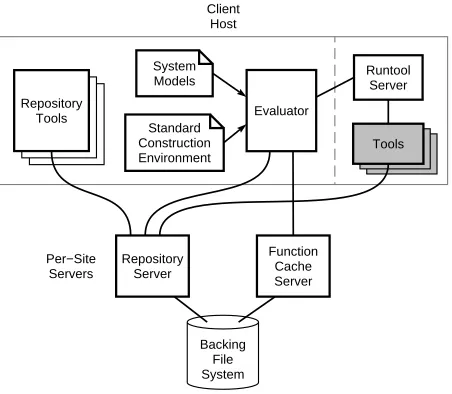
Figure 1 shows the main components of the Vesta system. The bottom half of the figure shows the repository and
function cache servers. One instance of each server is run
at each site. The repository server manages the storage of both sources and derived files. It provides both a stan-dard NFS interface to sources, and a remote procedure call (RPC) interface that is used by other Vesta tools. The function cache server stores the results of previous builds. Both servers use a normal file system for backing storage.
System Models
Standard Construction Environment
Evaluator
Runtool Server
Tools
Repository Server
Function Cache Server
Backing File System Repository
Tools
Client Host
[image:5.612.314.540.211.408.2]Per−Site Servers
Figure 1:Vesta’s main components.
The top half of Figure 1 shows the Vesta components run on each client host. The main client programs are the repository tools and the evaluator. The repository tools provide checkout, checkin, and other source con-trol operations. The evaluator is the Vesta builder. It reads user-written system models and a set of system-supplied models comprising the standard construction
en-vironment. Not shown in the figure are standard
develop-ment tools such as text editors and the like, which can be used to access sources via the repository’s NFS interface in the usual way.
During a build, the evaluator will often be called on to run an external tool like a compiler or linker. To do so, the evaluator makes a remote procedure call to a runtool
server process. As indicated by the dashed line in the
fig-ure, the runtool server may or may not be running on the same client host as the evaluator. Decoupling the runtool server from the evaluator allows tools to be invoked on different machine platforms (e.g, for cross development), or even for multiple clients to use the same runtool server running on a more powerful machine.
direc-tory tree in which the tool will be run. The runtool server then launches the tool in an encapsulated environment that causes all of the tool’s file references to go to this tree, where they are trapped and reported back to the evaluator. The evaluator records these references as dependencies.
During the build, the evaluator also contacts the func-tion cache server to determine if each piece of the build it is about to execute has been performed before (either by the same person or someone else). If so (a cache hit), the function cache returns the correct result. If not (a cache
miss), the evaluator performs the work and then calls the
cache to create a new cache entry for possible re-use in the future.
Figure 1 omits several administrative tools. Among these is a tool called the weeder that is used to delete unwanted derived files from the repository and unwanted cache entries from the function cache. The weeder reads a description file that says which build versions should be kept; it then uses a mark-and-sweep garbage collection al-gorithm to identify all derived files and cache entries that are safe to delete. The description file uses a simple but powerful pattern language; such rules as “keep builds of the last two versions” are easily expressed.
Parameterizing the weeder with an explicit instruction file gives each organization the flexibility to keep the builds it considers important. Of course, deciding what to weed is simply a time-space tradeoff. Even if a use-ful build is accidentally left out of the weeder instructions and deleted, Vesta’s repeatability guarantees that it can be reproduced, albeit more slowly, and re-cached.
4.2
Repository Operations
The Vesta repository is a general-purpose file system with special support for immutability. As mentioned earlier, it exports both an NFS interface (with some minor restric-tions) and an RPC interface. The repository also manages a site-wide pool of derived files.
The repository’s main job is to provide directory trees; the files themselves are stored in a normal Unix file sys-tem. In particular, the repository supports three kinds of directories: mutable, immutable, and appendable. The purposes of these three directory types will become ap-parent momentarily.
It is worth noting that the repository naming conven-tions we describe next are imposed not by the reposi-tory server, but by the much smaller client-side reposireposi-tory tools. This separation of concerns is important because it means that different source control paradigms (such as a more concurrent paradigm like that of CVS) could be implemented simply by rewriting the repository tools; changes to the repository proper would not be required.
Figure 2 illustrates several aspects of the naming
con-/vesta/src.dec.com
common cxx vesta
text thread table
1 2
2.fast
3 4
0 1 2
thread.c thread.h
build.ves
= Immutable = Appendable = Stub
repos eval
doc
Figure 2: Naming conventions assumed by the Vesta repository tools.
ventions engendered by our current repository tools:
• Related sources are grouped into arbitrary directory trees called packages. Versioning is done at the pack-age granularity. As shown in version 3 of the com-mon/threadpackage, each package version may contain arbitrary files and nested directories.
• To accommodate large-scale software, the package namespace is hierarchical. For example, the pack-ages of Figure 2 are arranged in a two-level hier-archy, with package names likecommon/thread andvesta/repos.
• Version numbers appear as explicit pathname arcs. For example, version 3 of the common/thread package is namedcommon/thread/3.
• The root directory of each package version is im-mutable. Hence, the contents of a package ver-sion cannot be changed. The directories that form the package hierarchy, such as commonand com-mon/thread, are appendable. The only operation allowed on such directories is the insertion of new items, such as new packages or package versions.
• Branches are like sub-packages. Hence, all the op-erations on packages apply to branches as well. In Figure 2, the branch common/thread/2.fast has three versions named 0, 1, and 2, the for-mer of which will typically be a copy of com-mon/thread/2.
= Immutable = Appendable = Stub = Mutable
/vesta/src.dec.com
common
thread
checkout
2 3
2 3
0 1 2 0 1 2
/vesta−work
jones
[image:7.612.313.540.72.243.2]thread
Figure 3:The checkout session of thecommon/thread
package.
while the one rooted at/vesta-workis mutable. There is a mutable directory in/vesta-workfor each user, and edits are performed in subtrees of those directories.
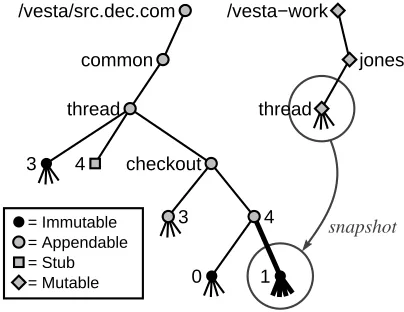
In addition to version directories and branch direc-tories, each package also contains a directory named checkout. This directory contains an appendable di-rectory for each checkout session, each of which contains a separate, immutable snapshot of a package version each time the package is built. Hence, Vesta keeps a version of each package not only across checkout sessions, but dur-ing checkout sessions as well.
The typical development cycle is as follows.
• Check out the package using vcheckout • Modify the package:
– Edit using your favorite text editor – Advance the package using vadvance – Build the package using vesta – Test
– Repeat as necessary
• Check in the package using vcheckin
The outer level consists of three steps: check out the package using vcheckout, modify it, and check it back in using vcheckin. The inner loop of the development cycle is the familiar edit-compile-test loop, but with an extra wrinkle. Recall that Vesta’s repeatability guarantee requires that all builds are performed against immutable sources. Therefore, before invoking the vesta builder, an immutable copy of the user’s current sources must first be made using a tool called vadvance3. We now describe these tools and their effect on the repository.
3Since vadvance and vesta are usually run together, we provide a
simple vmake script that runs them in sequence as a single command.
vadvance can also be used independently as a means of checkpointing a
user’s current sources.
4
4
0 thread
copy
copy = Immutable
= Appendable = Stub = Mutable
/vesta/src.dec.com
common
thread
checkout 3
3
1
2 3
/vesta−work
jones
Figure 4:The effects of vcheckout common/thread.
snapshot
1
= Immutable = Appendable = Stub = Mutable
/vesta/src.dec.com
common
thread
checkout 3
3
/vesta−work
jones
4
4
0
[image:7.612.85.293.75.230.2]thread
Figure 5:The effects of vadvance.
Figure 4 shows the effect of running the command vcheckout common/thread. In this figure and the next two, bold lines denote newly created elements. Assum-ing that the latest version of thecommon/thread pack-age was version 3, this command would first create a spe-cial element called a stub namedcommon/thread/4. The stub reserves a name under which the package will be checked back in; attempting to check out the pack-age again will fail because a stub for version 4 al-ready exists. Next, the new appendable directory com-mon/thread/checkout/4is created, and the latest version of the package is copied into that checkout direc-tory as checkout version 0. Finally, a mutable copy of the package is made in the user’s working directory under /vesta-work.
[image:7.612.323.525.283.439.2]appro-copy
delete
= Immutable = Appendable = Stub = Mutable
thread /vesta/src.dec.com
common
thread
checkout 3
3
/vesta−work
jones
4
4
[image:8.612.87.298.73.229.2]0 1 2 3
Figure 6:The effects of vcheckin.
priate part of the package’s checkout directory. Builds are then performed using these immutable sources.
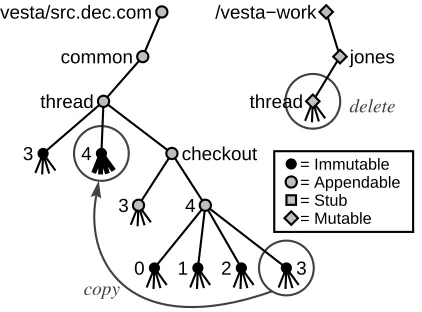
Finally, once the user is satisfied with the state of the package, vcheckin is used to check the package back into the main line of the package version space. As shown in Figure 6, vcheckin replaces the previously created ver-sion stub by the latest sub-verver-sion of the checkout ses-sion, and deletes the user’s working version of the pack-age from/vesta-work.
4.3
System Modeling Language
We now consider typical client system descriptions. A complete discussion of Vesta’s system modeling language is well beyond the scope of this paper, but its complete syntax and semantics are defined in a separate paper [5]. Here, we will try to motivate and describe the language’s main features.
Across different development organizations, there is a rather wide variation in build processes, including the size and scope of the systems being built, the structure and methodology of the organization, and the degree of pa-rameterization required. Vesta therefore supports varied descriptions through a general-purpose language that sup-ports abstraction. Abstraction permits the construction of
extensions that adapt the language to each organization’s
development methodology. As a proof of concept, we have built one fairly comprehensive extension called the
standard construction environment.
The system modeling language itself is a full-fledged functional programming language with a C-like syntax. The functional nature of the language is important, since each function call represents a unit of work appropriate for caching. The language uses strong, dynamic typing, which is to say that the run-time types of arguments to all built-in operations are checked for correctness. The language is methodology neutral. The main aspect of the
files
h = [ date.h ];
c = [ date.c, calendar.c ]; {
libs = < ./C/libc >;
return ./C/program("cal", h, c, libs); }
Figure 7: Abuild.vessystem model for building a sample application.
language that is specialized for software construction is a primitive to run external tools like compilers and linkers in an encapsulated environment (i.e., to invoke the runtool server of Figure 1). The language also includes an im-portstatement that encourages modular build descrip-tions and thereby supports hierarchical system modeling. Figure 7 shows a sample model for building an appli-cation. By convention, the model responsible for building all the components of a package is namedbuild.ves. Thefilesclause binds the program variableshandc to the listed files in the package. The body of the model then binds the variablelibsto a singleton list containing the standard C library, and returns the result of invoking theprogramfunction supplied by the standard environ-ment. It is theprogramfunction that is responsible for compiling the necessary sources and linking the program. Before a model like the one shown in Figure 7 can be invoked, the environment in which the build is performed must be created and bound to the special variable named “.” (dot). The variable “.” is special because it is passed as an implicit argument on all function calls. Hence, assign-ments or changes to “.” are visible in all descendant func-tions of the function call graph. This feature of Vesta’s function call semantics makes it easy to define customiza-tions that affect all relevant parts of a build.
The build environment embodies not only the complete set of functions, tools, libraries, and header files needed by the build, but also any requested build customizations. Such customizations are typically injected “from the out-side”; that is, a developer considers them as parameters of a particular build rather than inherent details of the system being built. It is thus appropriate to include them in the top-level (outermost) system model. Indeed, such models do little more than list parameter values and invoke the build procedure for a package or collection of packages. Such a model can therefore be readily constructed from a graphical “control panel” program in which the user spec-ifies desired customizations. The control panel then writes a (highly stylized) control panel model4. By convention, control panel models are named.main.ves.
4We have not implemented the control panel yet, so we presently
from /vesta/src.dec.com/common import std_env = std_env/23/build.ves; import
calendar = build.ves; {
. = std_env()/env_build("DU4.0");
// build customizations would go here... return calendar();
}
Figure 8:A.main.vescontrol panel model for estab-lishing the build environment.
from /vesta/src.dec.com/millicent import wallet = wallet/12/build.ves;
vendor = vendor/20/build.ves; broker = broker/7/build.ves; {
return wallet() ++ vendor() ++ broker(); }
Figure 9: An umbrella system model for building a col-lection of components and combining their results.
Figure 8 shows an example. The model begins with two imports. One import is of the non-local model com-mon/std env/23/build.ves (bound to the vari-able std env), and the other is of the local model build.ves(bound to the variablecalendar). The model body consists of two statements. The first in-vokes theenv buildfunction returned by thestd env model, and binds the result to the special variable “.”. The second statement then invokes and returns the result of the package’s own build.vesmodel shown in Figure 7. This example shows that a model can be called like a func-tion using the standard funcfunc-tion call syntax.
[image:9.612.312.532.428.609.2]The two examples shown so far also illustrate an im-portant point about the appearance of version numbers in system models. Because sources are versioned at the granularity of packages, and because related sources re-side in the same package, version numbers need be sup-plied only for cross-package imports. For example, in Figure 7, no version numbers are required because the ref-erenced sources reside in the same package as the model from which they are referenced. The local import in Fig-ure 8 requires no version specification for similar reasons. However, an explicit version number is required for the non-local import of thestd env package. The net re-sult is that explicit version numbers are not required in system models as often as might be expected. To further reduce the effort required to maintain such version spec-ifications, Vesta includes a vupdate tool that rewrites a model’s non-local imports to refer to the latest versions of their respective packages.
Figure 9 shows a system model for building what we call an umbrella package. Such packages do not contain any sources or build anything directly. Instead, they im-port a collection of packages, build them, and then com-bine the results together into a single result. Umbrella packages illustrate how to structure build descriptions in a modular fashion. In this example, the umbrella package serves to record the information that versions 12, 20, and 7 of the wallet, vendor, and broker components go together to make one coherent version of the Millicent system.
The examples presented here do not really demonstrate the full power of the Vesta system modeling language, such as the wide variety of build customizations supported by the standard construction environment. The system models that make up the standard environment are rather complicated, but we believe that investment in them by a modeling language “wizard” is more than offset by the re-sulting simplicity in the far more numerous user models.
5
Performance
If Vesta’s performance were significantly worse than that of alternative SCM systems, it would be of little practical interest. We have worked hard to make the system effi-cient. In fact, in this section we show that Vesta’s over-all performance on scratch builds is as good as Make’s, and that Vesta’s caching makes it significantly faster than Make on incremental builds.
Eval
RunTool Server
tool
Repository Server
Function Cache Server
Make tool
NFS Server Client
AlphaStation 500 5/333
Server AlphaStation
400 4/233 AN2 Network
AdvFS File System
Vesta Make
Local Disk
Local Disk
Figure 10: The experimental setup for our performance measurements.
Test Lines Files Tool Runs Pkgs
Hello 10 1 2 1
[image:10.612.80.293.71.122.2]Evaluator 53,304 103 117 11 Release 119,602 255 333 16
Table 1:Characteristics of three build tests.
[image:10.612.329.519.73.121.2]Test Vesta Make Hello 3.3s 3.4s Evaluator 310s 318s Release 912s 960s
Table 2: The elapsed time in seconds required by Vesta and Make to build the three test cases of Table 1 from scratch.
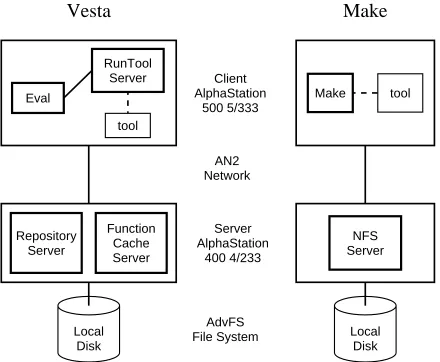
NFS server in the case of Make) were run on a 233MHz AlphaStation 400 4/233 server machine. In both cases, the server processes used the same AdvFS file system residing on a local disk, and the client and server ma-chines communicated via a high-speed ATM network called AN2. All machines were running version 4.0D of Compaq’s Tru64 Unix operating system.
We measured builds of software systems of varying sizes. The characteristics of these systems are shown in Table 1. The columns of this table indicate the total num-ber of lines of source code, the numnum-ber of C/C++ source files to be compiled, the number of tool invocations neces-sary, and the number of packages across which the sources reside.
The Hello test is a simple “hello world” program con-sisting of a single 10-line source file. It requires two tool invocations: one to compile the file, and one to link it. This test is included mainly for purposes of providing a baseline measurement. The Evaluator test consists of building all of the Vesta libraries and the Vesta evaluator application. The sources for this test are contained in 10 library packages and the evaluator package itself. Finally, the Release test consists of building the entire Vesta re-lease. In addition to building the evaluator, this includes building all the Vesta tools, servers, and documentation.
Table 2 shows the elapsed time (in seconds) required by Vesta and Make to perform each of the three test builds from scratch. These data show that scratch Vesta builds are somewhat faster than Make builds, but not appreciably so, since most of the time is spent compiling and linking. To measure the time required to perform incremental builds, we modified one of the source files in each build test and rebuilt. In the case of the Release test, we modi-fied the same evaluator source file as in the Evaluator test. Table 3 shows the elapsed time (in seconds) to perform each incremental build. For Make builds, we report two
Test Vesta Make One Make All
Hello 3.3s 3.4s 3.4s
Evaluator 12.5s 15.1s 23.3s Release 13.1s 15.1s 32.1s
Table 3: The elapsed time in seconds required by Vesta and Make to perform incremental builds of the three test cases of Table 1.
values. The “Make One” column reports the time required to run Make in the single directory containing the modi-fied source file. This is what developers typically do when working on a set of sources. However, if a source in an-other package was modified, the resulting build might be inconsistent. To get closer to a consistent build, the Make user would need to run Make in each of the other direc-tories, or packages, contributing to the build. The “Make All” column reports the elapsed time required to run Make in all such packages. The extra time in the case of the Evaluator and Release tests is the time required by Make to determine that all the other packages were up to date. Note that Vesta provides even stronger consistency guar-antees than the “Make All” approach, yet it is significantly faster, primarily due to top-down caching.
6
Conclusions
Due to space limitations, this paper omits discussion of many technical details. They are described more com-pletely in a separate report [6]. However, we feel it is worth at least mentioning some of the main technical problems we have solved.
Repository. The repository is a general-purpose file sys-tem with support for Vesta-specific features, but making that file system visible via an NFS interface was non-trivial. Also, the repository includes a nice design for partial replication of sources across geographically dis-tributed sites.
Caching. The main challenge in caching (parts of) builds is forming cache entries whose dependencies are as fine-grained as possible. For example, we do not want the compilation of a C file to appear dependent on every header file available in its environment, but only on those actually read when compiling it. This requires some non-trivial dynamic dependency analysis in the Vesta evalua-tor, as well as support for dynamic, fine-grained depen-dencies in the function cache. Also, to make incremental builds fast, the evaluator creates some special cache en-tries to get cheap high-level cache hits.
[image:10.612.126.248.159.211.2]modular build descriptions that can be highly parame-terized. The main challenge was designing a general-purpose language amenable to efficient execution that supported a variety of methodologies and build cus-tomizations.
Overall, Vesta handles the core SCM problems of ver-sion control and building quite well. It provides repeat-able, incremental, and consistent builds. It also sup-ports parallel development through several features, such as branching, explicit versioning, and partial replication. Vesta’s system modeling language is general enough to support different development organizations, and it en-courages modular software descriptions. On small- to medium-sized scratch and incremental builds, Vesta per-forms better than Make, and provides much stronger con-sistency guarantees. Finally, we have found the system easy to use; once we switched over from building the sys-tem with Make to building it with Vesta, we never wanted to go back. The advantages provided by being able to ex-actly name and reproduce any past build are difficult to fully appreciate until they are available.
However, despite these successes, there are still some open questions. The first relates to scalability. Although Vesta was designed to scale to very large software, we have used it to build only medium-sized systems. An ear-lier Vesta prototype saw use by 25 programmers develop-ing a 1.4 million line code base for over a year [9]. We designed the current system to overcome the scaling bot-tlenecks we observed at that time, but we have not yet used the current system to build anything much larger than itself. There is evidence that the system scales to a larger number of users: the Vesta prototype is currently in daily use by about 60 people in a Compaq engineering group. The code base they are developing is expected to exceed 700 thousand lines of code by the time it is complete.
Another question relates to ease of use. Our experi-ences have been positive, but as the developers of the sys-tem, we are obviously biased. The engineering group that is using Vesta has been able to adapt it to their application and development environment by writing a small number of “wrapper scripts” and a domain-specific control panel application. Overall, they have found Vesta to be a signif-icant improvement over their previous version and build management tools.
Finally, for Vesta to be adopted by any organization, some technical and non-technical hurdles must be over-come. Users of other SCM systems need to convert their code bases and descriptions to Vesta, which may require specialized tools that understand their existing develop-ment methodology. Perhaps a more substantial problem is the need to overcome the psychological barrier created by Vesta’s radically different approach to SCM. New users thus require training, not just in a different set of tools,
but in a different way of thinking about the software de-velopment process.
References
[1] Atria Software, Inc., 24 Prime Park Way, Natick, MA 01760. ClearCase Concepts Manual, 1992.
[2] S. I. Feldman. Make — A program for maintaining com-puter programs. Software — Practice and Experience,
9(4):255–265, April 1979.
[3] Glenn Fowler. A case for make. Software — Practice and
Experience, 20(S1):S1/35–S1/46, June 1990.
[4] Dick Grune, Brian Berliner, and Jeff Polk. cvs(1) manual
page. Free Software Foundation.
[5] Allan Heydon, Jim Horning, Roy Levin, Timothy Mann, and Yuan Yu. The Vesta-2 software description language. SRC Technical Note 1997–005c, Digital Equipment Corporation, Systems Research Center, June 1998. http://gatekeeper.dec.com/pub/DEC/SRC/technical– notes/abstracts/src–tn–1997–005c.html.
[6] Allan Heydon, Roy Levin, Timothy Mann, and Yuan Yu. The vesta software configuration management system. In preparation.
[7] David B. Leblang and Robert P. Chase, Jr. Computer-aided software engineering in a distributed workstation environ-ment. SIGPLAN Notices, 19(5):104–112, May 1984. [8] David B. Leblang, Robert P. Chase, Jr., and Gordon D.
McLean, Jr. The DOMAIN software engineering envi-ronment for large-scale software development efforts. In
Proceedings of the 1st International Conference on Com-puter Workstations, pages 266–280, San Jose, CA,
Novem-ber 1985. IEEE Computer Society, IEEE Computer Soci-ety Press. ISBN 0-8186-0649-5, IEEE Catalog Number 85CH2228-5.
[9] Roy Levin and Paul R. McJones. The Vesta ap-proach to precise configuration of large software sys-tems. SRC Research Report 105, Digital Equip-ment Corporation, Systems Research Center, June 1993. http://gatekeeper.dec.com/pub/DEC/SRC/research– reports/abstracts/src–rr–105.html.
[10] W. Tichy. Design, implementation, and evaluation of a revision control system. In Proceedings of the 6th
Interna-tional Conference on Software Engineering, pages 58–67.
IEEE Computer Society Press, 1982.
[11] W. Tichy. RCS — A system for version control. Software