http://www.scirp.org/journal/jcc ISSN Online: 2327-5227
ISSN Print: 2327-5219
Cryptographic Protocols Based on Nielsen
Transformations
Benjamin Fine
1, Anja I. S. Moldenhauer
2, Gerhard Rosenberger
21Department of Mathematics, Fairfield University, Fairfield, CT, USA 2Fachbereich Mathematik, Universität Hamburg, Hamburg, Germany
Abstract
We introduce in this paper cryptographic protocols which use combinatorial group theory. Based on a combinatorial distribution of shares we present secret sharing schemes and cryptosystems using Nielsen transformations. Nielsen transformations are a linear technique to study free groups and general infinite groups. In addition the group of all automorphisms of a free group F, denoted by Aut F
( )
, is generated by a regular Nielsen transformation between two basis of F, and each regular Nielsen transformation between two bases of F defines an automorphism of F.Keywords
Nielsen Transformation, Matrix Group SL
(
2,)
, Secret Sharing Protocol, PrivateKey Cryptosystem, Public Key Cryptosystem
1. Introduction
This paper is located in the area of group based cryptography. A cryptographic protocol consists of the collection of rules, formulas and methods to handle a cryptographic task. In cryptology it is common to call the parties who want to communicate privately with each other Alice and Bob.
The traditional cryptographic protocols, both symmetric key and public key, such as the RSA algorithm, Diffie-Hellman and elliptic curve methods, are number theory based. Hence, from a theoretical point of view, they depend on the structure of abelian groups. Although there have been no successful attacks on the standard protocols, there is a feeling that the strength of computing machinery has made the techniques less secure. As a result of this, there has been an active line of research to develop and analyse new cryptographic protocols, as for example cryptosystems and key exchange
How to cite this paper: Fine, B., Molden-hauer, A.I.S. and Rosenberger, G. (2016) Cryp- tographic Protocols Based on Nielsen Trans- formations. Journal of Computer and Com- munications, 4, 63-107.
http://dx.doi.org/10.4236/jcc.2016.412004
Received: August 14, 2016 Accepted: October 28, 2016 Published: October 31, 2016
Copyright © 2016 by authors and Scientific Research Publishing Inc. This work is licensed under the Creative Commons Attribution International License (CC BY 4.0).
http://creativecommons.org/licenses/by/4.0/
protocols, based on non-commutative cryptographic platforms. Up to this point the main sources for non-commutative platforms have been nonabelian groups. For an overwiev about mathematical cryptography see [1] and especially for a book about non-commutative group based cryptography see [2].
Important along the line of cryptographic protocols are secret sharing protocols. These consist of methods to distribute a secret among a group of users by giving a share of the secret to each. The secret can be recovered only if a sufficient number of users (but perhaps not all) combine their pieces. There are many different motivations for the secret sharing problem. One of the most important is the problem of maintaining sensitive information. There are two crucial issues here: availability and secrecy. If only one person keeps the entire secret, then there is a risk that the person might lose the secret or the person might not be available when the secret is needed. Hence it is often useful to utilize several people in order to access a secret. On the other hand, the more people who can access the secret, the higher the chance the secret will be leaked. By sharing a secret in a threshold scheme the availability and reliability issues can be addressed. The paper by C. Chum, B. Fine and X. Zhang [3] contains a wealth of information on secret sharing schemes in general and managing an access control group.
This paper is organized as follows. We first describe secret sharing protocols and a combinatorial distributions of shares, which are given by D. Panagopoulos in [4]. After introductory definitions we start with a secret sharing scheme using directly the combinatorial distribution of shares. Based on this we present two schemes in which we apply regular Nielsen transformations in connections with faithful representations of free groups and the Nielsen reduction theory. We also modify the secret sharing schemes to a private key cryptosystem and finally Nielsen transformations are used for a public key cryptosystem which is inspired by the ElGamal cryptosystem. The new cryptographic protocols are in the dissertation of A. Moldenhauer [5] under her supervisor G. Rosenb-erger at the University of Hamburg. Thus, parts of this paper are from [5].
2. Preliminaries for the Newly Developed Cryptographic
Protocols
A
( )
n t, -secret sharing protocol, with n t, ∈ and t≤n, is a method to distribute asecret among a group of n participants in such a way that it can be recovered only if at least t of them combine their shares. Hence any group of t−1 or fewer participants
cannot calculate the secret. The number t is called threshold. The person who distrib- utes the shares is called dealer.
One of the first
( )
n t, -secret sharing schemes is introduced by A. Shamir in [6]. Ithas become the standard method for solving the
( )
n t, -secret sharing problem.A. Shamir uses polynomial interpolation for his
( )
n t, -secret sharing scheme. Let be any field and let
(
x y1, 1) (
, x y2, 2)
,,(
x yt, t)
be t points in2
( )
i ig x =y, 1≤ ≤i t. A. Shamir’s secret sharing scheme is based on the following
theorem.
Theorem 1. [7]
Let be any field and let x x1, 2,,xt be t pairwise distinct elements of and let
1, 2, , t
y y y be any elements of . Then there exists a unique polynomial of degree less than or equal to t−1 that interpolates the t points
(
x yi, i)
, 1≤ ≤i t.A. Shamir’s
( )
n t, -secret sharing scheme is roughly this: The dealer chooses a field. The secret S is an element in . The dealer picks a polynomial g x
( )
of degree1
t− with the secret S as constant term, that is,
( )
2 11 2 1
t t
g x = +S a x+a x ++a−x− ,
i
a ∈ and at−1≠0. He chooses pairwise distinct elements x x1, 2,,xn∈, with
0
i
x ≠ for all 1≤ ≤i n and distributes to each of the n participants a point
( )
(
x g xi, i)
as a share. By Theorem 1 any t participants can determine the polynomial( )
g x (for example with Lagrange interpolation, see [7]) and hence recover the secret S. If less than t people combine their shares any element in can be the constant term and hence the secret. A. Shamir suggested to use = p= p where p is a large prime number.
D. Panagopoulos presents in his paper [4] a
( )
n t, -secret sharing scheme usinggroup presentations with solvable word problem. For the secret sharing schemes in the following sections we use a combinatorial distribution of the shares, which is explained in the paper of D. Panagopoulos.
Share distribution method explained by D. Panagopoulos.
To distribute the shares in a
( )
n t, -secret sharing scheme the dealer does the follo-wing steps: 1) Calculate
1
n m
t
= −
, the number of all elements, for example
{
a a1, 2,,am}
,the participants need to know for the reconstruction of the secret.
2) Let A A1, 2,,Am be an enumeration of the subsets of
{
1, 2,,n}
with t−1 elements. Define n subsets R R1, 2,,Rn of the set{
a a1, 2,,am}
with the property.for 1, 2, , and 1, 2, , .
j i j
a ∈R ⇔ ∈i / A j= m i= n (1) 3) The dealer distributes to each of the n participants one of the sets R R1, 2,,Rn. In addition to this share distribution method the new protocols in this paper are based on combinatorial group theory and Nielsen transformations. Therefore, we review some basic definitions concerning regular Nielsen transformations and Nielsen reduced sets (see [8] or [9]).
Combinatorial group theory is the branch of algebra which studies groups with the help of group presentations. A group presentation for a group G consists of a set X of generators and a set R of defining relators on X. We write.
| .
G= X R
group F is the set of all reduced words in 1
X± , which is defined as
{
}
1 1 1 1
1, 1 , 2, 2 , , q, q
X± = x x− x x− x x− , where a word is called reduced if it does not contain
subwords of the form 1
j j
x x− or x xj −j1, 1≤ ≤j q. The identity is considered as the
empty word, which is 1. The set of relators for a free group consists only of trivial relators, which are of the form 1
j j
w w− or w w−j1 j, with wj a word in X, thus we denote F by
.
F= X
The empty space on the right symbolized, that there are only trivial relators. For more information about group theory see for instance [8], [9] or [10].
Let F be a finitely generated free group on the free generating set X =
{
x x1, 2,,xq}
,2
q≥ , and let U=
{
u u1, 2,, ut}
⊂F, t≥2, with ui reduced words in X.Definition 2 An elementary Nielsen transformation on U=
{
u u1, 2,,ut}
⊂F is one of the following transformations.(T1) replace some ui by
1
i u− ;
(T2) replace some ui by u ui j where j≠i; (T3) delete some ui where ui =1.
In all three cases the uk for k≠i are not changed. A (finite) product of elemen- tary Nielsen transformations is called a Nielsen transformation. A Nielsen transfor- mation is called regular if it is a finite product of the transformations (T1) and (T2), otherwise it is called singular. The set U is called Nielsen-equivalent to the set V, if there is a regular Nielsen transformation from U to V.
Nielsen transformations are a linear technique to study free groups and general infinite groups. In addition the group of all automorphisms of a free group F, denoted by Aut F
( )
, is generated by a regular Nielsen transformation between two basis of F, and each regular Nielsen transformation between two basis of F defines an automo- rphism of F, see ([8], Korollar 2.10).Definition 3. A finite set U in F is called Nielsen reduced, if for any three elements
1, 2, 3
v v v from U 1
{
u u1, 11,u u2, 21, ,u ut, t1}
± = − − −
the following conditions hold: (N0) v1≠1;
(N1) v v1 2≠1 implies v v1 2 ≥ v1,v2 ;
(N2) v v1 2≠1 and v v2 3 ≠1 implies v v v1 2 3 > v1 − v2 +v3 .
Here v denotes the free length of v∈F.
Proposition 4. ([8], Theorem 2.3) or ([9], Proposition 2.2)
If U=
{
u u1, 2,,un}
is finite, then U can be carried by a Nielsen transformation into some V such that V is Nielsen reduced.For the secret sharing schemes based on Nielsen transformations we will only use regular Nielsen transformations. We agree on some notations.
We write
( )
T1i if we replace ui by ui1− and we write
( )
. 2
i j
T if we replace ui by u ui j. If we want to apply t-times one after the other the same Nielsen transfo- rmation
( )
T2 we write( )
2 . ti j T
and hence replace ui by
t i j
u u . In all cases the
k
u for i≠k are not changed.
Let F be a free group with basis X and let U be a subset of X which is Nielsen reduced. Then it is
1 1 1.
X± ∩ U =X± ∩U± (2)
Especially, if U is also a basis for F, then 1 1
X± =U± . Theorem 6. ([8], Satz 2.6)
Let U be Nielsen reduced, then U is free on U.
For the next lemma we need some notations. Let w≠1 be a freely reduced word in
X. The initial segment s of w which is “a little more than half” of w (that is,
1 1
1
2 w< s ≤2 w+ ) is called the major initial segment of w. The minor initial
segment of w is that initial segment s′ which is “a little less than half” of w (that is,
1 1
1
2w− ≤ s′<2 w ). Similarly, major and minor terminal segments are defined.
If the free length of the word w is even, we call the initial segment s of w, with
1 2
s = w the left half of w. Analogously, we call the terminal segment s′ of w with
1 2
s′ = w the right half of w.
Let
{
w w1, 2,,wm}
be a set of freely reduced words in X, which are not the identity. An initial segment of a w-symbol (that is, of either wi or1
i
w− , which are different w-symbols) is called isolated if it does not occur as an initial segment of any other w-symbol. Similarly, a terminal segment is isolated if it is a terminal segment of a unique w-symbol.
Lemma 7. ([10], Lemma 3.1)
Let M =
{
w w1, 2,,wm}
be a set of freely reduced words in X with wj ≠1,1≤ ≤j m. Then M is Nielsen reduced if and only if the following conditions are
satisfied:
1) Both the major initial and major terminal segments of each wi∈M are isolated. 2) For each wi∈M of even free length, either its left half or its right half is isolated. There are different problems known in combinatorial group Theory, for example: Theorem 8. ([8], Satz 1.9) Isomorphism problem in free groups:
Let X and Y be two sets. Let G= X and H = Y be two free groups on X and Y, respectively. The free group G is isomorphic to the free group H if and only if
X = Y .
Problem 9. Word problem:
Let G= X R be a presentation of a group and g∈G a given word in X.
Determine algorithmically (in finitely many steps) if g represents the identity or not. A further problem, which is a more general problem than the word problem and is needed for some of the developed cryptographic protocols based on combinatorial group theory, is the membership problem or also called extended word problem. Problem 10. Membership problem:
and an element g∈G, determine whether or not g∈H.
A related problem (to the membership problem) is the constructive membership problem.
Problem 11. Constructive membership problem:
Given a recursively presented group G, a subgroup H of G generated by h h1, 2,,hk and an element h∈H, find an expression of h in terms of h h1, 2,,hk.
Theorem 12. ([8], Satz 1.9) Isomorphism problem in free groups:
Let X and Y be two sets. Let G= X and H = Y be two free groups on X and Y, respectively. The free group G is isomorphic to the free group H if and only if
X = Y .
Furthermore, we introduce a linear congruence generator because it is also used for the cryptosystems in this paper.
For n∈ let n:= n be the ring of integers modulo n. The corresponding
residue class in n for an integer β is denoted by
β
(see also [1]). Definition 13. [1]Let n∈ and β γ ∈, n . A bijective mapping h:n →n given by
xβx+γ is called a linear congruence generator.
Theorem 14. [1] (Maximal period length for n = 2m, m∈)
Let n∈, with 2m
n= , m≥1 and let β γ, ∈ such that h:n →n, with
xβx+γ , is a linear congruence generator. Further let
α
∈{
0,1,,n−1}
be givenand x1=α , x2 =h
( )
x1 , x3 =h( )
x2 ,
.Then the sequence x , x , x ,1 2 3 is periodic with maximal periodic length 2
m n= if and only if the following holds:
1) β is odd, consequently β ≠0.
2) If m≥2 then
β
≡1 mod 4(
)
.3) γ is odd, consequently
γ
≠0.3. A Combinatorial Secret Sharing Scheme
Now we present a
( )
n t, -secret sharing scheme, whereby the secret is the sum of themultiplicative inverse of elements in the natural numbers. For the distribution of the shares the dealer uses the method by D. Panagopoulos described in Section 2.
The numbers n and t are given, whereby n is the number of participants and t is the threshold.
1) The dealer first calculates the number
1
n m
t
= −
.
2) He chooses m elements a a1, 2,,am∈. From these elements he constructs analogously as in Section 0 the sets R R1, 2,,Rn. The secret S is the sum
1
1
: .
m
i i S
a
+
=
=
∑
∈ (3)3) Each participant pi gets one share Ri, 1≤ ≤i n.
The secret is the sum of the inverse elements in the set R, that is
1
1 .
m
i i S
a
=
=
∑
(4)This cryptographic protocol is summarized in Table 1 .
If the dealer needs a special secret S∈ he gives every participant one more element x∈ in each Ri, with
: S.
x S
= (5)
The participants get S by multiplying the reconstructed secret S with x.
Security 15. Each element aj is exactly contained in n− −
(
t 1)
subsets. Hence for each j=1, 2,,m the element aj is not contained in t−1 subsets from{
R R1, 2,,Rn}
. As a consequence, aj is in each union of t subsets. Otherwise, if just1
[image:7.595.184.552.313.722.2]t− arbitrary sets from
{
R R1, 2,,Rn}
are combined, there exist a j such that the element aj is not included in the union of this sets.Table 1. Summary of the combinatorial
( )
n t, -secret sharing scheme.( )n t, -secret sharing scheme
Dealer Participants p p1, 2,,pn
Calculate
1 n m
t = − .
Choose a a1, 2,,am∈.
Construct sets Rj⊆{a a1, 2,,am} with share distribution
method given by D. Panagopoulos;
it is 1
1 j
n R
t − = −
for j=1, 2,,n.
Distribute shares to the participants.
1
1
R
p
→
2
2
R
p
→
n
R
n
p
→
t participants combine their shares and thus get
the set {a a1, 2,,am}.
The secret is
1
1 . m
i i S
a
=
If just one element aj is absent, the participants do not get the correct sum S, and hence cannot compute the correct secret.
Remark 16. We realize that the share distribution method by D. Panagopoulos is also given as a special case by M. Ito, A. Saito and T. Nishizeki in [11]. In [5] it is shown that if the method in [11] is used to generate a
( )
n t, -secret sharing scheme then thesame share distribution method as by D. Panagopoulos is described. M. Ito, A. Saito and T. Nishizeki use a multiple assignment scheme, which is a method to distribute to each participant more than only one share, together with a
(
m m,)
-secret sharing scheme.Thus, the share distribution method by D. Panagopoulos is a special case of paper [11]. In addition, in [5] it is shown in detail, that the purely combinatorial secret sharing scheme is very similar to a scheme, which J. Benaloh and J. Leichter obtain if they realize a
( )
n t, -secret sharing scheme using minimal CNF-formula, described in theirpaper [12].
Remark 17. It is important in terms of practicability, that the dealer calculates and distributes the shares for the participants long before the secret is needed by the participants. Hence, the dealer has enough time to execute the share distribution method and his computational cost should be of no consequence for the cryptographic protocol. If t participants reconstruct the secret, they add up only m elements, which is feasible in linear time.
Example 18. We perform the steps for a
( )
4, 3 -secret sharing scheme. It is n=4and t=3.
The dealer follows the steps:
1) He first calculates 4 6
1 2
n m
t
= = =
−
.
2) The dealer chooses the numbers a1: 2,= a2: 1,= a3: 2,= a4: 8= , a5: 4= and
6: 2
a = . The secret is
1
1 23
: .
8
m
i i S
a
=
=
∑
=(a) The six subsets with size 2 of the set
{
1, 2, 3, 4}
are{ }
{ }
{ }
1 1, 2 , 2 1, 3 , 3 1, 4 ,
A = A = A =
{ }
{ }
{ }
4 2, 3 , 5 2, 4 , 6 3, 4 .
A = A = A =
With help of the Ai the dealer gets the sets R R R1, 2, 3 and R4, which contain
elements from
{
a1,,a6}
. He puts the element aj for which i is not contained in the set Aj for i=1,, 4 and j=1,, 6, into the set Ri, thus it is:{
}
4 5 6 1 4 5 6
1∈/ A A A, , ⇒R = a a a, , ,
{
}
2 3 6 2 2 3 6
2∈/ A A A, , ⇒R = a a a, , ,
{
}
1 3 5 3 1 3 5
3∈/ A A A, , ⇒R = a a a, , ,
{
}
1 2 4 4 1 2 4
3) The dealer distributes the set Ri to the participant pi, for i=1,, 4.
If three of the four participants come together, they can calculate the secret S. For example the participants p p1, 2 and p3 hold the set
{
} {
} {
}
{
}
1 2 3
4 5 6 2 3 6 1 3 5
1 2 3 4 5 6
:
, , , , , ,
, , , , , ,
R R R R
a a a a a a a a a
a a a a a a
= ∪ ∪
= ∪ ∪
=
and hence get the secret
6
1
1 23
with .
8 i
i i
S a R
a
=
=
∑
= ∈ 4. A Secret Sharing Scheme Using a Regular Nielsen
Transformation
In this section we describe a
( )
n t, -secret sharing scheme extends the ideas in Section 3by using Nielsen transformations. We consider free groups as abstract groups but also as subgroups of the special linear group of all 2 2× matrices over , that is,
(
)
SL 2, a b | , , ,a b c d andad bc 1 .
c d
= ∈ − =
We use the special linear group over the rational numbers because these numbers can be stored and computed more efficiently on a computer than irrational numbers.
Let F be a free group in SL 2,
(
)
of rank : 1n m
t
= −
. The dealer wants to
distribute the shares for the participants as described in Section 2. The shares will be subsets of a free generating set of the group F (in an abstract and an explicit version).
The numbers n and t are given, whereby n is the number of participants and t is the threshold. The dealer does the following steps:
1) He chooses an abstract free generating set X for the free group F of rank
: 1
n m
t
= −
, that is
{
1 2}
with : , , , m .
F = X X = x x x (6) He also needs an explicit free generating set M, that is
{
1 2}
with : , , , m
F= M M = M M M (7) and Mi∈SL 2,
(
)
.2) With the known matrices in the set M he computes the secret
( )
11
: with : ,
m
j j
j j
S a tr M
a
+ =
=
∑
∈ = ∈ (8)( )
jtr M is the trace for the matrix Mi: a b SL 2,
(
)
c d
= ∈
, that is, tr M
( )
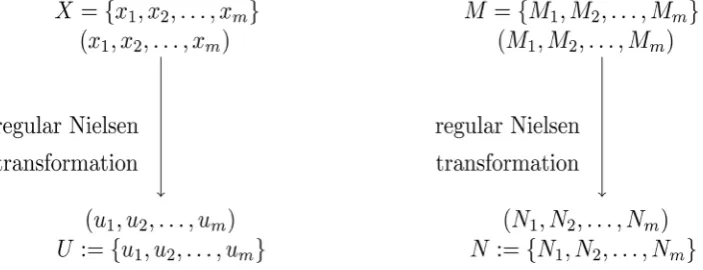
i := +a d.3) The dealer constructs the shares for the participants in the following way: (a) He first applies a regular Nielsen transformation simultaneously for both sets X and M to get Nielsen-equivalent sets U and N to X and M, respectively (see Figure 1).
The elements ui are words in X and the elements Ni are words in M. Hence, it is
(
)
SL 2,
i
N ∈ .
(b) The dealer now uses the method of D. Panagopoulos to split U and N and to get the shares
(
R Si, j)
for the participants with Ri ⊂U and Sj⊂N.4) The dealer distributes the shares.
If t of the n participants combine their parts they obtain the sets U and N. The secret can be recovered as follows:
1. The participants apply regular Nielsen transformations in a Nielsen reduction manner for U and step by step simultaneously for N. By Proposition 4 they get Nielsen reduced sets
{
1 2}
1 , 2 , , mm
X′ = x x x and
{
1 2}
1 , 2 , , mm
M′ = Mδ Mδ Mδ with
{
}
, 1, 1
i
δ
i∈ + − , see Figure 2.
Because of Corollary 5 it is 1 1
X± =X′± and M±1=M′±1, respectively. Hence,
(
x x1′ ′, 2,,xm′)
differs to(
x x1, 2,,xm)
just in the position order and inverses. That means the set X′ is the set X up to inverses. The same is true for M′ and M . Thus,it is
{
1 2}
1 , 2 , ,
m m
X′ = x x x and also
{
1 2}
1 , 2 , ,
m m
M′ = Mδ Mδ Mδ with i,
δ
i∈{
1, 1−}
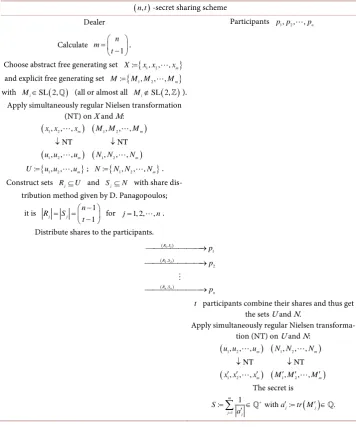
.The cryptographic protocol is summarized in Table 2 (page 73).
Less than t participants can neither get the whole set U, which is Nielsen-equivalent to
X, nor the set N, which is Nielsen-equivalent to M.
For the calculation of the secret, the participants need the set M, because the secret depends on the traces of the matrices Mi∈M. The participants need both sets U and N. If they just have one set U or N they cannot get information about the set M.
If the set U is known, it is only known which Nielsen transformation should be done to get the Nielsen-equivalent set X, but it is unknown on which matrices they should be done simultaneously.
If only the set N is known, then the matrices in SL 2,
(
)
are known, but nobody knows which Nielsen transformation should be done on N to get the set M. It is also unknown how many Nielsen transformations were used. [image:10.595.202.554.554.689.2]In the book ([13], page 247) of J. Lehner a method is given to explicitly obtain a free
Figure 2. Simultaneously regular Nielsen transformations for the participants.
Table 2. Summary of the secret sharing scheme using Nielsen transformations and SL 2,
(
)
.( )n t, -secret sharing scheme
Dealer Participants p p1, 2,,pn
Calculate
1 n m
t = − .
Choose abstract free generating set X : ={x x1, 2,,xm}
and explicit free generating set M:={M M1, 2,,Mm}
with Mi∈SL 2,( ) (all or almost all Mi∉SL 2,( )).
Apply simultaneously regular Nielsen transformation (NT) on X and M:
( )
( )
1 2
1 2
, , , NT , , , m
m
x x x
u u u
↓
( )
( )
1 2
1 2
, , , NT , , ,
m
m
M M M
N N N
↓
{1 2 }
: , , , m
U= u u u ; N:={N N1, 2,,Nm}.
Construct sets Rj⊆U and Sj⊆N with share
dis-tribution method given by D. Panagopoulos;
it is 1
1 j j
n
R S
t
−
= = −
for j=1, 2,,n.
Distribute shares to the participants.
(1,1)
1
R S
p →
(2,2)
2
R S
p →
(R Sn,n)
n p →
t participants combine their shares and thus get
the sets U and N.
Apply simultaneously regular Nielsen transforma-tion (NT) on U and N:
( )
( )
1 2
1 2
, , , NT , , , m
m
u u u
x x x
↓ ′ ′ ′
( )
( )
1 2
1 2
, , , NT , , ,
m
m
N N N
M M M
↓
′ ′ ′
The secret is
( )
1
1
: with : . m
j j
j j
S a tr M
a
+ =
′ ′
= ∈ = ∈
′
∑
Theorem 19. [13] Let F be a free group with countably many free generators
1, 2,
x x . Corresponding to xj define the matrix
2
1 1
j j j
j
r r
M
r
− − +
=
−
(9)
with rj∈ such that the following inequalities hold:
1 3 and 1 2.
j j
r+ − ≥r r ≥ (10) The group G generated by
{
M M1, 2,}
is isomorphic to F.We now present an example for this secret sharing scheme.
Example 20. We perform the steps for a
( )
3, 2 -secret sharing scheme with the helpof the computer program Maple 16. It is n=3, t=2 and hence 3 3 1
m= =
.
First the Dealer generates the shares for the participants.
1) The dealer chooses an abstract presentation for the free group F of rank 3
{
1 2 3}
with : , , .
F= X X = x x x
He takes an explicit presentation
{
1 2 3}
with : , , ,
F= M M = M M M
(
)
SL 2,
i
M ∈ as above. We first mention that the inequalities (10) hold for
1 2 3
7 15
, , 11
2 2
r = r = r =
and hence the set of the matrices
2
1
7 45
7 7
1
2 4
2 2 ,
7
7 1
1
2 2
M
−
− − +
= =
−
−
2
2
15 221
15 15
1
2 4
2 2 ,
15
15 1
1
2 2
M
−
− − +
= =
−
−
2
3
11 120
11 1 11
1 11
1 11
M =− − + =−
−
−
is a free generating set for a free group of rank 3. 2) The dealer chooses
( )
( )
( )
1: 1 7, 2: 2 15, 3: 3 22,
a =tr M = − a =tr M = − a =tr M = −
and hence the secret is
3
1
1 589
: .
2310
j j
S a
=
=
∑
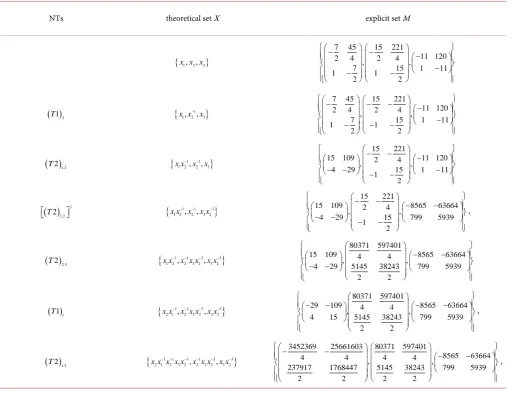
=(a) First the dealer applies regular Nielsen transformations (NTs) simultaneously for both sets X and M to get Nielsen-equivalent sets U and N to X and M, respectively. These transformations are shown in Table 3 (see page 75) and Table 4 (see page 76).
The Dealer obtains the sets
{
}
{
1 1 3 1 3 3 1 1 3}
1, 2, 3 : 2 1 2 3 2 , 2 3 2 , 2 3 2 3 2
U = u u u = x x x x x− − − x x x− − x x x x x− − −
and
{
1, 2, 3}
3452369 25661603 80371 597401 1132425929 8417369243
4 4 4 4 4 4
: , , .
237917 1768447 5145 38243 152350279 1132425989
2 2 2 2 4 4
N= N N N
− − = − −
[image:13.595.46.562.315.716.2](b) He gets the shares
(
R Si, j)
for the participants with Ri ⊂U and Sj⊂N as follows:Table 3. Nielsen transformations (NTs) of the dealer I.
NTs theoretical set X explicit set M
{x x x1, 2, 3}
7 45 15 221
11 120 2 4 , 2 4 ,
7 15 1 11
1 1 2 2 − − − − − −
( )T12
{
}
1 1, 2, 3
x x− x
7 45 15 221
11 120 2 4 , 2 4 ,
7 15 1 11
1 1 2 2 − − − − − − − −
( )T21.2
{
}
1 1 1 2, 2, 3
x x− x− x
15 221
15 109 2 4 11 120
, ,
4 29 15 1 11 1 2 − − − − − − − −
( )
33.2
2 T
{
1 1 3}
1 2, 2, 3 2
x x− x− x x−
15 221
15 109 2 4 8565 63664
, ,
4 29 15 799 5939 1 2 − − − − − − − − ,
( )T2 2.3
{
}
1 1 3 3 1 2, 2 3 2, 3 2
x x− x x x− − x x−
80371 597401
15 109 4 4 8565 63664
, ,
4 29 5145 38243 799 5939 2 2 − − − −
( )T11
{
}
1 1 3 3 2 1, 2 3 2, 3 2
x x− x x x− − x x−
80371 597401
29 109 4 4 8565 63664
, ,
4 15 5145 38243 799 5939 2 2 − − − − ,
( )T21.2
{
}
1 1 3 1 3 3 2 1 2 3 2, 2 3 2, 3 2
x x x x x− − − x x x− − x x−
3452369 25661603 80371 597401
8565 63664 4 4 , 4 4 ,
237917 1768447 5145 38243 799 5939
2 2 2 2
Table 4. Nielsen transformations (NTs) of the dealer II.
NTs theoretical set X explicit set M
( )T13
{
}
1 1 3 1 3 3 1 2 1 2 3 2, 2 3 2, 2 3
x x x x x− − − x x x− − x x−
3452369 25661603 80371 597401
5939 63664 4 4 , 4 4 ,
237917 1768447 5145 38243 799 8565
2 2 2 2
− −
− −
,
( )T23.2
{
}
1 1 3 1 3 3 1 1 3 2 1 2 3 2, 2 3 2, 2 3 2 3 2
x x x x x− − − x x x− − x x x x x− − −
3452369 25661603 80371 597401 1132425929 8417369243 4 4 , 4 4 , 4 4 237917 1768447 5145 38243 152350279 1132425989
2 2 2 2 4 4
− −
− −
i) It is 3 3
1 1
n m
t
= = =
−
.
ii) The dealer chooses the elements a a a 1, 2, 3 and gets the three sets
{ }
{ }
{ }
1 2 3
4A = 1 , A = 2 , A = 3 .
With the help of the Ai the dealer gets the sets R R1′ ′, 2 and R3′ which contain
elements from the set
{
a a a 1, 2, 3}
. He puts the element aj by which i is not contained in the set Aj for i=1, 2, 3 and j=1, 2, 3, into the set Ri′..{
}
2 3 1 2 3
1∈/ A A, ⇒R′= a a , ,
{
}
1 3 2 1 3
2∈/ A A, ⇒R′= a a , ,
{
}
1 2 3 1 2
3∈/ A A, ⇒R′= a a , .
Now we apply this to U and N to create the share-sets for the participants, respec- tively:
{
}
{
}
1 2, 3 , 1 2, 3 ,
R = u u S = N N
{
}
{
}
2 1, 3 , 2 1, 3 ,
R = u u S = N N
{
}
{
}
3 1, 2 , 2 1, 2 ,
R = u u S = N N
4) The Dealer distributes to each participant a tuple
(
R Si, j)
. Participant p1 gets(
R S1, 2)
, p2 gets(
R S2, 3)
and p3 gets(
R S3, 1)
.Assume the participants p1 and p2 come together to reconstruct the secret. They
are able to generate the sets U=
{
u u u1, 2, 3}
and N={
N N N1, 2, 3}
. The secret can berecovered as follows.
The participants apply regular Nielsen transformations step by step simultaneously for both sets U and N to get X′ and M′. The steps are shown in the Table 5 (see
page 77) and Table 6 (see page 78).
With the knowledge of the set
7 45 15 221
11 120
2 4 2 4
, ,
7 15 1 11
1 1
2 2
M
− −
−
′ = −
− −
the
Table 5. Nielsen transformations (NTs) from the participants I.
NTs theoretical set U explicit set N
{
1 1 3 1 3 3 1 1 3}
2 1 2 3 2, 2 3 2, 2 3 2 3 2
x x x x x− − − x x x− − x x x x x− − −
3452369 25661603 80371 597401 1132425929 8417369243 4 4 , 4 4 , 4 4 237917 1768447 5145 38243 152350279 1132425989
2 2 2 2 4 4
− − − −
( )T12
{
}
1 1 3 3 1 3 1 1 3 2 1 2 3 2, 2 3 2, 2 3 2 3 2
x x x x x− − − x x x x x x x x− − − −
3452369 25661603 38243 597401 1132425929 8417369243
4 4 , 2 4 , 4 4
237917 1768447 5145 80371 152350279 1132425989
2 2 2 4 4 4
− − − − − −
( )T23.2
{
}
1 1 3 3 1 3 1 2 1 2 3 2, 2 3 2, 2 3
x x x x x− − − x x x x x− −
3452369 25661603 38243 597401
5939 63664 4 4 , 2 4 ,
237917 1768447 5145 80371 799 8565
2 2 2 4
− − − − − −
( )T12
{
}
1 1 3 1 3 3 1 2 1 2 3 2, 2 3 2, 2 3
x x x x x− − − x x x− − x x−
3452369 25661603 80371 597401
5939 63664 4 4 , 4 4 ,
237917 1768447 5145 38243 799 8565
2 2 2 2
− − − −
( )T22.3
{
}
1 1 3 1 3 1 2 1 2 3 2 , 2, 2 3
x x x x x− − − x− x x−
3452369 25661603 15 221
5939 63664 4 4 , 2 4 ,
237917 1768447 15 799 8565 1
2 2 2
− − − − − − − −
( )T21.3
{
}
1 1 1 3 1 2 1 2, 2, 2 3
x x x− − x− x x−
653 9679 15 221
5939 63664 2 4 , 2 4 ,
667 15 799 8565 45 1 2 2 − − − − − − − −
( )
( )
( )
1: 1 7, 2: 2 15, 3: 3 22
a =tr M = − a =tr M = − a =tr M = −
and hence it is
3
1
1 1 1 1 589
: .
7 15 22 2310
j j
S a
=
=
∑
= + + =In general we can use any free matrix group F of rank : 1 n m t = −
for a
( )
n t, -secret sharing scheme as it is described in this section. The shares can be generated by the above method and are tuples
(
R Si, j)
with Ri⊂U and Sj⊂N. Some other ideas for the secret S are( )
( )
1 1
: or : or
m m
i i
i i
S tr M S tr M
= =
=
∏
=∑
(11)( )
(
)
2(
( )
)
2 11
: or : or
m m
i i
i i
S tr M S tr M
= =
=
∏
=∑
(12)(
)
( )
2
2
2 1 2
1 1
: , if is even or : .
m
m
i i i
i i
S tr M − M m S tr M
= =
Table 6. Nielsen transformations (NTs) from the participants II.
NTs theoretical set U explicit set N
( )T12
{
}
1 1 3 1 2 1 2, 2, 2 3
x x x− − x x x−
653 9679 15 221
5939 63664 2 4 , 2 4 ,
667 15 799 8565 45 1 2 2 − − − − − −
( )T21.2
{
}
1 3 1 2 1, 2, 2 3
x x− x x x−
15 221
29 109 2 4 5939 63664
, ,
4 15 15 799 8565 1 2 − − − − − −
( )T11
{
}
1 3 1 1 2, 2, 2 3
x x− x x x−
15 221
15 109 2 4 5939 63664
, ,
4 29 15 799 8565 1 2 − − − − − −
( )T21.2
{
}
3 1 1, 2, 2 3
x x x x−
7 45 15 221
5939 63664 2 4 , 2 4 ,
7 15 799 8565
1 1 2 2 − − − − − −
( )T13
{
}
3 1, 2, 3 2
x x x x−
7 45 15 221
8565 63664 2 4 , 2 4 ,
7 15 799 5939
1 1 2 2 − − − − − −
( )
33.2
2 T
{x x x1, 2, 3}
7 45 15 221
11 120 2 4 , 2 4 ,
7 15 1 11
1 1 2 2 − − − − − −
5. Another Secret Sharing Scheme Based on Nielsen
Transformations
We explain another secret sharing scheme which arises of the protocol in Section 4. As in the previous section, let F be a finitely generated free group with the abstract free generating set X:=
{
x x1, 2,,xq}
, q∈\ 1{ }
, that is,.
F= X
For a
( )
n t, -secret sharing scheme the dealer chooses a Nielsen reduced set{
1, 2, , m}
U = u u u ⊂F, with
1 n m t = −
. The ui are given as words in X. The secret
is the sum
1 1 : , m i i S u =
=
∑
(14)with ui the length of the word ui.
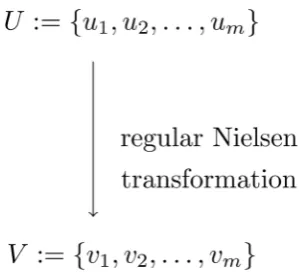
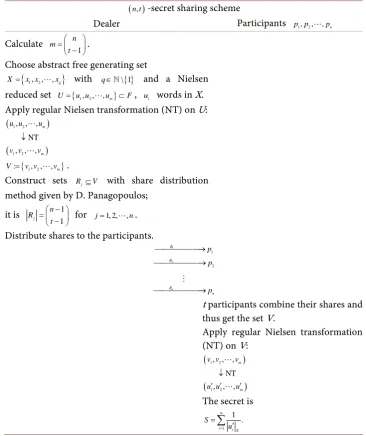
The dealer does a regular Nielsen transformation on the set U to get the Nielsen- equivalent set V (see Figure 3).
Figure 3. Regular Nielsen transformation.
If t of the n participants come together to reconstruct the secret, they combine their shares and get the set V =
{
v v1, 2,,vm}
. They have to find a Nielsen-reduced set{
1 2}
: , , , m
U′ = u u′ ′ u′ to V. They apply Nielsen transformations in a Nielsen reducing manner as described in [8] and [9], and get from V a Nielsen-reduced set U′. The
secret is the sum
1 1
, with
m
i
i i
S u U
u
=
′ ′
= ∈
′
∑
(15)because for each i it is ui′ =X ujX for some j (see the proof of Corollary 3.1 in [10]). From U′ we get U by permutations and length preserving Nielsen transformations.
This
( )
n t, -secret sharing scheme is summarized in Table 7 (page 80).6. A Symmetric Key Cryptosystem Using Nielsen Transformations
In this section we introduce a symmetric key cryptosystem using Nielsen transfo- rmations. Before Alice and Bob are able to communicate with each other, they have to make some arrangements.
We speak about public parameters also in private key cryptosystems, because these are parameters which each person, also an eavesdropper, Eve, gets, if she looks at the sent ciphertext. Public parameters are also elements, which Alice and Bob communicate with each other publicly. It is also not a secret which plaintext alphabet is used for the communication.
Public Parameters.
They first agree on the following public parameters.
1) A finitely generated free group F with free generating set X =
{
x x1, 2,,xq}
with2
q≥ .
2) A plaintext alphabet A=
{
a a1, 2,,aN}
with N≥2.3) An abstract free group H= U with rank H
( )
= A =N and an abstract free generating set U={
u u1, 2,,uN}
, with ui, 1≤ ≤i N, abstract letters.4) A subset Aut :=
{
f0,f1,,f2128−1}
⊂Aut H( )
of automorphisms of H. It is:
i
f H→H and the fi,
128
0,1, , 2 1
Table 7. Summary of the
( )
n t, -secret sharing scheme using Nielsen transformations together with Nielsen reduced sets and free lengths of certain words.( )n t, -secret sharing scheme
Dealer Participants p p1, 2,,pn Calculate m n1
t = − .
Choose abstract free generating set
{
1, 2, , q}
X = x x x with q∈\ 1{ } and a Nielsen reduced set U={u u1, 2,,um}⊂F, ui words in X. Apply regular Nielsen transformation (NT) on U:
(
)
(
)
1 2 1 2
, , ,
NT
, , , m
m
u u u
v v v
↓
{1 2 }
: , , , m
V = v v v .
Construct sets Rj⊆V with share distribution method given by D. Panagopoulos;
it is j 11 n R
t − = −
for j=1, 2,,n. Distribute shares to the participants.
1
1
R
p
→
2
2
R
p
→
n
R
n
p
→
t participants combine their shares and thus get the set V.
Apply regular Nielsen transformation (NT) on V:
(
)
(
)
1 2
1 2
, , ,
NT
, , , m
m
v v v
u u u
↓ ′ ′ ′
The secret is
1
1 . m
i i X S
u
=
= ′
∑
The set Aut is part of the key space.
5) They agree on a linear congruence generator h:2128 →2128 with a maximal
period length. Private Parameters.
Now, they agree on the private parameters.
1) Alice and Bob choose an explicit Nielsen reduced set U with N elements, which are words in X. Such systems U are easily to construct (see Lemma 7 and Theorem 6 or also [8] and [9]).
2) They use a one-to-one correspondence
for 1, , .
j j
A U
a u j N
→
=
(16)
3) Alice and Bob agree on an automorphism fα∈Aut, hence α is the common secret starting point
{
128}
0,1, , 2 1
α ∈ − , with u1= ∈
α
2128 , for the linearcongruence generator. With this α they are able to generate the sequence
1 2
u , u , , uz
f f f (with z the number of the plaintext units, which are letters from A) of automorphisms of the set Aut, which they need for encryption and decryption, respectively.
Remark 21. If the explicit set U:=
{
u u1, 2,,uN}
, ui word in X, is used, then FU is a free subgroup of F and with the automorphism fuj∈Aut with fuj :FU →FU, the set Ufuj ={
fuj( )
u1 ,fuj( )
u2 ,,fuj( )
uN}
is generated, which is Nielsen equivalentto the set U.
The key space: The set Nred of all minimal (with respect to a lexicographical order) Nielsen reduced set of F with N elements. The set Aut of 2
128 randomly chosen
automorphism of FU. Private Key Cryptosystem.
Now, we explain the private key cryptosystem and look carefully at the steps for Alice and Bob.
Public knowledge: F= X , X =
{
x x1, 2,,xq}
with q≥2; plaintext alphabet{
1, 2, , N}
A= a a a with N≥2; the set Aut; a linear congruence generator h. Encryption and Decryption Procedure:
1) Alice and Bob agree privately on the private parameters: a set U∈Nred and an automorphism fα∈Aut. They also know the one-to-one correspondence between U and A.
2) Alice wants to transmit the message
1 2 z, 1,
S =s s s z≥ (17) with si∈A to Bob.
2.1) She generates with the linear congruence generator h and the knowledge of fα the z automorphisms fu1,fu2,,fuz, which she needs for encryption. It is u1=α ,
( )
2 1
u =h u ,
, uz=h(
uz−1)
.2.2) The encryption is as follows.
( )
uif then : , 1 , 1 .
i
i t i i t
s =a s c = f u ≤ ≤i z ≤ ≤t N (18)
Recall that the one-to-one correspondence A→U with ajuj, for
1, 2, ,
j= N, holds. The ciphertext
( ) ( )
( )
1 2
u 1 u 2 u
1 2
with ˆ
z z i t i t
z
C f s f s f s s u s a
c c c
= = ⇔ =
=
(19)
word in U, because the set Ufuj =
{
fuj( )
u1 ,fuj( )
u2 ,,fuj( )
uN}
is Nielsen equivalentto U and fuj
( )
sj =ˆ fuj( )
uk =:cj, for sj =ak, is an element in Ufuj . On the other hand it can be written as a word in X, because the explicit elements in U are words in X and so are the elements in the Nielsen equivalent set Ufuj to U.3) Bob gets the ciphertext
1 2 z,
C=c c c (20) with cj, 1≤ ≤j z, words in X. He knows where each ciphertext unit cj begins and ends. Hence, he gets the information that he has to use z automorphisms of F from the set Aut for decryption. He has two possibilities for decryption.
3.1.a) With the knowledge of fα, the set U =
{
u u1, 2,,uN}
, the linear congruence generator h and the number z, he computes for each automorphism fui, i=1, 2,,z,the set
( )
( )
( )
{
}
ui ui 1 , ui 2 , , ui ,
f N
U = f u f u f u (21) with fui
( )
uj written as a reduced word in X. Hence, with the one-to-one correspondence between U and A, he gets a one-to-one correspondence between the letters in the alphabet A and the words of the ciphertext depending on the automorphisms fui. This is shown in Table 8 (page 82).With the knowledge of the Table 8 (page 82) the decryption is as follows
( )
uif then , 1 , 1 .
i
i t i i t
c = f u c s =a ≤ ≤i z ≤ ≤t N (22)
He generates the plaintext message
1 2 z,
S=s s s (23) with si∈A, from Alice.
3.1.b) Bob knows the Nielsen reduced set U, hence with an algorithm as for example explained in the book ([8], page~33) he is able to write the elements ci as words in U. With the knowledge of the automorphism fα, the set U=
{
u u1, 2,,uN}
, the linear congruence generator h and the number z, he gets the automorphisms fui whichAlice used for encryption of ci. Because of the fact that a one-to-one correspondence between A and U is used and the ciphertext unit ci is an image of an element in U under the automorphism fui , Bob knows with the automorphism fui and the ciphertext unit ci written as word in U, the plaintext letter aj∈A which corres- ponds to the ciphertext unit ci.
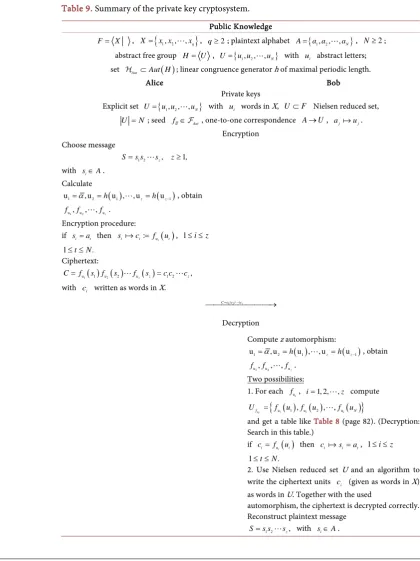
This cryptographic protocol is summarized in Table 9 (page 83).
Table 8. Plaintext alphabet A=
{
a a1, 2,,aN}
corresponding to ciphertext alphabet Ufuidepending on the automorphisms fui.
u1
f
U Ufu2 Ufuz
1
a fu1( )u1 fu2( )u1 fuz( )u1
2
a fu1( )u2 fu2( )u2 fuz( )u2
N
[image:20.595.192.553.627.702.2]Remark 22. As soon as Alice and Bob agree on the starting seed automorphism and the Nielsen reduced set U, Bob is able to calculate the first columns of Table 8 (page 82) for decryption (he does not know how many columns he will need because he does not know yet how long the plaintext from Alice will be). If he gets the ciphertext C from Alice, he only has to do a search in the table to get the corresponding plaintext units to
Table 9. Summary of the private key cryptosystem.
Public Knowledge
F= X , X=
{
x x1, 2,,xq}
, q≥2; plaintext alphabet A={a a1, 2,,aN}, N≥2;abstract free group H= U , U={u u1, 2,,uN} with ui abstract letters;
set Aut ⊂Aut H( ); linear congruence generator h of maximal periodic length.
Alice Bob
Private keys
Explicit set U={u u1, 2,,uN} with ui words in X, U⊂F Nielsen reduced set,
U =N; seed fα∈Aut, one-to-one correspondence A→U, ajuj.
Encryption Choose message
12 z, 1,
S=s ss z≥
with si∈A.
Calculate
( ) ( )
1 2 1 1
u =α, u =h u ,, uz =h uz− , obtain
1 2
u, u, , uz
f f f .
Encryption procedure:
if si=at then sici:=fui( )ut , 1≤ ≤i z 1≤ ≤t N.
Ciphertext:
( ) ( ) ( )
1 2
u 1 u 2 uz z = 12 z,
C=f s f s f s c cc
with ci written as words in X.
12 z
C c c= c
→ Decryption
Compute z automorphism:
( ) ( )
1 2 1 1
u =α, u =h u ,, uz =h uz− , obtain
1 2
u, u, , uz
f f f .
Two possibilities:
1. For each fui, i=1, 2,,z compute
( ) ( ) ( )
{
}
ui = ui 1 , ui 2 , , ui
f N
U f u f u f u
and get a table like Table 8 (page 82). (Decryption: Search in this table.)
if ci=fui( )ut then cisi=at, 1≤ ≤i z 1≤ ≤t N.
2. Use Nielsen reduced set U and an algorithm to write the ciphertext units ci (given as words in X)
as words in U. Together with the used
automorphism, the ciphertext is decrypted correctly. Reconstruct plaintext message
12 z,