An Integrated ISFET pH Microsensor on
a CMOS Standard Process
Francisco López-Huerta1*, Rosa María Woo-Garcia2, Miguel Lara-Castro1, Johan Jair Estrada-López3, Agustín Leobardo Herrera-May1
1
Research Center for Micro and Nanotechnology, University of Veracruz, Veracruz, Mexico
2
Faculty of Electronics Sciences, Meritorious Autonomous University of Puebla, Puebla, Mexico
3
Faculty of Mathematics, Autonomous University of Yucatán, Mérida, Mexico Email: *[email protected]
Received June 7, 2013; revised July 7, 2013; accepted July 15, 2013
Copyright © 2013 Francisco López-Huerta et al. This is an open access article distributed under the Creative Commons Attribution License, which permits unrestricted use, distribution, and reproduction in any medium, provided the original work is properly cited.
ABSTRACT
We present the design and integration of a nine-pH microsensor array on a single silicon substrate with its own signal readout circuit, integrated in a 0.6-µm commercial standard complementary metal oxide semiconductor (CMOS) proc- ess. An ion sensitive field effect transistor (ISFET) has been used as pH microsensor and an instrumentation amplifier as the read-out circuit. The ISFET structure is conformed by the channel length and ratio of MOS transistor, gate ex- tended and the selective membrane, for which silicon nitride (Si3N4) is employed as an ion selective element. The com-
plete design includes shielding around the pH microsensor and the readout circuit to avoid leakage of current to the substrate. The readout circuit is composed by three operational amplifiers and resistances that form the instrumentation amplifier, with a ±2.5 V bias has a 50 dB gain, power supply rejection ratio (PSSR) of 120 dB and common mode re- jection ratio (CMRR) of 127 dB. The complete system is integrated in a 1.12 mm2 silicon area; it presents a 59 mV/pH linearity, within a concentration range of 2 to 12 of pH level, making it a good alternative for biological or medical ap- plications.
Keywords: CMOS; Instrumentation Amplifier; ISFET; pH
1. Introduction
The ion sensitive field effect transistor (ISFET) has been used as pH sensor during the last years; also, they can detect chemical and biological phenomena or even can be used for biosensing [1-8]. Actually, the research, de- sign, development and application of ISFET-based sen- sors have displaced to the ion sensitive electrodes (ISE), pH indicator strips and optical sensors [9,10] due to their great advantages such as mass-production low cost, light weight, small size, fast response, low output impedance, high speed signal, distributed sensing, multiplexing pos- sibilities and temperature compensation; also, it allows that not only the readout circuits but also their control system can be integrated on the same integrated circuit (IC) in standard consumer CMOS processes [11-14], of- fering new tendencies for solid state sensors.
ISFET based electrochemical pH sensors have found applications in many fields such as environmental moni- toring, agriculture, medicine, biological sensing and me-
dical diagnosis [13-18]. Variations that exist in the IS- FET selectivity depend on the selective membrane em- ployed, the most used materials are: Al2O3, Si3N4, SiO2,
TaO5, ZrO2, SnO2/Al; also, other kind of materials like
polymers, metallic oxides and organic/inorganic materi- als [19-27] are used for this purpose. These materials are widely used due to its high selectivity with the hydrogen ions. ISFET structure is different to the conventional FET structure due to an exterior exposed window that is left inside the sensor structure where the sensitive mate- rial will be deposited to form the selective membrane of the hydrogen ions or others [28,29].
Particularly, the integration of sensors and electronics on the same substrate potentiate the benefits of the de- vices, improving functionalities like signal amplification, calibration and better signal to noise ratio. All these ad- vantages drive to call the attention for the studying and producing of ISFETs to apply them in many knowledge areas. The basic requirements that a sensor must accom- plish are 1) the superficial dielectric located in the IS- FET gate region must have a sensibility as great as pos-
sible to detect the pH levels of the analyzed solution with rapidness, efficiency and reliability; 2) the selected dielectric material must present an amount of drift cur- rent and hysteresis as minimum as possible during meas- urements, which is important if the ISFETs are used to measure pH levels for long periods of time. This last condition makes them very useful in biomedical field [18,27,30]. During the last years, the design and research of ISFETs and readout circuits have been developed in different ways, some authors do the research about the sensor and the others use the standard consumer CMOS technology, where the pH sensors and readout circuits are on the same substrate, including a reference electrode that is connected externally [31,32].
Considering the disadvantages previously presented, we can say that it is a necessity to do research related with microelectromechanical systems (MEMS) to improve the pH microsensors’ characteristics. In this work, we pro- pose the integration of 9 pH microsensors, implemented with ISFET’s, all of them have their own readout circuit associated. In addition, the reference electrode is inte- grated in the same silice substrate, using a 0.6 m stan- dard consumer CMOS process, wherewith very high level of reproducibility and dimension control of the fab- ricated devices will be obtained. Electrical properties of Si3N4 will be used to form the selective membrane for
hydrogen ions.
This paper is organized as follows: in Section 2, we describe both ISFET pH microsensor and readout circuit formed by an instrumentation amplifier and analog am- plifier. The results and experimental data are described in Section 3. Finally, we present our conclusions and pro- posed future research in Section 4.
2. Design of the ISFET pH Microsensor
2.1. ISFET Devices
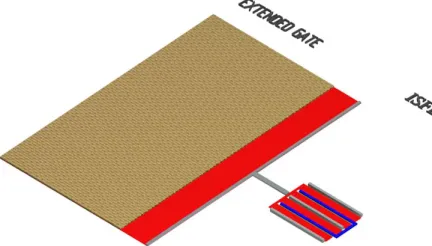
We design the ISFET pH microsensor using a standard 0.6 µm triple metal, double poly layer CMOS ON Semi- conductor process [33]. The ISFET’s structure is con- formed by a transistor geometric ratio, extended gate and the selective membrane (Figure 1), for which silicon
Figure 1. Schematic of the ISFET pH microsensor.
nitride (Si3N4) is employed as an ion selective element.
The complete design includes shielding around the IS- FET pH microsensor and the readout circuit to avoid leakage of current to the substrate.
The conventional MOSFET structure is different from ISFET since the sensor structure is left exposed the extension gate on which the sensitive material deposited for forming the selective membrane of hydrogen ions. The operation of the ISFET pH microsensor is similar to that the conventional metal oxide semiconductor field effect transistor (MOSFET) The Equation (1) for the ISFET in saturation as a function of the pH [20]:
*
2
1 2
n eff
D G T DS
C W
I V V
L
V (1)
where n is the mobility of the electrons in the channel,
the capacitance effective per unit area Equation (2),
eff
C
W and L the width and length of the channel, respec- tively, the gate voltage, the threshold voltage of the ISFET Equation (3),
G
V *
T
V
DS
V the drain to source volt- age, the channel modulation parameter.
ox M eff ox M C C C C C
(2)
where ox the capacitance per unit area of the gate in-
sulator and
C
M
C is the capacitance of the selective mem- brane.
*
ln
T T i Re
RT
V V a V
nF
f (3)
T
V T
the threshold voltage, the universal gas constant, the absolute temperature, the numbers of elec- trons perm mole,
R
n
F the Faraday constant, i the ac-
tivity of the ions and
a
Ref
V is the voltage of reference electrode.
2.2. CMOS Integrated Readout Circuit for pH Measurement
The instrumentation amplifier readout circuit for the IS- FET pH microsensor was designed to have a high input impedance, high common mode rejection ratio (CMRR) and power supply rejection ratio (PSRR). Figure 2
*
1
D DS n eff G T
L R
I V C W V V
(4)
In order to integrate both the ISFET pH microsensor and the readout circuit, we used the geometric pattern editor of L-Edit of Tanner® [34]. The readout circuit is also formed by three analog amplifiers and each one of them with a voltage gain of 1000, and Figure 3 shows the schematic. The analog amplifier has a first stage inte- grated by differential-pair transistors M1-M2 and a po- larization through transistors M5 and M6. The biasing of the circuit is made by means of a current mirror formed by the resistor R1 and transistors M3-M4. In order to improve the stability of this circuit, the compensation is implemented by the transistors M7-M10 as well as a ca- pacitor Cc [35]. The final stage consists of transistors
M11 and M12 that form a buffer. Table 1 shows the channel length and width (aspect ratios) of all MOS tran- sistors obtained for the proposed design in this work.
Our design for the measurement of pH ISFETs has 9 which present different aspect ratio to vary the sensitivity and dynamic range of detection of microsensors, Table 2
shows the dimensions. Each pH microsensor consists of
Figure 2. Block schematic of our system implementation.
Figure 3. Schematic of the analog amplifier used in our design.
the extended gate, the ISFET structure and the readout circuit formed by the instrumentation amplifier (Figure 4). The union between the extended gate and ISFET was made with a distance equivalent to all sensors, and each element is aligned there by facilitating the etching on metal or depositing the material to form the membrane sensitive to hydrogen ions. Figure 5 shows a cross sec- tion of the layers used in the CMOS process and the ion sensitive membrane sensitive. In this figure, metal layers are ML1, ML2, ML3 and the contacts between are via1 and via2.
3. Results and Discussions
The electrical results of the ISFET pH microsensor simu- lations were obtained from the analysis conducted with a
Table 1. Aspect ratio of the transistors for the proposed design.
Devices W/L (µm)
M1-M2 7.2/1.2
M3-M4 16.8/1.2
M5-M7 4.8/1.2
M8 33.6/1.2
M9 24/1.2
M10 74/1.2
M11 360/1.2
M12 1197/1.2
Table 2. Aspect ratio of the ISFET pH microsensor array.
W/L (20) W/L (25) W/L (30)
24/1.2 30/1.2 36/1.2
60/3 60/2.4 54/1.8
96/8 90/3.6 108/3.6
circuit simulator. A sinusoidal excitation signal of 200 mVpp at 1 kHz is supplied to the readout circuit and its output signal is amplified more than 20 times (26 dB), as shown in Figure 6.
[image:4.595.313.535.84.261.2] [image:4.595.313.537.298.685.2]The common mode rejection ratio (CMRR) simulated in the readout circuit was 127 dB at 20 kHz, as shown in
Figure 7.
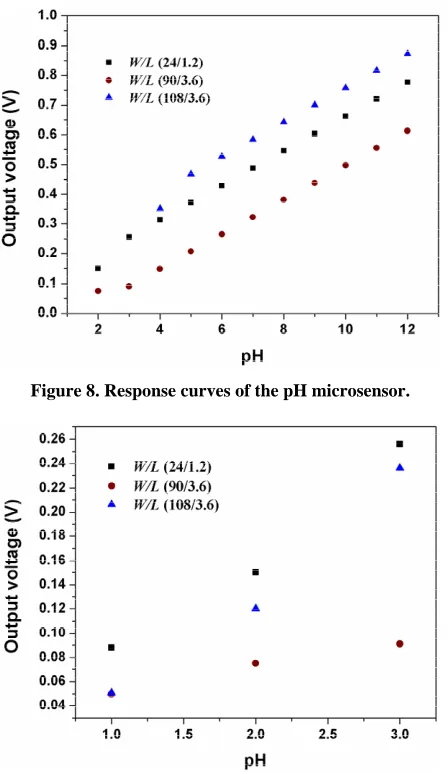
The Figure 8 shows the dynamic range for three IS- FET pH microsensor, 20, 25 and 30, the sensibility as function of the aspect ratio of the ISFET and the sensible material Si3N4. From this discussion it can be said that
using all microsensors a pH range from 2 to 12 could be covered. The second observed situation is the variation on the microsensor sensitivity for low pH values, the slope of the curves changes, in the pH range of 1 - 3. Such slope increase when the aspect ratio is 30, as shown in Figure 9.
[image:4.595.313.537.303.481.2]The pH microsensors’ response and dynamic range
Figure 5. Cross section of the layers employed for the IS-FET pH microsensor.
[image:4.595.63.282.310.485.2]Figure 6. Frequency response of the readout circuit of the pH microsensor.
Figure 7. Common mode rejection ratio in the readout elec- trical circuit of the pH microsensor.
Figure 8. Response curves of the pH microsensor.
Figure 9. Microsensor responses for different pH values.
[image:4.595.312.534.491.680.2] [image:4.595.63.285.521.709.2](2 - 12) through the electrical simulator.
The preliminary test of the electrical performance characteristics will be obtained of the ISFET pH mi- crosensor, using an arbitrary waveform generator, a digi- tal oscilloscope and two power supplies. The ISFET’s pH microsensos works with a ±2.5 volts DC and was pack- aged with a DIP-24 (twenty-four dual in-line package). The voltage applied to reference electrode is set to 2 volts, a sinusoidal excitation signal of 200 mV peak to peak at 1 kHz is supplied to the amplifier and its output signal is amplified as a function of the pH level. In order to measure the cutoff frequency of the amplifier, a fre- quency sweep for its input signal from 0.5 Hz to 1.5 MHz will be applied. The pH level is controlled using KOH and HNO3 to increase and decrease it, respectively
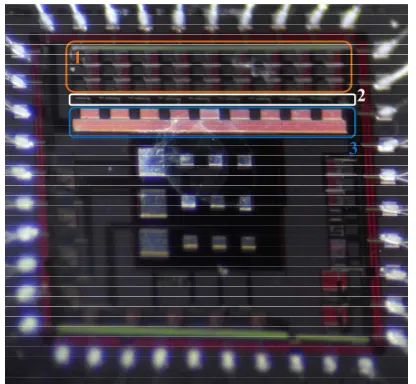
[image:5.595.59.289.350.470.2][10]. Figure 10 shows a schematic with the main com- ponents of a signal conditioning system that could be used for pH microsensor. Figure 11 shows the micro- photograph of the chip, which was fabricated by MOSIS [36] and the distribution for ISFET, extended gate and readout circuit.
Figure 10. Schematic of the signal condition system for the ISFET pH microsensor.
Figure 11. Microphotograph of the ISFET pH microsensor. Selective parts are numbered. 1. Readout circuit; 2. ISFET; 3. Extended Gate.
4. Conclusion
The design of an ISFET pH microsensor array based on CMOS process using ON Semiconductor technology was presented. The microsensor array includes the following elements: the ISFET (with different area), extended gate (100 × 100 m) and readout circuit (213 × 272.4 m). This array was designed to detect different pH level val- ues with a simple signal conditions system. It presented a linear response for pH levels between 2 pH and 12 pH, and resolution around the 60 mV/pH. Future work will include the electrical characterization of the pH micro- sensor array under different pH levels and the deposition of some materials on surface extended gate.
5. Acknowledgements
Authors wish to thank the facilities provided by MOSIS Research Program and CONACYT through grant 48757.
REFERENCES
[1] P. Bergveld, “Development of an Ion Sensitive Solid State Device for Neurophysiological Measurements,” IEEE Transactions on Biomedical Engineering, Vol. 17, No. 1, 1970, pp. 70-71.
[2] C. Soo, S. K. Kim and M. Kim, “Ion Sensitive Field Ef- fect Transistor for Biological Sensing,” Sensors, Vol. 9, No. 9. 2009, pp. 7111-7131, doi:10.3390/s90907111
[3] P. Bergveld, “The Operation of an ISFET as an Electron Device,”Sensors and Actuators, Vol. 1, 1981, pp. 17-29. doi:10.1016/0250-6874(81)80004-2
[4] P. Bergveld, “The Future of Biosensors,” Sensors and Actuators A: Physical, Vol. 56, No. 1-2, 1996, pp. 65-73. doi:10.1016/0924-4247(96)01275-7
[5] K. M. Chang, C. T. Chang and K. M. Chan, “Develop- ment of an Ion Sensitive Field Effect Transistor Based Urea Biosensor with Solid State Reference Systems,” Sensors, Vol. 10, No. 6, 2010, pp. 6115-6127.
doi:10.3390/s100606115
[6] G. Shalev, A. Cohen, A. Doron, A. Machauf, M. Horesh, U. Virobnik, D. Ullien and L. Ilan, “Standard CMOS Fabrication of a Sensitive Fully Depleted Electrolyte-In- sulator-Semiconductor Field Effect Transistor for Bio- sensor Applications,” Sensors, Vol. 9, No. 6, 2009, pp. 4366-4379. doi:10.3390/s90604366
[7] M. J. Schöning and A. Poghossian, “Recent Advances in Biologically Sensitive Field-Effect Transistors (BioFETs),” Analyst, Vol. 127, No. 6, 2002, pp. 1137-1151.
doi:10.1039/b204444g
[8] W. Olthuis, “Chemical and Physical FET-Based Sensors or Variations on an Equation,” Sensors and Actuators B: Chemical, Vol. 105, No. 1, 2005, pp. 96-103.
doi:10.1016/j.snb.2004.02.040
[image:5.595.69.277.508.700.2][10] G. Beltrán-Pérez, F. López-Huerta, S. Muñoz-Aguirre, J. Castillo-Mixcoatl, R. Palomino-Merino, R. Lozada-Mo- rales and O. Portillo-Moreno, “Fabrication and Chara- cterization of an Optical Fiber pH Sensor Using Sol-Gel Deposited TiO2 Film Doped with Organic Dyes,” Sensors
and Actuators B: Chemical, Vol. 120, No. 6, 2006, pp. 74-78. doi:10.1016/j.snb.2006.01.048
[11] C.-L. Dai, P.-W. Lu, C.-C. Wu and C. Chang, “Fabrica- tion of Wireless Micro Pressure Sensor Using the CMOS Process,” Sensors, Vol. 9, No. 11, 2009, pp. 8748-8760. doi:10.3390/s91108748
[12] E. Lauwers, J. Suls, W. Gumbrecht, D. Maes, G. Gielen and W. Sansen, “A CMOS Multiparameter Biochemical Microsensor with Temperature Control and Signal Inter- facing,” IEEE Journal of Solid-State Circuits, Vol. 36, No. 12, 2001, pp. 2030-2038. doi:10.1109/4.972154
[13] A. Morgenshtein, L. Sudakov-Boreysha, U. Dinnar, C. G. Jakobson and Y. Nemirovsky, “CMOS Readout Circuitry for ISFET Microsystems,” Sensors and Actuators B: Chemical, Vol. 97, No. 1, 2004, pp. 122-131.
doi:10.1016/j.snb.2003.08.007
[14] V. P. Chodavarapu, A. H. Titus and A. N. Cartwright, “Differential Read out Architecture for CMOS ISFET Microsystems,” Electronics Letters, Vol. 41, No. 12, 2005, pp. 698-699. doi:10.1049/el:20051044
[15] M. Futagawa, T. Iwasaki, H. Murata, M. Ishida and K. Sawada, “A Miniature Integrated Multimodal Sensor for Measuring pH, EC and Temperature for Precision Agri- culture,” Sensors, Vol. 12, No. 6, 2012, pp. 8338-8354. doi:10.3390/s120608338
[16] C. Jimenez-Jorquera, J. Orozco and A. Baldi, “ISFET Based Microsensors for Environmental Monitoring,” Sen- sors, Vol. 10, No. 1, 2012, pp. 61-83.
doi:10.3390/s100100061
[17] S. Martinoia, N. Rosso, M. Grattarola, L. Lorenzelli, B. Margesin and M. Zen, “Development of ISFET Array- Based Microsystems for Bioelectrochemical Measure- ments of Cell Populations,” Biosensors and Bioelectron- ics, Vol. 16, No. 9-12, 2001, pp. 1043-1050.
doi:10.1016/S0956-5663(01)00202-0
[18] V. P. Chodavarapu, A. H. Titus and A. N. Cartwright, “CMOS ISFET Microsystem for Biomedical Applica- tions,” Proceedings of IEEE Sensors Conference,Irvine, 30 October-3 November 2005, pp. 109-112.
[19] Y. I. Huang, R. S. Huang and L. L. His, “A New Struc- tured ISFET with Integrated Ti/PdAg/AgCl Electrode and Micromachined Back-Side P+ Contacts,” Journal of the Chinese Institute of Engineers, Vol. 25, No. 3, 2002, pp. 327-334. doi:10.1080/0253389.2002.9670707
[20] C. Lung, Y. Chuan, T. Ping, H. Kwei, W. Yaw and S. Kan, “A Novel SnO2/Al Discrete Gate ISFET pH Sensor
with CMOS Standard Process,” Sensors and Actuators B: Chemical, Vol. 75, No. 1-2, 2001, pp. 36-42.
doi:10.1016/S0925-4005(00)00739-5
[21] K.-M. Chang, C.-T. Chang, K.-Y. Chao and C.-H. Lin, “A Novel pH-Dependent Drift Improvement Method for Zirconium Dioxide Gated pH-Ion Sensitive Field Effect Transistors,” Sensors, Vol. 10, No. 5, 2010, pp. 4643- 4654. doi:10.3390/s100504643
[22] G. Scarpa, A.-L. Idzko, A. Yadav and S. Thalhammer, “Organic ISFET Based on Poly (3-hexylthiophene),” Sen- sors, Vol. 10, No. 3, 2010, pp. 2262-2273.
doi:10.3390/s100302262
[23] A. Loi, I. Manunza and A. Bonfiglio, “Flexible, Organic, Ion-Sensitive Field-Effect Transistor,” Applied Physics Letters, Vol. 86, No. 10, 2005, pp. 103512-1-103512-3. doi:10.1063/1.1873051
[24] S. S. Jan, Y. C. Chen, J. C. Chou, P. J. Jan and C. C. Cheng, “Preparation and Properties of Hydrogen Ion- Sensitive Field Effect Transistors with Sol-Gel-Derived Mg-Modified Lead Titanate Gate,” Journal of Non- Crystalline Solids, Vol. 332, No. 1, 2003, pp. 11-19. doi:10.1016/j.jnoncrysol.2003.08.054
[25] I. Poels, R. B. M. Schasfoort, S. Picioreanu, J. Frank, G. W. K. van Demen, A. van den Berg and L. Nagels, “An ISFET Based Anion Sensor for Potentiometric Detection of Organic Acids in Liquid Chromatography,” Sensors and Actuators B: Chemical, Vol. 67, No. 3, 2000, pp. 249-299.doi:10.1016/S0925-4005(00)00531-1
[26] F. Yan, P. Estrela, Y. Mo, P. Migliorato and H. Maeda, “Polycrystalline Silicon ISFETs on Glass Substrate,” Sensors, Vol. 5, No. 4, 2005, pp. 293-301.
doi:10.3390/s5040293
[27] C. Moldovan, R. Iosub, M. Modreanu, D. Ulieru, B. Firtat and M. Ion, “ISFET Microsensors HfO2 Based for Bio-
medical Applications,” International Semiconductor Con- ference, Sinaia, 27-29 September 2006, pp. 185-188,
[28] S. P. Lee, J. G. Lee and S. Chowdhury, “CMOS Humidity Sensor System Using Carbon Nitride Film as Sensing Materials,” Sensors, Vol. 8, No. 4, 2008, pp. 2662-2672. doi:10.3390/s8042662
[29] C. G. Ahn, A. Kim, C. W. Park, C. S. Ah, J. H. Yang, T. Y. Kim, M. Jang and G. Y. Sung, “Modified Ion Sensi- tive Field Effect Transistor Sensors Having an Extended Gate on a Thick Dielectric,” Applied Physics Letters, Vol. 96, No. 20, 2010, pp. 203702-1-203702-3.
doi:10.1063/1.3431296
[30] K. Nakazato, “An Integrated ISFET Sensor Array,” Sen-sors, Vol. 9, No. 11, 2009, pp. 8831-8851.
doi:10.3390/s91108831
[31] K. Cao, “A Chemical Sensor Design Using a Standard CMOS Process,” Master’s Thesis, University of Mani- toba, Winnipeg, 2007.
[32] R. M. Woo-García, F. López-Huerta, J. J. Estrada-López and B. S. Soto, “S. Electrochemical pH Sensor Integrated with Standard CMOS Process,” Ingeniería, Vol. 15, No. 2, 2011, pp. 69-79.
[33] “On Semiconductor®,” 2012. http://www.onsemi.com/
[34] “Electronic Design,” 2012. http://www.tannereda.com/
[35] F. López-Huerta, J. J. Estrada-López, M. Linares-Aranda, C. Zúñiga-Islas and B. S. Soto, “Study and Comparison of CMOS Layouts for Applications in Analog Circuits,” Journal of Scientific and Industrial Research, Vol. 71, No. 4, 2012, pp. 257-261.