doi:10.4236/jbbs.2013.34034 Published Online August 2013 (http://www.scirp.org/journal/jbbs)
Human Mirror Neuron System (hMNS) Specific
Differences in Resting-State Functional Connectivity in
Self-Reported Democrats and Republicans: A Pilot Study
Roger Newman-Norlund, Jessica Burch, Katie Becofsky Department of Exercise Science, University of South Carolina, Columbia, USA
Email: [email protected]
Received May 15, 2013; revised June 20, 2013; accepted July 8, 2013
Copyright © 2013 Roger Newman-Norlund et al. This is an open access article distributed under the Creative Commons Attribution
License, which permits unrestricted use, distribution, and reproduction in any medium, provided the original work is properly cited.
ABSTRACT
In light of ever-present partisan division in the US political system, it is critical that researchers gain a better under-standing of potential biological differences that exist between self-professed Democrats and Republicans. In the current pilot experiment, we examined differences within the human mirror neuron system (hMNS), a network linked to a host of social and emotional abilities, in a small group of self-identified Republicans and Democrats. We found clear ences between these two groups with respect to resting-state brain connectivity within the hMNS. These neural differ-ences were not systematically related to differdiffer-ences in empathy. Our findings are consistent with the idea that other factors, such as one’s preferential type of social connectivity (broad vs. tight), may have driven the reported findings.
These data provide novel insights regarding our knowledge of the biological basis of party identification, and suggest specific directions for future research.
Keywords: Political Neuroscience; fMRI; Resting-State Connectivity; Empathy
1. Introduction
In the wake of an ever-present partisan divide and the dire consequences associated with it [1-5], scientific cu- riosity regarding core biological differences between self-professed Democrats and Republicans is high. It is clear that Republicans and Democrats tend to have dif- ferent views regarding key political issues in any given election cycle, and that their behavior will vary accord- ingly. But at a more basic level, researchers in the emerging field of politicalneuroscience continue to ask
the question: Are the brains of Democrats and Republi- cans “wired” in the same way, and, if not, how might any differences influence the way members of these parties perceive, understand and interact with the world around them [6-12]?
Over the past decade, researchers working in the field of politicalneuroscience have made significant advances
in our understanding of how genetics and biology reflect political affiliation and influence decision making [13, 14]. Converging evidence strongly supports the idea that differences in political ideology may manifest as differ-ences in brain activity within brain networks associated with specific cognitive processes. For example, one re-
cent neuroimaging investigation established a link be-tween political ideology (liberal vs. conservative) and activity in the brain network responsible for processing threat [8]. Using a Go/No-Go task, other authors reported that the brains of more conservative individuals, specifi-cally sites in the anterior cingulate cortex (ACC), re-spond more robustly to conflict [9,15]. This latter finding is consistent with Zamboni et al. [11] who recently found
that participants reading conservative statements showed heightened responses in brain areas associated with with-drawal and response inhibition. Finally, Kanai and col-leagues [12] observed a correlation between ACC and amygdala volume and political orientation. All of these studies are consistent with neurocognitive theories posit-ing a relationship between political ideology and the neural responses to threat and uncertainty.
porters of Democratic candidates tend to score higher on the Interpersonal Reactivity Index (IRI) [19,21], a com-monly used measure of empathy, a psychological con-struct thought to reflect an individual’s ability to recog-nize or understand another individual’s emotions or state of mind [16]. Democrats also tend to score higher on personality measures that are typically associated with successful social interactions, including extraversion, openness and agreeableness [18,20]. A recent, large-scale, web-based study of more than 140,000 liberals and con-servatives essentially replicated and extended these find-ings [21].
What is the brain basis for the differences reported in these studies? A review of neuroscientific research con-ducted over the last two decades suggests the human mirror neuron system (hMNS) as a likely candidate. In the early 1990’s, mirror neurons, cells that respond to the same action whether it is executed by an actor or merely observed, were first reported in the inferior frontal gyrus of macaque monkeys [22]. Subsequent neuroimaging [23-33] and brain stimulation [34-37] research argues strongly for the existence of a roughly homologous bilat-eral hMNS, with one recent study actually managing to record from human cortical neurons that possess mir-ror-like response properties [38]. Research in both healthy and clinical populations has established a link between activation in the hMNS and individual social and emo-tional abilities. In particular, brain imaging experiments
indicate the involvement of the hMNS in 1) action un-derstanding [25,39-41]; 2) simulation of others’ mental states [23,26,42,43]; 3) recognizing the intentions of oth-ers [24,44-47]; 4) empathizing with othoth-ers [48-54]; 5) creation of interpersonal relationships [42,55]; 6) joint action/cooperation [56-60] and 7) motor contagion [61- 64]. Here, we focused our attention on “core” nodes of the hMNS including the inferior parietal lobe (IPL, BA 39 and 40) and inferior frontal gyrus (IFG, pars opercu-laris, BA 44) bilaterally.
In the present study, rather than measuring task-de- pendent brain activation, as has been done in the majority of previous neuropolitical investigations [6,8-10,12,15, 65], we were interested in isolating task-independent neural markers associated with self-reported party affilia-tion. Accordingly, we used fMRI to measure resting-state functional connectivity. Using this technique we were able to quantify the correlation between neural activation patterns in multiple, spatially disparate brain regions while self-reported Democrats and Republican rested comfortably with their eyes closed [66]. In effect, meas-urement of resting-state functional connectivity provides information regarding the default, or baseline strength of coupling, be it positive or negative, between specific brain regions. This technique has been used extensively
by cognitive neuroscientists to examine differences in coupling strength associated with complex psychological phenomenon ranging from personality [67] to memory [68,69] to social skills in Autism [70]. Importantly, rest-ing-state functional connectivity has been found to be predictive of real-life task-performance/behavior [68,71].
In the present study, we examined the relationship be-tween resting-state functional connectivity within a known functional network (i.e. the hMNS) and political
affilia-tion. Based on the research discussed above, we hypothe-sized that resting-state functional connectivity within the hMNS would be relatively greater in self-reported De-mocrats than in self-reported Republicans. In addition to asking participants about their political affiliation (Re-publican/Democrat), we also queried participants regard-ing their stance (for/against) on a number of political issues, some of which are generally seen as being associ-ated with specific partisan viewpoints. Because we felt that empathy might be a driving factor in any differences observed in patterns of resting-state functional connec-tivity, we assessed this construct using the IRI [16].
2. Methods
2.1. ParticipantsTwenty-four young adults (Male = 8, Female = 16), twelve of which were self-reported Democrats (3 Male, 9 Female) and twelve of which were self-reported
Repub-licans (5 Male, 7 Female), participated in the current study. Informed consent was obtained from all subjects prior to participation and subjects were paid $20 for their time. This experiment was approved by the local IRB committee and complied with the Declaration of Hel-sinki.
2.2. Data Collection
2.3. fMRI Data Analysis
All MRI data were preprocessed and analyzed using the CONN functional connectivity toolbox (Whitfield-Gab- rieli, S., and Nieto-Castanon, 2012; http://www.nitrc.org/ projects/conn) run under the SPM8 (www.fil.ion.ucl.ac. uk/spm/) statistical software package (Welcome Depart-ment of Cognitive Neurology, London, UK) using Mat-lab 2009 (The Mathworks Inc.). All functional data were imported and corrected for motion artifacts using bilinear interpolation. Functional images were then co-registered with the high-resolution T1-weighted anatomical image. Images were then normalized to the Montreal Neuro- logical Institute (MNI) template with a resolution of 2 × 2 × 2 mm, and smoothed in three dimensions using an 8 × 8 × 8 mm Gaussian kernel. Confounds associated with Blood Oxygen Level Dependent (BOLD) signal from 1) the white matter/cerebrospinal fluid (CSF) masks and 2) subject head motion, were removed. Finally, the data was band-pass filtered (0.008 Hz - 0.09 Hz).
We first modeled resting-state functional connectivity within the hMNS during the six-minute nine-second rest-ing-state functional session for each subject individually. Specifically, we performed seeded voxel correlations by estimating the correlation between BOLD signal from seed areas and target areas (i.e. areas known to be part of
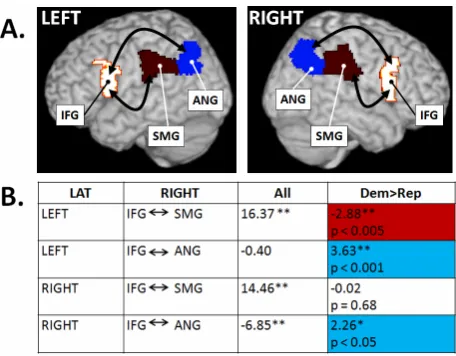
the same network). We conducted two separate analyses. In the first model the left IFG (BA 44) was set as the seed region and we measured the correlation between the BOLD signal generated in that region and the BOLD signal generated in the left ANG (BA 39) and left SMG (BA 40) across the resting-state functional run. In the second analysis, the right IFG (BA 44) was set as the seed region and we measured connectivity with the right ANG (BA39) and right SMG (BA 40) in the same man-ner. In all cases, definitions for anatomical areas of inter-est (BA 44, BA 39 and BA 40) were pre-defined within the CONN functional connectivity toolbox. We then de-fined a second-level model (between-subjects t-test), which allowed us to test for differences between resting-state hMNS functional connectivity in Democrats and Repub-licans. Fixed-effects results were thresholded using a voxel-level uncorrected p-value threshold (p < 0.05). The same approach was used to conduct t-tests to compare resting-state functional connectivity in participants that were for or against specific political issues we asked
them about.
3. Results
3.1. Resting-State Functional Connectivity Our analysis of resting-state functional connectivity re-vealed that, consistent with our apriori hypothesis, self-
reported Democrats exhibited significantly greater con-nectivity that self-reported Republicans within the hMNS.
Specifically, signals generated in the IFG (BA 44) and ANG (BA 39), in both the left and right hemispheres, were significantly higher in Democrats as compared to Republicans (Figure 1(A)). Unexpectedly, Republicans showed significantly greater connectivity between the IFG (BA 44) and SMG (BA 40), but only the left hemi-sphere (Figure 1(B)). It is important to note that the dif-ferences we report are relative difdif-ferences between the two groups.
We also compared hMNS specific resting-state func-tional connectivity in groups which were created based on participants’ stance (“for” or “against”) a number of specific political issues of interest. The results of these analyses are shown in Table 1.
3.2. Empathy (Interpersonal Reactivity Index) In order to examine the relationship between empathy and differences in resting-state functional connectivity we conducted a series of one-sided between-subjects t-tests comparing scores on each of the four IRI subscales (Fan-tasy, Perspective Taking, Empathic Concern, and Per-sonal Distress) in Republicans and Democrats. The over-all empathy score was not statisticover-ally significant in De-mocrats (M = 2.53, SD = 0.41) and Republicans (M = 2.48, SD = 0.33), t(22) = −0.34, p = 0.73. Scores on the Fantasy subscale (MDEM = 2.6, SDDEM = 0.83, MREP = 2.5,
SDREP = 0.71), the Perspective Taking subscale (MDEM =
2.77, SDDEM = 0.9, MREP = 2.51, SDREP = 0.67), the Em-
[image:3.595.309.537.449.627.2]pathic Concern subscale (MDEM = 3.14, SDDEM = 0.44,
Table 1. Comparison of hMNS specific resting-state functional connectivity in groups formed based on participants’ stance (“for” or “against”) regarding a number of specific political issues. All scores represent T-values. Negative values reflect greater connectivity in participants in favor of an issue whereas positive values reflect greater connectivity in participants opposed to specific issues. *Significant at p < 0.05, **Significant at p < 0.005, ***Significant at p < 0.0005, uncorrected for mul-tiple comparisons. All analyses were conducted as fixed-effect analyses.
Left Left Right Right
Issue FOR (N) AGST (N) IFG-ANG IFG-SMG IFG-ANG IFG-SMG
School Prayer 17 7 −1.99* ns ns ns
Pro-Choice/Abortion 12 12 3.45** ns ns ns
Cut Welfare 12 12 ns 3.83*** ns ns
Food Stamp Program 15 8 ns −3.23** −2.06* ns
Same-Sex Marriage 15 9 2.42* ns ns ns
Political Correctness 12 12 2.22* ns ns ns
Death Penalty 9 15 −3.51** ns ns −2.22*
National Health 11 12 ns ns ns ns
Gun Control 17 6 ns ns ns ns
Labor Unions 8 15 ns ns ns ns
Sex-Ed Children 22 2 ns ns ns ns
Medicare 3 20 ns ns ns ns
Condoms (Elem) 4 19 ns ns ns ns
Minimum Wages 24 0 ns ns ns ns
Meals on Wheels 24 0 ns ns ns ns
Help Homeless 24 0 ns ns ns ns
Racial Quotas (jobs) 4 20 ns ns ns ns
Racial Quotas (school) 4 20 ns ns ns ns
MREP = 2.5, SDREP = 0.54) and the Personal Distress
sub-scale (MDEM = 1.44, SDDEM = 0.43, MREP = 1.74, SDREP =
0.71) also failed to reach statistical significance (all p-values > 0.15).
4. Discussion
4.1. Differences in Resting-State Functional Connectivity in Republicans and Democrats The primary goal of the current experiment was to test the hypothesis that self-reported Democrats would show greater resting-state functional connectivity within the hMNS than self-reported Republicans. Consistent with our predictions, we found that core components of the hMNS were more strongly connected in our sample of self-reported Democrats than in our sample of self-re-ported Republicans. Specifically, we found that resting- state functional connectivity between the IFG and ANG, in both the left and right hemispheres, was more robust in Democrats as compared to Republicans. This finding is consistent with prior behavioral research indicating 1) heightened empathy in Democrats; and 2) the involve-ment of the hMNS in social behavior in general [6,17-19, 26]. Interestingly, we also found data inconsistent with this hypothesis. Self-reported Republican participants showed more robust resting-state functional connectivity between the IFG and SMG in the right hemisphere. It is
unlikely that this finding is related to differences in em-pathy as a comparison of emem-pathy in our subsample of self-reported Republicans and Democrats failed to reveal significant differences between the two groups [21].
4.2. Resting-State Functional hMNS Connectivity and Social Connections
This negative finding raises important questions regard-ing the relationship between empathy and restregard-ing-state functional connectivity within the hMNS. Interestingly, recent research suggests that political affiliation is not only associated with differences in empathy and person-ality, but also with specific types of social connections. In a recent large-scale study, Iyer and colleagues per-formed a principle component analysis of participant responses to the Individualism-Collectivism Scale [73], the Identification with All Humanity Scale [74] and the Love Scale [75] and found a 2-factor solution [21]. One of these factors, which they referred to as broad social
connection tapped into constructs like “love of friends” and “identification with the world”. The second term, which they referred to as tight social connection, had
social connectedness, whereas Republicans tended to
score higher on measures of tight social connectedness
[21].
Although we did not explicitly measure social con-nectedness in the present study, it is tempting to specu-late that specific connections within the hMNS may dif-ferentially serve to process broad and tight social
con-nections, and that this difference may be responsible for our finding that self-reported Democrats and Republicans show higher hMNS specific resting state connectivity in distinct pathways.
Particularly pertinent to the present study is the rich literature regarding the function of the inferior parietal lobe (IPL) in 1) processing the concept of self and 2) differentiating self from other. For example, recent
ex-periments have shown that the SMG is activated during sensorimotor conflicts (relevant to sense of agency), whereas the ANG is activated specifically during sensory conflicts that affect sense of agency and body ownership [76,77]. In what is perhaps an even more relevant study, der Heiden and colleagues recently demonstrated that adopting a self-centered perspective (as compared to an other-centered perspective) is associated with increased
activation SMG [78]. Finally, electrical stimulation of the ANG/SMG border via implanted electrodes is capable of eliciting out-of-body experiences in which the sense of self and other are significantly altered [79]. Taken together, studies such as these lend credence to the hypothesis that the SMG is more involved processing the relationship
between self and nearby entities, while the ANG is more
involved in processing of the relationship between self and distant entities. Results from the studies discussed
above are consistent with the hypothesis that greater IFGSMG connectivity observed in Republicans may be related to preferential processing of close (as opposed to distant) social relationships, and vice-a-versa, that greater IFGANG connectivity observed in Democrats may be related to preferential processing of tight social relation-ships. An important goal of future research will be to clarify the role of the ANG and SMG (and their connec-tions with pars opercularis) in the processing of different types of social connections.
4.3. Resting-State Functional hMNS Connectivity and Political Ideology
Our examination of the association between hMNS spe-cific resting-state functional connectivity and stance on individual political issues revealed a number of interest-ing relationships. First, there was a generally relationship between political affiliation and connectivity between the left IFG and left ANG. Participants who supported con-servative issues (i.e. school prayer and death penalty for
murders) exhibited less robust connectivity than partici-
pants who were opposed conservative issues. Conversely, participants who were in favor of more liberal issues (pro-choice and same-sex marriage) tended to have more robust IFG-ANG connectivity in the left hemisphere. It is also interesting to note that the majority of the significant differences reported in this study (7 out of 9) manifested as differences within the left hemisphere hMNS. These findings suggest that hMNS specific resting-state func-tional connectivity, especially in the left hemisphere, may be a particularly important in understanding political af-filiation.
A broader question in all of this is, of course, to what extent party affiliation is determined by biological factors as opposed to environmental ones. Interestingly, a recent study by Settle and colleagues comparing partisan strength in identical and non-identical twins found that heritability accounts for almost half the variance in the strength of partisan attachment [80]. Although no theoretical models currently postulate that basic processing characteristics (such as connectivity) of the hMNS are passed on from one generation to the next, the hMNS has been associ-ated with disorders known to have a significant heritable components including Schizophrenia [81-83] and Autism [43,84-86]). Thus, it is certainly conceivable that hMNS resting-state functional connectivity is influenced by ge-netic factors, and that these factors may at least partially explain the findings of Settle and colleagues. Clearly the current results could be due to either nature (i.e. genetic
factors), nurture (i.e. political socialization within one’s
family/community [87]), or both. At the very minimum, our data is consistent with the idea that differences in party affiliation, be they heritable, environmentally de-termined, or both, may be linked to the biology of the hMNS.
Prior research has established clear differences between liberals and conservatives regarding response inhibition, sensitivity to threat, withdrawal and disgust, all of which have been empirically linked to a specific brain areas (i.e.
dorsolateral prefrontal cortex [dlPFC], inferior frontal cor-tex [IFC], amygdala, insula and ACC [9,12,15,88]). While the areas identified in these previous investigations do not constitute core components of the hMNS, it is im-portant to note the hMNS is intricately connected with a number of these additional brain regions. For this reason, Pineda and colleagues recently proposed the existence of an “extended” mirror neuron system (EMNS) which en-compasses both core components of the hMNS (IFG and IPL) as well as brain areas thought to influence or
of many interesting topics for future study.
4.4. Limitations to Interpretation
While results from the present study clearly indicate dif-ferences in resting-state functional connectivity within the hMNS they must be interpreted with caution. First, the current experiment was a pilot study in which only 24 individuals participated. While we can confidently state that self-reported Republicans and Democrats in this sam-ple showed different patterns of resting-state functional connectivity, we are unable to claim that these results will necessarily hold for other subsamples of the general population. It is also important to note that our design was quasi-experimental in that it was not designed to address the important question of whether differences in political affiliation cause differences in resting-state func-tional connectivity or the other way around.
With regards to the association between hMNS rest-ing-state functional connectivity and specific political issues, it is important to note that, in the current study the sample size was not large enough in some of the groups (i.e. only 3 participants were opposed to Medicare) to
allow for meaningful comparisons between pro and anti
groups. In these cases, non-significant results are reported. This does not rule out the possibility that differences in hMNS resting-state functional connectivity exist between individuals that strongly support or oppose these issues.
Although the current findings should be interpreted with caution, they are consistent with recent literature and gen-erate important recommendations and predictions for fu-ture studies. First, it is imperative that fufu-ture studies should use larger sample sizes. This would make it pos-sible to filter out pospos-sible confounds including but not limited to the effects of age, gender, family circum-stances, education, and race, some of which have been shown to influence measures of brain connectivity [90]. Future studies should also obtain more detailed descrip-tions of participants’ political stance (level of political knowledge, strength of political beliefs, political engage-ment, etc) in order to provide a richer picture of the rela-tionship between political ideology and brain measure-ments.
Finally, it is important to note that the measure of em-pathy we used in the current experiment, the IRI, may not capture key components of the construct of empathy. Based on the recently identified preference for broad and tight social connections in Democrats and Republicans
respectively [21], it is reasonable to assume that mem-bers of these two groups may be more or less able to empathize with/take the perspective of various groups (i.e. friends, family, the nation and the world in general).
The IRI does not distinguish between empathy for one or the other group. Empathy scales that make this distinc-tion should be created and used in future research on
empathy and political affiliation.
4.5. General Conclusion
In the current experiment we compared hMNS specific resting-state functional connectivity in self-reported Re-publicans and Democrats. We found significant differ-ences in connectivity between these two groups within the hMNS bilaterally. While differences in connectivity were not readily understood on the basis of individual empathy scores, they may be related to differences in the nature of social connectedness favored by liberals and conservatives. Analysis of connectivity associated with specific political issues was consistent with the proposed involvement of the hMNS in partisan ideology and sug-gested that connectivity within the left hMNS may be
particularly important when considering party affiliation. Future experiments that examine the relationship between resting-state functional connectivity and social skills in larger populations have the potential to shed light on the neural basis of the serious and consequential behavioral differences we observe every day in Washington.
5. Acknowledgements
We would like to thank Jessica Richardson, Ph.D. for helping us collect the MRI data.
REFERENCES
[1] K. E. Poole and H. Rosenthal, “Congress: A Political- Economic History of Roll Call Voting,” Oxford Univer- sity Press, New York, 1997.
[2] A. J. Hoffman, “The Growing Climate Divide,” Sociology,
1, 2011, pp. 195-196.
[3] J. M. Stonecash, M. D. Brewer and M. D. Mariani, “Di-verging Parties: Realignment, Social Change, and Politi- cal Polarization,” Westview Press, Boulder, 2002. [4] N. McCarty, K. T. Poole and H. Rosenthal, “Polarized
America: The Dance of Ideology and Unequal Riches,” MIT Press, Cambridge, 2008.
[5] G. C. Layman, T. M. Carsey and J. M. Horowicz, “Party Polarization in American Politics: Characteristics, Causes and Consequences,” Annual Review of Political Science,
Vol. 9, 2006, pp. 83-110.
doi:10.1146/annurev.polisci.9.070204.105138
[6] J. T. Kaplan, J. Freedman and M. Iacoboni, “Us versus Them: Political Attitudes and Party Affiliation Influence Neural Response to Faces of Presidential Candidates,”
Neuropsychologia, Vol. 45, No. 1, 2007, pp. 55-64. doi:10.1016/j.neuropsychologia.2006.04.024
[7] J. T. Jost and D. M. Amodio, “Political Ideology as Mo- tivated Social Cognition: Behavioral and Neuroscientific Evidence,” Motivation and Emotion, Vol. 36, No. 1, 2012,
pp. 55-64. doi:10.1007/s11031-011-9260-7
tainty and Threat Associated with Political Conservatism or Ideological Extremity?” Personality and Social Psy- chology Bulletin, Vol. 33, No. 7, 2007, pp. 989-1007. doi:10.1177/0146167207301028
[9] D. M. Amodio, J. T. Jost, S. L. Master and C. M. Yee, “Neurocognitive Correlates of Liberalism and Conserva- tism,” Nature Neuroscience, Vol. 10, 2007, pp. 1246-
1247. doi:10.1038/nn1979
[10] D. M. Amodio, S. L. Master, C. M. Yee and S. E. Taylor, “Neurocognitive Components of Behavioal Inhibition and Activation Systems: Implications for Theories of Self- Regulation,” Psychophysiology, Vol. 45, 2008, pp. 11-19. [11] G. Zamboni, et al., “Individualism, Conservatism, and
Radicalism as Criteria for Processing Political Beliefs: A Parametric fMRI Study,” Society for Neuroscience, Vol. 4,
No. 5, 2009, pp. 367-383. doi:10.1080/17470910902860308
[12] R. Kanai, et al., “Political Orientations Are Correlated
with Brain Structure in Young Adults,” Current Biology,
Vol. 21, No. 8, 2011, pp. 677-680. doi:10.1016/j.cub.2011.03.017
[13] J. H. Fowler and D. Schreiber, “Biology, Politics and the Emerging Science of Human Nature,” Science, Vol. 322,
No. 5903, 2008, pp. 912-914. doi:10.1126/science.1158188
[14] P. K. Hatemi and R. McDermott, “Broadening Political Psychology,” Political Psychology, Vol. 33, No. 1, 2012,
pp. 11-25. doi:10.1111/j.1467-9221.2011.00867.x
[15] M. J. Weissflog, S. J. R. van Noordt, B. L. Choma, J. Dywan and S. J. Segalowitz, “Sociopolitical Ideology and Electrocortical Responses,” Psychophysiology, Vol. 47,
2010, p. 24.
[16] M. H. Davis, “Measuring Individual Differences in Em- pathy: Evidence for a Multidimensional Approach,” Jour- nal of Personality and Social Psychology, Vol. 44, No. 1,
1983, pp. 113-126. doi:10.1037/0022-3514.44.1.113 [17] C. P. McCue and J. D. Gopoian, “Dispositional Empathy
and the Political Gender Gap,” Women and Politics, Vol.
21, No. 2, 2008, pp. 1-20. doi:10.1300/J014v21n02_01 [18] A. S. Gerber, G. A. Huber, D. Doherty and C. M. Dowl-
ing, “Personality and the Strength and Direction of Parti- san Identification,” Political Behavior, Vol. 34, No. 4,
2011, pp. 653-688.
[19] R. Iyer, J. Graham, S. Koleva, P. Ditto and J. Haidt, “Be- yond Identity Politics: Moral Psychology and the 2008 Democratic Primary,” Analyses of Social Issues and Pub- lic Policy, Vol. 10, No. 1, 2010, pp. 293-306.
[20] J. J. Mondak and K. D. Halperin, “A Framework for the Study of Personality and Political Behaviour,” British Journal of Political Science, Vol. 38, No. 2, 2008, pp.
335-362. doi:10.1017/S0007123408000173
[21] R. Iyer, S. Koleva, J. Graham, P. Ditto and J. Haidt, “Understanding Libertarian Morality: The Psychological Dispositions of Self-Identified Libertarians,” PLoS One,
Vol. 7, No. 8, 2012, Article ID: e42366. doi:10.1371/journal.pone.0042366
[22] G. di Pellegrino, et al., “Understanding Motor Events: A Neurophysiological Study,” Experimental Brain Research,
Vol. 91, No. 1, 1992, pp. 176-180. doi:10.1007/BF00230027
[23] N. Sebanz and C. Frith, “Beyond Simulation? Neural Mechanisms for Predicting the Actions of others,” Nature Neuroscience, Vol. 7, No. 1, 2004, pp. 5-6.
doi:10.1038/nn0104-5
[24] M. Iacoboni, et al., “Grasping the Intentions of Others
with One’s Own Mirror Neuron System,” PLoS Biology,
Vol. 3, No. 3, 2005, Article ID: e79. doi:10.1371/journal.pbio.0030079
[25] G. Rizzolatti and L. Craighero, “The Mirror-Neuron Sys- tem,” Annual Review of Neuroscience, Vol. 27, 2004, pp.
169-192. doi:10.1146/annurev.neuro.27.070203.144230 [26] V. Gallese and A. Goldman, “Mirror Neurons and the
Simulation Theory of Mind-Reading,” Trends in Cogni- tive Sciences, Vol. 2, No. 12, 1998, pp. 493-501. doi:10.1016/S1364-6613(98)01262-5
[27] H. Theoret, et al., “Impaired Motor Facilitation during
Action Observation in Individuals with Autism Spectrum Disorder,” Current Biology, Vol. 15, No. 3, 2005, pp.
R84-R85. doi:10.1016/j.cub.2005.01.022
[28] L. Q. Uddin, et al., “Self-Face Recognition Activates a
Frontoparietal ‘Mirror’ Network in the Right Hemisphere: An Event-Related fMRI Study,” Neuroimage, Vol. 25,
No. 3, 2005, pp. 926-935.
doi:10.1016/j.neuroimage.2004.12.018
[29] S. Atmaca, et al., “Action Co-Representation: The Joint SNARC Effect,” Society for Neuroscience, Vol. 3, No.
3-4, 2008, pp. 410-420.
[30] L. Aziz-Zadeh, et al., “Lateralization of the Human
Mir-ror Neuron System,” Journal of Neuroscience, Vol. 26, No. 11, 2006, pp. 2964-2970.
doi:10.1523/JNEUROSCI.2921-05.2006
[31] I. Molnar-Szakacs, et al., “Observing Complex Action
Sequences: The Role of the Fronto-Parietal Mirror Neu-ron System,” Neuroimage, Vol. 33, No. 3, 2006, pp. 923-
935. doi:10.1016/j.neuroimage.2006.07.035
[32] J. M. Kilner, et al., “Evidence of Mirror Neurons in
Hu-man Inferior Frontal Gyrus,” Journal of Neuroscience, Vol. 29, No. 32, 2009, pp. 10153-10159.
doi:10.1523/JNEUROSCI.2668-09.2009
[33] A. F. Hamilton and S. T. Grafton, “Goal Representation in Human Anterior Intraparietal Sulcus,” Journal of Neu- roscience, Vol. 26, No. 4, 2006, pp. 1133-1137. doi:10.1523/JNEUROSCI.4551-05.2006
[34] C. Catmur, V. Walsh and C. Heyes, “Sensorimotor Learn- ing Configures the Human Mirror System,” Current Bi- ology, Vol. 17, No. 17, 2007, pp. 1527-1531.
[35] L. Fadiga, et al., “Motor Facilitation during Action Ob-
servation: A Magnetic Stimulation Study,” Journal of Neurophysiology, Vol. 73, No. 6, 1995, pp. 2608-2611. [36] R. D. Newman-Norlund, et al., “Virtual Lesions of the
IFG Abolish Response Facilitation for Biological and Non-Biological Cues,” Frontiers in Behavioral Neurosci- ence, Vol. 4, 2010, p. 5.
[37] M. Heiser, et al., “The Essential Role of Broca’s Area in
Imitation,” European Journal of Neuroscience, Vol. 17,
doi:10.1046/j.1460-9568.2003.02530.x
[38] R. Mukamel, et al., “Single-Neuron Responses in Hu-
mans during Execution and Observation of Actions,”
Current Biology, Vol. 20, No. 8, 2010, pp. 750-756. doi:10.1016/j.cub.2010.02.045
[39] L. Cattaneo, et al., “Impairment of Actions Chains in
Autism and Its Possible Role in Intention Understand- ing,” Proceedings of the National Academy of Sciences of the United States of America, Vol. 104, No. 45, 2007, pp.
17825-17530. doi:10.1073/pnas.0706273104
[40] J. C. Carmo, R. I. Rumiati and A. Vallesi, “Understand- ing and Imitating Unfamiliar Actions: Distinct Underly- ing Mechanisms,” PLoS One, Vol. 7, No. 10, 2012, Arti-
cle ID: e46939.doi:10.1371/journal.pone.0046939 [41] L. Fogassi, et al., “Parietal Lobe: From Action Organiza-
tion to Intention Understanding,” Science, Vol. 308, No.
5722, 2005, pp. 662-667.doi:10.1126/science.1106138 [42] V. Gallese, “Embodied Simulation: From Mirror Neuron
Systems to Interpersonal Relations,” Novartis Foundation Symposium, Vol. 278, 2007, pp. 3-12.
[43] L. M. Oberman, and V. S. Ramachandran, “The Simula- ting Social Mind: The Role of the Mirror Neuron System and Simulation in the Social and Communicative Deficits of Autism Spectrum Disorders,” Psychological Bulletin,
Vol. 133, No. 2, 2007, pp. 310-327. doi:10.1037/0033-2909.133.2.310
[44] J. M. Kilner, K. J. Friston and C. D. Frith, “Predictive Coding: An Account of the Mirror Neuron System,”
Cognitive Processing, Vol. 8, No. 3, 2007, pp. 159-166. doi:10.1007/s10339-007-0170-2
[45] F. P. de Lange, et al., “Complementary Systems for Un-
derstanding Action Intentions,” Current Biology, Vol. 18,
No. 6, 2008, pp. 454-457.doi:10.1016/j.cub.2008.02.057 [46] G. Buccino, et al., “The Neural Basis for Understanding
Non-Intended Actions,” Neuroimage, Vol. 36, Suppl. 2,
2007, pp. T119-T127.
doi:10.1016/j.neuroimage.2007.03.036
[47] N. Canessa, et al., “The Neural Bases of Social Intention
Understanding: The Role of Interaction Goals,” PLoS One, Vol. 7, No. 7, Article ID: e42347.
doi:10.1371/journal.pone.0042347
[48] M. Schulte-Ruther, et al., “Gender Differences in Brain
Networks Supporting Empathy,” Neuroimage, Vol. 42,
No. 1, 2008, pp. 393-403.
doi:10.1016/j.neuroimage.2008.04.180
[49] L. F. Hausser, “Empathy and Mirror Neurons. A View on Contemporary Neuropsychological Empathy Research,”
Praxis der Kinderpsychologie and Kinderpsychiatrie, Vol.
61, No. 5, 2012, pp. 322-335.
[50] J. T. Kaplan and M. Iacoboni, “Getting a Grip on Other Minds: Mirror Neurons, Intention Understanding, and Cognitive Empathy,” Social Neuroscience, Vol. 1, No. 3-
4, 2006, pp. 175-183. doi:10.1080/17470910600985605 [51] A. D. Baird, I. E. Scheffer and S. J. Wilson, “Mirror Neu-
ron System Involvement in Empathy: A Critical Look at the Evidence,” Social Neuroscience, Vol. 6, No. 4, 2011,
pp. 327-335. doi:10.1080/17470919.2010.547085
[52] S. A. Morelli, L. T. Rameson and M. D. Lieberman, “The
Neural Components of Empathy: Predicting Daily Proso- cial Behavior,” Social Cognitive and Affective Neurosci- ence, 2012.
[53] J. H. Pfeifer, et al., “Mirroring Others’ Emotions Relates
to Empathy and Interpersonal Competence in Children,”
Neuroimage, Vol. 39, No. 4, 2008, pp. 2076-2085. doi:10.1016/j.neuroimage.2007.10.032
[54] S. G. Shamay-Tsoory, J. Aharon-Peretz and D. Perry, “Two Systems for Empathy: A Double Dissociation be- tween Emotional and Cognitive Empathy in Inferior Frontal Gyrus versus Ventromedial Prefrontal Lesions,”
Brain, Vol. 132, No. 3, 2009, pp. 617-627. doi:10.1093/brain/awn279
[55] V. Gallese, M. N. Eagle and P. Migone, “Intentional At- tunement: Mirror Neurons and the Neural Underpinnings of Interpersonal Relations,” Journal of the American Psy- choanalytic Association, Vol. 55, No. 1, 2007, pp. 131- 176.doi:10.1177/00030651070550010601
[56] F. Chersi, “Neural Mechanisms and Models Underlying Joint Action,” Experimental Brain Research, Vol. 211, No. 3-4, 2011, pp. 643-653.
doi:10.1007/s00221-011-2690-3
[57] S. Ortigue, et al., “Understanding Actions of Others: The
Electrodynamics of the Left and Right Hemispheres. A High-Density EEG Neuroimaging Study,” PLoS One, Vol. 5, No. 8, 2010, Article ID: e12160.
doi:10.1371/journal.pone.0012160
[58] A. M. B. Stoit, H. T. van Schie, M. Riem, R. G. J. Meu- lenbroek, R. D. Newman-Norlund, H. Bekkering and B J. K. Uitelaar, “Internal Model Deficits Impair Joint Action in Children and Adolescents with Autism Spectrum Dis- orders,” Research in Autism Spectrum Disorders, Vol. 5,
No. 4, 2011, pp. 1526-1537. doi:10.1016/j.rasd.2011.02.016
[59] R. D. Newman-Norlund, et al., “Anatomical Substrates of Cooperative Joint-Action in a Continuous Motor Task: Virtual Lifting and Balancing,” Neuroimage, Vol. 41, No.
1, 2008, pp. 169-177.
doi:10.1016/j.neuroimage.2008.02.026
[60] R. D. Newman-Norlund, et al., “The Mirror Neuron Sys-
tem Is More Active during Complementary Compared with Imitative Action,” Nature Neuroscience, Vol. 10, No.
7, 2007, pp. 817-818.
[61] L. Dossey, “Strange Contagions: Of Laughter, Jumps, Jerks, and Mirror Neurons,” EXPLORE: The Journal of Science and Healing, Vol. 6, No. 3, 2010, pp. 119-128. doi:10.1016/j.explore.2010.03.001
[62] C. A. Bouquet, et al., “Motor Contagion: Goal-Directed
Actions Are More Contagious Than Non-Goal-Directed Actions,” Experimental Psychology, Vol. 58, No. 1, 2011,
pp. 71-78. doi:10.1027/1618-3169/a000069
[63] N. R. Cooper, et al., “Bridging a Yawning Chasm: EEG
Investigations into the Debate Concerning the Role of the Human Mirror Neuron System in Contagious Yawning,”
Cognitive, Affective, & Behavioral Neuroscience, Vol. 12, No. 2, 2012, pp. 393-405.doi:10.3758/s13415-011-0081-7 [64] H. Haker, et al., “Mirror Neuron Activity during Conta-
[65] K. M. Knutson, et al., “Politics on the Brain: An FMRI
Investigation,” Social Neuroscience, Vol. 1, No. 1, 2006, pp. 25-40.doi:10.1080/17470910600670603
[66] M. P. Van den Heuvel and H. E. H. Pol, “Exploring the Brain Network: A Review on Resting-State fMRI Func- tional Connectivity,” European Neuropsychopharmaco- logy, Vol. 20, No. 8, 2010, pp. 519-534.
doi:10.1016/j.euroneuro.2010.03.008
[67] J. S. Adelstein, et al., “Personality Is Reflected in the
Brain’s Intrinsic Functional Architecture,” PLoS One, Vol. 6, No. 11, 2011, Article ID: e27633.
doi:10.1371/journal.pone.0027633
[68] R. Sala-Llonch, et al., “Brain Connectivity during Resting
State and Subsequent Working Memory Task Predicts Behavioural Performance,” Cortex, Vol. 48, No. 9, 2011,
pp. 1187-1196. doi:10.1016/j.cortex.2011.07.006
[69] A. Martin, K. A. Barnes and W. D. Stevens, “Spontane- ous Neural Activity Predicts Individual Differences in Performance,” Proceedings of National Academy of Sci- ences of the United States of America, Vol. 109, No. 9, 2012, pp. 3201-3202.doi:10.1073/pnas.1200329109 [70] E. A. von dem Hagen, et al., “Reduced Functional Con-
nectivity within and between ‘Social’ Resting State Net- works in Autism Spectrum Conditions,” Social Cognitive and Affective Neuroscience, 2012.
[71] A. Baldassarre, et al., “Individual Variability in Func-
tional Connectivity Predicts Performance of a Perceptual Task,” Proceedings of National Academy of Sciences of the United States of America, Vol. 109, No. 9, 2012, pp.
3516-3521.doi:10.1073/pnas.1113148109
[72] D. Wendt, “Political Ideology Questionnaire,” 2012. https://wveis.k12.wv.us/teach21/cso/upload/LP1509WS1. doc
[73] T. M. Singelis, H. C. Triandis, D. P. S. Bhawuk and M. J. Gelfland, “Horizontal and Vertical Dimensions of Indi- vidualism and Collectivism: A Theoretical and Measure- ment Refinement,” Cross-Cultural Research, Vol. 29, No.
3, 1995, pp. 240-275.doi:10.1177/106939719502900302 [74] S. McFarland and D. Brown, “Who Believes that Identi-
fication with all Humanity Is Ethical?” Psicologia Poli- tica, Vol. 36, 2008, pp. 37-49.
[75] B. Campos, D. Keltner and G. C. Gonzaga, “Different Kinds of Love: How Love Experiences Differ across Re- lationships in Western Psychological Association,” 2002. [76] M. Tsakiris, M. R. Longo and P. Haggard, “Having a
Body versus Moving Your Body: Neural Signatures of Agency and Body-Ownership,” Neuropsychologia, Vol.
48, No. 9, 2010, pp. 2740-2749.
doi:10.1016/j.neuropsychologia.2010.05.021
[77] C. Farrer, et al., “Effect of Distorted Visual Feedback on
the Sense of Agency,” Behavioral Neurology, Vol. 1, No.
1-2, 2008, pp. 53-57.
[78] L. V. der Heiden, S. Scherpiet, L. Konicar, N. Birbau- mer and R. Veit, “Inter-Individual Differences in Suc- cessful Perspective Taking during Pain Perception Medi-
ates Emotional Responsiveness in Self and Others: An fMRI Study,” Neuroimage, Vol. 65, 2012, pp. 387-394. [79] D. De Ridder, et al., “Visualizing Out-of-Body Experi-
ence in the Brain,” The New England Journal of Medicine,
Vol. 357, No. 18, 2007, pp. 1829-1833. doi:10.1056/NEJMoa070010
[80] J. E. Settle, C. T. Dawes and J. H. Fowler, “The Herita- bility of Partisan Attachment,” Political Research Quar- terly, Vol. 62, No. 3, 2009, pp. 601-613.
doi:10.1177/1065912908327607
[81] P. Lichtenstein, et al., “Common Genetic Determinants of
Schizophrenia and Bipolar Disorder in Swedish Families: A Population-Based Study,” The Lancet, Vol. 373, No.
9659, 2009, pp. 234-249.
doi:10.1016/S0140-6736(09)60072-6
[82] U. M. Mehta, et al., “Mirror Neuron Dysfunction—A
Neuro-Marker for Social Cognition Deficits in Drug Na- ive Schizophrenia,” Schizophrenia Research, Vol. 141,
No. 2-3, 2012, pp. 281-283. doi:10.1016/j.schres.2012.07.005
[83] P. G. Enticott, et al., “Reduced Motor Facilitation during
Action Observation in Schizophrenia: A Mirror Neuron Deficit?” Schizophrenia Research, Vol. 102, No. 1-3,
2008, pp. 116-121.doi:10.1016/j.schres.2008.04.001 [84] J. Hallmayer, et al., “Genetic Heritability and Shared
Environmental Factors among Twin Pairs with Autism,”
Archives of General Psychiatry, Vol. 68, No. 11, 2011, pp.
1095-1102. doi:10.1001/archgenpsychiatry.2011.76 [85] M. Dapretto, et al., “Understanding Emotions in Others:
Mirror Neuron Dysfunction in Children with Autism Spectrum Disorders,” Nature Neuroscience, Vol. 9, No. 1,
2006, pp. 28-30.
[86] N. Hadjikhani et al., “Anatomical Differences in the Mir-
ror Neuron System and Social Cognition Network in Au- tism,” Cerebral Cortex, Vol. 16, No. 9, 2006, pp. 1276-
1282. doi:10.1093/cercor/bhj069
[87] R. G. Niemi and M. K. Jennings, “Issues and Inheritance in the Formation of Party Identification,” Journal of Po- litical Science, Vol. 35, No. 4, 1991, pp. 970-988.
[88] M. Jabbi, J. Bastiaansen and C. Keysers, “A Common Anterior Insula Representation of Disgust Observation, Experience and Imagination Shows Divergent Functional Connectivity Pathways,” PLoS One, Vol. 3, No. 8, 2008,
Article ID: e2939. doi:10.1371/journal.pone.0002939 [89] J. A. Pineda, “Sensorimotor Cortex as a Critical Compo-
nent of an ‘Extended’ Mirror Neuron System: Does it Solve the Development, Correspondence, and Control Problems in Mirroring?” Behavioral and Brain Functions,
Vol. 4, 2008, p. 47.doi:10.1186/1744-9081-4-47
[90] M. P. Lopez-Larson, J. S. Anderson, M. A. Ferguson and D. Yurgelun-Todd, “Local Brain Connectivity and Asso- ciations with Gender and Age,” Developmental Cognitive Neuroscience, Vol. 1, No. 2, 2011, pp. 187-197.