Studying developing country business
groups: some issues with reference to the
Indian case
Mazumdar, Surajit
2011
Online at
https://mpra.ub.uni-muenchen.de/38906/
1
Studying Developing Country Business Groups: Some Issues with
Reference to the Indian Case
Surajit Mazumdar
Ambedkar University, Delhi (AUD), India E-mail:[email protected]
This paper is mainly a modified version of the first three parts of my earlier paper titled the
‘Analysis of Business Groups: Some Observations with Reference to India’ but with has some additional material.
Abstract
Through a critical review of some of the literature and making use of information relating to Indian groups, the case is made for a more bottom-up, and more historical, approach to the study of the developing country business group. The lack of clarity and unanimity in the conceptualization of the business group, the mismatch between many conceptions and the reality of Indian groups and how avoidable ignorance has led to mistaken conclusions are highlighted. Arguing that these problems stem from an excessive bias towards a top-down method of analyzing business groups, a shift in emphasis towards the concrete investigation of these groups, of their structures and working, and of their evolution over time, is urged.
2
Studying Developing Country Business Groups: Some Issues with
Reference to the Indian Case
A fairy substantial body of literature has now developed which examines the origins and consequences of business groups in developing countries or ‘emerging markets’. The
institution is studied from a variety of angles, and differences exist in perceptions about why groups exist and what effects they produce (Khanna and Yafeh, 2007). Two basic premises however seem to have unquestioned acceptance. These are: groups dominate the corporate and business landscape in many developing countries; and, the business group is a generic organizational form that is a distinct coordinating device relative to the standard firm. This paper questions the appropriateness of starting from such presuppositions and the broad methodological approach implied by their acceptance, using for that purpose information relating to the Indian case. The point being made is that the validity of these premises themselves needs to be examined against evidence, something that has not been done systematically. Instead, effectively assuming the results it would throw up deflects attention away from the research which would generate the evidence necessary for this examination. This is the detailed, concrete investigations of business groups in different countries, of their structures and working, and of their evolution over time. Making generalized conjectures about emerging market business groups without such a foundation cannot be considered a methodologically sound approach. Yet there appears to be a tendency to do precisely that. The larger conclusion emerging out of this paper therefore is that a more bottom-up, and more historical, approach to the study of business groups is needed than appears to be prevalent.
3 what constitutes a business group, and the mismatch between many conceptions and the reality of Indian groups, are highlighted. This serves to drive home the point that the ‘emerging-market business group’ may be an over-abstract concept. The second section of
the paper then illustrates, with two cases drawn from the literature, how an excessive bias towards a top-down approach can be fatal for the analysis undertaken. In both, avoidable ignorance of Indian reality is shown to be culprit. The major implications of the discussion in these two sections are then laid out in the concluding section at the end of the paper.
What is a Business Group?
The business group has been described as a proto-concept (Smangs 2006) and the absence of a commonly agreed upon definition of the institution has been recognized (Cuervo-Cazurra 2006). Notwithstanding their family resemblance to each other, different conceptions of the emerging market business group are far from being even approximately the same, let alone identical. Broadly speaking, these definitions zero in on some combination of four different attributes to demarcate business groups. The first is their multi-company
structure – that they consist of a number of companies which are legally independent entities but whose activities are nevertheless coordinated. The second is their conglomerate character, a simultaneous engagement in a diverse set of often unrelated businesses. A third is that business groups are associated with concentration in ownership and control. Finally, the role that social networks based on family and other social ties, between individuals owning, controlling, and managing the constituent businesses or companies of the group, play in imparting cohesion to a group is also sometimes stressed.
4 important or subtle shifts in the specific meaning given to a particular feature have been introduced. Amsden and Hikino (1994) for instance took conglomerate diversification as the most important feature of the business group and made no reference to the multi-company form. The most important amendment of the second kind relates to the interpretation of the company nature of the group. In Leff each business group was an individual multi-company firm. But following Granovetter (1994 and 1995) business groups tend to be seen as collections of firms that occupy a somewhat intermediate position between the firm and the market, as a “hybrid organizational form” (Khanna and Yafeh, 2007, p. 333). Leff had
emphasized the role that participation of many families in a group played in pooling capital because of the limited development of separation of ownership and control. He did not therefore insist, as some more recent formulations have (Khanna and Palepu, 2000), on the multiplicity of public companies as a characteristic feature of the group.
If there is a common thread that runs through the different definitions of the business group, it would probably be the recognition of unrelated or conglomerate diversification as one of the important defining features of a group. Most explanations of the business group in developing countries (Leff, 1978; Amsden and Hikino, 1994; Ghemawat and Khanna, 1998, Khanna and Palepu, 2000; Guillen, 2000; Khanna and Rivkin, 2001; Jeon and Kim, 2004) also focus chiefly on this characteristic. The explicit connection between business groups and concentrated ownership is however drawn only occasionally (Khanna and Palepu, 2005; Morck, Wolfenzon, and Yeung, 2005).
The Firm, the Market and the Group
5 firms, and the difference is not merely a matter of the degree of coordination. The former is fundamentally no different from coordination within a stand-alone company. Extra-market coordination between firms having an independent identity prior to and outside of that coordination is quite another thing. To the latter kind of cases would be extremely relevant the question Granovetter (1994, 1995) considered the most important one in relation to groups: how individual firms establish links between their activities? When the group is an individual firm, this would be a redundant question. Instead one has to ask: why and in what circumstances are firms induced to adopt a specifically multi-company form and modify its structure? It would follow that the business group as firm and as inter-firm structure are two very different entities.
In India, the term business group has been basically used to describe a set of companies having a centralized common authority (Hazari, 1966). Its precursor was the managing-agency house, also a multi-company structure, which emerged in the 19th century1. Individual multi-company groups or managing agency houses in India have not been the results of processes of otherwise independent companies coming together in some kind of a federal structure. Instead, they have always been deliberate creations of their single controlling authorities. Behind the set of companies constituting an Indian business group at any point of time, their structure of connections, and the evolution of the group structure over time, has always been the guiding hand of the central controlling authority of the group. Thus
1The managing agency system involved the contractual vesting of the responsibility for
6 the Indian business group is simply a business firm given a multi-company rather than stand-alone company form by its creator, and not really a hybrid organizational structure. In this regard it may be close to Leff’s conception of the group, but far from so in other senses.
Families, Business Groups and Concentrated Ownership in India
The use of the multi-company form in India has not been limited to Indian family business firms. European businessmen were the initial creators of the multiple-company managing agency houses in the 19th century, at a time when most Indian businesses were single company firms (Rungta, 1970). Apart from such European controlled firms, some of whom survived till the 1970s, affiliates of foreign multinationals, government controlled enterprises, and even some of the few professionally managed enterprises in India have also assumed at times a multiple-company form. Amongst the top 70 odd largest ‘groups’
identified by the Monopolies Inquiry Commission (MIC) (Government of India, 1965) and the Industrial Licensing Policy Inquiry Committee (ILPIC) (Government of India, 1969) were European controlled ones like Andrew Yule and Gillanders Arbuthnot, and those like ICI and Swedish Match which were multinational affiliates. Subsequently, other multinationals like Unilever and British American Tobacco (BAT) also had multiple companies, as did professionally-managed Larsen & Toubro. Andrew Yule, taken over by the government in the 1970s, and the Gujarat Fertilizers group have been government-controlled groups.
7 family groups (Hazari, 1966; Government of India, 1965; Government of India, 1969). Over time, however, the cohesion provided by ties within and between families also came to be increasingly undermined. Internecine squabbles between collaborating families were followed by divisions within firms controlled by single families to the extent that there is hardly any Indian business group of significance today which has not experienced one or more division. Instead of social and family ties providing the glue for bringing independent firms into a common structure, the breaking up of originally single firms has been the more prominent aspect of family control over business firms in India. The different parts emerging from such partitions often themselves have had a multi-company group form or subsequently spawned one. In the case of one group which has remained free of the problem of division and also always been amongst the largest, the Tata group, the family in fact has been very small.
The multi-company group form in India has therefore not been an institution that is exclusively or primarily built around large networks of family and other social ties. Indian business families, in sharp contrast to Leff’s conception, have also not been major contributors of the capital to the enterprises controlled by them.
In India, private sector companies have for long generally relied on external funds for financing their growth2. Banks and financial institutions (mainly public sector for a long
2
8 stretch of time) have been the main fillers of this financing gap, accounting for over three-fourths of such funds for the last three decades and more than half in the three decades of the post-independence period prior to that (Reserve Bank of India, 2000 and 2007). Thus, those controlling business groups have neither been typically the source of external funds and often not even performed the function of pooling them.
Even what might be considered the share of the controlling business families in the internal sources of their companies has not been very high in India. The direct holdings of equity by such families, the only part to acquire which they would have had to provide funds, have tended to typically become small over time and with increase in company size. However, there has been a difference between the shareholding owned and that controlled by these families, the latter being usually much larger. The multi-company structure has allowed recourse to the device of what in India have been called inter-corporate investments, the holding of equity in companies by other companies (Hazari, 1966; Goyal, 1979; Singhania, 1980; Rao, 1985). Of such equity whose immediate ownership is vested in companies, those controlling them are not the ultimate owners. In fact group inter-corporate investments create fictitious share capital. They give rise to mutually cancelling out liabilities and assets for the group as a whole – the equity held by any one group company being a claim on other group companies. Such internally held share capital would therefore disappear if the group companies were to be consolidated into a single company.
In relation to the corporate sector, concentrated ownership can describe two kinds of concentration - a) in the distribution pattern of equity ownership of companies; and b) in the
9 distribution of corporate assets between firms, or aggregate concentration. Both have been characteristic features of the Indian corporate sector, but not because a few large family networks have been the main sources of financing business ventures. The former concentration has been instead the result of companies and institutions, both Indian and foreign, dominating ownership of corporate securities. Aggregate concentration on the other hand has been facilitated by the separation of ownership and control of capital, with concentration in the control being the result of the allocation pattern of finance through markets and intermediaries. The prevalence of multi-company firm structures has certainly meant that the actual level of aggregate concentration in India has been higher than that indicated by the degree of concentration in the size distribution of companies. However, unlike what may be true if groups were devices of inter-firm coordination, there is no causal connection between the two in the Indian case3. Why capital is concentrated in a few firms is a different question from why these firms distribute the capital commanded by them between many companies.
Business Groups and Diversification
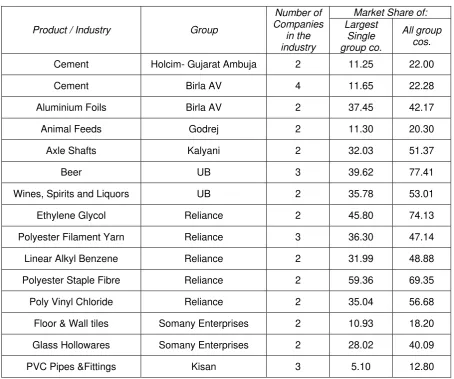
A link between conglomerate diversification and the multi-company attribute of groups is likely only when a group is a coalition of different individual firms engaged in different businesses. Individual companies can always have a conglomerate diversification pattern and have multiple divisions. Many companies are therefore not required by a single firm to organize a variety of businesses. On the other hand if a single firm does assume a multi-company character, it could choose to have more than a single company in the same
3
10 industry. Thus, for such firms, their diversification pattern and their multi-company form are distinct phenomenon.
11 Table 1: Illustrative List of Cases of Multiple Group Companies in the Same Industry, 2005-06
Product / Industry Group
Number of Companies
in the industry
Market Share of: Largest
Single group co.
All group cos.
Cement Holcim- Gujarat Ambuja 2 11.25 22.00
Cement Birla AV 4 11.65 22.28
Aluminium Foils Birla AV 2 37.45 42.17
Animal Feeds Godrej 2 11.30 20.30
Axle Shafts Kalyani 2 32.03 51.37
Beer UB 3 39.62 77.41
Wines, Spirits and Liquors UB 2 35.78 53.01
Ethylene Glycol Reliance 2 45.80 74.13
Polyester Filament Yarn Reliance 3 36.30 47.14
Linear Alkyl Benzene Reliance 2 31.99 48.88
Polyester Staple Fibre Reliance 2 59.36 69.35
Poly Vinyl Chloride Reliance 2 35.04 56.68
Floor & Wall tiles Somany Enterprises 2 10.93 18.20
Glass Hollowares Somany Enterprises 2 28.02 40.09
PVC Pipes &Fittings Kisan 3 5.10 12.80
Source: Derived from Centre for Monitoring the Indian Economy (CMIE), Market Size and Shares,
2007
12 textiles and fibres, and petrochemicals) and it diversified into unrelated activities (power, telecom, retail, financial businesses, construction, etc.) only in the 1990s and after. This evidence thus indicates that while some multi-company firms in India at any point of time have a highly diversified character; it is not always true of every such firm at all points of time and even for extended periods of time.
The Architecture of Indian Business Groups
The multi-company firm is a generic expression that conveys nothing about the nature and numbers of companies constituting a group, and their placing in relation to each other within the group structure. In India, group architectures have been actually quite varied.
The legal entities that have been the objects of a common centralized control in the Indian business world have been varied - companies with shares publicly traded on stock exchanges, narrowly held companies not listed on exchanges, and even partnership and proprietary firms. One dimension of variation between multi-company firms has been the numbers of each of these different kinds of entities and the pattern of distribution of assets between them4. A contemporary indication of this diversity is provided by the number of publicly listed companies that different groups have – which range from a single one to
4
13 numbers in double digits. If the multiple public company criteria were to be strictly applied, then many of those classified as group affiliated companies in the standard databases used by researchers5 would not qualify as groups. On the other hand if a simple multi-company criteria were adopted, many Indian private companies that are not classified as group affiliated in the same databases and therefore assumed by most to be stand-alone companies, would become group affiliated.
In fact, amongst public companies in India the pure stand-alone company is relatively rare. This is revealed by the common presence in the promoter’s stake (what is admitted as the part of the company’s equity controlled by those who manage it) of the holdings of other
companies. Table 2 shows that in a sample of 171 listed companies that were not classified as being attached to any group in the Prowess database6 not only is a high level of the promoter’s stake very common, more than half the companies also reported other companies
among their controlling group of shareholders. Even amongst companies where the promoter’s stake is held entirely by individuals, one can find cases like that of three India
Bulls companies where the promoter shareholders are common and who therefore have a common controlling authority.
Not only are pure stand-alone companies rare in India, even when they exist they do not necessarily remain so forever. The MIC as well as the ILPIC had in the 1960s identified
5
The Prowess of the Centre for Monitoring the Indian Economy (CMIE) is the most commonly used.
6
14 many that the latter called large independent companies, which were large stand-alone companies, many of whom were larger than some of the groups they had identified (Government of India,1965 and 1969). Subsequently, because of the discovery of other companies affiliated to them or because of the floating of additional companies by their controlling authorities, these companies acquired the character of groups. Examples of such groups are Godrej, Escorts, Larsen & Toubro, Mohan Meakins, Rohit, and Chowgule.
In multi-company firms each company can perform either one or both roles – it can be the legal entity through which one or more business activities are undertaken and it can be the holder of shares in other group companies. The arrangement of these functions between different companies also shows great variety amongst Indian groups. In some cases these two functions are more clearly demarcated between typically narrowly held investment companies and public companies respectively while in others public and private companies may simultaneously perform both functions7. In some groups, all the businesses of the firm may be concentrated in a single company while in others they may be distributed between a great many. There are also significant variations in the pattern of inter-corporate investments between group companies. A set of narrowly held investment companies sharing the holding of a controlling stake in one major company is one simple form. At the other end could be an extremely complex structure of different companies of different types being connected through chains of such investments, of both linear and circular varieties, with any single company being simultaneously part of many separate chains of both types (Hazari, 1966; Singhania, 1980).
7
15
Table 2: Promoter’s Share in ‘Stand-Alone’ Companies in India (As on 30 June 2008)
Threshold Level
Number of Companies in Sample with Share Greater than Threshold Level of:
Promoters Total Holding in Total
Equity
Promoter Group Bodies Corporate in
Total Equity
Bodies Corporate in Total Promoter Group
Equity
More than 50% 76 11 56
More than 40% 101 17 65
More than 30% 128 34 74
More than 20% 154 55 84
More than 10% 164 71 97
More than 0% 171 111 111
0% 0 60 60
Source: Bombay Stock Exchange (http://www.bseindia.com), Shareholding Patterns
The structures of individual firms, as illustrated by the case of independent companies turning into groups, are also variable across time. An interesting example of such variations is provided by the Reliance group. Before the public listing of Reliance Industries in 1977, the group had incorporated six companies, none of which was listed on any stock exchange and whose shares were held by mainly members of the controlling family. The manufacturing/processing activities were spread between four of these companies. After that there was a rapid proliferation in the number of companies of the group in the 1980s, mostly for holding the shares of what was the sole publicly listed company of the group for over a decade. The group’s manufacturing activities and productive assets also came to be
16
The Perils of a Top-Down bias: Two Illustrative Cases
The two cases discussed in this section are representative of two very different outlooks on business groups. They however share the common feature of misreading the evidence to support their position, the proximate cause in both instances being inadequate acquaintance with the reality of Indian groups. This unfamiliarity, and the willingness to arrive at conclusions in the face of it, is not limited to these two cases and should be attributed to the tendencies inherent in a top-down methodology rather than simple ignorance or carelessness.
Bertrand, Mehta and Mullainathan: Tunneling Amongst Indian Groups
Bertrand et al (2000 and 2002) set out to find evidence of tunneling amongst Indian groups, to quantify its extent, and to identify its mechanism. The phenomenon of tunneling refers to the transfer of profits, at the expense of other shareholders, by those controlling the group from companies where they have lower cash flow rights to those where these rights are greater. The feature of the Indian business group Bertrand et al were concerned with was consequently the multi-company structure with a common centralized control.
The basic method Bertrand et al relied on was a comparison of the responses of group affiliated companies and stand-alones in a sample data set to profit shocks in their own and other industries. The extent of deviation of their actual from predicted (average industry) responses was used for this purpose. The lower responsiveness of group affiliated companies to such profit shocks in their own industries and greater responsiveness to that in other industries was treated as the evidence of tunneling. It was also found that this tunneling was operating entirely through the non-operating profits.
17 groups but not in stand-alones; and that the difference in their responsiveness to profit shocks could only be on account of this. In the process two critically important facts related to the multi-company structure of the Indian group were ignored.
The first of these is that the multi-company structure with uneven cash flow rights is always a deliberate creation, and the option of creating such a structure is open to the management of any firm. The simplest way of doing so for anyone controlling a public company would be to create a parallel narrowly held private limited company. We have seen earlier that even companies that are apparently stand-alones often have such affiliated companies. In such circumstances, logically the tendency towards tunneling should exist in equal measure in all public companies whether group affiliated or stand-alone. The separation of the two kinds of companies in the sample could also have been more notional than real, reflecting only the exclusion of the narrowly held affiliated companies of many ‘stand -alones’ on account of these not being public companies. Both imply that there is no basis for
evidence of tunneling and its quantum to be revealed by comparing the responsiveness to profit-shocks of stand-alone or group-affiliated companies.
The second feature that was not taken into account is the connections between companies through inter-corporate investments. These provide channels for transmission of profit shocks independent of tunneling if dividend payments have a positive relationship with profits. Moreover, it is precisely in non-operating profits that dividends received by companies from their equity holdings in other companies would appear.
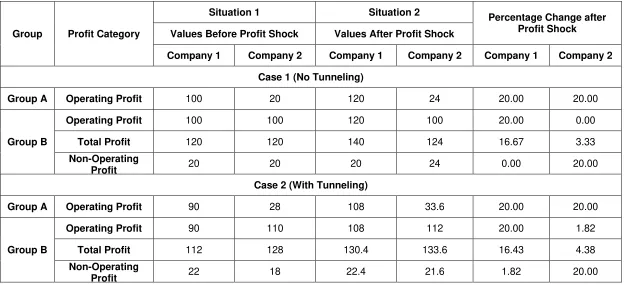
If the above two facts are taken into account and a reasonable assumption is made that the sample Bertrand et al used consisted of only public companies, their results can be explained without any link to tunneling. For this let us use a simple numerical example. Consider two ‘groups’, A and B, each having two companies, 1 and 2. Let these companies
18 narrowly held investment company, holds 40% of the equity. Let B1 and B2 be public companies involved in separate industries, with B1 being in the same industry as A1. Assume that B1 and B2 hold 40% of each other’s equity, but the personal holding of the group controllers is greater in B2. With these specifications, Group’s A and B can be said to respectively represent in simplified form the typical ‘stand alone’ and the typical ‘group’ in
India. In a sample consisting of only public companies, A1 would be designated as an unaffiliated firm while both companies of Group B would be group affiliated. A2 would of course not be part of the sample.
Now let us assume that each of the public companies make operating profits of Rs. 100 each in a year and pay 50% of these as dividends to their shareholders. Inclusive of these dividends, the profits of the 4 companies if there is no tunneling would be as shown in Situation 1 of Case 1 (assuming there is no other non-operating income). Let us also consider a Case 2 where we assume in addition that both groups indulge in tunneling to the same degree by transferring 10% of the actual operating profits from the more widely held to the more narrowly held company. In this case, the profits that the companies would show would be slightly different. Now let us see what happens if there is a 20% average increase in operating profits in the industry in which A1 and B1 operate and both companies reflect this, while all other industries situation remains unchanged. The revised positions would be as depicted by Situation 2s of the two cases. In both cases, since for B1 the increase was on a larger base which included the dividend income from its holding in B2, its ‘responsiveness’
to the profit shock would be less than of A1. On the other hand, B2 would reflect the profit shock in Industry 1 because of greater dividend income even though there is no change
within its own industry. Thus precisely the same combination of results that Bertrand et al got as proof of tunneling by ‘groups’ can be obtained when neither indulges in tunneling as well
19 Table 3: Illustration of Effects of Profit Shocks with and without Tunneling
Group Profit Category
Situation 1 Situation 2
Percentage Change after Profit Shock Values Before Profit Shock Values After Profit Shock
Company 1 Company 2 Company 1 Company 2 Company 1 Company 2
Case 1 (No Tunneling)
Group A Operating Profit 100 20 120 24 20.00 20.00
Group B
Operating Profit 100 100 120 100 20.00 0.00
Total Profit 120 120 140 124 16.67 3.33
Non-Operating
Profit 20 20 20 24 0.00 20.00
Case 2 (With Tunneling)
Group A Operating Profit 90 28 108 33.6 20.00 20.00
Group B
Operating Profit 90 110 108 112 20.00 1.82
Total Profit 112 128 130.4 133.6 16.43 4.38
Non-Operating
20 Khanna and Palepu: Instability amongst Leading Groups
Khanna and Palepu (2005) argued that concentration in India has been accompanied by substantial instability in the concentrated owners, and therefore at least in the Indian case the fears of entrenchment appear to be unwarranted. In substantiation they pointed towards the sharp difference in the composition of the top fifty business groups at two points of time, 1969 and 1997. According to their examination of the data they presented, as many as 43 of the top 50 groups in 1997 were not in the same list in 1969. As illustrative of the importance of innovative ability to the success of business groups, they also mentioned a story about the Reliance group which they took from another source8.
“...Dhirubhai Ambani single-handedly mobilized small investors around the country
in 1977 and listed on the Bombay and Ahmedabad stock exchanges when the dominant public financial institutions would not lend him capital.”(Khanna and Palepu, 2005, p. 301)
Unfortunately, the second story is a bit of a fiction while the former result is a gross exaggeration of the element of instability in Indian big business that does not follow from even the data Khanna and Palepu used. In reading this data, Khanna and Palepu failed to take account the following:
i) The 1969 list (which actually pertains to 1966) is from the ILPIC report, which also included a list of large independent companies. Of the ‘groups’ in the top fifty in 1997, some were from amongst these companies, and therefore were not ‘new’ constituents
of Indian big business
ii) Between the 1960s and the 1990s, many of the groups had split and it is one or more of their splinters that appear in the 1999 list. Two cases are of the opposite kind –
8
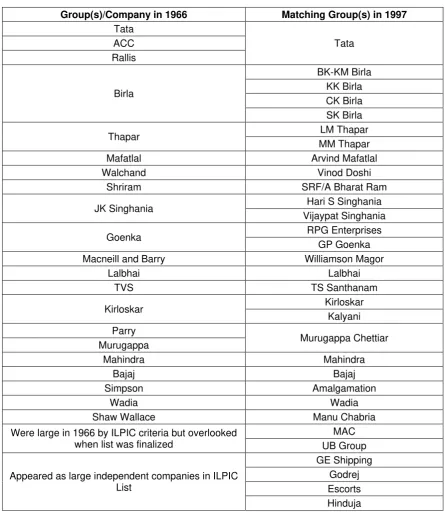
21 groups that were separate ones in 1966 being consolidated into single groups by 1999. For these and other reasons, some groups simply appear under slightly or very different names in the two lists. In other words, the ‘old’ dropping out from the list and the ‘new’ entering into it are in many cases actually the same.
iii) Some groups that were large in the 1960s did get somehow overlooked when the ILPIC or the MIC finalized their list of groups and large companies. Their appearance in the 1997 list therefore again does not represent the ‘new’ element.
Table 4 provides a mapping across the two points of time between groups appearing in the 1966 and 1997 lists used by Khanna and Palepu. It shows that 31 of the top fifty in 1997, and 21 of those in 1966, were ‘survivors’ over the interim period9
.
A contradiction of the story on Reliance can be found in the relevant annual reports of Reliance Industries (then known as Reliance Textile Industries). In the period before 1977, Reliance Textile Industries was a private limited company whose growth was mainly debt-financed. The outstanding debt liabilities in 1975-76 show that public sector banks and ICICI were its major creditors10. In fact even before Reliance Textile Industries became a public company, ICICI became a minority shareholder in it. In 1976-77 Reliance Textile Industries also made arrangements with financial institutions for term loans to finance a substantial part of its
9
Amongst those that did not survive were a number of European controlled groups that were subsequently Indianized.
10
22 proposed expansion project. The financial commitments made by the institutions amounted to Rs. 857 lakhs, nearly 69% of the total project cost of Rs. 1250 lakhs and nearly half of the value of the company’s assets at that time, including foreign currency loans of Rs 239 lakhs. All the
23 Table 4: Mapping of Groups, 1966 and 1997
Group(s)/Company in 1966 Matching Group(s) in 1997 Tata Tata ACC Rallis Birla BK-KM Birla KK Birla CK Birla SK Birla
Thapar LM Thapar
MM Thapar
Mafatlal Arvind Mafatlal
Walchand Vinod Doshi
Shriram SRF/A Bharat Ram
JK Singhania Hari S Singhania
Vijaypat Singhania
Goenka RPG Enterprises
GP Goenka
Macneill and Barry Williamson Magor
Lalbhai Lalbhai
TVS TS Santhanam
Kirloskar Kirloskar
Kalyani Parry
Murugappa Chettiar Murugappa
Mahindra Mahindra
Bajaj Bajaj
Simpson Amalgamation
Wadia Wadia
Shaw Wallace Manu Chabria
Were large in 1966 by ILPIC criteria but overlooked when list was finalized
MAC UB Group
Appeared as large independent companies in ILPIC List
GE Shipping Godrej Escorts Hinduja
24 holding for sale to the public. That first public offer and the subscription to it thus did not in fact bring any additional finance into the company because it only amounted to a change of ownership of existing shares. Its success however may have helped reveal to the group the possibilities that existed, which they subsequently exploited successfully.
Conclusions
The main conclusions emerging from the above discussion may be summarized as follows.
1) The literature on business groups in developing countries contains not one but many different conceptualizations of such groups. A short survey of them reveals that the different definitions of the developing country business group clearly use the same term to describe entities that are quite different from each other, even though they are supposedly talking of the same institution. Yet debate and discussion on which of these if any fits the reality, and the mustering of evidence for this, is conspicuous by its absence.
25 3) This scope for diversity amongst groups further underscores the importance of collecting evidence on the features actually exhibited by developing country business groups. If one had such evidence at hand, and chipped away at the features not found in all groups to try and isolate a common essence, we may find that none exists (except that they are all ‘different’ from some idealized picture of a firm). Certainly the logical possibility of such a
result, which would undermine the basis for a general theory of the developing country group, exists. Particularly important in this regard, because of the fundamental differences between them and the questions they throw up, is the need to check whether groups in their specific contexts are firms or coalitions of firms. This can only be done by examining the origins and nature of the connections within groups.
4) The limited evidence of a single country, India, reinforces the above conclusions. The common essence, if any, of Indian groups has been that they are multi-company firms. Multi-multi-company structures have been omnipresent in India, even more than presumed. They have however neither been stable arrangements of coordination between different firms nor necessarily served as a mechanism of pooling the capital of many families. Rather individual firms have tended to assume this generic form, and retain it even while otherwise changing and transforming over time. Indian groups therefore have been more distant from groups based on inter-firm coordination than from the classic stand-alone firm. Yet they have exhibited tremendous diversity across space and time, and there is no obvious average pattern around which they have tended to cluster. None of the standard definitions of the group therefore accurately describes Indian groups. Attributes of groups emphasized in some of them have been entirely absent amongst Indian groups while others have been less common than presumed.
26 of companies into group affiliated and independent companies in standard datasets. Such classifications can be quite arbitrary, not based on any specific conception of the business group let alone the one being used by the researcher. This has however been blissfully ignored by many while using such datasets.
27 References
Amsden, A. H. and Hikino, T. (1994). Project Execution Capability, Organizational Know-how and Conglomerate Corporate Growth in Late Industrialization. Industrial and Corporate Change, 3(1), 111-147.
Bertrand, Marianne, Mehta, Paras, and Mullainathan, Sendhil (2000). Ferreting Out Tunneling: An Application to Indian Business Groups, Cambridge, MA: National Bureau of Economic Research. NBER Working Paper 7952.
Bertrand, Marianne, Mehta, Paras, and Mullainathan, Sendhil (2002). Ferreting Out Tunneling: An Application to Indian Business Groups. The Quarterly Journal of Economics, 117(1), 121-148.
Chalapati Rao, K.S. (1985). Inter-Connections under the MRTP Act in the Context of Asset Limit Hike. Economic and Political Weekly, 20(27), 1132 - 1146.
Chalapati Rao, K. S. and Guha, Atulan (2006). Ownership Pattern of the Indian Corporate
Sector: Implications for Corporate Governance. New Delhi, India: Institute for
Studies in Industrial Development. ISID Working Paper 2006/09.
Cuervo-Cazurra, Alvaro (2006) Business Groups and their Types. Asia Pacific Journal of
Management, 23(4), 419–437.
Ghemawat, Pankaj and Khanna, Tarun (1998). The Nature of Diversified Business Groups: A Research Design and Two Case Studies. The Journal of Industrial Economics, 46(1), 35-61.
Government of India (1965). Report of the Monopolies Inquiry Commission (MIC Report).
28 Government of India (1969). Report of the Industrial Licensing Policy Inquiry Committee
(ILPIC Report). New Delhi: Department of Industrial Development, Ministry of Industrial Development, Trade and Company Affairs.
Goyal, S.K (1979). Monopoly Capital and Public Policy. New Delhi: Allied Publishers. Granovetter, Mark (1994). Business Groups. In Neil J. Smelser and Richard Swedberg (eds.)
The Handbook of Economic Sociology (pp. 453-475). Princeton and New York: Princeton University Press and Russel Sage Foundation,.
Granovetter, Mark (1995). Coase Revisited: Business Groups in the Modern Economy.
Industrial and Corporate Change, 4(1), 93–129.
Guillén, Mauro F. (2000) Business Groups in Emerging Economies: A Resource-Based View. The Academy of Management Journal, 43(3), 362-380.
Hazari, R.K. (1966). The Structure of the Private Corporate Sector, A Study of Concentration, Ownership and Control. Bombay: Asia Publishing House.
Jeon, Yoong-Deok and Kim, Young-Yong (2004). Conglomerates and Economic Calculation.
The Quarterly Journal of Austrian Economics, 7(1), 53-64.
Khanna, Tarun and Palepu, Krishna (2000). Is Group Affiliation Profitable in Emerging Markets? An Analysis of Diversified Indian Business Groups. The Journal of Finance, 55(2), 867-891.
Khanna, Tarun and Palepu, Krishna (2005). The Evolution of Concentrated Ownership in India: Broad Patterns and a History of the Indian Software Industry. In R. Morck (ed.) A History of Corporate Governance around the World: FamilyBusiness Groups to
29 Khanna, Tarun and Yafeh, Yishay (2007). Business Groups in Emerging Markets: Paragons
or Parasites. Journal of Economic Literature, 45(2), 331-372.
Khanna, Tarun and Rivkin, Jan W. (2001). Estimating the Performance Effects of Business Groups in Emerging Markets. Strategic Management Journal, 22(1), 45-74.
Kothari, M.L. (1967). Industrial Combinations, A Study of Managerial Integration in Indian Industries. Allahabad: Chaitanya Publishing House.
Leff, Nathaniel H. (1978). Industrial Organization and Entrepreneurship in the Developing Countries: The Economic Groups. Economic Development and Cultural Change, 26(4), 661-675.
Lokanathan, P.S. (1935). Industrial Organization in India. London: George Allen and Unwin.
Mehta, M.M. (1952). Combination Movement in Indian Industry (A Study of Concentration of Ownership, Control and Management in Indian Industries).Allahabad: Friends’ Book
Depot.
Morck, Randall, Wolfenzon, Daniel and Yeung, Bernard (2005). Corporate Governance, Economic Entrenchment, and Growth. Journal of Economic Literature, 43(3), 657-722.
Reserve Bank of India (2000) Flow of Funds Accounts of the Indian Economy, 1951-52 to 1995-96. Mumbai: Reserve Bank of India.
Reserve Bank of India (2007) Flow of Funds Accounts of the Indian Economy, 1994-95 to 2000-01. RBI Bulletin, 61(9), 1459-1537.
Rungta, Radhey Shyam (1970). The Rise of Business Corporations in India, 1851-1900.
30 Singhania, Vinod K. (1980). Economic Concentration through Inter-Corporate Investments.
Bombay: Himalaya Publishing House.