N u m e r i c al s t u d y of oxy g e n
d iff u sio n fr o m c a pill a r y t o ti s s u e s
d u r i n g h y p oxi a wi t h e x t e r n a l
fo r c e e ff e c t s
S riv a s t a v a , V, T ri p a t hi, D a n d B e g , A
h t t p :// dx. d oi.o r g / 1 0 . 1 1 4 2 / S 0 2 1 9 5 1 9 4 1 7 5 0 0 2 7 0
T i t l e N u m e r i c al s t u d y of oxy g e n d iff u si o n f r o m c a p ill a r y t o ti s s u e s d u r i n g h y p oxi a wi t h e x t e r n a l fo r c e eff e c t s
A u t h o r s S r iv a s t a v a , V, T ri p a t hi, D a n d B e g , A
Typ e Ar ticl e
U RL T hi s v e r si o n is a v ail a bl e a t :
h t t p :// u sir. s alfo r d . a c . u k /i d/ e p ri n t/ 3 8 9 3 8 /
P u b l i s h e d D a t e 2 0 1 7
U S IR is a d i gi t al c oll e c ti o n of t h e r e s e a r c h o u t p u t of t h e U n iv e r si ty of S alfo r d . W h e r e c o p y ri g h t p e r m i t s , f ull t e x t m a t e r i al h el d i n t h e r e p o si t o r y is m a d e f r e ely a v ail a bl e o nli n e a n d c a n b e r e a d , d o w nl o a d e d a n d c o pi e d fo r n o
n-c o m m e r n-ci al p r iv a t e s t u d y o r r e s e a r n-c h p u r p o s e s . Pl e a s e n-c h e n-c k t h e m a n u s n-c ri p t fo r a n y f u r t h e r c o p y ri g h t r e s t r i c ti o n s .
1
JOURNAL OF MECHANICS IN MEDICINE AND BIOLOGY
Accepted March 20 2016
Numerical study of oxygen diffusion from capillary
to tissues during hypoxia with external force effects
1V. Srivastava, 2D. Tripathi and3 *O. Anwar Bég
1Ajay Kumar Garg Engineering College, Ghaziabad, India.
2Department of Mechanical Engineering, Manipal University, Jaipur-303007, India. 3Gort (Medical, Aerospace and Marine Engineering), Gabriel’s Wing House, 11 Rooley Croft,
Bradford, BD7 3NU, England, UK.
Abstract
A mathematical model to simulate oxygen delivery through a capillary to tissues under the
influence of an external force field is presented. The multi-term general fractional diffusion
equation containing force terms and a time dependent absorbent term is taken into account.
Fractional calculus is applied to describe the phenomenon of sub-diffusion of oxygen in both
transverse and longitudinal directions. A new computational algorithm, i.e. the New Iterative
Method (NIM) is employed to solve the spatio-temporal fractional partial differential equation
subject to appropriate physical boundary conditions. Validation of NIM solutions is achieved with
a Modified Adomian Decomposition Method (MADM). A parametric study is conducted for three
loading scenarios on the capillary- radial force alone, axial force alone and the combined case of
both forces. The results demonstrate that the force terms markedly influence the oxygen diffusion
process. For example the radial force exerts a more profound effect than axial force on subdiffusion
of oxygen indicating that careful manipulation of these forces on capillary–tissues may assist in
the effective reduction of hypoxia or other oxygen depletion phenomena.
Keywords: Capillary-tissue diffusion; hypoxia; general fractional diffusion equation; New
Iterative Method (NIM); axial-radial forces; spatio-temporal concentration plots.
2
1. Introduction
Capillaries are thin and small blood vessels connecting arterioles with venules and forming
networks through the body. In abnormal blood circulation, cells in the area most distal to the
capillary at the venous end begin to suffer from hypoxia when perfusion levels drop to critically
low values [1-4]. The insufficient oxygen delivery to tissue may interrupt metastasis and destroy
part of the muscle.
The mechanisms controlling oxygen distribution are incompletely understood but involve a series
of convective and diffusive processes. Convective oxygen in blood depends on active, energy
consuming processes generating flow in the circulation. Diffusion transport refers to the passive
movement of oxygen down its concentration gradient across tissue barriers, including the alveolar
capillary membrane, and across the extracellular matrix between the tissue capillaries and
individual cells to mitochondria. The amount of diffusive oxygen movement depends on the
oxygen tension gradient and the diffusion distance, which is related to the tissue capillary density.
The greater the difference between capillary and cellular oxygen concentration and the shorter the
distance, the faster the rate of diffusion are reported in [1, 2]. However, should the oxygen tension
gradient become affected or oxygen concentration levels in capillary become very low, insufficient
oxygenation may lead to hypoxia.
Fig.1. Diffusion of oxygen to tissues through a single capillary.
3
Previously, Go [3] used a mathematical model for oxygen delivery through capillaries in which
the longitudinal diffusion of solute in capillaries was neglected and also it was assumed that the
diffusion of oxygen and the consumption rate of oxygen are the same everywhere, which is an
unrealistic simplification for clinical situations [1], as shown in Fig.1. The diffusion processes will
differ in different places. Go [3] also identified that physical exertion boosts oxygen consumption
rate but leads to depletion in oxygen from some cells and that cells engulfing capillaries can utilize
or preserve more oxygen than required for a subsequent cycle. Srivastava and Rai[4] removed all
the shortcomings discussed above and presented a new mathematical model for diffusion of
oxygen of all types, i.e. for sub-diffusion and diffusion processes, using fractional calculus.
Analysis of fractional diffusion equations(which are obtained from the classical diffusion
equations of mathematical physics by replacing the ordinary time derivative by a fractional time
derivative), constitute a field of growing interest in mathematical biology and other fields.
Numerous universal phenomena can be simulated to a greater degree of accuracy by exploiting the
properties of these evolution equations. Analytical methods used to solve these equations have
very restricted applications and the numerical techniques commonly used give rise to
rounding-off errors. Keeping these in mind Srivastava and Rai [4] examined the effect of the concentration
of the oxygen delivery from the capillary to the tissues by solving the linear and nonlinear
multi-term fractional diffusion equations analytically using mathematical tools like the new iterative
method (NIM) [6] and a modified Adomian decomposition method (MADM) [5].NIM was first
proposed by the Indian mathematicians Daftardar-Gejji and Jafari [6] and subsequently
implemented by Daftardar-Gejji and Bhalekar [7,8] to solve linear and nonlinear partial differential
equations and fractional partial differential (diffusion wave) equations. The main advantage of this
method is its computational simplicity; the solution obtained by this method is expected to give a
better approximation in a straightforward manner.
The decomposition method of Adomian has also been applied to solve a wide class of nonlinear
differential and partial differential equations (Adomian [9, 11], Adomian and Rach [12]) etc.
Wazwaz [13,5] made further progress in this method with some modifications. The modification
of the Adomian decomposition method will accelerate the rapid convergence of the series solution.
This modified technique has been shown to be computationally efficient for solving several
problems in applied fields (Wazwaz [14-16], Kaya and Yokus [17], Saha Ray [18]).
Daftardar-Gejji and Bhalekar [19] used this method for solving multi-term linear and nonlinear diffusion
wave equations of fractional order. Recently diffusion wave like models for physical problems
have attracted considerable attention. Many studies have been communicated addressing a diverse
4
physiology (peristaltic flow of viscoelastic fluids with various factional models) by Tripathi and
Beg [21, 22] and Tripathi [23, 24] and various numerical techniques have been employed.
In this work, we investigate a multi-term fractional diffusion equation which employs time
fractional derivative by taking an absorbent term and external forces into account. Recently,
Schotet al.[25] have proposed a generalized diffusion equation which employs space and time
fractional derivatives, an absorbent (or source) term, and an external linear force field. This leads
us for introducing the external forces along radial vector and axial line in our newly developed
multi-term fractional diffusion equation for oxygen delivery through a capillary to tissues [4].
In the present article, our aim is to discuss the significant role of external forces on the oxygen
delivery from capillary to tissues, considering all kinds of diffusion processes and to show its effect
by means of numerical solutions for different conditions and their application for the treatment in
hypoxia. The new iterative method (NIM) and modified Adomian decomposition method
(MADM) are used to obtain the numerical solutions of the multi-term fractional diffusion equation
for oxygen delivery from capillary to tissues containing absorbent term and external forces. The
expressions for the concentrations for different times, radii and lengths of the capillaries, using the
initial and boundary conditions, are deduced .Numerical computations are conducted using
Mathematica and presented graphically. Also, comparisons are made between the NIM and
MADM solutions, demonstrating excellent agreement.
2.The New Iterative Method (NIM)
Daftardar – Gejji and Jafari [6] have introduced a new iterative method for solving the functional
equation:
𝐶(𝑥̅, 𝑡) = 𝑓(𝑥̅, 𝑡) + 𝐿(𝐶(𝑥̅, 𝑡)) + 𝑁(𝐶(𝑥̅, 𝑡)). …… (1)
Heref is a given function, L and N are given linear and nonlinear functions of C respectively, 𝑥̅ = (𝑟, 𝑧). We seek solution C of Eq. (1) having the series form
𝐶(𝑥̅, 𝑡) = ∑∞ 𝐶𝑖(𝑥̅, 𝑡)
𝑖=0 . …… (2)
Since L is linear, then:
𝐿(∑∞ 𝐶𝑖
𝑖=0 ) = ∑∞𝑖=0𝐿(𝐶𝑖). …… (3)
The non-linear operator N is decomposed as follows (see [6]):
𝑁(∑∞ 𝐶𝑖
5 From Eqs. (2) – (4), (1) is equivalent to
∑∞ 𝐶𝑖
𝑖=0 = 𝑓 + ∑∞𝑖=0𝐿(𝐶𝑖)+ 𝑁(𝐶0) + ∑ {𝑁(∑∞𝑖=0 𝑖𝑗=0𝐶𝑗) − 𝑁(∑𝑖−1𝑗=0𝐶𝑗)}. …… (5)
We define the recurrence relation
𝐶0 = 𝑓 , …… (6a)
𝐶1 = 𝐿(𝐶0) + 𝑁(𝐶0) , ……(6b)
𝐶2 = 𝐿(𝐶1) + 𝑁(𝐶0+ 𝐶1) − 𝑁(𝐶0), …… (6c)
⋮
𝐶𝑚+1= 𝐿(𝐶𝑚) + 𝑁(𝐶0+ 𝐶1+ ⋯ + 𝐶𝑚) − 𝑁(𝐶0+ 𝐶1+ ⋯ + 𝐶𝑚−1), 𝑚 = 1,2, … . …… (6d)
Then,
(𝐶1+ ⋯ + 𝐶𝑚+1) = 𝐿(𝐶0) + 𝐿(𝐶1) + ⋯ + 𝐿(𝐶𝑚) + 𝑁(𝐶0+ 𝐶1+ ⋯ + 𝐶𝑚),𝑚 = 1,2, ……… (7)
and
∑∞ 𝐶𝑖
𝑖=0 = 𝑓 + 𝐿(∑∞𝑖=0𝐶𝑖) + 𝑁(𝐶0) + 𝑁(∑∞𝑖=0𝐶𝑖). …… (8)
For the convergence, see Ref. [6]. The k – term approximation solution of (1) and (2) is given by
𝐶 = 𝐶0+ 𝐶1+ ⋯ + 𝐶𝑘−1.
3. Mathematical Model for Oxygen Diffusion
A cylindrical capillary of radius, R, containing solute, is studied as a geometric model of the
system. We assume that the rate of consumption by surrounding tissue is given by ∫ 𝜇(𝑡 − 𝑥)0𝑡 ∙ 𝐶(𝑟, 𝑧, 𝑥)𝑑𝑥 [22].Here we present a new general mathematical model for diffusion of oxygen
under the influence of external forces, i.e. radial force and axial force. Also, we discuss the effect
of the fractional order of the derivatives as well as the influence of external forces on delivery of
oxygen from capillary to tissues. Previously, the general mathematical model for diffusion of
oxygen, as given by Srivastava and Rai [3] omitted external force.
To explain the sub-diffusion and diffusion phenomenon simultaneously, it is necessary to adopt a
fractional diffusion equation, i.e. instead of𝜕𝐶𝜕𝑡as in Eq. (2) of [4] we have to use 𝜕
𝛼𝐶
𝜕𝑡𝛼where 0 <α<
1 indicates the sub-diffusion process while α = 1 represents the diffusion process, since
longitudinal diffusion is also considered. Therefore the net diffusion of oxygen to tissues will be
𝜕𝛼𝐶
𝜕𝑡𝛼− 𝜏
𝜕𝛽𝐶
𝜕𝑡𝛽 ,where 𝜏 is the time lag in concentration of oxygen along the z-axis and 0 < β < α ≤ 1.
6
C becomes very small due to the consumption of oxygen by the surrounding tissues, i.e. as 𝑧 → ∞, 𝐶 → 0.
Now, for force we have introduced 𝜕𝑟𝜕 {𝐹(𝑟) ∙ 𝐶(𝑟, 𝑧, 𝑡)}, the force term along radial vector r, and
𝜕
𝜕𝑧{𝐹(𝑧) ∙ 𝐶(𝑟, 𝑧, 𝑡)}, the force term along z – axis. Therefore, the new general equation for
conveying oxygen from the capillary to the surrounding tissue is obtained:
𝜕𝛼𝐶 𝜕𝑡𝛼 − 𝜏
𝜕𝛽𝐶
𝜕𝑡𝛽 = ∇(𝑑 ∙ ∇𝐶) − 𝜕
𝜕𝑟{𝐹(𝑟) ∙ 𝐶(𝑟, 𝑧, 𝑡)} − 𝜕
𝜕𝑧{𝐹(𝑧) ∙ 𝐶(𝑟, 𝑧, 𝑡)} − ∫ 𝜇(𝑡 − 𝑥) 𝑡
0
∙ 𝐶(𝑟, 𝑧, 𝑥)𝑑𝑥
…… (9)
Here C(r, z, t) is the concentration of oxygen, d is the diffusion coefficient of oxygen, and this d
may be a function of C. No flux on the boundary yields the following boundary condition:
𝜕𝐶
𝜕𝑟|𝑟→𝑅 = 0. …… (10)
Consider at t = 0, C(r, z, t) = g(r, z), and according to the condition as 𝑧 → ∞, 𝐶 → 0. Eq. (9) above
is equivalent to the following integral equation:
𝐶(𝑟, 𝑧, 𝑡) = 𝑔(𝑟, 𝑧) (1 − 𝜏Γ(𝛼−𝛽+1)𝑡𝛼−𝛽 ) + 𝜏𝐷𝑡−(𝛼−𝛽)𝐶 + 𝐷𝑡−(𝛼−𝛽)(∇(𝑑 ∙ ∇𝐶)) − 𝐷𝑡−𝛼(𝜕𝑟𝜕 {𝐹(𝑟) ∙
𝐶(𝑟, 𝑧, 𝑡)}) − 𝐷𝑡−𝛼(𝜕𝑧𝜕 {𝐹(𝑧) ∙ 𝐶(𝑟, 𝑧, 𝑡)}) − 𝐷𝑡−𝛼(∫ 𝜇(𝑡 − 𝑥)0𝑡 ∙ 𝐶(𝑟, 𝑧, 𝑥)𝑑𝑥). …… (11)
Now for a solution applying the new iterative method (NIM); implementing algorithm (6)) in
Eq.(11) yields:
𝐶0(𝑟, 𝑧, 𝑡) = 𝑔(𝑟, 𝑧) (1 − 𝜏Γ(𝛼−𝛽+1)𝑡𝛼−𝛽 ) .…… (12a)
𝐶1(𝑟, 𝑧, 𝑡) = 𝜏𝐷𝑡−(𝛼−𝛽)𝐶0+ 𝐷𝑡−(𝛼−𝛽)(∇(𝑑 ∙ ∇𝐶0)) − 𝐷𝑡−𝛼(𝜕𝑟𝜕 {𝐹(𝑟) ∙ 𝐶0(𝑟, 𝑧, 𝑡)}) − 𝐷𝑡−𝛼(𝜕𝑧𝜕 {𝐹(𝑧) ∙
𝐶0(𝑟, 𝑧, 𝑡)}) − 𝐷𝑡−𝛼(∫ 𝜇(𝑡 − 𝑥)0𝑡 ∙ 𝐶0(𝑟, 𝑧, 𝑥)𝑑𝑥) …… (12b)
𝐶2(𝑟, 𝑧, 𝑡) = 𝜏𝐷𝑡−(𝛼−𝛽)𝐶1+ 𝐷𝑡−(𝛼−𝛽)(∇(𝑑 ∙ ∇𝐶1)) − 𝐷𝑡−𝛼(𝜕
𝜕𝑟{𝐹(𝑟) ∙ 𝐶1(𝑟, 𝑧, 𝑡)}) − 𝐷𝑡 −𝛼(𝜕
𝜕𝑧{𝐹(𝑧) ∙
𝐶1(𝑟, 𝑧, 𝑡)}) − 𝐷𝑡−𝛼(∫ 𝜇(𝑡 − 𝑥)𝑡
0 ∙ 𝐶1(𝑟, 𝑧, 𝑥)𝑑𝑥) …… (12c)
7
𝐶𝑛+1(𝑟, 𝑧, 𝑡) = 𝜏𝐷𝑡−(𝛼−𝛽)𝐶𝑛+ 𝐷𝑡−(𝛼−𝛽)(∇(𝑑 ∙ ∇𝐶𝑛)) − 𝐷𝑡−𝛼(𝜕𝑟𝜕 {𝐹(𝑟) ∙ 𝐶𝑛(𝑟, 𝑧, 𝑡)}) −
𝐷𝑡−𝛼(𝜕
𝜕𝑧{𝐹(𝑧) ∙ 𝐶𝑛(𝑟, 𝑧, 𝑡)}) − 𝐷𝑡
−𝛼(∫ 𝜇(𝑡 − 𝑥)𝑡
0 ∙ 𝐶𝑛(𝑟, 𝑧, 𝑥)𝑑𝑥)
…… (12d)
Applying the modified Adomian decomposition method (MADM), as elaborated in detail in [5])
to Eq.(11) leads to:
𝐶̅0(𝑟, 𝑧, 𝑡) = 𝑔(𝑟, 𝑧) (1 − 𝜏Γ(𝛼−𝛽+1)𝑡𝛼−𝛽 ) …… (13a)
𝐶̅1(𝑟, 𝑧, 𝑡) = 𝜏𝐷𝑡−(𝛼−𝛽)𝐶̅0+ 𝐷𝑡−(𝛼−𝛽)(∇(𝑑 ∙ ∇𝐶̅0)) − 𝐷𝑡−𝛼(𝜕
𝜕𝑟{𝐹(𝑟) ∙ 𝐶̅0(𝑟, 𝑧, 𝑡)}) − 𝐷𝑡 −𝛼(𝜕
𝜕𝑧{𝐹(𝑧) ∙
𝐶̅0(𝑟, 𝑧, 𝑡)}) − 𝐷𝑡−𝛼(∫ 𝜇(𝑡 − 𝑥)0𝑡 ∙ 𝐶̅0(𝑟, 𝑧, 𝑥)𝑑𝑥)…… (13b)
𝐶̅2(𝑟, 𝑧, 𝑡) = 𝜏𝐷𝑡−(𝛼−𝛽)𝐶̅1+ 𝐷𝑡−(𝛼−𝛽)(∇(𝑑 ∙ ∇𝐶̅1)) − 𝐷𝑡−𝛼(𝜕𝑟𝜕 {𝐹(𝑟) ∙ 𝐶̅1(𝑟, 𝑧, 𝑡)}) − 𝐷𝑡−𝛼(𝜕𝑧𝜕 {𝐹(𝑧) ∙
𝐶̅1(𝑟, 𝑧, 𝑡)}) − 𝐷𝑡−𝛼(∫ 𝜇(𝑡 − 𝑥)0𝑡 ∙ 𝐶̅1(𝑟, 𝑧, 𝑥)𝑑𝑥) …… (13c)
⋮ ⋮ ⋮ ⋮
𝐶̅𝑛+1(𝑟, 𝑧, 𝑡) = 𝜏𝐷𝑡−(𝛼−𝛽)𝐶̅𝑛+ 𝐷𝑡−(𝛼−𝛽)(∇(𝑑 ∙ ∇𝐶̅𝑛)) − 𝐷𝑡−𝛼(𝜕𝑟𝜕 {𝐹(𝑟) ∙ 𝐶̅𝑛(𝑟, 𝑧, 𝑡)}) −
𝐷𝑡−𝛼(𝜕
𝜕𝑧{𝐹(𝑧) ∙ 𝐶̅𝑛(𝑟, 𝑧, 𝑡)}) − 𝐷𝑡
−𝛼(∫ 𝜇(𝑡 − 𝑥)𝑡
0 ∙ 𝐶̅𝑛(𝑟, 𝑧, 𝑥)𝑑𝑥)
….… (13d)
The bar on C (i.e. 𝐶̅) corresponds to the MADM approximation.
3.1 Case I-Oxygen delivery when only radial force is acting on capillary .
If F(z) = 0, from Eq.(9)we readily obtain:
𝜕𝛼𝐶 𝜕𝑡𝛼− 𝜏
𝜕𝛽𝐶
𝜕𝑡𝛽 = ∇(𝑑 ∙ ∇𝐶) −
𝜕
𝜕𝑟{𝐹(𝑟) ∙ 𝐶(𝑟, 𝑧, 𝑡)} − ∫ 𝜇(𝑡 − 𝑥) 𝑡
0 ∙ 𝐶(𝑟, 𝑧, 𝑥)𝑑𝑥 …… (14)
Let d define a constant diffusivity. Theforce term, and 𝑐𝑜𝑛𝑠𝑢𝑚𝑝𝑡𝑖𝑜𝑛 𝑟𝑎𝑡𝑒 𝑝𝑎𝑟𝑎𝑚𝑒𝑡𝑒𝑟,are
defined as 𝐹(𝑟) = −𝑘1𝑟 𝑎𝑛𝑑 𝜇(𝑡) = Γ(𝛾)𝛿 𝑡𝛾−1 respectively, following [22], where 𝑘1 and 𝛿 are
constants. In light of this, eq. (14) reduces to:
𝜕𝛼𝐶
𝜕𝑡𝛼− 𝜏
𝜕𝛽𝐶
𝜕𝑡𝛽 = 𝑑∇2𝐶 +
𝜕
𝜕𝑟{𝑘1𝑟 ∙ 𝐶(𝑟, 𝑧, 𝑡)} − ∫ 𝛿
Γ(𝛾)(𝑡 − 𝑥) 𝛾−1 𝑡
8
which is linear fraction differential equationof order 𝛼 in time t coordinate and of second order
in space coordinates (r, z)(i.e. in cylidrical coordinates).
It can be shown that the equivalent integral equation of Eq. (15) takes the form:
𝐶(𝑟, 𝑧, 𝑡) = 𝑔(𝑟, 𝑧) (1 − 𝜏 𝑡𝛼−𝛽
Γ(𝛼 − 𝛽 + 1)) + 𝜏𝐷𝑡
−(𝛼−𝛽)𝐶 + 𝑑𝐷
𝑡−(𝛼−𝛽)(∇2𝐶) + 𝑘1𝐷𝑡−𝛼(𝐶(𝑟, 𝑧, 𝑡))
+ 𝑘1𝑟𝐷𝑡−𝛼(𝜕
𝜕𝑟𝐶(𝑟, 𝑧, 𝑡)) − 𝐷𝑡
−𝛼(∫ 𝛿
Γ(𝛾)(𝑡 − 𝑥)𝛾−1 𝑡
0 ∙ 𝐶(𝑟, 𝑧, 𝑥)𝑑𝑥) …… (16)
Here 𝑔(𝑟, 𝑧) is an initial guess.Now for a solution applying the new iterative method (NIM; in
view of algorithm (6)) to Eq. (16) leads to:
𝐶0(𝑟, 𝑧, 𝑡) = (𝑟 +𝑅
2
𝑟) 𝑒
−𝑧(1 − 𝜏 𝑡𝛼−𝛽
Γ(𝛼−𝛽+1)) …… (17a)
𝐶1(𝑟, 𝑧, 𝑡) = 𝜏𝐷𝑡−(𝛼−𝛽)𝐶0+ 𝑑𝐷𝑡−(𝛼−𝛽)(∇2𝐶
0) + 𝑘1𝐷𝑡−𝛼(𝐶0(𝑟, 𝑧, 𝑡)) + 𝑘1𝑟𝐷𝑡−𝛼(𝜕𝑟𝜕 𝐶0(𝑟, 𝑧, 𝑡)) −
𝐷𝑡−𝛼(∫ 𝛿
Γ(𝛾)(𝑡 − 𝑥)𝛾−1 𝑡
0 ∙ 𝐶0(𝑟, 𝑧, 𝑥)𝑑𝑥) …… (17b)
𝐶2(𝑟, 𝑧, 𝑡) = 𝜏𝐷𝑡−(𝛼−𝛽)𝐶1+ 𝑑𝐷𝑡−(𝛼−𝛽)(∇2𝐶1) + 𝑘1𝐷𝑡−𝛼(𝐶1(𝑟, 𝑧, 𝑡)) + 𝑘1𝑟𝐷𝑡−𝛼(𝜕𝑟𝜕 𝐶1(𝑟, 𝑧, 𝑡)) −
𝐷𝑡−𝛼(∫0𝑡Γ(𝛾)𝛿 (𝑡 − 𝑥)𝛾−1∙ 𝐶1(𝑟, 𝑧, 𝑥)𝑑𝑥) ….… (17c)
⋮ ⋮ ⋮
𝐶𝑛(𝑟, 𝑧, 𝑡) = 𝜏𝐷𝑡−(𝛼−𝛽)𝐶𝑛−1+ 𝑑𝐷𝑡−(𝛼−𝛽)(∇2𝐶
𝑛−1) + 𝑘1𝐷𝑡−𝛼(𝐶𝑛−1(𝑟, 𝑧, 𝑡))
+ 𝑘1𝑟𝐷𝑡−𝛼( 𝜕
𝜕𝑟𝐶𝑛−1(𝑟, 𝑧, 𝑡)) − 𝐷𝑡−𝛼(∫ 𝛿
Γ(𝛾)(𝑡 − 𝑥)𝛾−1 𝑡
0
∙ 𝐶𝑛−1(𝑟, 𝑧, 𝑥)𝑑𝑥)
..…… (17d)
Effectively the oxygen concentration field solution is:
𝐶(𝑟, 𝑧, 𝑡) = 𝐶0(𝑟, 𝑧, 𝑡) + 𝐶1(𝑟, 𝑧, 𝑡) + 𝐶2(𝑟, 𝑧, 𝑡) + ⋯ ⋯ + 𝐶𝑛(𝑟, 𝑧, 𝑡) ….…… (18)
3.2 Case II- Oxygen delivery when only axial force is acting on capillary
If F(r) = 0, from equation (9) we arrive at:
𝜕𝛼𝐶 𝜕𝑡𝛼− 𝜏
𝜕𝛽𝐶
𝜕𝑡𝛽 = ∇(𝑑 ∙ ∇𝐶) −
𝜕
𝜕𝑧{𝐹(𝑧) ∙ 𝐶(𝑟, 𝑧, 𝑡)} − ∫ 𝜇(𝑡 − 𝑥) 𝑡
9
Again let ddefine a constant diffusivity. The axialforce term and consumption rate parameter, are
defined as𝐹(𝑧) = −𝑘2𝑧 𝑎𝑛𝑑 𝜇(𝑡) = Γ(𝛾)𝛿 𝑡𝛾−1, respectively, following [22], where𝑘2 and 𝛿 are
constants. Now, eq. (19) reduces to:
𝜕𝛼𝐶
𝜕𝑡𝛼− 𝜏
𝜕𝛽𝐶
𝜕𝑡𝛽 = 𝑑∇2𝐶 +
𝜕
𝜕𝑧{𝑘2𝑧 ∙ 𝐶(𝑟, 𝑧, 𝑡)} − ∫ 𝛿
Γ(𝛾)(𝑡 − 𝑥) 𝛾−1 𝑡
0 ∙ 𝐶(𝑟, 𝑧, 𝑥)𝑑𝑥 ……(20)
which constitutes another linear fraction differential equation of order 𝛼 in time t coordinate and of second order in space coordinates (r, z) i.e. in cylidrical coordinates. As the order 𝛼 increases,
it is anticipated that oxygen delivery concentration will be elevated. The equivalent integral
equation of Eq.(20) is:
𝐶(𝑟, 𝑧, 𝑡) = 𝑔(𝑟, 𝑧) (1 − 𝜏 𝑡 𝛼−𝛽
Γ(𝛼 − 𝛽 + 1)) + 𝜏𝐷𝑡−(𝛼−𝛽)𝐶 + 𝑑𝐷𝑡−(𝛼−𝛽)(∇2𝐶)
+ 𝑘2𝐷𝑡−𝛼(𝐶(𝑟, 𝑧, 𝑡))
+𝑘2𝑧𝐷𝑡−𝛼(𝜕
𝜕𝑧𝐶(𝑟, 𝑧, 𝑡)) − 𝐷𝑡
−𝛼(∫ 𝛿
Γ(𝛾)(𝑡 − 𝑥)𝛾−1 𝑡
0 ∙ 𝐶(𝑟, 𝑧, 𝑥)𝑑𝑥) …… (21)
Implementing NIM based on the algorithm defined in Eq.(6), the resulting solution of Eq.(21)
emerges as:
𝐶0(𝑟, 𝑧, 𝑡) = (𝑟 +𝑅
2
𝑟) 𝑒
−𝑧(1 − 𝜏 𝑡𝛼−𝛽
Γ(𝛼−𝛽+1)) …… (22a)
𝐶1(𝑟, 𝑧, 𝑡) = 𝜏𝐷𝑡−(𝛼−𝛽)𝐶0+ 𝑑𝐷𝑡−(𝛼−𝛽)(∇2𝐶0) + 𝑘2𝐷𝑡−𝛼(𝐶0(𝑟, 𝑧, 𝑡)) + 𝑘2𝑧𝐷𝑡−𝛼(𝜕𝑧𝜕 𝐶0(𝑟, 𝑧, 𝑡)) −
𝐷𝑡−𝛼(∫ 𝛿
Γ(𝛾)(𝑡 − 𝑥) 𝛾−1 𝑡
0 ∙ 𝐶0(𝑟, 𝑧, 𝑥)𝑑𝑥) …… (22b)
𝐶2(𝑟, 𝑧, 𝑡) = 𝜏𝐷𝑡−(𝛼−𝛽)𝐶1+ 𝑑𝐷𝑡−(𝛼−𝛽)(∇2𝐶1) + 𝑘2𝐷𝑡−𝛼(𝐶1(𝑟, 𝑧, 𝑡)) + 𝑘2𝑧𝐷𝑡−𝛼(𝜕𝑧𝜕 𝐶1(𝑟, 𝑧, 𝑡)) −
𝐷𝑡−𝛼(∫ 𝛿
Γ(𝛾)(𝑡 − 𝑥)𝛾−1 𝑡
0 ∙ 𝐶1(𝑟, 𝑧, 𝑥)𝑑𝑥) …… (22c)
⋮ ⋮ ⋮
𝐶𝑛(𝑟, 𝑧, 𝑡) = 𝜏𝐷𝑡−(𝛼−𝛽)𝐶𝑛−1+ 𝑑𝐷𝑡−(𝛼−𝛽)(∇2𝐶
𝑛−1) + 𝑘2𝐷𝑡−𝛼(𝐶𝑛−1(𝑟, 𝑧, 𝑡)) +
𝑘2𝑧𝐷𝑡−𝛼(𝜕𝑟𝜕 𝐶𝑛−1(𝑟, 𝑧, 𝑡)) − 𝐷𝑡−𝛼(∫0𝑡Γ(𝛾)𝛿 (𝑡 − 𝑥)𝛾−1∙ 𝐶𝑛−1(𝑟, 𝑧, 𝑥)𝑑𝑥)
…… (22d)
10
𝐶(𝑟, 𝑧, 𝑡) = 𝐶0(𝑟, 𝑧, 𝑡) + 𝐶1(𝑟, 𝑧, 𝑡) + 𝐶2(𝑟, 𝑧, 𝑡) + ⋯ ⋯ + 𝐶𝑛(𝑟, 𝑧, 𝑡) …… (23)
3.3 Case III- Oxygen delivery when radial and axial both forces are acting on capillary .
For this third and final case, we consider both forces in action.Once again we define a constant diffusivity,d. The radial force term, axial force term and consumption rate parameter, are defined
as respectively, 𝐹(𝑟) = −𝑘1𝑟, 𝐹(𝑧) = −𝑘2𝑧, 𝑎𝑛𝑑 𝜇(𝑡) = Γ(𝛾)𝛿 𝑡𝛾−1, in accordance with [22].
Here 𝑘1, 𝑘2 and 𝛿 are all constants.
It follows that Eq.(9) becomes:
𝜕𝛼𝐶 𝜕𝑡𝛼 − 𝜏
𝜕𝛽𝐶
𝜕𝑡𝛽 = 𝑑∇2𝐶 + 𝜕
𝜕𝑟{𝑘1𝑟 ∙ 𝐶(𝑟, 𝑧, 𝑡)} + 𝜕
𝜕𝑧{𝑘2𝑧 ∙ 𝐶(𝑟, 𝑧, 𝑡)} − ∫ 𝛿
Γ(𝛾)(𝑡 − 𝑥)𝛾−1 𝑡
0
∙ 𝐶(𝑟, 𝑧, 𝑥)𝑑𝑥
……(24)
which is again a linear fraction differential equation of order 𝛼 in time t coordinate and of second
order in space coordinates (r, z) i.e. again in cylidrical coordinates. As elaborated earlier, for Cases
I and II, an equivalent integral equation for Eq.(24) may be derived:
𝐶(𝑟, 𝑧, 𝑡) = 𝑔(𝑟, 𝑧) (1 − 𝜏Γ(𝛼−𝛽+1)𝑡𝛼−𝛽 ) + 𝜏𝐷𝑡−(𝛼−𝛽)𝐶 + 𝑑𝐷𝑡−(𝛼−𝛽)(∇2𝐶) + 𝑘
1𝐷𝑡−𝛼(𝜕𝑟𝜕 𝐶(𝑟, 𝑧, 𝑡)) +
𝑘1𝑟𝐷𝑡−𝛼(𝜕
𝜕𝑟𝐶(𝑟, 𝑧, 𝑡)) + 𝑘2𝐷𝑡
−𝛼(𝐶(𝑟, 𝑧, 𝑡)) + 𝑘
2𝑧𝐷𝑡−𝛼(𝜕𝑧𝜕 𝐶(𝑟, 𝑧, 𝑡)) −
𝐷𝑡−𝛼(∫ 𝛿
Γ(𝛾)(𝑡 − 𝑥)𝛾−1 𝑡
0 ∙ 𝐶(𝑟, 𝑧, 𝑥)𝑑𝑥). …… (25)
Where 𝑔(𝑟, 𝑧) is initial guess in Eq.(25). Considering𝑔(𝑟, 𝑧) = (𝑟 +𝑅𝑟2) 𝑒−𝑧 and 𝜏 =1
3 as in [3],we
obtain:
𝐶0(𝑟, 𝑧, 𝑡) = (𝑟 +𝑅
2
𝑟) 𝑒
−𝑧(1 − 𝜏 𝑡𝛼−𝛽
Γ(𝛼−𝛽+1)) …….(26a)
𝐶1(𝑟, 𝑧, 𝑡) = 𝜏𝐷𝑡−(𝛼−𝛽)𝐶0+ 𝐷𝑡−(𝛼−𝛽)(∇(𝑑 ∙ ∇𝐶0)) + 𝑘1𝐷𝑡−𝛼(𝜕𝑟𝜕 𝐶0(𝑟, 𝑧, 𝑡)) +
𝑘1𝑟𝐷𝑡−𝛼(𝜕
𝜕𝑟𝐶0(𝑟, 𝑧, 𝑡)) + 𝑘2𝐷𝑡 −𝛼(𝐶
0(𝑟, 𝑧, 𝑡)) + 𝑘2𝑧𝐷𝑡−𝛼(𝜕𝑧𝜕 𝐶0(𝑟, 𝑧, 𝑡)) − 𝐷𝑡−𝛼(∫ 𝜇(𝑡 − 𝑥)0𝑡 ∙
11
𝐶2(𝑟, 𝑧, 𝑡) = 𝜏𝐷𝑡−(𝛼−𝛽)𝐶1+ 𝐷𝑡−(𝛼−𝛽)(∇(𝑑 ∙ ∇𝐶1)) + 𝑘1𝐷𝑡−𝛼(𝜕𝑟𝜕 𝐶1(𝑟, 𝑧, 𝑡)) +
𝑘1𝑟𝐷𝑡−𝛼(𝜕𝑟𝜕 𝐶1(𝑟, 𝑧, 𝑡)) + 𝑘2𝐷𝑡−𝛼(𝐶1(𝑟, 𝑧, 𝑡)) + 𝑘2𝑧𝐷𝑡−𝛼(𝜕𝑧𝜕 𝐶1(𝑟, 𝑧, 𝑡)) − 𝐷𝑡−𝛼(∫ 𝜇(𝑡 − 𝑥)0𝑡 ∙
𝐶1(𝑟, 𝑧, 𝑥)𝑑𝑥) ……(26c)
⋮ ⋮ ⋮ ⋮
𝐶𝑛+1(𝑟, 𝑧, 𝑡) = 𝜏𝐷𝑡−(𝛼−𝛽)𝐶𝑛+ 𝐷𝑡−(𝛼−𝛽)(∇(𝑑 ∙ ∇𝐶𝑛)) + 𝑘1𝐷𝑡−𝛼(𝜕𝑟𝜕 𝐶𝑛(𝑟, 𝑧, 𝑡)) +
𝑘1𝑟𝐷𝑡−𝛼(𝜕
𝜕𝑟𝐶𝑛(𝑟, 𝑧, 𝑡)) + 𝑘2𝐷𝑡 −𝛼(𝐶
𝑛(𝑟, 𝑧, 𝑡)) + 𝑘2𝑧𝐷𝑡−𝛼(𝜕𝑧𝜕 𝐶𝑛(𝑟, 𝑧, 𝑡)) − 𝐷𝑡−𝛼(∫ 𝜇(𝑡 − 𝑥)0𝑡 ∙
𝐶𝑛(𝑟, 𝑧, 𝑥)𝑑𝑥)…… (26d)
The resultingsolution for oxygen delivery concentration is:
𝐶(𝑟, 𝑧, 𝑡) = 𝐶0(𝑟, 𝑧, 𝑡) + 𝐶1(𝑟, 𝑧, 𝑡) + 𝐶2(𝑟, 𝑧, 𝑡) + ⋯ ⋯ + 𝐶𝑛(𝑟, 𝑧, 𝑡) …… (27)
4. Computational Results and Discussion
In this section, we shall examine a range of computations performed using NIM. The solutions
generated with this algorithm have been shown to demonstrate excellent correlation with the
MADM algorithm (Fig.2). Inspection of this figure reveals that oxygen concentrate depletes
rapidly with increasing radial coordinate through the capillary i.e. diffusion across transverse
direction of the capillary is inhibited significantly.
Fig.2. Comparison between NIM (orange) and MADM (dotted blue) concentration solutions
(for 𝛼 = 0.9; 𝛽 = 0.4; 𝑅 = 0.005; 𝛾 = 2; k1 = 1; k2 = 1; 𝜏 =13; 𝛿 = 1. ; 𝑑 = 1.5; 𝑧 = 1).
0.5 1.0 1.5 2.0
15 20 25 30
Concentration, C
Radial coordinate, r
10
12
In Figs.2-12, a sufficiently accurate solution (and convergence rate) is achieved with a four term
appoximation in all calculations.
As with the radial force scenario (Case I), for numerical solutions (as depicted in Figs.3-8), we
consider 𝑔(𝑟, 𝑧) = (𝑟 +𝑅
2
𝑟) 𝑒
−𝑧 and 𝜏 =1
3 as in [4], and also consider the case where the
following biophysical data applies: 𝛼 = 0.9; 𝛽 = 0.4; 𝑅 = 0.005; 𝛾 = 2. ; k1 = 1. ; k2 =
0(𝑆𝑖𝑛𝑐𝑒 𝐹(𝑧) = 0 𝑡𝑎𝑘𝑒𝑛 𝑖𝑛 𝐶𝑎𝑠𝑒 𝐼); 𝛿 = 1. ; 𝑑 = 1.5.
Figs 3 and 4 depict the radial-temporal oxygen concentration distribution and axial-temporal
oxygen concentration distribution, at respectively, prescribed axial and radial coordinate locations.
Fig.3. ( C at z = 0.5) Fig.4. (C at r = 1)
Fig.5. (C at t = 1.0) Fig.6. (C at z = 0.5, t = 1)
0.2 0.4 0.6 0.8 1.0
50 100 150 200 250 300
r t
r z r
C
C C C
r
z t
13
Fig.7. (at r =1,t= 1)
Fig.8 (𝑎𝑡 𝑧 = 1; 𝑡 = 1; 𝑘2= 1)
There is a significant deviation between these profiles. For the radial distribution (Fig. 3), a high
oxygen concentration is sustained for all time values, at low radial coordinate, but diminishes
strongly as the r values increase, reaching a minimum at maximum radial coordinate. Conversely
for the axial distribution (Fig. 4) concentration is minimized for all values of axial coordinate and
is only elevated with passage of time. It is found to be maximized at low z values and high time
values, and furthermore although the concentration magnitudes decrease again with increasing z
values, they are always greater than for low time values. Fig. 5 depicts the isochronal radial-axial
concentration distribution i.e. at fixed time (t=1). Again we observe that oxygen concentration
delivery attains a peak for low radial coordinate values and low axial coordinate, and decays
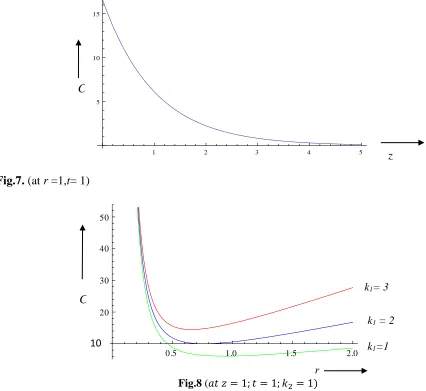
strongly as both coordinates increase. These trends are further confirmed in Figs.6 &7. It is also
noteworthy that the values of the concentration are at least an order of magnitude greater in Fig.6
than Fig.7. Therefore although both profiles are depleted rapidly with increasing coordinate values,
the radial concentration delivery is greatly in excess of the axial concentration delivery.
1 2 3 4 5
5 10 15
0.5 1.0 1.5 2.0
20 30 40 50
z C
r C
k1 = 2
k1=1
k1= 3
14
Fig.8 illustrates the effect of radial force on oxygen concentration, via the parameter, k1. It is
observed that, when only radial force acting on the capillary – tissues system , the concentration
of oxygen is dramatically elevated i.e. consumption of oxygen is greater with radial force present
than in the absence of radial force. Also, as force varies concentration of oxygen also varies
accordingly. The plots while similar, exhibit an increasingly pronounced peak at large r value and
low z value as k1 increases from 1 through 2 to 3. However k2 remains the same i.e. equal to 0
since in this case I, F(z) is not considered.
As with the axial force scenario (Case II), we develop a numerical solution. We consider (as
depicted in Figs.9-11) 𝑔(𝑟, 𝑧) = (𝑟 +𝑅
2
𝑟) 𝑒−𝑧 and 𝜏 = 1
3 as in [4], with the following prescribed
data:
= 0.9; 𝛽 = 0.4; 𝑅 = 0.005; 𝛾 = 2. ; k1 = 0(𝑠𝑖𝑛𝑐𝑒 𝑖𝑛 𝑡ℎ𝑖𝑠 𝑐𝑎𝑠𝑒 𝐹(𝑟)𝑖𝑠 𝑛𝑜𝑡 𝑐𝑜𝑛𝑠𝑖𝑑𝑒𝑟𝑒𝑑); k2 = 1; 𝛿 = 1. ; 𝑑 = 1.5.
Fig.9. (C for z = 1) Fig.10. (C for r = 1)
Fig.11. (C for t = 1) r
t
r z
C C
C
z
15
Fig.12. Effect of external forces on sub-diffusion of oxygen at k1=1,k2=1.
Figs.9-11 illustrate further computations, similar to those described in Figs.3-5, albeit at different
r, z and t values, respectively. Only marginal differences are observed. The general trends are of
the same fashion with peaks and troughs in oxygen concentration delivery arising at the same
locations.
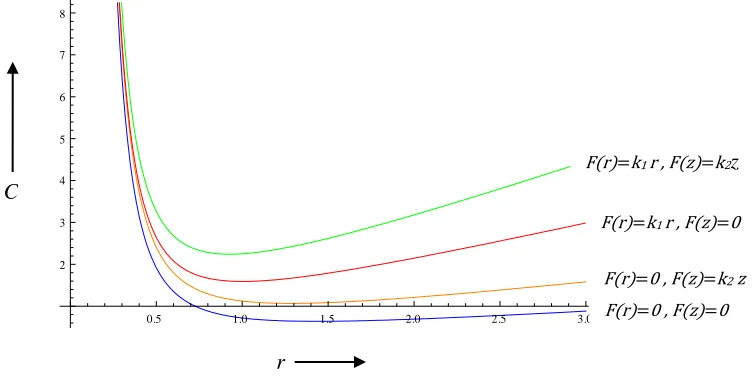
Finally, from Fig. 12 it is apparent that, when both the forces (radial force F(r) and axial force
F(z)) are acting simultaneously on the system, the maximum effect is attained i.e. though there is
a sub-diffusion of oxygen from capillary to tissues, nevertheless owing to the presence of these
forces, tissues will receive much more oxygen than without such forces present, or in the event of
only a single force (either radial force or axial force) being present. It is also observed that radial
force is much effective than axial force in controlling the sub-diffusion of oxygen. This has
significant implications for replenishment of oxygen in vital clinical scenarios such as hypoxia.
5.Conclusions
In the present article a generalized diffusion equation has been presented to simulate more
accurately the oxygen delivery from capillary to tissues. The new model features both absorbent
(consumption) terms as well as force (radial and axial) terms. The differential form of the new
generalized equation describing oxygen transport phenomena has been rendered into a more
amenable integral form, subject to pertinent boundary conditions, using fractional calculus. This
integral equation has been solved using NIM (New Iterative Method) and solutions validated with
MADM (Modified Adomian Decomposition Method). The computations have shown that both
force terms markedly effect the diffusion of oxygen, although the radial force is found to be more
influential and more dramatically enhances concentration of oxygen. Although new parameters
0.5 1.0 1.5 2.0 2.5 3.0
2 3 4 5 6 7 8
r C
F(r)=k1 r , F(z)=k2z
F(r)=k1 r , F(z)=0
F(r)=0 , F(z)=k2 z
16
arise in this generalized model, certain refinements are currently being explored to further improve
the model. Aspects of this refinement include utilizing a variety of initial guesses for the solution,
using force terms which are non-linear and incorporating a variable diffusivity (as a function of
concentration). However the present model is sufficiently complex to demonstrate that via
judicious manipulation of external forces acting on capillary–tissue oxygen diffusion systems, the
detrimental effects of hypoxia associated with subdiffusion of oxygen may be suppressed, if not
eliminated entirely. Capillary bed structure [26] has also been neglected in the present analysis,
and this is also an important area for future investigation.Since oxygen is a crucial factor for
metastasis, arteriolar occlusions [27], which are also common, serve to decreases oxygen
concentration and may contribute to muscle damage. This also remains an important area to
analyse, and could be achieved via extending the current work to multiple non-homogeneous
capillaries, featuring different solutes and via controlling each stable source of oxygen by a
transient function to model disturbed hemodynamics.
Acknowledgement
The authors are grateful to the reviewers for their comments and suggestions which have served
to improve the present article.
References
[1] R.M. Leach, D.F. Treacher, ABC of oxygen. Oxygen transport-2.Tissue hypoxia, Clinical
Rev. BMJ 317 (1998) 1370-1373.
[2] C.Y. Wang, J.B. Bassingthwaighte, Capillary supply regions, Math. Biosci.173 (2) (2001)
103.
[3] J. G. Go, Oxygen delivery through capillaries, Math. Biosci. 208 (2007) 166 - 176.
[4] V. Srivastava, K.N. Rai, A multi-term fractional diffusion equation for oxygen delivery
through a capillary to tissues, Mathematical and Computer Modelling, 51 (2010) 616 –
624.
[5] A.M. Wazwaz, A reliable modification of Adomian decomposition method, Appl. Math.
Comput. 102 (1999) 77 - 86.
[6] V. Daftardar-Gejji, H. Jafari, An iterative method for solving nonlinear functional
equations, J. Math. Anal. Appl. 316 (2006) 753 - 763.
[7] V. Daftardar-Gejji, S. Bhalekar, Solving fractional diffusion-wave equations using a new
17
[8] S. Bhalekar, V. Daftardar-Gejji, New iterative method: Application to partial differential
equations, Appl. Math. Comput. 203 (2008) 778 - 783.
[9] G. Adomian, A review of the decomposition method in applied mathematics, J. Math. Anal.
Appl. 135 (1988) 501 - 544.
[10] G. Adomian, Solving Frontier Problems of Physics: The Decomposition Method, Kluwer
Academic Publishers, Boston, USA (1994).
[11] G. Adomian, Solutions of nonlinear PDEs, Appl. Math. Lett. 11 (1998) 121-123.
[12] G. Adomian, R. Rach, Linear and nonlinear Schrodinger equations, Found Phys. 21
(1991) 983-991.
[13] A.M. Wazwaz, Partial Differential Equations: Methods and Applications, 1st ed., Taylor
& Francis, 2002.
[14] A.M. Wazwaz, The decomposition method applied to systems of PDEs and to the
reaction-diffusion Brusselator model, Appl. Math. Comput. 110 (2000) 251-264.
[15] A.M. Wazwaz, Approximate solutions to boundary value problems of higher order by the
modified decomposition method, Comput. Math. Appl. 40 (2000) 679-691.
[16] A.M. Wazwaz, The modified decomposition method applied to unsteady flow of gas
through a porous medium, Appl. Math. Comput. 118 (2001) 123-132.
[17] D. Kaya, A. Yokus, A numerical comparison of partial solutions in the decomposition
method for linear and nonlinear partial differential equation, Math. Comput. Simul. 60
(2002) 507-512.
[18] S. Saha Ray, A numerical solution of the coupled sine-Gordon equation using the
modified decomposition method, Appl. Math. Comput. 175 (2006) 1046-1054.
[19] V. Daftardar-Gejji, S. Bhalekar, Solving multi-term linear and non-linear diffusion_wave
equations of fractional order by Adomian decomposition method, Appl. Math. Comput.
202 (2008) 113-120.
[20] G.D. Manolis, T.V. Rangelov, Non-homogeneous elastic waves in soils: Notes on the
vector decomposition technique, Soil Dyn. Earthq. Eng. 26 (2006)952-959.
[21] D. Tripathi, and O. Anwar Bég, Peristaltic propulsion of generalized Burgers’ fluids
through a non-uniform porous medium: A study of chyme dynamics through the diseased
intestine, Mathematical Biosciences, 248 (2014) 67-77.
[22] D. Tripathi and O.A. Beg, A numerical study of oscillating peristaltic flow of generalized
Maxwell viscoelastic fluids through a porous medium, Transport in Porous Media, 95
18
[23] D. Tripathi, Peristaltic transport of fractional Maxwell fluids in uniform tubes:
Application of an endoscope, Computers and Mathematics with Applications, 62 (2011)
1116–1126
[24] D. Tripathi,A mathematical model for the peristaltic flow of chyme movement in small
intestine, Mathematical Biosciences, 233 (2011) 90-97
[25] A. Schot, M. K. Lenzi, L. R. Evangelista, L. C. Malacarne, R.S. Mendes, E.K. Lenzi,
Fractional diffusion equation with an absorbent term and a linear external force: Exact
solution, Phy. Lett. A, 366 (2007) 346 – 350.
[26] E F Leonard and S B Jørgensen, The analysis of convection and diffusion in capillary
beds, Annual Review of Biophysics and Bioengineering, 3 (1974) 293-339.
[27] D. Goldman and A.S. Popel, A computational study of the effect of capillary network