International Journal of Emerging Technology and Advanced Engineering
Website: www.ijetae.com (ISSN 2250-2459, ISO 9001:2008 Certified Journal, Volume 6, Issue 9, September 2016)
51
APPARKING: Smart Parking System based on Cloud
Computing using Android and IoT
Ulka Jadhav
1, Kavita Kahandal
2, Yojana Gaikwad
3, Bhushan Kadam
41,2,3,4Department of Computer Engineering, SND College of Engineering & RC, Yeola, India, India
Abstract- Cloud computing is one of the most widespread technology in recent time which has vigorously changed the nature of a business. Internet of Things is another technology which has impressed the day to day of human being. Improvement in Cloud computing and Internet of things can be united and functional for solving real-time difficulties. In our research work, we have combined the Internet of Things technology and an Android application using cloud computing to design an enhanced intelligent parking system. Overview for designing an Intelligent parking system has been narrated in this paper with an architecture diagram.
This system will be manageable through an Android app or through the web portal provided. We have studied some of the existing designs and it shows that most of the existing designs aren’t absolutely automated and necessitate a definite level of human meddling or collaboration in or with the system. The difference between this mechanism and the other existing systems is that we intent to make our system as less human-dependent and less physical actions as possible by automating the cars and the entire parking lot.
To solve the traffic congestion difficulty we require a superior mechanism in the parking area to measure empty space, Services and show the information to the people who looking for the empty space for Parking lot. The reservation process is happening only by the user. Hence the user discovers the unfilled parking lot and makes the action of booking through an internet access by an Android Application with driver's own knowledge Parking Lot.
Keywords- Android, Cloud Computing, Mobile computing, Raspberry pi, Smart Parking System.
I. INTRODUCTION
In big cities, Traffic congestion is major problem. Finding in large city Traffic congestion occurs when a volume of traffic, it demands for space greater than currently available road capacity, people can’t maintain a steady speed, there’s too many cars and not enough road or in case of rainy season etc. Nowadays, traffic congestion may occur because of several reasons like unawareness of information on available parking spaces. So, the result as car drivers spend lot of time driving along the streets in search of parking space, driver frustration, and air pollution. This also creates further traffic delays and exasperate for other car drivers.
After finding parking space to the driver, he parks the vehicle, it maybe spend small amount of time to looking for a city council parking attendant to pay the parking fees. Sometimes, the time spent looking for the attendant is important and most drivers leaving their cars before they pay the parking fee due to the fact which include having your vehicle locked or event owed which in turn attracts heavy penalties.
In some cases, drivers collide with parking attendants so that they give up the receipt but pay an amount less than the actual parking fee to the attendant. Assignment of supervisors for the region with a number of attendants is aimed at reducing fraud hence increasing earning. However, the supervisors themselves have been agreement with the attendants in many cases such as drivers park the vehicles at a lesser fee but which they pocket and do not give up to the city council. The reality is that there is bigger loss since the council has to offer for wages of both the attendants and supervisors. Most of the problem related to finding parking slot to park the car can be accomplished and degrades by using new technologies.
Our proposed system, eliminate or significantly reduce corruption to provide an alternative way for payment of the parking fees which do not require exchanging the cash by using hands. To reduce the time spent for locating parking space. This system provides the way of requesting for accessing available parking’s slots information remotely. It also shows the possibility of variable message and application being used for providing such information related to available parking slot.
II. LITERATURE SURVEY
International Journal of Emerging Technology and Advanced Engineering
Website: www.ijetae.com (ISSN 2250-2459, ISO 9001:2008 Certified Journal, Volume 6, Issue 9, September 2016)
52
This charge will be used to propose a result of judgment of an accessible parking space upon a demand by the customer and a solution of suggesting a new car park if the existing car park is full. The model outcome shows that the algorithm helps get better probability of victorious parking and reduces the customer waiting time.This paper proposed a system that helps customers automatically discover a free parking space at the smallest amount of charge based on new routine metrics to determine the customer parking charge by taking into consideration the distance and the total number of open places in every car park. [1]
Secondly we have studied the paper, “Smart Parking System Using Cloud Computing” (Ajay R. Jadhav, Datta P. Hujare, Anil A. Pawar, Prashant B. Khandale, and Prof. P. S. Desai) which supposed to achieve maximum efficiency in a parking system management. This system is a special system for smart parking reservation and safety preservation of a commercial car parking area in an inner-city atmosphere. Now a day’s overcrowding of traffic increasing rapidly. To solve this major problem in huge cities this system was designed. This system reduced human power required for Parking and other requirements. [2]
And beyond this, the design “Smart Parking System Based on Embedded System and Sensor Network” (Faiz Ibrahim Shaikh, Pratik Nirnay Jadhav, Saideep Pradeep Bandarkar, Omkar Pradip Kulkarni, Nikhil kumar B. Shardoor) helped us to plan our system by using IoT device such as Raspberry pi. This design consists of IoT devices, embedded systems and wireless sensor networks. This system and execution was based on prototype of Reservation-based Smart Parking System (RSPS) that permits users to successfully find and refuse to give the available parking spaces. [3]
III. PROPOSED SYSTEM
[image:2.612.357.529.132.285.2]The system Architecture for Smart Parking Portal is "To assist with the exact information, at right place in real-time with responsible setup and location sensitiveness”. In this era we are dealing with tables and Smart Phones. A very appealing application include monitoring where instant information needed to decide if the employee being monitored is any real threat or wrong target. We have been able to create number of different application where we provide the manager with rights to monitor employee he/she wants to. But these applications are limited to desktop only. We need to import them on mobile devices. We ensure that while traveling does not need to carry heavy files or system with him. All information must be available in his mobile device in user friendly format.
Figure 3.1: System Architecture
3.1 System Design A. Customer device:
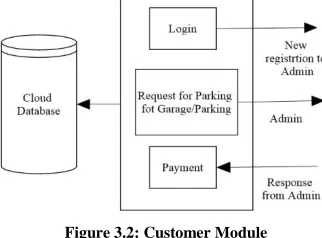
A user can connect with the smart parking system with their smart phones. User device will provide services like Parking lot number, Ticket and manual numbers and License plate etc. The service ‘parking lot number’ consist of the details about parking area in the garage which describes available slots as well as unavailable slots.
Figure 3.2: Customer Module
‘Ticket and manual number’ contains the details about what kind of service should provide to customer. During every service, the customer gets unique ticket and manual number. This makes to find out details about activity done on car at any time in future if required.
B. Raspberry pi:
[image:2.612.361.522.399.518.2]International Journal of Emerging Technology and Advanced Engineering
Website: www.ijetae.com (ISSN 2250-2459, ISO 9001:2008 Certified Journal, Volume 6, Issue 9, September 2016)
53
C.
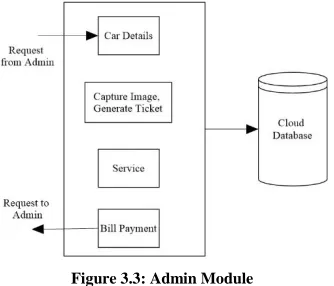
Garage Admin device: [image:3.612.361.529.153.439.2]The customer device will get connected to garage admin device. Garage admin app will provide various services like garage information, employee details, cash details, add/remove cars etc. Garage information includes the information about available space, cars parked at the moment, services happening on particular car, total number of car entered, total number of car out from garage i.e. inward outward details of parking. This device forwards all collected data to cloud. This stored data can be visible by admin via his web portal.
Figure 3.3: Admin Module
D.Super Admin:
Super admin will act as an administrator. Super admin will control the cloud service and garage environments. Super admin will not directly get connected to customer. He will provide service to garage admins only. Super admin provides services like add/remove users (Garage Admins), provides maintenance to them and all required tasks using cloud. The raspberry pi programed by super admin.
Following table shows the typical difference between an APPARKING and Local Parking System:
Table 3.1:
APPARKING vs. Local Parking
IV. ALGORITHMS
A.MD5 Algorithm:
This proposed system uses MD5 algorithm for cryptographic hash function. MD5 is one in a series of message digest algorithms designed by Professor Ronald Rivest of MIT in 1992. MD5 produces 128 bit (16-byte) hash value, typically expressed in text formats a 32 digit hexadecimal number. MD5 is commonly used to verify data integrity. MD5 is unbreakable. [2][6]
APPARKING SPS
Parking Lot
Extra Hardware
required
No EPCU
Data Storage
On Cloud Server
Local Computer/
Server
End user
oriented Yes No
Data
Security Maintain
Not maintain
Employee
training Not required Required
Parking
reservation Possible
Not Possible
employee required
Less than Parking Lot
More than APPARKI
NG
[image:3.612.87.254.270.413.2]International Journal of Emerging Technology and Advanced Engineering
Website: www.ijetae.com (ISSN 2250-2459, ISO 9001:2008 Certified Journal, Volume 6, Issue 9, September 2016)
[image:4.612.354.548.125.264.2]54
Figure 4.1 MD5 ConceptA hash function offers a way of creating a fixed-size blocks of data by using entry data with variable length. It is also known as taking the digital fingerprint of the data, and the exit data are known as message digest or one-way encryption. The hash values solve the problem of the integrity of the messages.
MD5 encryption algorithm provide high security even if the encrypted data were leaked, data itself would not leak the true meaning. MD5 is one-way irreversible encryption mean once a data is encrypted, the value is generated and cannot be decrypted and reversed to the initial data. [6]
B.Encryption and Decryption:
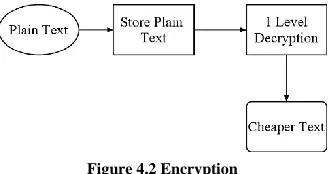
The purpose of encryption is to ensure that only somebody who is authorized to access data will be able to read it, using the decryption key. Somebody who is not authorized can be excluded, because he or she does not have the required key, without which it is impossible to read the encrypted information. [2]
Figure 4.2 Encryption
In order to protect the security of network data, a high speed chip module for encrypting and decrypting of network data packet is designed.
Figure 4.3 Decryption
C. Dijkstra’s algorithm:
Shortest path search has been widely applied recently in many applications such as Geographic Information System (GIS), Global Positioning System (GPS), traffic information system, routing system, mapping such as Google Maps and many more. One of the most used algorithms is Dijkstra. [1]
Sample Pseudo code:
In the following algorithm, the code u ← vertex in Q with min dist[u], searches for the vertex u in the vertex set Q that has the least dist[u] value. length (u, v) returns the length of the edge joining (i.e. the distance between) the two neighbor-nodes u and v. The variable alt on line 17 is the length of the path from the root node to the neighbor node v if it were to go through u. If this path is shorter than the current shortest path recorded for v, that current path is replaced with this alt path. The prev array is populated with a pointer to the "next-hop" node on the source graph to get the shortest route to the source.
function Dijkstra(Graph, source):
create vertex set Q
for each vertex v in Graph: //
Initialization
dist[v] ← INFINITY
// Unknown distance from source to v
prev[v] ← UNDEFINED //
[image:4.612.87.254.499.586.2]International Journal of Emerging Technology and Advanced Engineering
Website: www.ijetae.com (ISSN 2250-2459, ISO 9001:2008 Certified Journal, Volume 6, Issue 9, September 2016)
55
add v to Q // All nodes initially in Q(unvisited nodes)
dist[source] ← 0 // Distance from source to source
while Q is not empty:
u ← vertex in Q with min dist[u] // Source node will be selected first
remove u from Q
for each neighbor v of u: // where v is
still in Q
.
alt ← dist[u] + length(u, v)
if
alt
< dist[
v
]: // A shorter path to v has been founddist[
v
] ←
alt
prev[v] ← u
return dist[], prev[]
V. CONCLUSION
We have proposed a Smart Parking System to optimize a parking system management in which dynamic pricing schemes for satisfying the different needs of drivers and service provider, which is based on real-time parking information.
The pricing scheme is integrated with the proposed parking lot in which parking price is dynamically adjusted in response to the relationship of demand and congestion level.
REFERENCES
[1] Thanh nam pham, ming-fong tsai, duc binh nguyen, chyi-ren dow, and der-jiunn deng. "a cloud-based smart-parking system based on internet-of-things technologies." digital object identifier 10.1109/access.2015.2477299 (2015): 1581-1591.
[2] ajay.r.jadhav, datta .p. Hujare, anil.a. Pawar, prashant.b.khandale, prof. P. S. Desai. "Smart parking system using cloud computing." international journal of modern trends in engineering and research, www.ijmter.com, e-issn no.:2349-9745, date: 28-30 April, 2016 (2016): 251-252.
[3] Faiz Ibrahim Shaikh, Pratik nirnay jadhav, saideep Pradeep bandarkar, omkar pradip kulkarni, nikhilkumar b. Shardoor. "Smart parking system based on embedded system and sensor network." international journal of computer applications (0975 – 8887) volume 140 – no.12, April 2016 (2016): 45-51.
[4] Prof. Yashomati r. Dhumal, harshala a. Waghmare, aishwarya s. Tole, swati r. Shilimkar. "Android based smart car parking system." international journal of advanced research in electrical, electronics and instrumentation engineering, (an iso 3297: 2007 certified organization), vol. 5, issue 3, March 2016 (2016): 1371-1374. [5] Rajakumari, r.kaudilyar and kavitha esther. "Intelligent parking
system using cloud." Asian journal of computer science and technology, ISSN 2249-0701 vol. 4 no. 1, 2015, pp.18-20, © the research publication, www.trp.org.in (2015): 18-20.
[6] Vandana Pandey, V.K Mishra. "Architecture based on MD5 and MD5-512 Bit Applications." International Journal of Computer Applications (0975 – 8887) Volume 74– No.9, July 2013 (2013): 29-33.
[7] Kurt, Gokhan. "Raspberry Pi Android Projects." (September 25, 2015).