International Journal of Emerging Technology and Advanced Engineering
Website: www.ijetae.com (ISSN 2250-2459,ISO 9001:2008 Certified Journal, Volume 4, Issue 1, January 2014)
485
Lossless Data Hiding using Histogram Modification and Hash
Encryption Scheme
Nutan Palshikar
1, Prof. Sanjay Jadhav
21
ME (Comp Engg) II Year Student, Department of Computer Engineering,MGM’s College of Engineering and Technology, Navi Mumbai, University of Mumbai, India.
2Assistant Professor, Department of Computer Engineering, Sarswati College of Engineering, Kharghar, Mumbai, University of
Mumbai, India.
Abstract— The security of multimedia data can be done with encryption or data hiding algorithms. This paper attempts to undertake the study of authentication creation and proprietorship checking using linear histogram and non linear equalize histogram techniques with and without hash encryption algorithm .The development of information hiding techniques provides a solution for protecting digital media.A lossless data hiding method based on histogram shifting and encryption is proposed. The sub image information is replaced by the watermark image which is the hidden information by dividing image in 3 planes of R,G,B layer , then the three tier image after hiding information recorded as R’,G’,B’. The encryption algorithm enhances the security and offers the original data to the authenticated user and allow to recover original image without any distortion from the marked image after the hidden data have been extracted. An efficient histogram shifting method that modifies the pixel grayscale value within the range is proposed to embed data into the image and it provide good quality of marked images. Non-linear contrast limited enhancing Adaptive histogram equalization method along with encryption offers the great security and results of exhaustive experimentation using standard input colour images demonstrate the efficiency of Watermarking through better range of PSNR Values.
Keywords - Histogram Equalization, Hash encryption, Reversible data hiding, Rijndael Encryption, Watermarking.
I. INTRODUCTION
Digital watermarking is one of the ways to prove the ownership and the authenticity of the media. There are mainly two types of watermarking algorithms: visible watermarking and invisible watermarking. For invisible watermarking, the watermark should be perceptually transparent and robustness [2] [3]. For visible watermarking, the watermark should be perceptually visible and robustness.
Lossless data hiding (LDH) has been widely studied as a popular and powerful technique to protect copyright in many sensitive scenarios, e.g., medical diagnosis, remote
sensing and law enforcement [1]. Data hiding [4] is
referred to as a process to hide data (representing some information) into cover media.
The data hiding process links two sets of data, a set of the embedded data and another set of the cover media data. The relationship between these two sets of data characterizes different applications. For instance, in covert communications, the hidden data may often be irrelevant to the cover media. In authentication, however, the embedded data are closely related to the cover media. In these two types of applications, invisibility of hidden data is an important requirement. In most cases of data hiding, the cover media will experience some distortion due to data hiding and cannot be inverted back to the original media. That is, some permanent distortion has occurred to the cover media even after the hidden data have been extracted out.
In some applications, such as medical diagnosis and law enforcement, it is critical to reverse the marked media back to the original cover media after the hidden data are retrieved. Digital watermarking can intuitively indicate copyright, but by removing the watermark we can also allow users to obtain complete data, showing that digital watermarking does not prevent authentic users of using the data. The lossless visible watermark technology would damage the image quality, limits its applications.
The original image of this method is non-destructive image reproduction, overcoming the limitations of the destruction in image quality. Some researchers have used wavelet transform for lossless and visible watermarking, this algorithm uses wavelet transform, which compute more complexly, and the hidden data is limited. This method of histogram shifting is used to mask the sub-image information, restore more information, and attain the purpose to limit unauthorized usage.
In recent years, several lossless data hiding techniques have been proposed for images. Lossless embedding can take place in the spatial domain [5], or in the transform domain [6]. Z. Ni [5] proposed a lossless data embedding technique, which utilizes the zero or the minimum point of the image histogram.
International Journal of Emerging Technology and Advanced Engineering
Website: www.ijetae.com (ISSN 2250-2459,ISO 9001:2008 Certified Journal, Volume 4, Issue 1, January 2014)
486
The hidden watermarking information is actually part of the sub-image information covered by the watermark, the amount of information depends on the format of the original image, which makes the amount of information hidden much higher than the amount of information in two value image as a watermark. On the other hand, after the restoration of the sub-image and the whole image must be no difference visually. Finally, we must consider security of the watermarking, illegal user can not remove the watermark. In the absence of representation of the hidden information, the illegal user can not access all value of the images.
The visible digital watermarking the paper focuses on the following points :
1. The information hidden problem, can be solved using histogram shifting algorithm for information hiding, 2. It concentartes on restoration of image quality, so
that the covered image can be fully retrieved.
3. For greatly enhancing the security the Encryption of the covered image is done,so that in the absence of the key,the illegal user can not access the image information.
II.PROPERTIES &REQUIREMENTS OF DIGITAL WATERMARKING
The various properties or can say the characteristics [20] [21] that digital watermarking holds are:
Invisible The use of watermarking system comes to an extinct if it distorts the cover image to such an extent that it becomes useless, or even highly distracting. Mainly the motive is that the watermarked image should not get easily distinguishable from the original image even on the highest quality equipment.
RobustThe intentional attack i.e. the purposeful attempt to distort the watermark or the unintentional attempt which can generally occur by mistake should all be resistant. Under unintentional attacks cropping resizing contrast enhancement categories are included which is normally used.
SecurityA watermark as being used for protection must a secret and uncatchable code. Only authorised parties should have the right to access the watermark. The avoidance of unauthorised parties only help to protect the image. Watermark because of this is treated as secure requirement. As keys were used in cryptography, same way watermark can be achieved. The algorithms are being used and published to everyone to work on digital watermark. A watermark signal is related with a unique number which is used for embedding and extracting. This embedding and extracting is similar to the encryption and decryption of information.
The special and unique number is used just to identify the authorised or legal user of digital information. If we focus more on robustness then the invisibility can be poor. So concluding that robustness with invisibility in digital watermarking is of great use.
III. COMPARATIVE ANALYSIS OF RECENT RESEARCHES
The techniques of Difference expansion is to It calculate the differences of neighboring pixel values, and select some difference values for the difference expansion and compress message data as well as related information and embed the result directly into the cover image. However, not all pairs can be expanded for data hiding location map is used to indicate whether pairs are expanded or not. A method in this group is Barton [7] which compresses the secret message before embedding them into the bit stream of digital data. The second group of reversible data hiding methods aims to explore the redundancy of pixel values in images. The next technique of reversible data hiding methods, to which the proposed method belongs, is based on the concept of histogram shifting. Che-Wei Lee[15] presented scheme of hierarchically dividing a cover image into smaller blocks for data embedding using the histogram shifting technique, which yields a large data hiding capacity and results in a high stego-image quality. The key issues of the robust LDH methods is to design a lossless embedding mechanism to ensure the reversibility, and construct the invariant features to achieve the robustness against the attacks, so robust lossless data hiding (LDH) methods is presented by Lingling An,[14]. To design the novel robust LDH methods by introducing the more effective and efficient invariant features, e.g., feature
points. Embedding distortion of visible watermarking is
International Journal of Emerging Technology and Advanced Engineering
Website: www.ijetae.com (ISSN 2250-2459,ISO 9001:2008 Certified Journal, Volume 4, Issue 1, January 2014)
487
Hu et al. [23] first proposed a reversible visible watermarking scheme by modifying one significant bit plane of the pixels of the host image. They achieved reversibility via losslessly hiding the compressed version of the altered bit plane into the non-watermarked image region. However, the embedded visible watermark with this method appears to be somewhat blurred, and the visual quality of the original image is significantly distorted.
Yip et al. [17] presented two lossless visible watermarking methods based on pixel value matching and pixel position shift, respectively. Yang et al. [18] proposed a reversible visible watermarking scheme satisfy the applications, in which the visible watermark is expected to conflict copyright piracy but can be removed to losslessly recover the original image. The performance of the proposed method is verified, and the test results show that the introduced scheme succeeds in preventing the embedded watermark from illegal removal. In [19], the visible and removable watermarking is extended in JPEG domain. From the literature, most of the watermarks are binary logos, and few methods of color visible removable watermarking are proposed in JPEG domain
Tsai et al. [22] mapped the pixel values of the host image underlying the watermark into a small range for showing the watermark and then reversibly inserted a reconstruction packet into the watermarked image for perfect restoration.
IV. NONLENEAR CONTRAST ENHANCEMENT Nonlinear contrast enhancement often involves histogram equalizations through the use of an algorithm.
A. Histogram Equalization
Histogram equalization is one of the most useful forms of nonlinear contrast enhancement. When an image's histogram is equalized, all pixel values of the image are redistributed so there are approximately an equal number of pixels to each of the user-specified output gray-scale classes (e.g., 32, 64, and 56).Contrast is increased at the most populated range of brightness values of the histogram (or "peaks"). It automatically reduces the contrast in very light or dark parts of the image associated with the tails of a normally distributed histogram . Histogram equalization can also separate pixels into distinct groups, if there are few output values over a wide range. Histogram equalization is effective only when the original image has poor contrast to start with, otherwise histogram equalization may degrade the image quality to this case the adaptive histogram equalization is improve this case.
B. Adaptive Histogram Equalization
Adaptive histogram equalization where you can divide the image into several rectangular domains, compute an equalizing histogram and modify levels so that they match across boundaries. Depending on the nature of the non uniformity of the image.
Adaptive histogram equalization uses the histogram equalization mapping function supported over a certain size of a local window to determine each enhanced density value. It acts as a local operation. Therefore regions occupying different gray scale ranges can be enhanced simultaneously. The image may still lack in contrast locally. We therefore need to apply histogram modification to each pixel based on the histogram of pixels that are neighbors to a given pixel. This will probably result in maximum contrast enhancement. According to this method, we partition the given image into blocks of suitable size and equalize the histogram of each sub block. In order to eliminate artificial boundaries created by the process, As in proposed system histogram modification using adaptive histogram equalization gives better results than linear histogram modification.
V. PROPOSED LOSSLESS VISIBLE WATERMARKING In proposed method the primary image is I, with 24-bit true color image as a original image, the image is divided in the three color layers of the image in R,G,B planes respectively as Ir,Ig,Ib. Hidden image first encrypted , So as to be hidden as encrypting information W, and then divide W into three sections of Wr ,Wg, Wb planes, after hiding image information recorded as Ir’,Ig’,Ib’. Now perform Embedding of encrypted information to original image using lossless data hiding and histogram shifting techniques. For example in the Ir layer, the process of Hiding Wr as follows:
1. Generating the original image histogram, denoted by
h(I)
2. In the h( I ) search for H(b)=min {h(k ), k ={0, 255}, simply, we might suppose H(b)=0 . Then search for H(a) >=L/3, a = {0, 255}. L is the hidden message Wr’s length. We may as well set up a<b , a, b as key record.
3. In the open interval (a, b) of gray values in Ir within the pixel gray value increased by 1 (if b<a, reduce 1). 4. Progressive scan original image, and embed L/3 bit
information If current embedded information bit is 1, it serves to increase the pixel gray value 1 (if b<a , then reduction of 1); if the current embedded information bit is 0, then pixel gray value keep this constant. The other pixels in the image do not need to change.
International Journal of Emerging Technology and Advanced Engineering
Website: www.ijetae.com (ISSN 2250-2459,ISO 9001:2008 Certified Journal, Volume 4, Issue 1, January 2014)
488
[image:4.612.53.302.235.463.2]At this point, Wr has been embedded into the image Ir, get the watermarked image Ir’. Embedded interval endpoints a, b as the key saved in part by a watermark extraction side. Encryption is employed from the point of security .Embedding process of watermark using histogram shifting is can be reversible by searching the range of histogram , and varying the pixels grey value the original image and watermark image can be recoverd.
Fig. 1. Process of embedding Reversible and Hidden Information.
[image:4.612.365.566.484.707.2]The above figure shows the overall embedding process, skip the encryption steps for linear and non linear histogram modification without encryption method. It is easy to see through the embedding process that histogram shifting is completely reversible in the case of getting the key, when extracting the watermark the steps as follows,
Fig. 2 Process of extracting Reversible and Hidden Information.
This text uses the method of histogram shifting using linear histogram and contrast limited equalize histogram to mask the sub-image information and to shelter more information, and attain the purpose to limit unauthorized use.
VI. RIJNDAEL ALGORITHM A.Rijndael Encryption
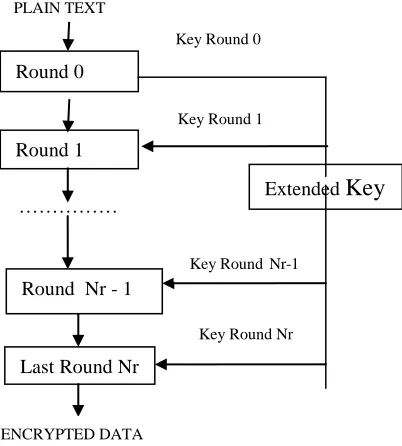
Rijndael the advanced encryption standard is a symmetric block cipher.It uses the same key between the sender and receiver to encrypt and decrypt the message.Speed and cost make symmetric algorithms as the algorithm of choice for encrypting large amounts of data. It works in parallel over the whole input block.It is an iterated block cipher with variable block length and variable key length. More the key length more the security. The block length and the key length can be independently specified to 128, 192 or 256 bits with the constraint that the input and the output have the same length. Internally Rijndael operations are performed on a two dimensional array of bytes called the state. All the intermediate cipher and inverse cipher results are stored in the state. This array has four rows. The number of columns represents the data block length to be encrypted divided by 32 and is denoted by Nb. At the start of the cipher and inverse cipher operations, the input block is copied into the state array; the cipher or inverse cipher operations are then conducted on this state array. Many mathematical operations within Rijndael ciphertext algorithm.
………
Fig. 3. Secure Encryption using key
Histogram Calculation of original images separate layer
Search the range (a,b) in 3 layers using encrypted Message length.
Merge (ak.bk) range of carrier image by checking value of Watermark and change accordingly.
concealed image encrypt and divide into RGB layer divide
Calculation of encrypted message length as M/3
If embedded 1, pixel grey value increase by1, if embedded 0 , keep constant , Save (ak,bk)
Single carrier image divide into RGB layer divide
Find pixels whose grey value ak, ak+1 if ak extract 0 else extract 1 till M/3 bits extracted
Pixels grey value decreased by 1 in range ak,bk
Reconstruct the original and watermark image Key (ak,,bk)
Round 0
Round 1
Extended
Key
Round Nr - 1
Last Round Nr
Key Round 1
Key RoundNr-1
Key Round Nr
ENCRYPTED DATA
[image:4.612.59.266.573.698.2]International Journal of Emerging Technology and Advanced Engineering
Website: www.ijetae.com (ISSN 2250-2459,ISO 9001:2008 Certified Journal, Volume 4, Issue 1, January 2014)
[image:5.612.120.230.148.334.2]489
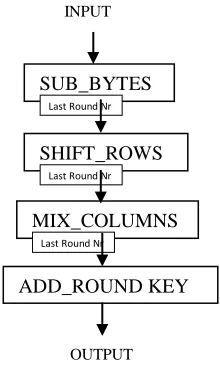
Fig. 4. Various steps in the encryption.
The AES algorithm’s operations are performed on a two-dimensional array of bytes called the State, The array of bytes in input is copied in the State matrix, At the end, the State matrix is copied in the output matrix.
B. Rijndael Decryption
The decryption algorithm is not identical with the encryption algorithm, but uses the same key schedule.There is also a way of implementing the decryption with an algorithm that is equivalent to the encryption algorithm (each operation is replaced with its inverse), however, in this case, the key schedule must be changed.
VII. LOSSLESS IMAGE DATA HIDING
Histogram shifting is a lossless data hiding method, its advantage is that the data embedded is large, visibility is good, the peak signal to noise ratio is high. In the histogram, we first find a zero point, and then a peak point. A zero point corresponds to the grayscale value where no pixel in the given image. A peak point corresponds to the grayscale value which the maximum number of pixels in the given image. The aim of finding the peak point is to increase the embedding capacity as large as possible.The number of bits that can be embedded into an image equals to the number of pixels which are associated with the peak point.
To enhance the security and to recover the image information A reversible data hiding techniques can be applied to restore images after the hidden data are extracted. Such techniques can be classified as on the basis of:
(a) Data compression Techniques [7,8];
(b) Pixel-value difference expansion Techniques[9,10]; and (c) Histogram shifting Techniques [11,12].
The techniques of the first classified method is to compress message data as well as related information and embed the result directly into the cover image. A method in this group is Barton [7] which compresses the secret message before embedding them into the bit stream of digital data. The second group of reversible data hiding methods aims to explore the redundancy of pixel values in images. Tian [9] proposed a technique of pixel-value difference expansion by performing fundamental arithmetic operations on pairs of pixels to discover hidable space. However, not all pairs can be expanded for data hiding. A location map is used to indicate whether pairs are expanded or not. An enhanced pixel-value difference expansion method proposed by H. J. Kim[10] used a refined location map and a new concept of expandability to achieve higher data hiding capacities while keeping the resulting image distortion as low as that yielded by Tian’s method [9].
The last technique of reversible data hiding methods, to which the proposed method belongs, is based on the concept of histogram shifting. Z. Ni[11] proposed a reversible data hiding method which shifts slightly the part of the histogram between the maximum point and the minimum point to the right side by one pixel value to create an empty bin besides the maximum point for hiding an input message.
Advantages of this method include yielding superior hiding capacities and providing higher qualities in stego-images. The knowledge of the maximum point and the minimum point of the histogram is necessary for retrieving the hidden data and restoring the stego-image losslessly to the original state.
VIII. SECURITY ANALYSIS
For the illegal users, the image embedded visible watermark has been marked with a copyright, and the visible watermark covered a part of original image, so the embedded watermark image are meaningless for the illegal users, because the visible image watermark shelter important information In the premise of an open method of watermark embedding, only when legitimate users have the key to eliminate visible watermark important information can be extracted from the image. If unauthorized users eliminate the visible watermark by sharing the image, it also breaks the image itself and prevents the use, so as to achieve the purpose of copyright protection.
SHIFT_ROWS
Last Round Nr Nr
MIX_COLUMNS
Last Round Nr Nr
SUB_BYTES
Last Round Nr Nr
ADD_ROUND KEY INPUT
International Journal of Emerging Technology and Advanced Engineering
Website: www.ijetae.com (ISSN 2250-2459,ISO 9001:2008 Certified Journal, Volume 4, Issue 1, January 2014)
490
For the visible digital watermarking, its purpose is to prevent unauthorized users access to the complete image information. Only legitimate users who have the key and password in advance can eliminate the visible watermark. Of course, the visible watermark obscures important parts of the image, as long as unauthorized users obtain these important parameters information they will get whole value of the image. That is only to obtain partially the hidden sub-image information; all users can obtain the image value. Visible digital watermark need to ensure that the hidden sub-image cannot be illegally obtained, even partially, are not permitted access. Rijndael the advanced encryption standard is a symmetric block cipher. It uses the same key between the sender and receiver to encrypt and decrypt the message. Speed, cost, code length and memory utilization make symmetric algorithms as the algorithm of choice for encrypting large amounts of data. It works in parallel over the whole input block.It is an iterated block cipher with variable block length and variable key length. More the key length more the security. In proposed system we are using AES 128 bit , Internally, the AES algorithm’s operations are performed on a two-dimensional array of bytes called the State, The array of bytes in input is copied in the State matrix, At the end, the State matrix is copied in the output matrix
IX. LOSSLESS PARAMETERS We have to calculate PSNR and MSE.
Peak signal noise ratio is used to calculate the quality of the recovered image. It is a better test since it takes the signal strength in to consideration.
PSNR = 10
log
10MSE
2
255
Where, MSE is the mean square error between the original image and the watermark recovered image. This is used to test whether two pictures are similar or not.
The definition of MSE is given by
:
MSE =
, 21
0 1
0
,
'
)
(
1
j i M
i N
j j i
x
x
N
M
Where, xi,j and x'i,j are the pixel values of the original image and the watermark recovered image, respectively. A higher PSNR value means that the quality of lossless restore image is closer to the original image. Our experimental result by comparing different watermarking techniques shows the variations in efficiency of PSNR and MSE values.
X.EXPERIMENTAL RESULTS
To verify the algorithm, we make use of standard color grayscale images in the experiment, color and grayscale watermark were visibly embedded to verify whether the lossless representation of the original image. We are comparing our watermarking and watermark removal method using four techniques,
1)Linear Histogram modification using Encryption 2)Linear Histogram modification without using
Encryption
3)Equalized Histogram modification using Encryption 4)Equalized Histogram modification without using
[image:6.612.334.557.220.572.2]Encryption
Fig. 5. Original image
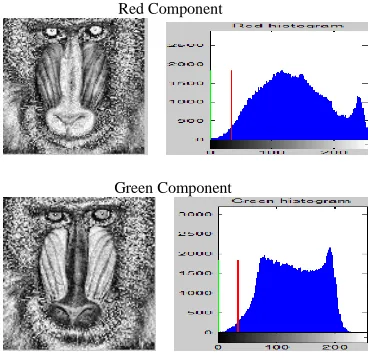
Fig. 6. Separation of Red, Green and Blue component
Red Component
Green Component
[image:6.612.351.535.499.678.2]
International Journal of Emerging Technology and Advanced Engineering
Website: www.ijetae.com (ISSN 2250-2459,ISO 9001:2008 Certified Journal, Volume 4, Issue 1, January 2014)
491
Blue Component [image:7.612.340.548.121.489.2]Fig. 7 Histogram of Red, Green and Blue component
Red Component
Green Component
Blue Component
[image:7.612.71.268.139.228.2]Fig. 8 Equalized Histogram of Red, Green and Blue component
The image-histogram illustrates how pixels in an image are distributed by graphing the number of pixels at each colour intensity level.
a1. Original Image b1. Watermarking
c1. Watermarked image d1. Lossless restore image
a2. Original Image b2. Watermarking
c2. Watermarked image d2. Lossless restore image
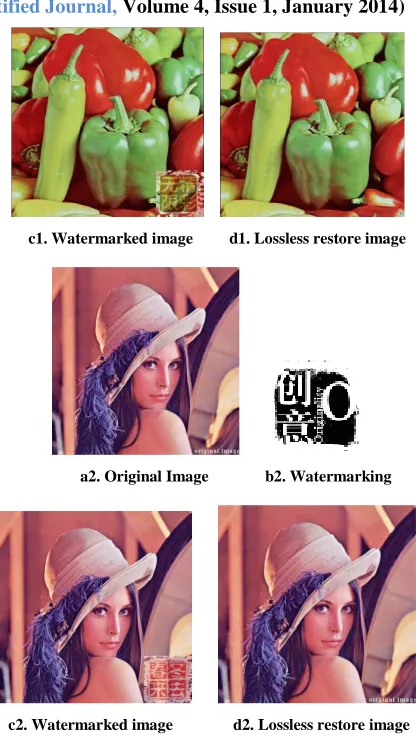
Fig. 9 The visible lossless Digital watermarking experiments
Fig. 6 shows the visible watermark concealing and the host image non-destructive recovery process, in the pictures above the images are all 512X512 standard color images. Figure c1, c2, c3, c4 are the embedded visible watermark images, and we can see from the experiment that visible watermark logo watermark function can be achieved, Figure d1, d2, d3, d4 are the lossless.The experimental verification of digital watermark can be seen from the non-destructive recovery performance. The algorithm can recover the original image losslessly.
[image:7.612.71.269.254.528.2] [image:7.612.90.194.589.686.2]International Journal of Emerging Technology and Advanced Engineering
Website: www.ijetae.com (ISSN 2250-2459,ISO 9001:2008 Certified Journal, Volume 4, Issue 1, January 2014)
[image:8.612.41.298.153.305.2]492
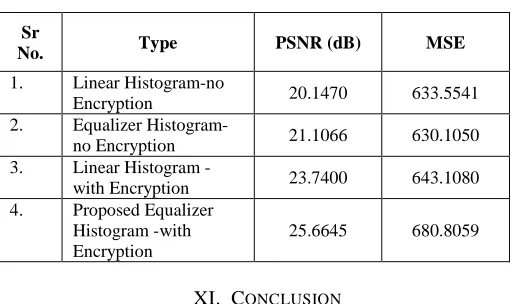
TABLE I
Result Of PSNR & MSE Values of Four Techniques
Sr
No. Type PSNR (dB) MSE
1. Linear Histogram-no
Encryption 20.1470 633.5541
2. Equalizer
Histogram-no Encryption 21.1066 630.1050
3. Linear Histogram -
with Encryption 23.7400 643.1080
4. Proposed Equalizer Histogram -with Encryption
25.6645 680.8059
XI. CONCLUSION
Based on the design rules discussed earlier, the new image encryption scheme with histogram equalization is designed.
This proposed scheme introduces a lossless recovery with visible digital watermarking technology. Through histogram shifting we achieve hiding and recovering the information losslessely, resolving the destruction of original images in visible digital watermark, and solving small amount of information hidden problems. From comparison table Non linear histogram equalization with Encryption provides the best ratio of peak signal to noise ratio to calculate the quality of the recovered image
.
For security, in proposed scheme the encryption algorithm offers to encrypt the data of sub image, and then spreading a disturbance to the whole image ,so as to achieve the purpose of protecting the image data with high security. The visible digital watermark by hiding parts of the image restricts the use of illegal users to protect the image. The growth of any organization leads to enhancements, in future the system can be enhanced according to requirements. In order to become an effective system, these system should provide improvement and enhancement. Future research may be guided to more applications of the proposed method and extensions of the method to other data types other than bitmap images, like DCT coefficients in JPEG images and MPEG videos. This paper can be further enhanced based on the future trends and strategies.REFRENCES
[1 ] L. An, X. Gao, C. Deng, and F. Ji, “Reversible watermarking based on statistical quantity histogram,” Lecture Notes in Computer Science, vol. 5879, pp. 1300-1305, 2009.
[2 ] N. Nikolaidis and I.Pitas, “Copyright protection of images using robust digital signatures” Proc. Int. Conf. Acoustics, Speech and Signal Processing, vol. 4, pp. 2168-2171, May 1996
[3 ] I. Cox, Kilian, T. Leighton, and T. Shamoon, “Secure spread spectrum watermarking for images, audio, and video” Proc Int. Conf. Image Processing, vol. 3, pp. 243-246, Sep. 1996
[4 ] W. Zeng, “Digital watermarking and data hiding: technologies and applications,”in Proc. Int. Conf. Inf. Syst., Anal. Synth., vol. 3, 1998, pp.223–229.
[5 ] Ni, Z., Shi, Y., Ansari, N., Su, W.: Reversible data hiding. Proc. ISCAS (2003) 912–915
[6 ] Xuan, G., Zhu, J., Chen, J., Shi, Y., Ni, Z., Su, W.: Distortionless data hiding based on interger wavelet transform. IEE Electrionics Letters (2002) 1646–1648
[7 ] J. M. Barton, “Method and apparatus for embedding authentication information within digital data,” U. S. Patent 5646997, 1997. [8 ] M. U. Celik, G. Sharma, A. M. Tekalp, and E. Saber, “Lossless
generalized-LSB data embedding,” IEEE Transactions on Image Processing, Vol. 14, 2005, pp. 253-266.
[9 ] J. Tian, “Reversible data embedding using a difference expansion,” IEEE Transactionson Circuits Systems and Video Technology, Vol. 13, 2003, pp. 890-896.
[10 ]H. J. Kim, V. Sachnev, Y. Q. Shi, J. Nam, and H. G. Choo, “A novel difference expansion transform for reversible data embedding,” IEEE Transactions on Information Forensics and Security, Vol. 3, 2008, pp. 456-465
[11 ]Z. Ni, Y. Q. Shi, N. Ansari, and W. Su, “Reversible data hiding,” IEEE Transactionson Circuits Systems and Video Technology, Vol. 16, 2006, pp. 354-362.
[12 ]W. C. Kuo, D. J. Jiang, and Y. C. Huang, “A reversible data hiding scheme based on block division,” in Proceedings of International Congress on Image and Signal Processing, Vol. 1, 2008, pp. 365-369.
[13 ]Shu-Kei Yip, Oscar C. Au, Chi-Wang Ho, Hoi-Ming Wong, “Lossless Visible watermarking”, 1424403677/06/$20.00 ©2006 IEEE ,ICME 2006
[14 ]Lingling An, Xinbo Gao, Cheng Deng, and Feng Ji Robust Lossless Data Hiding: Analysis and Evaluation”978-1-4244-6829-4/10/$26.00 ©2010 IEEE,”
[15 ]CHE-WEI LEE1 AND WEN-HSIANG TSAI1,2” A Lossless Large-Volume Data Hiding Method Based on Histogram Shifting Using an Optimal Hierarchical Block Division Scheme*” , JOURNAL OF INFORMATION SCIENCE AND ENGINEERING 27, 1265-1282 (2011)
[16 ]Yongjian Hu, Sam Kwong, Jiwu Huang, “An Algorithm for Removable Visible Watermarking”, IEEE Transactions on Circuits and Systems for Video Technology, Vol. 16, No. 1, pp. 129-133, 2006.
[17 ]Soo-Chang Pei, Yi-Chong Zeng, “A novel image recovery algorithm for visible watermarked images”, IEEE Transactions on Information Forensics and Security, Vol. 1, no.4, pp.543–550, 2006.
[18 ]Y.Yang, X.Sun, H.Yang, C.-T.Li, “Removable visible image watermarking algorithm in the discrete cosine transform domain”, Journal of Electronic Imaging, vol.17, no.3, pp.033008-1–033008-11, 2008.
[19 ]Yeh, F.H, Lee, G.C, Lin, Y.T., “Removable Visible Watermarking in JPEG Compression Domain”, Asia-Pacific Services Computing Conference, 2008. APSCC „08. IEEE. 9-12 Dec. 2008 pp: 1328-1331, 2008
International Journal of Emerging Technology and Advanced Engineering
Website: www.ijetae.com (ISSN 2250-2459,ISO 9001:2008 Certified Journal, Volume 4, Issue 1, January 2014)
493
[21 ]Evelyn Brannock, Michael Weeks, Robert Harrison, ComputerScience Department Georgia State University “Watermarking with Wavelets: Simplicity Leads to Robustness”, Southeastcon, IEEE, pages 587 – 592, 3-6 April 2008
[22 ]Vasiliy Sachnev, Hyoung Joong Kim, “Reversible Watermarking Algorithm Using Sorting and Prediction,” in Proc. IEEE Int. Conf. on circuits & systems for video technology, 2009, pp. 989–999.