Application of Response Surface Methodology in Optimization of Cadmium
Adsorption By Raw Rice Husk
Monik Kasman
Civil and Environmental Engineering dept Engineering Fac. University of Malaya Environmental Engineering Dept, Engineering Faculty,
University of Batanghari, Jambi, Indonesia
E-mail: [email protected]
Shaliza Ibrahim
Civil and Environmental Engineering department Engineering Faculty, University of Malaya
Kuala Lumpur Malaysia E-mail: [email protected]
Abstract— this study was aimed to model and optimize the adsorption process of cadmium from aqueous solution onto raw rice husk (RRH). The batch experiment was carried out in four factors as a function of pH (A: 5 – 9), adsorbent dosage (B: 2 – 8 g/100 ml), contact time (C: 60 – 240 minutes) and initial concentration of adsorbate (D: 70 – 110 mg/L) to response (percentage of cadmium removal). Response surface methodology (RSM) was used to analyzed and optimize the effect of four factors in cadmium adsorption. The result showed that RRH can successfully reduce cadmium from aqueous solution in removal percentage from 79.45% to 97.978%. Value of pH, dosage, contact time and initial concentration was noted significant statistically. RSM was undoubtedly used to optimize the adsorption process where the optimum condition achieved at pH 9, dosage 5 g/100 ml, contact time 240 minutes and initial cadmium concentration 90 mg/L.
Keywords- Adsorption; Cadmium; Response surface methodology; Raw rice husk
I. INTRODUCTION
Water and wastewater containing heavy metals has been concerned environmental crisis in worldwide due to the harmful impact. Some of the heavy metals are essential in trace amounts by living organism, but, the excess of a threshold concentration will be dangerous toxic to living organism as well as environment. As highly toxic metal, cadmium which is derived from commonly of anthropogenic activities such as phosphate fertilizer, fossil fuel combustion and industrial activities produces adverse health effects on human being. The accumulation of cadmium in human body causes high blood-pressures, liver disease, nerve or brain damage
,
even cancer [1], [4]. Clearly, it was needed the innovative treatment to reduce cadmium concentration attaining permitted toxicity threshold level.Development of easy and economical technique of heavy metals treatment including cadmium is definitely a priority in recent years. Some of them are electro-coagulation, reduction and precipitation, ion exchange and reverse osmosis [3]. However, most of these methods suffer from drawbacks like high capital and operational cost and
problems in disposal of the residual metal sludge [10]. Adsorption has been recommended as alternative attractive treatment for few years. It employs some adsorbents from industrial, agricultural and biomass waste. Some previous researches have done adsorption in reducing of cadmium in wastewater [1]-[3], [5]-[8], [10], but only a few of them focusing on optimization of cadmium using rice husk by certain statistical tools.
Rice husk, a by-product of the rice milling industry, was favorable selected as an adsorbent in several wastewater treatment by reason of its local availability, low production cost, insolubility in water, granular structure, high mechanical strength, and chemical stability [10], [11]. As previous researches proved that rice husk, either treated or untreated was effective on heavy metal removal [1], [5], [6], [10], [11].
Response surface methodology (RSM) is a collection of mathematical and statistical approach for experimental design useful for analyzing and evaluating the effects of variable as well as searching optimum conditions of variable to predict targeted responses [2], [7]. RSM has been proven to be successfully implemented in some researches, such as engineering, food processing, biotechnology and adsorption processes for optimization [2], [3], [7], and [8].
The main purposes of this study are to model and to optimize adsorption of cadmium using raw rice husk (RRH) by RSM under DESIGN EXPERT software. Besides, investigation to the effect of pH, adsorbent dosage, contact time and initial concentration also was done.
II. MATERIALS AND METHODS
A. Adsorbent
(national MK 110) and sieved to a particle size of 600 μm. Finally, the adsorbent was stored in air-tight container at room temperature until testing.
B. Batch study
Stock solution of cadmium (1000 mg/L) was prepared by dissolving 2.75 g cadmium nitrate (Cd(NO3)2.4H2O) in
distilled water, and certain concentrations of cadmium were obtained by further dilutions The pH of each last solution was adjusted to the required value with diluted and concentrated H2SO4 and NaOH solution. All the chemicals
used were of analytical reagent grade.
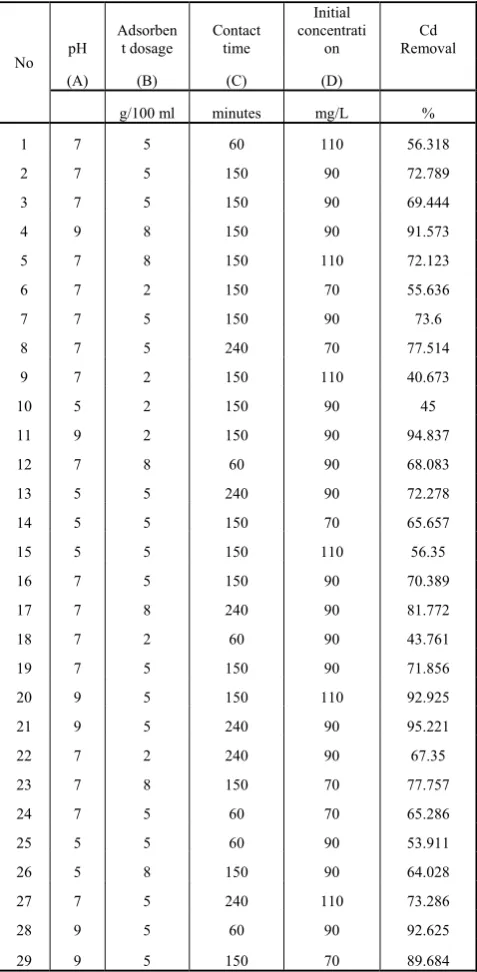
Batch experiment was carried out with variation of the four factors including pH, initial concentration of cadmium aqueous solution, adsorbent dosage and contact time as shown in Table.1. The 29 runs with all combinations of factors for each adsorbent were randomly performed according to a box-behnken statistical design (BBD), one of Response Surface Methodology experimental design under Design Expert 6.0.8 stat ease software (Stat-Ease Inc., Minneapolis, MN,USA) for linear, quadratic and interaction effects of four factors. All the experiments conducted in duplicate and mean values were presented. The removal efficiency of cadmium solution was defined as equation 1:
(1)
Where, Ci = initial concentration (mg/L), Cf = final
concentration (mg/L) and m = mass of adsorbent (g/L).
III. RESULTS AND DISCUSSION
A. Stastical Analysis
As seen Table 1, performance of RRH in reducing cadmium from aqueous solution was satisfied whereas the removal up to 100%. It was also noted that these recent result have high dependence and correlation between the observed values and predicted values of responses due to value of R2 and adjusted R2 over raw rice husk is more than 80% or in other word regression model provides an excellent explanation of the relationship between the independent variables (pH, adsorbent dosage, contact time, initial concentration) and the response (cadmium removal) (Table 4.2). The Pred R-Squared of RRH obtained 0.994 is in reasonable agreement with the Adj R-Squared of RRH (0.986).
[image:2.595.302.541.114.601.2]Table 2 is presented the analysis of variance producing by the statistical analysis using the DESIGN EXPERT 6.0.8 software. Previously mentioned that the significant factor and interaction between factors are noticed
TABLE I. DESIGN AND OBTAINED RESULTS
No pH
Adsorben t dosage
Contact time
Initial concentrati
on
Cd Removal
(A) (B) (C) (D)
g/100 ml minutes mg/L %
1 7 5 60 110 56.318
2 7 5 150 90 72.789
3 7 5 150 90 69.444
4 9 8 150 90 91.573
5 7 8 150 110 72.123
6 7 2 150 70 55.636
7 7 5 150 90 73.6
8 7 5 240 70 77.514
9 7 2 150 110 40.673
10 5 2 150 90 45
11 9 2 150 90 94.837
12 7 8 60 90 68.083
13 5 5 240 90 72.278
14 5 5 150 70 65.657
15 5 5 150 110 56.35
16 7 5 150 90 70.389
17 7 8 240 90 81.772
18 7 2 60 90 43.761
19 7 5 150 90 71.856
20 9 5 150 110 92.925
21 9 5 240 90 95.221
22 7 2 240 90 67.35
23 7 8 150 70 77.757
24 7 5 60 70 65.286
25 5 5 60 90 53.911
26 5 8 150 90 64.028
27 7 5 240 110 73.286
28 9 5 60 90 92.625
29 9 5 150 70 89.684
with the the p-value less than 5% (< 0.05). The summary output of ANOVA of RRH-Cd removal in Table 2 shows that the Rcubic model was significant due to the p-value <0.0001, and all of factors was significantly influenced to the response. Actually, the adsorption process of cadmium was also manipulated by interaction of some factors as shown in Table 2 (coded) including AB, AC, AD, BC and BD. The model can be developed due to the P-value of the lack of fit (LOF) attained for this model was valid (0.4372) for the present work. All of insignificant model terms having limited influence were excluded to improve the
Y = ቀି
model. The construction equation for this model is stated in equation (2).
RRH-Cd removal =71.323+15.282*A+13.393*B + 8.309*C -2.408*D+7.970*A2-5.967*B2-3.390*D2 - 5.573*A*B-3.943*A*C+3.137*A*D-2.475*B*C + 2.332*B*D - 9.452*A2*B - 3.069*A2*C + 4.064*A*B2-2.742*B2*D -
3.707*B*C2
(2)
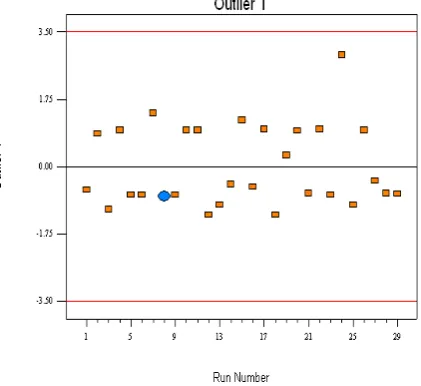
[image:3.595.323.534.336.529.2]This validity of this equation model was also supported by the Figure 1 and Figure 2 which illustrated statistically that residual point followed the normal distribution and the residual run was scattered in the outlier T
TABLE 2. ANALYSIS OF VARIANCE
Source Coef SS F P
Model 71.323 6490.031 113.47 < 0.0001
A 15.282 1868.366 555.32 < 0.0001
B 13.393 717.474 213.25 < 0.0001
C 8.309 552.358 164.17 < 0.0001
D -2.408 46.376 13.784 0.0034
A2 7.97 427.306 127.01 < 0.0001
B2 -5.967 239.524 71.192 < 0.0001
D2 -3.39 77.317 22.98 0.0006
AB -5.573 124.23 36.924 < 0.0001
AC -3.943 62.182 18.482 0.0013
AD 3.137 39.364 11.7 0.0057
BC -2.475 24.503 7.283 0.0207
BD 2.332 21.756 6.466 0.0273
A2B -9.452 178.676 53.107 < 0.0001
A2C -3.069 25.113 7.464 0.0195
AB2 4.063 44.032 13.087 0.004
B2D -2.742 20.044 5.958 0.0328
BC2 -3.707 27.48 8.168 0.0156
Residual 37.009
Lack of
Fit 25.418 1.253 0.4372
Pure
Error 11.591
Cor
Total 6527.04
Figure 1. Diagnostic Plot-Normal Probability of The chosen model
Figure 2. Diagnostic Plot-Outlier T of The chosen model
B. Effects of factors to cadmium removal
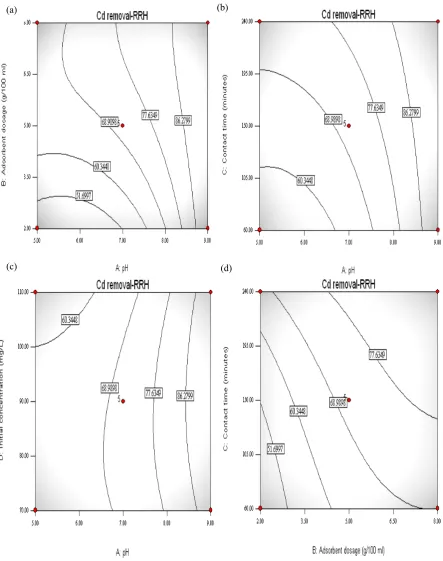
Normally, all of graphs in Figure. 1 illustrates that the increase of removal occurring in the increase of pH of alkali, the increase of adsorbent dosage, the decrease of initial concentration and the increase of contact time. Furthermore, those graphs also point out that the interaction between of factors over response was very significant influencing the cadmium adsorption process using RRH. These were contact time over pH and over initial concentration.
Figure 3. The contour plot for the effect of (a) pH and adsorbent dosage; (b) pH and contact time; (c) pH and initial concentration; (d) adsorbent dosage and contact time
(a) (b)
According to Figure 3, the response surface plots pointed out that RRH successfully reduced cadmium concentration from aqueous solution. All of factors were significant in reducing of adsorption that either indicated in P-value (less than 5%) or reflected in the plot of response surface. The plot was also used to determine adsorption of the cadmium concentration (mg/L) for combinations of interactive factors like pH, adsorbent dosage, contact time initial cadmium) concentration. The curved contour lines and table ANOVA shown that there was a significant interaction between pH and dosage, pH and contact time, pH and initial concentration, dosage and contact time as well as dosage ad initial concentration.
Figure 3 (a–d) shows the interaction between pH to three other factors (adsorbent dosage, contact time and initial concentration. Value of pH and contact time was highly significant in adsorption process as reflected their P-values. Clearly, appropriate pH for process was in neutral or alkali condition (more than 7). The reason for this condition was probably due to the presence of a large number of H+ ions,
which in turn neutralize the negatively charged adsorbent surface thereby reducing hindrance to the diffusion of iron [3]. Further, Deepak and Gupta, 1991 was quoted by Bishnoi et al and Kiran et al stated that the effect of pH is also governed by the development of an electrical double layer on the surface adsorbent. The surface of adsorbent were more negative, caused the change in polarity from positive to negative as the H+ changes from acidic to basic region. This accounts for the downfall in the adsorption of iron at increased pH [4] [5].
Adsorbent dosage, contact time and initial concentration also have significant factors in cadmium removal as marked from the equation and plot (Figure 3). As a result of increasing in contact time and decreasing in initial concentration, the cadmium removal increased. Some previous researches reported similar condition whereas the higher adsorbent dosage, the higher adsorption removal [1], [3], [5]-[8], [10]. This phenomenon was due to enhance of adsorbent surface availability in adsorbing of solute [10]. The less initial concentration of cadmium ensued increasing of the mass transfer driving force. Consequently, the rate of cadmium passes the bulk solution to the particle surface [1], [2].
IV. CONCLUSSIONS
The findings obtained from current study are concluded below:
1. The Use of Response surface methodology, in batch experiment was strong useful to optimize and to model the adsorption process in purposing to get optimum condition for cadmium adsorption process using raw rice husk.
2. The obtained results indicated that the cadmium removal by RRH reached up to 100%, of which was in range 40.673% – 95.221%.
3. The Cadmium adsorption process using RRH was noted dominated significantly by all of factors (pH, adsorbent dosage, contact time and initial concentration).
ACKNOWLEDGMENT
Authors are grateful to IPPP (Institute of Research Management and Monitoring) of University of Malaya for financial support
REFERENCES
[1] A. H. Mahvi, N. Alavi and A. Maleki. (2005). Application of Rice Husk and Its Ash in Cadmium Removal from Aqueous Solution.
Pakistan Journal of Biological Sciences8 (5), pp. 721–725.
[2] B. Kiran, A. Kaushik and C.P. Kaushik. (2007). Response surface methodological approach for optimizing removal of Cr (VI) from aqueous solution using immobilized cyanobacterium. Chemical
Engineering Journal (126), pp. 147–153. Available:
http://www.elsevier.com/locate/cej.
[3] F. Ghorbani, et al. (2008). Application of response surface methodology for optimization of cadmium biosorption in an aqueous solution by Saccharomyces cerevisiae. Chemical Engineering Journal
(145), pp. 267–275. Available: http://www.elsevier.com/locate/cej. [4] Lenntech water treatment & air purification Holding B.V. (2008).
Water treatment solution_ Cadmium. Available: http://www.lenntech.com/periodic-chart-elements/cd-en.htm.
[5] M. Ajmal, R.A. Khan Rao, S. Anwar, J. Ahmad, R. Ahmad. (2003). Adsorption studies on rice husk: removal and recovery of Cd (II) from wastewater. Bioresource Technology (86), pp. 147–149. Available: http://www.elsevier.com/locate/biortech
[6] M. Akhtar, M.I. Bhanger, S. Iqbal and S.M. Hasany. (2006). Sorption potential of rice husk for the removal of 2.4-dichlorepheno from aqueous solutions: Kinetic and thermodynamic investigations.
Journal of Hazardous Materials (B128), pp. 44–52. Available:
http://www.elsevier.com/locate/biohazard.
[7] M. Amini et al.(2008). Application of response surface methodology for optimization of lead biosorption in an aqueous solution by
Aspergillus niger. Journal of Hazardous Materials (154), pp. 694–
702. Available: http://www.elsevier.com/locate/jhazmat.
[8] M. Fereidouni, A. Daneshi, and H. Younesi. (2009). Biosorption equilibria of binary Cd(II) and Ni(II) systems onto Saccharomyces
cerevisiae and Ralstonia eutropha cells: Application of response
surface methodology. Journal of Hazardous Materials (168), pp.1437–1448. Available: http://www.elsevier.com/locate/jhazmat. [9] Montgomery, D.C, Design and analysis of experiments. 5th ed. New
York: John Wiley and Sons, 2001.
[10] N.R. Bishnoiet, et al. (2004). Adsorption of Cr(VI) on activated rice husk carbon and activated alumina. Bioresource Technology (91), pp. 305–307. Available: http://www.elsevier.com/locate/biortech. [11] U. Kumar and M. Bandyopadhyay. (2006). Fixed Bed Column Study
for Cd (II) Removal from Wastewater Using Treated Rice Husk.
Journal of Hazardous Waste Materials (B129), pp. 253–259.