Micalizzi, L. and Ronald, Angelica and Saudino, K.J. (2016) A genetically
informed cross-lagged analysis of autistic-like traits and affective problems in
early childhood. Journal of Abnormal Child Psychology 44 (5), pp. 937-947.
ISSN 0091-0627.
Downloaded from:
Usage Guidelines:
Please refer to usage guidelines at or alternatively
A Genetically Informed Cross-lagged Analysis
of Autistic-Like Traits and Affective Problems in Early Childhood Lauren Micalizzi1*, Angelica Ronald2*, Kimberly J. Saudino1
1Boston University 2Birkbeck, University of London
Abstract
A genetically informed cross-lagged model was applied to twin data to explore
etiological links between autistic-like traits and affective problems in early childhood. The sample comprised 310 same-sex twin pairs (143 monozygotic and 167 dizygotic;
53% male). Autistic-like traits and affective problems were assessed at ages 2 and 3 using parent ratings. Both constructs were related within and across age (r = .30-.53) and
showed moderate stability (r = .45-.54). Autistic-like traits and affective problems showed genetic and environmental influences at both ages. Whereas at age 2, the covariance between autistic-like traits and affective problems was entirely due to
environmental influences (shared and nonshared), at age 3, genetic factors also
contributed to the covariance between constructs. The stability paths, but not the
cross-lagged paths, were significant, indicating that there is stability in both autistic-like traits and affective problems but they do not mutually influence each other across age. Stability effects were due to genetic, shared, and nonshared environmental influences. Substantial novel genetic and nonshared environmental influences emerge at age 3 and suggest change in the etiology of these constructs over time. During early childhood, autistic-like traits tend to occur alongside affective problems and partly overlapping genetic and environmental influences explain this association.
A Genetically Informed Cross-lagged Analysis of Autistic-Like Traits and Affective
Problems in Early Childhood
Autism spectrum disorders (ASD) are neurodevelopmental conditions that typically begin in early childhood (American Psychiatric Association, 2013). There is
considerable interest in understanding the causes of co-occurrence in psychopathology generally (Smoller et al., 2013), including in ASD. ASD are known to co-occur with
other forms of psychopathology at rates higher than chance (Simonoff et al., 2008). Affective problems are characteristics that define major depressive disorder and dysthymic disorder and that are also present to varying degrees in the general population (Achenbach & Rescorla, 2000; Pickles et al., 2001). In terms of the co-occurrence of affective problems and ASD, while some studies do not find elevated levels of depression
in children with ASD, elevated levels of dysthymic disorder are present (Simonoff et al., 2008), and older children and adults with ASD have elevated levels of depression (Kim, Szatmari, Bryson, Streiner, & Wilson, 2000; Lainhart & Folstein, 1994; Lake, Perry, & Lunsky, 2014).
affective problems in the general population may provide insights for understanding the causes of clinically recognized ASD and depression (Plomin, Haworth, & Davis, 2009).
Twin studies from middle childhood onwards demonstrate that autistic traits are moderately to highly heritable and show modest nonshared environmental influences (i.e., environmental influences that are unique to each family member) (Holmboe et al., 2014; for reviews see Posthuma & Polderman, 2013; Ronald & Hoekstra, 2011). Molecular genetics research concurs with twin study findings. A measured heritability study, which employs data from single nucleotide polymorphisms (SNPs) to estimate variance explained by measured genetic variants (Yang, Lee, Goddard, & Visscher, 2011), found that autistic traits are influenced by common genetic variations in middle childhood to adolescence (St Pourcain et al., 2014).
Affective problems, such as depression, are also genetically influenced. Twin studies find modest heritability, shared and nonshared environmental influences, and evidence that the etiological architecture changes from childhood to adulthood (Lau & Eley, 2006; Nivard et al., 2014; Waszczuk, Zavos, Gregory, & Eley, 2014). A measured heritability study concurs with twin study results in showing that major depression is influenced by common genetic variation in adults (Lee et al., 2013).
items (Stilp, Gernsbacher, Schweigert, Arneson, & Goldsmith, 2010). In terms of twin studies of affective problems in preschoolers, a large study showed that anxiety and depression in 3-year-olds was 76% heritable, with the remaining variance explained by nonshared environment (Boomsma., Van Beijsterveld, & Hudziak, 2005). There have not been any studies exploring the degree to which affective problems and autistic traits in preschoolers share genetic and environmental influences. A genetically-sensitive study on affective problems and autistic traits in preschoolers could provide clues about the early developmental and etiological processes that lead these types of traits to co-occur.
Family studies show that affective disorders occur at elevated levels in relatives of
individuals with ASD (Piven et al., 1991; Piven et al., 1990) and information garnered
about the onset of these affective disorders implies that the increased risk is not solely
during the period after the birth of the child with ASD (e.g., Bolton, Pickles, Murphy, &
Rutter, 1998). That is, affective disorders appear to run in families of individuals with
ASD because of shared familial effects (i.e., shared genes and/or environments), not
because affective disorders are a consequence of having a relative with ASD. Mothers of
children with ASD are known to take selective serotonin reuptake inhibitors (SSRIs)
during pregnancy more commonly than mothers of children without ASD (Man et al.,
2015). SSRI use is not equivalent to affective problems but might be considered a proxy.
Although the mechanism of the association between maternal prenatal SSRI use and ASD
is not known, this elevated use of SSRIs would suggest that depression and ASD to some
extent run in the same families.
To our knowledge, only one twin study has explored the degree to which autistic
2011). In this study, on adults in the Swedish population, traits of depression and autistic
traits correlated approximately .3, and just over half of this covariation was explained by
genetic influences, and just under half by nonshared environmental influences. Risk of
depression increased monotonically with increasing scores on autistic traits. Bivariate
genomic-relatedness-matrix restricted maximum likelihood (GREML) approaches that
use measured genetic similarity (via SNPs) to predict phenotypic similarity in large
groups of unrelated individuals suggest low genetic overlap of common genetic variants
between ASD and major depressive disorder (Lee et al., 2013) but this result might be
hampered by low power in the analyses.
In terms of causal explanations for two forms of psychopathology co-occurring,
one potential reason is correlated risk factors, where some of the same genetic and
environmental risk factors influence both phenotypes. This has been shown to be the case
for ASD and ADHD (Ronald, Simonoff, Kuntsi, Asherson, & Plomin, 2008). Another
mechanism that can explain co-occurrence is phenotypic causality, where one form of
psychopathology leads onto another. For example, in middle childhood it has been shown
that autistic traits phenotypically influence later anxiety-related behaviors (Hallett, Ronald, Rijsdijk, & Happé, 2010). These two explanations will be tested here in relation to the co-occurrence of autistic traits and affective problems in early childhood.
investigate, using a longitudinal cross-lagged model, whether across developmental time from age 2 to age 3, autistic traits impact later affective problems, and vice-versa, over and above their existing association at age 2 and any shared genetic and environmental influences between them.
Methods
Participants
Measures
DSM-Oriented Scales on the Child Behavior Checklist for Ages 1½-5
Autistic-like traits and affective problems were assessed with DSM-Oriented Scales on the Child Behavior Checklist for Ages 1½- 5 (CBCL; Achenbach & Rescorla, 2000). Parents report on 99 problem items on a scale of 0 (not true) to 2 (very true or often true) based on the child’s behavior in the preceding 2 months. Although the CBCL includes clinical cutoffs for screening purposes, these scales were used as dimensional measures of autistic-like traits and affective problems. Studies have shown significant associations between DSM diagnoses and CBCL scores (Achenbach & Rescorla, 2000).
Autistic-Like Traits
Autistic-like traits were assessed with the CBCL Pervasive Developmental Problems DSM-Oriented Scale. This scale includes 13 items (e.g., “can’t stand things being out of place”; “rocks head, body”) and is consistent with DSM diagnostic criteria for Autistic Disorders. Previous research has found this subscale to be a sensitive and useful screening device for Autistic Disorders in toddlers, both in comparison with typically-developing children and those with other psychiatric conditions (Muratori et al., 2011; Narzisi et al., 2013) In the current sample, internal consistency as indicated by Cronbach’s alpha was .64 and .69 for ages 2 and 3, respectively.
Affective Problems
Internal consistency for affective problems as indicated by Cronbach’s alpha was .55 at age 2 and .58 at age 3.
Statistical Approach
Data Transformations
Both autistic-like traits and affective problems were positively skewed and were log transformed to correct for skewedness at both ages. Because twin covariances can be inflated by variance due to sex, all scores were residualized for sex effects (see McGue & Bouchard, 1984). These residualized scores were used in all behavioral genetic analyses in the present study.
Twin Design
The twin method involves comparing MZ twins, who share 100% of their genes with DZ twins who share, on average, 50% of their segregating genes. Additive genetic influence (A) is suggested when similarity on a trait varies with genetic relatedness (i.e., MZ cotwin resemblances exceed DZ resemblances). Shared environments (C) are family-wide experiences that act to make twins more similar than would be predicted by genes alone. Nonshared environmental influences (E) are effects that are unique to the
individual and make individuals within a family different. Based on twin methodology, structural equation models can be used to estimate the contributions of A, C, and E to autistic-like traits and affective problems and to the covariation between the constructs.
Cross-Lagged Analysis
the stability of each trait (Figure 1). This model constrains all cross-age associations to function as phenotypic partial regression coefficients (i.e., b11, b22, b12, b21). The paths
leading from the phenotype at age 2 to the same phenotype at age 3 (b11 and b22) index
the stability of the phenotype while controlling for any prior association with the second phenotype. The cross-lagged paths (b12 and b21) reflect the effects of each trait at Time 1
on the other trait at Time 2 and allow us to partial out the independent impact of one trait on another across age above and beyond their preexisting relation and the stability of each construct. For example, path b12 indicates whether autistic-like traits at age 2 impact
affective problems at age 3 above and beyond their association at age 2 and the stability of autistic-like traits. Variances of autistic-like traits and affective problems at age 2 were decomposed into their genetic, shared environmental, and nonshared environmental path estimates. The path estimates a1, c1, e1 and a2, c2, e2 indicate the relative influences of the
latent variables A1, C1, and E1 and A2, C2, and E2 on each phenotype at age 2 and the square of these path values represent genetic and environmental variances. The genetic correlation at age 2 (rg1) indicates the extent to which the genetic effects on autistic-like traits correlate with the genetic effects on affective problems independent of the
estimate the relative influences of the latent variables A3, C3, and E3 and A4, C4, and E4 on the phenotypes at age 3 that are independent of the age 2 effects, and thus reflect change. The genetic and environmental correlations at age 3 (rg2, rc2, re2) index genetic and environmental overlap of these novel effects across the phenotypes.
To understand the extent to which autistic-like traits and affective problems influence each other over time, the genetic and environmental variances in autistic-like traits and affective problems at age 3 can be further portioned into four different effects. That is, the total genetic variance in autistic-like traits at age 3 can be decomposed into: (1) stability effects: genetic influences specific to autistic-like traits at age 2 that are transmitted to age 3 (calculation; b112 x a12); (2) cross-lagged effects: genetic influences
specific to affective problems at age 2 transmitted to autistic-like traits at age 3
(calculation; b212x a22); (3) common effects from age 2: the genetic effects common to
autistic-like traits and affective problems at age 2 (calculation; 2x[b11 x a1 x rg1 x a2 x
b21]); and (4) residual effects: unique genetic effects on autistic-like traits at age 3
(calculation; a32) (Larsson, Viding, Rijsdijk, & Plomin, 2008).The age 3 variance for
affective problems is similarly decomposed.
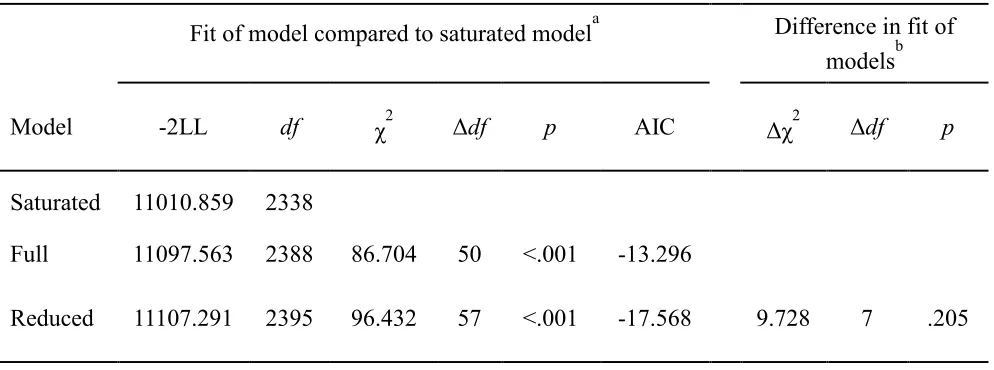
difference in the amount of estimated parameters between the full model and a saturated model. A reduced model, in which all nonsignificant parameters were dropped, was compared to the full model in which all parameters were estimated. The relative fit of the reduced model was determined by the chi-square difference (Δχ2) between the full model and the reduced model and corresponding change in degrees of freedom (Δdf). A
nonsignificant change in chi-square between the full and reduced model indicates that the nonsignificant parameters can be dropped from the model without a significant
decrement in overall model fit. Akaike’s Information Criterion (AIC; AIC= χ2 – 2*Δdf) values were also computed, with lower AIC values indicating better fit of the model to the observed data.
Results
Descriptive Statistics
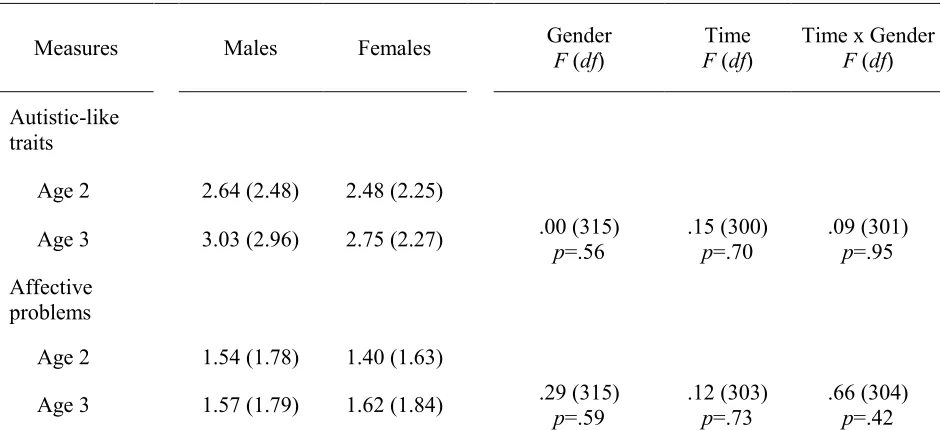
Table 1 lists the means and standard deviations (SD) for autistic-like traits and affective problems at age 2 and age 3 by sex. Mean differences were assessed using linear mixed effects models fitted using the SAS PROC MIXED procedure to account for the nested structure of the data. Family was the group effect and individual twins represented repeated observations. For autistic-like traits and affective problems, the main effects for time, gender and the interaction between time and gender were nonsignificant.
Phenotypic Correlations
between autistic-like traits at age 2 and affective problems at age 3 was modest (r=.30,
p<.001, df=292) and a similar correlation was obtained for affective problems at age 2 and autistic-like traits at age 3 (r=.31, p<.001, df=293).
Intraclass and Cross Correlations
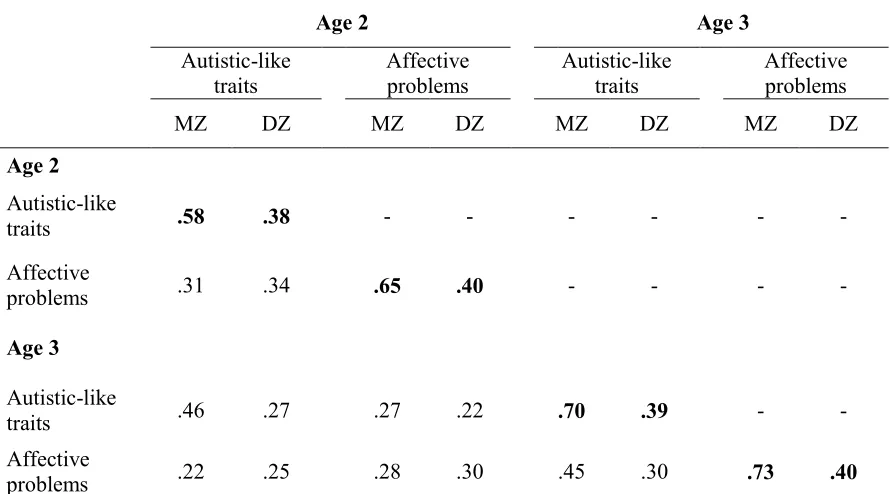
Table 2 presents the intraclass correlations and cross-trait cross-twin correlations for autistic-like traits and affective problems at ages 2 and 3 by zygosity. For both measures at both ages, the intraclass correlations for MZ twins exceeded those of DZ twins suggesting that genetic influences contribute to individual differences in these traits. In all instances, the DZ intraclass correlations were greater than half of the MZ correlations, which suggested that shared environmental influences also impacted these traits. With one exception, the cross-age cross-trait correlation between autistic-like traits at age 2 and affective problems at age 3, the cross correlations showed a similar pattern of results. The genetic and environmental influences on these phenotypes can be tested by more powerful multivariate genetic model-fitting analyses.
Model-Fitting Analyses
became nonsignificant after all nonsignificant paths from the full model were dropped. It is likely, therefore, that the significance of this path in the full model is due to chance and interpretations of this path should be made cautiously. All other paths were significant in the reduced model. Results from the full model are reported to avoid artificial inflation of parameter estimates (Figure 2 and Table 4).
Genetic and Environmental Influences on Autistic-Like Traits and Affective Problems in
Early Childhood
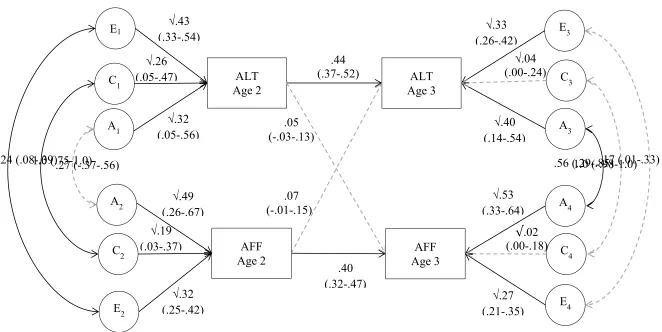
The genetic and environmental contributions to autistic-like traits and affective problems at age 2 are the squared path values of the latent variables A1, C1, E1 and A2, C2, E2 in Figure 2. These values represent the percentage of variance due to genetic, shared environmental, and nonshared environmental effects, respectively. For autistic-like traits, genetic factors explained 32% of the variance, and shared environmental and nonshared environmental influences contributed 26% and 43% of the variance,
respectively. For affective problems, genetic factors explained 49% of the variance, shared environmental influences explained 19% of the variance, and nonshared environmental factors accounted for 32% of the variance.
The paths on the right side of the model at age 3 represent novel genetic and environmental effects that are independent of the effects at age 2. Total genetic, shared environmental and nonshared environmental variances on autistic-like traits and affective problems are presented in Table 4. For autistic-like traits at age 3, genetic factors
accounted for approximately 61% of the variance, shared environmental factors 6%, and nonshared environmental influences 41%.
Concurrent Overlap between Autistic-Like Traits and Affective Problems at Each Age
At age 2, the genetic correlation (rg1) was nonsignificant, suggesting that although autistic-like traits and affective problems are genetically influenced at age 2, these effects are unique to the phenotypes. The shared environmental correlation at age 2 (rc1=1.0) indicates that autistic-like traits and affective problems are influenced by the same shared environmental factors. The nonshared environmental correlation at age 2 (re1=.24)
suggests that although these two constructs have some nonshared environmental influences in common, many of the effects are unique to each phenotype. At age 3, the genetic correlation (rg2) between the residual variances of autistic-like traits and affective problems was .56. This moderate-to-high correlation suggests that roughly 50% of the novel genetic effects that emerge at age 3 overlap across autistic-like traits and affective problems. Given that the genetic correlation at age 2 was nonsignificant, this suggests substantial developmental change in common genetic effects underlying the association between autistic-like traits and affective problems from age 2 to age 3.
Autistic-Like Traits and Affective Problems across Age (Stability and Cross-Lagged
Effects)
The stability paths (i.e., b11, b22), but not the cross-lagged paths (b12, b21) were
the respective paths. Stability effects from autistic-like traits at age 2 explained 19.3% of the variance in autistic-like traits at age 3 and the stability effects from affective problems from age 2 explained 16% of the variance affective problems at age 3.
Genetic and Environmental Influences over Time
Table 4 decomposes the genetic, shared environmental, and nonshared environmental effects on autistic-like traits and affective problems at age 3 into
components that are transmitted from age 2 and residual effects that are specific to age 3. The total variance at age 3 is the sum of the component variances. Approximately 20% of the total variance at age 3 reflects effects that are stable from age 2. These effects
contribute modestly to the total variances for genetic and nonshared environmental variances at age 3, but account for all of the significant shared environmental variance in autistic-like traits at age 3. Unique variance specific to age 3 was substantial (77%) and accounted for most of the genetic (84.7%; i.e., .399/.471x100) and nonshared
environmental (74.8%; i.e., .330/.441x100) influences on this trait at age 3.
The effects on affective problems at age 3 show a similar pattern of results. Approximately 16% of the total variance at age 3 is due to stability effects. As with autistic-like traits, these effects contribute modestly to the total variances for genetic and nonshared environmental variances at age 3, but account for all of the significant shared environmental variance in affective problems. Unique variance specific to age 3 was, again, substantial (82%) and accounted for most of the genetic (86.9%; i.e.,
both autistic-like traits and affective problems, shared environmental influences persist longitudinally from age 2 through the cross-age stability paths.
Discussion
Our study shows that autistic-like traits and affective problems tend to travel together in young children, as demonstrated by their correlations ranging from .47-.53.
These results from our community sample parallel those from clinical studies of older
individuals diagnosed with ASD, which show that depression and dysthymic disorder co-occur at an elevated rate in individuals with ASD (e.g., Kim et al., 2000; Simonoff et al.,
2008). It is also informative to be aware of the degree of stability in psychopathology
across age for making predictions about individual trajectories, and the results here for
each trait on its own (correlations of .54 and .45 for autistic-like traits and affective
problems, respectively) are in line with existing reports on older children of considerable
stability of autistic-like traits and affective problems individually across development
(e.g., Holmboe et al., 2014; Nivard et al., 2014; St Pourcain et al., 2014).
Both autistic-like traits and affective problems showed moderate heritability, low
shared environment, and modest nonshared environmental influence in our sample.
These results mirror the existing literature: in the only other preschool twin sample that
has been assessed on autism screening items, the estimates of heritability (46%), low
shared environment (12%), and modest nonshared environmental influence (42%) are
closely similar (within 2%) and not significantly different from the estimates derived in
the present sample at age 3 (see first row of Table 4) (Stilp et al., 2010). Compared to a
previous twin study of anxiety and depression in 3 year olds, which showed 76%
problems in our sample at age 3 was comparable, with a lower heritability point estimate
(61%).
The present study also tackled the important question of why autistic-like traits and affective problems covary. Their association was caused by the presence of genetic and environmental influences that were partly overlapping for both autistic-like traits and affective problems in our study. Sources of covariance between the two domains may differ across age. At age 2 years, shared and nonshared environmental influences explained the covariance between autistic-like traits and affective problems. At age 3, new genetic effects emerged for both autistic-like traits and affective problems and these genetic effects substantially covaried across domains.That is, some of the same genes that influence autistic-like traits also influence affective problems, and this would lead them to present in combination more often than chance. Likewise, the results showed that some of the same environmental factors that influence autistic-like traits also influence affective problems and this would also increase the likelihood of their co-occurrence. The next step for research is to identify the specific genes and environments that play a role in a common causal pathway underlying both of these forms of psychopathology. However, given the differential pattern of genetic covariance across age, researchers will need to carefully consider possible age differences when searching for specific genes.
that autistic-like traits at age 7 contribute to the presence of internalizing traits at age 12 (Hallett et al., 2010). Our study showed that during early childhood, autistic-like traits and affective problems covary because of shared genetic and environmental factors but there was no evidence for phenotypic effects on each other across time. That is, the presence of autistic-like traits at age 2 does not in and of itself impact subsequent
affective problems a year later, and vice-versa, affective problems at age 2 do not impact subsequent autistic-like traits at age 3. One reason why a phenotypic interaction was found in a previous study (Hallett et al., 2010) but not in our sample might be the
difference in ages of the samples (middle childhood and early childhood, respectively).
There is likely even more etiological change across a wider age span, but this is an empirical question.
The present set of results should be considered in light of the study limitations.
The twin design makes a number of assumptions such as that there is no assortative
mating and that there are equal environments for MZ and DZ twins, but these
assumptions have been thoroughly tested (Evans & Martin, 2000). The ACE
model-fitting used here assumes that genetic effects are additive, and does not directly model
gene-environment interaction or correlation effects (for more information see Rijsdijk & Sham, 2002). The limitations of the twin design can be resolved by using other research designs to address the same research question. Characteristics of the sample merit discussion. The modest sample size led to wide confidence intervals for some estimates and the sample was not powered to test for etiological sex differences. The sample did not include children at the very severe end of the autism spectrum. Eight children out of the sample of 624 individuals were diagnosed with an ASD at age 3. This prevalence is still within current prevalence estimates of ASD, taking into account relatedness between twin pairs (Baird et al., 2006), indicating that the sample was reasonably representative. Furthermore, the sample was selected not to include children who had a very low birth weight or were preterm. It is important that data from twins generalizes to singletons. There is good evidence that twins do not show different mean levels of autistic-like traits than singletons (Curran et al., 2011) or CBCL-assessed internalizing behaviors in
It was advantageous to employ scales from the CBCL, which have been widely used and assessed for reliability and validity (Achenbach & Rescorla, 2000).
Nevertheless, the reliability, as assessed by Cronbach’s alpha, for both scales was modest in the present sample, and may have led to inflated estimates of the nonshared
environment term (which includes measurement error). The CBCL autistic-like traits scale has been shown to have modest specificity for detecting children with ADOS-G classification of autism, and therefore this limitation regarding the measure’s validity should be taken in account when assessing the results.Nonetheless, this subscale has been shown to be a sensitive and useful screening device for ASD in toddlers, both when compared to typically-developing children and those with other psychiatric conditions (Muratori et al., 2011; Narzisi et al., 2013; Sikora et al., 2008). Moreover, this subscale has been found to be strongly correlated with other autism screening measures such as the Gilliam Autism Rating Scale (GARS; Sikora et al., 2008). Similarly, the CBCL affective problems scale demonstrates criterion validity with referral for mental health services (DSM IV checklists completed by professionals), with referred children scoring
significantly higher on the affective problems scale than nonreferred children (Dekker et al., 2007; Achenbach & Rescorla, 2000). Parent report contains some bias and shows modest correlation with other raters (Najman et al., 2001). On the other hand, there are few alternatives to parental assessment of behavior in early childhood, it is a practical solution for large samples, and parents are aware of young children’s behavior across development and across a range of situations.
1Boston University, Department of Psychological and Brain Sciences, 64
Cummington Mall, Boston, MA 02215
2Birkbeck, University of London, Department of Psychological Sciences,
Malet Street, London 7HX, United Kingdom
Correspondence to: Lauren Micalizzi: Department of Psychological and Brain Sciences, Boston University, Boston, MA 02215; 353-1102; [email protected]; fax 617-353-6933
Acknowledgements: This research is supported by grants R01 HD068435 and R01 MH062375 from the National Institutes of Health to Dr. Saudino.
References
Achenbach, T.M., & Rescorla, L.A. (2000). Manual for the ASEBA Preschool Forms & Profiles. Burlington, VT: University of Vermont, Research Center for Children, Youth, & Families.
American Psychiatric Association. (2013). Diagnostic and statistical manual of mental disorders (5th ed.). Arlington, VA: American Psychiatric Publishing.
Baird, G., Simonoff, E., Pickles, A., Chandler, S., Loucas, T., Meldrum, D., & Charman, T. (2006). Prevalence of disorders of the autism spectrum in a population cohort of children in South Thames: The Special Needs and Autism Project (SNAP).
Lancet, 368, 210-215. doi:10.1016/S0140-6736(06)69041-7
Bolton, P. F., Pickles, A., Murphy, M., & Rutter, M. (1998). Autism, affective and other psychiatric disorders: Patterns of familial aggregation. Psychological Medicine, 28, 385-395. doi:10.1017/S0033291797006004
Boomsma, D. I., Van Beijsterveldt, C. E. M., & Hudziak, J. J. (2005). Genetic and environmental influences on anxious/depression during childhood: A study from the Netherlands Twin Register. Brain and Behavior, 4, 466-481.
Burt, S. A., McGue, M., Krueger, R. F., & Iacono, W. G. (2005). How are parent-child conflict and childhood externalizing symptoms related over time? Results from a genetically informative cross-lagged study. Development and Psychopathology, 17, 145-165. doi:10.1017/S095457940505008X
Curran, S., Dworzynski, K., Happe, F., Ronald, A., Allison, C., Baron-Cohen, S., . . . Bolton, P. F. (2011). No major effect of twinning on autistic traits. Autism Research, 4, 377-382. doi: 10.1002/aur.207
Dekker, M. C., Ferdinand, R. F., Van Lang, N. D., Bongers, I. L., Van Der Ende, J., & Verhulst, F. C. (2007). Developmental trajectories of depressive symptoms from early childhood to late adolescence: Gender differences and adult outcome.
Journal of Child Psychology and Psychiatry, 48, 657-666. doi:10.1111/j.1469-7610.2007.01742.x
Evans, D. M., & Martin, N. G. (2000). The validity of twin studies. GeneScreen, 1, 77-79.
Gau, J. S., Silberg, J. L., Erickson, M. T., & Hewitt, J. K. (1992). Childhood behavior problems: A comparison of twin and non-twin samples. Acta Geneticae Medicae Et Gemellologiae: Twin Research, 41, 53-63.
Hallett, V., Ronald, A., Rijsdijk, F., & Happé, F. (2010). Association of autistic-like and internalizing traits during childhood: A longitudinal twin study. The American Journal of Psychiatry, 167, 809-817. doi:10.1176/appi.ajp.2009.09070990 Hollingshead, A. B. (1975). The four-factor index of social status. Unpublished
manuscript, Yale University, New Haven, CT.
Kim, J. A., Szatmari, P., Bryson, S. E., Streiner, D. L., & Wilson, F. J. (2000). The prevalence of anxiety and mood problems among children with autism and asperger syndrome. Autism, 4, 117-132. doi:10.1177/1362361300004002002 Lainhart, J. E., & Folstein, S. E. (1994). Affective disorders in people with autism: A
review of published cases. Journal of Autism and Developmental Disorders, 24, 587-601. doi:10.1007/BF02172140
Lake, J. K., Perry, A., & Lunsky, Y. (2014). Mental health services for individuals with high functioning autism spectrum disorder. Autism Research and Treatment, 2014, 502420. doi: 10.1155/2014/502420
Larsson, H., Viding, E., Rijsdijk, F. V., & Plomin, R. (2008). Relationships between parental negativity and child antisocial behavior over time: A bidirectional effects model in a longitudinal genetically informative design. Journal of Abnormal Child Psychology, 36, 633-645. doi: 10.1007/s10802-007-9151-2
Lau, J. F., & Eley, T. C. (2006). Changes in genetic and environmental influences on depressive symptoms across adolescence and young adulthood. The British Journal of Psychiatry, 189, 422-427. doi:10.1192/bjp.bp.105.018721 Lee, S. H., Ripke, S., Neale, B. M., Faraone, S. V., Purcell, S. M., Perlis, R. H., . . .
Lundstrom, S., Chang, Z., Kerekes, N., Gumpert, C. H., Rastam, M., Gillberg, C., . . . Anckarsater, H. (2011). Autistic-like traits and their association with mental health problems in two nationwide twin cohorts of children and adults.
Psychological Medicine, 41, 2423-2433. doi: 10.1017/S0033291711000377 Lundstrom, S., Chang, Z., Rastam, M., Gillberg, C., Larsson, H., Anckarsater, H., &
Lichtenstein, P. (2012). Autism spectrum disorders and autistic like traits: Similar etiology in the extreme end and the normal variation. Archives of Genetic
Psychiatry, 69, 46-52. doi: 10.1001/archgenpsychiatry.2011.144
Man, K. C., Tong, H. Y., Wong, L. L., Chan, E. W., Simonoff, E., & Wong, I. K. (2015). Exposure to selective serotonin reuptake inhibitors during pregnancy and risk of autism spectrum disorder in children: A systematic review and meta-analysis of observational studies. Neuroscience and Biobehavioral Reviews, 4982-4989. doi:10.1016/j.neubiorev.2014.11.020
McGue, M., & Bouchard, T. J. (1984). Adjustment of twin data for the effects of age and sex. Behavior Genetics, 14, 325-343. doi: 10.1007/BF01080045.
Muratori, F., Narzisi, A., Tancredi, R., Cosenza, A., Calugi, S., Saviozzi, I., & ...
Calderoni, S. (2011). The CBCL 1.5–5 and the identification of preschoolers with autism in Italy. Epidemiology and Psychiatric Sciences, 20, 329-338.
doi:10.1017/S204579601100045X
Narzisi, A., Calderoni, S., Maestro, S., Calugi, S., Mottes, E., & Muratori, F. (2013). Child Behavior Checklist 1½–5 as a tool to identify toddlers with autism spectrum disorders: A case-control study. Research in Developmental Disabilities, 34, 1179-1189. doi:10.1016/j.ridd.2012.12.020
Neale, M. C., Boker, S. M., Xie, G., & Maes, H. H. (2006). Mx: Statistical modeling (7th ed.) [Computer software]. Richmond, VA: Department of Psychiatry, Virginia Commonwealth University
Nivard, M. G., Dolan, C. V., Kendler, K. S., Kan, K. J., Willemsen, G., van Beijsterveldt, C. E., . . . Boomsma, D. I. (2014). Stability in symptoms of anxiety and
depression as a function of genotype and environment: A longitudinal twin study from ages 3 to 63 years. Psychological Medicine, 1-11. doi:
10.1017/S003329171400213X
Pickles, A., Rowe, R., Simonoff, E., Foley, D., Rutter, M., & Silberg, J. (2001). Child psychiatric symptoms and psychosocial impairment: Relationship and prognostic significance. The British Journal of Psychiatry, 179, 230-235.
doi:10.1192/bjp.179.3.230
Piven, J., Chase, G. A., Landa, R., Wzorek, M., Gayle, J., Cloud, D., & Folstein, S. (1991). Psychiatric disorders in the parents of autistic individuals. Journal of the American Academy of Child and Adolescent Psychiatry, 30, 471-478.
Piven, J., Gayle, J., Chase, G. A., Fink, B., Landa, R., Wzorek, M. M., & Folstein, S. E. (1990). A family history study of neuropsychiatric disorders in the adult siblings of autistic individuals. Journal of the American Academy of Child & Adolescent Psychiatry, 29, 177-183. doi:10.1097/00004583-199003000-00004
Plomin, R., Haworth, C. M., & Davis, O. S. (2009). Common disorders are quantitative traits. Nature Reviews Genetics, 10, 872-878. doi: 10.1038/nrg2670.
Posthuma, D., & Polderman, T. J. (2013). What have we learned from recent twin studies about the etiology of neurodevelopmental disorders? Current Opinion in
Neurology, 26, 111-121. doi: 10.1097/WCO.0b013e32835f19c3
Price, T. S., Freeman, B., Craig, L., Ebersole, L., & Plomin, R. (2000). Infant zygosity can be assigned by parent questionnaire data. Twin Research, 3, 129-133. doi: http://dx.doi.org/10.1375/twin.3.3.129
Rijsdijk, F. & Sham, P. (2002). Analytic approaches to twin data using structural equation models, Bioinformatics, 3, 119–133.
Robinson, E. B., Koenen, K. C., McCormick, M. C., Munir, K., Hallett, V., Happé, F.,. . . Ronald, A. (2011). Evidence that autistic traits show the same etiology in the general population and at the quantitative extremes (5%, 2.5%, and 1%). Archives of Genetic Psychiatry, 68, 1113-1121. doi: 10.1001/archgenpsychiatry.2011.119 Ronald, A., Edelson, L. R., Asherson, P., & Saudino, K. J. (2010). Exploring the
Ronald, A., Happé, F., Bolton, P., Butcher, L. M., Price, T. S., Wheelwright, S., . . . Plomin, R. (2006). Genetic heterogeneity between the three components of the autism spectrum: A twin study. Journal of the American Academy of Child and Adolescent Psychiatry, 45, 691-699. doi: 10.1097/01.chi.0000215325.13058.9d Ronald, A., & Hoekstra, R. A. (2011). Autism spectrum disorders and autistic traits: A
decade of new twin studies. American Journal of Medical Genetics Part B: Neuropsychiatric Genetics, 156B, 255-274. doi: 10.1002/ajmg.b.31159
Ronald, A., Simonoff, E., Kuntsi, J., Asherson, P. & Plomin, R. (2008). Evidence for
overlapping genetic influences on autistic and ADHD behaviours in a community
twin sample. Journal of Child Psychology and Psychiatry, 49, 535-542.
Sikora, D. M., Hall, T. A., Hartley, S. L., Gerrard-Morris, A. E., & Cagle, S. (2008). Does parent report of behavior differ across ADOS-G classifications: Analysis of scores from the CBCL and GARS. Journal of Autism and Developmental
Disorders, 38, 440-448. doi:10.1007/s10803-007-0407-z
Simonoff, E., Pickles, A., Charman, T., Chandler, S., Loucas, T., & Baird, G. (2008). Psychiatric disorders in children with autism spectrum disorders: Prevalence, comorbidity, and associated factors in a population-derived sample. Journal of the American Academy of Child and Adolescent Psychiatry, 47, 921-929. doi:
10.1097/CHI.0b013e318179964f
St Pourcain, B., Skuse, D. H., Mandy, W. P., Wang, K., Hakonarson, H., Timpson, N. J., . . . Smith, G. D. (2014). Variability in the common genetic architecture of social-communication spectrum phenotypes during childhood and adolescence.
Molecular Autism, 5, 18. doi: 10.1186/2040-2392-5-18
Stilp, R. H., Gernsbacher, M. A., Schweigert, E. K., Arneson, C. L., & Goldsmith, H. H. (2010). Genetic variance for autism screening items in an unselected sample of toddler-age twins. Journal of the American Academy of Child and Adolescent Psychiatry, 49, 267-276. doi:10.1097/00004583-201003000-00010
Waszczuk, M. A., Zavos, H. M., Gregory, A. M., & Eley, T. C. (2014). The phenotypic and genetic structure of depression and anxiety disorder symptoms in childhood, adolescence, and young adulthood. JAMA Psychiatry, 71, 905-916. doi:
10.1001/jamapsychiatry.2014.655
Table 1.
Means (standard deviations) of measures of autistic-like traits and affective problems at age 2 and age 3
by gender.
Measures Males Females Gender
F (df)
Time
F (df)
Time x Gender
F (df)
Autistic-like traits
Age 2 2.64 (2.48) 2.48 (2.25)
Age 3 3.03 (2.96) 2.75 (2.27) .00 (315) p=.56 .15 (300) p=.70 .09 (301) p=.95
Affective problems
Age 2 1.54 (1.78) 1.40 (1.63)
Age 3 1.57 (1.79) 1.62 (1.84) .29 (315)
p=.59
.12 (303)
p=.73
.66 (304)
p=.42
Table 2.
Twin intraclass and cross correlations.
Age 2 Age 3
Autistic-like traits
Affective problems
Autistic-like traits
Affective problems
MZ DZ MZ DZ MZ DZ MZ DZ
Age 2
Autistic-like
traits .58 .38 - - -
-Affective
problems .31 .34 .65 .40 - - -
-Age 3
Autistic-like
traits .46 .27 .27 .22 .70 .39 -
-Affective
problems .22 .25 .28 .30 .45 .30 .73 .40
Note. MZ monozygotic twins, DZ dizygotic twins. Intraclass correlations are bolded. All
Table 3.
Model fitting results for autistic-like traits and affective problems at age 2 and age 3.
Fit of model compared to saturated modela Difference in fit of modelsb
Model -2LL df χ2 Δdf p AIC Δχ2 Δdf p
Saturated 11010.859 2338
Full 11097.563 2388 86.704 50 <.001 -13.296
Reduced 11107.291 2395 96.432 57 <.001 -17.568 9.728 7 .205
Note. -2LL= log likelihood statistic; df= degrees of freedom; χ2= chi-square fit statistic; AIC= Akaike’s information criterion.
a
Overall fit of the model determined by the difference in -2LL of the model and that of a saturated model.
b
Table 4.
Proportion of the total genetic, shared environmental, and nonshared environmental variation in
autistic-like traits and affective problems at age 3.
Autistic-Like Traits at age 3 Total
Variance A C E
Total ACE variance due to: 1.000 .471 .104 .441
Autistic-like traits at age 2
(cross-age stability effects) .196 (13.4%).063 (48.1%).050 (18.8%).083 Affective problems at age 2
(cross-lagged effects) .025
.002
(.42%) (.87%) .0009 (5.2%) .023
Common effects at age 2 .026 .007
(1.5%) (13.5%) .014 (1.1%) .005 Specific effects at age 3 .769 (84.7%).399 (38.4%).040 (74.8%).330
Affective Problems at age 3 Total
Variance A C E
Total ACE variance due to: 1.000 .613 .056 .405
Affective problems at age 2
(cross-age stability effects) .156 (12.4%).076 (53.6%).030 (12.3%).050 Autistic-like traits at age 2
(cross-lagged effects) .067
.0009 (.15%) .0007 (1.3%) .066 (16.3%)
Common effects at age 2 .028 (.65%).004 (16.1%).009 (3.7%).015
Specific effects at age 3 .823 (86.9%) .533 (28.6%) .016 (67.7%) .274
rg2 rc1 c3 c4 rc2 a3 a2 rg1 b22 b11 e4 a4 e3 c2 a1 c1 e1 re2 re1 b12 b21 ALT Age 2 E1 A1 C1 AFF Age 2 e2 ALT Age 3 AFF Age 3 A2 C2 E2 A3 C3 E3 A4 C4 E4
Fig 1 A path diagram of the cross-lagged model shown for one twin.
Latent factors appear in circles (i.e., A for genetic factors, C for shared environments, E for nonshared environments), while observed (measured) variables appear in rectangles. Latent factors at age 3 represent residual variances. Standardized path estimates for the latent factors are indicated by lowercase letters (e.g., a1, c1, e1). Cross-age stability is represented by b11 and b22, while b12 and b21 indicate cross-lagged effects. Double-headed
.56 (.29-.85) .24 (.08-.39) 1.0 (.75-1.0)
√.27 (.21-.35) √.53 (.33-.64) √.40 (.14-.54) √.33 (.26-.42) √.32 (.25-.42) √.19 (.03-.37) √.49 (.26-.67) √.32 (.05-.56) √.26 (.05-.47) √.43 (.33-.54) .44 (.37-.52) E1 A2 A1 C1 C2 E2 A3 E3 A4 E4 ALT Age 2 AFF Age 3 AFF Age 2 ALT Age 3 .40 (.32-.47)
Fig 2 Best-Fitting Model
C3 C4 √.04 (.00-.24) √.02 (.00-.18) .05 (-.03-.13) .07 (-.01-.15)
[image:38.792.68.730.119.451.2]