Iranian R ehabilitation Journal
Survey of Behavioral Problems and Sensory Processing in
Children with Attention Deficit/Hyperactivity Disorder
Fatemeh Molagholamreza Tabasi1, Faranak Aliabadi1*, Mehdi Alizade Zarei1, Mostafa Qorbani2, Reza Rostami3
1. Department of Occupational Therapy, School of Rehabilitation Sciences, Iran University of Medical Sciences, Tehran, Iran. 2. Department of Community Medicine, School of Medicine, Alborz University of Medical Sciences, Karaj, Iran.
3. Department of Psychology, Faculty of Psychology and Education Sciences, University of Tehran, Tehran, Iran.
* Corresponding Author: Faranak Aliabadi, PhD
Address: Department of Community Medicine, School of Medicine, Alborz University of Medical Sciences, Karaj, Iran. Tel: +98 (919) 9269909
E-mail: [email protected]
Objectives: All individuals need to have the ability of appropriate sensory processing for proper functioning in the environment and participation in daily activities. Moreover, behavioral functions can be affected by sensory processing problems. This study aimed to determine the relationship between behavioral problems and sensory processing in 7 to 10 years old children with Attention Deficit/Hyperactivity Disorder (ADHD).
Methods: This descriptive (cross-sectional) study included 60 children with ADHD aged 7 to 10 years, who were referred to a comprehensive psychiatric center. Short Sensory Profile (SSP) and Child Behavior Checklist (CBCL) questionnaires were used for assessing the patterns of sensory processing and behavioral problems in the patients.
Results: There was a negative correlation between internalizing behavioral problems (r=−0.426) and externalizing behavioral problems (r=−0.465), and the total score of sensory processing in ADHD children (P<0.05).
Discussion: The findings of this study showed that some behaviors in children with ADHD could be due to certain defects in their sensory processing.
A B S T R A C T
Article info:Received: 13 Jul. 2015
Accepted:26 Nov. 2015
Keywords:
Sensory perception, Attention deficit/hyperactivity disorder (ADHD), Behavioral problem
Citation: Molagholamreza Tabasi F, Aliabadi F, Alizade Zarei M, Qorbani M, Rostami R. Survey of behavioral problems and sensory processing in children with attention deficit/hyperactivity disorder. Iranian Rehabilitation Journal. 2016; 14(1):63-68. http://dx.crossref.org/10.15412/J.IRJ.08140110
:
: http://dx.crossref.org/10.15412/J.IRJ.08140110
1. Introduction
ttention Deficit/Hyperactivity Disorder (ADHD) is a neuro developmental behav-ior disorder that is defined based on the diagnostic criteria of the fourth edition of the Diagnostic Statistical Manual of mental
disorders1. ADHD is known as a persistent
pattern of inattention or severe hyperactivity, which is
1. DSM-IV
more frequent than what is typically seen in children
with the same level of maturity or evolution [1].
In the United States, 4 to 12% of children aged 6 to 12 years suffer from this disorder [2]. The prevalence of ADHD in Tehran (Iran) was reported to be about 3 to 6% in children aged 7 to 12 years in 2002 [3]. ADHD is one
of the major risk factors in the implementation of educa -tional activities and psycho-social adjustment, as more than half of the children with ADHD have sufficient di -agnostic criteria for psycho-social and behavioral disorders.
A
CrossMark
tation, disorderedness, aggressiveness, stressful, and tional. Such children are more likely to suffer from
emo-tional, social, and behavioral problems and will also face a
lack of confidence, anxiety, and depression [5].
Researchers and clinicians have shown that children with ADHD are constantly affected by defects in sen-sory processing in general and deficits in sensen-sory modu-lation specifically [6-8]. Sensory processing refers to
the central and peripheral nervous systems that manage
incoming sensory information including the reception,
adjustment, integration, and organization of sensory stimuli [9]. Using physiological and behavioral assess-ments, researchers have tried to explain the way children with ADHD respond to sensory stimulations. There are some physiological assessments of children with ADHD such as Somatosensory Evoked Potential (SEP) [8] and
Electrodermal Reactivity (EDR) [7]. These assessments indicate that a significant percentage of these children show some differences in sensory reactions compared to children without ADHD at the same age. The possibility of defects in sensory processing in children with ADHD has also been reported in several other studies [10-14].
Behavioral problems are important in children with
ADHD [5]. Various behavioral assessments, using paren -tal questionnaires and Child Behavior Checklist (CBCL), show increasing sensitivity of children to sensory stimula-tion such as tactile, taste, visual and auditory senses [15-18]. In addition, other studies suggest that children with ADHD have vestibular and somatosensory dysfunctions in balance, postrotary nystagmus and tactile distinction, and
recognition [8, 19]. There are only a few studies that have investigated the relationship between sensory processing disorders and behavioral problems in children with ADHD.
Mangeot et al. [4] evaluated 26 children with ADHD and 30 children without ADHD in the age group of 5-13 years through Short Sensory Profile (SSP), CBCL, and EDR and showed that children with ADHD have more sensory processing disorders than children without ADHD
ac-cording to parents’ reports and physiological assessments.
Children with ADHD significantly obtain lower scores subtests of SSP, especially in seeks movement sensation, auditory filtering and tactile, taste/smell, and visual/audi-tory sensitivity. Furthermore, more variety was seen in the sensory response of these children in the subtest of SSP except for auditory filtering. A significant relationship
was seen between sensory processing problems and high
Studies on other psychiatric diagnoses such as Perva -sive Developmental Disorders (PDD) have shown diffi-culty in sensory processing similar to ADHD. Tseng et al.
[20] evaluated emotional, behavioral, and sensory pro -cessing problems in 67 autistic children aged 4 to 6 years and compared them with 45 children of the same age group without autism. They found that 95.8% of autistic children who had a significant internalization problem in at least one part of SP showed a significant difference while 81.8% of those who had externalization problems in at least one part of SP showed a significant difference.
Normal children at the same age had lower rates (66.7% and 40%, respectively). Their study determined factors that affect the emotional and behavioral problems in autistic
chil-dren [20]. Since studies in this context are limited and incom-prehensive, the present study was performed in Iran, for the first time, to determine the relationship between behavioral problems and sensory processing in children with ADHD.
2. Methods
This descriptive (cross-sectional) study included 60 chil-dren (aged 7-10 years) with ADHD who were referred to a psychiatric center. The inclusion criteria of this study were as follows: ADHD diagnosed by psychiatrists according to DSM-IV and the CSI-4 questionnaire, age between 7 to 10 years, residence in Tehran city (the capital of Iran), no
ob-vious psychiatric abnormalities and neurologic disorders
(according to patient’s and parent’s report), no pharmaco-logical treatments, and at least four months of having tak-en medicines (if any). First, the objective of the study was explained, and written consent was obtained from parents of eligible children. Then, demographic characteristics were recorded, and the SSP and CBCL questionnaires
were completed by the parents. Each participant was al -lowed to arbitrarily withdraw from the study.
Iranian R ehabilitation Journal
was 38 to 190, so that the scores ranging from 190 to 155 showed the normal function. The scores ranging between 142 and 154 and between 38 and 141 showed possible differences and significant differences in performance,
respectively [21]. The Persian version of SSP was car-ried out for Iranianchildren 5 to 12 years of age in 2011in which the validity and reliability were above 90% [22].
The CBCL questionnaire is a tool that assesses a child’s
behavior by parents or caregivers using ascoring range
of zero to three. This scale consists of 113 components, which give a total score. It also includes two dimen-sions: internalizing behavioral problems and external-izing behavioral problems. Based on the analysis by Achenbach and Rescorla, internalizing problems cover three scales such as anxiety/depression, withdrawal/ depression, and somatic complaints. Externalization of
problems involves breaking thelaw and aggressive behav
-iors [23, 24]. Finally, the data was analyzed using the SPSS software (version 22).
3. Results
In this study, the statistical test of Spearman’s correlation coefficient was used to analyze the data due to the lack of
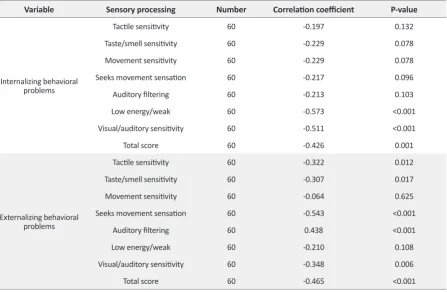
normal distribution of data. There was a significant corre-lation between internalizing behavioral problems and the total score of sensory processing, and Low Energy/Weak and Visual/Auditory Sensitivity (P<0.05) (Table 1). In other words, the total score of sensory processing, Low Energy/Weak, and Visual/Auditory Sensitivity decreased if internalizing behavioral problems increase.
A significant correlation was not seen between internal-izing behavioral problems and subscales like Movement Sensitivity, Taste/Smell Sensitivity, Seeks Movement Sen-sation, and auditory filtering (P>0.05). In children with ADHD, there was a significant negative relation between externalizing behavioral problems, and the total score of sensory processing and its other subscales. In other words,
the total score of sensory processing and its other subscales
decreased if externalizing behavioral problems increase.
4. Discussion
To the best of our knowledge, this is the first such study in Iran. This study aimed to determine the relationship
between behavioral problems and sensory process -ing in 7-10 years old children with ADHD. The
find-ings showed that sensory dysfunction in children with
Table 1. Correlation between sensory processing and behavioral problems in children with ADHD (Spearman’s
correla-tion coefficient).
Variable Sensory processing Number Correlation coefficient P-value
Internalizing behavioral problems
Tactile sensitivity 60 -0.197 0.132
Taste/smell sensitivity 60 -0.229 0.078
Movement sensitivity 60 -0.229 0.078
Seeks movement sensation 60 -0.217 0.096
Auditory filtering 60 -0.213 0.103
Low energy/weak 60 -0.573 >0.001
Visual/auditory sensitivity 60 -0.511 >0.001
Total score 60 -0.426 0.001
Externalizing behavioral problems
Tactile sensitivity 60 -0.322 0.012
Taste/smell sensitivity 60 -0.307 0.017
Movement sensitivity 60 -0.064 0.625
Seeks movement sensation 60 -0.543 >0.001
Auditory filtering 60 0.438 >0.001
Low energy/weak 60 -0.210 0.108
Visual/auditory sensitivity 60 -0.348 0.006
Total score 60 -0.465 >0.001
izing behavioral problems, and the total score of sensory processing in these children (P<0.05).
Mangeot et al. [4] showed that children with ADHD
have sensory processing problems more than children
without ADHD at the same age. They also reported a sig-nificant relationship between sensory processing
prob-lems and high levels of aggression, and tactile sensitivity with aggressive behavior subscales and physical prob
-lems [4]. Stellar and Stellar [25] explained that several conditions are required to develop purposeful behaviors.
Such conditions include an internal environment that
supports the behavior, an external environment that pro-vides reasonable opportunities, and a stimulus to initiate
the behavior and opportunities for learning.
According to the principles of sensory processing, the internal environment is the ability of the central nervous
system for processing and adjusting sensory data, and the external environment is sensory experiences showed by children in their daily lives. When children pay attention, they respond to specific sensory stimuli and are able to act. These children can have problems in the performance of
their daily living due to a malfunction in any of these cir -cumstances. If the central nervous system is unable to
pro-cess sensory information, the child will be unable to learn about the environment and may seem inattentive [25].
The Dunn’smodel [26] of sensory processing states that children with ADHD with an avoidant sensory behavior have low neurological thresholds. They are resistant to changes and avoid non-familiar stimulus. These children often feel anxious or refuse to participate in the activi-ties due to encountering new sensory stimulus. Anxiety or withdrawing from facing a severe sensory stimulation can cause internalizing behavioral problems. In contrast,
children with sensory seeking behaviors show high neu -rological thresholds. They make a fuss and mutability and
engage in unsafe behaviors to create sensory information
due to their neurological needs. Thus, they often seem hyperactive, wacky, and aggressive, which suggest an increase in their externalizing behavioral problems [26].
5. Conclusion
Sensory processing has a large impact on individual’s performance. Poor sensory processing in children with
ADHD can affect their social, cognitive, sensory, and emotional development. Results obtained from this
health systems to design the required planning for them.
Early detection of the disorder in childhood can encour
-age them to successfully do purposeful activities.
Acknowledgements
The article is extracted from Ms. Fatemeh Molagholam-reza Tabasi’s MSc thesis in the Department of Occupation-al Therapy, Iran University of MedicOccupation-al Sciences, Tehran, Iran.
Conflict of Interests
The authors declared no conflict of interests.
References
[1] Ghalae-Bandi F. [Psychiatry for medical students and general
practitioners (Persian)]. Tehran: Farhangsazan Publisher; 2000.
[2] Barkley R. ADHD and the nature of self control. New York:
Guilford Press; 1997.
[3] Khoushabi K, Pour-Etemad H, Mohammadi M, Houman A,
Biglarian A, Tofigh N. [Prevalence of ADHD and associated disorders in primary school students in Tehran (Persian)] [Research Project]. Tehran: University of Social Welfare and Rehabilitation Sciences; 2002.
[4] Mangeot SD, Miller LJ, McIntosh DN, McGrath-Clarke J, Si
-mon J, Hagerman RJ, et al. Sensory modulation dysfunction in
children with attention-deficit–hyperactivity disorder. Devel
-opmental Medicine & Child Neurology. 2001; 43(6):399-406.
[5] Yousefi Sh, Soltanifar A, Teimouri S. Comparison of parent
-ing stress in mothers of children with attention deficit hyper
-activity disorder with mothers of normal children. Journal of Mental Health. 2009; 2(42):115-22.
[6] Anastasi A. Psychological testing. New York: Macmillan
Press; 1988.
[7] Angold A, Costello EJ, Erkanli A. Comorbidity. Journal of
Child Psychology and Psychiatry. 1999; 40(1):57-87.
[8] Ayres AJ. Tactile functions: their relation to hyperactive and
perceptual motor behavior. American Journal of Occupation
-al Therapy. 1964; 18:6–11.
[9] Barkley RA. Attention deficit hyperactivity disorder: a handbook for diagnosis and treatment. New York: Guilford Press; 1964.
[10] Dunn W, Bennett D. Patterns of sensory processing in chil
-Iranian R ehabilitation Journal
[11] Yochman A, Parush S, Ornoy A. Responses of preschool
children with and without ADHD to sensory events in daily life. American Journal of Occupational Therapy. 2004; 58(3):294-302.
[12] Dunn W. Supporting children to participate successfully in
everyday life by using sensory processing knowledge. Infants & Young Children. 2007; 20(2):84-101.
[13] Engel-Yeger B, Ziv-On D. The relationship between sen
-sory processing difficulties and leisure activity preference of
children with different types of ADHD. Research in Develop
-mental Disabilities. 2011; 32(3):1154-162.
[14] Dehghan F, Mirzakhani N, Alizade-Zaeri M, Razjoyan K.
[The relationship between sensory processing and behavio
-ral problems in children with attention deficit hyperactivity disorder 7 to 10 years and normal children at the same age (Persian)]. Journal of Modern Rehabilitation. 2015; 9(3):9-18.
[15] Behar LB. The preschool behavior questionnaire. Journal of
Abnormal Child Psychology. 1977; 5(3):265-75.
[16] Behar LB, Stringfield S. Preschool behavior questionnaire,
scale and manual. Durham, N.C.: Learning Institute of North Carolina; 1974.
[17] Blondis TA. Motor disorders and attention-deficit/hyper
-activity disorder. Pediatric Clinics of North America. 1999; 46(5):899-913.
[18] Campbell SB. Behavior problems in preschool children: A
review of recent research. Journal of Child Psychology and Psychiatry. 1995; 36(1):113-49.
[19] Campbell SB, Breaux AM, Ewing LJ, Szumowski EK. Cor
-relates and predictors of hyperactivity and aggression: a longitudinal study of parent-referred problem preschoolers. Journal of Abnormal Child Psychology. 1986; 14(2):217-34.
[20] Tseng MH, Fu CP, Cermak SA, Lu L, Shieh JY. Emotional
and behavioral problems in preschool children with autism: Relationship with sensory processing dysfunction. Research in Autism Spectrum Disorders. 2011; 5(4):1441-450.
[21] McIntosh DN, Miller LJ, Shyu V. Development and valida
-tion of the short sensory profile. In: Dunn W, editor. Sensory Profile Manual. San Antonio, T.X.: Psychological Corpora
-tion; 1999, p. 59–73.
[22] Mirzakhani N, Zeynali R. [Iranian version of short sensory
profile in children 5 to 12 years (persian)]. Scientific Journal of Rehabilitation Medicine. In press.
[23] Achenbach TM, Rescorla LA. Manual for the ASEBA
school-age forms & profiles. Burlington, V.T.: University of Vermont; 2001.
[24] Ahadi B. [Comparision of behavior problems and academ
-ic achievement in children with and without motor problems (Persian)]. Journal of Rehabilitation. 2009; 10(37):32-36.
[25] Stellar J, Stellar E. The neurobiology of motivation and re
-ward. New York: Springer-Verlag; 1985.
[26] Dunn W. The impact of sensory processing abilities on the
daily lives of young children and their families: a conceptual model. Infants & Young Children. 1997; 9(4):23-35.