© 2016, IRJET | Impact Factor value: 4.45 | ISO 9001:2008 Certified Journal
| Page 3358
Mobile Structure Design For 5g Communications Using Wireless
Network
*1
Ms. Abarna N, *
2Mrs. Tamilselvi M.
*1
Assisant Professor, PG & Research Department of Computer Science & Information Technology Arcot Sri
Mahalakshmi Women's College, Vilapakkam, Vellore, TamilNadu, India.
*2
M.Phil Research Scholar, PG & Research Department of Computer Science & Information Technology Arcot
Sri Mahalakshmi Women's College, Vilapakkam, Vellore, TamilNadu, India.
---***---Abstract
- The fourth generation wireless communication systems have been deployed or are soon to be deployed in many countries. However, with an explosion of wireless mobile devices and services, even 4G systems cannot adequately address issues such as the spectrum crisis and high energy consumption. Wireless system designers have been facing demand for increasingly higher data rates. 5Th generation (5G) wireless systems will address these needs and more and are expected to be deployed by 2020. This article proposes cellular architectures that separate indoor and outdoor scenarios. In addition, it discusses various promising technologies for 5G wireless communication systems, such as massive MIMO, energy-efficient communications, cognitive radio networks, and visible light communications.There are several challenges for 5G designers. One of the most crucial challenges is the physical scarcity of radio frequency (RF) spectra allocated for cellular communications. These frequency spectra have been used heavily, and there is no more to spare in the existing cellular bands. Another challenge is the deployment of advanced wireless technologies comes at the cost of high energy consumption. In addition to environmental concerns, it has been reported by cellular operators that the energy consumption of base stations contributes to over 70% of their electricity bill. Other challenges include but are not limited to: increasing spectral efficiency, high data rate coupled with high mobility requirements, seamless coverage, diverse quality-of-service (QoS) requirements, and fragmented user experience (incompatibility of
different wireless devices/interfaces and
heterogeneous networks).
Key Words:
5Th Generation (5G), Radio Frequency (RF),Quality-of-Service (QoS).
I. INTRODUCTION
Next generation mobile communication system (4G) will provide all time access and seamless mobility across different heterogeneous networks like WLAN, Wi-MAX, UMTS and WWAN etc. In wireless networks, mobility of a Mobile Node (MN) can be defined as “changing the point of attachment without loosing its ability to communicate in the network” with correspondent node (CN). Whenever a MN changes its point of attachment, handover occurs. A common goal among all the approaches for mobility management is that mobility should not break the existing connections between two hosts and also the MN should not become unreachable for future connections.
The admission control procedure across heterogeneous networks is much more complicated than in a homogeneous network. If multiple networks are available to a user at any one time, then choosing the most optimal network for a particular service delivery and choosing the correct time to execute a vertical handover to improve the QoS for all users are important factors. A mobility management system can be used to control the migration of users from one system to another. The user, network or both can govern the mobility management and admission control procedures. Giving total control to the user can result in network instability as users compete for network resources; while a network controlled system will ignore user preferences and QoS requirements.
1.1 HANDOVER
Mobile networks allow users to access services while on the move so giving end users “freedom” in terms of mobility. However, this freedom does bring uncertainties to mobile systems. The mobility of the end users causes dynamic variations both in the link quality and the interference level, sometimes requiring that a particular user change its serving base station. This process is known as handover (HO).
1.1.1 Types of handover
There are four different types of handovers in mobile networks. They are:
Inter-© 2016, IRJET | Impact Factor value: 4.45 | ISO 9001:2008 Certified Journal
| Page 3359
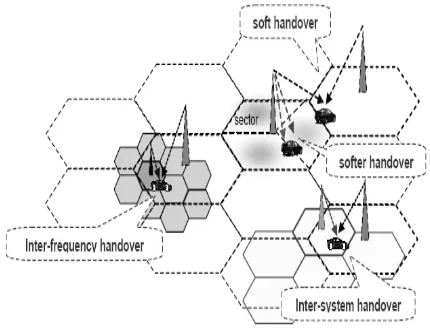
frequency HO. Intra-frequency occurs between cells belonging to the same network carrier, while Inter-frequency occurs between cells operate on different network carriers.
Hard Handover: It is a category of HO procedures in which all the old radio links of a mobile are released before the new radio links are established. For real-time bearers it means a short disconnection of the bearer; for non-real-time bearers HHO is lossless.
[image:2.595.305.561.75.201.2]Soft Handover: During soft handover, a mobile simultaneously communicates with two (2-way SHO) or more cells belonging to different BSs of the same RNC (intra-RNC) or different RNCs (inter-RNC).
Fig 1.1 Types of Handover scenarios.
Table 1.1 Hard handover and Soft handover Comparison
1.1.2 Horizontal handoff Vs Vertical handoff
Handoff between homogenous networks where one type of network is considered is called horizontal handoff. On the other hand, handoff between different types of networks is also possible. A handoff in such a heterogeneous environment is named vertical handoff.
Figure1.2 Horizontal and vertical handoff
1.1.3 Handover procedure
The handover procedure can be divided into three phases: measurement, decision and execution phases. In the handover measurement phase, the necessary information needed to make the handover decision is measured
In the handover decision phase, the measurement results are compared against the predefined thresholds and then it is decided whether to initiate the handover or not. Different handover algorithms have different trigger conditions.
In the execution phase, the handover process is completed and the relative parameters are changed according to the different types of handover.
1.2 HANDOFF IN 4G NETWORKS
Nowadays, there are various wireless communication systems existing for different services, users and data rates such as GSM, GPRS, W-CDMA, Wireless LAN etc. Fourth generation (4G) wireless systems integrate all existing and newly developed wireless access systems. It refers to universal wireless access, which makes the ability of a user to connect anywhere at any time any network.
II. RELATED WORK
2.1 END-to-END MOBILITY MANAGEMENT
Mobility can be handled at different layers of the traditional TCP/IP protocol stack but in any case link layer support is necessary for providing meaningful information to initiate the handover. It can be handled at Network layer (Mobile. Etc.,), Transport layer (SCTP, variants of TCP etc.) and at session layer (SIP, SLM etc.). At each of these layers mobility management schemes have strengths and weaknesses. At Network layer mobility management has several shortcomings e.g. an intermediate entity is introduced between MN and CN.
Drawbacks
Handover performance for SIP, Mobile IP, and SCTP Protocols is made but SIP and Mobile IP are not based on end-to-end philosophy.
[image:2.595.57.272.286.451.2]© 2016, IRJET | Impact Factor value: 4.45 | ISO 9001:2008 Certified Journal
| Page 3360
mathematical model, but the analysis is not made for TCP based connections.
A comparison of host mobility for IP networks using TCP Migrate, HIP and Mobile IP is done but it does not consider end-to-end mobility.
Advantages
Solutions for end-to-end mobility management for TCP based communication.
A comprehensive analysis is made for different TCP under some common parameters and strengths and weaknesses are identified on the basis of these parameters.
An analysis of some approaches is done on the basis of handover delay and throughput degradation and solutions are made to make use of parallel TCP connections between communicating nodes
2.2 A QOS-SUPPORT MOBILITY MANAGEMENT
Mobile IP mainly handles the management of the movement of MHs on a global scale, which is referred to as macro-mobility management. In addition, intra-domain mobility protocols are required to provide for fast and seamless intra-domain mobility management of MHs, thereby reducing the delay, packet loss and signaling overhead. Such protocols become especially important when the wireless Internet is deployed for Real-Time multimedia applications. The design of intra-domain mobility management protocols stands out as an important challenge in integrating wireless networks into the IP-based Internet.
Various protocols for intra-domain mobility management include the HMIPv4, Cellular IP, HAWAII, Tele MIP , Anchor Handover, HMIPv6, MPLS based intra-domain mobility and BRAIN have been proposed. Much of the focus in these proposals has been on the routing and handover issues in intra-domain mobility. With the increasing deployment of wireless Internet for services such as voice over-IP, streaming video, medical imaging and virtual collaboration, providing for QoS guarantees in an efficient manner becomes an important design aspect of intra-domain mobility management. Normally, based on the styles used to forward downlink packets, existing protocols for intra-domain mobility can be broadly classified into three types: hierarchical tunneling, mobile-specific routing and MPLS-based tunneling.
2.3 BANDWIDTH EFFICIENT MOBILITY MANAGEMENT FOR HETEROGENEOUS WIRELESS NETWORKS
Future wireless networking environments will be built up of a variety of access technologies with overlapping coverage areas. At the same time, handsets typically already today support two or more access technologies. Furthermore, the Upcoming 4G type of networks will support heterogeneous. Access and be built up in an all-IP fashion. This way, operators may have the
opportunity to perform a smooth transition into new technologies and leverage existing investments. Also, end-users will benefit from having the opportunity to connect to various types of access networks optimizing capacity, cost, or any other parameter of interest.
An Authentication, Authorization and Accounting (AAA) server in the home network, Layer 2 Tunneling (L2TP) or Generic Routing Encapsulation (GRE), both enabling bidirectional tunneling to the home network are used to implement user policies into the MN allowing the end-user to set priorities among various parameters like bandwidth, cost, and/or power consumption to have a make –before-break handover.
III. PREVIOUS IMPLEMENTATIONS
3.1 EVOLUTION OF WIRELESS TECHNOLOGIES
1G Mobile systems: In 1980 the mobile cellular era had started, and since then mobile communications have undergone significant changes and experienced enormous growth. This shows the evolution of the mobile networks. First generation mobile systems used analog transmissions for speech services. In 1979, the first cellular system in the world became operational by Nippon Telephone and Telegraph (NTT) in Tokyo, Japan. The system utilized 600 duplex channels over a spectrum of 30 MHZ in the 800 MHZ band, with a channel separation of 25 KHZ. Two years later, the cellular epoch reached Europe.
2G Mobile systems: They were introduced in the end of 1980s. Low bit rates data services were supported as well as the traditional speech service. Consequently, compared with first generation systems, higher spectrum efficiency, better data services, and more advanced roaming were offered by 2G systems. In Global system for Mobile Communications (GSM) was deployed to provide a single unified standard.
3G Mobile systems: The massive success of 2G technologies is pushing mobile networks to grow extremely fast as ever –growing mobile traffic puts a lot of pressure on network capacity. In addition, the current strong drive towards new applications, such as wireless Internet access and video telephony, has generated a need for a universal standard at higher user bitrates: 3G. Most of the services require bitrates up 2 MBit/s.
3.2 4G WIRELESS NETWORK
© 2016, IRJET | Impact Factor value: 4.45 | ISO 9001:2008 Certified Journal
| Page 3361
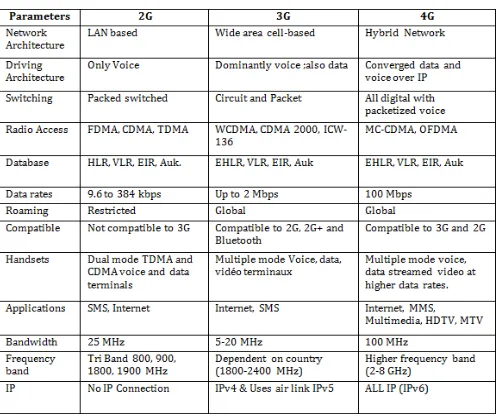
Table 1.1 Comparison of 2G, 3G and 4G technologies
3.3 HETEROGENEOUS NETWORK
CDMA networks are based circuit-switched data service up to 14.4 Kbps and packet-switched data service up to 64 Kbps. CDMA2000 comes in two versions: 1X and 3X. Operators can readily deploy 1X technology in existing spectrum but may have to wait for new spectrum to deploy 3X, which combines three CDMA 1.25-MHz radio channels for higher-performance services.
Fig1.2: CDMA Architecture
[image:4.595.39.288.96.306.2]UMTS: Universal Mobile Telecommunications System (UMTS), also referred to as Wideband Code Division Multiple Access (WCDMA), is one of the most significant advances in the evolution of telecommunications into third-generation (3G) networks.
Figure 1.3 UMTS Architecture
IV. SYSTEM IMPLEMENTATION
4.1 Mobility ManagementMobility management enables telecommunication networks to locate roaming terminals for call delivery and to maintain connections as the terminal is moving into a new service area, process known as handoff. The handoff may be executed between different segments (cells) of the same or different systems. Thus, mobility management supports mobile terminals, allowing users to roam while simultaneously offering them incoming calls and supporting calls in progress.
4.1.1 Location management
[image:4.595.315.561.350.485.2]Location management is a process that enables the network to discover the current attachment point of the mobile user for call delivery. The first segment is location registration (or location update). In this stage, the mobile terminal periodically notifies the network of its new access point, allowing the network to authenticate the user and revise the user’s location profile. The second segment is call delivery.
Fig 1.4 Components of location management process
4.1.2 Handoff management
Handoff management enables the network to maintain a user’s connection as the mobile terminal continues to move and change its access point to the network. The three-stage process for handoff first involves initiation, where the user, a network agent or changing network conditions identify the need for handoff.
4.2 MOBILITY MANAGEMENT IN CELLULAR NETWORKS
© 2016, IRJET | Impact Factor value: 4.45 | ISO 9001:2008 Certified Journal
| Page 3362
location information of each MT in the location databases. Then the information can be retrieved for call delivery.
4.3 Mobility Management for Mobile IP
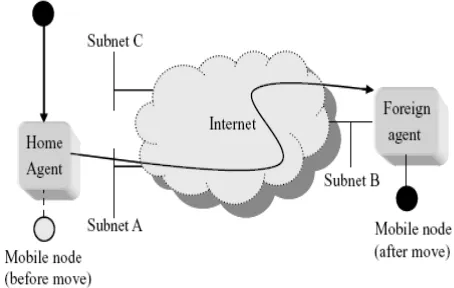
[image:5.595.311.558.243.347.2]The mobility-enabling protocol for the Internet, mobile IP, enables terminals to move from one sub network to another as packets are being sent, without interrupting this process. An MN is a host or router that changes its attachment point from one subnet to another without changing its IP address. The MN accesses the Internet via a home agent (HA) or a foreign agent (FA). The HA is an Internet router on the MNs home network, while the FA is a router on the visited network. The node at the other end of the connection is called the correspondent node (CN).
Fig 1.5: A simple mobile IP architecture
4.3.1 Location registration
When visiting any network away from home, each MN must have an HA. The MN registers with its home agent in order to track the MN’s current IP address. There are two IP addresses associated with each MN, one for locating and the other one for identification. In the standard terminology, the new IP address associated with an MN while it visits a foreign link is called its care of address (CoA).
4.3.2 Handoff management
Current routing optimization schemes in IPv4 allow the previous foreign agent (or agents) to maintain a binding for their former mobile visitors, showing a current CoA for each. Then, as packets are sent to the old CoA, the corresponding previous foreign agents can forward the packets to the current CoA of the MN.
4.4 Overview on Mobility Management Protocols In this sections an overview of IPv6, Host-based mobility and Network-based mobility management protocols.
4.4.1 Internet Protocol Version 6
The new version of IP that is make mobility easier to handle by defines some new features, as follows:
IPv6 Addresses: There are different scopes of IPv6 addresses that can be differentiated by looking at certain bit patterns of the address prefix.
Unicast: This every unicast address belongs to only one interface.
Multicast: This address belongs to more than one interface. A node with multicast address will receive all packets sent to this multicast address.
[image:5.595.54.281.290.434.2]Anycast: It is the new types of address, and it is also assigned to more than one interface like the multicast address, but if a packet is sent to such an address, it will only be delivered to one of the interfaces.
Fig 1.6: Mobile IPv6 Overview
V. IMPLEMENTATION OF EVHD ALGORITHM
5.1 INTRODUCTION
An efficient vertical handoff (VHO) is very essential in ensuring the system performance because the delay experienced by each handoff has a greater impact on the quality of multimedia services. The EVHD algorithm should reduce the number of unnecessary handoffs to provide better throughput to all flows. Research on design and implementation of optimized EVHD algorithms has been carried out by many scholars using various techniques.
EVHD algorithms meets the individual needs and also improve the whole system performance by reducing the unnecessary handoffs and increasing the throughput. The system consists of Mobile node connected to the Base Station of the Network. The MN can move anywhere in any direction in the environment.
5.2 VARIOUS HANDOFF ALGORITHMS
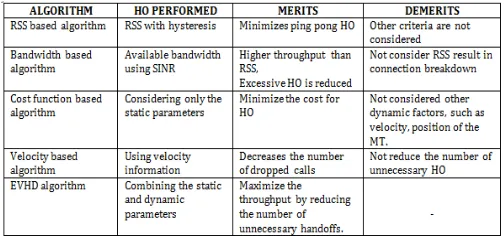
In RSS based algorithms, RSS is used as the main criterion for handoff decision. Various schemes have been developed to compare RSS of the current point of attachment with that of the candidate point of attachments. They are: Relative RSS, RSS with hysteresis, RSS with hysteresis plus dwelling timer method. Relative RSS is not applicable for VHD, since the RSS from different types of networks can not be compared directly due to the disparity of the technologies involved.
© 2016, IRJET | Impact Factor value: 4.45 | ISO 9001:2008 Certified Journal
| Page 3363
higher throughput than RSS based handoffs since the available bandwidth is directly dependent on the SINR.
In user mobility based algorithms, velocity information is a critical one for handoff decision. In the overlay systems, to increase the system capacity, micro/Pico cells are assigned for slow moving users and macro cells are assigned for fast moving users by using velocity information. It decreases the number of dropped calls.
Proposed handoff algorithm based on velocity
Step 1: When the velocity is in the range 150 to 250 km/h, the MN is connected to WiMAX, else connect to UMTS. Step 2: If WiMAX and UMTS are not available then, there are no neighboring networks.
Step 3: When the velocity is in the range 60 to 150 km/h, the MN is connected to UMTS, else connect to WiMAX. Step 4: If WiMAX and UMTS are not available then connect to CDMA.
Step 5: When the velocity is in the range 5 to 60km/h, the MN is connected to CDMA, else connect to UMTS.
Step 6: If CDMA and UMTS are not available then connect to WLAN1 or WLAN2.
Step 7: When the velocity is less than 5km/h, the MN is connected to WLAN1 or WLAN2, else connect to CDMA. Step 8: If WLAN1, WLAN2 and CDMA are not available then connect to UMTS otherwise to WiMAX.
[image:6.595.308.557.67.232.2]Step 9: Else there are no neighboring networks.
Table 1.2 Comparison of various vertical algorithms
5.3 VELOCITY BASED HANDOFF ALGORITHM
[image:6.595.37.289.462.580.2]The system consists of Mobile node connected to the Base Station of the Network. The MN can move anywhere in any direction in the environment. The handoff decision is made when the node is moving away from the BS based on anyone of the parameter such as RSS, bandwidth, velocity of mobile node, etc.
Fig 1.6 System Architecture
5.4 Proposed Efficient Vertical Handoff Decision Algorithm
EVHD algorithm is a combined algorithm that combines the static parameters of the network such as usage cost, bandwidth and power consumption and dynamic parameters such as RSS, velocity and position of the MT. The main objective of EVHD is to maximize the throughput by reducing the number of handoffs.
The functions are illustrated below:
VI. EVALUATION RESULT:
In the wireless technology integrates to communicate with each other. So Mobility management scheme is required for location management and handoff management in heterogeneous wireless environment. Location management enables to locate the mobile node for call delivery. A handover scheme is required to enable mobility management whenever a mobile node moves from one coverage area to another.
Thus we propose a vertical handoff decision algorithm (EVHD) for heterogeneous networks based on the velocity of Mobile Node and the signaling cost. The algorithm used in this project considers the number of handoff when the velocity increases and the probability of handoff delay. The simulated result shows the effectiveness of the algorithm during handover between different wireless networks.
Using the EVHD algorithm, the best network is selected and the number of handoffs is considerably reduced while comparing to the other algorithms which considers either only the static parameters or the dynamic parameters. The simulation has been performed for velocity based algorithm and our efficient vertical handoff algorithm.
CDMA WLAN
UMTS WiMAX
MN CDMA WLAN
UMTS WiMAX
CDMA WLAN
UMTS WiMAX
© 2016, IRJET | Impact Factor value: 4.45 | ISO 9001:2008 Certified Journal
| Page 3364
Fig: 1.7 Handover Probability based on Overall gain function For Different Network Of Mobile Node
Figure 1.7: illustrates handover probability of a mobile node based on overall gain function for different network. It shows that handover probability based on overall gain for different network has been reduced when compared with velocity based handover probability. This shows that unnecessary handover has been reduced using EVHD algorithm compare to velocity based algorithm.
Fig1.8 : Handover Probability based on Overall gain function For Different Network Of Mobile Node
Fig1.8: Illustrates handover probability of a mobile node based on overall gain function for different network. It shows that handover probability based on overall gain for different network has been reduced when compared with velocity based handover probability. This shows that unnecessary handover has been reduced using EVHD algorithm compare to velocity based algorithm.
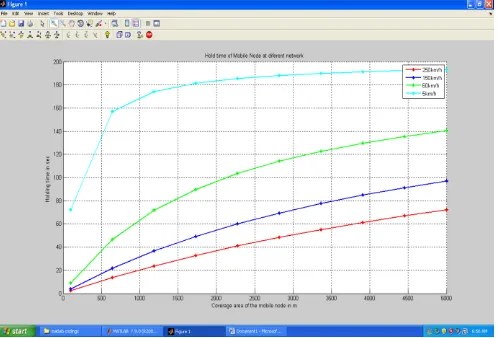
Fig 1.9 : Hold time of Mobile node at different network
Fig 1.9 Illustrates hold time of a mobile node based on overall gain function for different network. It shows that hold time based on overall gain for different network has been increased when compared with hold time based on velocity algorithm. This also shows that unnecessary handover has been reduced using EVHD algorithm compare to velocity based algorithm.
Fig 1.10: Hold time of mobile node at different velocity
[image:7.595.306.569.92.275.2] [image:7.595.38.287.401.570.2]© 2016, IRJET | Impact Factor value: 4.45 | ISO 9001:2008 Certified Journal
| Page 3365
CONCLUSION
Efficient vertical handoff decision algorithm is a combined algorithm that combines the static parameters of the network such as usage cost, bandwidth and power consumption and dynamic parameters such as RSS, velocity and position of the MT. The algorithm has been implemented successfully using Mat lab simulator. It is proved from the simulated results of both the algorithm that the handover probability of proposed vertical handoff algorithm is considerably less while compared to velocity based algorithm. Thus EVHD has outperformed the other algorithms by providing minimum handoff probability and high throughput and hence it is efficient in enhancing QoS for multimedia applications.
In future, using compare & swap technique in VLSI Signal processing to realize the handover probability operation to reducing latency and unnecessary Handoff with low power consumption, high throughput and enhanced QoS for multimedia applications.
REFERENCES:
[1]Chandravva Hebbi Lecturer, Department of Information Science and Engineering R.V College Of Engineering Bangalore, “Vertical Handoff in Heterogeneous Wireless Mobile Networks”, Inida 2009 First International Conference Networks & Communications International Journal of Computer Science and Information Security, Vol. 8, No. 7, October 2011
[2] WiMAX Forum, www.wimaxforum.org
[3] Vasos Vassiliou and Zinon Zinonos. “An Analysis of the Handover Latency Components in Mobile IPv6”, Journal of Internet Engineering, vol. 3, no. 1, December 2009. ed Network Selection Scheme in Heterogeneous wireless networks
[4] C. Perkins, D. Johnson, and J. Arkko, “IP Mobility Support in IPv6”, Internet Engineering Task Force Request for Comments RFC 3775. Available at http://www.ietf.org/rfc/rfc3775.txt
[5] Rosli Salleh and Xichun Li, “Handoff Techniques for 4G Mobile Wireless Internet”, Information technology Journal 6(5): 745 – 750, 2007, ISSN 1812 – 5638
[6] Meriem Kassar, Brigitte Kervella and Guy Pujolle, ”An overview of vertical handover decision strategies in heterogeneous wireless networks”, Available online at www.sciencedirect.com, Computer Communications 31 (2008) 2607–2620
[7] Faouzi Zarai, Ikram Smaoui, Jean-Marie Bonnin, Lotfi Kamoun, “Seamless
Mobility in Heterogeneous Wireless networks” LETI Laboratory, University of Sfax, Tunisia .Lusheng Wang, “Mobility-based Network Selection Scheme in Heterogeneous Wireless Networks”, Telecom Paris Tech (E.N.S.T.), Paris.
[8] Aggeliki Sgora, Dimitrios D. Vergados and Periklis Chatzimisios, “An Access Network Selection Algorithm for Heterogeneous Wireless Environments”, 2010 IEEE.
[9] Ling-Jyh Chen, Tony Sun, Benny Chen, Venkatesh Rajendran and Mario Gerla, “A Smart Decision Model for Vertical Handoff”
[10] S.Aghalya, P.Seethalakshmi, “ An Efficient Decision Algorithm for Vertical Handoff Across 4G Heterogeneous Wireless Networks”,