ScholarWorks @ Georgia State University
ScholarWorks @ Georgia State University
Psychology Theses Department of Psychology
Spring 5-7-2011
Predicting Ecological Behavior in the Era of Climate Change
Predicting Ecological Behavior in the Era of Climate Change
Jalika C. Street
College of Arts and Sciences, Psychology
Follow this and additional works at: https://scholarworks.gsu.edu/psych_theses
Recommended Citation Recommended Citation
Street, Jalika C., "Predicting Ecological Behavior in the Era of Climate Change." Thesis, Georgia State University, 2011.
https://scholarworks.gsu.edu/psych_theses/84
PREDICTINGECOLOGICALBEHAVIORINTHEERAOFCLIMATECHANGE
by
JALIKAC.STREET
Under the Direction of Marci R. Culley, Ph.D.
ABSTRACT
The most devastating effects of climate change may be avoided if humans reduce activities that
produce greenhouse gases and engage instead in more sustainable ecological behaviors. The
current mixed methods study of 279 undergraduate students explored whether environmental
worldview, belief in climate change, knowledge of climate change, personal efficacy, and
intention to address climate change influenced participants‘ engagement in ecological behavior.
Results indicated that those with a stronger intention to address climate change and a more
ecocentric worldview reported significantly more ecological behavior. Next, the study examined
whether participants‘ intentions to address climate change mediated the relationship between
their belief in climate change and engagement in ecological behavior and whether intentions
mediated the relationship between efficacy and ecological behavior. Intentions to address
climate change did not mediate the relationship between belief and ecological behavior but fully
mediated the relationship between efficacy to address climate change and ecological behavior.
PREDICTINGECOLOGICALBEHAVIORINTHEERAOFCLIMATECHANGE
by
JALIKAC.STREET
A Thesis Submitted in Partial Fulfillment of the Requirements for the Degree of
Master of Arts
In the College of Arts and Sciences
Georgia State University
Copyright by Jalika C. Street
PREDICTINGECOLOGICALBEHAVIORINTHEERAOFCLIMATECHANGE
by
JALIKAC.STREET
Committee Chair: Marci R. Culley, Ph.D.
Committee: Roderick Watts, Ph.D.
Kelly M. Lewis, Ph.D.
Electronic Version Approved:
Office of Graduate Studies
College of Arts and Sciences
Georgia State University
AKNOWLEDGEMENTS
I owe my deepest gratitude to my advisor, Marci R. Culley, Ph.D, whose encouragement,
guidance and support from the initial stage to the final enabled me to complete this study. I
would also like to thank the members of my committee Roderick Watts, Ph.D and Kelly M.
Lewis, Ph.D for helping me develop my thinking and see the study to fruition. This study would
not have been possible without the support of my colleagues Adam D. Carton and Emma
Ogley-Oliver. Lastly, I offer my regards to the participants and all of those who supported me in any
TABLE OF CONTENTS
AKNOWLEDGEMENTS iv
LIST OF TABLES viii
LIST OF FIGURES ix
INTRODUCTION 1
Defining the Problem 2
Literature Review 6
Ecological Behavior 6
Demographic Factors 8
Environmental Worldview 11
Attitudes towards Climate Change 11
Knowledge of Climate Change. 13
Personal Efficacy to Address Climate Change 14
Perceived Barriers to Ecological Behavior 14
Theoretical Framework 15
Summary 16
Current Study 17
METHOD 18
Participants 18
Procedure 18
Outcome Variable 19
Ecological Behavior (DV) 19
Demographic Factors (Predictor 1) 20
Environmental Worldview (Predictor 2) 20
Belief in Climate Change (Predictor 3) 21
Knowledge of Climate Change (Predictor 4) 21
Efficacy to Address Climate Change (Predictor 5) 22
Intention to Address Global Climate Change (Predictor 6, Mediator) 22
Perceived Barriers to Addressing Climate Change 22
RESULTS 23
Preliminary Analyses 23
Descriptive Statistics 24
Correlation Analysis 25
Regression Analysis: Predicting Ecological Behavior 25
Mediation Analyses 27
Mediation Model 1 27
Mediation Model 2 28
Barriers to Environmental Behavior: Emerging Themes 29
Inconvenience/Effort 29
Expense 30
Lack of services and resources 30
Lack of knowledge or information 30
Apathy or personal preference 31
Habit 31
Not social norm 31
Miscellaneous 32
DISCUSSION 33
REFERENCES 39
LIST OF TABLES
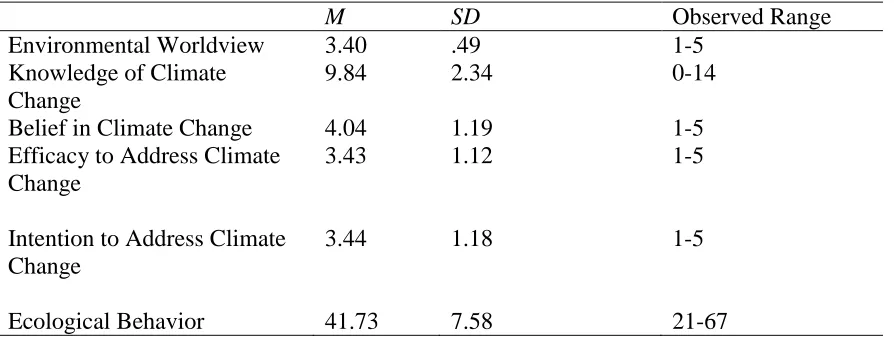
Table 1 Descriptive Statistics 45
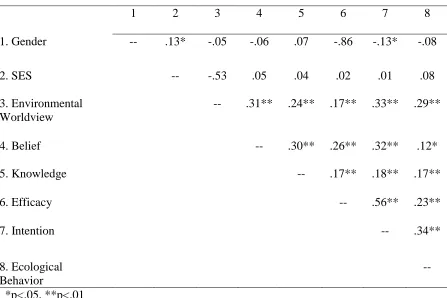
Table 2 Correlations Among Variables 46
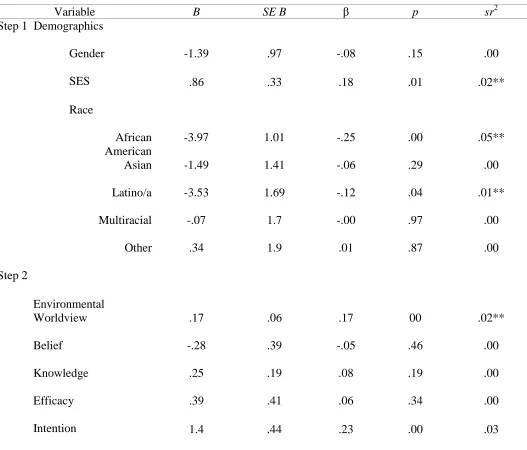
Table 3 Multiple Linear Regression 47
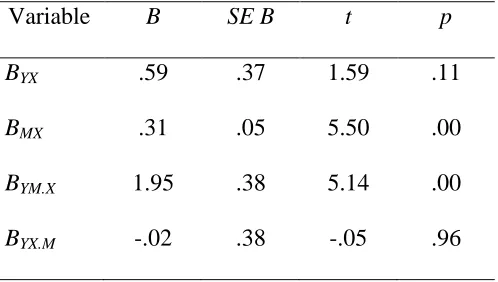
Table 4 Regression Coefficients for Direct and Total Effects: Beliefs as Mediator 48
Table 5 Regression Coefficients for Direct and Total Effects: Efficacy as Mediator 49
LIST OF FIGURES
Figure 1 Hypothesized Hierarchical Regression Model of Ecological Behavior 51
Figure 2 Hypothesized Mediation Model of Ecological Behavior 52
Figure 3 Hypothesized Mediation Model of Ecological Behavior 53
INTRODUCTION
Climate change is arguably one of the biggest challenges of the 21st century. If no
action is taken to mitigate its effects, climate change is predicted to have far-reaching
negative consequences for life on earth (Intergovernmental Panel on Climate Change -
IPCC, 2007). Engagement in ecological behavior, in addition to other strategies, will be
essential to prevent the most devastating effects of climate change. A premier obstacle in
addressing climate change, and an important step to solving any problem, lies in how the
problem is defined.
Therefore, this paper first attempted to define climate change as a problem that
psychologists should be concerned about and next provided an overview of the research
that has been conducted on ecological behavior and related variables. Based on the
theoretical models of ecological behavior, this study explored whether demographic
factors, environmental worldview, belief in climate change, knowledge of climate
change, personal efficacy, and intention to address climate change influenced
engagement in ecological behavior. Next, this study examined whether participants‘
intentions to address climate change mediated the relationship between their belief in
climate change and engagement in ecological behavior and whether intentions mediated
the relationship between efficacy and ecological behavior. Finally, this study explored
Defining the Problem
Scientific evidence indicates that global temperatures are increasing due to the
heat-trapping effect of greenhouse gases which have built up in the earth‘s atmosphere.
Greenhouse gases, primarily carbon dioxide (CO2), methane (CH4), and nitrous oxide
(N2O), have been produced from the burning of fossil fuels and other carbon emitting
processes over the last 200 years (IPCC, 2007). An increase in the global temperature, by
only a couple of degrees, is predicted to have catastrophic effects on humans and other
natural systems (IPCC, 2007). Although the terms ―climate change‖ and ―global
warming‖ are often used interchangeably, there is a shift toward the term climate change
as it better captures the range of potential outcomes (Environmental Protection Agency,
2009).
Climate change poses an alarming number of threats to public health and the
stability of the ecosystems that sustain life. It increases the likelihood of severe storms,
flooding, droughts, coastal erosion, outbreaks of infectious disease, and higher summer
temperatures (IPCC, 2007). Climate change also poses a number of environmental
justice concerns. The United Nations Institute for Environment and Human Security
(2005) estimated that by 2010, environmental destruction, largely associated with
human-influenced climate change, will have produced 50 million ―environmental refugees.‖ The
fairly new term ―environmental refugees‖ is used to refer to people displaced by
environmental disasters, and recent estimates show that more people may be displaced by
environmental disasters than by war (United Nations Institute for Environment and
Human Security, 2005). Although globally, people of color and those who are poor are
be more adversely affected by it (St. Louis & Hess, 2008). Bevan (1991), as cited in
Winter (2000), highlighted the importance of addressing climate change and stated that,
―myopically investigating small questions while the big problem of human survival goes
unattended is professionally irresponsible‖(Winter, 2000, p.516).
Although climate change is a human-created problem, human behavior is one of
the least understood components (IPCC, 2007). Psychology as a field has contributed
little to the discussion on climate change until recently. However, there is growing
awareness and research on the topic. For example, in 2008 the American Psychological
Association (APA), the premier organization dealing with the discipline of psychology in
North America, recognized global climate change as one of ―society‘s grand challenges‖
and developed a report that outlined the importance of insights from the psychological
sciences in creating solutions to climate change (Benson, 2008, p.1). The report identified
ways that psychologists can help to develop solutions to climate change, especially in the
areas of: assessing risk, promoting effective communication, policy making, exploring
humans‘ beliefs about self in relation to nature, and managing stress caused by
environmental factors (Benson, 2008). An APA taskforce was also formed to promote
further attention to the issue (Swim, Clayton, Doherty, Gifford, & Howard, et al., 2009).
Furthermore, community psychologists have much to contribute to addressing the
climate crisis. Research within community psychology on issues of climate change—
although nascent—is beginning to take shape. For example, a special issue dedicated to
climate change as it relates to community psychology will soon be published in the
American Journal of Community Psychology, representing the work of a handful of
press). Additionally, at the 2009 biennial meeting of the Society for Community Research
and Action (APA Division 27), an Environment and Justice Interest Group was founded
to facilitate research and action related to such issues.
Mitigating climate change has been difficult, in part given the nature of the
political debate that has encompassed the issue. Perhaps more importantly, unlike some
social problems such as war or poverty that are more visible and evoke a strong
emotional response, climate change is nefariously imperceptible. The ―time-delayed,
abstract, and often statistical nature of the risks of global warming does not evoke strong
visceral reactions‖ (Weber, 2006, p. 103), which makes it difficult to mobilize around the
issue. However, because there is overwhelming evidence that human activity has caused
climate change, solutions to climate change are rooted in human behavior change
(Oreskes, 2004; IPCC, 2007).
While most scientists agree that climate change is real and created largely by
humans, some argue that we must go further to examine climate change within a larger
global context (Oreskes, 2004; Etkin & Ho, 2007). The actual problem, according to
these scientists, is in our narrow definition of climate change. Instead, we must examine
the capacity of the earth to sustain life, the limits of growth, and our use of the world‘s
resources as infinite and expendable (Etkin & Ho, 2007). As Etkin and Ho (2007) pointed
out, the discourse on climate change ―normally views human induced global warming as
a problem that is in need of a solution – mainly reduction of greenhouse gas emissions –
that itself creates perceived risks to the wellbeing or wealth of dominant sectors in
―fundamentally dysfunctional relationship between humankind and the natural world‖ (p.
634). Consequently,
instead of asking the question ‗How can we mitigate the emission of
greenhouse gases in a way that does not incur costs that exceed the
potential damage climate change will create?‘ it makes more sense to ask
‗How can we relate to nature in a more sustainable and functional way, so
that we live in harmony and equilibrium with the ecosystems that sustain
us?. In other words, the issue of climate change needs to be addressed as
one part of a wider question of how to live sustainably within a world that
demonstrably and inevitably is finite in terms of the resources it offers.
(Etkin & Ho, 2007, p. 634)
As some have pointed out, the causes of these problems are rooted in two key aspects of
human behavior: overpopulation and overconsumption (Oskamp, 2000). Ultimately,
solutions to climate change must be addressed within the larger framework of making
human behavior more ―sustainable‖ or better able to support life on earth for future
generations. Solutions to climate change will work best if they are more comprehensive
and focused on making human behavior more sustainable, rather than focused solely on
reducing carbon emissions.
Given the lack of research in this area, despite the importance and urgency of this
problem, this study explored variables which influenced peoples‘ engagement in
ecological behavior. These include: demographic factors, environmental worldview,
belief in climate change, knowledge of climate change, and personal efficacy to address
climate change mediated the relationship between their belief in climate change and
engagement in ecological behavior. A second mediation model was run to examine
whether intentions to address climate change mediated the relationship between
participants‘ climate change efficacy and ecological behavior. Finally, the study explored
perceived barriers to ecological behavior. To place the current proposal in context, this
study first provided an overview of research and theories within psychology that have
examined variables thought to influence peoples‘ engagement in ecological behavior and
attitudes towards climate change, including demographic factors, environmental
worldview, belief in climate change, knowledge of climate change, personal efficacy to
address climate change and intentions to address climate change. Although numerous
disciplines have contributed to the discourse on climate change, a review of these
literatures is beyond the scope of this research. The present literature review focused
primarily on research within the field of psychology.
Literature Review
Ecological Behavior.
Because climate change is the result of human behavior, most solutions to
climate change involve behavior change. Changes in consumption patterns, drastic
reductions in activities that produce greenhouse gases, and large scale human engagement
in ecological behavior (in addition to other strategies), will be essential to prevent the
most devastating effects of climate change. It will take changes on both an individual and
societal level to tackle this global issue. This study will focus on people‘s engagement in
ecological behavior (largely an individual level phenomenon) as a means to address
There remains much to be understood about peoples‘ ecological behavior and perceived
barriers to such behavior. Both creating a definition of ecological behavior and
measuring this construct is a difficult task.
The terms ―environmentally conscious,‖ ―ecological,‖ ―environmentally
significant,‖ and ―pro-environmental‖ behavior have all been used to describe behavior
with a lower environmental impact. For the purposes of this study, this construct will be
referred to as ecological behavior, using the definition of environmentally conscious
behavior developed by Kollmuss and Agyeman (2002) which is ―behavior that
consciously seeks to minimize the negative impact of one‘s actions on the natural and
built world‖ (p. 240). Regardless of the name assigned to the construct, there is even less
consistency as to what behaviors the construct includes. Researchers define which
behaviors are ―pro-environmental‖ and often focus on behaviors that have only a small
effect on the environment based on energy or material use (Gatersleben, Steg, & Vlek,
2002).
Situational variables further complicate the measurement of ecological behavior
as some ecological behaviors are more feasible than others, depending on the situation
(Kaiser & Wilson, 2000). To address the impact of situational influences, some
researchers have developed scales that weigh different behaviors based on the difficulty
to perform them or the impact they have on the environment (e.g. Kaiser & Wilson, 2000;
Gatersleben, et al., 2002). Another limitation of most current measures of ecological
behavior is that they require participants to self-report their level of engagement in
ecological behaviors. The validity of this method is questionable, and self-reported
intentions to engage in ecological behavior rather than actual behavior (Gatersleben, et
al., 2002). For example, Gatersleben, et al., (2002) found that typical self-reports of
ecological behavior related to energy use were more strongly correlated with attitudinal
variables and household income and size than with household energy usage.
For the purposes of the current study, only certain items that are commonly
included in the measurement of ecological behavior were selected. Omitted items were
those that would not likely to apply to the participants. For example, participants in this
sample were students who were unlikely to live in, or have access to, the type of
household information (e.g. type of stove or cost of electric bill) relied upon in more
comprehensive behavioral measures such as the one developed by Gatersleben et al.
(2004). Ecological behaviors were not weighted based on the level of difficulty to
perform them or on the level of impact on the environment. Therefore, the behavioral
measure used may be more strongly related to environmental attitudes or perceived
ecological behavior than to actual behavior.
Demographic Factors.
Gender.Demographic factors such as a person‘s gender, education level, income
and race have been found to relate to a person‘s attitudes towards climate change and
engagement in ecological behavior. Women consistently perceive a greater number of
environmental hazards and more risks associated with them (Bordy, Zahran, Vedlitz, &
Grover 2008; Bord & O‘Connor, 1997; O‘Connor, Bord, & Fisher, 1999, Tribbia, 2007).
For example, according to Kollumuss and Agyeman: ―Women usually display less
extensive environmental knowledge than men, but they are more emotionally engaged,
solutions, and are more willing to change‖ (2002, p. 248). Men‘s lower perception of
risk in regard to environmental hazards appears to apply to climate change as well (Bord
& O‘Connor, 1997; Bordy et al., 2008). According to Bord and O‘Connor (1997),
perceptions of health risks associated with environmental hazards may be responsible for
these differences. Women are also more likely to indicate that they intend to take
voluntary action to address climate change (O‘Connor et al., 1999). O‘Connor, Bord,
Yarnal, and Wiefek (2002) found that, although women were more likely than men to
think that climate change will occur, they were also more likely to believe that false
causes, such as pesticides, contribute to climate change. However, O‘Connor, et al.
(2002) also found that men were equally likely to indicate support for initiatives to
address climate change. For now, it appears that findings regarding gender and climate
change are mixed.
Socioeconomic Status (SES).There are also mixed findings about the
relationship between SES and peoples‘ attitudes towards climate change and engagement
in ecological behavior. For example, while some researchers cite evidence that people
living in poorer nations are more concerned about the environment and are more likely to
perceive risk associated with climate change than those of wealthier nations, others have
proposed that there is no relationship between income and environmental attitudes
(Bordy, Zahran, & Vedlitz, 2008; O'Connor, et al., 2002). Inconsistency exists not only in
the relationship between income and peoples‘ attitudes towards the environment, but also
in the relationship between income and engagement in environmental behavior. Whereas
people with larger incomes may have the resources to afford cars, heat and cool large
buy energy-efficient appliances and be educated about the causes of climate change
(Tribbia, 2007).
While the relationship between income and attitudes towards climate change is
unclear, people living in poverty and other disenfranchised groups are predicted to be
hardest hit by the negative effects of climate change (Agyerman, Doppelt, Lynn & Hatic,
2007). For example, climate change is predicted to increase the occurrence of natural
disasters, especially hurricanes, tornados, droughts, and flooding. Poor communities are
at higher risk of devastation from natural disasters and slower to receive vital aid, as
demonstrated by the response to Hurricane Katrina. Climate change also poses a greater
threat to the health of disenfranchised groups by increasing the likelihood of outbreaks of
infectious disease, natural disasters, respiratory illness, and heat stress (Elliott, Winslow,
& Hoerner, 2004). These risks are compounded by the fact that many marginalized
populations are often without health insurance and already suffer from polluted
environments (Agyerman, Doppelt, Lynn, & Hatic, 2007).
Race.Additionally, researchers have begun to explore differences in attitudes
towards the environment in relationship to a person‘s race. In the United States,
differences in attitudes based on race have primarily been examined between African
Americans and Whites. Although there is a commonly held misconception that African
Americans do not care about the environment as much as Whites, several researchers
have found equal concern for the environment between racial groups (e.g. Mohai &
Bryant 1998; Mohai, 2003; Parker & McDonough, 1999). However, there may be some
difference in concern for the environment depending on the focus of the environmental
about the local effects of pollution and pesticides, while Whites have expressed more
concern about global issues such as climate change (Mohai & Bryant 1998; Mohai, 2003;
Parker & McDonough, 1999).
Environmental Worldview.
Although psychologists are just beginning to contribute to the discussion on
climate change, they have been studying attitudes and behavior related to the natural
environment for some time. For example, Pirages and Ehrlich (1974) first explored the
idea that each person has an environmental worldview or beliefs about nature and
humans‘ relationship to it. Drawing upon the idea that a person‘s attitude toward the
environment is an important and measurable concept, numerous social scientists have
explored the relationship between a person‘s beliefs about the environment and numerous
other aspects of attitudes and personality. For example, a more ecocentric worldview (the
view that nature has inherent worth that humans should respect) has previously been
found to relate to pro-environmental beliefs as compared to people with a more
anthropocentric worldview (the belief that humans are superior to nature and have
dominion over nature) (Dunlap et al., 2000). Brody et al. (2008) found that
environmental worldview, as measured by the New Environmental Paradigm (NEP), first
developed by Dunlap and his colleagues in 1978, was a significant predictor of people‘s
perceptions of risk associated with climate change. This scale measures where a person
falls between the ecocentric/anthropocentric dimensions.
Attitudes towards Climate Change.
Although psychologists have been studying people‘s attitudes towards the
change. A few studies have examined the relationship between attitudes toward climate
change and more general environmental attitudes (Etkin & Ho, 2007; Weber, 2006;
Heath & Gifford, 2006, Bord & O‘Connor, 1997). For example, Heath and Gifford
(2006) found that approximately 56% of the variance in the intention to address climate
change was explained by free-market ideology, environmental worldview, and
self-efficacy. Those with higher free-market ideology, greater environmental apathy,
anthropocentric values, and beliefs that climate change is not occurring and is not human
caused were less likely to have the intention to mitigate its effects (Heath & Gifford,
2006).
Similarly, O‘Connor et al. (1999) found a positive relationship between
environmental worldview and willingness to act to address climate change in a national
sample. Those who believed climate change is occurring and that the balance of nature is
fragile (part of an ecocentric worldview) were more willing to address climate change
through voluntary actions such as not buying a gas-guzzling car, installing more home
insulation, and replacing older appliances (O‘Connor, et al., 1999). However, fewer
respondents indicated intentions to drive less, carpool, or use public transportation to
address climate change. When asked to indicate what legislation they would support to
address climate change, participants showed little support for large gasoline taxes, energy
use taxes for businesses, and international treaties aimed to reduce carbon emissions.
Conversely, respondents showed more favor for programs that involved preservation of
rain forests, increased automobile fuel efficiency standards and, by narrower margins, a
gas guzzler tax and heat/air conditioning controls for public buildings. This led
initiatives themselves and oppose all government efforts to reduce greenhouse gas
emissions, nor ‗believers‘ who promise both to make personal efforts and to vote for
every government proposal. Instead, most people are in the middle, favoring some
actions and opposing others.‖ (p. 469)
Knowledge of Climate Change.
Several psychologists have explored the relationship between knowledge about
climate change and behavioral outcomes (O‘Connor et al., 1999, Grotzer & Lincoln,
2007). Knowledge of the causes of climate change appears to be a powerful predictor of a
person‘s intention to address climate change, independent from believing that it is a real
phenomenon that will have negative consequences (O‘Connor et al., 1999). Research on
people‘s knowledge of climate change, even among those deemed well educated, often
reveals that most people have, at best, a minimal understanding of the causes of climate
change (Grotzer & Lincoln, 2007). ―Research continues to find that people tend to
confuse global warming with ozone depletion, do not understand the causes of global
warming – rarely mentioning energy use and automobile emissions as causes and naming
pollution in general as the most commonly cited cause...‖ (Grotzer & Lincoln, 2007, p.
267). As Grotzer and Lincoln (2007) pointed out, this lack of knowledge about climate
change may not be surprising given the complexity of the issue and lack of opportunity to
learn about it for, ―the current adult population grew up at a time when the curriculum did
not offer the understandings necessary to enable people to understand the language or
pattern of nature in general or climate change in particular‖ (p. 267).
Even when people have an awareness of the impact of their actions on the
impact via ecological behavior (Kollmuss & Agyeman, 2002). This suggests that other
factors, such as the ones discussed previously (e.g. demographic factors, institutional,
social, and individual beliefs), may play a key role in the relationship between a person‘s
knowledge and environmental behavior.
Personal Efficacy to Address Climate Change.
Personal efficacy related to climate change, or the belief that one can change the
environment and make a difference, has been found to significantly explain differences in
attitudes towards climate change (Kellstedt, Zahran, & Vedlitz, 2008; Brody et al., 2008).
Kellstedt, et al., (2008) found that people who believed that they were able to address
climate change were considerably more likely to be concerned about the issue. This has
also been found to be true with similar concepts such as perceived behavioral control
which ―refers to people‘s perception of the ease or difficulty of performing the behavior
of interest‖ (Ajzen, 1991, p. 183). Ajzen (1991) identified perceived behavioral control
as an important and previously neglected factor which influences whether people act in
ways that are consistent with their intentions.
Perceived Barriers to Ecological Behavior.
As a result of a disconnect between knowledge, attitudes, and behavior,
researchers have examined other variables to try to parse out the reasons why some
individuals behave in more ecological ways than others. There are often significant
barriers that prevent behavior change from occurring. Most current theoretical models
that map the relationship between attitudes and environmental behavior also include
The development of effective strategies to promote ecological behavior depends
on addressing the perceived and structural barriers that prevent the behavior from
occurring (McKenzie-Mohr, 2000). Identifying and addressing perceived and structural
barriers are steps that are often neglected but can make the difference between effective
programs and ineffective ones (McKenzie-Mohr, 2000). For example, if a psychologist
wanted to change the behavior of a community‘s use of incandescent light bulbs over the
more expensive but more energy efficient compact fluorescent light bulbs, it would be
important first to understand the barriers that prohibit the adoption of the new behavior.
Although identified barriers such as time pressures and cost are generally recognized, a
more in-depth analysis is needed to truly understand the forces that influence behavior
change in a given community (McKenzie-Mohr, 2000). For example, researchers may
detect concerns in the community about the safety of compact fluorescent light bulbs due
to their mercury content or that there is a belief that the compact light bulbs do not
provide favorable light. Tactics to change the light bulb usage behavior should therefore
be tailored to these concerns in order to be most effective. Little has been done to explore
exactly what perceived barriers exist to engaging in ecological behavior. Notably, the
present study will help to fill this gap.
Theoretical Framework
Theoretical models have been used to help distinguish the complex factors that
predict and explain human action and facilitate behavior change. These models have
been applied to ecological behavior. The oldest and simplest models proposed a linear
progression of environmental knowledge leading to environmental awareness and
Agyeman, 2002). However, there has continuously been a lack of support for these
models, as the relationship between attitudes and behavior seems to be far more complex
(Kollmuss & Agyeman, 2002).
The Theory of Planned Behavior takes into account the multiple factors that must
be considered to predict behavior (Ajzen, 1985, 1991). According to this theory,
attitudes do not determine behavior directly. Rather, they influence behavioral intentions
which in turn shape our actions (Kollmuss & Agyeman, 2002). Building off of this
concept, Kollmuss and Agyeman (2002) developed models to better understand the
multiple factors that lead to ecological behavior. Their model includes demographics,
external factors (economic, social, cultural) and internal factors (motivation,
environmental knowledge, values, locus of control). The Theory of Planned Behavior
highlights the importance of intentions mediating the relationship between beliefs and
behavior. The current study attempted to apply this theory and test whether the intention
to address climate change is critical as a mediating variable.
Summary
Variables that have been found to be most influential in relation to beliefs and
behaviors regarding climate change include: beliefs about whether climate change is real,
environmental worldview, gender, knowledge of climate change, and efficacy to address
climate change. Very few studies have examined the likely complicated relationships
(such as mediation or moderation) between variables that impact climate change beliefs
and behavior. To the author‘s knowledge, no studies have examined these variables in
regard to ecological behavior which, in addition to other strategies, will be essential to
clarify which variables are most important in predicting reported ecological behavior and
help determine whether people are making the connection between climate change and
their daily consumption of natural resources.
Current Study
A mixed methods approach was used to explore this emerging area of research
and to provide some insight into measurement issues related to climate change and
barriers to engaging in ecological behavior. Because much is unknown about the factors
that influence people‘s attitudes and behavior as they relate to climate change and
ecological behavior, the current study was exploratory in nature. The following research
questions were explored:
1) Which variables (demographic factors, environmental worldview, belief in climate
change, knowledge, personal efficacy, and intention to address climate change) are
related to participants‘ self-reported ecological behavior? (see Figure 1);
2) Do participants‘ intentions to address climate change mediate the relationship between
their belief in climate change and engagement in ecological behavior? (see Figure 2);
3) Do participants‘ intentions to address climate change mediate the relationship between
climate change efficacy and ecological behavior (see Figure 3); and
METHOD Participants
Two hundred seventy-nine college students enrolled in entry level psychology
courses at a large, Southeastern university agreed to participate in this study. Of these
279 participants, 9 did not complete the survey and were omitted from further analysis.
Participants ranged in age from 18 to 48 years old (M = 20.69, SD = 4.38) and were
racially diverse (39% White, 30% Black, 10% Asian, 7% Latino, 7% Multiracial, and 5%
other). The majority of the sample, 45%, identified as politically middle of the road, 31%
identified as somewhat or very liberal, 20% as somewhat or very conservative, and 4% as
other. Most participants (76%) reported making less than $10,000 annually, whereas
13% reported earning $10,001-20,000, 5% $20,001-30,000, 2% $30,001-40,000, and 4%
over $40,000. About half (55%) of the sample identified as Christian, 15% as spiritual
but not religious, 13% as Atheists or Agnostic, 13% other, and 5% Muslim. The sample
was predominantly female (74%) which represents a higher percentage of women as
compared to the overall female population at the university— 60% (Georgia State
University, 2009). However, this gender distribution was expected given the higher
percentage of women enrolled in introductory level psychology courses at the university.
Overall, participants tended to be female young adults who were ethnically, politically,
and religiously diverse.
Procedure
Students were recruited via Sona Systems, an online database for undergraduate
research participants. Data were collected as a part of a larger, exploratory pilot study
energy sources, worldview, environmental behavior, and demographic characteristics.
After consenting to participate (see Appendix I), students completed the survey via
PsychData, an online survey tool. Appendix II lists the survey items used for this study.
The entire survey took students approximately 45 minutes to complete. Students
received class credit in exchange for their participation in the study. The university‘s
Institutional Review Board approved the study, and all participants were treated in
accordance with the guidelines set forth by the APA Ethics Code.
Outcome Variable
Ecological Behavior (DV). Responses to items on a modified version of the
Ecological Behavior Measure (EBM) (Kaiser & Wilson, 2000) assessed participants‘
self-reported ecological behavior. This scale included 18 items measured on a 5-point
Likert-type scale which ranged from Never to Always. A higher score on this scale
indicated that a participant self-reported more ecological behavior (e.g. recycles, avoids
using products with toxic chemicals, and travels by car less frequently).
The original measure was modified by selecting one or two questions from each
of the domains of the original measure (ecological garbage removal, water and power
conservation, ecologically aware consumer behavior, garbage inhibition, volunteering in
nature-protection activities). One of the domains, ecological automobile use, was
measured by 2 alternative items that were created to assess participant‘s use of
transportation. Items were selected based on their relevance to the sample and in order to
shorten the length of the entire survey. All responses were converted to standard scores
As expected, the distribution of the ecological behavior DV was normal
(skewness = -1.25, kurtosis = -.22). The original scale demonstrated moderately strong
internal consistency (a = .73) and has been used with samples of college students. This
internal consistency was replicated in the current study sample (a = .74).
Predictor Variables
Demographic Factors (Predictor 1).Participants‘ self-reported their gender,
race, and social economic status (see Appendix II). Gender was coded 0 for male, 1 for
female, and 2 for transgender. No participants identified as transgender so this category
was dropped for analysis. Participants identified their race by choosing from 1 of 6
categories (African American/Black, Asian, Caucasian/White, Latino/Hispanic,
Multiracial, and other). For analysis, participants‘ race was dummy coded with
Caucasian/White being chosen as the comparison group because it included the most
members. Participants indicted their socio-economic status choosing from 1 of 6
categories ranging from (below 5,000) to (above 40,000) dollars annually.
Environmental Worldview (Predictor 2). Responses to items on the New
Environmental Paradigm (NEP; Dunlap, Van Liere, Mertig, & Jones, 2000) assessed
participants‘ environmental worldview. Originally published in 1978, the NEP is a
widely used measure of environmental orientation or perceptions of the
human-environmental relationship.The NEP is composed of 15 items measured on a 5-point
Likert-type scale ranging from Strongly Disagree to Strongly Agree.
A higher score on this scale indicated an ecocentric worldview and a lower score
an anthropocentric worldview. The scale has been previously used with samples of
demonstrated adequate internal consistency (a = .83). This internal consistency was
replicated in the current study sample (a = .77). Responses on the NEP total were
mean-centered for ease of interpretation and to reduce nonessential multicollinearity.
Belief in Climate Change (Predictor 3).Participants‘ belief as to whether
climate change is occurring was measured by one item which read: How likely do you
think it is that global warming is occurring now? (Heath & Gifford, 2007). Response
options were on a 5 point Likert-type scale that ranged from Very Unlikely to Very Likely.
Knowledge of Climate Change (Predictor 4).Responses to items on a modified
version of the scale used by O‘Connor, Bord, and Fisher (1999) assessed participants‘
knowledge of climate change. Participants were asked to rate the extent to which a list of
items contributed to climate change. Participants could rate the extent to which a number
of factors were perceived to contribute to climate change. A higher score on this scale
indicated more knowledge of the causes of climate change. Participants received higher
scores for following the responses: Pollution/emissions from business and industry,
People driving their cars, Use of coal and oil by utilities or electric companies, People
heating and cooling their homes, and Destruction of tropical forests. Inaccurate causes
including: Use ofaerosol spray cans, Use of chemicals to destroy insect pests, Depletion
of ozone in the upper atmosphere, Wind power generation, and Don’t know, gave
participants lower scores.
Two modifications were made to the original scale. First, ―wind power
generation‖ was added in lieu of ―nuclear power generation‖ as an inaccurate cause of
climate change. In the original scale, ―nuclear power generation‖ was included in the list
change because the extent to which the life cycle of nuclear power generation contributes
to climate change is controversial and such wording does not accurately reflect the
carbon footprint of nuclear power as compared to renewable energy sources such as wind
or solar power generation (Culley & Angelique, 2010, in press). Institute for Energy and
Environmental Research; IEER, 2006). Also, the response choices which originally
ranged from 1 Not a cause at all to 3 Major or primary cause, were changed for clarity
and to discourage participants from guessing if they did not know the answer. This scale
demonstrated low internal consistency in the current sample (a =.46). A Cronbach‘s
alpha value was not provided by the developers of the measure.
Efficacy to Address Climate Change (Predictor 5).Participants‘ personal
efficacy or their belief that they can make a difference in addressing climate change was
measured by one item: I believe that little things I can do will make a difference to ease
the negative effects of global warming (Heath & Gifford, 2007). The response options
ranged from Strongly Disagree to Strongly Agree on a 5 point Likert-type scale.
Intention to Address Global Climate Change (Predictor 6, Mediator).
Participants‘ intention to address climate change was measured by one item: I plan to
take some actions to stop global warming (Heath & Gifford, 2007). The response options
ranged from Strongly Disagree to Strongly Agree on a 5 point Likert-type scale.
Perceived Barriers to Addressing Climate Change.To better understand the
extent to which participants perceived barriers to engaging in ecological behavior,
participants were asked to respond to one open-ended question: Please describe what
makes it hard to perform some of these behaviors after they completed the section on
In accordance with the systematic indexing procedures outlined by Tesch (1990),
responses to the open-ended question were textually analyzed for their content. Thus, to
fully capture the content of qualitative data, the researcher developed a coding scheme to
capture the range of responses and to identify emerging themes. Unlimited space was
provided for the responses, and all participants were required to write something before
moving on to the next section of the questionnaire.
One lead coder read all responses and developed a content-related coding scheme
(N= 270). Two additional coders then independently read a 10% sample (n=27) of
responses, which were randomly selected via a random numbers generator. Coders met
to discuss the coding scheme until 100% inter-rater agreement was reached and the lead
coder reanalyzed the entire sample based on the agreed upon categories.
RESULTS Preliminary Analyses
A mixed-methods approach was used to explore the phenomena of interest. All
predictors were mean-centered to enhance interpretability of unstandardized coefficients.
Before testing the model, the assumptions underlying the regression framework were
tested. That is, it was determined that (a) residuals were normally distributed based on an
examination of a histogram for standardized residuals against the normal curve, (b)
residuals appeared to be linear based on a scatter plot of each predictor and the
corresponding residuals which were equally distributed around the Loess line and
Ordinary Least Square lines, (c) data were heteroscedastic based on scatter plots of the
residuals and each predictor, (d) VIF was relatively low for all variables. Statistical
Participants who did not complete the survey were excluded from analyses. There did not
appear to be any attrition patterns among those who did not complete the survey. Because
the data met all assumptions, analyses were conducted as planned.
Descriptive Statistics
Descriptive statistics for all variables are shown in Table 1. There was a wide
range in response regarding participants‘ ecological behavior, with some participants
reporting that they never engaged in ecological behavior and others reporting that they
did the majority of the time. For example, most participants indicated that they engaged
in behaviors such as washing only full loads of laundry (M = 4.34, SD = .80) and putting
on a sweater instead of turning up the heat in the winter (M = 3.13, SD = 1.0).
Illustratively, 38% of participants indicated that they Never or Hardly ever recycled
empty bottles, while 28% indicated that they Always or Almost always did. Few
participants described using a compost bin for leftovers (M = 2.12, SD = 1.35), donating
financially (M = 1.62, SD = .83), or volunteering their time to an environmental
organization (M = 1.97, SD = .82).
Participants held slightly more ecocentric beliefs than anthropocentric beliefs but
generally fell in the middle range (M = 3.40, SD = .49). Participants mostly agreed that
climate change is occurring. That is, 50% indicated that it is Very Likely and 24%
reported it is Somewhat Likely that climate change is occurring. Only 6% indicated that it
was Very Unlikely and 7% that it was Somewhat Unlikely (belief: M = 4.04, SD = 1.19).
Participants demonstrated some knowledge of the causes of climate change
receiving an average of 9.84 out of 16 possible points on the eight questions about
people driving automobiles Contributes Substantially to climate change while 24%
indicated that it ContributesSomewhat. Only 6% indicated that automobile traffic does
not contribute to climate change or indicated that they did not know. Most participants
(97%) were also aware that depletion of the ozone in the upper atmosphere does not
contribute to climate change. Only 3% reported that depletion of the ozone in the upper
atmosphere does contribute to climate change and 3% reported that they did not know.
Fifty-nine percent agreed Somewhat or Strongly that they could make a difference
in mitigating climate change, while 22% disagreed Somewhat or Strongly with this
statement (efficacy: M = 3.43, SD = 1.12). A large percentage of respondents reported an
intention to engage in ameliorative actions, with 50% who Somewhat or Strongly agreed
that they planned to take some steps to stop climate change. A substantial 32% were in
the Neutral range (intention: M = 3.44, SD = 1.18).
Correlation Analysis
Significant correlations were found among many of the variables (see Table 2).
There was a significant small to moderate positive correlation between all climate change
variables (knowledge, beliefs, efficacy, and intention) ranging from r = .17 to r = .56.
The strongest correlation (r = .56) was found between beliefs and intentions to address
climate change.
Regression Analysis: Predicting Ecological Behavior
A hierarchical regression was conducted with ecological behavior as the outcome
variable and independent variables entered in two steps as follows: demographic factors
knowledge of climate change, efficacy to address climate change, and participants‘
intention to stop climate change entered second.
Despite the correlations between a number of the predictors and ecological
behavior, many of these relationships were not statistically significant at the .05 level
when entered into a hierarchical linear regression analysis (see Table 3). Four predictors
(participants‘ race, SES, environmental worldview, and the intention to address climate
change) significantly predicted climate change. Collectively, the model explained 19% of
the variance in ecological behavior F(12, 269) = 6.14, p < .001.
Of the demographic variables, race and SES significantly predicted ecological
behavior p < .01 (see Table 3). Whites reported significantly more ecological behavior
than African Americans, p < .01 and Latinos/as, p < .05. Additionally, differences in SES
predicted differences in reported ecological behavior. Those of higher incomes were
more likely to report ecological behavior p < .01. Participants‘ environmental worldview
also significantly predicted reported ecological behavior. Those with more ecocentric
values reported greater engagement in ecological behavior, p < .01. Participants‘
knowledge of the causes of climate change was unrelated to their ecological behavior.
Contrary to what was expected given the high correlation between the variables,
participants‘ beliefs that climate change is occurring (climate change belief) and the
belief that they are able to make a difference to mitigate its effects (efficacy) were
unrelated to their ecological behavior. Interestingly, participants‘ intentions to take steps
to address climate change were the strongest predictor of their self-reported ecological
behavior p < .01. Those who intended to take some action to address climate change
Given the strong correlation between participants‘ beliefs that climate change is
occurring, efficacy to address climate change, and their intention to address climate
change, it was surprising that these variables did not significantly predicted ecological
behavior when entered into the regression model. This indicated that there may be a more
complex relationship between these variables, which prompted further exploration via
two mediation analyses as described below.
Mediation Analyses
To test whether the intention to address climate change functions as a mediator,
two mediation analyses following the methods discussed by Baron and Kenny (1986)
were designed. According to Baron and Kenny (1986), variable M is considered a
mediator if: 1) X significantly predicts Y, 2) X significantly predicts M, and 3) M
significantly predicts Y controlling for X (Baron and Kenny, 1986, in Preacher & Hayes
2004). To test the strength of the indirect effects and produce confidence intervals, the
bootstrapping technique—with 5000 bootstraps— described by Preacher and Hayes
(2004) was used. This technique requires fewer assumptions and has greater power than
other common mediation methods as it randomly generating pseudo samples from the
data set. The strength of each of the 5000 X, Y relationships unique to each sub-sample
due to randomization are then ranked in order based on their value. Then—based on our
95% confidence interval—the top and bottom 2.5% of these ranked values are deleted.
What is left is the confidence interval and the significance of the influence of X, Y is
determined by whether zero falls within these intervals.
Mediation Model 1. One model tested whether intentions mediated the
Figure 1). Because there was no direct effect of climate change beliefs on ecological
behavior (X predicting Y) the mediation model was not significant. However, there was
a significant indirect effect of climate change beliefs on intentions indicating whether a
person believes climate change is real or not does have some effect on whether they
intend to take ameliorative action (see Table 4). Additionally, the intention to reduce
climate change was significantly related to ecological behavior while controlling for
beliefs in climate change. While these two indirect pathways were significant, there
appeared to be no direct connection between climate change beliefs and ecological
behavior. The gap between beliefs and behaviors may thus be explained by barriers that
prevent the behavior from happening or other variables not included in this model that are
important to this relationship.
Mediation Model 2. A second model tested whether intentions mediate the
relationship between efficacy and ecological behavior (see Figure 2). Results indicated
that the intention to address climate change fully mediated the relationship between
participants‘ efficacy to address climate change and their ecological behavior. That is,
the apparent relationship between X and Y (efficacy and ecological behavior) was no
longer statistically significant when the intention to address climate change was added to
the equation. Preacher and Hayes (2004) bootstrapping technique was used to calculate
coefficients for direct and indirect effects (see Figure 5). As is the case in mediation, zero
did not fall within the 95% confidence intervals (estimate = .96, CI95%= .47 to 1.5, SE =
.26). Mediation model 2 indicated that efficacy was related to ecological behavior
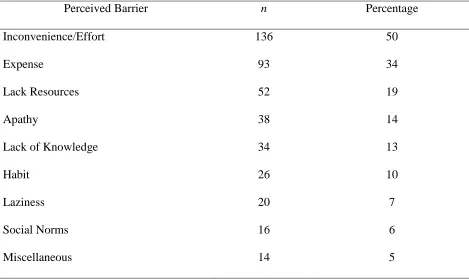
Barriers to Environmental Behavior: Emerging Themes
Participants reported a variety of barriers to environmental behavior. Given
unlimited space in which to respond, participants provided responses that ranged from
one word to a short paragraph describing barriers to ecological behavior. The average
response was approximately two sentences long. Perceived barriers to performing
ecological behaviors were fully captured by nine content-related categories. Listed in
order of salience, these are Inconvenience/Effort, Expense, Lack of the services/resources,
Apathy, Lack of knowledge/information, Habit, Laziness, Lack of social norm, and
Miscellaneous (See Table 5 & Figure 3). Categories were not mutually exclusive, as
responses were assigned to more than one content area when appropriate.
Inconvenience/Effort. Of the 270 participants, approximately half (n=136,
50%) perceived inconvenience or the amount of time or effort it took to perform an
ecological behavior as a barrier. Many respondents described ecological behaviors as
being inconvenient to perform because they had to go out of their way to perform them.
For example, a number of participants simply stated that ecological behaviors were ―Not
always convenient” or “Difficult.” Others elaborated and made statements like:
―Convenience. Americans have evolved in such a way that anything that is
easier to do and takes less effort is more desirable. If there was a more
convenient way to recycle, wipe your hand without paper towel, and use
local famers’ produce then the American population would be able to
Other responses that were coded as fitting into this category described ecological
behavior as undesirable to perform due to the time and energy they took. For example,
one participant, referring to recycling, stated: ―Who wants to separate trash?”
Expense. Approximately one third of participants (n = 93, 34%) perceived
expense or cost as a barrier to ecological behavior. Many participants simply stated that
―cost‖ or ―expense‖ was a barrier. Others chose specific behaviors from the given list and
described how they were more expensive. For example, one participant stated, “Most of
the environmentally friendly choices are more expensive, such as organic produce and
using solar energy.” Another noted that “…natural products costs a lot more than other
products...”
Lack of services and resources. Nearly one fifth (n = 52, 19%) of participants
perceived a lack of the services and/or the resources necessary to perform ecological
behaviors as a barrier. For example, participants described a lack of recycling centers and
bins, public transportation, and alternatives to environmentally unsustainable packaging
(e.g., Styrofoam). For example, one participant stated, “I do not live in an area that
produces fresh produce.” Another wrote ―It is hard to find recycling centers in Atlanta,
especially living in a dorm.‖
Lack of knowledge or information. Thirty four participants (13%) cited a lack
of knowledge as a barrier to ecological behaviors. The following quotes typify
participants‘ views in this content area: ―It is not that obvious how to recycle in the
community.‖ Another stated, ―Overall some people are just ignorant of how they can help
make a difference.‖ One said: ―Ignorance, people don’t realized global climate change is
Apathy or personal preference.Thirty eight participants (14%) attributed their
or others‘ lack of ecological behavior to their belief that it was unimportant or not
beneficial to engage in. For example, participants made statements like ―Recycling isn’t
necessarily hard, I just have profound cynicism that it’s worthwhile since recycling
centers utilize the same or nearly the same amount energy.‖ Another participant stated ―It
is not something that is important to me. I would rather go out of my way for people or
things I am passionate about.‖ Others indicated that although they knew that some of
their choices did not represent the most environmentally conscious of decisions, they
preferred using products like chemical insecticides, plastic bags, and paper towels instead
of less toxic or reusable products. For example, one participant stated, ―Stores give you
bags. I shouldn’t have to bring my own. I already have a purse to carry.‖
Habit. Twenty six responses (n = 26, 10%) perceived habit or routine as barriers
to performing ecological behaviors. For example, one participant stated, “It is what I
have been doing for over eighteen years. It is hard to sometimes make changes from bad
habits.” Another participant stated ―A lot of these behaviors are hard to perform simply
because they take extra time to remember, such as using cloth bags at the grocery store:
you have to remember to bring the cloth bags from home.‖
Laziness.Twenty participants (7%) perceived laziness as a barrier to ecological
behavior. Numerous participants simply wrote ―laziness‖ in the space provided. Others
elaborated and wrote, ―Sometimes people are just lazy and the efficiency of technology
fosters our laziness.‖
Not social norm. Sixteen participants perceived prevailing social norms as barrier
communities were not engaging in ecological behaviors, this was a barrier to their own
engagement. For example, participants wrote that ecological behavior ―Is not community
supported, “we don’t recycle as a family‖ or that ―economic and social conditioning‖
made people less likely to participate. Two participants expressed the view that
environmental organizations are seen as ―extremist‖ and therefore on the fringe of what is
considered acceptable to participate in. One of those noted: ―In terms of environmental
groups, it is difficult to volunteer and contribute or I am hesitant to do so because of their
relative lack of notoriety and reach or because they are perceived as being extreme and
on the fringe.‖ Two other participants reported that because ecological behaviors such as
recycling are not mandated they are less likely to perform them, thus serving as a barrier.
For example, one participant reported, ―I would even go as far as to say that things such
as, recycling, using non-toxic cleaners etc., should be more encouraged and, perhaps,
even mandated….But it is obvious that people are more likely to do things when they
know those things are required.‖ The other participant stated “recycling is not enforced
by the government.”
Miscellaneous.Finally, 14 responses (5%) did not seem to fit in any of the other
thematic categories. Responses that were coded as ―miscellaneous‖ often denied the
existence of barriers to ecological behavior (e.g. ―I don’t really think it’s hard to perform
these behaviors.‖), failed to answer the question (e.g. ―I’m not really sure.‖), or were too
DISCUSSION
The current study explored ecological behavior in the context of climate change.
Ecological behaviors which promote the use of resources in a sustainable manner, in
addition to other strategies, will be essential to curbing the overconsumption patterns
responsible for climate change. While climate change is a pressing issue with
wide-ranging ecological and social implications, it has received little attention in the
psychological literature. Therefore, the current exploratory study sought to 1) illuminate
variables pertinent to predicting ecological behavior, 2) explore whether there is a
connection between peoples‘ beliefs about climate change and their ecological behavior,
and 3) examine barriers to ecological behavior.
The largely female, undergraduate sample reported a range of ecological
behaviors. For example, more participants endorsed engaging in behaviors such as
washing only full loads of laundry than using a compost bin for leftovers or donating
financially to an environmental organization. The sample was also slightly more
ecocentric than anthropocentric. Respondents demonstrated basic knowledge about the
causes of climate change. Nearly three quarters of the sample agreed that climate change
is occurring. The majority of participants also stated the intention to help stop climate
change and believed that they were able to make a difference (efficacy).
Researchers have documented differences in a variety of attitudes and behaviors
based on where a person falls along the ecocentric/anthropocentric continuum. Results
from the current study were congruent with previous research and indicated that those
with more ecocentric values are more likely to report ecological beliefs and behavior (e.g.
dedicated to whether people with ecological worldviews actually engage in this behavior
or just view themselves as more environmentally conscious. The present study also gives
preliminary evidence that an ecocentric worldview may be positively related to the belief
that climate change is real and the intention to address it, as compared to a more
anthropocentric worldview (i.e. the correlation between these variables).
The present study highlighted the need for further exploration into how race and
income influence ecological behavior. While in this study, Whites reported higher levels
ecological behavior than African Americans and Latinos/as this finding should be
interpreted with caution as race and income may be confounded in their measurement.
Tools used to measure ecological behavior in this study may be biased toward people
with more economic resources. For example, while some of the behaviors associated with
items on the measure of ecological behavior used in this study could result in monetary
savings (e.g. I wait until I have a full load before doing my laundry), many of the items
favored the economically advantaged (e.g. I buy locally grown produce, I contribute
financially to an environmental organization). Since African Americans and Latinos are
disproportionately likely to be members of economically disadvantaged groups, this may
result in lower scores on measures of ecological behavior and misrepresent their actual
usage of resources. Elliott (2004) presented data that suggests that African Americans
and the people of lower SES generally contribute less to climate change, having lower
overall carbon ―footprints.‖
Current measures of ecological behavior may also be picking up on group/cultural
norms rather than a group‘s actual impact on the environment. For example, eating
American or Latino/a participants. While the ecological behaviors measured in the
current study may not have been viewed as normative, this does not mean that African
Americans or Latinos/as care less about the environment, a myth that researchers such as
Mohai and Bryant (1998), Mohai (2003), and Parker and McDonough (1999) have
worked to debunk. It may be the case that Whites or people of higher SES find it more
socially desirable to report ecological behavior, thus explaining this difference.
Furthermore, African Americans and Latinos/as may encounter more barriers to
performing ecological behaviors (e.g. buying locally grown produce in an urban
environment). Given these findings, it is important that researchers develop ways to
measure ecological behavior that takes into consideration possible bias toward the
economical advantaged or dominant racial and cultural groups.
Results from the current exploratory study begin to make the crucial and
understudied connection between peoples‘ beliefs about climate and their ecological
behavior. The current study explored whether beliefs about climate change influenced
peoples‘ behavior. However, a gap often lies between peoples‘ beliefs and their
behavior. As identified in the Theory of Planned Behavior (Ajzen, 1985, 1991),
behavioral intentions may be the missing link between what someone believes and how
they act. In the present study, this theoretical framework was applied to climate change
beliefs and behaviors using two mediation models. Mediation was used to test whether
intentions mediated the relationship between climate change beliefs and ecological
behavior and climate change efficacy and ecological behavior. In the current sample, a
belief in climate change was not directly related to increased ecological behavior.