CLASSIFYING DRIVER FACIAL EMOTIONS
NUR SURAYAHANI SURAINI
HERMILA M.A
PROCEEDINGS OF MUCEET 2009
MALAYSIAN TECHNICAL UNIVERSITIES CONFERENCE
ON ENFINEERING AND TECHNOLOGY
2 0 - 2 2 JUNE 2009
Proceedings of MUCEET2009
Malaysian Technical Universities Conference on Engineering and Technology
June 20-22,2009, MS Garden,Kuantan, Pahang, Malaysia
MUCEET2009
C l a s s i f y i n g D r i v e r F a c i a l E m o t i o n s
N o r Surayahani B . S , H e r m i l a M . A
Abstract—
This paper describes the emotion
recognition to determine the driver's conditions.
The emotion recognition could be envisioned to
sense the driver emotions automatically through a
camera. Therefore, facial images were analyzed to
extract the features to characterize the variations
between facial emotions images. The features
extraction techniques apply was Principal
Component Analysis (PCA), this algorithm finds
the principle components of the covariance matrix
of a set of face images. Then, the eigenvalues
component will be used as an input to the
K-Nearest Neighbor (KNN) classifier. The facial
expression recognition used to investigate the
emotion and thus carry out an awareness system
for drivers to perform an appropriate intervention
system.
Keywords: E m o t i o n s r e c o g n i t i o n , P C A
I. In t r o d u c t i o n
E
M O T I O N can b e detected through physiological signal such as facial expression, heart beat, temperature and galvanic skin response. In the psychological literature, emotion has been defined as an individual's response to goal-relevant stimuli that includes behavioral, physiological and experiential components. Emotion recognition influence many researchers t o study human being social attitude and performance. Hence, the outcome can b e used in many applications like automobile system, marketing and smart environment where many system and devices that had been created require u s e r ' s face tracked by a video camera to capture images of a person's face on cell phones, webcams, even in automobiles with the goal of using facial information as a clue to understand more about the current state of mind of the user. T h e driver sensor is a camera based driver monitoring system which derives information about the driver's attention to the road and the driver's emotions level.B. S. Nor Surayahani is with Computer Engineering Department, University T u n Hussein O n n Malaysia, (e-mail: [email protected]).
M . A Hermila, was with University T u n Hussein O n n Malaysia. She is now a graduate student in B E n g in Electric and Electronic.(e-mail: [email protected]).
T h e system can be integrated with other assistance systems such as braking system, steering vibration, lane departure warning and automatic cruise control. These systems accomplish intelligent automobile system in preventing unwanted incident on the road.
I I . Im p o r t a n t Re m a r k s
• Some of related works that similar with this
paper are in Section III
• Techniques for feature extraction (PCA)
discussed in Section IV and V
• Classification method
(KNN)
presented in
Section VI.
• Section VII discuss and analyzed the result
and conclude in Section VIII. The
performance of this technique will benefit the
efficiency of facial emotions applications.
H I . R E L A T E D W O R K S
For the synthesis of facial emotions for drivers, many related research have been studied. Driving is an important activity for people and research proves that drivers emote while they driving and their driving are affected by their emotions [1]. T h e ability of vehicles to sense their environment will increase the important of vehicle to intelligently dispatching warnings system to the driver effectively. T h e physiological measurements predict the rated emotion by gender where sadness was easily to predict in female face [3]. T h e inability t o manage emotions while driving is often identified as one of the major causes for accidents. Anger is one of the emotions that negatively affect people driving. When drivers become angry, they start feeling self-righteous about events and anger impairs their normal thinking and judgment, their perception is altered, thus leading to the negative cause of events
emotions and voice car to improve the automotive safety [2]. Another appropriate awareness system among other driver's on the road will increase the automobile safety level where some indicator is needed to alert other driver's.
Meanwhile, research in face recognition was growth aggressively and many techniques were used to analyze the facial images through estimation of optical flow, holistic spatial analysis, such as principal component analysis, independent component analysis, local feature analysis, and linear discriminant analysis; and methods based on the outputs of local filters, such as Gabor wavelet representations and local principal components. This paper used the most popular technique for facial recognition which is Principal Component Analysis (PCA).
IV. P R I N C I P A L C O M P O N E N T S A N A L Y S I S
PCA is mathematically defined as an orthogonal linear transformation that transforms the data to a new coordinate system such that the greatest variance by any projection of the data comes to lie on the first coordinate (called the first principal component), the second greatest variance on the second coordinate, and so on.
The main idea of using PCA was a 2-D facial image can be represented as 1-D vector by concatenating each row (or column) into a long thin vector. Let's suppose we have M vectors of size N (= rows of image x columns of image) representing a set of sampled images, pfs represent the pixel values.
x
i=[p
l....p
N]
T,i = l
. . . M
(1)
The images are mean centered by subtracting the mean image from each image vector. Let m represent the mean image.
1
Mm =
175><
( 2 )And let wi be defined as mean centered image
wi- xi -m ( 3 )
Our goal is to find a set of ei's which have the largest possible projection onto each of the wi's. W e wish to find a set of M orthonormal vectors e; for which the quantity
)
2 (4)is maximized with the orthonormality constraint
ejek = 8lk ( 5 )
It has been shown that the e,'s and V s are given by the eigenvectors and eigenvalues of the covariance matrix
C = WWT (6)
where W is a matrix composed of the column vectors w, placed side by side. The size of C is N x N which could be enormous. A common theorem in linear algebra states that the vectors e, and scalars X,- can be obtained by solving for
the eigenvectors and eigenvalues of the M xM matrix WTW.
Let di and ^ be the eigenvectors and eigenvalues of WTW,
respectively.
WTWdt =flidi
By multiplying left to both sides by W
WWT(Wdi) = /Ii0Vdi)
(7)
(8)
which means that the first M - 1 eigenvectors et and
eigenvalues 3 i of WW* are given by Wrf,- and respectively.
Wdi needs to be normalized in order to be equal to c,-. A
facial image can be projected onto M'(< M) dimensions by computing
i i = [ v , v2. . . vM. f (9)
where V,. = e^Wi. v,- is the i* coordinate of the facial image
in the new space, which came to be the principal component, the face class k that minimizes the Euclidean distance
(10)
where ilk is a vector describing the ic"1 face class. If ek is less
than some predefined threshold &c, a face is classified as
belonging to the class k.
V. F A C I A L E M O T I O N S S Y N T H E S I S
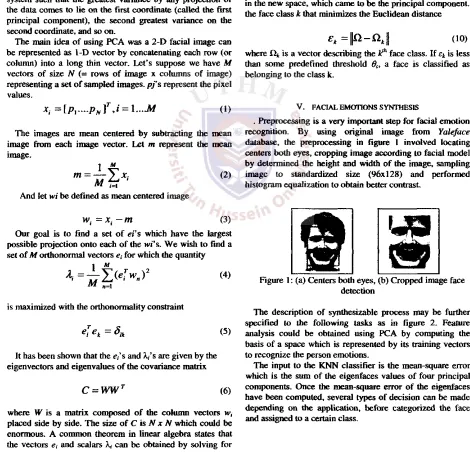
. Preprocessing is a very important step for facial emotion recognition. By using original image from Yaleface database, the preprocessing in figure 1 involved locating centers both eyes, cropping image according to facial model by determined the height and width of the image, sampling image to standardized size (96x128) and performed histogram equalization to obtain better contrast.
Figure 1: (a) Centers both eyes, (b) Cropped image face detection
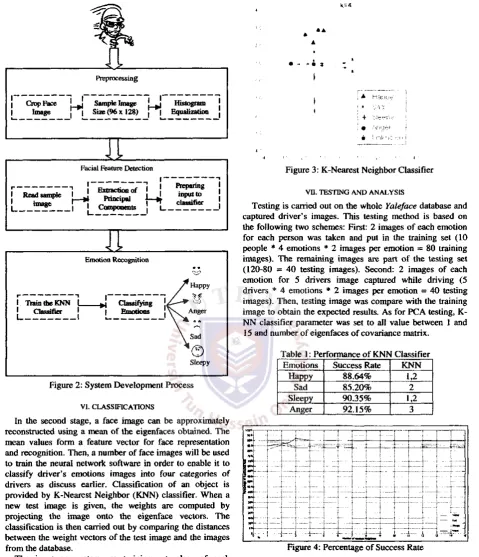
The description of synthesizable process may be further specified to the following tasks as in figure 2. Feature analysis could be obtained using PCA by computing the basis of a space which is represented by its training vectors to recognize the person emotions.
[image:3.600.61.531.263.715.2]Preprocessing
J Crop Face j J Sample Image [ J Histogram [
i . j | Size (96 x 128) j | Equalization J
Facial Feature Detection
I Read sample I
[image:4.598.62.542.52.610.2] [image:4.598.318.494.52.236.2].1
| Extraction of j Principal I Components
Preparing input to classifier
Emotion Recognition
I Train the KNN L | ^ Classifier j
Classifying
Happy
Anger
Sleepy
Figure 2: System Development Process
V I . C L A S S I F I C A T I O N S
In the second stage, a face image can be approximately reconstructed using a mean of the eigenfaces obtained. The mean values form a feature vector for face representation and recognition. Then, a number of face images will be used to train the neural network software in order to enable it to classify driver's emotions images into four categories of drivers as discuss earlier. Classification of an object is provided by K-Nearest Neighbor (KNN) classifier. When a new test image is given, the weights are computed by projecting the image onto the eigenface vectors. The classification is then carried out by comparing the distances between the weight vectors of the test image and the images
from the database.
The input parameters are training set, class of each element of training set and a value of K. While the output parameters will determined class of testing example and number of classes, which have maximum in the nearest neighbor subset, i.e. figure 3 shows the 4 classes are (happy, sad, anger, sleepy) and K=8 then smile class have 4 elements , sad class have 2 elements and other two classes have 1 element each. The classifier will return smile class because maximum in the nearest neighbor subset is 4 and smile class occurs with this maximum frequency.
Figure 3: K-Nearest Neighbor Classifier
VII. T E S T I N G A N D A N A L Y S I S
Testing is carried out on the whole Yaleface database and captured driver's images. This testing method is based on the following two schemes: First: 2 images of each emotion for each person was taken and put in the training set (10 people * 4 emotions * 2 images per emotion = 80 training images). The remaining images are part of the testing set (120-80 = 4 0 testing images). Second: 2 images of each emotion for 5 drivers image captured while driving (5 drivers * 4 emotions * 2 images per emotion = 40 testing images). Then, testing image was compare with the training image to obtain the expected results. As for PCA testing, K-N K-N classifier parameter was set to all value between 1 and 15 and number of eigenfaces of covariance matrix.
Table 1: Performance of KNN Classifier
Emotions Success Rate KNN
Happy 88.64% 1,2
Sad 85.20% 2
Sleepy 90.35% 1,2
Anger 92.15% 3
Figure 4: Percentage of Success Rate
classifier takes only 1 to 3 nearest neighbor to classify the
facial emotions in this paper.
VIH. CONCLUSIONS AND FUTURE WORK
As a conclusion, PCA give good effect in recognizing emotions images. Other technique like local point feature
detector could be used to enhance the performance for this
classifier. However, this paper has successfully produced
results for the first stage in investigating driver's behavioral
and their driving conditions by detecting the facials
emotions thus design the human-computer interaction of automobiles awareness systems for future cars.
Ac k n o w l e d g m e n t
W e are thankful for the helpful comments from our
colleagues on the proposed grant project. W e believed their
suggestion will enhanced the quality of this project.
Re f e r e n c e s
[ I ] Cristiiie LXiserti, Fatma Nasoz, "Affective Intelligent Car Interfaces with Emotion Recognition" in Proceedings of 11* International Conference on Human Computer Interaction, Las Vegas.USA, July 2005.
[2] Clifford Nass, Ing-Marrie Jonsson.Heten Harris,Ben Reaves Jack Endo.Scott Brave.Leila Takayama, "Improving Automotive Safety by Pairing Driver Emotion and Car Voice Emotion", CHI 2005, Oregon,
U S A .
[3] Jeremy N.Bailenson, Emmanuel D., bis B, James J, Maria E, Cendri
A. C , Clifford N and Oliver John," Real-time classification of evoked
emotions using facial feature tracking and physiological responses", Elsevier Human Computer Studies 2008.
[4] Gurvfioder Singh, Abdolhossein S , Olaf Diegel and Aruna S „
"Computerized Sales Assistants:The Application of Computer
Technology To Measure Consumer Interest-A Conceptual
Framework", Journal of Electronic Commerce Research, Vol 9, No 2, 2008.
[5] Gianluca D, Marian S.B. Joseph C, Paul H. Terrance J.. "Classifying
Facial Actions" , IEEE Transactions on Pattern Analysis and Machine Intelligent, Vol 21, No 10, October 1999.
[6] J.A. Colquitt, J.A. LePine, and R.A. Noe. "Toward an integrative theory of training motivation: A meta-analytic path analysis of 20 years of research". Journal of Applied Psychology, 85:678-707,2000. [7] J. Larson and C Rodriguez. "Road Rage to Road-Wise". Tom
Doherty Associates, Inc., New york, NY, 1999.
[8] Ashish Kapoor Yuan Qi Rosalind W. Picard, "Fully Automatic Upper Facial Action Recognition" IEEE IntematJonalWorkshop on Analysis and Modeling of Faces and Gestures, Oct 2003.
[9] K Karibasappa p, David Oziem, Lisa Gralewslri, NeiU Campbell, Colin Dal ton, David Gibson, Barry Thomas, "Face Recognition by ANN using Wavelet Transform Coefficients", Synthesising Facial Emotions.stol, Proceedings of the Theory and Practice of Computer Graphics 2004 (TPCG'04) 2004.
[10] Christine L. Usetti Diane J. Schiano, "Automatic Facial Expression Interpretation: Where Human-Computer Interaction, Artificial Intelligence and Cognitive Science Intersect", Pragmatics and
Cognition (Special Issue on Facial Information Processing: A
Multidisciplinary. 2000.
[ I I ] Rafael C.Gonzalez, Richard E.Woods, Steven LEddins "Digital Image Processing using MATLAB", Prentice Hall Pearson Education, 2004.
[12] S . T. Gandhe, K. T. Talele, and A.G.Keskar," Face Recognition Using Contour Matching" International Journal of Computer Science.2008