ASSESSING THE ORGANIZATIONAL CLIMATE TOWARDS DEVELOPING
INNOVATIVE WORK BEHAVIOR: A LITERATURE REVIEW
Bari’ah Dzulkifli & Haris Md Noor
Faculty of Technology Management, Business & Entrepreneurship Universiti Tun Hussein Onn Malaysia
[email protected] [email protected]
ABSTRACT
Agricultural sector has drawn a huge attention from many scholars regarding to the issues it holds towards human necessity. While innovation is essential to ensure the agricultural sector grows steadily to meet human needs on food, there is still a lack of study on organizational climate significance in the agricultural sector. Therefore, this study aims to examine the variables of organizational climate in assisting innovative work behavior as its pertaining to innovation. This study will specifically performs a comparative analysis on organizational climate models and their variables in the literature review and explores the most frequent variables that created organizational climate towards developing innovative work behavior. The discussion and analysis of the literature will able to develop components of variables required in organizational climate to develop innovative work behavior. Indeed, this paper puts some theoretical meanings as well as the direction of future research in this area.
Field of Research: Innovative work behavior, organizational climate.
---
1. Introduction
The vitalities of agriculture to serve for human needs especially on providing food to the world’s population are undeniable. Besides serving for human needs, agricultural sector’s position is also essential in contributing to the Gross Domestic Product (GDP) and socio-economic development of Malaysia (Abd Rahim, 2006). However, according to Malaysia Productivity Council report 2010/2011 and Quah (2011) the agricultural sector productivity grows at 1.82%, is still lower as compared to the
nation’s aggregate productivity growth such as manufacturing productivity which grows at 9.42% in 2010. In regard to the report by MPC, the productivity growth of agricultural sector after
industrialization era is still considered sluggish.
Due to the economic development by sectors is vital, most of the developed and advanced countries today have achieved their economic growth and technological success by relentless efforts in R&D (Rukunudin, 2009). However, although the government of Malaysia had invested vast amount of money on research and development in agriculture integrated with socio-economic program through
to supply safe, nutritious and high quality food at affordable price, (2) shortage of land and labor, (3) competitiveness and productivity and (4) strengthening industrialization in agriculture. Hence, does the efficiency of public agriculture agencies insufficient to overcome the challenges?
Therefore, innovation is the answer on behalf of discussing the issues and challenges as mentioned above. Moreover, R&D is part of the overall process of innovation where the idea is transformed into tangible output and being utilized by many users (Rukunudin, 2009). Prior to that, the ability to constantly innovate products, services and work processes is crucial for organization (De Jong & Den Hartog, 2010, Reuvers, et.al, 2008). Many technological innovations in agriculture and elsewhere could not have occurred without innovations in institutional and organizational arrangements (Van De Ven, 1986). Hence, one way for organizations to become more innovative is to capitalize on their employees’ ability to innovate. To facilitate the innovation to transpire in an organization, scholars had empirically proven the capability of organizational climate to develop innovative work behavior of employees (Amabile, 1996 & Montes et.al, 2003, Hunter et.al, 2007). However, The public agriculture agencies which are important organization in the forefront of agriculture development in the state, quite
surprisingly has not been studied scientifically and systematically with a focus on its extension personnel and human factors having lot of bearing on the very success of this department.
2. Innovative work behavior
The epistemology of innovative work behavior was derived from the term innovation. The innovation as has been defined generally by scholars comprised both ideation and the application of new ideas, whereas the ideation originated from creativity component (Shalley & Zhou, 2008 & Mc Lean 2005). In extent, Shalley & Zhou (2008) added creativity as an iterative process that involve reflection and action, seeking feedback, experimenting, and discussing new ways to do things rather than just relying on habit or automatic behavior.
According to McLean (2005) the terms of creativity and innovation are often used interchangeably in research studies. Creativity has to do with the production of novel and useful ideas while innovation has to do with the production or adoption of useful ideas and idea implementation (Khan et.al,2009 & Amabile et.al, 2005).
Upon the diversification of judgment, scholars have agreed that creativity is closely related to innovative
behavior (Ayranci, 2011, De Jong et.al, 2007 & Morales et.al, 2008). Creativity is intended to produce some kind of benefits and has clearer applied component since it is expected to result in innovative output (De Jong et.al, 2007). De Jong & Den Hartog (2008) conclude that innovative work behavior does not only require the generation of idea but also requires behaviors to implement the ideas that ultimately achieve improvement for business performance.
However, the innovative work behavior measurement to date has focused on generation of new ideas (creativity) rather than the behaviors involved in implementing these creative ideas (De Jong et.al, 2008 & Carmeli et.al, 2006). Furthermore, previous researches only focus on innovative work behavior
3. Organizational Climate
3.1 Definition
The organizational climate theory was first introduced by Kurt Lewin in 1930 in psychological climate study. There are proliferations of meanings regarding to the organizational climate definition. According to Litwin, the climate itself is powerful, as it can influence the behavior of those who experienced the climate (Stringer, 2002). Ekvall (1996) who had intensively done research for creativity and innovation climate defines climate as an organization attribution, a conglomerate of attitudes, feelings, and
behaviors which characterizes life in the organization and exist independently of the perception and understandings of the organization’s members. As stated by West & Ritcher (2008) climate refers to the perceptions of the work environment and the term climate can designate description and perception at the individual, group or organizational level of analysis.
As the organizational climate can designate the individuals, it is also believed to increase intrinsic motivation of the employees. (Goepel, 2011, Ayranci, 2011, De Jong & Den Hartog, 2003 & Ahmed, 1998). According to Vallerand(1997) intrinsic motivation relates to the pleasure perception of doing
behavior. Meanwhile, intrinsic motivation is believed to be the most crucial factor to develop innovative work behavior within employees (Amabile, 1996, Patterson,2005, Hunter et.al, 2007,Ekvall, 2010). This finding also supported by Amabile (2008) who found that in the componential theory, creativity or innovativeness is influenced by three components within the individual; 1) domain relevant skills, 2) creativity relevant processes, 3) intrinsic motivation and one component outside the individual the work environment or organizational climate.
3.2 Organizational Climate Dimension
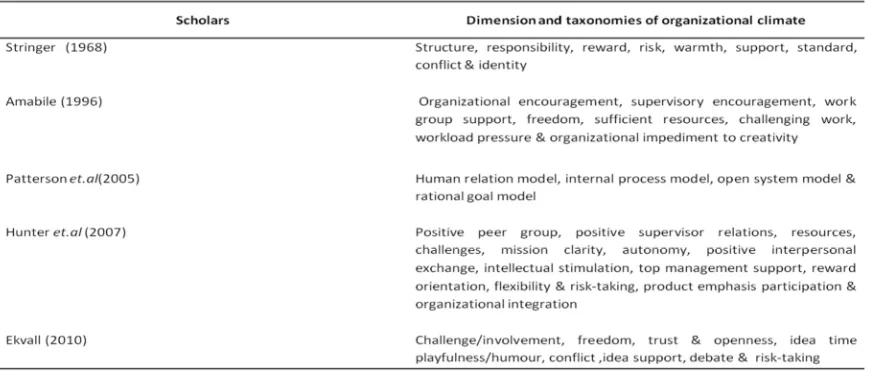
[image:3.612.77.513.517.705.2]There are five organizational climate dimensions were analyzed consisted from organizational climate by Stringer, 1968 (Rogers, Miles & Biggs, 1980), Amabile (1996), Patterson (2005), Hunter et.al (2007) and Ekvall (2010). The similarities of the five dimensions are clustered and placed together. The table below indicates dimensions and taxonomies found by five scholars.
However, Stringer (2002) has revised his first climate dimensions where he claims that reward, warmth and support are overlapping each other. Thus, Stringer had formulated new climate dimensions which tell all work environment aspects will likely have some influence over how people act. There are six distinct dimensions newly proposed by Stringer; 1) structure, 2) standards, 3) responsibility, 4) recognition, 5) support and 6) commitment. These entire six distinct dimensions would assists to increase intrinsic motivation among employees themselves. Subsequently, the successful dimensions in actual situation will help people to increase their performance by acting appropriate behavior.
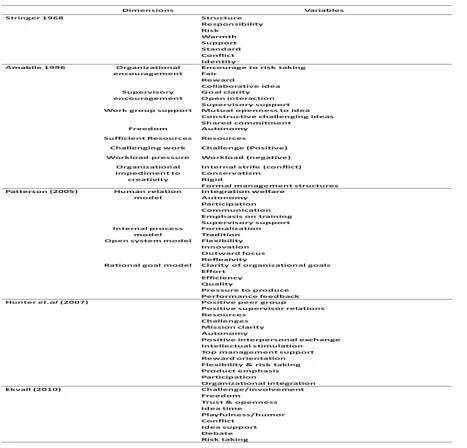
[image:4.612.75.542.273.721.2]All the dimensions and taxonomies are clustered as the table below. Several scholars did not attempt to cluster the dimension but tend to list the taxonomies. Meanwhile, several of them have clustered taxonomies into numerous dimensions. The overall conclusion when assessing the dimensions and taxonomies, all the scholars have agreed that certain behaviors of leader and work contact would have impact on organizational climate development.
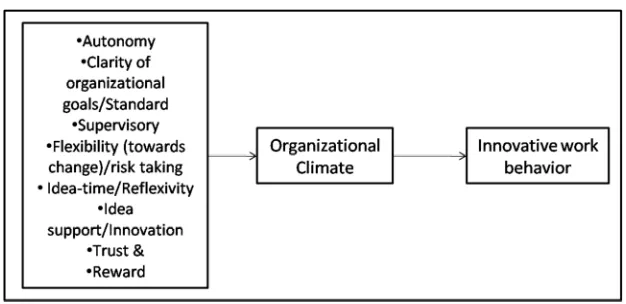
Through the dimension clustered above, the authors had analyzed certain variables in the taxonomies and have analyzed it accordingly. The most likely taxonomy is grouped together that is shown in a figure like below.
3.3 Organizational Climate versus Culture
The similarity between organizational culture and organizational climate is that it has been considered in the literature as one of the factors that can most stimulate innovative behavior among members of the organization (Ahmed, 1998 &Montes, Moreno & Fernández, 2003). Organizational culture can be seen as its member’s collective mental models (Senge, et.al 1994).
Mahal (2009) & McLean(2005) opine that the concepts of organizational culture and organizational climate have been used in a rather vague way and the definitions are almost as numerous as the researchers. Precise definitions are rare and in many cases ‘organizational climate’, ‘organizational culture’, ‘managerial climate’, ‘organizational atmosphere’, ‘management culture’ are accepted as interchangeable terms. However, other scholar’s definition of organizational climate is not identical with organizational culture (Ekvall,1996 & De Jong et.al, 2007).
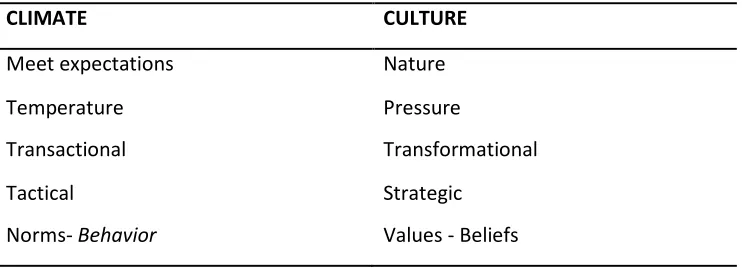
[image:6.612.69.440.376.510.2]Scholars have debated, that there are distinction between organizational climate and culture, although culture can be seen as a reflection of climate (Yukl & Lepsinger, 2004). The terms “culture” and “climate” are frequently used mistakenly in the organizational literature. West et.al (2008) added that individual perception of the work environment are usually termed psychological climate, and when shared to a level sufficient for aggregation to the group or organizational level are labeled group or organizational climate. Kouzes and Posner (1993) had differentiated between culture and climate by this table:
Table 3: Climate and culture differences (Source: adapted from Kouzes&Posner, 1993)
CLIMATE CULTURE
Meet expectations Nature
Temperature Pressure
Transactional Transformational
Tactical Strategic
Norms- Behavior Values - Beliefs
4. Relationship of Organizational Climate and Innovative Work Behavior.
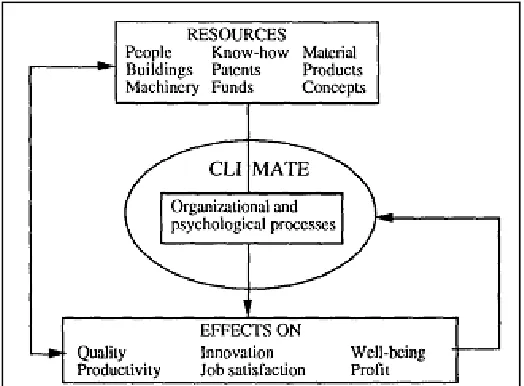
Figure 2: Climate serves as intervening variable ( Ekval, 1996)
There are many dimensions for organizational climate have been proposed by several scholars. Among the dimensions are support, autonomy or freedom and participation, workload pressure and cohesion. Empirical studies have been done to measure the relation of organizational climate and innovative work
behavior. There are evidence that shows the relationship between organizational climate and innovation that is moderated by organizational slack (Moreno, Morales & Montez, 2006).
Amabile (1996) found that the organizational climate is consisted from pressure and divided the dimensions into two; (1) Excessive workload pressure and (2) Challenge. The first one have negative impacts on creativity while the second one, challenge could assist employee to develop innovative work
behavior (Ekvall,2010 & Hunter et.al, 2007). The climate dimensions have been able to discriminate between worst and best work environment such as creativity and job satisfaction, in fact level of growth in market capitalization, revenues and profitability (Ekvall, 2010 & Isaksen, et.al., 2001)
Although the ease of communication throughout the organization could promote individual’s creativity (Patterson et.al, 2005) there is a contradiction found by De Dreu, et.al (1999) that the ease of
communication will therefore increase chances of conflict. According to Amabile (1996) & Ekvall (2010) conflict or internal strife will impede creativity.
Perception of support from organization, supervisor and work group is the most frequent dimension discussed to have a positive relationship with innovative work behavior. However, there was a research that the supporting climate for innovation was not significant (Shalley & Zhou, 2008). Hence, future research should be done in order to validate the evidence of support for innovation.
5. Discussion and Analysis
2005, Ekvall, 2010, Stringer, 2002). Support for innovation comes from the managerial or supervisory level, where the ideas thrown by employees are being accepted by appraising and giving rewards. Whereas, the behavior of giving appraisal and rewards may lead to innovative work behavior (De Jong & Den Hartog, 2007) as it increases intrinsic motivation of the employees (Montes, Moreno & Fernandez, 2003 & Amabile, 1996).
Despite the support from the top level of management, innovative work behavior also influenced by the challenge of the task. How employees perceive their task would increase their level of motivation by leading a thinking skill of how to solve the problems that helps to promote innovative work behavior
among themselves. Positive conditions of the team also assist warmth within the group yet letting the intrinsic motivation to develop (Ekvall, 2010 & West, 2008). However, the interesting part among those dimensions, Patterson do mention in his study that the dimension he propose can be taken individually to measure the outcomes of the climate as it is more flexible (Patterson, 2005). In accordance to Patterson, he reported that, many scholars who were using Litwin & Stringer Organizational climate Questionnaire showed poor split half-reliabilities and lack of validity and was not a consistent measurement device.
Although the Stringer’s climate questionnaire (1968) was reported to have lack of validity, the table shows, the climate items by Stringer are parable with other climate. Hence, the analysis of climate dimension will take the highest score to be included in conceptual framework in the conceptual framework. Moreover, Stringer had discussed back the variables of organizational climate and eliminates warmth in the dimension as it overlapped with support.
The author also had found that, certain taxonomies are difficult to be clustered due to the definition given by the developers are quite similar. For example, some developers of organizational climate are preferred to define support as general support. Some of them prefer to distinguish every level of support such as, support from organization, supervisory support and team support. The determination of climate should be studied deeply in order to overcome the overlaps.
[image:8.612.72.385.490.642.2]6. Conceptual Framework
7. Conclusion and Future Recommendation
While progress in understanding that dimensions of climate predict outcomes in a variety of studies, knowledge develops arbitrarily in this field in a way that appears not to be synergistic or to lead to theory development. This is partly because virtually every study referred to above uses a different mea- sure of climate, each assessing rather different dimensions. The accruing knowledge is not cumulative, hence the study we describe here which seeks to develop an inclusive, robust and theoretically based approach to the measurement of climate. Moreover, many instruments are not validated, are poorly designed, and fail to specify the level of analysis.
The future research should be undertaken in determining the factor of organizational climate. It is also recommended to do empirical test in order to measure the relationship of organizational climate towards innovative work behavior.
8. Acknowledgement
This paper is supported by Centre of Postgraduate Study of Universiti Tun Hussein Onn Malaysia.
References
Abd Rahim Ahmad (2006) FFTC-NACF International Seminar on Agricultural Cooperatives in Malaysia: Innovations and Opportunities in the Process of Transition Towards the 21st Century Model, Seoul, Korea, 11-15 September 2006
Ahmed, P.K. (1998) Culture and Climate for Innovation, European Journal of Innovation Management, 1, (1), 30-43
Amabile, T.M., Barsade, S.G., Mueller, J.S., & Staw, B.M. (2005) Affect and Creativity Work, Administrative Science Quarterly, 50, 367-403
Amabile, T.M., & Mueller, J.S. (2008) Studying Creativity, Its Processes, and Its Antecedents: An Exploration of the Componential Theory of Creativity in Handbook of Organizational Creativity edited by Zhou., J & Shalley, C.E., US:Lawrence Erlbaum Associates
Ayranci, E. (2011) A Research on the Relationship between Leadership Orientations and the Innovativeness of Owner-Managers in Turkish Businesses. Journal of Management & Strategy. 2 (1) Carmeli, A., Meitar, R., & Weisberg, J.(2006) Self-leadership Skills and Innovative Behavior at Work, International Journal of Manpower, 27(1), 75-90.
De Dreu, C. K. W., Harinck, S., & Van Vianen, A. (1999) Conflict and Performance in Groups and Organizations. In C. L. Cooper & I. T. Robertson (Eds.), International review of industrial and organizational psychology, 369–414. Chichester: Wiley
De Jong, J.P.J., Den Hartgog, D.N. (2007) How leaders Influence Employees’ Innovative Behavior, European Journal of Innovation Management, 10 (1), 41-64
De Jong, J.P.J., Den Hartgog, D.N. (2008) Innovative Work Behavior: Measurement and Validation, Research Report of Scientific Analysis of Entrepreneurship and SMEs, Netherlands Ministry of Economic Affairs
De Jong, J., Den Hartog, D., (2010)Measuring Innovative Work Behavior, Creativity and Innovation Management journal, 19(1), 23-36
Ekvall, G. (1996) Organizational Climate for Creativity and Innovation, European Journal of Work and Organizational Psychology, 1(5), 105-123
Goepel, M. (2011) Antecedents of Individuals support for Innovation, Paper presented to the DIME-DRUID ACADEMY, Winter Conference, Denmark, 20-22 January.
Hunter, S.T., Bedell. K.E., & Mumford, M.D. (2007) Climate for Creativity: A Quantitative Review, Creativity Research Journal, 19(1), 69-90
Isaksen, S.G. and Lauer, K.J. (2001) Convergent Validity of the Situational Outlook Questionnaire: Discriminating Levels of Perceived Support for Creativity. North American Journal of Psychology, 3, 31– 40.
Isaksen, S.G, & Ekvall, G. (2010) Managing for Innovation: The Two Faces of Tension in Creative Climate, Craetivity and Innovation Management, 19 (2), 73-88.
Khan, R., Rehman, A.U. & Fatima, A. (2009) Transformational Leadership and Organizational Innovation: Moderated by Organizational Size, African Journal of Business Management, 3, 878-884
Kouzes, J.M. & Posner, B.Z. (1993) Credibility, How Leaders Gain it and Lose it, Why People Demand it, San Francisco; Jossey-Bass Publishers
Malaysia Productivity Council (2010) Productivity Report 2010/2011, Retrieved 2 December 2010, from http://www.mpc.gov.my/mpc/images/file/APR/APRSnapshot.pdf
McLean, L.D. (2005) Organizational Culture’s Influence on Creativity and Innovation: A Review of the Literature and Implications for Human Resource Development, Advances in Developing Human Resources, 7(2), 226-246
Montes, F.J.L., Moreno, A.R. & Fernandez, L.M.M. (2004) Assessing the Organizational Climate and Contractual Relationship for Perceptions of Support for Innovation, International Journal of Manpower, 25(2) 167-180
Moreno, A.R., Morales, V.J.G., & Montes,J.L. (2008) The Moderating Effect of Organizational Slack on the Relation Between Perceptions of Support for Innovation and Organizational Climate, Personnel Review, 37(5), 509-525
Paulsen, N., Maldonado, D., Callan, V.J, Ayoko, O. (2009) Charismatic leadership, Change and Innovation in an R&D organization, Journal of Organizational Change, 22 (5), 511-523.
Quah, B.H. (2011) Does revitalizing agriculture as a growth engine defy logic? 21 May 2011. StarBiz Week
Reuvers, Engen, vinkenburg Wilson-evered (2008) Transformational Leadership and Innovative Work Behavior: Exploring the Relevance of Gender Differences, Journal compilation, Blackwell Publishing 17(3) Rukunudin, I.H. (2009, October) Mechanization R&D: Technology Generation for Sustainable Agriculture in Malaysia. Paper presented at the Asian Pacific Center for Agricultural Engineering and Machinery (APCAEM) Los Banos, Phillipines
Rogers, E.D., Miles, W.G.J. & Biggs,W.D. (1980) The Factor Replicability of the Litwin and Stringer Organizational Climate Questionnaire: An inter- and Intra-Organizational Assessment, Journal of Management, 6 (1), 65-78.
Senge, P., Roberts, C., Ross, R., Smith, B. & Kleiner, A. (1994). Moving forward - Thinking Strategically about Building a Learning Organization. From P. M. Senge, C. Roberts, R. B. Ross, B. J. Smith & A. Kleiner, The Fifth Discipline - Strategies and Tools for Building a Learning Organization, 15-47
Shalley, C.E., & Zhou, J. (2008) Organizational Creativity Research: A Historical Overview in Handbook of Organizational Creativity edited by Zhou., J & Shalley, C.E., US:Lawrence Erlbaum Associates
Stringer, R.,(2002) Leadership and Organizational Climate: The Cloud Chamber Effect, Upper Saddle River,NJ: Prentice Hall
Tierney, P. (2008) Leadership and Employee Creativity in Handbook of Organizational Creativity edited by Zhou., J & Shalley, C.E., US:Lawrence Erlbaum Associates
Van de Ven, A.H. (1986) Central Problems in the Management of Innovation, Journal of Management Science, vol.32 (5), 590-607
Valencia, J.C.N., Valle, R.S., & Jiménez, D.J. (2010) Organizational Culture as Determinant of Product Innovation, Journal of Innovation Management, 13(4), 466
Vallerand, R. J. 1997. Toward a Hierarchical Model of Intrinsic and Extrinsic motivation. Adv. Experiment. Soc. Psych. 29, 271–360
West, M.A., & Ritcher, A.W., (2008) Climates and Cultures for Innovation and Creativity at Work in Organizational Creativity Research: A Historical Overview in Handbook of Organizational Creativity edited by Zhou., J & Shalley, C.E., US:Lawrence Erlbaum Associates, 211-236