Review Article
Effects of apolipoprotein E polymorphism on the development of stroke
Usman Ahmad, M. Saeed Mahmood*, Safiuddin Siddiqui*, Philippe M. Frossard*
Department of Biological and Biomedical Sciences*, Faculty of Health Sciences, Medical College, Aga Khan University, Karachi.
Introduction
Stroke is the third leading cause of death in the U.S. and the second most frequent specific determinant of age adjusted death.1 As stroke more often results in disability than death, the overall loss in terms of person years, DALY, resources and energy is such that it has become one of the leading health issues all over the world.1
Several classical risk factors for stroke such as hypertension, alcohol consumption and cigarette smoking have been ascertained and established on firm ground of evidence through their patho-physiological correlation with etiology of stroke.1 Association studies done in different populations all over the world have controversial results about the effect of serum cholesterol level in the etiology of stroke. In western populations, a positive association between serum cholesterol levels and the risk of stroke has been noted, whereas an inverse relationship between serum cholesterol and occurrence of intracerebral hemorrhage (ICH) and Cerebral Infarction has been observed in certain Asian populations.2
Lipids form an important structural and functional part of the human body. A normal healthy individual takes about 90 to 150g of lipids in his diet daily. Although this seems to be a large quantity, the concentration of lipids in the blood is closely regulated. Any disturbance in the regu-lation of lipids, especially of the cholesterol esters, can lead to a range of vascular and related disorders. Most prominent among these disorders is atherosclerosis. Apart from itself being a dangerous vascular change, atherosclerosis can lead to a variety of disabling and fatal conditions, depending on its site of origin. One of its secondary complications is stroke.
Cholesterol is the most abundant sterol in the body. Apart from dietary cholesterol, virtually all the tissues of body synthesize cholesterol, with liver, intestine, adrenal cortex and reproductive organs being the main contributors to the endogenous cholesterol pool.
Cholesterol is an essential component of all natural membranes, which is its most important function the body. Liver is the main metabolic organ involved with cholesterol regulation. It receives cholesterol from three sources: a) dietary cholesterol, b) de novo synthesis and c) synthesis in extra hepatic tissues.
As cholesterol is insoluble in aqueous solutions, its transport takes place in the form of particles, which are ren-dered soluble by the presence of apolipoproteins on their sur-face. The apolipoproteins and polar lipids form a non-molec-ular film that surrounds the non-polar lipids in the core of the particle. The apolipoproteins (APO) involved are APOB48, APOB100, APOCII and APOE. If the metabolism and pro-duction of any of these lipoproteins is disturbed, it will lead to derangements in cholesterol metabolism leading to either hypercholesterolemia or hypocholesterolemia, which are important risk factors for many disorders including IHD, hypertension and hepatic disorders.
Shore and Shore3, first identified APOE as a con-stituent of very low density lipoprotein (VLDL) in 1973. Initially it was termed as the "arginine-rich lipoprotein." Later, a relationship between plasma distribution of APOE and dietary cholesterol level was also discovered. Experimental animal studies revealed that APOE becomes a part of the cholesterol-enriched particles that accumulate in plasma of animals, fed high levels of fats and cholesterol. We now know that these cholesterol-rich lipid particles are chy-lomicron remnants, VLDL and HDL, and that APOE is involved in their metabolism.
APOE has attracted considerable attention due to the controversial results of different studies done all over the world. The APOE gene has been found to be one of the fac-tors contributing to inter-individual variations in serum cho-lesterol levels. The genetic variation in the APOE gene explains about 7% of the variations in total cholesterol lev-els in Caucasian population.4
This review focuses on the structure and function of APOE and the effects of its genetic variations, in order to put the possible roles of APOE in stroke into perspective.
APOE Gene
APOE is present on chromosome 19q13.2.5It is 3.7 kilobase pairs long and consists of four exons and three introns.6A promoter sequence TATAATT is present approx-imately 30bp upstream from the transcriptional initiation site. Other enhancer and promoter elements have also been found which can affect its biosynthesis.6APOE is linked to APOC1 and APOC1 pseudo-genes that are present in its vicinity on the chromosome.7Complete functional mapping of the human genome may reveal other factors and genes that possibly affect the expression of APOE or are in link-age disequilibrium with it.
APOE mRNA is 1163 bp in length.7 The study of messenger RNAs has been a useful resource for scientists to evaluate tissue-specific syntheses of different proteins. APOE mRNA has been found in all organs with its larger concentrations in the liver, spleen, adrenal gland and brain.8 An important exception is the intestinal epithelium which otherwise is actively involved in dietary lipid and choles-terol uptake. Liver is a major source of APOE and accounts for about two thirds of the plasma APOE concentration. Hepatic parenchymal cells are primarily responsible for its synthesis. In the brain, which is the second most active organ in APOE production, astrocytes are the principal cell type involved in its synthesis.9
Protein Synthesis and Structure
The APOE mRNA is translated into a 317 amino acid product. The first 18 amino acids on the amino termi-nal of this nascent peptide, serve as a sigtermi-nal sequence that is later cleaved off.7 The mature APOE is a 34.2 KD prod-uct10, which is secreted from the cells in combination with phospholipids and occur as APOE-phospholipid disks that have an approximate density of 1.08g/.8
APOE is composed of two main structural domains that probably also serve as its functional domains, an amino terminal domain that includes the LDL receptor-binding site and a carboxy terminal domain that has high affinity for lipids. Digestion of APOE with thrombin yields a 22 kD fragment and a 10 kD fragment corresponding to the amino and carboxy terminal domains respectively.8
Experimental studies have shown that amino acids 1-183 are sufficient for normal APOE binding to the LDL receptor.11Detailed analysis has shown this amino terminal domain be composed of a four helix bundle that constitutes the receptor binding site. This region contains many basic amino acids that are thought to interact with the acidic residues in the ligand-binding domain of the LDL recep-tor.12 The carboxy-terminal domain, which consists of amino acids 216-299, is thought to be the lipid-binding domain. This region is a strong amphipathic a-helical struc-ture that has a polar side and a lipid-binding non-polar side.8
Physiological Role of APOE
APOE is one of almost more than ten protein con-stituents of plasma lipoproteins that are involved in various metabolic and transport pathways.8 APOE possibly has multiple roles in the body, one of which is its function in maintenance of lipoprotein particles and lipid transport. APOE is also thought to be involved in nerve growth9and regeneration13, which may explain its high concentration in the nervous tissue and CSF.14APOE also has a "paracrine like" mode of action. It is involved in movement of choles-terol from cholescholes-terol rich cells to those with its lesser con-centration, within an organ or tissue. This accounts for the large concentration of APOE in the interstitial fluid. We will restrict our discussion to its involvement in lipid metabo-lism.
In transporting lipids through out the body, APOE is involved at three steps:
a) Dietary lipids, which include fats and cholesterol, are packed into chylomicrons, which are released into lym-phatic vessels and ultimately reach the blood stream. In the lymph and blood, the chylomicron particles acquire APOE from high density lipoproteins (HDL) that makes them less hydrophobic. The modified chylomicrons are then acted upon by lipoprotein lipase and most of the triglycerides are removed, leaving a high concentration of cholesterol. The particles are now called Remnants. These remnant particles are taken up by hepatocytes through APOE receptors, also known as remnant receptors. After their uptake, the remnant particles are catabolised in the lysosomes and their choles-terol is either excreted in bile or incorporated into hepatoge-nous lipoproteins.
VLDL remnants can be taken up by the hepatocytes through APOE mediated endocytosis as in the case of chy-lomicron remnants. However most VLDL remnants under-go another metabolic step to form Low Density Lipoproteins (LDL). During this process, all the triglyc-erides and proteins are lost except APOB-100, which is the only lipoprotein component of LDL. Hepatic and extra hepatic uptake of LDL is mediated by APOB-100 through its specific receptors. However, the metabolism of LDL occurs slowly over days, in contrast to VLDL, which is nor-mally metabolized in a few hours.
c) As a result of these and other processes, choles-terol accumulates in different body tissues, especially vas-cular endothelium. A third class of lipoproteins called high density lipoproteins (HDL) is responsible for bringing this surplus cholesterol to liver for its breakdown and excretion. Nascent HDL containing apoproteins A and E is secreted from liver and intestine. The cholesteryl esters that make the core of HDL are derives from the action of the enzyme lecithin-cholesterol acyltransferase (LCAT). This enzyme is secreted by the liver and it esterifies cholesterol with a fatty acyl residue, derived from lecithin. The cholesterol in HDL is rapidly transferred to other lipoprotein particles that are then taken up. A subclass of HDL is directly taken up by hepatocytes through interaction of APOE with its receptor.
APOE Variants
To date, about 30 APOE variants have been charac-terized.15-17 The most common APOE variants in different populations all over the world are APOE €2, APOE €3 and APOE €4. All other variants have been designated according to their positions, relative to these three after isoelectric focusing.18APOE2, E3 and E4 differ at a single locus in the gene. These alleles differ by base substitutions at codons 112 and 158 (Figure). APOE €3 has not been associated with any disorder and therefore taken as the reference allele in all studies.
Effects of APOE Polymorphisms on Protein Function
As discussed earlier, APOE has three major variants that are the most common APOE alleles in the existing human population. The mature protein products of these three alleles differ at two amino acid positions. APOE €3 has a cysteine residue at position 112 and an arginine residue at position 158 while APOE €2 has cysteine and APOE €4has arginine residues at both these positions.
APOE €3 is the most frequent allele in all popula-tions and age groups with a frequency of over 60%.4 Although it is not thought to be the ancestral allele, any involvement of APOE €3 in any disorder has never been observed. APOE €3binds to its receptor normally and there is no evidence of any association between APOE €3carrier
status and lipid dysregulation.
APOE €2has a significantly reduced affinity for its receptor as compared to APOE €3.4 In this case, the substi-tution of arginine with cysteine at position 158 is thought to disturb the conformation of the α-helical structure of this part of the protein, which reduces its ability to bind to the receptor.4 Arginine being a basic amino acid probably serves to enhance the affinity of the protein for its receptor that has acidic residues in its ligand-binding domain.
The hepatic uptake of HDL and VLDL remnants, IDL and HDL is dependant upon binding of APOE to its receptor. Due to lower affinity of APOE €2for its receptor, the uptake of these particles decreases. To compensate for the reduced uptake of cholesterol and to control serum cho-lesterol level, the hepatocytes upregulate LDL receptors on their membranes.19As a result, LDL decreases in blood by its APOB-100 mediated uptake. Hence, dysbetalipopro-teinemia is a common finding in €2 homozygotes. These individuals have elevated plasma levels of VLDL triglyc-erides, VLDL cholesterol and chylomicron remnants, while LDL and HDL are usually low. There is an increased risk of atherosclerosis and its complications in these people.
APOE €4 binds to LDL receptor normally but it attaches to the dietar y derived lipoproteins and VLDL more readily as compared to APOE €3.8Crystal structure analysis of APOE €3 suggests that arginine at position 112 (as in APO E4) may disrupt specific interactions between the amino and carboxy terminals of the protein and hence alter its affinity for lipids. As a result, there is an increased clear-ance of these particles by the hepatocytes. The resultant decrease in total plasma cholesterol induces the hepatocytes to downregulate APOB-100 LDL receptors.16Thus, €4 car-riers have higher LDL cholesterol levels in blood as
com-Figure. Schematic representation of APOE protein variants. The products of the three alleles dif-fer at positions 112 and 158, which in APOE3 are occupied by a cysteine and an arginine,
resultant decrease in total plasma cholesterol induces the hepatocytes to downregulate APOB-100 LDL recep-tors.16Thus, €4carriers have higher LDL cholesterol levels in blood as compared to €3carriers. Increased LDL choles-terol puts them at a high risk of atherosclerosis.
APOE €2 homozygotes have a reduced LDL choles-terol level as compared to €3and €4 homozygotes; hence, they may be at a lower risk for atherosclerosis and ischemic stroke. Cholesterol being an important constituent of cell membranes, the €2 carriers have a greater chance of endothelial weakening in intracerebral arteries because of their low cholesterol levels.20In some populations, APOE
€2 homozygotes have been shown to have a significantly higher risk of getting intracerebral hemorrhage.21 On the other hand, increased LDL cholesterol in €4carriers increas-es their risk of developing atherosclerotic vascular disease. Higher plasma cholesterol levels may enhance the forma-tion of atheromatous plaques in the fatty streaks. Hence, these people are a high risk group for ischemic stroke. Atherothrombotic process may add to the effects of under-lying atherosclerosis.22
Prevalence of Stroke
Cerebrovascular disease is the second leading cause of death, worldwide.23It is the leading cause of DALYs lost among persons aged 60 and above. The incidence of stroke varies in different parts of the world. Epidemiology of stroke had been extensively studied in Europe, North America and Eastern Asian countries. Unfortunately, most of the data available from these and other countries shows the mortality of stroke instead of its incidence. Still the mor-tality patterns of stroke are a good measure of its incidence, because there does not seem to be much difference in the two.
The strike rate of stroke, when compared interna-tionally does not show any regular geographic pattern. Generally, China, Japan, Taiwan, Eastern European coun-tries, Trinidad and Tobago and the former Russian states have some of the highest incidence rates in the world..24 Stroke is the number one cause of death in China, Hungary and Brazil.25The lowest incidence rates are found among the affluent western European countries and North America. Canada, France, Switzerland and Australia also have some of the lowest incidence rates.24,25
During the four decades, from 1950 to 1990 there has been a decline in the incidence and mortality of stroke all over the world. This decline was more pronounced in Established Market Economy Countries (EMEC), which include the U.S, Japan, Europe, Finland, Sweden and Switzerland, among others. By far the largest declines in incidence have been observed in Japan and Finland.25
Eastern European countries and China have improved, yet continue to be high incidence rate zones.25 In the last decade, incidence rates have stabilized across the globe but the incidence is on the rise again in some countries.
In all the populations studied, men have higher inci-dence than women. The temporal trends in mortality are also more favorable in women than in men. Hormonal dif-ferences are thought to play a part on creating this gap, but the evidence is still conflicting.26 Postmenopausal women are apparently at an almost equal risk of getting stroke, as compared to men.26
By far, the most important risk factors are age and lifestyle. The incidence of stroke increases a 100 folds from around 30/100 000 in the 3rd and 4th decades, to almost 300/100 000 in those aged 80 and above.1The risk of stroke increases by 80% with every ten years of life.1Race is also an important non-modifiable risk factor, which puts blacks at a higher risk for stroke. Modifiable risk factors like dia-betes mellitus, hypertension and lipid profile are the most important determinants in the etiology of stroke.
Association of APOE polymorphism with Stroke
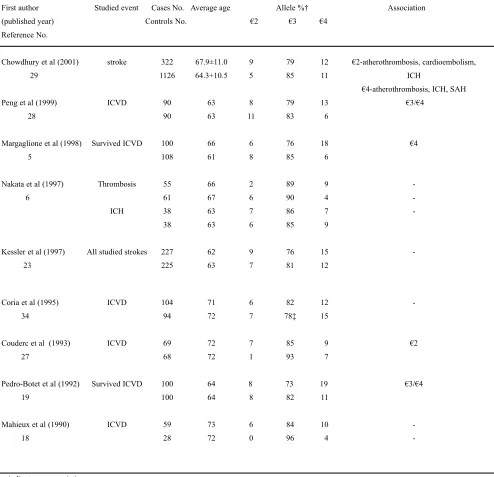
APOE holds a key position in the lipid metabolism in the body; hence, its role in the development of lipid relat-ed vascular diseases has been under perspective since it was discovered. APOE gene polymorphisms has been studied in different populations for putative roles in the development of stroke. Results have been controversial or not statistical-ly significant, and no definitive conclusion has been reached (Table). Analysis of the important case control studies done so far, does not yield any conclusion as half of the results are insignificant and the remaining do not support each other.
According to Couderc et al27, APOE €2 is associat-ed with ischemic cerebrovascular disease (ICVD) in the French population. At the same time, APOE €4 has been associated not only with ICVD19,28but also with large ves-sel ICVD. In the western populations, APOE was shown to be unrelated to cerebral infarction. In a south Asian popula-tion cerebral thrombosis was associated with APOE €4 car-rier status and APOE €2 was found to be significantly pres-ent in hemorrhagic stroke patipres-ents.29In the stroke, morbidi-ty and mortalimorbidi-ty region of Japan APOE was found to be unrelated to cerebral infarction as well as to ICH.
differ in males and females due to difference in mor-bidity rates between the two genders.
These results suggest a polygenic basis of stroke pathogenesis. The gene-environment interaction may have an important part in explaining the variations in the allelic associations found in different regions of the world.
Special Populations
[image:5.612.37.531.74.551.2]In certain parts of the world, strange patterns of APOE allele distribution have been observed. Among them are the Amerindians, who have no APOE €2 allele.31The same is the case of Mexican Mayans and Yanomas of Brazil. The frequency of APOE €2 is either very low or nil
Table. Worldwide association studies of APOE alleles with stroke.
First author Studied event Cases No. Average age Allele %† Association
(published year) Controls No. €2 €3 €4
Reference No.
Chowdhury et al (2001) stroke 322 67.9±11.0 9 79 12 €2-atherothrombosis, cardioembolism,
29 1126 64.3+10.5 5 85 11 ICH
€4-atherothrombosis, ICH, SAH
Peng et al (1999) ICVD 90 63 8 79 13 €3/€4
28 90 63 11 83 6
Margaglione et al (1998) Survived ICVD 100 66 6 76 18 €4
5 108 61 8 85 6
Nakata et al (1997) Thrombosis 55 66 2 89 9
-6 61 67 6 90 4
-ICH 38 63 7 86 7
-38 63 6 85 9
Kessler et al (1997) All studied strokes 227 62 9 76 15
-23 225 63 7 81 12
Coria et al (1995) ICVD 104 71 6 82 12
-34 94 72 7 78‡ 15
Couderc et al (1993) ICVD 69 72 7 85 9 €2
27 68 72 1 93 7
Pedro-Botet et al (1992) Survived ICVD 100 64 8 73 19 €3/€4
19 100 64 8 82 11
Mahieux et al (1990) ICVD 59 73 6 84 10
-18 28 72 0 96 4
-- indicates no association.
in the Squimos of Greenland. Certain African Pygmy populations also have no APO E2 homozygotes in the population. At the same time, the proportion of APOE €4 is very high in these individuals. APOE €2 is also absent in the Tutsi of Burundi and the Fon from Benin. On the other side of the world, the Australian Aborigines of Mowanjum also appear to be devoid of APOE €2 allele.32 To date, no such population has been found where APOE €4 allele is absent. These inter-ethnic variations may be geo-graphical in origin, and close observation of these popula-tions for development of vascular diseases and problems of lipid metabolism may help to improve our insight into the pathogenesis of cerebrovascular diseases.
Possible Role of APOE in development of stroke
So far, the exact association of any APOE variant with stroke has not been established. The different possible mechanisms through which APOE has been proposed to act are probably only a few of its roles in the body. APOE has been hypothesized and in some cases shown to have sever-al completely different roles in the body, which range from lipid metabolism to immunologic and neurogenerative actions.
It has been shown that in the presence of ß-VLDL, APOE €3 increases neurite outgrowth, whereas APOE €4 decreases the outgrowth, in vitro studies.33Hence, APOE may be involved in the regeneration of lost neuronal tissue and this may be true for post-ischemic regeneration in the brain. Therefore, one particular variant of APOE may actu-ally render a person stroke resistant while the other makes him stroke prone, even in mild hypoxic insults. This is sup-ported by the fact that multiple sclerosis patients who are in the remyelination phase have elevated levels of APOE in the CSF.
APOE also has specific receptors on macrophages and oligodendrocytes.34 APOE €2 binds defectively to these receptors, so it may inhibit repair mechanisms and hence increase the parenchymal damage after cerebral ischemia. APOE may play a role in the development of ath-erosclerosis by affecting the growth, proliferation and dif-ferentiation of smooth muscle cells in the arterial walls.35 All these and other mechanisms may act synergistically or individually to cause or prevent cerebrovascular pathologies but no single factor has yet been found, the presence or absence of which can cause a cerebrovascular disease on its own. Stroke, like hypertension has a polygenic basis and may be the result of many indirectly acting factors. Hence finding out more and more intermediate phenotypes would help in reaching to its root cause.
We hypothesize that APOE variants may act in the pathogenesis of stroke by a mechanism mediated through atherosclerosis. Studies done to date demonstrate that the
prevalence of APOE €3allele is high in both stroke patients
and controls ranging from 73%-96% (Table). APOE €3
being the normal variant, its high prevalence in both dis-eased and healthy populations hint us to the fact that APOE may be involved in the overall pathogenesis of stroke in not an extremely major way. As we are yet unaware of the boundaries of action of APOE, we can suspect any addition-al role that a genetic variant may take up. Complete func-tional mapping of the human genome will help in determi-nation of any other genes and gene products that effect the action of APOE in the body. The discovery of the role of APOE in stroke will be of immense diagnostic importance and will help to decrease the physical, psychological and economic sufferings caused by stroke.
References
1. Tanaka H, Yokoyama T. Cerebrovascular disease. In: Detels R, Holland WW, eds. Oxford Text book of Public Health, 3rd ed, Oxford: Oxford University Press, 199, pp.: 1065-79.
2. Ueshima H, Iida M, Shimamoto T, et al. Multivariate analysis of risk factors for stroke: eight-year follow-up study of farming villages in Akita, Japan. Prev Med 1980;9:722-40.
3. Shore VG, Shore B. Heterogeneity of human plasma very low density lipopro-teins. Separation of species differing in protein components. Biochem 1973;12:502-7.
4. Davignon J, Gregg RE, Sing CF. apolipoprotein E polymorphism and athero-sclerosis. Arteriosclerosis 1988;8:1-21.
5. Das HK, McPherson J, Bruns GA, et al. Isolation, characterization and map-ping to chromosome 19 of the human apolipoprotein E gene. J Biol Chem 1985;260: 6240-7.
6. Paik YK, Chang DJ, Reardon CA, et al. Nucleotide sequence and structure of the human apolipoprotein E gene. Proc Natl Acad Sci 1985;82:3445-9. 7. Tata F, Henry I, Markham AF, et al.. Isolation and characterization of a cDNA
clone for human apolipoprotein CI and assignment of the gene to chromosome 19. Hum Genet 1984;69:345-9.
8. Breslow JL. Human apolipoprotein molecular biology and genetic variation. Ann Rev Biochem 1985;54: 699-727.
9. Pitas RE, Boyles JK, Lee SH, et al. Astrocytes synthesize apolipoprotein E and metabolize apolipoprotein E-containing lipoproteins. Biocheim Biophys Acta 1987;917: 148-61.
10. de-Knijff P, van-den-Maagdenberg AM, Frants RR, et al. Genetic heterogene-ity of apolipoprotein E and its influence on plasma lipid and lipoprotein lev-els. Hum Mutat 1994;4:178-94.
11. Wilson C, Wardell MR, Weisgraber KH, et al. Three-dimensional structure of the LDL receptor-binding domain of human apolipoprotein E. Science 1991;252:1817-22.
12. Mahley RW, Innerarity TL, Rall SC Jr, et al. Apoliporotein E: genetic vari-ants provide insights into its structure and function. Current Opin Lipidology 1990;1:87-95.
13. Boyles JK, Zoellner CD, Anderson LJ, et al. A role for apolipoprotein E, apolipoprotein A-I, and low-density lipoprotein receptors in cholesterol trans-port during regeneration and remyelination of the rat sciatic nerve. J Clin Invest 1989;83:1015-31.
14. Pitas RE, Boyles JK, Lee SH, et al. Lipoproteins and their receptors in the central nervous system.Characterization of the lipoproteins in cerebrospinal fluid and identification of apolipoprotein B,E(LDL) receptors in the brain. J Biol Chem 1987 262: 14352-60.
15. Rall SC Jr, Weisgraber KH, Innerarity TL, et al. Structural basis for receptor binding heterogeneity of apolipoprotein E from type III hyperlipoproteinemic subjects. Proc Natl Acad Sci 1982;79:4696-700.
17. van den Maagdenberg AM, Weng W, de Bruijn I H, et al. Characterization of five new mutants in the carboxyl-terminal domain of human apolipoprotein E: no cosegregation with severe hyperlipidemia. Am J Hum Genet 1993;52:937-46.
18. Zannis VI, Breslow JL, Utermann G, et al. Proposed nomenclature of APOE isoproteins, APOE genotypes, and phenotypes. J Lipid Res 1982;23:911-14. 19. Pedro-Botet J, Senti M, Nogues X, et al. Lipoprotein and apolipoprotein
pro-file in men with ischemic stroke: role of lipoprotein (a), triglyceride-rich lipoproteins and apolipoprotein E polymorphism. Stroke 1992;23:1556-62. 20. Reed DM. The paradox of high risk of stroke in populations with low risk of
coronary heart disease. Am J Epidemiol 1990;131:579-88.
21. Tanaka H. Age-dependent association of apolipoprotein E genotypes with stroke subtypes in a Japanese rural population. Stroke 2000;31:1299-1306. 22. Ribeiro PA, Shah PM. Unstable angina: new insights into pathophysiologic
characteristics, prognosis, and management strategies. Curr Probl Cardiol 1996;21:669-731.
23. Murray CJ, Lopez AD. Mortality by cause for eight regions of the world: global burden of disease study. Lancet 1997;349:1269-76.
24. Sarti C, Rastenyte D, Cepaitis Z, et al. International trends in mortality from stroke. Stroke 2000;31:1588-601.
25. Kalache A, Aboderin I. Stroke: the global burden: Health-Policy-Plan. 1995;10:1-21.
26. Oger E, Scarabin PY. Hormone replacement therapy in menopause and the risk of cerebrovascular accident. Ann Endocrinol (Paris) 1999;60:232-41. 27. Couderc R, Mahieux F, Bailleul S, et al. Prevalence of apolipoprotein E
phe-notypes in ischemic cerebrovascular disease. A case-control study. Stroke 1993;24:661-4.
28. Peng, DQ, Zhao SP, Wang JL. Lipoprotein (a) and apolipoprotein E epsilon 4 as independent risk factors for ischemic stroke. J Cardiovasc Risk 1999;6:1-6.
29. Chowdhury AH, Yokoyama , Kokubo Y, et al. Apolipoprotein E genetic poly-morphism and stroke subtypes in a Bangladeshi Hospital-based study. J Epidemial 2001;11:131-8.
30. Ferrucci L, Guralnik JM, Pahor M, et al. Apolipoprotein E epsilon 2 allele and risk of stroke in the older population. Stroke 1997;28:2410-16.
31. Jaramillo-Correa JP, Keyeux G, Ruiz-Garcia M, et al. Population genetic analysis of the genes APOE, APOB (3' VNTR) and ACE in some black and Amerindian communities from Columbia. Hum Hered 2001;52:14-33. 32. Kamboh MI, Serjeantson SW, Ferrell RE Genetic studies of human
apolipoproteins. XVIII. Apolipoprotein polymorphisms in Australian Aborigines. Hum Biol 1991;63: 179-86.
33. Nathan BP, Bellosta S, Sanan DA, et al. Differential effects of apolipoproteins E3 and E4 on neuronal growth in vitro. Science 1994;264:850-2. 34. Pitas RE, Boyles JK, Lee SH, et al. Lipoproteins and their receptors in the
central nervous system: characterization of the lipoproteins in cerebrospinal fluid and identification of apolipoprotein B,E (LDL) receptors in the brain. J Biol Chem 1987;262:14352-60.