The London School of Economics and Political Science
Interpretation
From audiences to users
Ranjana Das
Declaration
I certify that the thesis I have presented for examination for the MPhil/PhD degree of the London School of Economics and Political Science is solely my own work other than where I have clearly indicated that it is the work of others (in which case the extent of any work carried out jointly by me and any other person is clearly identified in it). The copyright of this thesis rests with the author. Quotation from it is permitted, provided that full acknowledgement is made. This thesis may not be reproduced without the prior written consent of the author.
Abstract
Contents
Declaration ... 2
Abstract ... 3
Contents ... 4
List of papers produced out of this thesis ... 7
Acknowledgements ... 8
1. Interpretation: from audiences to users... 10
Transforming audiences and the evolution of an agenda ... 13
The significance of heterogeneity in interpretation and use ... 15
A genre of interest ... 17
Conceptual challenges ... 19
Empirical challenges ... 20
A shared agenda ... 21
Interpretative work – users ... 23
The conceptual and the empirical ... 25
Conclusion ... 29
2. In pursuit of interpretation ... 31
In pursuit of interpretation: mass media and the story as told… ... 34
In pursuit of interpretation: new media, and an unfolding story ... 46
Audiences and interpretation, users and literacies ... 47
Concepts of the interface ... 50
Interpretation: between stable legacies and promising possibilities... 54
Six texts ... 55
One of many repertoires ... 63
3. The contract of interpretation ... 66
Introduction ... 66
De/links ... 68
Theories of meaning – textual considerations ... 73
The work and the text ... 74
Conventions and the anticipation of roles in reading ... 77
From conventions to affordances ... 79
Openness and closure ... 81
Theories of meaning – the act of interpretation ... 84
The interpretative contract ... 84
A reader-oriented position ... 87
Conclusion ... 91
4. The interface of interpretation ... 95
Decisions ... 96
Operationalizing the interpretative contract ... 96
Problems with and the significance of textual analysis ... 97
Beyond canonized divides ... 99
Prior instrumentation in data gathering... 101
The qualitative interview ... 105
Processes ... 107
Research ethics ... 107
Decisions in sampling and recruitment ... 108
Interviews ... 110
Returning to the theoretical agenda ... 122
Analytical strategy ... 123
Hybridizing template coding and immersive/emergent coding ... 128
Notes on evaluation ... 130
5. The resources and limits of interpretation ... 134
Introduction ... 134
Locations ... 136
Resources, restraints ... 139
Relationships ... 145
Talents, aspirations, ambitions ... 147
Empirical findings ... 151
Conclusion ... 152
6. Heterogeneity in interpretation ... 154
Introduction ... 154
Authors, other readers and stories about the text ... 155
Perceptions of authorial presence ... 156
Expectations of the author ... 159
Perceiving other readers ... 162
Stories about the text ... 165
Engaging textual boundaries ... 168
Expertise with the interface ... 169
Creativity and participation ... 171
Empirical findings ... 174
Conclusion ... 176
7. The task of interpretation ... 180
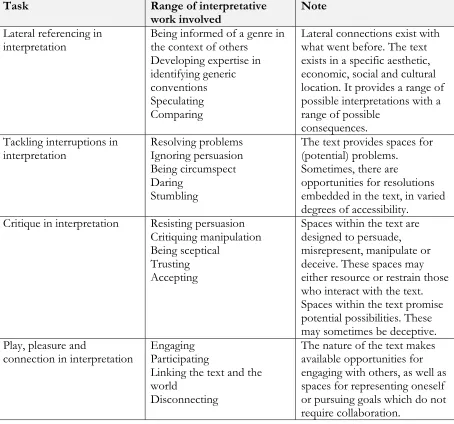
Interpretative work: the task of interpretation ... 182
The interpretative logic of the four tasks through deduction and induction ... 183
Lateral referencing in interpretation ... 185
Tackling interruptions in interpretation ... 192
Critique in interpretation ... 195
Play, pleasure and connection in interpretation ... 201
Theoretically relevant findings ... 205
Conclusions ... 206
8. Concepts in interpretation ... 208
Introduction ... 208
Gap filling ... 211
The horizon of expectations ... 214
The wandering viewpoint ... 219
The contract of interpretation ... 222
Accounting for interpretative diversity ... 224
Conclusion ... 227
9. Connecting interpretative conditions ... 229
A personal account ... 230
The language of texts and readers ... 235
Alternative approaches? ... 239
Ways forward ... 240
What I hope to have achieved ... 247
References ... 254
List of papers produced out of this thesis
Das, R. (accepted following minor revisions for May 2012) The task of interpretation. Participations: The International journal of Audience and Reception Studies.
Das, R. (2011) Converging perspectives in audience studies and digital literacies: Youthful interpretations of an online genre. European Journal of Communication 26 (4).
Das, R. (2010) Meaning at the interface: New genres, new modes of interpretative engagement? Communication Review 13 (2), 140-59.
Das, R. (2010) The task of interpretation: converging perspectives in audience research and digital literacies? In Nico Carpentier, Ilija Tomanic Trivundza, Pille Pruulmann-Vengerfeldt, Bart Cammaerts, Richard Kilborn, Hannu Nieminen, Tobias Olsson and Ebba Sundin (Eds) Media and Communication Studies: Intersections and Interventions. Tartu: University of Tartu Press.
Das, R. (2010) Digital youth, heterogeneity and diversity. Journal of Media Practice 11 (3), 293-299.
Livingstone, S. and Das, R. (in press, forthcoming 2012) The end of audiences? Theoretical echoes of reception amidst the uncertainties of use. Chapter for the Blackwell Companion to New Media Dynamics, edited by John Hartley, Jean Burgess and Axel Bruns.
Acknowledgements
This thesis was inspired by a book I read in New Delhi, India. It was written and defended in London, UK. This version for final submission was prepared in Hamburg, Germany. I am grateful to many around the world.
“Always keep the intellectual demands high, bring people together and make things happen.” In setting me these three tasks, Sonia Livingstone resourced me for an entire career. She introduced me to the wonderful world of audiences, let me make notes from her bridge-building and is my harshest critic. I am indebted to my mentor.
Lilie Chouliaraki has been an inspiring thesis committee chair, a patient writer of countless references, a great advisor and an unwavering source of confidence in my research every time I landed up in S102. Thank you so much Lilie.
Words aren’t enough to thank my PhD family – friends who tolerated me, supported me, inspired me and enabled me, without demanding much, or anything at all, in return. Isabel Pavez-Andonaegui – I am more grateful than I can ever say to this incredible person for everything she did for me all through this PhD. Your love, loyalty, generosity and kindness were priceless, Isa. The remarkable Sally Broughton Micova, for whom no mountain is too high – I am ever grateful to you for being there at your supportive best every time I needed you, you are so admirable Sal. Gemma Martinez Fernandez – for our many sessions of ‘Frustrated Friday Fries’ at Wrights, those many rounds of silly Spanish words to de-stress and for all the laughter and sunshine you brought in when you spent a year with us, thank you. And, as I wrote this PhD, I found a matchless friend and critic in Maximillian Hänska-Ahy. Our co-authored papers on theory and method greatly enriched this thesis. For your intellectual inputs and invaluable friendship during my time in London, my enduring gratitude Max.
My parents have been stellar. Ranjan Das is the inspiration who has been supporting my every dream right from when I wanted to be a singer, a geographer and a war-reporter and Sanjukta Das reads everything I write, many times over, and listens to a lot of gibber-gabber, with interest and warmth. My timeless gratitude goes to my aunt Reeta Das for her inestimable love, now mediated perfectly by Skype. My aunt Sanchita Mitra kindly printed and prepared this thesis in India for my mum to read it, thank you. Anjana Ghose gave me loving and supportive kindness. Rita Dutta, Nivedita Bhattacharya, Chandrima Mukherjee, Jayasri Raychaudhuri and Bonhishikha Sarkar listened to many phone calls with patience and affection, countless times, during the PhD years. How lucky I have been to have been taught by teachers like you who take such an active interest in my life, even years after I have finished my lessons in Geography, History, French and English!
Thanks much to Zoe Sujon for her timely advice in preparing for my viva and for her consistent confidence in me right from my stumbling MSc days – this gives me much strength. Thanks to Anita Howarth for her wisdom and cheer in the days leading up to my viva. Yinhan Wang– your support, cheer and wisdom have been so appreciated. David Brake – apart from inspiring me with your own research, you have been stellar in cheering me on and I hope you continue to for years to come! Shakuntala Banaji – your comments on some of my writing and your determination and spirit have been invaluable. And for being with me on my viva day, a huge, big thank you to Rafal, Tal, Rahoul, David, Marco, Anita, Anke, Shaku and Jowan.
Many have provided critique and encouragement at various points throughout this process. For their diverse contributions I thank a diverse group of people – Phul Acharjee, Charlie Beckett, Amal Benaissa, Anke Goerzig, Uwe Hasebrink, Ellen Helsper, Daniel Kardefelt-Winther, Richard Kilborn, Gunther Kress, Peter Lunt, Rahoul Masrani, Lothar Mikos, Kjartan Olafsson, Jonathan Ong, Pille Prulmann-Vengerfeldt, Julie Uldam, Tony Wilson, my colleagues at the 2010 ECREA Summer School, on EU Kids Online, Family Platform, COST IS0906, YECREA and the MC500 group at the LSE amongst others. Sixty children gave me their time and attention for this project. Without their voices none of my conceptual interests would have been pursued. A big thank you to all of them. And I am grateful to the Television 2.0 project at the University of Luneburg in Germany, for giving me a generous and inspiring post-doctoral position which allowed me the time to prepare this thesis for final submission.
A friend taught me about goodbyes, that if we pay attention we can sense the presence in our lives, of those who are no longer in our lives. Mamma - my wonderful grandmother Nilima Das - to your memory I dedicate this thesis.
Ranjana Das
1. Interpretation: from audiences to users
In this thesis, I ask in what ways our knowledge about the interpretation of genres, emergent from many decades of empirical research with mass media audiences, is useful in understanding engagement with new media. Throughout this thesis I use interpretation as the sum total of active, engaged, creative, sometimes critical and resistant tasks performed in interfacing with the media, irrespective of the directionality of communication (i.e, one way, interactive, etc.). I use interpretation to indicate a set of tasks enmeshed within the relations of social histories and practices of audiences and users and shaped to a considerable extent by the provisions of the media itself. Throughout, I use the word ‘interpretation’ to connect audiences with users and to extend audience theory into the age of the internet, without positioning a gulf between audiences and users. What is of interest to me is how far the conceptual framework accumulated around the notion of interpretative activity is instructive and constructive in the context of multidirectional, user-generated, interactive media. I carry these concepts into a project with the users of interactive media, but the subjects of interrogation are the concepts themselves.
message shows interpretation to be critical and sometimes resistant and finally, audiences are transforming as the media is transforming. Those sitting in front of the television now also hold the latest iPhone. That much has been established.
engage with it, and use a set of concepts derived from literary aesthetics largely to indicate the ‘set of concepts’ I speak about.
In what follows I try to bring together audiences and users using a family of concepts around the text-reader metaphor, which, like all families perhaps, presents an opportunity for me to look at multiple relationships, generations, agendas, lines of discord and also multiple possibilities of integration – only a few of which I am able to pursue here. This chapter introduces the problems and prospects of bringing the fields of audience reception analysis and research with new media use (framed appropriately by many, through ‘literacies’) in close contact with each other, integrating selected concerns in each field, using questions on the agenda of the one to inform and illuminate those on the agenda of the other. Audiences and users are sufficiently similar in that they are both concerned with people’s involvment and active engagement with the media, which in turn has wider societal implications, and they are sufficiently dissimilar in that they represent entirely different contexts of mediation – the former rooted in mass-mediated environments, and the latter in the interactive digital world.
Transforming audiences and the evolution of an agenda
The first three texts I read on audience research inspired me to think of a project that would research the interpretations of genres – one which would look at the mutuality, movement, action and engagement in the text-reader relationship. My very first piece of reading on empirical audience research – Making Sense of Television (Livingstone, 1998a) – continues to inspire me as I write a thesis on users and SNSs, for it reminds me of the centrality of genre and the centrality of interpretation in any moment of mediated communication. The second piece, which I read shortly after, The Export of Meaning (Liebes and Katz, 1993), embedded the concept of references, associations and mutual aid in my mind, and the third, Reading the Romance (Radway, 1984), showed me how texts and readers worked in contexts. All these concepts from research done with one-way mass media return time and again throughout this thesis that works with users of the internet.
The medium in question in my mind was still television. All these books dealt with the act of audience interpretation for television or print. My second moment of inspiration came from the sudden realization that this was all now challenged in the face of more visibly ‘active’ use that physically alters textual form and shape in a world with very new genres. But use, like interpretation, is also perhaps ‘the whole array of sense making practices that are proper to a given medium in its situation’ (Hartley, 1996, p. 58). While I was interested in interpretation, the idea of taking this task into the empirical clutter of the World Wide Web was born as I stumbled across a journal article titled ‘The challenge of changing audiences: Or what is the audience researcher to do in the age of the internet?’ (Livingstone, 2004) This was the key intellectual trigger for this project that captured the audiences-and-users puzzle succinctly and contextualized it within a range of interdisciplinary debates. In asking eight questions around the media-user relationship, the paper linked the mass media audience with the new media user thus:
of new media users? How do people variously “read” the World Wide Web? What practices surround the use of the web, email, chat and so forth? What competencies or literacies are people thereby developing? (Livingstone, 2004, p. 80)
This all linked audiences and users with multiple lines of inquiry in social research and constructed an exciting moment for audience research that was different from the exciting moment of the 1980s. The challenge was no longer to prove that human beings were not passive objects in their engagement with the media, but to argue for the retention of a narrative in a different technological and social moment by asking and answering questions which would need to use the audience reception repertoire (texts, readers, genres, narratives, interpretation) in the interactive world.
The significance of heterogeneity in interpretation and use
overarching interest was in the text-reader metaphor in the age of the internet, my interest in heterogeneity therefore seemed to introduce a comparative element into the text-reader relationship that explains why the empirical work presented in this thesis seeks differences and similarities in children’s negotiations of these texts. After the unifying narrative of excitement around youthful expertise was being sobered by researchers focusing on the highly diverse nature of use, the equally variable quality of use and not least, critical questions around youthful abilities to evaluate content, the ‘digital generation’ as an umbrella grouping had started being suitably queried (see Buckingham, 2006a; McPherson, 2008), primarily because it had started leading to problematic generalizations across the category of ‘youthful experts’ or even what seems to be called technocratic generations (Das, forthcoming in 2011). While much research was speaking of heterogeneity in the larger population as such, (note the research on media literacy for adults or for children) ‘youth’, ‘young people’ and ‘children’ continued to inform research as blanket categories that were often exoticized, suggesting that youth share a monolithic identity (Ito et al, 2010). For this project on audiences and users, it seemed interesting to ask why some diverged at the text-reader moment, when others agreed, and how, essentially, the interactive text was ‘realized’ differently. In imagining the media-user relationship for mass media, concepts spanning the cognitive, the affective, the cultural, the social and so forth had all proven useful and it was indeed clear in the context of new media that users continued to have different expectations and experiences in their readings (now physically alterative of texts), and that their creative competencies and meaning making were, as always, shaped by their symbolic resources.
accounts presented on being evaluative and critical users? These gave me overarching theoretical concerns and as I began researching children reading an online genre, their negotiations of syntax, their resistance and acceptance of norms, the creative and collaborative interpretative work and the critical literacies of ‘digital natives’ became increasingly important.
A genre of interest
by youth, and resultant concerns around identity, privacy, trust, display, performance and so on. The latter has involved questions of identities (boyd, 2006a; boyd and Heer, 2006; Hewitt and Forte, 2006; DiMicco and Millen, 2007; Clemens et al, 2008; Livingstone, 2008a; Magnuson and Dundes, 2008; Zhao et al, 2008), trust (boyd, 2003; Dwyer et al, 2007), risk (Weeks et al, 2002; Brown and Strasburger, 2007; Moreno et al, 2007; Rosenblum, 2007; Livingstone, 2008a; Ybarra and Mitchell, 2008), privacy (boyd, 2006; Dwyer et al, 2007, Melber, 2007; Rosenblum, 2007; Livingstone, 2008a; Moreno et al, 2008), harm, offence and the potential for public participation amongst other things, with an increasing amount of attention being devoted now to the anticipation and prediction of what forms social networking might take in the semantic web (Finin et al, 2005). Undoubtedly, there are a wide range of network sites, and a recent UK government research report (CLG, 2008) identifies ‘genres’ within the genre: profile-based, content-based, white-label, multi-user, mobile, micro-blogging/presence updates, social search, local forums, thematic websites and perhaps many more. If one tries accessing all of these in languages whose scripts are unfamiliar, immediately one recognizes them as SNSs. We all know documentaries, soaps and films ‘look’ a particular way), from the ‘feel of the thing’ – soap operas from diverse languages being the most common example (see Liebes and Livingstone, 2005 for the ‘diversification’ of this genre). This is also something that has long been recognized in the field of library and information sciences as user-document interaction (perhaps reminiscent of text-reader interaction), leading scholars in the field to suggest genre to be an ‘interface’ metaphor (Toms and Campbell, 1999).
principles by which the reader (substitute ‘user’) is able to recognize any specific instance as a SNS. Indeed the empirical connect between literacies and social networks has started developing; it only has to be sought out from within textual analysis of SNSs (e.g. Papacharissi, 2009) and the multiple literacies associated with it (e.g. Perkel, 2008).
Conceptual challenges
An optimistic recognition of these dis/continuities is on the minds of many today, so for instance, Langer and Ito point out (2010) that contemporary interactive media make it difficult to ignore that viewers and readers actively shape meanings, or that as new genres evolve new forms of literacy are clearly required (Buckingham 2005). These literacies must, in order to move beyond the component of being critical about other people’s production, be inclusive of the concept of creation and hence be more ‘demand-led’ rather than provided from above (Hartley et al, 2007). However, something that could be said in passing, or more often assumed than studied, actually poses multiple theoretical questions. Livingstone (2004), for instance, is concerned that there are practical and methodological problems researching new media interpretation and use, although she remains hopeful of studying reception from an analysis of use, something I call interpretation that is physically transformative of texts. Bruns (2008) points out today that interpretation is no longer silent, and setting aside for a moment that audience interpretation was never quite silent (take the audiences of plays, or those in multiplexes, or even those watching a television show in their bedrooms), one must agree that interpretation was silent as far as feeding back into the text itself was concerned: the text, unlike today’s Web 2.01 texts, was not changeable. So, despite audience interpretation now having become more
‘interiorized’, and immensely more private and not least, leaving the text changed with use, usefully, it seems that ‘reception may be once again gleaned – at least to some extent- from an analysis of use’ (Livingstone, 2004, p. 11).
Empirical challenges
Distinctive methodological and empirical challenges emerge when one tries to study interpretation from the footprints left in use. As audiences transform into users and as texts are less stable than ever before, conceptual questions sometimes revolve around societal transformations; sometimes attention is paid to
1 The term Web 2.0 generally is taken to refer to a generation of interactive applications and platforms on the worldwide web
the semantic distinctions between audiences and users (e.g. Lievrouw and Livingstone, 2006), and generally, there is a search for new theories of meaning (Kress, 2003). This is also a difficult question of method, thereby placing question marks on how one is to go about researching private practices of use or indeed make sense of texts which disappear or change as fast as they were created, perhaps explaining why many of the conceptual claims listed in the previous section are often claimed by individual scholars rather than tested. Some identify methodological resources in the history of audience research to enter the age of the internet (Press and Livingstone, 2006); some call for testable and verifiable propositions for audience research in general (e.g. Barker, 2006); some adopt unconventional methods for studying audience reception (see Wood, 2007); some turn to visual methods (see, for instance, Gauntlett and Holzwarth, 2006); while others stop to ponder the efficacy of these new non-verbal methods despite their evident promise (see Buckingham, 2009). And there are many practical problems to consider. Livingstone (2004), in writing about the challenge of changing audiences, locates the problem of method as also being one of unavoidable practicalities – use is often private, more difficult to research than television viewing, increasingly it is also mobile, and she says we can no longer store up stacks of internet texts as we could video files. Markham and Baym’s book on internet research methods (2008) which brings together people conversing on method raises new questions around ethics, trust, privacy, online versus offline, ‘real’ versus ‘virtual’, and there are many attempts within audience researchers to move beyond tried and tested methods of research (cf. Gauntlett, 2007).
A shared agenda
to interactive environments. As the Transforming Audiences conference prepares for a third round (2011), and as the COST Action IS0906 on Transforming Audiences and Transforming Societies begins its work (2010), I realize that the European academy is making an attempt to keep changing audiences high on individual and collaborative research agendas. Today, academic publications from audience researchers who made seminal contributions to the field’s exciting mass media days in the 1980s and 1990s frequently foreground the question of change (see Livingstone, 2004; Buckingham, 2009). For three years now, the Transforming Audiences conference has grown to become Europe’s major recurring international conference for audience/user studies, with its latest conference (being planned as this thesis is submitted) on the transforming ‘audiences’ of online and mobile media, everyday creativity and DIY culture. Audience courses in graduate programmes focus on change in the face of interactive media, reception across genres and platforms informs multi-country projects with audiences of film, for instance (see Barker and Mathijs, 2008), a new journal, P@rticipations: Journal of Audience and Reception Studies (see www.participations.org), places audiences at the centre of its priorities and media literacy scholars often hail from an expertise in audience research and therefore frame ‘new’ questions for new environments with an appropriate degree of historicity. Conference sessions are being proposed on new audiences outlining that ‘media convergence challenges not only the conceptual canon of (popular) communication research, but poses profound methodological challenges’ (ICA Pre-conference #3, 20102) and multi-country projects want to pay ‘equal attention to audience-focused issues (especially
media interpretations and mediated experiences) and user-focused issues (both adoption and use of technologies)’ (COST IS0906 project summary3, 2010). All of this is necessarily linked to the wider
questions of societal change and transformation with media and user fragmentation (for diverse ways in which this is incorporated into research agendas, see Hermes, 2006; Thumim, 2006; Lundby, 2008).
2http://www.ica2010.sg/attend.html (As accessed on 28th March 2011)
3 See
Interpretative work – users
to convergence culture and participatory media (Jenkins, 2006), or Klaus Bruhn Jensen, from news reception (Jensen, 1988) to analysing the semiotics of interactive media (Jensen, 2005).
The connection through all this is an engagement with people’s active, engaged, critical, creative and resistant work with the media and increasingly, literacies, especially in the context of media literacies, have been offered as a suitable framework within which to place this in the age of creative interpretation. Is the hyper-reader fundamentally different from the traditional reader (Calvi, 1999)? What is the difference between reading and searching, or browsing? Is reading becoming more (or less) social, collective or collaborative than in the past (Thomas, 2005)? And thus, as Henry Jenkins and his colleagues argue, is intelligence (and perhaps even interpretation) now collective (Jenkins, 2006)? As scholars make connections from audiences to literacies (Livingstone, 2008), are hyperlink pathways in digital genres to be understood via discussions from the earliest days of hypertext, even by juxtaposing for instance encyclopaedia pages and hyperlinks (Brügger, 2009)? One can anticipate, for instance, that new textual genres are to emerge (Kress, 2009), but how is one to know how these new genres necessitate new modes of interpretative engagement? In moving from users to literacies, there are arguments that one is too wedded to technology in these kinds of conversations and an increasing recognition that ‘computer skills’ – of pushing buttons and changing fonts – is not equal to the wider, more critical concept of literacy. The very idea of literacy must necessarily be linked to an idea of legibility, as Livingstone asserts (2009), getting back a focus on the design of the interface itself (the text), and one must remember that use/literacies (like audience reception) are not isolated practical skills waiting to be graded, but practices within a societal/historical context.
framed via audience studies, admittedly, as I do here). Many are inspired by the idea of reformulating much of what reception, learning, reading and writing come to mean in the context of digital media. These conversations rest on an older conversation around media literacy and dissatisfy many who do not wish to fix media-related prefixes to literacies (see, for instance, Kress, 2009). This argument is broadly that if every medium makes necessary a separate literacy, then the result is a technologically deterministic changing-media-changing-literacies thesis. And yet, new media technologies have fundamentally altered the ways in which one conceives of authorship, reception and so forth.
The conceptual and the empirical
This chapter began with a problem that could perhaps be framed in two ways. First, that there were insights and priorities emergent about engaged and active interpretation of the media from several decades of audience reception studies which could in some ways be applied to the world of users engaging with interactive media. For some substantial time I tried to use this framing, following the suggestion that there were clear points of connection between mass media audiences and media users (both, as Livingstone [2008] suggests, shared a focus on texts, interpretation, divergence and contexts). Another framing, the one which I retain in the chapters that follow, seems to be that our theory of interpretation, generated and tested in a certain range of communicative situations, begs some clarification in a rather differently mediated communicative situation. What might one learn if one carries this conceptual repertoire into a different communicative moment? There is perhaps little to discern between the two framings until we note that the second framing speaks more to audience researchers than those who research users.
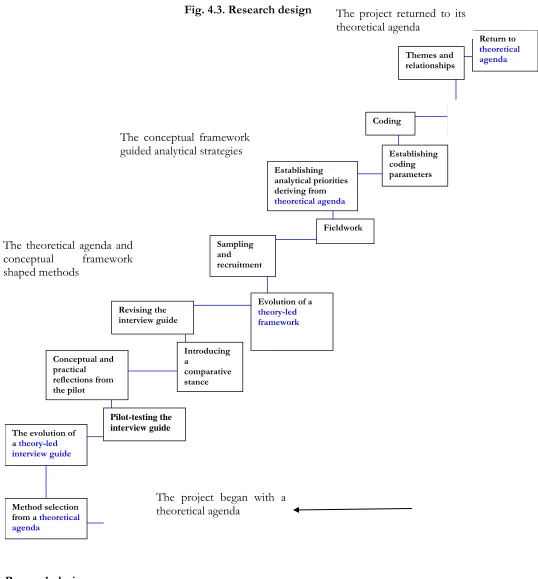
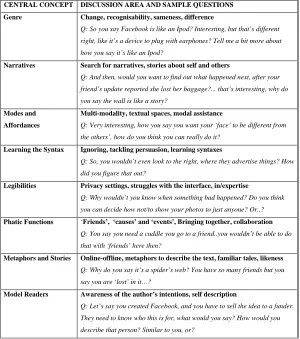
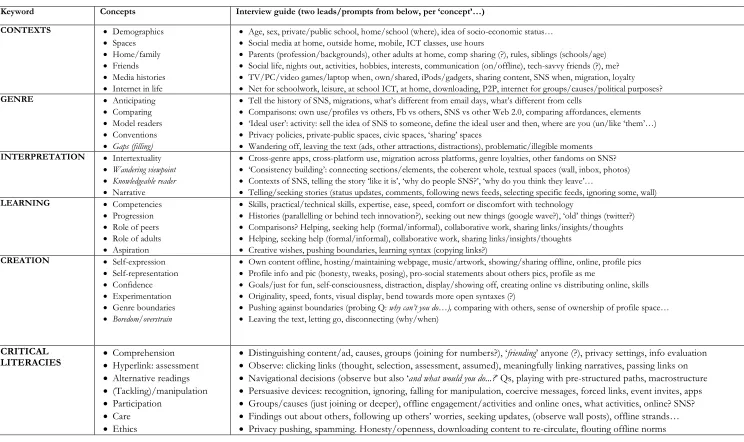
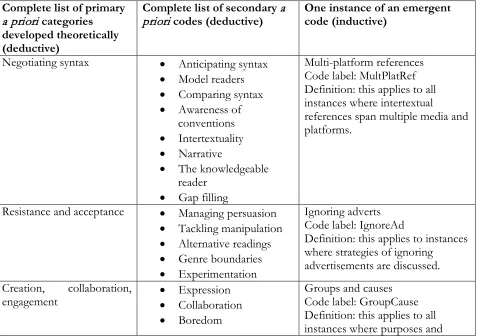
many possible ways, to inferring a potential resolution. I note that if the task, in the end, of reflecting on concepts from one mediated condition to another, is conceptual, then my inference at the end is to be conceptual, indicating that the empirical must weave out the conceptual problem and must weave into the conceptual inference in some synergy. This synergy I see being developed in this thesis via concepts. As I elucidate in Chapter 4, two distinct methodologically relevant moments in this thesis – with a rather tangible device of expression – place concepts as the link between a theoretical question/agenda/ambition and an empirical task and between an empirical task and theoretical inferences (Das and Hänska-Ahy, 2011). The first of these moments is apparent in the interview guide, where the theoretical problem has been broken down into secondary and tertiary concepts that prepare this problem to enter the empirical, the task of empirical work. The second point where the moment of synergy between conceptual and empirical returns is in the coding framework, developed as a mix of deductive and inductive modes of inquiry, where the social world is filtered back into a set of concepts, themes and categories which will then lead to my conceptual inference. That, briefly, is the role of the empirical as I see it evolving, in this thesis. Next, using the chapter outline as a narrative device, I break down this task from a theoretical problem, complicating the theoretical problem, distilling it into core concepts, operationalizing those concepts, interpreting data in three levels rather than discrete strands of analyses, returning to a reflection on core concepts to inferences at the theoretical level.
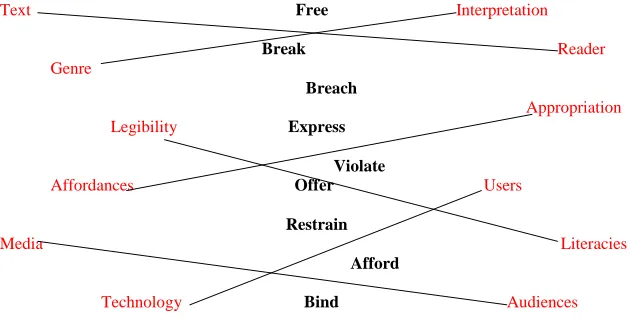
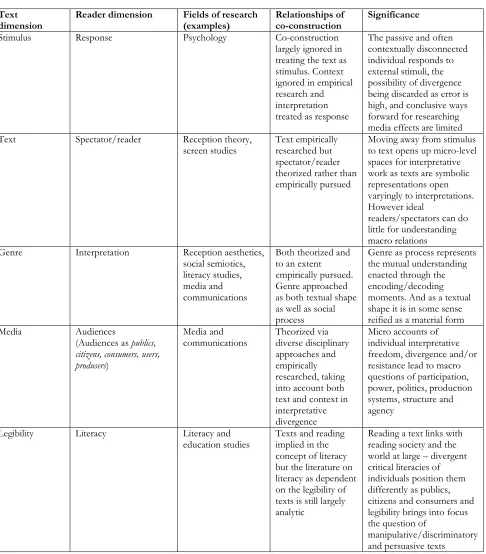
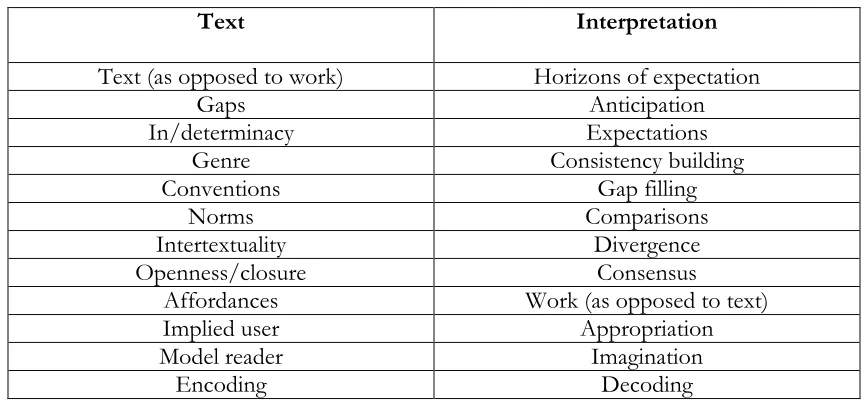
particular on the audiences to users question. It is for this question that I review the literature that has in fact focused on changing audiences and changing genres, where I draw in links between audiences and users, interpretation and literacies, and so on. In Chapter 3, The contract of interpretation, I bring this discussion down to a set of key concepts that this thesis will carry into the social world and later reflect on, in returning back from the empirical to the conceptual. Framed around the text-reader metaphor, I construct an interdisciplinary framework of concepts from reader response studies, reception aesthetics, semiotics and science and technology studies – work and the text, affordances and appropriation, openness and closure, genre and anticipations, horizons of expectations and the interpretative contract. The task in this chapter is to move from a theoretical problem into a clearly outlined set of concepts.
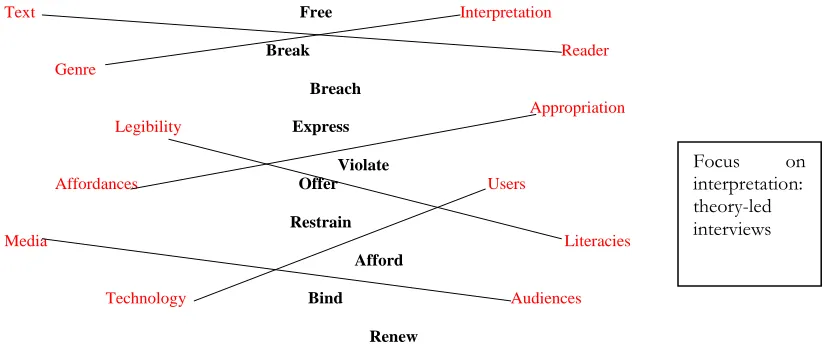
In Chapter 4, The interface of interpretation, I operationalize these concepts to enter the empirical world. elaborating the design of a theory-led interview guide, I discuss a primarily theory-led research design, outline the conceptual and empirical focus on interpretation in this thesis, the analytical and interpretative strategy, empirical work, ethics and the pitfalls of my methodological stance. This chapter traces the largely (although qualified) deductive stance that is adopted for the empirical task undertaken in this project. It outlines how the conceptual priorities in this project have shaped its methodological decisions and discusses questions of epistemology, methodology and method, sampling strategy, recruitment and steps in design. It presents the analytical strategy and concludes with an evaluation of this piece of research.
empirical material for this thesis, are introduced – as resources and limits in their backgrounds are identified, similarities and differences in these resources and limits spotted. In Chapter 6, Heterogeneity in interpretation, I move the empirical focus on contexts to a level of comparison of interpretative work, between these children, as I seek interesting similarities and differences in their interpretative work using a set of themes around text, reader and author – perceiving authorial presence and other users, pushing textual boundaries and collecting stories about the text, for instance.
In Chapter 7, The task of interpretation, I move my analysis to a more theoretical clarification of the range of responsibilities involved in interpretation in interactive environments. Inspired by the tasks involved in the act of reading, based on reception aesthetics, I present an analysis in terms of interpretation as play and collaboration, as tackling interruptions, as intertextual navigations and as a task of resistance and critique. I then reach my final empirical chapter. Having first contextualized agents in diversities of usage, practices, resources and restraints, next, having investigated their interpretative work for similarities and differences, then having distilled reflections on the diversity of tasks involved in interpretation itself, in Chapter 8, Concepts in interpretation, I use empirical data illustratively to focus on three concepts around interpretation – to reflect on how far these concepts have proved worthwhile in the analysis presented in this thesis. I present a conceptual analysis of the horizon of expectations, the wandering viewpoint and gap filling. At this point, my analysis uses data illustratively to make for a conceptually heavy chapter. And here ends the second part of my thesis, where the theoretical problem introduced, complicated, conceptualized and operationalized in the first part has now been carried into the social world – to be contextualized, comparatively analysed and distilled into reflections on core concepts again.
my original theoretical problem was proposed. I ask how the text has been differentially realized, I indicate that the conceptual repertoire needs retention, for specific theoretical and empirical purposes; and finally, I argue that the many decades of empirical research with audiences could all be of significance not just to those who research audiences today but also those who work with users.
Conclusion
In this chapter I have outlined the evolution of an agenda, tracing the personal, intellectual origins of this thesis into a wider, academy-wide context where this merged into a larger individual and collective research agenda. I introduced the distinctive ‘predicaments’ within research with audience reception as well as use, that this thesis seeks to address. I noted that audience reception seems to face uncertainties in the age of the internet, and with new media use and literacies research there is the question of moving beyond homogeneity in practices of use. Both these terms, audiences and users, are conceptually rooted at the interface (Livingstone, 2008) of readers and texts in context, and hence this thesis seeks to link them through the relationship of mutuality embedded in interpretation. And thus, this thesis prioritizes a focus on interpretation as a relationship of mutuality between texts and readers, because this mutuality can offer ways forward out of both technological determinism and also the risk of homogenizing practices of use. It enters its task with key concepts – emergent from audience reception studies – to make these concepts from reception studies work usefully for the analysis of new media use. It uses these concepts as an empirically useful toolkit and concludes at the level of the concepts themselves (Chapter 8).
2. In pursuit of interpretation
A review of literature connecting audiences and users is not the easiest to pen. My central argument is that we have a repertoire of concepts revolving around interpretation, emergent from audience reception analysis, that might need utilization, advancement and extension in the context of new media use. In what follows, I attempt to reveal, first, how the pursuit of interpretation within reception studies has been described divergently, fraught with debates and critiques, and which of these critiques may still matter for the new media user. Next, I focus on the pursuit of interpretation in work with new media users and their literacies and specifically in a group of selected texts, spanning different bodies of literature to reveal how they use the concept of interpretation and the assumptions they make about it, in order to pave the way for a more conceptual treatment of the topic in the next chapter, the contract of interpretation.
accounting for the audience as mass, as group, as market, once he reaches interactive media, he predicts that new media would soon render the term audience a misnomer, and, true enough, for a very long time now users have been studied.
would not perhaps frame the audiences to users question thus. But even then, there must be something specific to the provisions of a particular media technology, a specific text or genre which shapes the audience experience in myriad ways. Consider the calls by many audience researchers not to lose sight of the screen itself in looking at the contexts surrounding the screen, however significant they are (Press and Livingstone, 2006), reiterating the audience researcher’s intrinsic connection to texts and textual analysis.
specific attention to a selection of texts that have specifically looked at the question of transforming audiences. Finally, I narrow this all down to a question of inter-disciplinarity in the theoretical frameworks of audience researchers for the repertoires that sustain this work hail from a range of different fields. When this thesis began by saying it is interested in ‘testing’ a conceptual repertoire around the interpretation of texts, it makes a choice about which repertoire it is particularly interested in. This is the body of literary reception theory emerging from within European reception aesthetics, and is just one part of a diverse set of theoretical frameworks that audience research has successfully worked with.
In pursuit of interpretation: mass media and the story as told…
In sum, the matter of interpretation being an active and engaged process was first ignored, in the face of powerful media effects propositions (for various positions on this see Ball-Rokeach and DeFleur, 1976; Anderson and Avery, 1988; Emmers-Sommer and Allen, 1999; Livingstone, 1996; Bryant and Oliver, 2009; for a review, see Scheufele and Tewksbury, 2007), to which uses and gratifications research was taken to have provided the first responses (Katz et al, 1973; see also Katz et al, 2003; Blumler, 1979; McLeod and Becker, 1981; Palmgreen et al, 1985; Rosengren et al, 1985; Rayburn, 1996), which in turn was reviewed (see Carey and Kreiling, 1974; Swanson, 1979; Windahl, 1981; Lichtenstein and Rosenfeld, 1983; McQuail, 1984; Lin, 1996) for a host of reasons, not least among which was an overt focus on individual needs and gratifications (see Elliott, 1974), and this critique countered as well (see Barker, 2006). But the interpretative work of audiences had long occupied the interest of the academy – consider for instance Herta Herzog’s account of radio listeners (1942). An impetus came from cultural studies, especially from feminist traditions and ethnographic methods through the 1980s and 1990s, where interpretative work was contextualized within relations of structure and power (see Lotz, 2000 for a review; see Radway, 1984; Ang, 1985, 1991; Gordon, 1988; Brown, 1990, 1994; Behar, 1993; McRobbie, 1976; 1991; Bobo, 1995; Brunsdon, 1997; Press, 1991; Press and Cole, 1999). But yet, as Hay et al point out, the 1980s were fraught with a sense of mission and yet also a sense that no one had got it right (Hay et al, 1996). A split seemed significant – the American academy regarded European reader response as too jargon-laden and theoretical and the American mass communications tradition was regarded as too quantitative. But other splits seemed evident as well.
Quoting from Schramm et al (1961, cited in Katz 1996), he notes that their discussion of the role of the reader is linked to their claim that the text neither dictates the reader nor is it an inkblot. And thus the field got the idea of viewers’ work (something I return to in Chapter 6) – ‘what interests us, is not what people take from television, but what they put into it’ (Katz, 1996, p. 11). He writes of different kinds of work, where ‘Morley’s viewers […] do ideological work, Livingstone’s viewers do referential, ludic and aesthetic work’ (Katz, 1996, p. 13), referring to Morley’s Nationwide (1980) study and Livingstone’s research (1998) with soap opera viewers.
In parallel, linked with cultural studies through the 1980s was the rise of genre-specific, often ethnographic studies of the interpretations of film and television texts in contexts, and the valuable pursuit of pleasure, resistance, critique, play and identity populated audience studies (see Long, 1986; Brown, 1990; Ang and Hermes, 1991; Morley, 1992, 1993; Allen, 1999; Bailey, 2005). Radical contextualism offered by Janice Radway (1988) 20 years ago held two possibilities. One was the promise of contextual richness which is still today being interestingly adopted by many audience ethnographers, leading to thick accounts of cultural reception in everyday life (e.g. Bird, 2003). The other, as Ang put it, in different words, was a feeling of endlessness in this journey (Ang, 1991).
concerns and challenges seem to have shifted now, although many old questions are still of relevance as I have been arguing), reviewing a text from about three decades ago seems useful for it has much to teach us.
Radway’s Reading the Romance was ‘conceived in response to a set of theoretical questions about literary texts’ and her aim was to ‘see whether it was possible to investigate reading empirically so as to make “accurate” statements about the historical and cultural meaning of literary production and consumption’ (p 4). She assumed from the outset (following Stanley Fish) that meanings (textual interpretations) are constructed through the specific strategies of interpretive communities and it was this which led her to contrast textual analyses of the genre of romance novels with responses from fans of the genre. She departed from Fish’s treatment of interpretive communities in the sense that her communities were not literary analysts but rather social groups, but she herself remained dissatisfied with the extent to which she had been able to theorise this. She does, however, follow David Morley’s reminder that a departure from an encoding-decoding model towards a more genre-based understanding of reading might prove fruitful. Her own summary of what she did and how (p 10 –11) shows this. First, she focused on the socio-material situation of Smithtonian women to ask how this analyses their interpretive practices i.e. the starting point was the context of reading. Second, she made use of not only observations but a very detailed questionnaire (provided in the book’s appendices) about their habits, practices, preferences i.e. she combined ethnographic inquiry with some of the tools of survey research, it seems. And third, she used psychoanalytic theory to understand the category of pleasure in reading.
compensatory (i.e. allowing them to focus on themselves and their pleasure). The ‘mild protest’ which Radway sees in this act of reading, is also something, she feared, would be seen as not enough for the protest for social change demanded by feminists, rightly. But she argues, adequately – “We as feminists might help this change along by first learning to recognise that romance reading originates in very real dissatisfaction and embodies a valid, if limited, protest” (p 220).
Radway’s account of 42 ‘Smithtonian’ women interpreting romance novels is especially instructive for the ethnographic nature of the inquiry. This is not to say that one can and always should delve into the kaleidoscope of everyday life (Radway, 1988) for how often is that entirely possible? But the priorities that are evident throughout the work – consider Radway’s relationship with Dot or Dorothy, and the care with which that rapport was established, or the familial nature and contexts of viewing that she pursued – these, without doubt, are not only methodological strong points but ones which need to be carried forward, if not in ethnographies that always satisfy the demands of the anthropologist but at least in an ethnographic spirit that begins with, stays close to and prioritises the contexts of cultural consumption.
The empirical tone of chapters in Reading the Romance seems to be set for identifying patterns – all the more laudable considering she was conducting in-depth, qualitative work. Searching for patterns following demographic axes is always difficult, but Radway’s search for meanings that aligned themselves closely with the text, or away from it, helps her make a crucial point, that “similar readings are produced because similarly located readers learn a similar set of reading strategies and interpretive codes which they bring to bear upon the texts they encounter” (pp 67-68).
In discussing Reading the Romance in later years, Radway points out another achievement of the study, one that is now again being taken up by scholars (see Kress, 2003 on genres for instance). She outlines that there needs to be a focus shift away from simplistic models of activity and passivity and encoding and decoding towards understanding interpretations by genre - where genre is far more than a typology, where genre is a set of norms which may include and exclude, and where modes of engagement with a text are shaped to some extent by the genres people engage with.
Fourth, in many ways, Radway’s work, by bringing together psychoanalytical theories or feminist theories of representation into her work with interpretation, indicates a convergence of the richness of textual analysis with the richness of empirical audience research. This, while seemingly simple, is difficult to achieve in projects that deal with audiences and the text is very often lost sight of or simplistically accounted for by the researcher before embarking on findings about how audiences diverge from or stick to the intended meaning. By bringing together representation and interpretation, genre and reception, text and reader in the theoretical underpinnings to her analysis, Radway reminds us of a simple but often missing convergence of research with texts and with that with readers.
empirical studies have unfortunately gone on to celebrate divergence as resistance and misread questions of power. But Radway perhaps suffered from a desire to judge. Wood, in her essay, expresses this well – “It seems that Radway is struggling over passing judgement; while she sees romantic texts as problematic in their ideology, she recognizes that the intricacies of the women’s reading strategies mean that they are hardly the dopes rendered by popular discourse” (Wood, 2004, p 150) What is the solution? To refrain from the individual spirit that doubtless resides in every researcher so that not one sentence in written up research can be read as judgement? Perhaps this is more a problem of representing ourselves as researchers in written up research than a colossal error in the research process itself.
And this introduces other critiques – ones that emerged about the feminist identity of the researcher and a desire to produce more feminists in the women she spoke to, as Ang or even Modleski has noted (see Wood, 2004 for an excellent account of these critiques). But this is perhaps to do with the relationship between the researcher and the researched. In this thesis, when I speak to children about their strategies to protect themselves from potential online harms, am I not treading, even if ever so unconsciously, into the world of the didactic perhaps, and sometimes, even, the world of advice and counselling? This critique of Radway’s relationship with the Smithtonian women is instructive to bear in mind for any project where researcher-research equations sometimes straddle uncomfortable boundaries.
and sense making often without thinking about what is exactly meant by these terms (Dahlgren, 1998), or that this all neglected real issues of power by celebrating the micro (Corner, 1991).
Some of this was responded to, as Morley points out – the micro does embed issues of politics in the grain of everyday life, which after all, was the purpose of the feminist agenda (Morley, 2006), and that the division between the public knowledge and popular culture projects (Corner, 1991) defined politics far too narrowly (see Gray, 1999). In contrast to Morris’s critique of rapidly accumulating studies, Barker bemoans the lack of empirical, real audiences in much theory (Barker, 1998). Swanson draws to our attention ‘the extent to which Blumler, Gurevitch and Katz’s sketch for gratifications research in 1985 was influenced by the work of critical theorists and reception analysts and, on the other side, the way in which some insights of uses and gratifications research have provided foils against which Morley has developed his own approach to family television and domestic media’ (Swanson, 1986, p. 58). As Boyd-Barrett (1995) points out, a distinguishing feature of Morley’s work in his eyes is the importance ‘it attributes to different readings of any given text and the relationship of such differences to cultural and social contexts’ (1995, p. 499). Complexity of the interrelationship of readings cannot be mapped onto easily privileged categories which link with demographic attributes.
circulated, and to what effect’ (1996, p. 146). Contrasting the empirical reader of reception studies with the theoretically active reader of literary aesthetics, he points out that ‘if the provenance of the “determined active reader” has been largely sociological, that of the “indecipherably active reader” has been chiefly literary’ (p. 153). It is perhaps with some sense of desperation that he makes the point that the mutuality of the text-reader relationship is forever indecipherable as the literary reader is ‘one whose activity, while subject to an endless theoretical affirmation, is simultaneously unfathomable since neither the place of the reader that reads nor that of the text that is read is susceptible, even in principle, to a definite determination’ (p. 153).
This all indicates a fine mesh of flows and counter-flows of ideas and dis/agreements dotting the empirical pursuit of interpretation within reception analysis. Scholars have produced ambitious meta-theoretical accounts that have been torn down by their equally experienced colleagues as teleological and sometimes just bad (Barker, 2006; also see Morley, 2006)4. Scholars continue to be in disagreement in
their intellectual positions on the past (see, for instance, the divergent positions5 on the centrality of
encoding/decoding in the historiography of the field), their subtly and not-so-subtly selective reconstructions of histories, their takes on the global, transnational future, their selection of research priorities and their positions on different sides of many divides. Most importantly, critiques both external and internal have been fierce, well-researched and often interestingly, prophetic. There have also been scholars who have repeatedly drawn attention to answering the accumulated body of critiques (e.g. Livingstone, 1998), or to the crucial fact that (most of) the empirical accounts have largely been generated from Western industrialized societies, majorities and mainstreams though in this decade this concern is being addressed using diverse entries (see Mankekar, 1999; Abu Lughod, 2004; Sood et al,
4 While writing this I was acutely conscious of Martin Barker’s worry about students who ‘try out’ audience research for
dissertations and then proceed to write ‘about’ audiences (Barker, 2006).
5 This debate is interesting. One may draw attention to Livingstone’s observation that an adoption of the text-reader
In any case, the implication of this all for communication and cultural studies was first, that at the level of the individual, we could now theorize the role of the reader (Eco, 1979) with appropriate empirical accounts of lived practices of interpretative work (Liebes and Katz, 1993), and second, that the interpretative activity of audiences, despite being an admittedly media-oriented construct, now became visible in relation to a range of other societal roles of people, instead of being distinctly different from any of them, thereby making audience studies meet other disciplines which had not hitherto engaged themselves with real audiences as such. Audiences, understood as communities of interpretation (Fish, 1980), met research with gender, class, ethnicity, sexuality and so forth (see, for instance, the contribution of studies of audiences as fans in this context; Jenkins, 1992, 2006); audiences were theorized as publics, bringing together people/publics from democratic participation with the audience of media theory (see Livingstone and Lunt, 1994); audience studies met studies of ethnic identity and connections (see, for instance, Gillespie, 1995; Georgiou, 2001); audiences were conceptualized as citizens (Livingstone, et al, 2005), as consumers, users and even produsers of media content (Bruns, 2008). Also, not insignificantly, this narrative of academic audience research, in some ways interfaced with the real audiences of media content as frequently, audience researchers have been called on to inform policy (e.g. Buckingham, 2005).
critique in mind in the analysis I present on interpretative diversity. I have consciously tried to move beyond the matter of obvious ‘activity’ – perhaps evidenced in technical expertise and skills – to draw out broader and perhaps more significant themes – that necessarily link use with participation, being critical and resistant, taking initiatives and pushing boundaries. In the end, perhaps there is consensus that ‘audiences do not really exist simply as audiences; they are constructs that we in communication studies have created, abstracting them out of their sociological context to help us study mass media and popular culture reception, usually in a quantifiable, measurable “scientific” way’ (Press, 1996, p. 117).
Going back to McQuail’s (1997) point about audiences being a misnomer in the age of interactive media, the most relevant critique as far as this thesis has been concerned has been one about the future of conducting audience research in a different technological context. Had we reached the end of audiences in an interactive, networked world, that is, was this a rich agenda that had now run its race (Livingstone, 2004)? Which of the questions and debates I outlined above are important to carry into what follows? The achievement of establishing interpretative divergence is as crucial it seems in the face of the digital natives argument (Das, 2010; forthcoming in 2011) as the critique that we might well over-do a celebration of divergence yet again. Shall we, in focusing on diversities in use, simply reach differences in practices of use, or shall we, as anticipated, reach differently realized texts? The celebration of endless polysemy that Condit (1989) warned audience researchers about might be useful to keep in mind in our celebrations of user-generated content and the agency of the users of online media, for if texts are limitlessly polysemic, shall not those who produce them evade all responsibility (Boyd-Barrett, 1995)?
media, it opens up a conversation on the theoretical relevance of interpretation in the age of new media, a conversation which requires by default a disciplinary mix of repertoires – not just of media studies and user studies, but many other fields, and this is something I take up in the next chapter. I will conclude in this thesis that the conceptual repertoire around interpretation, as emergent from within audience studies, remains valid, if in many ways unsatisfactory, to employ in the contexts of interactive media. This stance has important conceptual implications for the study of audiences because it takes forward the theoretical repertoire that lies at the heart of audience studies in mass-mediated environments into a rather different textual condition.
In pursuit of interpretation: new media, and an unfolding story
In what follows I attempt to articulate a sense of guarded optimism. First, I indicate that audience research is already embedded in the age of the internet, and second, that much remains to be done, as the field requires further conceptual analysis to be conducted. This is possible solely through extensive empirical engagement to suitably revise and refine its repertoire, for all cannot be transported across communicative moments in a straightforward manner. To articulate the former position, I trace how the media literacies conversation seems to be reframing much of what has already been discussed in the domain of audience reception studies. To outline the more reserved position that much more is required by way of conceptual clarification, I propose further work on genres of both texts as well as interpretation.
Audiences and interpretation, users and literacies
internet, theoretically as well as empirically. It is possible to note the link between these two fields with some optimism as a connection also between audiences and users, for it has been suggested (Livingstone, 2008) that both these fields – reception analysis and digital literacies – should retain a focus on divergent textual interpretations at the heart of the diverse use of technologies, as this would facilitate a focus on both changing media technologies (a distributed and fragmenting text) and on diversity in practices of use (creative, collaborative reception). That link, of hermeneutic engagement between media and user/text and reader, makes mass media audiences and new media literacies interface concepts (Livingstone, 2008). Both concepts converge at the interface of readers and texts, with shared ambitions of looking at agentic, creative and playful engagement with a mediated world.
There are worries about literacies, especially new media literacies or digital literacies. One is that much about ‘digital’ is still ‘print’, not just in terms of written text being available (because by ‘print’ we must include images as well), and therefore ‘digital’ literacies don’t work, in its being too exclusive a term that doesn’t quite grasp the multimodal and multimedia nature of the media environment; or even that in the focus on the technology, there may be a danger in losing sight of the content carried by the technology (Bazalgette, at a round table with Blake, Hassel and Livingstone, 20086). The academy is not too sure of
what it means by the term, edited collections offering different approaches to the concept, still wavering around outlining a scope (see Snyder and Beavis, 2004; Lankshear and Knobel, 2008), theorists still unsure of the very prefix ‘digital’ in digital literacies (Kress, 2009). The worry over the many prefixes of literacies – cyber, digital, media, new media, techno, information, multi and so on – has been a worry expressed over technological determinism. Scholars express discomfort that these prefixes may not ultimately make much sense, and that the conversation may be hijacked over to technologies (or texts) alone (Snyder and Beavis, 2004; Kress, 2009).
6 Accessed from http://preview.channel4learning.com/espresso/clipbank/html/ttv_features_medialiteracy1.html on 4
Concepts of the interface
This account of connections between audiences and literacies was one of optimism. There is reason for such optimism when one notes the intriguing ways in which audience research has already connected with a range of other agendas, all of which are rooted in the world of the interactive. A 30-country European project on Transforming Audiences, Transforming Societies places all of this at the centre of its priorities, and is just taking off as this thesis is being written up. Audience researchers who have spent many years researching mass media audiences are reframing and reshaping the agenda for the future of the field, on this project, and also elsewhere. But this optimistic account must be tempered.
Core concepts of reception, interpretation, text and genre are now difficult to define; indeed precise claims about their utility for changing media environments can no longer be made. The battle of terminologies in media and communications studies around audiences and/or users (see Lievrouw and Livingstone, 2006 for the debate around this) has been interdisciplinary. Scholars in education studies and critical new literacies, for instance, have shared the same anxieties around ‘naming’7, naming being
not just a semantic dilemma but also one that raises key questions about the nature of media use and interpretation, and the conventions, norms and structure of the media itself, which today, must include technologies and texts whose terms are still unclear (Peters, 2009). In leaving us perplexed about terminology, with new terms such as ‘prosumers’ and then ‘produsers’ (Bruns, 2008) emerging, the argument for the end of audiences has generally been that in an age of media convergence, ‘writing back’, hybridization, multimodality (see Kress and van Leeuwen, 2001), the very concept of the audience is too ‘passive’ to work, ‘interactivity’8 emerging to be a key word. The trendy puzzles have even perhaps
started to shift from mass interactive over to the endless varieties of the interactive itself as new interfaces usher us into the semantic web (Berners Lee et al, 2001; Zimmer, 2009). As audience scholars
7 I borrow the word ‘naming’ from Gunther Kress’s talk at the Institute of Education in London, in late 2008, on the problems one is faced with in the age of interactive media with previously unproblematic terms such as ‘text’, ‘genre’ and so forth.
who made the move from mass to interactive media shall point out, interactivity has complicated many things, including the taken-for-granted media-audience relationship (Jenkins, 2002; Livingstone, 2004, 2008 and others). Interactivity itself, a much-used term in everyday academic and non-academic parlance, remains, as Jensen (2005a) would argue, a notoriously difficult concept to define9 for if interactivity is to
mean interactive interfaces between media and user, it must also mean collaborative interaction between user and user, the former being technologically and socially novel, the latter with roots in age-old face-to-face communication and intersected by new media technologies and their affordances (Hutchby, 2001). In new media research, the early days of interest in hypertext and the web had seen much work in departments of information systems, linguistics, library science and communications studies on hyper text and hyper reading (Sloan, 1995; Broad, 1999; Parry, 2007), most of these providing rich analyses of hypertextual domains (i.e., the structure of literary works online, the narrativity of massively multiplayer gaming domains and so on), producing insightful account of texts, but often constructing an ‘implied reader’ (Iser, 1974) without the empirical focus on real interpretative work. Insights developed in those early hypertext years are still drawn attention to today as texts that may well be useful for studies of online textuality. Promising accounts of comparative discourse analysis of SNSs (Papacharissi, 2009), textual environments of web pages (Brügger, 2009) and hyperlinks and print parallels (Zimmer, 2009) abound. Similarly, in recent years new literacy studies (see Snyder, 1998) have spoken of new dimensions of reading and writing, added to which has been a reminder of meaning production and ‘reception’ in interactive media forms (e.g. Jensen, 2007). But little empirical research followed with ‘real’ processes of hyper reading and writing, thereby cordoning off these debates from many other lively areas of research.
In the work around literacies and its prefixes, there are two broad kinds of prefixes being added: one is to do with medium and the other to do with mode (distinct but mutually influenced). So, on the one hand, digital or print literacies, and on the other, visual, verbal, audiovisual literacies, and then perhaps
an amalgamation of both in ‘multiliteracies’. Kress, in his approach to visual literacies, does use a prefix, and his prefixes are always to do with modal changes, and modalities. There is indeed perhaps some tension between those who opt for modal prefixes and those who opt for media prefixes in their comments on XYZ literacies. As Kress (2005, p. 6) points out, ‘I use the term “mode” for the culturally and socially produced resources for representation and “medium” as the term for the culturally produced means for distribution of these representations-as-meanings, that is as messages’. It is not merely splitting hairs over semantic issues, but actually prioritizing on conceptual analysis and clarification when one notes that it is important to keep in mind that mode and medium are not coterminous, as we think of converging our conceptual resources across audiences and users, or of cross-fertilizing concepts across fields. Indeed the ‘digital’ presents many modes, and a single mode can simultaneously make itself visible across print, screens, and so on. My attention to ‘mode and medium’ in this section is because of the increasing divergence in the prefixes to literacies. With media literacy being complemented if not replaced (albeit amidst disagreement) by digital literacies, and with edited collections on digital literacies proving to be increasingly uneven in what scholars would choose to mean by the term, the question largely seems to hover around the fact that while both mode and medium matter, it is the medium prefix that raises problems, and most usually the problem is a concern about technological determinism.
Prior (2005) , Kress draws attention to the ‘reader’s task’, and the reader’s task doubtless has roots in reception aesthetics. Later, in Chapter 8, I discuss the concept of filling gaps, and one may notice, in Kress’s account too, there is the question, ‘what was the reader’s task, and what or where was the reader’s freedom to act?’ (Kress, 2005, p. 7). Kress argues for a revolutionary shift from writing to image (hence the use of the past tense). On a web page Kress argues for what he calls reading by design, ‘In effect, out of material presented (by an author, designer and/or design-team?) on a page, the reader designs a coherent complex sign that corresponds to the need she or he has’ (Kress, 2005, p. 8).
Audience reception would then make two arguments: first, that this focus on filling gaps, on interpreting was and still is necessary on a trans-media continuum, and second, while Kress says this displaces traditional models of decoding, it does still bear traces of the uses and gratification model in his focus on ‘needs’. Audience reception in this case probably shifts the focus from mode to medium and asks, in the light of a history of looking at interpretation as a socially located practice, questions about how interfaces come to mean what they do, why things work that way, and why this may matter at all. In place of questions on which mode is dominant, then, in this thesis, which looks at reviewing concepts from reception studies across mediated conditions, I ask questions not only about mode, but essentially about medium, about technologies as texts, about implied and ideal readers, about realization of generic devices, and about reception being written into the media itself.
Speaking of the media, it seems that key concepts demands further analysis. In this thesis I attempt a conceptual analysis of three concepts in interpretation – the horizon of expectations, the wandering viewpoint and gap filling. What of texts? While ‘genre’ is a highly theorized concept in screen/literary studies, it begs clear analysis in the context of multimodal/multigeneric mediated communication.
10 This debate is difficult to accommodate here but it is enough to say that Prior disagrees with the clear-cut divisions