2017 2nd International Conference on Manufacturing Science and Information Engineering (ICMSIE 2017) ISBN: 978-1-60595-516-2
Rapid Identification Method for Abnormal
Noise of Suspension System Based on Transfer
Path Analysis
Yugang Zhu, Jidong Gao, Hongliang Li and Cansong Gu
ABSTRACT
In the development of a domestic passenger car, it is found that there is a severe abnormal noise of suspension system. In response to the problem, firstly, the frequency range of abnormal noise of the suspension system is identified through vehicle road test and subjective evaluation, secondly, the main path of abnormal noise source is acquired by transfer path analysis(TPA), finally, abnormal noise source of the key component of the main path is identified through the time difference method and the characteristic energy of wavelet analysis method. Through this method, the main abnormal noise source of suspension system can be identified quickly in a relatively short time. The result of the study can provide theoretical and practical guidance for other similar suspension abnormal noise problems.1
KEYWORDS
TPA; suspension; abnormal noise; identification
INTRODUCTION
In recent years, as the main source of vehicle noise and vibration(such as power train) have been better controlled, the noise problem of other components become
1Yugang Zhu, Hebei University of Technology, Tianjin, China, 300401.
more and more prominent, especially suspension system. Interaction between the tire and the road is the main form of vibration and noise source when vehicle is running at a low speed. The excitation from the uneven road causes the wheel vibration, which can cause vibration, to erosional and bending deformation of suspension system, and there may be relative movement and friction between the overlapped plates of suspension system, the above statement is the cause of abnormal noise production[1].
At present, the identification of suspension abnormal noise in China is mainly focused on the research on the shock absorber. HongyuShu [2] used acceleration curve of the piston rod in the damper test to identify the abnormal sound, RuiSong [3] coped signal of vibration acceleration of the piston rod with power change and linear average processing, HaiboHuang [4]coped signal of vibration acceleration of the piston rod with wavelet analysis based on characteristic energy. However, there are few researches on the method of rapid identification to abnormal noise of suspension system.
The problem of abnormal noise of suspension system is studied by this paper. Firstly, the frequency range of abnormal noise of the suspension system is identified through vehicle road test and subjective evaluation, secondly, the main path of abnormal noise source is acquired by transfer path analysis(TPA), finally, abnormal noise source of the key component of the main path is identified through the time difference method and the characteristic energy of wavelet analysis method.
IDENTIFICATION OF FREQUENCE RANGE OF ABNORMAL NOISE BASED ON VEHICLE ROAD TEST AND SUBJECTIVE EVALUATION
There was a phenomenon that suspension system could make some abnormal noise when the vehicle run uneven road with 25km/h during the process of vehicle development. In response to the problem, signals of the occupant's right ear noise and vibration acceleration of each component of chassis system were collected. In order to obtain accurate noise samples and vibration signals, the LMS noise & vibration signal acquisition equipment and the HEAD high-performance playback system were used to collect signals, so that the noise signal playback could truly reflect the subjective feelings of occupant.
Figure 1. Consistency check of frequency distribution of suspension’s abnormal noise.
TPA FOR ABNORMAL NOISE OF SUSPENSION SYSTEM
In order to solve the above problem, firstly the TPA (transfer path analysis) method [6] is adopted. The theoretical formula is as follows:
1 1
( ) n ( ) ( ) p ( ) ( )
k ik ik jk jk
i j
y H F H Q
(1)
In the formula,yk( ) represents the total contribution of the target point k,w represents the frequency, n represents the number of the path to be passed, Fik( )
and Qjk( ) represent the structural loads and acoustic loads acting on the active side
respectively.Hjk( ) andHik( ) represent the structural and acoustic frequency response
function (FRF) matrix between uncoupled active and response respectively.
The front suspension is composed of double wishbone independent suspension. There are three ways to cause the vehicle interior noise by uneven road excitation: path one is from the wheel, steering knuckle, lower control arm, shock absorber to the body, path two is from the wheel, steering knuckle, upper control arm to the body, path three is from the wheel, steering knuckle, lower control arm, sub-frame to the body.
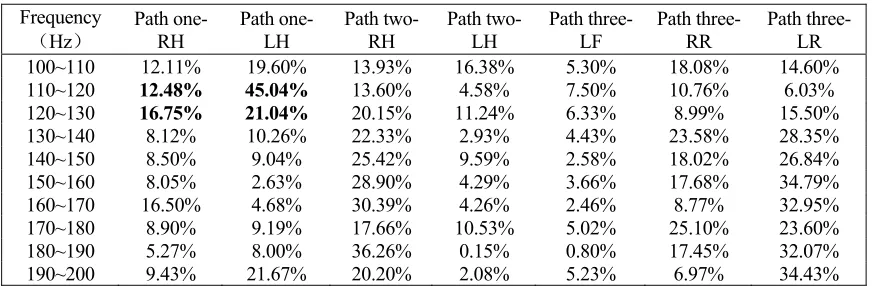
The distribution of the frequency band of the abnormal noise through the different path was analyzed by the TPA, the result was shown in TABLEI. It can be found that the frequency contribution from the left side of path one was accounted for 45.04% in 110~120Hz and 21.04% in 120~130Hz, which far more than the other two paths. On the right side of the path one, the contribution rate of 110~130Hz reached 29.23%, which also more than two other paths. It can be concluded that the generation of abnormal noise of suspension system was mainly contributed by the path one.
300.00
50.00 Hz
36.18
-3.82
dB(
A)
Pa
50.00 50.00
100.00 112.64
300.00
129.56 200.00
TABLE I. THE DISTRIBUTION OF FREQUENCY BAND OF ABNORMAL NOISE. Frequency
(Hz)
Path
one-RH Path one-LH Path two-RH Path two-LH Path three-LF Path three-RR Path three-LR 100~110 12.11% 19.60% 13.93% 16.38% 5.30% 18.08% 14.60% 110~120 12.48% 45.04% 13.60% 4.58% 7.50% 10.76% 6.03% 120~130 16.75% 21.04% 20.15% 11.24% 6.33% 8.99% 15.50% 130~140 8.12% 10.26% 22.33% 2.93% 4.43% 23.58% 28.35% 140~150 8.50% 9.04% 25.42% 9.59% 2.58% 18.02% 26.84% 150~160 8.05% 2.63% 28.90% 4.29% 3.66% 17.68% 34.79% 160~170 16.50% 4.68% 30.39% 4.26% 2.46% 8.77% 32.95% 170~180 8.90% 9.19% 17.66% 10.53% 5.02% 25.10% 23.60% 180~190 5.27% 8.00% 36.26% 0.15% 0.80% 17.45% 32.07% 190~200 9.43% 21.67% 20.20% 2.08% 5.23% 6.97% 34.43%
IDENTIFICATION OF ABNORMAL NOISE FOR KEY COMPONENT
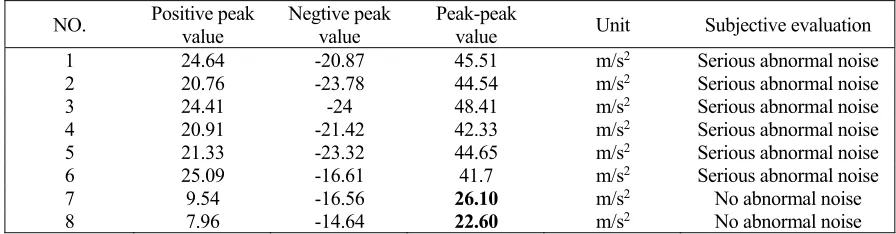
From the TPA analysis, it was found that the main source of the abnormal noise of the suspension system was composed of path one, and the key component that could cause abnormal sound in the path one was the shock absorber. In the process of stretching, compressing and reversing, the shock and vibration of the shock absorber on the piston rod were easily to produce abnormal noise, therefore, the vibration signal of the piston rod of the shock absorber was needed to be collected and analyzed from rig test. There were eight sets of shock absorber specimens to be tested, in which the 1-6 group was the sample without change after the vehicle test, and the 7-8 group was the sample which was changed by the valve system. The identification methods of abnormal noise of shock absorber mainly include time difference method and the characteristic energy of wavelet analysis method[4].
Time Difference Method
According to the experience, the gap between peak and valley of the vibration time domain signal from piston rod of the same type shock absorber was greater, the abnormal noise was more obvious, therefore, the gap f between peak and valley of the vibration time domain signal from piston rod can be used to evaluate the abnormal noise level of the shock absorber, The formula is as follows:
| | | | fmax fmin
f
(2)
In the formula,| fmax|,| fmin|represent absolute value of peak and valley of
TABLE II. ACCELERATION PEAK VALUE FOR PISTON ROD OF SHOCK ABSORBER.
NO. Positive peak value Negtive peak value Peak-peak value Unit Subjective evaluation 1 24.64 -20.87 45.51 m/s2 Serious abnormal noise
2 20.76 -23.78 44.54 m/s2 Serious abnormal noise
3 24.41 -24 48.41 m/s2 Serious abnormal noise
4 20.91 -21.42 42.33 m/s2 Serious abnormal noise
5 21.33 -23.32 44.65 m/s2 Serious abnormal noise
6 25.09 -16.61 41.7 m/s2 Serious abnormal noise
7 9.54 -16.56 26.10 m/s2 No abnormal noise
8 7.96 -14.64 22.60 m/s2 No abnormal noise
The vibration signal of the piston rod of the shock absorber was analyzed by the time difference method, the results obtained from rig test and subjective evaluation were shown in TABLEII, it can be concluded that the peak value of the acceleration from piston rod of shock absorber without change were above 40m/s2 and the
subjective evaluation result of vehicle road test were serious abnormal noise, while the peak value of the acceleration from piston rod of shock absorber which was changed by the valve system were below 27m/s2, and the abnormal noise was
eliminated after the vehicle road test.
The Characteristic Energy Of Wavelet Analysis Method
Because wavelet analysis has the characteristic of multi-resolution, the main characteristic information of the shock absorber's abnormal noise can be obtained by paying attention to the impact moment and frequency range of the piston rod. The concept of characteristic energy is introduced to indicate the energy power of the signal at a certain time and in a frequency band.
2
1 i
i
n
j
m j d E
(3)
In the formula, Ei represents characteristic energy of signal, dmj represents wavelet transform coefficient, i i
Figure 2. Result of sample with abnormal noise. Figure 3. Result of sample without abnormal noise.
The piston rod worked with 2 shocks in one cycle, the time frequency energy of the piston rod operating 5 cycles was shown in Figure 2~ Figure 3. It can be seen from Figure 2 that the energy was mainly concentrated in the range of 350~450Hz, and the characteristic energy was above 1(m/s2)2. It can be also seen from Figure 3
that the energy was mainly concentrated within 100Hz, and the characteristic energy was below 0.2(m/s2)2.
CONCLUSIONS
To solver the abnormal noise of suspension, the main path of abnormal noise source is acquired by transfer path analysis(TPA), then, abnormal noise source of the key component is identified through the time difference method and the characteristic energy of wavelet analysis method. Through this method of rapid identification, the abnormal noise source of suspension system can be identified quickly in a relatively short time. The result of the study can provide theoretical and practical guidance for other similar abnormal noise problems of suspension system.
REFERENCES
1. Jian Pang, Gang Chen, Hua He.2006. Automotive Nosie and Vibration: Principle and Application. Beijing Institute of Technology Press, pp. 1-10.
2. Sou Nakamura, Toshimitsu Maki, Toshitaka Sugimoto.2011.“Study of Supension System for Reduction of Road Noise,” Honda R & D Technical Review, 23(1): 1-10.
3. Ichiro Kido and Sagiri Ueyama. 2005. “Coupled Vibration Analysis of Tire and Wheel for Road Noise Improvement,” LTD SAE 2005 Noise and Vibration Conference and Exhibition, May 16-19, 2005.
4. Akeru Nnkamura, Takeshi Hayashi and Makoto Asai. 1999. “Suspension Vibration Analysis for Road Noise Using Finite Element Modal,” Proceedings of the 1999 Noise and Vibration Conference, 1999.
5. Jian Chen,Wen Yang and Weiyi Li.Subjective Evaluation Test Method On Vehicle Sound Quality [J]. Automobile Technology, 2009, 31(4): 389-392.